The main tag of Gold News Today Articles.
You can use the search box below to find what you need.
[wd_asp id=1]

26 06, 2024

XAU/USD battles to retain the $2,300 mark

By |2024-06-26T20:56:46+03:00June 26, 2024|Forex News, News|0 Comments


You have reached your limit of 5 free articles for this month.

Take advantage of the Special Price just for today!

50% OFF and access to ALL our articles and insights.

Your coupon code


Subscribe to Premium

XAU/USD Current price: $2,301.49

  • Firmer US Treasury yields provide an additional impulse to the US Dollar.
  • Stock markets remain in the red, reflecting the dismal market mood.
  • XAU/USD maintains the downward route and challenges the $2,300 threshold.

XAU/USD bearish momentum accelerated on Wednesday, and the bright metal trades at around $2,300.00 a troy ounce mid-American afternoon, with the US Dollar firmer against all major rivals. As reflected by stock markets, a poor market mood remains behind the Greenback’s broad strength. European indexes closed in the red, while Wall Street is also in a bearish route. The Nasdaq Composite is an exception, posting modest gains amid NVIDIA’s comeback, underpinning the tech sector since the beginning of the day.

Firmer government bond yields contributed to the XAU/USD slide. The United States (US) 10-year Treasury note currently offers 4.31%, up 7 basis points (bps) in the day, while the 2-year note yields 4.74%, up 5 bps.

Regarding the US Dollar, it also found strength in market talks, suggesting the Federal Reserve (Fed) will likely deliver just a 25 bps interest rate cut before year-end, far from the roughly 100 bps trim anticipated earlier in the year.

Data-wise, US figures kept disappointing. The country released May New Home Sales, which fell a whopping 11.3% in the month. The country will release more interesting macroeconomic figures on Thursday, as the calendar includes May Durable Goods Orders, the final estimate of Q1 Gross Domestic Product (GDP), weekly unemployment figures and the May Goods Trade Balance.

XAU/USD short-term technical outlook

XAU/USD slid for a second consecutive day, reaching an intraday low of $2,293.54 during US trading hours. From a technical point of view, the risk of a bearish extension has increased. The daily chart shows the pair is below a mildly bearish 20 Simple Moving Average (SMA)  while slowly but steadily getting closer to a bullish 100 SMA, currently at $2,249.60. At the same time, technical indicators head firmly south within negative levels and far from signaling downward exhaustion, supporting the case of another leg south.

The case for a bearish continuation is even stronger in the near term. The 4-hour chart shows XAU/USD has fallen below all its moving averages, while a firmly bearish 20 SMA crossed below a flat 100 SMA, usually a sign of persistent selling interest. At the same time, the Momentum indicator turned south after failing to overcome its midline, maintaining a clear downward slope. Finally, the Relative Strength Index (RSI) indicator accelerated south, now hovering around 30 with no signs of changing course.

Support levels: 2,293.50 2,279.60 2,265.60

Resistance levels: 2,316.60 2,329.50 2,337.00

XAU/USD Current price: $2,301.49

  • Firmer US Treasury yields provide an additional impulse to the US Dollar.
  • Stock markets remain in the red, reflecting the dismal market mood.
  • XAU/USD maintains the downward route and challenges the $2,300 threshold.

XAU/USD bearish momentum accelerated on Wednesday, and the bright metal trades at around $2,300.00 a troy ounce mid-American afternoon, with the US Dollar firmer against all major rivals. As reflected by stock markets, a poor market mood remains behind the Greenback’s broad strength. European indexes closed in the red, while Wall Street is also in a bearish route. The Nasdaq Composite is an exception, posting modest gains amid NVIDIA’s comeback, underpinning the tech sector since the beginning of the day.

Firmer government bond yields contributed to the XAU/USD slide. The United States (US) 10-year Treasury note currently offers 4.31%, up 7 basis points (bps) in the day, while the 2-year note yields 4.74%, up 5 bps.

Regarding the US Dollar, it also found strength in market talks, suggesting the Federal Reserve (Fed) will likely deliver just a 25 bps interest rate cut before year-end, far from the roughly 100 bps trim anticipated earlier in the year.

Data-wise, US figures kept disappointing. The country released May New Home Sales, which fell a whopping 11.3% in the month. The country will release more interesting macroeconomic figures on Thursday, as the calendar includes May Durable Goods Orders, the final estimate of Q1 Gross Domestic Product (GDP), weekly unemployment figures and the May Goods Trade Balance.

XAU/USD short-term technical outlook

XAU/USD slid for a second consecutive day, reaching an intraday low of $2,293.54 during US trading hours. From a technical point of view, the risk of a bearish extension has increased. The daily chart shows the pair is below a mildly bearish 20 Simple Moving Average (SMA)  while slowly but steadily getting closer to a bullish 100 SMA, currently at $2,249.60. At the same time, technical indicators head firmly south within negative levels and far from signaling downward exhaustion, supporting the case of another leg south.

The case for a bearish continuation is even stronger in the near term. The 4-hour chart shows XAU/USD has fallen below all its moving averages, while a firmly bearish 20 SMA crossed below a flat 100 SMA, usually a sign of persistent selling interest. At the same time, the Momentum indicator turned south after failing to overcome its midline, maintaining a clear downward slope. Finally, the Relative Strength Index (RSI) indicator accelerated south, now hovering around 30 with no signs of changing course.

Support levels: 2,293.50 2,279.60 2,265.60

Resistance levels: 2,316.60 2,329.50 2,337.00


Source link

26 06, 2024

Coffee Prices Fall Back on Forecasts for Rain in Brazil Next Week

By |2024-06-26T06:47:28+03:00June 26, 2024|Forex News, News|0 Comments


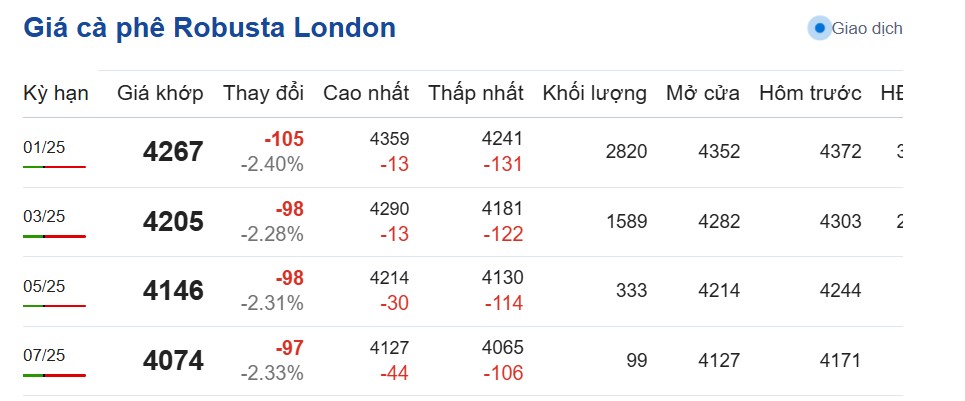
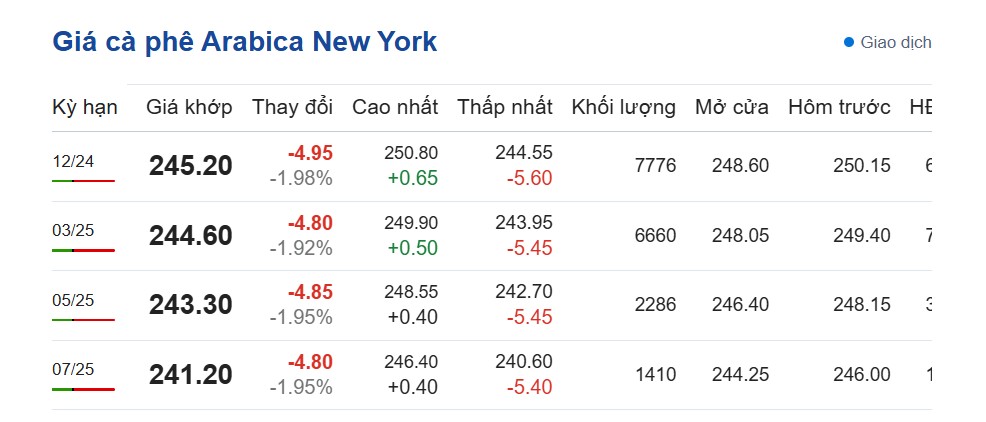
September arabica coffee (KCU24) today is down -7.10 (-3.01%), and July ICE robusta coffee (RMN24) is down -73 (-1.64%).

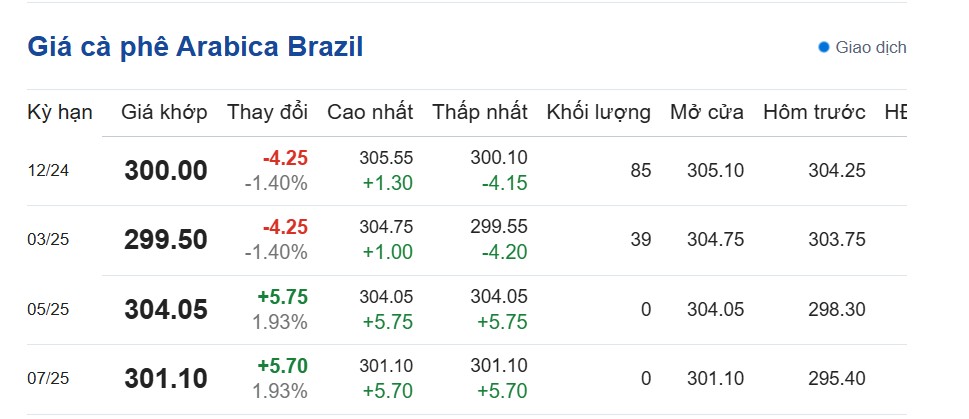
Coffee prices today are moderately lower after updated weather forecasts called for rain next week in Brazil’s coffee-growing regions, easing drought concerns and fueling long liquidation in coffee futures.   Coffee prices Tuesday fell back after previously surging to 2-week highs on Monday due to concerns that drier-than-normal conditions would adversely affect Brazil’s coffee crops.  Somar Meteorologia reported Monday that Brazil’s Minas Gerais region last week received no rain for the third consecutive week.  Minas Gerais accounts for about 30% of Brazil’s arabica crop.

Robusta coffee prices are underpinned by fears that excessive dryness in Vietnam will damage coffee crops and curb global production.  On May 22, coffee trader Volcafe said Vietnam’s 2024/25 robusta coffee crop may only be 24 million bags, the lowest in 13 years, as poor rainfall in Vietnam has caused “irreversible damage” to coffee blossoms.  Volcafe also projects a global robusta deficit of 4.6 million bags in 2024/25, a smaller deficit than the 9-million-bag deficit seen in 2023/24 but the fourth consecutive year of robusta bean deficits.

Last Thursday’s bi-annual report from the USDA was bearish for coffee prices.  The USDA’s Foreign Agriculture Service (FAS)projected that world coffee production in 2024/25 will increase +4.2% y/y to 176.235 million bags, with a +4.4% increase in arabica production to 99.855 million bags and a +3.9% increase in robusta production to 76.38 million bags.  The USDA’s FAS forecasts that 2024/25 ending stocks will climb by +7.7% to 25.78 million bags from 23.93 million bags in 2023/24.  The USDA’s FAS projects that Brazil’s 2024/25 arabica production would climb +7.3% y/y to 48.2 mln bags due to higher yields and increased planted acreage.  The USDA’s FAS also forecasts that 2024/54 coffee production in Colombia, the world’s second-largest arabica producer, will climb +1.6% y/y to 12.4 mln bags.

The pace of the Brazilian coffee harvest has picked up, a bearish factor for coffee prices.  Safras & Mercado reported last Friday that Brazil’s 2024/25 coffee harvest was 44% completed as of June 18, faster than 39% last year at the same time and faster than the 5-year average of 40%.

A rebound in ICE coffee inventories from historically low levels is also negative for prices.  ICE-monitored robusta coffee inventories on February 21 fell to a record low of 1,958 lots, although they recovered to an 11-1/2 month high last Thursday of 5,995 lots.  Also, ICE-monitored arabica coffee inventories fell to a 24-year low of 224,066 bags on November 30, but they recovered to a 16-month high Monday of 835,444 bags.

Tight robusta coffee supplies from Vietnam, the world’s largest producer of robusta coffee beans, are a bullish factor.  On March 26, Vietnam’s agriculture department projected that Vietnam’s coffee production in the 2023/24 crop year would drop by -20% to 1.472 MMT, the smallest crop in four years, due to drought.  Also, the Vietnam Coffee Association said that Vietnam’s 2023/24 coffee exports would drop -20% y/y to 1.336 MMT.  Late Monday, Vietnam’s Customs Department reported that Vietnam’s May coffee exports fell -47% y/y to 79,358 MT, the lowest amount for the month of May since 2009.  Also, Jan-May coffee exports fell -5.8% y/y to 817,154 MT.  USDA FAS on May 31 projected that Vietnam’s robusta coffee production in the new marketing year of 2024/25 will dip slightly to 27.9 million bags from 28 million bags in the 2023/24 season.

There has recently been some bearish coffee export news.  On June 12, Cecafe reported that Brazil’s May green coffee exports surged 90% y/y to 4 million bags.  On June 5, the International Coffee Organization (ICO) reported that global Apr coffee exports rose +16.8% y/y to 10.24 million bags, and Oct-Apr global coffee exports were up +11.1% y/y at 80.99 million bags.  Brazil’s exporter group Comexim, on February 1, raised its Brazil 2023/24 coffee export estimate to 44.9 million bags from a previous estimate of 41.5 million bags.  Brazil is the world’s largest producer of arabica coffee beans.

This past year’s El Nino weather event has been bullish for coffee prices.  An El Nino pattern typically brings heavy rain to Brazil and drought to India, negatively impacting coffee crop production.  The El Nino event has brought drought to Vietnam’s coffee areas this year, according to an official from Vietnam’s Institute of Meteorology, Hydrology, and Climate Change.

In a bearish factor, the International Coffee Organization (ICO) projected on May 3 that 2023/24 global coffee production would climb +5.8% y/y to 178 million bags due to an exceptional off-biennial crop year.  ICO also projects global 2023/24 coffee consumption will rise +2.2% y/y to 177 million bags, resulting in a 1 million bag coffee surplus. 
More Coffee News from Barchart

On the date of publication, Rich Asplund did not have (either directly or indirectly) positions in any of the securities mentioned in this article. All information and data in this article is solely for informational purposes. For more information please view the Barchart Disclosure Policy here.

The views and opinions expressed herein are the views and opinions of the author and do not necessarily reflect those of Nasdaq, Inc.


Source link

26 06, 2024

Citi Forecasts Oil Price Drop to $60s by 2025

By |2024-06-26T04:46:43+03:00June 26, 2024|Forex News, News|0 Comments


Citi predicts that oil prices will plummet to the $60s range by 2025 as inventories build following a tight market this summer, signaling a bearish outlook despite current robust demand and higher prices.

Oil has recouped the losses from early June when the OPEC+ group’s indication that it could begin returning some supply to the market in the fourth quarter sent bearish signals across the market.


Early on Friday, the international benchmark, Brent Crude, traded above $85 per barrel, while the U.S. benchmark, WTI Crude, was above $82 a barrel, as signs of tightening physical markets started to emerge.

The market expects solid summer demand in the third quarter but fears that the quarterly consumption growth will start waning in the fourth quarter, pressuring oil prices downwards.


Citi is one of the most prominent bears among major banks, expecting oil to drop into the $70s range later this year and further down to the $60s range in 2025 due to solid inventory builds.


“Global inventories will be building a lot next year,” Citi’s global energy strategist Eric Lee told Yahoo Finance in an interview this week.

“We do think that there is a bit of a tight stretch [with supply] through the summer, so we do see prices staying in the low- to mid-80s for a little longer,” the strategist added.

Related: Supply Concerns and Demand Optimism Are Boosting Oil Prices

“But as we’re looking through the second half of the year into 2025, we really see markets getting a lot weightier.”

Citi also expects global oil demand growth to slow down as “Oil demand can grow at a slower and slower rate relative to GDP and in fact peak before the end of this decade,” Lee told Yahoo Finance.


Citi holds one of the most bearish near and long-term views on oil prices and demand.

Goldman Sachs, for example, said in a report this week that “Peak oil demand is still a decade away.”

Earlier this month, the International Energy Agency said that global oil demand would peak before 2030. This forecast drew criticism from OPEC, whose Secretary General Haitham Al Ghais said that “peak oil demand is not on the horizon,” and that IEA’s forecast “is a dangerous commentary, especially for consumers, and will only lead to energy volatility on a potentially unprecedented scale.”

Goldman’s analysts, for their part, said, “While some prominent forecasters have predicted oil demand will peak by 2030, our researchers expect oil usage will increase through 2034.”

“We think peak demand is another decade away, and more importantly, after the decade it takes to peak, it plateaus, rather than sharply declines, for another few years,” write Nikhil Bhandari, co-head of Asia-Pacific Natural Resources and Clean Energy Research, and analyst Amber Cai in the team’s report.

In the near term, Goldman Sachs sees Brent crude at $86 per barrel this summer amid strong consumer demand, which will put the market into a sizeable deficit in the third quarter.

The investment bank also sees a floor of $75 per barrel under Brent due to physical demand for crude, which tends to rise amid lower prices, including in China and in the U.S. for the refill of the Strategic Petroleum Reserve (SPR).  

Most banks expect oil prices to hold above $80 a barrel this summer and decline in the fourth quarter and early next year into the $70 range.

JP Morgan expects oil prices to average $75 a barrel next year, sliding from an expected range of $80-$90 this summer.

Commodity analysts will monitor trends in interest rates and global economic growth to use as assumptions for their forecasts later this year, but they will also closely watch OPEC+’s next move.

While the group has signaled willingness to begin unwinding part of the current supply cuts, the cartel and its non-OPEC allies led by Russia are unlikely to leave oil prices lingering in the low $70s and plunging to the $60s, as none of the alliance’s producers can balance their budgets at these relatively low prices.     

By Tsvetana Paraskova for Oilprice.com

More Top Reads From Oilprice.com:


Source link

26 06, 2024

XAU/USD extends slide below $2,320 as USD demand persists

By |2024-06-26T02:45:37+03:00June 26, 2024|Forex News, News|0 Comments


You have reached your limit of 5 free articles for this month.

Take advantage of the Special Price just for today!

50% OFF and access to ALL our articles and insights.

Your coupon code


Subscribe to Premium

XAU/USD Current price: $2,319.23

  • Mixed comments from Federal Reserve officials and Canadian inflation dented the market mood.
  • Consumer Sentiment in the US contracted by less than anticipated in June.
  • XAU/USD under pressure, bears aiming to pressure the $2,300 threshold.

Gold traded lifeless throughout the first half of Tuesday, confined to a tight range just below the $2,330 mark, further sliding after Wall Street’s opening. US indexes trade mixed, with the Dow Jones Industrial Average heading south but the S&P500 and the Nasdaq Composite posting gains. The focus is on NVIDIA as the AI chipmaker finally found the strength to bounce following a three-day slump. In the absence of relevant news, the focus remained on the tech sector.

At the same time, investors are assessing inflation figures and Federal Reserve (Fed) speakers. On the one hand, Canada reported that the Consumer Price Index (CPI) rose by 2.9% YoY in May, higher than the 2.9% posted in April and above the 2.6% forecast. Furthermore, the Bank of Canada’s (BOC) core CPI saw a yearly increase of 1.8%, up from the 1.6% growth previously recorded. The news spurred concerns about persistent inflationary pressures and reminded speculative interest of the risks of trimming interest rates too early.

Meanwhile, Fed Governor Michelle Bowman said the Fed is not yet at the point where it is appropriate to cut rates. Even further, Bowman expressed willingness to raise rates if inflation stalls. Finally, she added that the labor market remains tight and only saw modest progress on inflation this year. Also, Governor Lisa Cook noted that the central bank is on track for a rate cut if the economy’s performance meets her expectations, but she was unable to anticipate when. Cook was far more optimistic than Bowman about future rate cuts, limiting US Dollar strength mid-US afternoon.

Finally, Consumer sentiment in the US kept sliding in June, as the Conference Board’s Consumer Confidence Index declined to 100.4 from 101.3 (revised from 102.00) in May. The reading, however, beat the 100.0 expected.

XAU/USD short-term technical outlook

XAU/USD trades around $2,320, and the daily chart suggests it may maintain the downward bias. The pair is finding sellers around a flat 20 Simple Moving Average (SMA) for a second consecutive day while still holding above bullish 100 and 200 SMAs. However, technical indicators gain bearish momentum within negative levels, in line with an extended slide, particularly on a break below $2,306.45, the immediate support level.

The bearish case is firmer in the near term. XAU/USD accelerates south below all its moving averages, which anyway remain directionless. The 20 SMA slowly grinds lower, although between the longer ones, not enough to confirm additional selling interest. Nevertheless, technical indicators head firmly south within negative levels, reflecting persistent selling interest.

Support levels: 2,306.45 2,295.20 2,279.60

Resistance levels: 2,334.10 2,346.70 2,360.30

XAU/USD Current price: $2,319.23

  • Mixed comments from Federal Reserve officials and Canadian inflation dented the market mood.
  • Consumer Sentiment in the US contracted by less than anticipated in June.
  • XAU/USD under pressure, bears aiming to pressure the $2,300 threshold.

Gold traded lifeless throughout the first half of Tuesday, confined to a tight range just below the $2,330 mark, further sliding after Wall Street’s opening. US indexes trade mixed, with the Dow Jones Industrial Average heading south but the S&P500 and the Nasdaq Composite posting gains. The focus is on NVIDIA as the AI chipmaker finally found the strength to bounce following a three-day slump. In the absence of relevant news, the focus remained on the tech sector.

At the same time, investors are assessing inflation figures and Federal Reserve (Fed) speakers. On the one hand, Canada reported that the Consumer Price Index (CPI) rose by 2.9% YoY in May, higher than the 2.9% posted in April and above the 2.6% forecast. Furthermore, the Bank of Canada’s (BOC) core CPI saw a yearly increase of 1.8%, up from the 1.6% growth previously recorded. The news spurred concerns about persistent inflationary pressures and reminded speculative interest of the risks of trimming interest rates too early.

Meanwhile, Fed Governor Michelle Bowman said the Fed is not yet at the point where it is appropriate to cut rates. Even further, Bowman expressed willingness to raise rates if inflation stalls. Finally, she added that the labor market remains tight and only saw modest progress on inflation this year. Also, Governor Lisa Cook noted that the central bank is on track for a rate cut if the economy’s performance meets her expectations, but she was unable to anticipate when. Cook was far more optimistic than Bowman about future rate cuts, limiting US Dollar strength mid-US afternoon.

Finally, Consumer sentiment in the US kept sliding in June, as the Conference Board’s Consumer Confidence Index declined to 100.4 from 101.3 (revised from 102.00) in May. The reading, however, beat the 100.0 expected.

XAU/USD short-term technical outlook

XAU/USD trades around $2,320, and the daily chart suggests it may maintain the downward bias. The pair is finding sellers around a flat 20 Simple Moving Average (SMA) for a second consecutive day while still holding above bullish 100 and 200 SMAs. However, technical indicators gain bearish momentum within negative levels, in line with an extended slide, particularly on a break below $2,306.45, the immediate support level.

The bearish case is firmer in the near term. XAU/USD accelerates south below all its moving averages, which anyway remain directionless. The 20 SMA slowly grinds lower, although between the longer ones, not enough to confirm additional selling interest. Nevertheless, technical indicators head firmly south within negative levels, reflecting persistent selling interest.

Support levels: 2,306.45 2,295.20 2,279.60

Resistance levels: 2,334.10 2,346.70 2,360.30


Source link

26 06, 2024

Natural Gas Price Forecast: Poised for Breakout After Key Reversal

By |2024-06-26T00:44:43+03:00June 26, 2024|Forex News, News|0 Comments


Strength Confirmed Above 2.95

Today’s price behavior reiterates the importance of natural gas getting above the most recent swing high of 2.95, also a weekly high, before buyers start to get more aggressive. Until then, resistance could be seen that takes natural gas down to again test support at this week’s low of 2.635, and possibly lower. There remains a series of lower swing highs and lower lows until the 2.95 high is breached.

Retracement Likely Complete

Nonetheless, there are reasons to believe that the 2.635 low from Monday may be the end of the retracement. It completed a 78.6% Fibonacci retracement (2.62), and yesterday’s strong bullish reversal ended with a key reversal day (open below prior day, close above prior day). The key reversal day reflects a shift in sentiment in only one day, from the sellers being in charge to the buyers taking back control of price action. Yesterday’s swing low also set up a measured move. The measured move is reflected in a rising ABCD pattern shown on the chart.

Initial Upside Target of 3.32

The second move or CD leg of the pattern has the potential to at least match the price appreciation seen in the first move or AB leg up. Price symmetry is reflected when the two swings match. It completes an initial target at 3.32. Once symmetry is present between the swings, a potentially significant pivot level has been identified. Either price breaks out above the pivot zone, or it behaves as resistance and a pullback ensues. Also, a choppy relatively sideways pattern could develop as well around the pivot point.

For a look at all of today’s economic events, check out our economic calendar.


Source link

24 06, 2024

XAU/USD consolidates around $2,330 in quiet start to the week

By |2024-06-24T20:31:19+03:00June 24, 2024|Forex News, News|0 Comments


You have reached your limit of 5 free articles for this month.

Get Premium without limits for only $479.76 for the first month

Access all our articles, insights, and analysts.

Your coupon code


UNLOCK OFFER

XAU/USD Current price: $2,329.11

  • United States inflation and FOMC meeting Minutes stand out this week.
  • Upcoming elections in Europe keep investors in cautious mode.
  • XAU/USD trades with a soft tone around $2,330, bearish scope well-limited.

Spot Gold trades with a soft tone on Monday, with XAU/USD hovering around $2,330.00. A certain caution prevails across financial markets as investors await fresh news from the macroeconomic and political sides. In the United States (US), the focus will be on the Federal Open Market Committee (FOMC) meeting minutes and the May US Personal Consumption Expenditures (PCE) Price Index, the Federal Reserve (Fed) preferred inflation gauge.

Other than that, investors are keeping an eye on European upcoming elections as France and the United Kingdom will soon go to the polls. Speculative interest also looks at Russia after President Vladimir Putin mentioned potential changes to the country’s nuclear policy, escalating tensions with the West.

The US Dollar posted a modest advance at the beginning of the day but turned lower with Wall Street’s opening amid an upsurge in US equities following Friday’s poor performance. Little variation around government bond yields and a scarce macroeconomic calendar help to keep XAU/USD within familiar levels.

XAU/USD short-term technical outlook

XAU/USD is technically neutral, according to the daily chart, although the bearish potential seems well-limited. The pair is currently battling a directionless 20 Simple Moving Average (SMA), while the longer moving averages maintain their upward slopes below the current level. At the same time, technical indicators lack directional strength just below their midlines, reflecting the absence of speculative interest rather than suggesting bulls are about to give up.

In the near term, and according to the 4-hour chart, XAU/USD offers a neutral-to-bearish stance. The pair develops below all its moving averages, with the 20 SMA flat between also directionless longer ones. Technical indicators, in the meantime, head nowhere just below their midlines. The bright metal traded as low as $2,316.61 on Friday, the level to pierce to expose the $2,300 threshold.

Support levels: 2,316.60 2,301.00 2,288.70

Resistance levels: 2,334.10 2,346.70 2,360.30

XAU/USD Current price: $2,329.11

  • United States inflation and FOMC meeting Minutes stand out this week.
  • Upcoming elections in Europe keep investors in cautious mode.
  • XAU/USD trades with a soft tone around $2,330, bearish scope well-limited.

Spot Gold trades with a soft tone on Monday, with XAU/USD hovering around $2,330.00. A certain caution prevails across financial markets as investors await fresh news from the macroeconomic and political sides. In the United States (US), the focus will be on the Federal Open Market Committee (FOMC) meeting minutes and the May US Personal Consumption Expenditures (PCE) Price Index, the Federal Reserve (Fed) preferred inflation gauge.

Other than that, investors are keeping an eye on European upcoming elections as France and the United Kingdom will soon go to the polls. Speculative interest also looks at Russia after President Vladimir Putin mentioned potential changes to the country’s nuclear policy, escalating tensions with the West.

The US Dollar posted a modest advance at the beginning of the day but turned lower with Wall Street’s opening amid an upsurge in US equities following Friday’s poor performance. Little variation around government bond yields and a scarce macroeconomic calendar help to keep XAU/USD within familiar levels.

XAU/USD short-term technical outlook

XAU/USD is technically neutral, according to the daily chart, although the bearish potential seems well-limited. The pair is currently battling a directionless 20 Simple Moving Average (SMA), while the longer moving averages maintain their upward slopes below the current level. At the same time, technical indicators lack directional strength just below their midlines, reflecting the absence of speculative interest rather than suggesting bulls are about to give up.

In the near term, and according to the 4-hour chart, XAU/USD offers a neutral-to-bearish stance. The pair develops below all its moving averages, with the 20 SMA flat between also directionless longer ones. Technical indicators, in the meantime, head nowhere just below their midlines. The bright metal traded as low as $2,316.61 on Friday, the level to pierce to expose the $2,300 threshold.

Support levels: 2,316.60 2,301.00 2,288.70

Resistance levels: 2,334.10 2,346.70 2,360.30


Source link

24 06, 2024

Natural Gas Price Forecast – Natural Gas Continues to Be Noise Driven

By |2024-06-24T18:30:31+03:00June 24, 2024|Forex News, News|0 Comments


A small position on dips makes sense because given enough time, we could see buyers push this market to the upside and break above the $3 level. But I think that happens sometime later in the year as we start to approach fall. So that’s why I use an ETF. I don’t really care about day-to-day fluctuations. Natural gas is a great market to lose money in and most retail traders find that out really quickly. Remember, it’s driven by supply and demand, transmission, the lines in America, for example, and of course, the weather patterns of the Northeast and part of the United States.

Peripherally, you can add whether or not Russian gas is being bought by Europeans who are currently at war with them peripherally via transmission through Ukraine. So, you can see how much nonsense it’s kind of baked into this market. When you say that out loud, looking at the four hour chart from a bit of a distance, you can see that we are also perhaps in the middle of a rising wedge. So maybe another shot higher and then a plunge that could put us down to about $2.33, which is a very viable price this time of year. At that point, I would probably be looking to add to my ETF position.

For a look at all of today’s economic events, check out our economic calendar.



Source link

24 06, 2024

XAU/USD sellers eye $2,300 yet again as new week kicks in

By |2024-06-24T08:23:18+03:00June 24, 2024|Forex News, News|0 Comments


You have reached your limit of 5 free articles for this month.

Get Premium without limits for only $479.76 for the first month

Access all our articles, insights, and analysts.

Your coupon code


UNLOCK OFFER

  • Gold price licks its wounds early Monday in the aftermath of Friday’s sell-off. 
  • The US Dollar holds gains amid risk-aversion and subdued US Treasury bond yields.
  • Gold price closes the week below 50-day SMA even after the symmetrical triangle breakout.
  • The daily RSI drops back below 50 while Bear Cross remains in play. Fedspeak awaited.

Gold price is nursing losses early Monday, having witnessed a more than 1% sell-off on Friday. Gold traders now look forward to a slew of speeches from US Federal Reserve (Fed) policymakers due later on Monday for fresh policy cues and its impact on the US Dollar (USD).

Gold price stays vulnerable ahead of Fedspeak

Persistent US Dollar strength and a sharp upsurge in Palladium price weighed heavily on Gold price last Friday. The Greenback extended its recovery momentum alongside the US Treasury bond yields after the S&P Global preliminary US business activity jumped to a 26-month high. The Composite PMI Output Index that tracks the manufacturing and services sectors rose to the highest level since April 2022 at 54.6 this month. The final reading in May was at 54.5.

Markets’ pricing of a 25 basis points (bps) Fed rate cut in September remained at about 60% after the data release, little changed from late Thursday and at the time of writing, according to CME FedWatch Tool. Renewed signs of US economic resilience gave a boost to the US Dollar at the expense of the Gold price.

Additionally, significant exchange-traded funds (ETF) flows into Palladium drove the white metal sharply higher and reduced the appeal of Gold price as an alternate investment in the precious metals group.  

Early Monday, a sense of caution prevails as the US PCE inflation week kicks in and investors still scouting for hints on the Fed’s next interest move while bracing for the outcome of the French elections on Sunday. Also, traders stay unnerved heading into the half-yearly close.

Against this backdrop, investors scurry toward the safe-haven US Dollar, keeping it afloat against its major six currency rivals and the Gold price. It remains to be seen if Gold price extends the downside in the upcoming sessions should the Fed speak send a hawkish message, pushing back against expectations of a September Fed rate cut.

Also, the persisting risk trend and the end-of-the-month flows will play a pivotal role in the Gold price action in the lead-up to Friday’s key US inflation data release.

Gold price technical analysis: Daily chart

Despite a triangle breakout confirmed last Thursday, Gold price failed to extend the upside break and turned south, yielding a weekly closing below the key 50-day Simple Moving Average (SMA), now at $2,342.

Such a move has revived sellers, now aiming for Gold price to close Monday below the triangle support line at $2,325. Daily closing below that level will lead to the triangle pattern failure.

The 14-day Relative Strength Index (RSI) moved back below the 50 level, currently near 47.50, suggesting that the downside appears more compelling for Gold price.

Further, a Bear Cross validated last week, after the 21-day SMA crossed the 50-day SMA from above on a daily closing basis, remains a cause for concern for buyers.

Gold price needs to reclaim the 50-day SMA at $2,342 to revive the previous week’s recovery momentum.

Further up, the two-week high of $2,366 will be challenged. A sustained move above that level will expose the June 7 high of $2,388.

If sellers flex their muscles then the initial demand area is seen at the $2,310 round level. The next relevant support is seen at the $2,300 threshold.

Acceptance below the latter will put the May 3 low at $2,277 back in the spotlight.

Gold FAQs

Gold has played a key role in human’s history as it has been widely used as a store of value and medium of exchange. Currently, apart from its shine and usage for jewelry, the precious metal is widely seen as a safe-haven asset, meaning that it is considered a good investment during turbulent times. Gold is also widely seen as a hedge against inflation and against depreciating currencies as it doesn’t rely on any specific issuer or government.

Central banks are the biggest Gold holders. In their aim to support their currencies in turbulent times, central banks tend to diversify their reserves and buy Gold to improve the perceived strength of the economy and the currency. High Gold reserves can be a source of trust for a country’s solvency. Central banks added 1,136 tonnes of Gold worth around $70 billion to their reserves in 2022, according to data from the World Gold Council. This is the highest yearly purchase since records began. Central banks from emerging economies such as China, India and Turkey are quickly increasing their Gold reserves.

Gold has an inverse correlation with the US Dollar and US Treasuries, which are both major reserve and safe-haven assets. When the Dollar depreciates, Gold tends to rise, enabling investors and central banks to diversify their assets in turbulent times. Gold is also inversely correlated with risk assets. A rally in the stock market tends to weaken Gold price, while sell-offs in riskier markets tend to favor the precious metal.

The price can move due to a wide range of factors. Geopolitical instability or fears of a deep recession can quickly make Gold price escalate due to its safe-haven status. As a yield-less asset, Gold tends to rise with lower interest rates, while higher cost of money usually weighs down on the yellow metal. Still, most moves depend on how the US Dollar (USD) behaves as the asset is priced in dollars (XAU/USD). A strong Dollar tends to keep the price of Gold controlled, whereas a weaker Dollar is likely to push Gold prices up.


  • Gold price licks its wounds early Monday in the aftermath of Friday’s sell-off. 
  • The US Dollar holds gains amid risk-aversion and subdued US Treasury bond yields.
  • Gold price closes the week below 50-day SMA even after the symmetrical triangle breakout.
  • The daily RSI drops back below 50 while Bear Cross remains in play. Fedspeak awaited.

Gold price is nursing losses early Monday, having witnessed a more than 1% sell-off on Friday. Gold traders now look forward to a slew of speeches from US Federal Reserve (Fed) policymakers due later on Monday for fresh policy cues and its impact on the US Dollar (USD).

Gold price stays vulnerable ahead of Fedspeak

Persistent US Dollar strength and a sharp upsurge in Palladium price weighed heavily on Gold price last Friday. The Greenback extended its recovery momentum alongside the US Treasury bond yields after the S&P Global preliminary US business activity jumped to a 26-month high. The Composite PMI Output Index that tracks the manufacturing and services sectors rose to the highest level since April 2022 at 54.6 this month. The final reading in May was at 54.5.

Markets’ pricing of a 25 basis points (bps) Fed rate cut in September remained at about 60% after the data release, little changed from late Thursday and at the time of writing, according to CME FedWatch Tool. Renewed signs of US economic resilience gave a boost to the US Dollar at the expense of the Gold price.

Additionally, significant exchange-traded funds (ETF) flows into Palladium drove the white metal sharply higher and reduced the appeal of Gold price as an alternate investment in the precious metals group.  

Early Monday, a sense of caution prevails as the US PCE inflation week kicks in and investors still scouting for hints on the Fed’s next interest move while bracing for the outcome of the French elections on Sunday. Also, traders stay unnerved heading into the half-yearly close.

Against this backdrop, investors scurry toward the safe-haven US Dollar, keeping it afloat against its major six currency rivals and the Gold price. It remains to be seen if Gold price extends the downside in the upcoming sessions should the Fed speak send a hawkish message, pushing back against expectations of a September Fed rate cut.

Also, the persisting risk trend and the end-of-the-month flows will play a pivotal role in the Gold price action in the lead-up to Friday’s key US inflation data release.

Gold price technical analysis: Daily chart

Despite a triangle breakout confirmed last Thursday, Gold price failed to extend the upside break and turned south, yielding a weekly closing below the key 50-day Simple Moving Average (SMA), now at $2,342.

Such a move has revived sellers, now aiming for Gold price to close Monday below the triangle support line at $2,325. Daily closing below that level will lead to the triangle pattern failure.

The 14-day Relative Strength Index (RSI) moved back below the 50 level, currently near 47.50, suggesting that the downside appears more compelling for Gold price.

Further, a Bear Cross validated last week, after the 21-day SMA crossed the 50-day SMA from above on a daily closing basis, remains a cause for concern for buyers.

Gold price needs to reclaim the 50-day SMA at $2,342 to revive the previous week’s recovery momentum.

Further up, the two-week high of $2,366 will be challenged. A sustained move above that level will expose the June 7 high of $2,388.

If sellers flex their muscles then the initial demand area is seen at the $2,310 round level. The next relevant support is seen at the $2,300 threshold.

Acceptance below the latter will put the May 3 low at $2,277 back in the spotlight.

Gold FAQs

Gold has played a key role in human’s history as it has been widely used as a store of value and medium of exchange. Currently, apart from its shine and usage for jewelry, the precious metal is widely seen as a safe-haven asset, meaning that it is considered a good investment during turbulent times. Gold is also widely seen as a hedge against inflation and against depreciating currencies as it doesn’t rely on any specific issuer or government.

Central banks are the biggest Gold holders. In their aim to support their currencies in turbulent times, central banks tend to diversify their reserves and buy Gold to improve the perceived strength of the economy and the currency. High Gold reserves can be a source of trust for a country’s solvency. Central banks added 1,136 tonnes of Gold worth around $70 billion to their reserves in 2022, according to data from the World Gold Council. This is the highest yearly purchase since records began. Central banks from emerging economies such as China, India and Turkey are quickly increasing their Gold reserves.

Gold has an inverse correlation with the US Dollar and US Treasuries, which are both major reserve and safe-haven assets. When the Dollar depreciates, Gold tends to rise, enabling investors and central banks to diversify their assets in turbulent times. Gold is also inversely correlated with risk assets. A rally in the stock market tends to weaken Gold price, while sell-offs in riskier markets tend to favor the precious metal.

The price can move due to a wide range of factors. Geopolitical instability or fears of a deep recession can quickly make Gold price escalate due to its safe-haven status. As a yield-less asset, Gold tends to rise with lower interest rates, while higher cost of money usually weighs down on the yellow metal. Still, most moves depend on how the US Dollar (USD) behaves as the asset is priced in dollars (XAU/USD). A strong Dollar tends to keep the price of Gold controlled, whereas a weaker Dollar is likely to push Gold prices up.


Source link

23 06, 2024

Crude Oil Weekly Forecast – 24/06: Bullish Streak (Chart)

By |2024-06-23T22:17:49+03:00June 23, 2024|Forex News, News|0 Comments


Date


(MENAFN– Daily Forex) WTI Crude Oil has continued its climb higher and went into this weekend near the 80.520 price, the commodity has seen an upwards trajectory since the 4th of June.

  • Buyers remained rather strong in WTI Crude Oil last week and a high of 81.750 was seen on Friday, this before a reversal lower had the commodity go into the weekend at 80.520 USD.

  • However, the trend higher in WTI Crude Oil has been clear since the first week of June when a low around 72.400 was challenged.

WTI Crude Oil is now within the highest elements of its one month chart. Yet when a three month chart perspective is glanced via technical prices, the commodity is within the middle of its price range. WTI Crue Oil traded near the 87.640 price around the 5th of April. The upwards trajectory of WTI Crude did see some selling going into the weekend, which may give short-term bullish traders some cautious sentiment. The higher price of the commodity in early April seems rather distant still as a goal for traders Crude Oil and Developing News ImpetusAlthough the price of WTI Crude Oil has climbed since the first week of June, the commodity has not seen a violent buying surge. The momentum higher in the commodity has been done in a polite incremental manner; this may indicate that buyers are simply purchasing WTI Crude Oil because their clients are asking for more supply. The lack of price velocity higher may suggest that additional upwards value will still be found.Also moves lower in WTI Crude Oil have not been particularly fast when reversals have taken place. Although the selloff going into this weekend could be considered strong, the ability to finish above the 80.000 USD mark may be significant. The last time WTI Crude Oil has seen sustained trading above the 80.000 ratio was in the last week of April and first week of May.
It is also unlikely that higher prices have been triggered by nervousness regarding the Middle East; it appears on the surface that buying is being done because there has been greater demand the past few weeks.Top Forex Brokers

  • 1 Get Started 74% of retail CFD accounts lose money

Speculative Highs and Resistance Levels AboveAs the price of WTI Crude Oil went above the 81.000 level on Thursday and Friday of last week, commodity was not able to step above the 82.000 apex. The last time this level was traded happened on the 30th of April, and it occurred when the commodity was selling off and settled around the 79.100 level on the 1st of May.

  • Monday’s opening in WTI should be watched for behavioral sentiment because of the selloff that happened as the commodity closed on Friday.

  • If the 80.000 price holds on Monday, this could be a signal additional buying momentum may be left within WTI Crude Oil.

  • The price range of WTI will be intriguing the first two days of trading this week as the price of the commodity tests its higher near-term range.

WTI Crude Oil Weekly Outlook:Speculative price range for WTI Crude Oil is 78.100 to 83.100The buying of WTI Crude Oil the past few weeks has taken on a bullish trend that is noticeable, but the move higher may start to run into resistance and perhaps Friday’s price action is a sign of things to come. The inability of WTI Crude Oil to climb above the 82.000 level Thursday and Friday shows buyers could be running out of power. However, if the 82.000 mark is suddenly punctured higher and if it happens without a sudden surge, this could mean buyers remain in control and higher levels could be seen which have not been tested since late April.Speculators who believe WTI Crude Oil has now been overbought due to global economic considerations regarding weaker outlooks should be careful. The trend higher the past few weeks is a warning sign that institutional traders are looking towards the mid and long-term regarding supply and demand. If WTI Crude Oil were to test the 79.000 to 78.000 range early this week, technically short-term speculators may want to look for reversals higher. The test of what has developed into a higher price range for the commodity should be treated cautiously in the days ahead.Ready to trade our Crude Oil weekly forecast ? Here are the best Oil trading brokers to choose from.MENAFN23062024000131011023ID1108362801


Daily Forex


Legal Disclaimer:
MENAFN provides the information “as is” without warranty of any kind. We do not accept any responsibility or liability for the accuracy, content, images, videos, licenses, completeness, legality, or reliability of the information contained in this article. If you have any complaints or copyright issues related to this article, kindly contact the provider above.


Source link

22 06, 2024

Thursday’s analyst upgrades and downgrades for June 20, 2024

By |2024-06-22T20:03:06+03:00June 22, 2024|Forex News, News|0 Comments


Inside the Market’s roundup of some of today’s key analyst actions

Reiterating his bullish long-term view on copper, Citi analyst Alexander Hacking raised his recommendation for First Quantum Minerals Ltd. (FM-T) to “buy” from “neutral” previously., citing “some easing” in the metal’s price after a decline of almost 12 per cent since May as well as an “idiosyncratic” valuation discount.

“FM is pricing close to zero value on Panama which is too bearish, in our view,” he said.

“We calculate $14 per share value for FM ex-Panama and current $17 per share price seems overly discounted, in our view. The stock was at $28 per share in Oct 1 2023 and would be priced at $37 per share today assuming the same 30-per-cent upside as FCX. Our updated target price incorporates Panama at 50 per cent value (approximately US$7-billion). Our base case is for the mine to return in 2026-27, based on approval from the broader population and Supreme Court.”

Noting the firm’s view on copper is “near-term cautious ($9,000-ish possible) but mid-term bullish ($12,000 in 2025),” Mr. Hacking hiked his target for First Quantum shares to $26 from $14. The average target on the Street is currently $19.48, according to LSEG data.

“We see more upside than downside from the current situation in Panama,” he added. “The stock currently discounts Panama close to zero value, in our view; with very little consideration for potential upside. Downside risks would include a protracted stalemate at Panama or lower copper prices.”

“Mid-term growth options would include Taca Taca (Argentina) and La Granja (Peru) once Panama is resolved & the balance sheet is stronger. We also note that FM is the most acquirable name in our coverage given its size & shareholder base, in our view. There are less than 5 realistic deals for more than 500,000 tons of current copper production and FM is one of them.”

In the same research report, Mr. Hacking raised his target for Vancouver’s Ivanhoe Mines Ltd. (IVN-T) to $24 from $15, maintaining a “buy” recommendation. The average is currently $23.49.

“Ivanhoe has successfully delivered the 600ktpa Kamoa-Kakula mine – maybe the best mining project of the past 20 years,” he said. “De-bottlenecking will likely creep output higher-near term but grades are peak & Phase IV will ultimately be required to offset this with more tonnage. The main valuation differentiator for IVN vs peers is exploration upside at Western Foreland. The odds of finding another Kamoa-Kakula are low but the odds of finding a lesser deposit with strong economics at $10,000/ton appear reasonably high, e.g. Makoko, Kiala and Kitoko. This exploration upside is unique amongst our coverage & gives IVN incremental leverage to the copper price.”

=====

CIBC World Markets analyst Bryce Adams raised his price forecast for both copper and uranium on Thursday, believing the outlook for both metals continues to improve.

“In our last base metals update we were more constructive on copper pricing and shifted from a cautious tone that we held from mid-2022 to late-2023,” he said. “In hindsight, we should have been more positive on copper fundamentals as pricing increased from roughly $3.80/lb at the time of our report and surpassed $5/lb in May 2024, well ahead of our forecast. Since then, copper prices retreated back to around $4.50/lb and we forecast upside potential in pricing over the next three years.

“We prefer uranium over copper and reiterate our Outperformer and top pick status on Cameco. A key catalyst is a potential reaction by Russia to halt enriched uranium deliveries to the U.S., ahead of the U.S.’s sanctions fully effective in 2028. Our top picks for copper exposure are Capstone, Ero Hudbay and Filo.”

For uranium, Mr. Adams said pricing was strong to start 2024 and “has since been volatile but resilient.” He increased his 2024 term price by 8 per cent to $79 per pound. His 2025 and 2026 projections rose to $90 and $95, respectively, from $80 previously for both. His long-term price is now $80, up from $75.

His copper price forecast for 2024, 2025 and 2026 increased by 10 per cent, 6 per cent, and 12 per cent, respectively, with his long-term price rising to $4.00 per pound from $3.80.

Calling its 2025 free cash flow yield “impressive,” Mr. Adams upgraded Ero Copper Corp. (ERO-T) to “outperformer” from “neutral” on Thursday with a $36 target, up from $32 and exceeding the $35.06 average on the Street.

“Ero has a strong growth profile, with Tucumã set to achieve first production in the near-term,” he said. “In our view, the project has been well managed, and is now well positioned to ramp up into year-end. Delivery on the growth plans remains key to share appreciation, and de-risking of the Tucumã development project has been positive. We expect first production around the middle of 2024 and a ramp-up into year-end, which bodes well for 2025 estimates. At Caraíba operations, Q1/24 results were a weaker start to the year, but are expected to improve through the remainder of the year.”

He also made these other target adjustments to stocks in his coverage universe:

  • Cameco Corp. (CCO-T, “outperformer”) to $80 from $74. The average is $76.48.
  • Capstone Copper Corp. (CS-T, “outperformer”) to $12 from $10.50. Average: $13.08.
  • Filo Corp. (FIL-T, “outperformer”) to $40 from $38.50. Average: $34.08.
  • First Quantum Minerals Ltd. (FM-T, “neutral”) to $18 from $15. Average: $19.48.
  • Hudbay Minerals Inc. (HBM-T, “outperformer”) to $15.50 from $14.50. Average: $16.01.
  • Lundin Mining Corp. (LUN-T, “neutral”) to $16 from $15. Average: $17.97.

=====

Ahead of the release of its second-quarter results next Wednesday morning, Scotia Capital analyst Phil Hardie predicts AGF Management Ltd. (AGF.B-T) will continue to face a fund flow headwind.

“We anticipate operating EPS of 33 cents, slightly below the Street at 34 cents,” he said. This will be the first quarter with Kensington’s results being consolidated into AGF’s and included as part of the AGF Capital Partners segment. We believe this introduces a degree of forecasting error for the quarter. We expect Adjusted EBITDA of 52 cents per share, predominantly driven by Core Investment EBITDA of 43 cents per share and AGF Capital Partners EBITDA at 8 cents per share.

“The sales environment remains challenging, with the mutual fund industry remaining in outflows. We do not expect AGF to be an exception and forecast retail mutual fund net redemptions of $320-million. This will mark the fourth straight quarter of outflows, after AGF ended a solid run of 11 consecutive quarters of positive flows. AGF pre-announced its total AUM [assets under management] and fee-earning assets of $47.8 billion, rising 6 per cent sequentially and a solid 16 per cent year-over-year, with the sequential rise driven by mutual fund AUM and Kensington consolidation, partially offset by the previously disclosed $800 million institutional redemptions.”

Reiterating his “sector perform” recommendation for AGF shares, Mr. Hardie bumped his target to $10.75 from $10.50 after raising his estimates to reflect an upward revision to the expected contribution from AGF Capital Partners. The average is $10.89.

“In a scenario where the market makes a stronger-than-expected rebound and sentiment related to the sector improves, we believe AGF can offer significant upside potential above our target price,” he said. “AGF’s high exposure to equities is likely to provide torque to the stock price in an upward equity market swing, with its strong balance sheet providing a floor to the stock.

“Despite its demonstrated resilience and strategic progress, AGF continues to trade at a steep discount relative to its peers. AGF has developed an alternative asset management platform where it has co-invested its own capital. We estimate that, including the value of these investments, AGF stock trades at just 2.7 times Adj. EV/EBITDA (NTM), around 3.2 times turns lower than what the conventional calculates. This represents a 67-per-cent discount to its peers.”

=====

While seeing Andrew Peller Ltd.’s (ADW.A-T) fourth-quarter 2024 as “mixed,” Acumen Capital analyst Nick Corcoran emphasized the winemaker’s business “continues to progress to historical levels of performance: targeted sales growth of 2-3 per cent, gross margins of 41-43 per cent, SG&A of 25-27 per cent, and EBITA margins of 15-16 per cent.”

After the bell on Tuesday, the Grimsby, Ont.-based company reported sales of $85-million for the quarter, up 9.4 per cent year-over-year and in line with the analyst’s expectation. Adjusted EBITDA of $9.3-million was up from a loss of $1.2-million a year ago and above Mr. Corcoran’s $8-million projection.

He said: “FY/25 guidance. Revenue will be flat with continued margin expansion. Weakness in premium has been partially offset by value. Margins are expected to improve from: (1) cost saving initiatives that are progressing as planned with $10-million expected to be realized in both FY/24 and FY/25, (2) SG&A reduced by $8-10-milllion from a headcount reduction, and (3) the federal Wine Sector Support Program and Ontario VQA Support Program.”

“The search for a new CEO is a top priority with ADW well through the process. We expect an announcement in the next three months.”

Pointing to “slightly more conservative margin assumptions,” Mr. Corcoran, who remains the lone analyst covering the company, lowered his full-year 2025 and 2026 earnings expectations, leading him to trim his target by $1 to $10 with a “buy” recommendation.

“ADW is trading at a discount to the alcoholic beverages peer group on both EV/EBITDA and P/E,” he said. “Despite inflationary pressures in the short- to mid-term, we continue to believe that ADW’s scalable business model, brand recognition, and significant barriers to entry will allow it to trade closer to the peer group.”

=====

Eight Capital analyst Puneet Singh initiated coverage of F3 Uranium Corp. (FUU-X) with a “buy” rating, seeing its ability to define multiple zones at its Patterson Lake North project in the Athabasca Basin potentially leading to a takeout offer.

“The stock has been range-bound since its initial discovery,” he said. “For the stock to break out again we believe FUU needs to prove out the project beyond the JR zone, and if it does so, then this may also be the takeout trigger for the Company. The Athabasca Basin has shown time and again, that if an additional pod or shear zone of mineralization is found, then there is further likelihood that multiple zones of uranium beyond this exist. Nexgen’s Arrow, for example, is comprised of sub-parallel shear zones that were discovered over time after one another. FUU’s catalysts for the rest of the year include radioactivity and assay results from the A1 & B1 areas. Key investment risks include commodity price (uranium), exploration risk, and key management/personnel risk.”

Mr. Singh thinks the Kelowna, B.C.-based is “aptly located at the next major centre of development in the Athabasca Basin, near Fission’s PLS project and NexGen’s (NXE-T, Buy, Target $21.00) Rook I project.”

“In Oct/23, Denison (DMLT, Not Rated) made a $15-million strategic investment into F3 through convertible debentures,” he added. “Denison is the first to make a bet, but we believe there are many in the Basin that would potentially be interested in FUU, as it proves out the true extent of the PLN property. Management’s current corporate restructuring exercise involving spinning out properties outside of PLN into a separate vehicle (named F4 Uranium; transaction to close in Q3/24; see more here) may be telling that management is potentially lining up F3/PLN for a future acquisition.”

He set a target of 70 cents per share. The average is currently 63 cents.

=====

In other analyst actions:

* In response to its revised Detour Lake mine plan and initial underground study, Jefferies’ Matthew Murphy bumped his Street-low target for shares of Agnico Eagle Mines Ltd. (AEM-N, AEM-T) to US$59 from US$58 with a “hold” recommendation. Conversely, BMO’s Jackie Przybylowski cut her target to US$77 from US$79 with an “outperform” rating. The average on the Street is US$78.84.

“Highlights of an updated PEA-level technical study continue to build on Detour Lake’s large, bulk, low-cost operation with expansion of the mill to 29Mtpa (from 28Mtpa) and an initial underground project,” said Ms. Przybylowski. “Detour expansion is a low-risk operation at an existing site and managed by an experienced team. This update represents a snapshot in time, based on drilling completed before the October 2023 cutoff. Agnico Eagle will host a site tour to Detour Lake on June 20, 2024. We look forward to seeing the site’s growth potential in situ [Thursday].”


Source link

Go to Top