Most are based on the Henry Hub, Louisiana contract, meaning you’re trading US weather. And as somebody who lives in the northeastern part of the United States, I can assure you the weather is not stable. So therefore, you get these massive moves. There are also concerns about natural gas supply in Europe, again. So that means that they may be coming over to Louisiana to pick up their gas.
And it just remains to be seen. But we also have geopolitical concerns and everything else to worry about. Quite frankly, this is a market that’s overextended. So, for myself, I sold off some of my ETF position a couple of days ago, willing to buy in again down here, taking the leverage out. Natural gas is not something you want a lot of leverage in, because a sudden spike in temperature in the summertime can cause something like this, just as the markets can completely collapse, like we’ve seen a couple of times over the last couple of years.
So, protect your account. If you’re going to trade natural gas, do so with a low leverage. Use an ETF if you have the ability. If not, then a small CFD position should suffice because quite frankly, this is a market that can just rocket in either direction. I’m looking for support underneath to add to my position in the ETF and take advantage of what should be a longer term move, but we could see a move all the way down to $2, and I would still be very interested.
For a look at all of today’s economic events, check out our economic calendar.
Gold price retreats further from the new all-time-high of $2,450 set on Monday.
The US Dollar extends rebound with US Treasury bond yields, as risk sentiment sours.
Downside appears limited for Gold, as RSI stays bullish on the daily chart.
The focus shifts to more Fedspeak for policy cues and the next Gold price move.
Gold price extends pullback from the lifetime high of $2,450 set on Monday, as the US Dollar (USD) draws haven demand amid broad risk aversion. Attention again turns toward upcoming speeches from the Federal Reserve (Fed) policymakers that dominate early this week, in the absence of top-tier US economic events.
Gold price retreats ahead of more Fedspeak
The week set off with a bunch of Fed officials taking up the rostrum, adopting a cautious stance on the inflation and interest rate outlook. The Fedspeak suggested that even though rate cuts remain on the table later this year, expectations for 75 basis points (bps) rate cuts waned significantly.
Cleveland Fed President Loretta Mester warned on Monday that “inflation risks are tilted to the upside,” adding that she no longer thinks three rate cuts in 2024 are appropriate. San Francisco Fed President Mary Daly said that while she expects shelter inflation to slowly improve, the Fed policymaker doesn’t expect progress to be quick.
Fed Vice Chair for Supervision Michael Barr said that the Fed is in a good position to hold the policy steady and watch the economy, per Reuters. Meanwhile, Fed Vice Chair of the Board of Governors Phillip Jefferson noted that it was too early to tell if the recent slowdown in the disinflationary process will be long-lasting.
These cautious remarks helped the US Dollar find demand due to easing bets of aggressive Fed rate cuts while also fuelling a rebound in the US Treasury bond yield. Gold price, thus, retraced from fresh record highs.
Gold price jumped to $2,450, a new all-time high, after reports Iran’s President Ebrahim Raisi and Foreign Minister Hossein Amirabdollahian died in a helicopter crash in Iran’s East Azerbaijan province hit wires in the Asian hours on Monday.
In Tuesday’s trading so far, risk-aversion keeps the safe-haven flows into the US Dollar intact, exerting further selling pressure on Gold price. Markets turn cautious ahead of a slew of speeches from Fed policymakers, including Vice Chair John Williams and Governor Christopher Waller.
Also, Gold traders also refrain from placing fresh positions ahead of Wednesday’s Fed Minutes and Nvidia earnings results, which could have a signficant impact on risk sentiment and the value of the US Dollar.
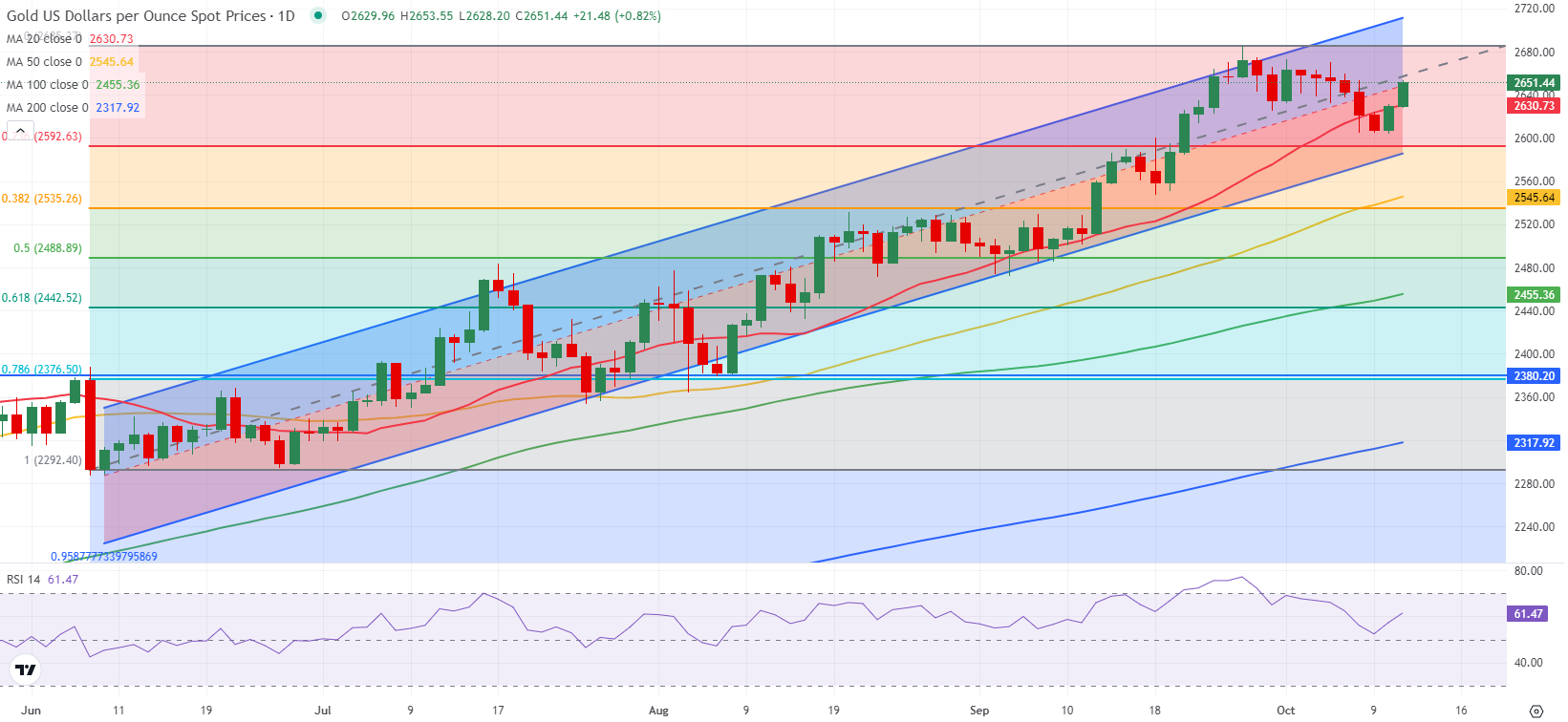
Gold price technical analysis: Daily chart
As observed on the daily chart, the 14-day Relative Strength Index (RSI) has turned south but holds above the midline to currently hover near 62.60, suggesting that the downside appears limited for Gold price.
Gold buyers must find acceptance above the record high of $2,441 if the $2,450 psychological level needs to be taken out.
A sustained move above the latter could open doors for a fresh rally toward $2,500.
However, if Gold sellers need to defend the $2,400 round figure. Failure to do so could trigger a fresh drop toward Friday’s low of $2,374.
The next downside target is seen at the 21-day Simple Moving Average (SMA) at $2,344.
Gold FAQs
Gold has played a key role in human’s history as it has been widely used as a store of value and medium of exchange. Currently, apart from its shine and usage for jewelry, the precious metal is widely seen as a safe-haven asset, meaning that it is considered a good investment during turbulent times. Gold is also widely seen as a hedge against inflation and against depreciating currencies as it doesn’t rely on any specific issuer or government.
Central banks are the biggest Gold holders. In their aim to support their currencies in turbulent times, central banks tend to diversify their reserves and buy Gold to improve the perceived strength of the economy and the currency. High Gold reserves can be a source of trust for a country’s solvency. Central banks added 1,136 tonnes of Gold worth around $70 billion to their reserves in 2022, according to data from the World Gold Council. This is the highest yearly purchase since records began. Central banks from emerging economies such as China, India and Turkey are quickly increasing their Gold reserves.
Gold has an inverse correlation with the US Dollar and US Treasuries, which are both major reserve and safe-haven assets. When the Dollar depreciates, Gold tends to rise, enabling investors and central banks to diversify their assets in turbulent times. Gold is also inversely correlated with risk assets. A rally in the stock market tends to weaken Gold price, while sell-offs in riskier markets tend to favor the precious metal.
The price can move due to a wide range of factors. Geopolitical instability or fears of a deep recession can quickly make Gold price escalate due to its safe-haven status. As a yield-less asset, Gold tends to rise with lower interest rates, while higher cost of money usually weighs down on the yellow metal. Still, most moves depend on how the US Dollar (USD) behaves as the asset is priced in dollars (XAU/USD). A strong Dollar tends to keep the price of Gold controlled, whereas a weaker Dollar is likely to push Gold prices up.
Gold price retreats further from the new all-time-high of $2,450 set on Monday.
The US Dollar extends rebound with US Treasury bond yields, as risk sentiment sours.
Downside appears limited for Gold, as RSI stays bullish on the daily chart.
The focus shifts to more Fedspeak for policy cues and the next Gold price move.
Gold price extends pullback from the lifetime high of $2,450 set on Monday, as the US Dollar (USD) draws haven demand amid broad risk aversion. Attention again turns toward upcoming speeches from the Federal Reserve (Fed) policymakers that dominate early this week, in the absence of top-tier US economic events.
Gold price retreats ahead of more Fedspeak
The week set off with a bunch of Fed officials taking up the rostrum, adopting a cautious stance on the inflation and interest rate outlook. The Fedspeak suggested that even though rate cuts remain on the table later this year, expectations for 75 basis points (bps) rate cuts waned significantly.
Cleveland Fed President Loretta Mester warned on Monday that “inflation risks are tilted to the upside,” adding that she no longer thinks three rate cuts in 2024 are appropriate. San Francisco Fed President Mary Daly said that while she expects shelter inflation to slowly improve, the Fed policymaker doesn’t expect progress to be quick.
Fed Vice Chair for Supervision Michael Barr said that the Fed is in a good position to hold the policy steady and watch the economy, per Reuters. Meanwhile, Fed Vice Chair of the Board of Governors Phillip Jefferson noted that it was too early to tell if the recent slowdown in the disinflationary process will be long-lasting.
These cautious remarks helped the US Dollar find demand due to easing bets of aggressive Fed rate cuts while also fuelling a rebound in the US Treasury bond yield. Gold price, thus, retraced from fresh record highs.
Gold price jumped to $2,450, a new all-time high, after reports Iran’s President Ebrahim Raisi and Foreign Minister Hossein Amirabdollahian died in a helicopter crash in Iran’s East Azerbaijan province hit wires in the Asian hours on Monday.
In Tuesday’s trading so far, risk-aversion keeps the safe-haven flows into the US Dollar intact, exerting further selling pressure on Gold price. Markets turn cautious ahead of a slew of speeches from Fed policymakers, including Vice Chair John Williams and Governor Christopher Waller.
Also, Gold traders also refrain from placing fresh positions ahead of Wednesday’s Fed Minutes and Nvidia earnings results, which could have a signficant impact on risk sentiment and the value of the US Dollar.
Gold price technical analysis: Daily chart
As observed on the daily chart, the 14-day Relative Strength Index (RSI) has turned south but holds above the midline to currently hover near 62.60, suggesting that the downside appears limited for Gold price.
Gold buyers must find acceptance above the record high of $2,441 if the $2,450 psychological level needs to be taken out.
A sustained move above the latter could open doors for a fresh rally toward $2,500.
However, if Gold sellers need to defend the $2,400 round figure. Failure to do so could trigger a fresh drop toward Friday’s low of $2,374.
The next downside target is seen at the 21-day Simple Moving Average (SMA) at $2,344.
Gold FAQs
Gold has played a key role in human’s history as it has been widely used as a store of value and medium of exchange. Currently, apart from its shine and usage for jewelry, the precious metal is widely seen as a safe-haven asset, meaning that it is considered a good investment during turbulent times. Gold is also widely seen as a hedge against inflation and against depreciating currencies as it doesn’t rely on any specific issuer or government.
Central banks are the biggest Gold holders. In their aim to support their currencies in turbulent times, central banks tend to diversify their reserves and buy Gold to improve the perceived strength of the economy and the currency. High Gold reserves can be a source of trust for a country’s solvency. Central banks added 1,136 tonnes of Gold worth around $70 billion to their reserves in 2022, according to data from the World Gold Council. This is the highest yearly purchase since records began. Central banks from emerging economies such as China, India and Turkey are quickly increasing their Gold reserves.
Gold has an inverse correlation with the US Dollar and US Treasuries, which are both major reserve and safe-haven assets. When the Dollar depreciates, Gold tends to rise, enabling investors and central banks to diversify their assets in turbulent times. Gold is also inversely correlated with risk assets. A rally in the stock market tends to weaken Gold price, while sell-offs in riskier markets tend to favor the precious metal.
The price can move due to a wide range of factors. Geopolitical instability or fears of a deep recession can quickly make Gold price escalate due to its safe-haven status. As a yield-less asset, Gold tends to rise with lower interest rates, while higher cost of money usually weighs down on the yellow metal. Still, most moves depend on how the US Dollar (USD) behaves as the asset is priced in dollars (XAU/USD). A strong Dollar tends to keep the price of Gold controlled, whereas a weaker Dollar is likely to push Gold prices up.
Gold price retreats further from the new all-time-high of $2,450 set on Monday.
The US Dollar extends rebound with US Treasury bond yields, as risk sentiment sours.
Downside appears limited for Gold, as RSI stays bullish on the daily chart.
The focus shifts to more Fedspeak for policy cues and the next Gold price move.
Gold price extends pullback from the lifetime high of $2,450 set on Monday, as the US Dollar (USD) draws haven demand amid broad risk aversion. Attention again turns toward upcoming speeches from the Federal Reserve (Fed) policymakers that dominate early this week, in the absence of top-tier US economic events.
Gold price retreats ahead of more Fedspeak
The week set off with a bunch of Fed officials taking up the rostrum, adopting a cautious stance on the inflation and interest rate outlook. The Fedspeak suggested that even though rate cuts remain on the table later this year, expectations for 75 basis points (bps) rate cuts waned significantly.
Cleveland Fed President Loretta Mester warned on Monday that “inflation risks are tilted to the upside,” adding that she no longer thinks three rate cuts in 2024 are appropriate. San Francisco Fed President Mary Daly said that while she expects shelter inflation to slowly improve, the Fed policymaker doesn’t expect progress to be quick.
Fed Vice Chair for Supervision Michael Barr said that the Fed is in a good position to hold the policy steady and watch the economy, per Reuters. Meanwhile, Fed Vice Chair of the Board of Governors Phillip Jefferson noted that it was too early to tell if the recent slowdown in the disinflationary process will be long-lasting.
These cautious remarks helped the US Dollar find demand due to easing bets of aggressive Fed rate cuts while also fuelling a rebound in the US Treasury bond yield. Gold price, thus, retraced from fresh record highs.
Gold price jumped to $2,450, a new all-time high, after reports Iran’s President Ebrahim Raisi and Foreign Minister Hossein Amirabdollahian died in a helicopter crash in Iran’s East Azerbaijan province hit wires in the Asian hours on Monday.
In Tuesday’s trading so far, risk-aversion keeps the safe-haven flows into the US Dollar intact, exerting further selling pressure on Gold price. Markets turn cautious ahead of a slew of speeches from Fed policymakers, including Vice Chair John Williams and Governor Christopher Waller.
Also, Gold traders also refrain from placing fresh positions ahead of Wednesday’s Fed Minutes and Nvidia earnings results, which could have a signficant impact on risk sentiment and the value of the US Dollar.
Gold price technical analysis: Daily chart
As observed on the daily chart, the 14-day Relative Strength Index (RSI) has turned south but holds above the midline to currently hover near 62.60, suggesting that the downside appears limited for Gold price.
Gold buyers must find acceptance above the record high of $2,441 if the $2,450 psychological level needs to be taken out.
A sustained move above the latter could open doors for a fresh rally toward $2,500.
However, if Gold sellers need to defend the $2,400 round figure. Failure to do so could trigger a fresh drop toward Friday’s low of $2,374.
The next downside target is seen at the 21-day Simple Moving Average (SMA) at $2,344.
Gold FAQs
Gold has played a key role in human’s history as it has been widely used as a store of value and medium of exchange. Currently, apart from its shine and usage for jewelry, the precious metal is widely seen as a safe-haven asset, meaning that it is considered a good investment during turbulent times. Gold is also widely seen as a hedge against inflation and against depreciating currencies as it doesn’t rely on any specific issuer or government.
Central banks are the biggest Gold holders. In their aim to support their currencies in turbulent times, central banks tend to diversify their reserves and buy Gold to improve the perceived strength of the economy and the currency. High Gold reserves can be a source of trust for a country’s solvency. Central banks added 1,136 tonnes of Gold worth around $70 billion to their reserves in 2022, according to data from the World Gold Council. This is the highest yearly purchase since records began. Central banks from emerging economies such as China, India and Turkey are quickly increasing their Gold reserves.
Gold has an inverse correlation with the US Dollar and US Treasuries, which are both major reserve and safe-haven assets. When the Dollar depreciates, Gold tends to rise, enabling investors and central banks to diversify their assets in turbulent times. Gold is also inversely correlated with risk assets. A rally in the stock market tends to weaken Gold price, while sell-offs in riskier markets tend to favor the precious metal.
The price can move due to a wide range of factors. Geopolitical instability or fears of a deep recession can quickly make Gold price escalate due to its safe-haven status. As a yield-less asset, Gold tends to rise with lower interest rates, while higher cost of money usually weighs down on the yellow metal. Still, most moves depend on how the US Dollar (USD) behaves as the asset is priced in dollars (XAU/USD). A strong Dollar tends to keep the price of Gold controlled, whereas a weaker Dollar is likely to push Gold prices up.
Oil prices declined in early Asian trading on Tuesday, with expectations of sustained U.S. inflation and higher interest rates dampening consumer and industrial demand.
Both benchmarks fell less than 1% on Monday as Federal Reserve officials awaited clearer signs of slowing inflation before considering rate cuts. Analysts noted fears of weaker demand due to delayed rate cuts.
Nevertheless, there is no assurance the higher targets will be reached. Interim price targets include 2.80 and 2.86. They are derived from the 2.5% and 261.8% extensions of the rising ABCD pattern, respectively. Another price level of 2.88 is marked from the June 2023 swing high. Although all previous potential targets from the rising ABCD pattern have been exceeded during the current rally, a top in natural gas will be found at some point, and it may match with an ABCD target.
The ABCD pattern looks to identify price symmetry between the second CD leg of the advance and the initial AB leg. Symmetry first occurs when the price appreciation in each advance matches. Subsequently, Fibonacci ratios are used to identify extended targets for the CD leg. For example, for the 261.8% target, the price distance of the AB leg is multiplied by the Fibonacci ratio to derive a target of 2.86.
Relative Strength of Current Rally
The current rally of 73.5% is well above the prior two greatest advances since the first bottom of the downtrend in February 2023. There were four prior larger rallies from 34.7% to 53.9%. The current advance of 73.5% clearly exceeds the previous rallies. This points to a likely change in character as natural gas further shows strength and provides signs of a transition from a downtrend to an uptrend, in which case the 3.00 price zone becomes more likely to be reached.
For a look at all of today’s economic events, check out our economic calendar.
A significant driver of the bullish sentiment in natural gas markets is the decline in domestic production. Leading producers like EQT and Chesapeake Energy have postponed well completions and reduced drilling activities in response to earlier price drops, contributing to an approximate 9% production decrease in 2024. Additionally, the near-full service return of the Freeport LNG plant in Texas has elevated gas flows to LNG export facilities, tightening supply further.
Record High Gas Flows to Freeport LNG
Natural gas flowing to Freeport LNG’s export plant in Texas hit a five-month high, according to LSEG data. This increase followed the return of a liquefaction train after a brief upset. U.S. gas futures at the Henry Hub benchmark have soared by around 59% over the past three weeks, partly due to increased feedgas at Freeport following an outage in late April.
As of Friday, gas flows to the seven major U.S. LNG export plants rose from an average of 11.9 billion cubic feet per day (bcfd) in April to 12.7 bcfd in May, with Freeport’s 2.1-bcfd plant contributing significantly.
EIA Report and Inventory Levels
June natural gas prices saw significant gains, supported by a U.S. Energy Information Administration (EIA) report showing a smaller-than-expected increase in natural gas inventories. For the week ending May 10, inventories rose by 70 billion cubic feet (bcf), short of the forecasted 76 bcf and the five-year average of 90 bcf. Despite this, total natural gas inventories were still up 17.5% year-on-year and 30.8% above the five-year seasonal average.
Lower-48 states’ dry gas production on Thursday was reported at 98.3 bcf per day, marking a 2.1% year-on-year decline, according to Bloomberg New Energy Finance (BNEF). Concurrently, gas demand in these states stood at 64.4 bcf per day, a 2.7% decrease from the previous year. LNG exports from U.S. terminals were at 13.2 bcf per day, up 4.0% week-on-week, indicating robust international demand.
Market Forecast
Given the current market conditions—reduced storage increases, lower production, and strong LNG exports—natural gas futures are likely to maintain their upward trend in the short term. However, potential cooler weather could temper this bullish outlook by reducing immediate demand for natural gas. Traders should remain vigilant regarding inventory reports and weather forecasts to navigate this volatile market effectively.
Iranian President Ebrahim Raisi and his foreign minister died in a helicopter crash in the mountainous terrain of East Azerbaijan province. The crash was attributed to icy weather conditions, and the wreckage was located on Monday, causing shockwaves through the market due to potential instability in one of the world’s major oil producers.
Health Concerns for Saudi King
Separately, Saudi Crown Prince Mohammed bin Salman postponed his visit to Japan citing health issues faced by King Salman. The 88-year-old king is undergoing treatment for lung inflammation. This development adds another layer of uncertainty in the energy market, which is closely monitoring the health of the Saudi monarch, a key figure in global oil politics.
OPEC+ Maintains Oil Demand Forecast
OPEC’s latest report maintained its forecast for strong global oil demand growth in 2024, predicting a rise of 2.25 million barrels per day (bpd). The report also highlighted a shift in focus towards OPEC+ demand, underscoring the group’s significance in the current market framework. OPEC+ will meet on June 1 to discuss extending voluntary output cuts into the second half of the year.
U.S. Strategic Petroleum Reserve Refill
In the U.S., the government capitalized on the recent dip in oil prices, purchasing 3.3 million barrels at $79.38 each to refill the Strategic Petroleum Reserve. This move follows the significant stockpile sales of 2022, aimed at stabilizing the market.
Market Forecast: Bullish Outlook
Given the geopolitical uncertainties and positive economic indicators from major oil consumers, the crude oil market is expected to maintain a somewhat bullish outlook in the short term. The potential for further price increases remains, particularly as market participants await clarity on OPEC+ output policy decisions in the upcoming meeting.
Last week’s U.S. inflation data revealed consumer prices rose less than anticipated in April, reinforcing the belief that inflation is on a downward trend. This data has fueled speculation that the Federal Reserve may cut interest rates as early as September. Lower interest rates tend to benefit gold by reducing the opportunity cost of holding non-yielding assets.
Market Reactions to Global Events
Despite recent geopolitical tensions, particularly the death of Iranian President Ebrahim Raisi, a potential successor to Supreme Leader Ayatollah Ali Khamenei, safe-haven demand for gold has not notably increased. Instead, the current rally appears more linked to economic factors, such as U.S. inflation trends and China’s measures to stabilize its property sector, which have broader implications for metals markets.
Treasury Yields and Fed’s Stance
U.S. Treasury yields remained steady on Monday as investors awaited further economic data and comments from Federal Reserve officials. Key data points this week include home sales figures and durable goods orders, alongside the Fed’s meeting minutes, which will provide insights into the central bank’s economic outlook and policy direction. The Fed has maintained that interest rates will not be cut until there is greater confidence in inflation easing to the 2% target.
Dollar Trends and Future Rate Cuts
The U.S. dollar edged lower as traders anticipated more clarity on the interest rate outlook. Despite the cooling inflation data, Federal Reserve officials have been cautious about predicting imminent rate cuts. Market expectations have adjusted accordingly, now pricing in a potential rate cut by November. The upcoming Personal Consumption Expenditures (PCE) price index report on May 31 will be a critical indicator for future Fed decisions.
Market Forecast
Given the current economic indicators and the anticipation of further dovish signals from the Federal Reserve, gold prices are likely to remain bullish in the short term. Traders should monitor upcoming economic data and Fed communications for cues on the timing and magnitude of potential rate cuts, which will be pivotal in shaping gold’s market movement.
Risk Disclosure: Trading in financial instruments and/or cryptocurrencies involves high risks including the risk of losing some, or all, of your investment amount, and may not be suitable for all investors. Prices of cryptocurrencies are extremely volatile and may be affected by external factors such as financial, regulatory or political events. Trading on margin increases the financial risks. Before deciding to trade in financial instrument or cryptocurrencies you should be fully informed of the risks and costs associated with trading the financial markets, carefully consider your investment objectives, level of experience, and risk appetite, and seek professional advice where needed. Fusion Media would like to remind you that the data contained in this website is not necessarily real-time nor accurate. The data and prices on the website are not necessarily provided by any market or exchange, but may be provided by market makers, and so prices may not be accurate and may differ from the actual price at any given market, meaning prices are indicative and not appropriate for trading purposes. Fusion Media and any provider of the data contained in this website will not accept liability for any loss or damage as a result of your trading, or your reliance on the information contained within this website. It is prohibited to use, store, reproduce, display, modify, transmit or distribute the data contained in this website without the explicit prior written permission of Fusion Media and/or the data provider. All intellectual property rights are reserved by the providers and/or the exchange providing the data contained in this website. Fusion Media may be compensated by the advertisers that appear on the website, based on your interaction with the advertisements or advertisers.
Recent declines in oil and refined product inventories at major global trading hubs have sparked optimism about oil demand growth. This reverses the trend of rising stockpiles that had previously pressured crude oil prices. As of Thursday, Brent crude futures were down around 10% from their peak of $92.18 a barrel on April 12.
U.S. Economic Indicators Boost Sentiment
Economic indicators from the United States have fueled optimism over global demand. U.S. consumer prices rose less than expected in April, which has raised expectations of lower interest rates. This expectation was further supported by data indicating a stabilizing U.S. job market. Lower interest rates could weaken the U.S. dollar, making oil cheaper for investors holding other currencies and boosting demand.
China’s Industrial Output and Russian Supply Concerns
China’s industrial output increased by 6.7% year on year in April, accelerating from 4.5% in March, indicating a recovery in its manufacturing sector and potential stronger future demand. Additionally, disruptions in Russian oil infrastructure, such as the recent Ukrainian drone attack on the Tuapse oil refinery, have also contributed to price support.
OPEC+ Meeting and Market Outlook
Investors are now looking ahead to the OPEC+ meeting on June 1 for further direction. With two consecutive weeks of declines in U.S. crude stockpiles and expectations of additional economic stimulus measures from China, analysts are optimistic. Financial markets have placed significant bets on a September interest rate cut by the Federal Reserve, which could further support commodity prices.
Market Forecast: Bullish Outlook
Given the improving demand indicators from the U.S. and China, alongside inventory declines and potential monetary easing, the short-term outlook for crude oil prices appears bullish. Traders should monitor upcoming economic data and OPEC+ decisions, as these factors will likely influence market sentiment and price movements.