The main tag of Gold News Today Articles.
You can use the search box below to find what you need.
[wd_asp id=1]

21 12, 2025

Prices Slip on Warm Forecasts as LNG Supply Plans Shift

By |2025-12-21T21:27:45+02:00December 21, 2025|Forex News, News|0 Comments


December 21, 2025 — Natural gas markets are closing out the year with a familiar winter paradox: heating season is underway, but prices are being dragged lower by milder temperature forecasts and a supply picture that still looks comfortable in both the U.S. and Europe.

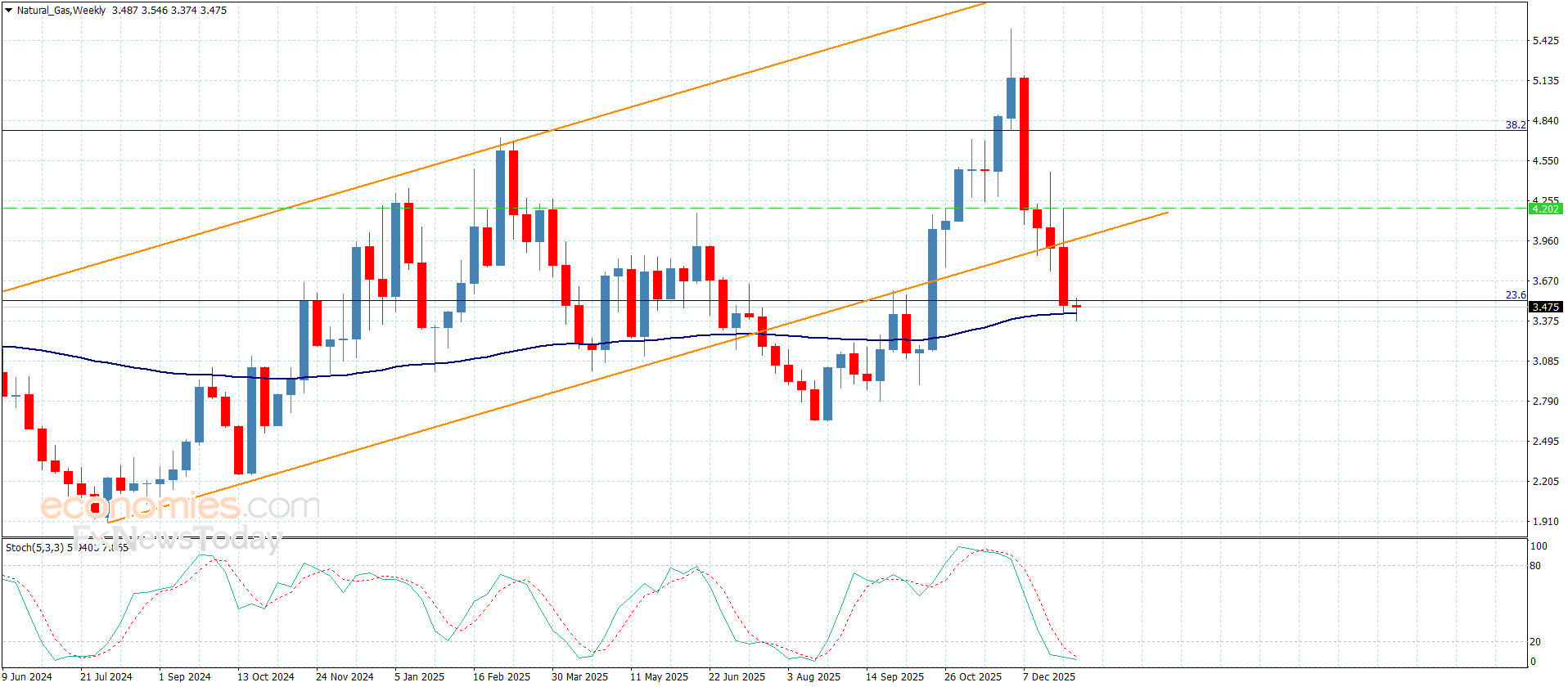
In the United States, NYMEX natural gas futures for January delivery slid to $3.879 per million British thermal units (mmBtu) in the latest session, touching a seven-week low as traders priced in warmer-than-normal weather into early January and continued strength in Lower 48 production. [1]

Globally, the soft tone is reinforced by weaker benchmark prices in Europe and Asia—reducing LNG “pull” from overseas and narrowing export margins. At the same time, major structural stories continue to reshape the longer-term outlook: Qatar-linked expansion activity moved forward with a new offshore contract, while at least one large proposed U.S. export project was paused amid cost and oversupply concerns. [2]

Below is a detailed look at the key news, forecasts, and market analysis shaping natural gas as of Dec. 21, 2025.


Key takeaways driving natural gas today

  • U.S. prices: January futures ended the latest session around $3.879/mmBtu, pressured by milder weather outlooks and near-record output. [3]
  • Supply comfort signals: The closely watched March–April 2026 spread (“widow-maker”) traded near a record-low premium of ~1 cent, a sign traders aren’t pricing in major late-winter scarcity risk right now. [4]
  • Production and demand: Lower 48 output hovered around 109.6 bcfd (billion cubic feet per day) for December, while projected total demand (including exports) was expected to fall sharply over the next two weeks as warmth trims heating needs. [5]
  • LNG feedgas remains high: Flows to the eight large U.S. LNG export plants averaged about 18.5 bcfd so far this month—near record territory—though plant-specific fluctuations continue. [6]
  • Project signals: Energy Transfer said it is suspending development of its Lake Charles LNG export project in Louisiana as it prioritizes pipeline investments amid cost inflation and oversupply concerns. [7]
  • Geopolitics and regional gas: Israel approved what it described as its largest-ever gas export deal, tied to Leviathan supply to Egypt through 2040 (or until contract value is reached), underscoring how East Med gas is becoming more central to North African balances. [8]
  • Europe policy shift continues: The European Parliament approved legislation to phase out Russian gas imports—including halting Russian LNG by end‑2026 and pipeline gas by end‑September 2027—a structural bullish factor for LNG demand over time even if near-term prices are soft. [9]
  • 2026 forecasts diverge: EIA expects Henry Hub to average about $4.01/mmBtu in 2026 (and around $4.30/mmBtu this winter season), while Enverus projects $3.80 through winter before softening in summer 2026; Goldman sees higher 2026 pricing in both the U.S. and Europe than current winter softness implies. [10]

Where U.S. natural gas prices stand—and what’s pushing them

The current U.S. move is less about a sudden collapse in fundamentals and more about a rapid repricing of winter expectations. After earlier cold-driven strength, the latest model runs shifted warmer—enough to shave expected heating demand in the critical late-December/early-January window.

Reuters-reported market data showed meteorologists expecting weather to stay mostly warmer than normal through Jan. 3, reducing the volume of gas needed for residential and commercial heating. [11]

At the same time, supply remains strong. Lower 48 output has been hovering near record levels (~109.6 bcfd), giving the market less reason to pay up for winter risk. [12]

One of the most telling indicators is the forward curve. The March–April 2026 spread—nicknamed the “widow-maker” for how violently it can move when late-winter weather swings—compressed to around a 1-cent premium, an unusually calm signal for the end of winter. [13]

Storage: still not tight (for now)

Storage is also helping keep a lid on panic pricing. In the same Reuters dataset, the U.S. storage position was shown close to normal—recently around 0.9% above the five-year average at the reported point in time (with totals cited around 3,579 bcf for the referenced week). [14]

That doesn’t mean winter is “solved.” It means the market currently believes supply + storage are adequate unless a sustained cold regime emerges.


LNG: high export flows, but global prices are softening

U.S. LNG export demand continues to be a critical support pillar. Feedgas to the eight major U.S. LNG plants averaged around 18.5 bcfd so far this month—up from a monthly record of 18.2 bcfd in November, according to Reuters-reported figures. [15]

However, softer global gas benchmarks are complicating the picture.

Earlier in the week, Reuters reporting noted European (TTF) and Asian (JKM) benchmarks trading near multi‑month lows, with global prices declining as the winter heating season began slowly and markets weighed prospects of improved Russia-linked supply conditions over time. [16]

This matters because LNG is not just a “volume” story—it’s a margin story. When international prices fall faster than Henry Hub (or when shipping and liquefaction costs rise), U.S. cargo economics can tighten, especially for spot-linked volumes.

Operational noise: Freeport and Venture Global headlines

Operationally, traders are still tracking plant-level events. Reuters noted a shutdown of one liquefaction train at Freeport LNG in Texas during the week, a reminder that unplanned outages can quickly change short-term balances. [17]

Separately, Reuters also pointed to small flow declines at Venture Global facilities in Louisiana in recent days (as referenced in market reporting), though overall U.S. LNG feedgas stayed near record highs. [18]


Big project signal: Energy Transfer pauses Lake Charles LNG

One of the most important structural stories heading into 2026 isn’t a price tick—it’s what developers are doing (or not doing) with multi‑billion-dollar export projects.

Energy Transfer said it is suspending development of its Lake Charles LNG export project in Louisiana, citing a preference to focus capital on pipeline investments amid rising costs and fears of looming global oversupply as more LNG capacity comes online. The project had been planned at roughly 16.45 million tonnes per annum of liquefaction capacity. [19]

For the market, this is a two-sided signal:

  • In the short-to-medium term, fewer new terminals could be supportive for U.S. balances if demand growth from LNG slows.
  • In the long term, it highlights how financing and cost inflation can gatekeep the next wave of LNG—potentially preventing the most bearish oversupply scenarios from materializing on schedule.

Qatar keeps the long game in focus

While some U.S. capacity ambitions are being reassessed, Qatar’s expansion narrative keeps moving.

Italy’s Saipem won an offshore EPCI contract from QatarEnergy LNG (in partnership with China’s COOEC), with the overall contract value around $4 billion and Saipem’s share around $3.1 billion. The work is described on a multi‑year timeline, with offshore installation operations expected later in the decade. [20]

The strategic message is clear: Qatar’s North Field-linked expansion remains one of the most consequential supply additions expected for the second half of the 2020s.

For traders and policymakers, that raises the central question: Will demand growth (Europe’s LNG reliance, Asia’s industrial/power growth, and new uses like data center power demand) keep pace with the supply wave? [21]


Europe: policy is tightening even as prices stay calm

European gas is increasingly shaped by policy—and by the reality that LNG is now a structural pillar of supply.

EU moves closer to a Russian gas phase-out

The European Parliament approved the bloc’s plan to phase out Russian gas imports, including halting Russian LNG by end‑2026 and ending pipeline gas imports by end‑September 2027. Reuters reported Russia accounted for about 12% of EU gas imports as of October 2025, down sharply from pre‑2022 levels. [22]

This is a long-duration bullish factor for LNG infrastructure and flexible supply—but it doesn’t automatically translate into high near-term prices if weather is mild and inventories are adequate.

Methane regulation becomes a trade friction point

Another European factor that could influence LNG flows—and compliance costs—is methane policy.

Reuters reported the U.S. asked the EU to exempt U.S. oil and gas imports from aspects of the EU’s methane emissions regulation until 2035, framing it as a trade barrier and warning of implementation challenges given complex U.S. supply chains and commingled molecules. The EU, however, signaled the legislation stands while discussing implementation pathways. [23]

For market participants, methane rules can affect contract structures, certification practices, and potentially the attractiveness of certain supply sources over time—particularly in a world where Europe is expected to remain a premium LNG buyer for years.

Trading infrastructure: TTF’s financial market is getting bigger

Even as prices soften, European gas market activity is expanding. Intercontinental Exchange (ICE) reported record trading volumes for benchmark Dutch TTF contracts in 2025 and said it is preparing to extend trading hours to better align with global cycles, reflecting how Europe’s gas pricing is increasingly connected to Henry Hub and Asian LNG benchmarks. [24]


East Mediterranean gas: Israel’s Leviathan deal reshapes Egypt’s supply picture

A major regional headline this week came from the Eastern Mediterranean.

Reuters reported Israel approved what it described as its largest-ever natural gas export deal—valued around $34.67 billion—to supply Egypt with gas from the Leviathan field. The deal referenced roughly 130 bcm of gas through 2040 (or until the contract value is met), and it comes as Egypt works through an energy crunch linked to domestic production declines and rising demand. [25]

Why this matters beyond the region:

  • Egypt’s ability to secure reliable pipeline gas can influence whether it becomes a steadier LNG exporter again—or remains a net importer during tight periods.
  • The deal underscores how “regional pipeline gas” can still compete with LNG in certain corridors, even as Europe globalizes gas through LNG.

Australia’s domestic gas debate highlights a global tension

Natural gas is increasingly global: LNG prices and flows often ripple back into domestic energy bills.

In Australia, policy debate remains active over how to protect local consumers and industry from LNG-linked price pressures. Reporting highlighted concerns around high gas prices and scrutiny of mechanisms meant to ensure adequate domestic supply. [26]

For global readers, the takeaway is broader than Australia: countries that are large LNG exporters often face political pressure to “decouple” domestic pricing from international markets—especially when cost-of-living becomes a dominant theme.


Forecasts for 2026: what major outlooks are saying now

Forecasting gas is notoriously difficult because weather dominates and LNG is both a demand source and a volatility amplifier. Still, several major outlooks released or highlighted in December frame today’s debate: Is the recent pullback a pause—or a reset lower?

EIA: firmer 2026, strong LNG exports, and winter volatility risk

In its December Short‑Term Energy Outlook messaging, EIA forecast Henry Hub natural gas prices at $3.56/mmBtu for 2025 and $4.01/mmBtu for 2026, and described winter conditions putting upward pressure on prices—projecting a winter average around $4.30/mmBtu in its forecast narrative. EIA also projected U.S. LNG gross exports rising to ~16 bcfd in 2026 (from ~15 bcfd in 2025). [27]

Enverus: the winter spike looked “premature”

Enverus Intelligence Research projected Henry Hub prices averaging about $3.80/mmBtu through winter before softening to around $3.60/mmBtu in summer 2026, arguing the earlier run-up had gotten ahead of fundamentals amid expectations for a mild winter and continued Lower 48 supply growth. [28]

Goldman: higher 2026 pricing assumptions than the market is signaling today

Reuters reporting on Goldman’s outlook included expectations that in 2026 Dutch TTF could average around €29/MWh and U.S. natural gas around $4.60/mmBtu, illustrating how some bank forecasts still lean above what today’s softened winter curve implies. [29]

Kpler: storage trajectory and LNG imports will decide Europe’s end‑winter comfort

Kpler’s European natural gas outlook suggested EU‑27 storage could end the 2025–26 winter around 36% full, with the estimate sensitive to LNG import expectations and pipeline inflows—another reminder that Europe’s balance is increasingly an LNG scheduling story. [30]


What to watch next week (and why it matters)

Natural gas is entering a period where small changes in weather models can drive outsized moves. Here’s what professionals are watching right now:

  1. Late‑December / early‑January weather revisions
    With forecasts currently leaning warm, any shift toward sustained cold could quickly reprice the curve—especially given how aggressively winter risk premium has been compressed. [31]
  2. LNG plant reliability and feedgas trends
    Feedgas is near record highs, but events like the Freeport train outage show how quickly balances can change. [32]
  3. U.S. storage withdrawals vs. expectations
    The market has been pricing “comfortable” storage conditions; surprises (either direction) will matter more with the curve already leaning bearish. [33]
  4. Policy signals in Europe
    Russian gas phase-out timelines and methane compliance negotiations are structural, but they can influence contracting, LNG sourcing, and long-run price formation. [34]
  5. Final investment decisions and cancellations in LNG
    The Energy Transfer pause is a reminder: not all proposed LNG capacity becomes real, and that uncertainty is itself a key driver of 2026–2028 expectations. [35]

References

1. www.tradingview.com, 2. www.tradingview.com, 3. www.tradingview.com, 4. www.tradingview.com, 5. www.tradingview.com, 6. www.tradingview.com, 7. www.reuters.com, 8. www.reuters.com, 9. www.reuters.com, 10. www.eia.gov, 11. www.tradingview.com, 12. www.tradingview.com, 13. www.tradingview.com, 14. www.tradingview.com, 15. www.tradingview.com, 16. www.tradingview.com, 17. www.tradingview.com, 18. www.tradingview.com, 19. www.reuters.com, 20. www.tradingview.com, 21. www.reuters.com, 22. www.reuters.com, 23. www.reuters.com, 24. www.reuters.com, 25. www.reuters.com, 26. www.theguardian.com, 27. www.eia.gov, 28. www.mrt.com, 29. www.reuters.com, 30. www.kpler.com, 31. www.tradingview.com, 32. www.tradingview.com, 33. www.tradingview.com, 34. www.reuters.com, 35. www.reuters.com


Source link

21 12, 2025

XAG/USD Near Record Highs Around $67 as Supply Tightness and Fed Cut Bets Drive 2026 Forecasts

By |2025-12-21T01:14:59+02:00December 21, 2025|Forex News, News|0 Comments


December 20, 2025 — Silver is ending 2025 with a bang. After surging to fresh all-time highs in the latest U.S. session, spot silver (XAG/USD) is holding around the mid-$67 range on Saturday, with live spot quotes near $67.40–$67.48 per ounce depending on the feed and timestamp. [1]

That price zone caps an extraordinary year in which silver has outpaced nearly every major liquid asset class—and it keeps the spotlight fixed on one question heading into the new year: Is $70 silver the next stop, or is the market setting up for a volatility-driven reset?

Silver price snapshot: where XAG/USD stands on December 20

While weekend trading conditions differ from the most liquid weekday sessions, Saturday’s spot indications underscore how strong the momentum remains after Friday’s record-setting move.

Here’s the latest context:

  • Friday, Dec. 19: Reuters reported spot silver jumped 2.6% to $67.14/oz, after hitting a record high of $67.45/oz in-session and finishing the week up 8.4%. [2]
  • Saturday, Dec. 20: Retail/live spot trackers showed silver around $67.40–$67.48/oz late morning U.S. time. [3]
  • 2025 performance: Reuters put silver’s year-to-date gain at roughly +132%, far ahead of gold’s rise in the same period. [4]

Silver’s late-year acceleration is also showing up in the broader investment narrative, with market coverage increasingly treating the metal as both a macro hedge and a strategic industrial input as AI and electrification demand grows. [5]

What’s driving silver’s rally: the “perfect storm” narrative goes mainstream

In recent days, the dominant explanation across major market reporting has converged around a similar mix of catalysts:

1) Rate-cut expectations are re-pricing non-yielding metals

Silver—like gold—tends to benefit when investors anticipate lower policy rates and easier financial conditions.

Reuters pointed to U.S. macro data feeding that narrative, including cooler-than-expected inflation and a higher unemployment rate, reinforcing expectations that the Federal Reserve stays on an easing path. [6]

In the same report, Reuters noted traders were pricing at least two 25-basis-point rate cuts in 2026, based on LSEG data. [7]

2) Supply tightness isn’t a slogan—it’s becoming a pricing factor

Silver’s physical market is small enough that marginal changes in inventories and financing costs can matter a lot, fast.

  • Reuters has emphasized silver’s persistent supply deficit and the role of “momentum buying” amplifying moves. [8]
  • Investopedia, citing a Deutsche Bank report, highlighted silver lease dynamics: the cost to lease silver rose to its highest since 2002, and Deutsche Bank described industrial-available supply as the tightest on record. [9]

Even when COMEX inventories look large on paper, analysts have warned that regional availability and deliverable liquidity can be a separate story—especially when flows and policy risks drive metal into specific hubs. [10]

3) Industrial demand is no longer “background noise”—AI is pulling it forward

Silver is unique among precious metals because its investment identity coexists with heavy industrial usage.

Reuters has tied demand strength to AI data centers, solar cells, and electric vehicles. [11]

Business Insider went further, arguing the AI build-out is turning silver into “another AI play,” citing commentary from Ed Yardeni and pointing to a report from The Silver Institute and Oxford Economics on rising silver demand tied to digitalization and AI adoption. [12]

The flows story: ETFs and retail participation are back in focus

Beyond macro and industrial demand, several reports highlight that investment flows are doing real work in this rally.

On Friday, Reuters quoted Blue Line Futures chief market strategist Phillip Streible saying silver ETF flows remain a dominant theme, alongside retail speculation. [13]

Meanwhile, Investopedia reported Deutsche Bank expects ETF holdings to climb further—projecting silver held in ETFs could reach about 1.1 billion troy ounces by end-2026, surpassing a prior record. [14]

And in a separate 2026 outlook write-up carried by Nasdaq, Ole Hansen of Saxo Bank said (via an X post cited in the article) that inflows into silver-backed ETFs reached ~130 million ounces in 2025, lifting total holdings to roughly 844 million ounces (an ~18% increase). [15]

Taken together, the flow picture reinforces a key point for 2026: even a small incremental shift in investor demand can overwhelm a tight physical balance—especially when the market is already trending.

Technical picture: $70 is the headline, but the risk is in the speed

By the numbers, the market has moved fast enough that even bulls are talking about consolidation.

A December 20 technical note from FXLeaders said silver has “a good chance” of reaching $70 before the New Year, pointing to strong demand conditions and momentum after the gold/silver ratio dropped below 65. [16]

Other technical coverage has been framing the next steps in terms of whether silver can push through resistance cleanly—or whether overbought conditions trigger a shakeout:

  • ActionForex (via Windsor Brokers) flagged $67.23 and $69.36 as upside targets (Fibonacci projections), with the psychological $70 barrier in focus, while warning that overbought readings could lead to consolidation or a limited correction. [17]
  • The same analysis suggested dips “ideally” hold around $64.50–$65.00 to keep the bullish structure intact. [18]

A mainstream warning sign: “historic deviations”

Not all of the latest analysis is celebratory.

Barron’s cited Sundial Capital Research warning that silver (as tracked by the iShares Silver Trust) had stretched to “historic deviations” above key moving averages—conditions that in prior cycles (including 2011 and 2020) preceded sharp drops of 20%+. [19]

That doesn’t invalidate the bullish fundamentals—but it does underline silver’s reputation for violent swings in both directions.

Silver price forecast for 2026: wide range, sharper disagreement

As of December 20, 2025, forecasts and outlooks for 2026 are clustering into three broad camps:

Camp 1: The “$70+ is realistic” base case

This is the most common bullish-but-not-extreme view right now:

  • Reuters quoted WisdomTree commodities strategist Nitesh Shah saying silver prices could rise to around $75/oz by end-2026, citing supportive conditions and inventory dynamics. [20]
  • A Nasdaq-hosted silver outlook article said this aligns with Citigroup’s view that silver could continue to outperform and reach upwards of $70 in 2026, particularly if industrial fundamentals remain supportive. [21]
  • A December 20 report in India, citing PL Capital’s outlook, said gold and silver are expected to retain momentum into 2026 amid strong demand (though it did not attach a specific USD target for silver). [22]

Camp 2: The cautious institutional view (silver lags gold)

The key dissenting institutional angle isn’t that silver collapses—it’s that silver underperforms after an exceptional year.

Reuters reported Morgan Stanley expects silver to lag gold, calling 2025 a likely peak deficit year and noting expectations for falling solar installations in 2026. [23]

This is a reminder that a big part of the silver bull thesis is industrial momentum; if any major industrial driver softens, silver can re-price quickly.

Camp 3: Conservative forecasts that may look “behind the curve” after December’s surge

Some bank projections published earlier in the rally are now being re-evaluated against spot prices in the high-$60s:

Investopedia reported Deutsche Bank forecast silver would average about $55/oz in 2026, while also expecting stronger investor demand to crowd out industrial availability and lift ETF holdings. [24]

With spot already well above that level, readers should interpret such “average price” forecasts as scenarios that implicitly include volatility and pullbacks—not as a ceiling.

The fundamentals underneath: deficits, inventories, and the industrial bottleneck

A useful way to reconcile the forecast spread is to separate structural factors from cyclical factors:

  • Structural: A Nasdaq-hosted 2026 outlook cited Metal Focus forecasting a fifth straight annual silver supply deficit in 2025 (63.4 million ounces), easing but still negative in 2026 (30.5 million ounces)—a setup that can keep physical tightness in play even if prices cool from extremes. [25]
  • Cyclical: Policy expectations (rates, USD direction), growth fears, and geopolitical risk can rapidly change demand for “hard assets,” which Reuters has also highlighted as a support for silver alongside gold. [26]

This dual nature is why silver can look like a precious metal in one moment and a high-beta industrial commodity in the next.

What to watch next: the catalysts that could move silver after December 20

With silver already priced for a lot of good news, the next phase likely depends on whether the macro tailwinds and physical tightness persist into early 2026. Traders and longer-term investors are likely focused on:

  1. Fed expectations and U.S. data
    Reuters cited softer inflation readings and a higher jobless rate as key inputs into easing expectations. Any re-acceleration in inflation—or a re-pricing of the cuts path—could hit silver quickly. [27]
  2. ETF flows and positioning
    If ETF inflows continue, they can tighten the “available” pool of metal quickly, as several reports have underscored. [28]
  3. Industrial demand headlines (AI, electrification, solar)
    Business Insider’s reporting tied the latest leg of the move to AI infrastructure demand and commentary from The Silver Institute/Oxford Economics, while Reuters also linked demand to AI data centers, solar, and EVs. [29]
  4. Policy and trade risk around the physical market
    Reuters has already highlighted tariff concerns shaping flows and liquidity in 2025, and the Financial Times reported a policy review/tariff angle as part of the supply squeeze narrative. [30]

Bottom line for December 20: silver is strong—and still fragile

Silver’s price action into December 20, 2025 reflects an unusual alignment: easier-rate expectations, tight physical conditions, and a powerful industrial narrative tied to AI and electrification. [31]

But the same combination that can propel silver into the $70s can also produce fast air pockets if positioning gets crowded or macro expectations reverse—an issue raised in both mainstream commentary and technical warnings. [32]

For 2026, the center of gravity in forecasts is moving toward $70+ scenarios, with bullish calls extending toward $75 in some strategist outlooks—while large institutions still debate how sustainable the deficit and industrial impulse will be after an extraordinary 2025. [33]

References

1. www.jmbullion.com, 2. www.reuters.com, 3. www.jmbullion.com, 4. www.reuters.com, 5. www.businessinsider.com, 6. www.reuters.com, 7. www.reuters.com, 8. www.reuters.com, 9. www.investopedia.com, 10. www.reuters.com, 11. www.reuters.com, 12. www.businessinsider.com, 13. www.reuters.com, 14. www.investopedia.com, 15. www.nasdaq.com, 16. www.fxleaders.com, 17. www.actionforex.com, 18. www.actionforex.com, 19. www.barrons.com, 20. www.reuters.com, 21. www.nasdaq.com, 22. timesofindia.indiatimes.com, 23. www.reuters.com, 24. www.investopedia.com, 25. www.nasdaq.com, 26. www.reuters.com, 27. www.reuters.com, 28. www.reuters.com, 29. www.businessinsider.com, 30. www.reuters.com, 31. www.reuters.com, 32. www.barrons.com, 33. www.nasdaq.com


Source link

20 12, 2025

XAU/USD Holds Near $4,338 as Big Banks Lift 2026 Targets Toward $5,000

By |2025-12-20T23:13:45+02:00December 20, 2025|Forex News, News|0 Comments


Gold prices are ending 2025 in rare territory: near record highs, up roughly two-thirds year-to-date, and with Wall Street forecasts increasingly clustering around the $4,500–$5,000 zone for 2026. As of Saturday, December 20, spot gold (XAU/USD) is hovering around $4,338 per ounce after Friday’s close, with the latest daily range showing buyers defending dips toward the $4,300 handle and sellers leaning against the mid-$4,350s. [1]

That near-term “pause” masks a bigger story: gold is being pulled between a firmer U.S. dollar and higher yields on one side, and rate-cut expectations, central-bank demand, and persistent geopolitical uncertainty on the other—an unusually supportive mix that has kept pullbacks shallow in late December trading. [2]

Where the gold price stands on 20.12.2025

  • Spot gold (XAU/USD): about $4,338.55 (latest quoted level following Friday’s session). [3]
  • Recent resistance zone:$4,350–$4,355, where multiple attempts have stalled. [4]
  • Key psychological support:$4,300 (a level repeatedly referenced in late-week trading commentary and technical setups). [5]
  • 2025 record high: around $4,381/oz (October peak), which remains the main “line in the sand” for breakout watchers into year-end. [6]

Friday’s session capped a steady week: Reuters reported spot gold around $4,347/oz late Friday in New York trading, with U.S. gold futures settling higher and gold posting a weekly gain. [7]

What’s driving gold right now

1) The Fed pivot narrative is still the backbone of the rally

Gold’s 2025 surge has been closely tied to expectations that U.S. policy rates will continue to ease and that real rates will be less restrictive in 2026. Reuters noted that traders have been leaning toward at least two 25-basis-point cuts next year, and recent U.S. data has kept that debate alive. [8]

Even within thin year-end conditions, gold has stayed resilient as investors digest softer inflation and a cooling jobs backdrop referenced in market coverage this week. [9]

2) A firmer dollar is a headwind—but not (yet) a deal-breaker

A stronger U.S. dollar typically makes gold more expensive for non-dollar buyers. Late-week reporting highlighted that the dollar recovered toward short-term highs, adding friction to gold’s attempts to push cleanly beyond the mid-$4,350s. [10]

FXStreet also flagged that holiday conditions can reduce liquidity and magnify swings—often producing sharp, headline-driven moves that do not always reflect a true change in trend. [11]

3) Central banks are still seen as the “anchor” bid

The most important structural element underpinning gold into 2026 is official-sector buying. Reuters’ mid-December outlook framed it plainly: central banks have been diversifying reserves away from dollar assets, providing a foundation for prices even when investor positioning becomes stretched. [12]

In the same Reuters report, J.P. Morgan’s metals strategy team estimated that to keep prices flat, the market needs roughly 350 tonnes per quarter of central bank and investment demand—and they forecast that buying could average 585 tonnes per quarter in 2026. [13]

That “official bid” theme is also colliding with politics. For example, Reuters reported that an Italian parliamentary committee backed language asserting that the Bank of Italy’s gold reserves “belong to the people,” a politically charged move that drew criticism from the European Central Bank over central bank independence. [14]

4) ETF demand and speculative positioning matter again

Gold’s 2025 rally has not been purely a central-bank story. The World Gold Council’s 2026 outlook highlighted that investment demand—especially through gold ETFs—has been a major driver during the current bull run. It cited about $77 billion of inflows this year, adding more than 700 tonnes to ETF holdings, and noted that total holdings are up by roughly 850 tonnes since May 2024. [15]

Meanwhile, a World Gold Council weekly monitor noted that increased ETF buying and rising bullish positioning in derivatives were among the forces pushing gold higher into December. [16]

5) Physical demand is shifting, not disappearing

High prices are changing the composition of consumer demand—especially in price-sensitive regions.

A Dec. 20 report in The Economic Times, citing the World Gold Council’s India commentary, said India’s gold consumption is projected to fall to 650–700 tonnes in 2025 from 802.8 tonnes in 2024, reflecting how the price surge has crimped volume demand even as investment buying remains comparatively firm. [17]

This matters for the 2026 outlook because softer jewellery volumes can reduce one source of baseline demand. But it can also reinforce gold’s shift from “consumer good” toward “financial asset,” especially when investment flows are strong.

Gold price forecast roundup: the $4,500–$5,000 debate for 2026

A striking feature of late-December research notes is how many major institutions now see gold staying elevated in 2026—though they disagree on how quickly it gets there and how volatile the path may be.

Here are the most widely cited targets and ranges circulating as of Dec. 20:

  • Goldman Sachs: base-case $4,900/oz by December 2026, citing structurally high central bank demand and cyclical support from Fed rate cuts (with upside risk if private-investor diversification broadens). [18]
  • Morgan Stanley: expects gold to reach $4,800/oz by Q4 2026, even if gains slow versus 2025; drivers include rate cuts, a weaker dollar, and Chinese retail demand. [19]
  • Deutsche Bank: raised its 2026 forecast to $4,450/oz, projecting a $3,950–$4,950 trading range next year and maintaining a $5,150 view for 2027. [20]
  • HSBC: sees a possible spike to $5,000/oz in the first half of 2026, while also warning of volatility and potential moderation later in 2026. [21]
  • Reuters’ mid-December survey-style outlook: cited analysts at J.P. Morgan, Bank of America and Metals Focus seeing $5,000/oz in 2026; it also reported J.P. Morgan expecting average prices above $4,600 in Q2 2026 and above $5,000 in Q4 2026, while Macquarie was more conservative at an average $4,225 in 2026. [22]

The common thread across these forecasts is that the “old” gold playbook—rates down, dollar down, gold up—has been joined by a newer structural narrative: reserve diversification, geopolitical fragmentation, and persistent tail risks that keep gold strategically relevant even when inflation is not spiking.

World Gold Council’s 2026 scenarios: what would push gold higher—or pull it back?

Rather than offering a single point forecast, the World Gold Council mapped out scenario-based ranges for 2026 performance (and explicitly described them as hypothetical illustrations rather than firm forecasts).

Key scenarios it outlined include: [23]

  • Macro consensus: roughly rangebound performance (about -5% to +5%).
  • “A shallow slip” (moderate slowdown / defensive rotation): gold could rise 5% to 15%.
  • “The doom loop” (deeper synchronized slowdown + higher geopolitical stress): gold could rise 15% to 30%, with ETF demand a key driver.
  • “Reflation return” (stronger growth + higher yields + stronger dollar): gold could fall 5% to 20% as opportunity cost rises and risk-on sentiment returns.

What makes these scenarios useful for investors and readers right now is that they translate the 2026 gold debate into a simple framework:

  • If rates fall faster than expected or risk appetite deteriorates, gold has a credible path to another leg higher. [24]
  • If yields stay high and the dollar strengthens materially, gold’s opportunity cost rises—and the market becomes vulnerable to a more meaningful correction. [25]

Technical and market analysis: why $4,300 is the level to watch

Late-December technical commentary has converged around a familiar structure: consolidation below resistance with buyers stepping in on dips.

  • FXStreet described gold as “treading water” between roughly $4,300 and $4,355, with price action consistent with consolidation rather than capitulation. [26]
  • A World Gold Council weekly monitor also referenced a triangle continuation pattern, noting that gold cleared resistance around $4,245/oz to confirm the pattern’s continuation in its review of the week. [27]

What that means in practical terms:

  • A sustained move above $4,355–$4,381 would refocus attention on record territory and reinforce breakout narratives. [28]
  • A break below $4,300 would not automatically end the bull market, but it would increase the odds of a deeper reset toward lower support zones that technicians have been monitoring beneath the triangle structure. [29]

Also worth noting: multiple market commentaries emphasized that late-December trading can be distorted by holiday liquidity, which can produce exaggerated moves around key levels like $4,300 and $4,350. [30]

Other gold-linked headlines in the mix

While macro drivers dominate, several policy and supply-side developments are also feeding into the broader gold narrative:

  • Italy’s gold reserves and central bank independence: Reuters reported that Italy’s parliamentary budget committee approved language saying the central bank’s gold reserves belong to “the people,” despite ECB objections. The Bank of Italy’s gold stockpile is 2,452 tonnes, valued at about $300 billion, per Reuters. [31]
  • Zimbabwe’s mining royalties: Reuters reported Zimbabwe reversed plans to double its gold royalty to 10%, keeping the 5% rate for prices between $1,200 and $5,000/oz, with the 10% rate applying only above $5,000/oz—a reminder that governments are watching the “$5,000 gold” narrative closely. [32]
  • India’s demand adjustment: As noted, India’s consumption outlook suggests volume pressure from high prices, even as investment demand holds up. [33]

These aren’t day-to-day price drivers the way U.S. rates are, but they help explain why gold is increasingly treated as a strategic asset class—intertwined with reserves, fiscal debates, and policy decisions.

What to watch next week for gold (and why it matters)

With markets reopening after the weekend, gold traders are likely to focus on three near-term themes:

  1. Fed expectations vs. dollar strength
    Gold can rally with a firm dollar for short stretches (safe-haven demand can overwhelm FX), but persistent dollar strength tends to cap upside. [34]
  2. Central bank and ETF flow signals
    The 2026 outlooks from major banks and the World Gold Council repeatedly circle back to the same idea: gold is most powerful when official buying and ETF investment demand reinforce each other. [35]
  3. Year-end liquidity and volatility risk
    Thin liquidity can turn routine moves into sharp spikes—especially around the obvious magnets: $4,300 support and $4,350–$4,380 resistance. [36]

Bottom line: gold enters 2026 expensive—but still structurally supported

As of Dec. 20, 2025, gold is consolidating near $4,338/oz after an extraordinary year. [37] The market is no longer just trading inflation headlines; it is pricing a broader set of forces—rate paths, reserve diversification, ETF demand, and geopolitics—that many forecasters believe can keep gold elevated into 2026. [38]

The key question for the months ahead is not whether gold remains important, but which driver dominates: a softer growth/risk-off backdrop that fuels the next leg higher—or a stronger dollar/higher-yield regime that finally forces a deeper reset after a historic run. [39]

References

1. www.investing.com, 2. www.fxstreet.com, 3. www.investing.com, 4. www.fxstreet.com, 5. www.fxstreet.com, 6. www.reuters.com, 7. www.reuters.com, 8. www.reuters.com, 9. www.reuters.com, 10. www.fxstreet.com, 11. www.fxstreet.com, 12. www.reuters.com, 13. www.reuters.com, 14. www.reuters.com, 15. www.gold.org, 16. www.gold.org, 17. m.economictimes.com, 18. www.reuters.com, 19. www.reuters.com, 20. www.reuters.com, 21. www.reuters.com, 22. www.reuters.com, 23. www.gold.org, 24. www.gold.org, 25. www.gold.org, 26. www.fxstreet.com, 27. www.gold.org, 28. www.fxstreet.com, 29. www.fxstreet.com, 30. www.fxstreet.com, 31. www.reuters.com, 32. www.reuters.com, 33. m.economictimes.com, 34. www.fxstreet.com, 35. www.reuters.com, 36. www.fxstreet.com, 37. www.investing.com, 38. www.reuters.com, 39. www.gold.org


Source link

20 12, 2025

Henry Hub Volatility, Europe’s TTF Moves, LNG Prices and 2026 Forecasts

By |2025-12-20T21:12:45+02:00December 20, 2025|Forex News, News|0 Comments


December 20, 2025 — Natural gas markets are closing out the week with a familiar winter tug-of-war: weather forecasts softening near-term heating demand, while LNG export pull and policy shifts keep longer-term supply anxiety alive. Friday’s last traded levels (with weekend markets largely closed) show a market that’s no longer panicking about immediate shortages—but also not comfortable enough to price in a smooth ride through 2026.

Below is a comprehensive roundup of the key natural gas news, forecasts, and analyses in circulation on 20.12.2025, spanning the U.S. Henry Hub benchmark, Europe’s TTF, and global LNG pricing—plus what major outlooks imply for 2026. [1]

Key takeaways driving natural gas prices right now

  • U.S. natural gas futures swung sharply as warmer weather outlooks through early January weighed on heating demand, even as LNG feedgas flows stayed near record highs. [2]
  • Europe’s gas market is balancing lower-than-last-year storage against a strong LNG inflow backdrop, while wind generation volatility continues to move day-to-day pricing. [3]
  • Asian spot LNG prices slid to around a 20‑month low as demand stayed muted and supply remained ample—an important signal for where “global clearing prices” may sit as new LNG capacity ramps up. [4]
  • For 2026, forecasts diverge—but the debate is clear: LNG export growth vs. production response will decide whether Henry Hub settles closer to $4… or pushes toward $5. [5]

U.S. natural gas prices: Henry Hub ends the week whipsawing

The U.S. benchmark (NYMEX) January Henry Hub contract ended Friday’s session higher at $3.984/MMBtu, with Reuters noting the move was supported by near-record LNG export flows even as the broader weather narrative stayed bearish. [6]

But the session’s headline was volatility. Another Reuters update circulating on Dec. 20 described futures easing toward a seven-week low near $3.879/MMBtu as forecasts turned warmer—before prices later firmed into the close. [7]

That intraday push-pull matters because it reveals what traders are currently pricing:

  • Warmth (bearish): Meteorologists’ outlooks showed much of the U.S. warmer than normal through Jan. 3, typically reducing residential and commercial heating demand. [8]
  • Exports (bullish): Feedgas flows to the eight major U.S. LNG plants averaged ~18.5 Bcf/d so far in December, above November’s prior record pace, according to LSEG data cited by Reuters. [9]
  • Output (bearish): Lower 48 production has been holding around 109.6 Bcf/d, matching November’s record-high monthly average, again per LSEG figures cited by Reuters. [10]

Storage and the “widow-maker” spread are flashing a comfort signal

One of the most telling signals right now isn’t the front-month contract—it’s the shape of the curve.

Reuters reporting highlighted that the March–April 2026 premium (a spread traders watch to express late-winter risk) was trading at an ultra-thin ~1 cent—a record low in that update. In industry slang, this March/April position is called the “widow-maker” because violent weather-driven moves have historically wiped out leveraged bets. [11]

When that spread compresses, it usually implies the market is less worried about end-of-winter scarcity—at least given current information. That doesn’t mean winter can’t surprise; it does mean the curve is currently pricing more “manageable winter” than “crisis.” [12]

On fundamentals, the U.S. Energy Information Administration’s weekly update (released Dec. 18, covering the week ending Dec. 17) also documented a 167 Bcf net storage withdrawal for the week ending Dec. 12, leaving total working gas stocks at 3,579 Bcf—about 1% above the five-year average but 2% below year-ago levels. [13]

LNG is still the center of gravity—and the headlines prove it

Even on days when weather models dominate U.S. price action, the LNG complex keeps “pulling” on the balance sheet.

U.S. LNG feedgas near records despite small plant fluctuations

Reuters noted that feedgas gains came despite small flow declines at Venture Global’s Calcasieu Pass and Plaquemines facilities in Louisiana in recent days (as described by analysts in that report). [14]

Meanwhile, the EIA weekly update recorded 33 LNG vessels departing U.S. ports between Dec. 11 and Dec. 17 with a combined capacity of 126 Bcf, underscoring how strong the shipping cadence has been heading into year-end. [15]

Major project development news: Energy Transfer pauses Lake Charles LNG

In one of the week’s most closely watched corporate signals, Energy Transfer said it was suspending development of its Lake Charles LNG export project in Louisiana, citing capital allocation priorities toward pipelines and concerns around the economics of an increasingly crowded LNG buildout cycle. Reuters reported the proposed facility was expected to have 16.45 mtpa of liquefaction capacity. [16]

Why this matters for prices: a pause or cancellation doesn’t change tomorrow’s molecule flows, but it alters the market’s long-run “oversupply” assumptions—especially if it becomes a pattern rather than a one-off. [17]

LNG shipping rates slide, changing arbitrage math

Another “plumbing” indicator moved this week: Atlantic LNG shipping rates fell below $100,000/day. LNG Prime reported Spark’s Atlantic freight assessment at $92,000/day (down $23,750 week-on-week), with Pacific rates also lower. [18]

Freight doesn’t just affect shipping companies—it can widen or narrow netbacks and influence whether marginal cargoes flow toward Europe or Asia when price spreads are thin. [19]

Europe natural gas: TTF edges up as wind fades—while storage stays the real story

Europe’s gas market has been trading a different narrative than the U.S.: less about one country’s weather model and more about the system-wide resilience of storage, LNG inflows, and power-sector swings.

A Reuters update republished on Dec. 20 reported the Dutch TTF front-month up around €0.70 to ~€28.05/MWh, with prices supported by weaker wind power output, which can increase gas-fired generation needs. [20]

Europe’s storage is lower than last year—yet targets were relaxed

A widely circulated ING analysis (also dated Dec. 20) emphasized that the EU entered the 2025/26 heating season below the original 90% storage target by Nov. 1—but crucially, it also noted the Commission’s earlier move to relax storage rules, reducing the pressure to buy “at any cost.” Storage peaked around 83% in mid-October, and by early December had fallen to about 75%, below both the five-year average and last year’s ~85% at that point. [21]

This is the key European tension:

  • Lower storage increases vulnerability to cold spells or supply disruptions. [22]
  • Relaxed targets and strong LNG imports reduce “panic bidding.” [23]

Complementing that view, LNG Prime cited Gas Infrastructure Europe (GIE) data showing EU storage at about 68.24% full on Dec. 17, down from 71.29% a week earlier and 77.10% on the comparable date in 2024. [24]

Speculators are heavily short TTF—setting up a squeeze risk

ING’s analysis flagged positioning as a risk factor: it said investment funds moved from net long 292 TWh in February to net short 50 TWh by end-November, with gross shorts at a reported record high in that dataset. The implication is straightforward: if Europe gets a true cold shock—or a major outage—short covering could amplify price spikes. [25]

Russian gas phase-out: Europe is legislating a long-term LNG dependence

While day-to-day prices may hinge on wind and temperature, Europe’s longer-term story is policy-driven.

On Dec. 17, Reuters reported the European Parliament approved the EU plan to phase out Russian gas imports by late 2027, with the agreement specifying a halt to Russian LNG imports by end‑2026 and pipeline gas by end‑September 2027 (pending final approval steps). [26]

This matters because it structurally increases Europe’s reliance on LNG—especially from the U.S.—even if the region continues adding renewables and trying to curb demand. [27]

Asia spot LNG: prices slide to a 20‑month low as demand stays soft

In global LNG, Asia is often the swing buyer. Right now, the swing looks… restrained.

A Reuters market wrap republished by Business Recorder reported spot LNG for February delivery into Northeast Asia around $9.50/MMBtu, described as roughly a 20‑month low, citing ample supply and subdued demand. [28]

The same update also pointed to a narrowing spread between Asia’s JKM and European pricing, with Europe’s LNG marker cited near $8.881/MMBtu in that report—tight spreads that reduce the incentive to chase the “best basin” and instead emphasize logistics, freight, and regas capacity. [29]

The China question is hanging over every 2026 LNG model

ING’s Dec. 20 analysis argued that China is “driving the weakness” in Asian LNG demand in 2025, citing factors including industrial softness, higher domestic production growth, and rising pipeline gas imports. [30]

Even if you disagree with every datapoint, the strategic point is hard to ignore: pipeline gas growth can displace LNG demand, and that changes global clearing prices when new LNG export trains arrive. [31]

The 2026 natural gas forecast debate: $4 or $5 for Henry Hub?

If 2025 was the year the market re-learned winter risk, 2026 is shaping up as the year of a new argument: how tight does the U.S. balance get once incremental LNG demand arrives—and how quickly does production respond?

EIA (STEO): Henry Hub averages about $4.01 in 2026

In the U.S. Energy Information Administration’s Short-Term Energy Outlook, the EIA forecasts Henry Hub at $4.01/MMBtu on average in 2026, with dry natural gas production around 109.11 Bcf/d and LNG exports averaging 16.3 Bcf/d. [32]

EIA also projects end-of-winter (end of March 2026) storage around 2,000 Bcf, reflecting an overall balance that is tighter than the ultra-loose periods of the last decade—but not necessarily “crisis tight.” [33]

Bernstein: “faith in five” and a $5 equilibrium thesis

A Bernstein outlook distributed via Investing.com on Dec. 20 argued it still “has faith in five,” framing $5/mcf Henry Hub as the new equilibrium after years nearer ~$3.50. The note emphasized demand growth led by LNG exports and power generation, claiming current U.S. LNG volumes are at record levels and “around 5 Bcf/d above a year ago.” [34]

On supply, Bernstein highlighted producer restraint—especially in Haynesville—arguing that depressed rig activity and lags between drilling and output mean much of 2026 supply is already “set” at lower levels, while Permian horizontal rig counts were noted as down about 20% from early-2025. [35]

Goldman Sachs: $4.60 in 2026 for U.S. gas; €29/MWh for TTF

In a separate 2026 commodities outlook, Reuters reported Goldman forecasts U.S. natural gas at $4.60/MMBtu for 2026 (and $3.80 for 2027), while projecting TTF at €29/MWh for 2026 (and €20 for 2027). [36]

Even though this was published Dec. 18, it’s still part of the active “current outlook stack” being referenced in market commentary on Dec. 20. [37]

The global macro overlay: trade flows and geopolitics are shifting the map

Two additional developments—while not Saturday headlines—remain directly relevant to price formation as of Dec. 20:

  • Eastern Mediterranean supply: Reuters reported Israel approved a major gas supply deal to Egypt, describing up to $35 billion in gas supply from Leviathan to Egypt through 2040 (or until contract values are fulfilled), a flow that could influence Egypt’s LNG import needs over time. [38]
  • Asia–U.S. LNG trade: Reuters columnist Clyde Russell reported Asia’s LNG imports from the U.S. are on track to fall in 2025 (to ~19.08 million tons from ~29.78 million in 2024), with China’s U.S. LNG imports down sharply—highlighting that geopolitics and tariffs can reroute cargoes even when “global gas” looks fungible on paper. [39]

What to watch next: the catalysts that can still move natural gas fast

Even with the curve signaling near-term comfort, natural gas remains one of the most headline-sensitive commodities. Here are the catalysts most likely to move prices coming out of Dec. 20:

  1. Weather model risk (U.S., Europe, Northeast Asia)
    A shift from “mostly warmer than normal” to sustained cold can quickly flip demand expectations—especially in late December and January. [40]
  2. LNG plant uptime and feedgas volatility
    With feedgas near record territory, even “small declines” can become big narratives if they persist—or if an outage hits a major facility during a cold snap. [41]
  3. Storage trajectory into late winter
    The market is watching not just weekly withdrawals, but where inventories may land by March—because that determines the refill burden for summer 2026. [42]
  4. Europe’s policy-driven demand for LNG
    Europe’s Russian gas phase-out timeline is becoming more defined, which raises the structural LNG “call” even if spot prices remain calm. [43]
  5. Positioning and potential squeezes (TTF especially)
    Heavy speculative shorts can be tinder; all it takes is a spark—cold, outage, or geopolitical surprise. [44]

Bottom line for Dec. 20, 2025

As of 20.12.2025, the natural gas market is sending a mixed but coherent message:

  • Near-term: Warmth and record output are keeping U.S. prices from breaking higher, even with LNG demand humming. [45]
  • Mid-term (2026): Forecasts cluster around $4+ Henry Hub, but a credible camp is arguing for a structurally higher equilibrium closer to $5, especially if LNG growth keeps arriving faster than production responds. [46]
  • Global: Asia’s weak spot LNG prices are currently acting as a cap on global gas exuberance, while Europe’s storage and policy path keep a risk premium lurking beneath the surface. [47]

References

1. www.tradingview.com, 2. www.hellenicshippingnews.com, 3. www.hellenicshippingnews.com, 4. www.brecorder.com, 5. www.eia.gov, 6. www.tradingview.com, 7. www.hellenicshippingnews.com, 8. www.hellenicshippingnews.com, 9. www.hellenicshippingnews.com, 10. www.hellenicshippingnews.com, 11. www.hellenicshippingnews.com, 12. www.hellenicshippingnews.com, 13. www.eia.gov, 14. www.hellenicshippingnews.com, 15. www.eia.gov, 16. www.reuters.com, 17. www.reuters.com, 18. lngprime.com, 19. lngprime.com, 20. www.hellenicshippingnews.com, 21. www.hellenicshippingnews.com, 22. www.hellenicshippingnews.com, 23. www.hellenicshippingnews.com, 24. lngprime.com, 25. www.hellenicshippingnews.com, 26. www.reuters.com, 27. www.reuters.com, 28. www.brecorder.com, 29. www.brecorder.com, 30. www.hellenicshippingnews.com, 31. www.hellenicshippingnews.com, 32. www.eia.gov, 33. www.eia.gov, 34. www.investing.com, 35. www.investing.com, 36. www.reuters.com, 37. www.reuters.com, 38. www.reuters.com, 39. www.reuters.com, 40. www.hellenicshippingnews.com, 41. www.hellenicshippingnews.com, 42. www.eia.gov, 43. www.reuters.com, 44. www.hellenicshippingnews.com, 45. www.hellenicshippingnews.com, 46. www.eia.gov, 47. www.brecorder.com


Source link

20 12, 2025

Gold (XAU/USD) Price Forecast: Six-Day Tight Range – Low Volatility Consolidation Persists

By |2025-12-20T17:10:33+02:00December 20, 2025|Forex News, News|0 Comments


Expected Support Test

Given recent low volatility, a pullback to test support near the 10-day average at $4,282 and rising, before a decisive advance, wouldn’t be surprising. Resistance has been seen near the completion of a 100% measured move at $4,356, which matches the price advance in the first measured move as marked on the chart. A failure of the 20-day average could see a test of support near the 20-day average, now at $4,234.

Upside Breakout Requirements

If the short-term trend high from this week can be exceeded, then a breakout to a new record high above $4,381 becomes a possibility. A 127.2% measured move projection first targets $4,454. Then, a 127.2% extension of the more recent bearish correction in October points to a potential initial upside target of $4,516. The extension target carries more weight as it is derived from a larger pattern.

Weekly Perspective

On the weekly timeframe, a weekly breakout triggered this week above last week’s high of $4,353, but it will not confirm today as the weekly close will likely be below that weekly high. This is consistent with the lack of bullish momentum and sideways movement recently, showing a lack of strong conviction from buyers.

Outlook

Gold’s multi-week uptrend stays intact above rising averages and trendlines, but persistent low volatility and an unconfirmed weekly breakout highlight absent buyer conviction. Expect a likely dip to the 10-day $4,282 or 20-day $4,234 before resolution; clearance of $4,375–$4,381 unlocks $4,454–$4,516, while loss of the 10-day raises short-term seller risk.

For a look at all of today’s economic events, check out our economic calendar.


Source link

20 12, 2025

Share Price Pullback, Alta Copper Deal, Green Iron Push and 2026 Iron Ore Forecasts (Dec. 20, 2025)

By |2025-12-20T09:06:45+02:00December 20, 2025|Forex News, News|0 Comments


Fortescue Ltd (ASX: FMG) heads into the weekend with investors juggling three big forces that rarely play nicely together: an iron ore market that’s proving tougher than many expected, a fresh push into copper via the proposed buyout of Alta Copper, and a decarbonisation strategy that’s shifting from “hydrogen hype” toward nearer-term industrial projects like green iron and electrification. [1]

On the last trading day before Saturday, December 20, Fortescue shares closed at A$21.88 on Friday (Dec. 19), down 3.23% on the session—after trading between A$21.75 and A$22.50—with volume around 16.84 million shares, notably above recent norms. [2]

That selloff matters because it arrived after the stock had recently tagged a 52‑week high of A$23.38 on Dec. 11, leaving FMG about 6.4% below that peak at Friday’s close. [3]


Fortescue share price snapshot (as of Dec. 20, 2025)

Because the ASX is closed on Saturday, the “today” reference point for Fortescue stock is the most recent close: Friday, Dec. 19, 2025. On that day, FMG opened at A$22.41, hit a high of A$22.50, dipped to A$21.75, and finished at A$21.88 (‑3.23%). [4]

The down day also came with a clear “attention signal” in activity: FT market data shows an average volume around 8.14m, while Friday’s volume on Investing.com’s historical tape was roughly 16.84m—roughly double the typical clip. [5]


The iron ore paradox: steel output is weak, but iron ore prices and imports are holding up

Fortescue is still, first and foremost, an iron ore business—so the real heartbeat is the China steel/iron ore complex.

A Reuters commodities column this week highlighted the odd divergence: China’s steel production is sliding, yet iron ore imports look set to hit a record in 2025. Reuters cited November steel output at 69.87 million tonnes (‑10.9% y/y) and argued 2025 output is tracking toward the lowest annual total since 2018, even as iron ore imports for the year are on pace to top 2024’s record. [6]

Iron ore pricing has been resilient in that environment. Reuters noted Singapore iron ore contracts were on a rising trend from US$93.35/t (July 1) and closed at US$106.25/t earlier this week, near a Dec. 4 high close of US$107.90/t. [7]

The catch (and it’s a big one): Reuters also pointed to port stockpiles rising (SteelHome data), suggesting there’s only so far restocking can run before import strength cools. [8]

For Fortescue investors, that’s the central near-term question: is iron ore strength a durable “floor” (helping margins and dividends), or a restocking mirage before a softer 2026?


2026 iron ore forecasts are turning cautious—Westpac vs ING vs government outlook

The forward view is where “FMG stock forecast” conversations get spicy.

Westpac’s December 2025 commodities update expects a pullback: it forecasts a 20% decline in iron ore to US$83/t by end‑2026, tying the call to falling Chinese steel production, rising port inventories, and the growing gap between Chinese steel prices and input costs. [9]

ING’s commodities team is also leaning bearish, but a touch less dramatic on averages: ING says 2026 faces a “more challenging” backdrop and explicitly states, “We see prices averaging $95/t in 2026.” [10]

ING also frames Guinea’s Simandou as a genuine supply wildcard, saying Simandou is expected to ship around 20 million tonnes in 2026 and ramp toward 120 million tonnes per year by 2030. [11]

Meanwhile, Australia’s Resources and Energy Quarterly (December 2025) strikes a policy-grade version of the same story: iron ore prices have been “more resilient than expected,” but are forecast to decline in coming years due to rising supply from Africa, Brazil and Australia, and it forecasts Australian iron ore export earnings easing from $116b (2024–25) to $114b (2025–26) and $107b (2026–27). [12]

The short version: the macro tape is still supportive today, but a lot of serious forecasters see 2026 as the year the supply/demand math starts acting like the adult in the room.


Company news: Fortescue’s Alta Copper move is a real pivot—not just a headline

The biggest Fortescue-specific catalyst in December has been its plan to buy the remaining stake in Alta Copper.

Fortescue announced (via ASX release) it will acquire the ~64% of Alta Copper it doesn’t already own, via its subsidiary Nascent Exploration, offering C$1.40 per share in cash—an implied equity value of C$139 million—with Alta’s board supporting the transaction. [13]

Key deal mechanics investors are watching:

  • A shareholder meeting is expected in January 2026, and closing is targeted for Q1 2026 (March quarter), subject to approvals and conditions. [14]
  • The asset is the Cañariaco copper project in northern Peru, described in the announcement as having ~1.1 billion tonnes at 0.42% CuEq (plus additional resources reported by Reuters). [15]

Strategically, it puts Fortescue more visibly into the copper lane—where long-run demand narratives (electrification, grids, data centres) have kept prices buoyant.

Reuters, reporting on copper markets on Dec. 19, noted copper prices hovering near record highs amid tight supply concerns and highlighted bullish long-term calls like Goldman Sachs pointing to US$15,000/ton by 2035 (even as near-term forecasts vary). [16]

That doesn’t automatically make Alta Copper a near-term earnings driver—it’s a development-stage story with permitting, community engagement and build-out risk—but it does signal Fortescue’s capital allocation is no longer a single-commodity bet. [17]


Decarbonisation: green iron tech with TISCO, electrification in the Pilbara, and a longer runway in Norway

Fortescue’s “energy and green tech” narrative hasn’t vanished. It’s evolving—more practical boots, fewer moon boots.

Green iron trial with China’s TISCO

Fortescue and Taiyuan Iron and Steel Group (TISCO), a subsidiary of China Baowu, are collaborating on a hydrogen‑based, plasma‑enhanced metallurgical process aimed at cutting emissions in steelmaking.

Reuters reported the partnership includes building and operating a trial line that could produce 5,000 metric tons of hot metal, and that Fortescue will fund the project using its Pilbara iron ore. [18]

Fortescue’s own release frames it as a potential pathway to reduce or eliminate some traditionally high‑emissions steps (like sintering/pelletizing/coking) and as a response to growing demand for lower‑emissions steelmaking inputs. [19]

A real-world decarbonisation lever: big batteries in the Pilbara

On the “do the work, not the vibes” side, Fortescue says it delivered its first large-scale BYD Battery Energy Storage System (BESS) to North Star Junction in the Pilbara: 48 containers, providing 250 MWh and 50 MW (five hours). It’s positioned as the first step in a planned 4–5 GWh BESS rollout across its Pilbara energy network. [20]

Holmaneset in Norway: power agreement extended to 2029

In Europe, the timeline is stretching.

Statkraft announced it and Fortescue agreed to amend and extend the conditional power agreement for Fortescue’s Holmaneset green hydrogen/green ammonia project. The amendments extend the agreement timeframe to 2029 and expand it to cover a 10-year power supply, with the PPA conditional on financial close and commercial operations starting. [21]

Fortescue’s project page describes Holmaneset as a proposed project with stated capacity of 40k tonnes per year (green hydrogen) and status listed as scoping. [22]

Taken together, the message to markets is subtle but important: Fortescue’s decarbonisation push is increasingly about de-risking its own operations (power, electrification) and building optionality in green iron—while some hydrogen export ambitions are being given more runway. [23]


Fortescue fundamentals: what investors keep paying for

Even in a week dominated by macro and deal headlines, Fortescue’s core attraction remains the same: a large, cash-generative iron ore operation with a history of shareholder returns.

Fortescue’s investor material highlights FY25 Underlying EBITDA of US$7.9bn, NPAT of US$3.4bn, and A$3.4bn in dividends paid (FY25). [24]

Market data on FT shows FMG at Friday’s close carrying a market cap around A$69.62bn, with an indicated annual dividend yield around 5.03% (based on its displayed annual dividend figure and price data). [25]

Dividends are never guaranteed (commodity cycles have sharp teeth), but for many portfolios, Fortescue is still treated as an iron ore + yield exposure—just with more strategic “call options” attached than it had a few years ago. [26]


Analyst forecasts for Fortescue stock: targets below the current price

Here’s where the plot thickens.

Several widely followed consensus aggregators currently show average price targets below FMG’s latest close, implying the market price is running ahead of the typical analyst midpoint.

  • TradingView’s analyst summary shows an average target around A$19.64 (with a spread of targets around that average). [27]
  • Investing.com’s analyst tool shows an average target around A$19.20, and explicitly calculates that as roughly 12% downside versus the reference price it uses. [28]
  • Fintel shows a 1‑year average target around A$19.30, with a range from A$16.66 to A$22.58 (as of its displayed record date). [29]
  • Simply Wall St’s forward view flags expectations for earnings and EPS declines over the next few years (its page shows earnings and EPS forecast declines around the high single digits per year). [30]

Why might targets lag the share price?

Because analysts aren’t just forecasting Fortescue-the-company; they’re forecasting the iron ore price regime (and therefore margins) that Fortescue will live in. And right now, major outlooks (Westpac, ING, Australia’s REQ) are collectively leaning toward a softer iron ore environment into 2026–27, even if 2025 finishes strong. [31]


What to watch next for FMG shares

1) The next production update

Fortescue’s investor key dates show the December Quarterly Production Report is scheduled for 22 January 2026—the next big “hard numbers” catalyst for shipments and costs. [32]

2) Deal progress on Alta Copper

Investors will look for updates on the expected January 2026 shareholder meeting and any signals around permitting strategy and development timetable for Cañariaco. [33]

3) Iron ore price direction vs steel reality

The near-term iron ore bid has been supported by imports/restocking, but Reuters’ analysis suggests inventories are already elevated, which could cap further upside if steel demand doesn’t improve. [34]

4) The “Simandou effect” (and other supply)

ING explicitly flags Simandou as a supply game-changer over the next few years, and both ING and Australia’s REQ point to rising supply from multiple regions as a core reason prices could trend lower. [35]

5) Fortescue’s decarbonisation execution

Announcements like the Pilbara BESS rollout, the TISCO green iron trial, and the Holmaneset power agreement extension are worth tracking—not because they change next quarter’s earnings, but because they shape Fortescue’s cost base, strategic positioning, and future optionality. [36]


Bottom line

As of Dec. 20, 2025, Fortescue stock is being pulled by two magnets at once: resilient iron ore pricing in late 2025 (good for cash flow) and increasingly cautious 2026 forecast frameworks (bad for mid-cycle valuation assumptions). [37]

Layer on top Fortescue’s copper pivot (Alta Copper), and the company starts to look less like a pure iron ore dividend machine—and more like an iron ore cash engine trying to buy itself a second (and third) act. Whether that earns a higher multiple or just adds execution risk is exactly what the next few quarters of delivery will decide. [38]

References

1. www.reuters.com, 2. www.investing.com, 3. markets.ft.com, 4. www.investing.com, 5. markets.ft.com, 6. www.reuters.com, 7. www.reuters.com, 8. www.reuters.com, 9. www.westpaciq.com.au, 10. think.ing.com, 11. think.ing.com, 12. www.industry.gov.au, 13. content.fortescue.com, 14. content.fortescue.com, 15. www.reuters.com, 16. www.reuters.com, 17. content.fortescue.com, 18. www.reuters.com, 19. www.fortescue.com, 20. www.fortescue.com, 21. www.statkraft.com, 22. www.fortescue.com, 23. www.statkraft.com, 24. investors.fortescue.com, 25. markets.ft.com, 26. investors.fortescue.com, 27. in.tradingview.com, 28. in.investing.com, 29. fintel.io, 30. simplywall.st, 31. www.westpaciq.com.au, 32. investors.fortescue.com, 33. content.fortescue.com, 34. www.reuters.com, 35. think.ing.com, 36. www.fortescue.com, 37. www.reuters.com, 38. content.fortescue.com


Source link

20 12, 2025

Henry Hub Whipsaws on Weather vs LNG Exports, Europe’s TTF Firms, and Asia LNG Slides to a 20‑Month Low

By |2025-12-20T07:05:46+02:00December 20, 2025|Forex News, News|0 Comments


Natural gas markets closed the week with a split personality: U.S. futures bounced off fresh lows even as milder weather forecasts capped upside, European prices ticked higher on weaker wind output, and Asian spot LNG fell to its lowest level since April 2024 as demand stayed soft.

The result is a global gas story defined by abundant supply, weather-driven volatility, and a growing debate over how profitable incremental LNG exports will be as price spreads narrow—all while major policy and project decisions reshape the outlook for 2026 and beyond.

Natural gas price snapshot: the key benchmarks traders watched on Dec. 19, 2025

Here’s where the most-followed gas markers stood during Friday’s session:

  • U.S. Henry Hub (NYMEX front-month, January): settled at $3.984/MMBtu, up about 2% on the day, after a volatile week. [1]
  • Europe TTF (front-month): around €28.05/MWh (about $9.63/MMBtu) in morning trade, lifted by lower wind output forecasts. [2]
  • Asia spot LNG (February delivery into Northeast Asia): estimated at $9.50/MMBtu, down from $10 last week and the lowest since April 2024. [3]

Those headline numbers mask a crucial nuance: the market is being pulled in opposite directions. On one side, weather forecasts reduce near-term heating demand. On the other, LNG export feedgas remains near record highs, keeping a firm bid under U.S. supply-demand balances even when the forecast turns warm. [4]

U.S. natural gas today: why Henry Hub swung between “warm winter” and “LNG pull”

U.S. gas traders spent Dec. 19 wrestling with one dominant question: Is this winter demand going to show up in time to tighten balances—or will mild forecasts and record output keep the market comfortably supplied?

1) Weather forecasts cooled the bull case

Reuters data cited in market coverage showed forecasts for mostly warmer-than-normal U.S. weather through Jan. 3, which tends to reduce heating demand versus seasonal norms. [5]

That warmth showed up in projected demand: LSEG estimates referenced in the same reporting pointed to Lower 48 demand (including exports) falling from about 144.6 bcfd this week to roughly 127.5 bcfd over the next two weeks—a meaningful step down for mid-winter. [6]

2) LNG export feedgas stayed near record highs

Even with mild forecasts, U.S. export pull remained the market’s stabilizer. Reported flows to the eight major LNG export plants averaged about 18.5 bcfd so far in December, above November’s 18.2 bcfd record. [7]

This matters because LNG demand is sticky—term contracts, cargo scheduling, and liquefaction operations can keep feedgas elevated even when domestic weather turns warm.

3) Record output is still the market’s “gravity”

On the supply side, LSEG data cited in the same coverage pegged Lower 48 production at about 109.6 bcfd so far in December, matching November’s record pace. [8]

In other words, the U.S. market is balancing:

  • near-record production, and
  • near-record LNG feedgas,
    with weather changes determining which side “wins” from day to day.

4) The day’s price action showed the tug-of-war in real time

Two separate intraday storylines captured the volatility:

  • In one update, the January contract was described sliding to about $3.879/MMBtu, near a seven-week low, as warm forecasts dominated. [9]
  • Later, the same contract settled higher at $3.984/MMBtu, helped by export flows and a technical rebound from oversold conditions. [10]

That kind of reversal is classic “weather + positioning” natural gas behavior.

Storage check: inventories tightened, but the market still looks “not worried”

If you want a single indicator of whether traders fear winter scarcity, watch the calendar spreads.

On Dec. 19, Reuters market coverage noted that the March-over-April 2026 spread was trading around a record-low ~1 cent, signaling traders were not paying up for late-winter risk versus shoulder-season supply. [11]

Storage data also helped frame the picture:

  • The latest EIA-reported week referenced in market coverage showed a 167 Bcf withdrawal (week ending Dec. 12), leaving working gas at 3,579 Bcf—about 32 Bcf above the five‑year average for that date, but below year-ago levels. [12]
  • Forward-looking estimates embedded in the same market reporting pointed to an additional ~154 Bcf draw for the following report week (week ending Dec. 19), which would pull storage closer to (or slightly below) the five‑year norm depending on outcomes. [13]

Bottom line: withdrawals have been meaningful, but not yet “scarcity signaling.” The curve is still telling you the market expects supply to be adequate—unless weather surprises.

Europe gas prices today: TTF rose on weaker wind, but storage and supply capped the move

European wholesale gas moved up modestly Friday morning, and the reason wasn’t a sudden supply shock—it was power-market physics.

The front-month TTF contract was up around €28.05/MWh as forecasts for lower wind generation implied higher gas burn for power. [14]

But the upside was limited by a familiar set of anchors:

  • Solid supply, including stable Norwegian flows cited in the same update. [15]
  • Comfortable storage for this point in the season, with Europe’s gas storage reported around 68.2% full. [16]

The key European takeaway for Dec. 19: power-sector swings (wind output) can move the prompt contract, but storage and pipeline supply have kept rallies contained.

Asia LNG today: spot prices fell to a 20‑month low as demand stayed soft

Asian spot LNG extended its downtrend, with Reuters-reported market estimates putting February Northeast Asia spot LNG at $9.50/MMBtu, down from $10 the prior week and the weakest since April 2024. [17]

Why the softness?

  • Analysts cited weaker Northeast Asian demand, supported by firm pipeline gas flows into China and strong Japanese renewable generation, both of which reduce LNG call. [18]
  • Import appetite from China was described as limited at current levels, with pricing commentary indicating some buyers would prefer mid‑$8/MMBtu as a more compelling threshold. [19]

A separate, highly relevant datapoint: S&P Global reported Chinese domestic LNG prices fell to five-year winter lows, highlighting oversupply and muted demand conditions inside the region that can blunt spot LNG buying. [20]

LNG shipping and arbitrage: freight eased, and Europe kept winning cargoes

Shipping economics quietly reinforced the global split:

  • Atlantic LNG freight was cited around $92,000/day, with Pacific around $75,750/day, according to Spark Commodities commentary embedded in Reuters coverage. [21]
  • The same update noted that U.S. arbitrage routes to Northeast Asia were effectively pointing toward Europe, reflecting where netbacks looked better after considering price differentials and freight. [22]

That matches the bigger theme of late 2025: Europe continues to act as the balancing market—absorbing flexible LNG when Asia demand is price-sensitive.

The headline project shift: Energy Transfer put Lake Charles LNG “on ice”

One of the most consequential pieces of Dec. 19’s natural gas news wasn’t a price tick—it was a project decision.

Energy Transfer said it would suspend development of the Lake Charles LNG export project, citing a mix of rising costs, global LNG oversupply concerns, and a strategic preference for pipeline investments. [23]

Why this matters for natural gas markets:

  • It’s a reminder that even in a world of booming U.S. LNG exports, not every proposed terminal will reach final investment decision—especially when the market is staring at a future supply wave and thinner margins. [24]
  • It also underscores a growing investor question: are LNG returns becoming more sensitive to spreads and costs, rather than just “export more volume”?

Profitability and spreads: the LNG margin squeeze is back in focus

A Dec. 19 analysis piece highlighted that the profit window for spot U.S. LNG cargoes has tightened, as U.S. gas prices rose while Europe and Asia LNG prices softened—compressing the spread exporters rely on. [25]

Reuters commentary earlier in December similarly pointed to the Henry Hub–TTF spread shrinking and warned that if spreads narrow enough, some LNG volumes could become uneconomic versus variable costs, particularly in a more oversupplied global market later this decade. [26]

This is the crucial “second layer” of today’s market:

  • High LNG feedgas today can support Henry Hub,
  • but compressed international prices can limit how high export demand can go before economics start pushing back.

Forecasts: what’s next for natural gas prices and LNG in 2026?

Forecasts published and referenced around this period converge on a clear near-term message: winter strength, then moderation—but with plenty of volatility risk.

EIA: higher winter prices, then easing in early 2026

EIA’s December Short‑Term Energy Outlook projected:

  • Henry Hub averaging almost $4.30/MMBtu this winter (Nov–Mar),
  • then moderating with milder-than-normal weather in early 2026 and rising output, with prices averaging about $4.00/MMBtu next year. [27]

EIA also projected the annual Henry Hub price at $3.56 in 2025 and $4.01 in 2026, alongside rising U.S. LNG exports (about 14.9 bcfd in 2025 and 16.3 bcfd in 2026 in the STEO overview). [28]

Goldman: higher U.S. gas prices to incentivize production; softer Europe later

A Reuters-cited Goldman outlook projected TTF around €29/MWh in 2026 and €20/MWh in 2027, while forecasting U.S. gas around $4.60/MMBtu in 2026 and $3.80/MMBtu in 2027—a framework aimed at balancing supply growth with rising LNG-linked demand. [29]

Geopolitics and policy: Europe’s Russian gas exit and a major Israel–Egypt export deal

Two structural stories continued to shape sentiment in the background:

  • The European Parliament backed plans aimed at phasing out Russian gas, including Russian LNG and pipeline supply, on timelines extending into 2026–2027. [30]
  • Israel approved what was described as its largest natural gas export deal, supplying Egypt from Leviathan under a long-term framework (through 2040 or until value thresholds are met), reinforcing the Eastern Mediterranean’s role in regional gas flows. [31]

These don’t necessarily move Henry Hub day-to-day, but they influence where LNG goes, how hard Europe competes for supply in cold spells, and how new supply projects are justified.

What to watch next week: the 5 catalysts that can move gas fast

  1. Weather model updates (especially any shift toward colder-than-normal in late December/early January). [32]
  2. LNG feedgas levels—whether flows stay near ~18.5 bcfd or soften on operational changes. [33]
  3. Next storage report expectations—the market has been pricing a sizable follow-on draw after the 167 Bcf withdrawal. [34]
  4. Europe’s wind generation and storage trajectory—a sustained wind lull can lift prompt gas burn even in a well-supplied system. [35]
  5. Asian demand signals—China’s domestic oversupply and price weakness remain a headwind to spot LNG buying. [36]

References

1. www.tradingview.com, 2. www.tradingview.com, 3. www.tradingview.com, 4. www.tradingview.com, 5. www.tradingview.com, 6. www.tradingview.com, 7. www.tradingview.com, 8. www.tradingview.com, 9. www.tradingview.com, 10. www.tradingview.com, 11. www.tradingview.com, 12. www.eia.gov, 13. www.tradingview.com, 14. www.tradingview.com, 15. www.tradingview.com, 16. www.tradingview.com, 17. www.tradingview.com, 18. www.tradingview.com, 19. www.tradingview.com, 20. www.spglobal.com, 21. www.tradingview.com, 22. www.tradingview.com, 23. www.reuters.com, 24. www.reuters.com, 25. gasoutlook.com, 26. www.reuters.com, 27. www.eia.gov, 28. www.eia.gov, 29. www.reuters.com, 30. www.reuters.com, 31. www.reuters.com, 32. www.tradingview.com, 33. www.tradingview.com, 34. www.tradingview.com, 35. www.tradingview.com, 36. www.spglobal.com


Source link

20 12, 2025

XAG/USD Near $66 as Softer US Inflation Keeps Fed Cut Bets Alive

By |2025-12-20T05:04:32+02:00December 20, 2025|Forex News, News|0 Comments


Silver prices are holding close to record territory on Friday, December 19, 2025, as traders balance a cooler U.S. inflation print (supportive for rate-cut expectations) against a firmer dollar and year-end positioning.

At around 09:34 GMT (FXStreet’s latest update just ahead of that at 09:32 GMT), spot silver (XAG/USD) traded at $65.76 per troy ounce, up about 0.5% from Thursday’s close. [1]

Silver price today: the latest levels investors are watching

Silver’s price action on Dec. 19 has been tight but elevated, with multiple market feeds showing it hovering in the mid-$65s to around $66:

  • 09:32 GMT:$65.76/oz (FXStreet data). [2]
  • Mid-morning London (10:46 a.m. London time): silver up ~0.9% to $66.08/oz, trading near Wednesday’s record zone (Bloomberg via Moneyweb). [3]
  • 11:11 GMT: silver up 0.8% to $65.93/oz, and on track for a ~6% weekly gain after hitting an all-time peak of $66.88 earlier this week (Reuters). [4]
  • 09:25 EST:$65.77 bid / $65.89 ask, with an intraday low of $64.49 and high of $66.26 (Kitco). [5]

Despite minor fluctuations across venues and timestamps, the bigger message is consistent: silver remains close to historic highs, with dips quickly attracting buyers.

What’s driving silver on Dec. 19, 2025?

1) Softer U.S. inflation is reinforcing the “lower rates” narrative

A cooler-than-expected U.S. inflation reading has helped keep precious metals supported. Reuters reported U.S. consumer prices rose 2.7% year-on-year in November, below economists’ 3.1% forecast, which nudged market expectations toward easier policy. [6]

This matters for silver because it is a non-yielding asset: when markets expect lower interest rates, the opportunity cost of holding metals tends to fall.

FXStreet’s silver commentary also framed the pullbacks as potentially limited because rate-cut expectations can support the metal after profit-taking. [7]

2) A stronger dollar is capping upside (at least intraday)

Even with rate-cut chatter, the U.S. dollar’s firmness has been a headwind. Reuters noted the dollar was near over one-week highs, making dollar-priced metals more expensive for buyers using other currencies—often a near-term drag on gold and silver. [8]

This tug-of-war—dovish macro vs. firm USD—is a big reason silver is consolidating rather than surging straight through its record.

3) Profit-taking after a record week is real—and visible

Silver is coming off a powerful run, including a push to $66.88 earlier this week. [9]
That kind of move naturally triggers “lock in gains” flows, especially into year-end.

FXEmpire described Friday’s weakness in early European trade as position-adjustment/profit-taking rather than a decisive break in the bullish macro backdrop. [10]

4) Geopolitics are back in the safe-haven mix

Alongside macro, geopolitical risk is supporting haven demand. Moneyweb (citing Bloomberg) flagged Venezuela-related tensions as a factor lifting haven appeal in precious metals. [11]
FXStreet also pointed to escalating U.S.–Venezuela tensions as a potential tailwind for safe-haven assets like silver. [12]

Silver performance in 2025: why this rally is getting so much attention

Silver isn’t just “up today”—it has been one of the standout trades of 2025.

  • FXStreet reported silver prices up 127.6% year-to-date. [13]
  • Reuters put silver’s year-to-date gain at 128%, also highlighting outperformance versus gold. [14]

FXStreet also noted the gold/silver ratio around 65.78 in Friday’s data snapshot—a level many traders monitor as a quick gauge of relative valuation between the two metals. [15]

Silver price forecast and analysis: key levels after 9:34

Forecast coverage on Dec. 19 is converging on one theme: silver is still bullish, but stretched—so levels matter.

FXStreet technical view: bullish bias, but watch overbought signals

In a Dec. 19 technical outlook, FXStreet’s analysis highlighted:

  • Dynamic support near the 100-hour SMA around $64.75, viewed as a key “buy-the-dip” area if tested. [16]
  • Near-term support zones cited around $65.40–$65.35, then the $65.00 psychological level. [17]
  • Resistance near $66.50–$66.55, followed by the record-high zone near $67.00. [18]
  • A caution flag: the daily RSI was described as overstretched, suggesting consolidation or a modest pullback could occur before the next leg higher. [19]

FXEmpire forecast: support at $65, breakout targets toward $68.70

FXEmpire’s Dec. 19 outlook framed silver as consolidating near $65.85 with:

  • Key support:$65.00 (and additional support near the mid-$64s). [20]
  • Immediate resistance: around $66.90
  • Upside target on a clean break:$68.70 [21]

FXEmpire also cited futures pricing implying roughly a 26.6% probability of a rate cut at the next Fed meeting (via CME FedWatch), underscoring that traders are still debating timing—even if the broader disinflation trend is supportive. [22]

FXStreet “profit-taking” scenario: downside may be limited if cuts stay in play

Another FXStreet update earlier in the session described silver slipping to around $64.95 on profit-taking, while arguing the downside could be limited if cooling inflation keeps expectations tilted toward lower rates. [23]

What could move silver next?

With silver near record highs, the next catalyst often decides whether the market breaks out or consolidates:

  • U.S. rate expectations: If incoming data keeps pointing to cooling inflation and softer growth, it can reinforce the bid under precious metals. [24]
  • Dollar direction: Any renewed USD strength can slow silver’s advance, even in a broadly bullish metals environment. [25]
  • Headline risk/geopolitics: Escalation can boost haven demand; de-escalation can cool it. [26]
  • Positioning into year-end: Thin liquidity and profit-taking can amplify swings in both directions, especially after a year like 2025. [27]

Bottom line for silver at 9:34 today

Silver remains firmly in focus on Dec. 19, 2025. Around 09:34 GMT, the market was trading near $65.76/oz, staying close to record territory after this week’s $66.88 peak. [28]

The near-term roadmap is clear: rate-cut expectations and geopolitics are supportive, but a stronger dollar and profit-taking are keeping silver in a tight, headline-sensitive range—right below the levels that could trigger the next breakout. [29]

References

1. www.fxstreet.com, 2. www.fxstreet.com, 3. www.moneyweb.co.za, 4. www.reuters.com, 5. www.kitco.com, 6. www.reuters.com, 7. www.fxstreet.com, 8. www.reuters.com, 9. www.reuters.com, 10. www.fxempire.com, 11. www.moneyweb.co.za, 12. www.fxstreet.com, 13. www.fxstreet.com, 14. www.reuters.com, 15. www.fxstreet.com, 16. www.fxstreet.com, 17. www.fxstreet.com, 18. www.fxstreet.com, 19. www.fxstreet.com, 20. www.fxempire.com, 21. www.fxempire.com, 22. www.fxempire.com, 23. www.fxstreet.com, 24. www.reuters.com, 25. www.reuters.com, 26. www.moneyweb.co.za, 27. www.reuters.com, 28. www.fxstreet.com, 29. www.reuters.com


Source link

20 12, 2025

Analyst Price Targets, 2026 Forecasts, and the Key Headlines Driving Shares on Dec. 19, 2025

By |2025-12-20T03:03:53+02:00December 20, 2025|Forex News, News|0 Comments


Starbucks Corporation stock (NASDAQ: SBUX) is trading slightly lower on Friday, December 19, 2025, as investors balance a “turnaround-in-progress” narrative against real-world crosscurrents: elevated coffee costs, labor disruption risk, and a still-evolving international strategy—especially in China.

As of early afternoon, Starbucks shares were $88.77, down $0.65 (-0.72%). [1]

Below is a full, up-to-the-minute look at the news flow, forecasts, and analyst views shaping SBUX today—plus the specific issues Wall Street is watching into 2026.


Starbucks stock price today: what’s happening with SBUX on Dec. 19, 2025?

After a strong stretch of “green shoots” optimism around CEO Brian Niccol’s operational reset, SBUX is seeing modest profit-taking into the end of the week. The intraday dip also comes as the broader conversation around coffee prices—one of Starbucks’ most important input costs—has re-entered headlines today.

Market data trackers showed SBUX near $88.77 by early afternoon. [2]


The three forces moving Starbucks shares right now

1) Cost pressure is back in focus: coffee prices may stay high even after tariff relief

A major macro theme for beverage and restaurant names today is the reality that retail coffee prices can remain elevated even if tariff-related pressure eases, because price transmission through the supply chain can lag by months.

In a Reuters report published today, analysts and industry sources pointed to prior supply tightness and timing lags as reasons consumer coffee prices may not quickly fall—even after recent tariff changes. [3]

This matters for Starbucks because recent company results already highlighted how commodities and related cost items can squeeze profitability. In Starbucks’ late-October earnings coverage, Reuters reported that coffee prices and tariffs were among the factors pressuring margins, alongside investment costs tied to the turnaround. [4]

Why investors care: if Starbucks stays cautious on menu price increases (to protect traffic), sustained coffee inflation can make margin recovery slower—and the stock tends to trade on the pace and credibility of that recovery.


2) The “Back to Starbucks” turnaround is real—but execution is the story

Starbucks is in a multi-quarter effort to make stores feel less transactional and more like the brand’s original “third place,” while also improving throughput and labor deployment.

Reuters has described Niccol’s strategy as a cost-and-experience reset that he calls “Back to Starbucks.” [5]
That plan has included operational changes such as menu simplification, faster service goals, and store upgrades. [6]

Recent reporting also described Starbucks piloting new store designs and committing meaningful staffing/labor-hour investments to support execution at scale. [7]

Market takeaway: Starbucks bulls generally argue the stock can re-rate higher if “throughput + experience” improvements translate into sustainably higher transactions. Bears tend to argue it’s difficult to fix speed, service, and staffing economics simultaneously—especially with commodity and wage pressures.


3) China remains a headline risk—and a potential valuation unlock

Starbucks’ strategy in China has been one of the most consequential moving pieces for the equity story in 2025.

Reuters reported that Starbucks agreed to sell control of its China operations to Boyu Capital in a deal valuing the business at $4 billion, with Boyu holding up to 60% and Starbucks 40%, while Starbucks continues to license brand/IP to the venture. [8]

The same Reuters report also highlighted the competitive reality in the market, including Starbucks’ declining China market share and the rise of lower-priced competitors. [9]

Earlier in the process, Reuters also reported that bidders had valued Starbucks China as high as $5 billion, with offers often framed around an EBITDA multiple approach. [10]

What investors are debating now:

  • Does the structure meaningfully reduce operational drag and let Starbucks monetize China exposure more efficiently?
  • Or does selling control limit upside if the China market rebounds sharply?

Labor and regulation: two issues investors can’t ignore

A month-long U.S. strike has expanded

A clear near-term uncertainty for SBUX is labor disruption risk and reputational overhang.

Reuters reported on December 11 that hundreds of baristas walked off the job in 34 U.S. cities, escalating a month-long strike. The union said over 3,800 baristas had participated and that the strike had spread to more than 180 stores across 130 cities. [11]

Starbucks, in the same Reuters report, argued the impact was limited—stating that fewer than 1% of its roughly 17,000 U.S. coffeehouses had been affected at any point. [12]

New York City settlement adds a cost-and-governance headline

On the regulatory front, New York City announced a $38.9 million settlement with Starbucks related to alleged violations of the city’s Fair Workweek Law, describing it as the largest worker-protection settlement in city history. [13]

The city said the settlement requires over $35.5 million in restitution to workers plus $3.4 million in civil penalties and costs, and applies to hourly workers in NYC across a multi-year period. [14]

Investor relevance: these items don’t necessarily change Starbucks’ long-term brand power, but they can influence risk perception, operating leverage assumptions, and how much “execution discount” the market applies to the stock.


Supply chain headline: a key Starbucks supplier explores a potential sale

A Reuters report on December 18 said Cuisine Solutions—known for producing Starbucks’ egg bites—hired Morgan Stanley and Rothschild to explore a potential sale process, with a valuation that could exceed $2 billion, according to sources. [15]

This isn’t a direct Starbucks corporate action, but it’s relevant in two ways:

  • It highlights how valuable certain “behind-the-counter” product platforms have become in foodservice.
  • It puts attention on supplier concentration and continuity for high-volume items.

Brand momentum headline: Starbucks expands culture strategy into fashion and beauty

Starbucks is also leaning into cultural collaborations as part of brand re-energizing.

Modern Retail reported this week that Starbucks hired Neiv Toledano (previously at e.l.f. Cosmetics) as a senior marketing manager of fashion and beauty, described as a first-of-its-kind dedicated role focused on partnerships/collabs. [16]

Why it matters for the stock: These initiatives are unlikely to move near-term EPS by themselves, but they speak to management’s push to rebuild relevance and traffic—especially among younger, trend-driven consumers.


What Wall Street forecasts say about Starbucks stock today

Analyst communities still skew constructive on SBUX—but targets are dispersed, reflecting uncertainty about how quickly the turnaround can convert into earnings power.

MarketBeat consensus (last updated Dec. 19, 2025)

  • Average 12-month price target: $101.44
  • Range: $76.00 (low) to $165.00 (high)
  • Ratings mix: 2 Sell, 11 Hold, 15 Buy, 1 Strong Buy
  • Consensus view: “Moderate Buy” [17]

StockAnalysis consensus

StockAnalysis reports:

  • Analyst consensus: Buy
  • Average price target: $97.87 (with a stated forecast gain over the next year)
  • Range: $76 to $115 [18]

It also lists notable recent rating actions (examples include reiterated/maintained ratings and price-target changes from firms such as TD Cowen, Citi, RBC, and Piper Sandler across Oct–Dec). [19]

TipRanks snapshot

TipRanks shows:

  • Average price target: $95.00
  • Consensus: Moderate Buy (buy/hold/sell mix shown on its page) [20]

How to interpret the spread:
When one aggregator shows a ~$95 target and another shows ~$101+, it’s usually methodology and coverage differences—not a sudden change in core sentiment. The more important signal is that targets cluster around “modest upside,” while the wide high/low range signals a market still debating Starbucks’ medium-term earnings trajectory.


Next catalyst: Q1 results and (likely) January guidance updates

The next major scheduled inflection point is earnings.

MarketBeat lists Starbucks’ upcoming Q1 earnings date as “Jan. 27 after market closes (estimated).” [21]

Separately, Reuters reporting around Starbucks’ recent results indicated the company expected to provide a financial outlook at an investor event in January (context: Starbucks suspended guidance shortly after Niccol took the helm). [22]


The bull case vs. bear case for Starbucks stock heading into 2026

What supports SBUX (the bull view)

  • A credible store-ops reset under Niccol, with tangible initiatives around speed, service, design, and staffing investments. [23]
  • A clearer China strategy through a structured partnership that may improve focus and capital efficiency. [24]
  • Street forecasts still leaning to “Buy/Moderate Buy,” with many targets above current prices. [25]

What could cap the stock (the bear view)

  • Coffee and other inputs staying expensive longer than investors expect, limiting margin recovery even if traffic stabilizes. [26]
  • Labor uncertainty (strike escalation, bargaining outcomes, and potential operational disruption). [27]
  • Regulatory and legal headlines that keep pressure on costs and governance narrative. [28]

References

1. www.marketbeat.com, 2. www.marketbeat.com, 3. www.reuters.com, 4. www.reuters.com, 5. www.reuters.com, 6. www.reuters.com, 7. www.reuters.com, 8. www.reuters.com, 9. www.reuters.com, 10. www.reuters.com, 11. www.reuters.com, 12. www.reuters.com, 13. www.nyc.gov, 14. www.nyc.gov, 15. www.reuters.com, 16. www.modernretail.co, 17. www.marketbeat.com, 18. stockanalysis.com, 19. stockanalysis.com, 20. www.tipranks.com, 21. www.marketbeat.com, 22. www.reuters.com, 23. www.reuters.com, 24. www.reuters.com, 25. www.marketbeat.com, 26. www.reuters.com, 27. www.reuters.com, 28. www.nyc.gov


Source link

20 12, 2025

Natural Gas Price Forecast: Third Close Below 200-Day – $3.44–$3.48 Next

By |2025-12-20T01:02:36+02:00December 20, 2025|Forex News, News|0 Comments


Confirmed Bearish Signals

Friday’s closing price is on track to be the third day out of four where natural gas closed below prior support at the 200-day average, now at $3.75, and a long-term rising trendline. Daily closes below the 200-day line and trendline is bearish behavior as prior dynamic support switches to resistance. Now the 20-day average has touched the 50-day average, and it will soon cross below it, further confirming bearish sentiment.

Downside Risk Remains

Despite being possibly extended to the downside, bearish price action shows the potential for further downside. Given the current chart pattern, unless natural gas can rise above and then close above Thursday’s lower swing high of $3.93, downside pressure remains. However, given Thursday’s relatively large range, natural gas could continue to consolidate at support seen near the 61.8% retracement.

Deeper Support Targets

A decisive drop below today’s low, also a weekly low, at $3.60, triggers a continuation of the bearish retracement. If price then continues to weaken, the next lower potential support zone around $3.48 to $3.44 becomes the next downside target. The beginning of the range is a 78.6% Fibonacci retracement of an internal upswing, while the lower boundary was resistance at the swing high in early-September. If that price zone fails to attract buyers and natural gas continues to weaken, the 78.6% Fibonacci retracement of the last full upswing becomes a potential target at $3.48.

Upside Resistance

On the upside, if a rally above $3.93 can be sustained, then potential resistance from prior support at $4.09 to the 38.2% Fibonacci retracement at $4.15 is identified as the first potential resistance zone. But the also significant 20-day average presents dynamic resistance, and it is at $4.24 currently and falling.

Outlook

Natural gas remains under bearish pressure with multiple closes below the 200-day average and trendline, but the hammer off the 61.8% Fib and hold above $3.60 offers early hope for consolidation or bounce. Clearance of $3.93 targets $4.09–$4.15; failure to defend $3.60 opens $3.44–$3.48 and keeps the retracement alive.

For a look at all of today’s economic events, check out our economic calendar.


Source link

Go to Top