The main tag of GoldPrice Articles.
You can use the search box below to find what you need.
[wd_asp id=1]
The main tag of GoldPrice Articles.
You can use the search box below to find what you need.
[wd_asp id=1]
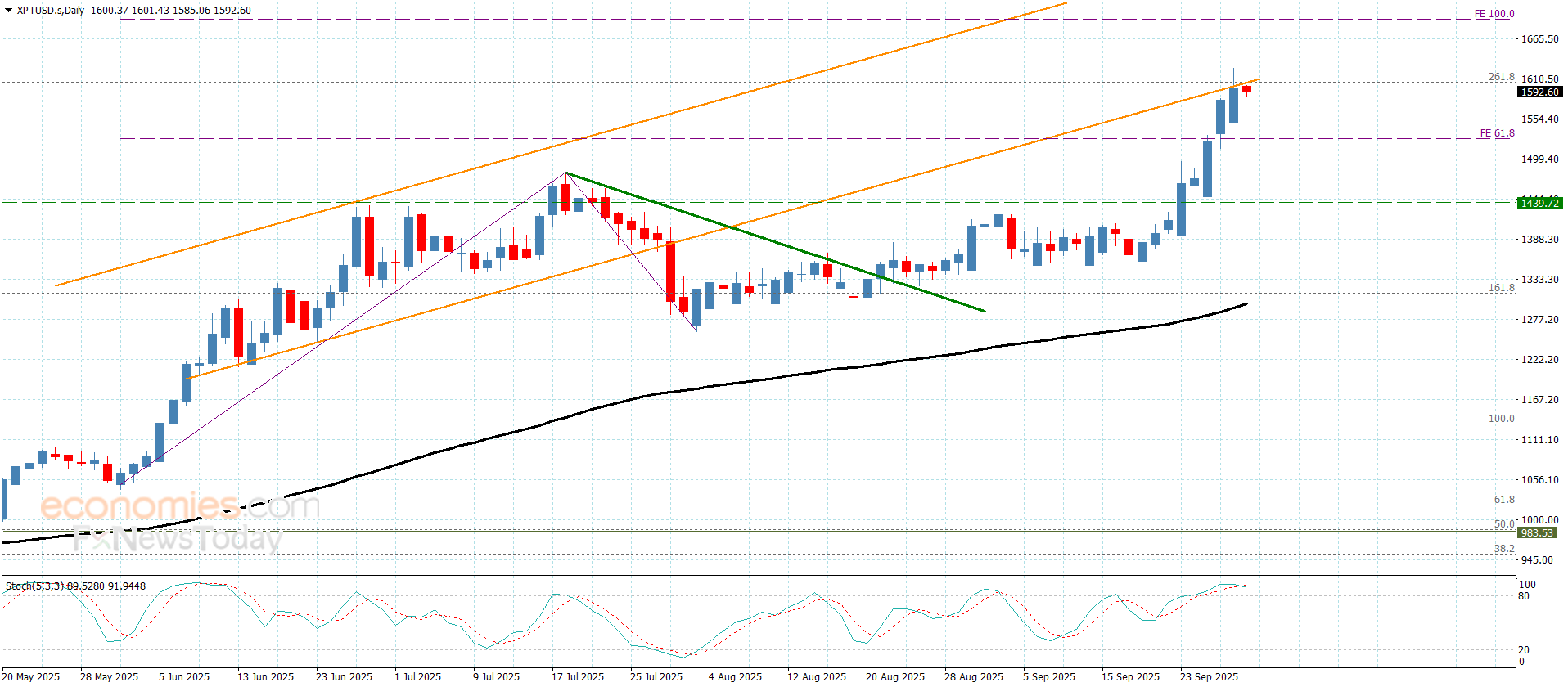
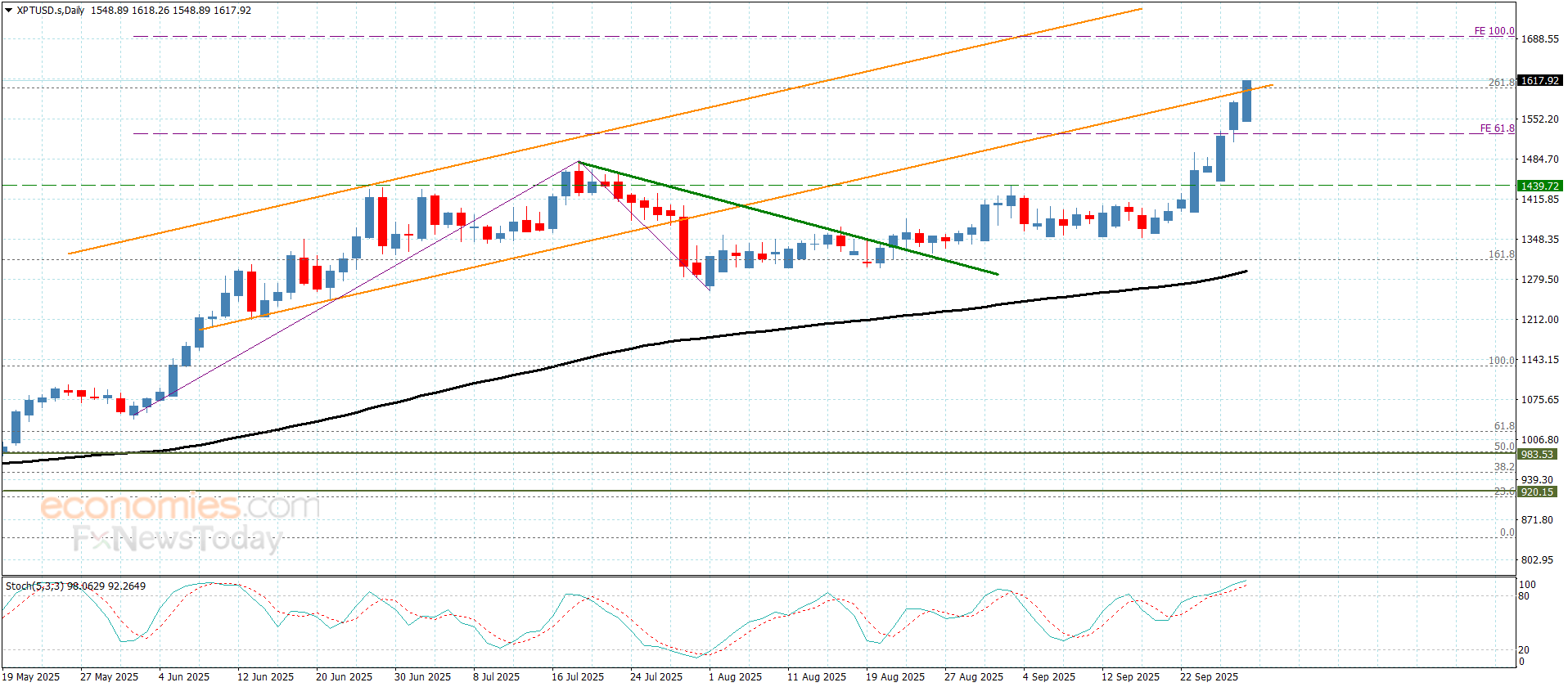
Platinum price reached $1625.00 level in its last rally, then bounces quickly to settle below 261.8%Fibonacci extension level at $1605.00, forming a strong barrier against the attempt of holding within the bullish channel’s levels that appear in the above image.
The price might be force to provide mixed trading, its stability above the extra support near $1525.00 besides the continuation of providing positive momentum by the main indicators will increase the chances for confirm breaching the current barrier, to ease the mission of achieving extra gains that might extend to $1642.00 initially, reaching $1690.000.
The expected trading range for today is between $1565.00 and $1642.00
Trend forecast: Bullish
WTI crude (CL=F) climbed 2.55% to $65.64, while Brent crude (BZ=F) rose 1.51% to $69.18, with gains reinforced by a rebound in Asia’s buying activity. Data showed that Asia’s August crude imports averaged 27.18 million barrels per day, up from July’s year-low of 24.91 million bpd and higher than a year earlier. China and India, which together drive more than a third of global oil demand, boosted imports after prices in May and June dropped into the low $60s per barrel. Opportunistic buying during that dip is now showing up in stronger August arrivals. However, forward flows could tighten again, as cargoes contracted after June’s spike above $80 per barrel during the Israel–Iran war will likely soften September imports.
Urals crude is trading at $62 per barrel, narrowing its discount against Brent, which sits at $69.12. Since the G7’s $60 price cap was introduced in 2022, Urals has defied enforcement, trading above that level on 75% of days thanks to shipments through “dark fleets.” China remains the largest buyer, while Russia has kept its top-supplier position for India despite U.S. sanctions pressure. That dynamic shifted in late August when the U.S. imposed a 50% tariff on Indian imports of Russian oil, effective August 27, after New Delhi refused to scale back purchases. The EU and G7 allies will lower the threshold of the price cap to $46.50 per barrel, but enforcement remains patchy. This geopolitical tug-of-war is adding volatility across the curve, forcing traders to watch not just demand but also policy intervention.
Saudi Arabia faces fiscal strain as Brent crude trades near $69, well below the estimated $90 per barrel price needed to balance its 2025 budget. Oil export revenues in April fell to $16.5 billion, down 21% year-over-year and the weakest in four years, as prices crashed 15% during the U.S. tariff blitz and OPEC+ production hikes. To finance its widening deficit, Riyadh is again tapping debt markets, issuing new tranches of Sukuk bonds. Investors placed $15 billion in orders by midday, showing global demand for Saudi debt remains strong despite oil’s downturn. Brent has lost 8% year-to-date, raising questions about how long Saudi can sustain spending on diversification projects while simultaneously defending market share.
Speculation ahead of the OPEC+ meeting points to a likely rollover of current quotas, with no major cuts expected. The bloc faces a difficult balancing act: U.S. production set a record in 2024 and continues to beat weekly estimates in mid-2025, while Russia is keeping exports strong to Asia. Brent futures at $68.43 for November delivery and WTI October contracts at $64.91 show that markets are anchored in the mid-$60s to high-$60s range, struggling to break higher. The 200-day EMA sits at $62 for WTI and $70.52 for Brent, marking key technical pivot levels. For WTI, a sustained break above $66.50–$67.00 could target $70, while support lies at $62.00. Brent must clear $70.50–$73.00 to escape the consolidation band.
India saved $12.6 billion on its oil import bill this year by leveraging discounted Russian crude, while China has expanded purchases from both Russia and Saudi Arabia. Together, their opportunistic buying strategies amplified August’s rebound in Asian imports. Yet this reliance comes at a geopolitical cost. Trump’s tariffs directly target India’s Russian inflows, and future U.S. policy may pressure Chinese refiners as well. India’s imports from sanctioned suppliers such as Nayara Energy are under scrutiny, with Saudi Arabia and Iraq suspending shipments in response to Western sanctions compliance issues. These disruptions highlight the fragility of Asia’s supply chain, where opportunistic savings clash with policy risks.
Drone strikes forced Sudan to shut down production in the Heglig basin, cutting about 30,000 bpd. Separately, Houthis claimed a missile attack on an Israel-linked oil tanker in the Red Sea, and Russia’s Baltic fuel ports remain impaired after drone damage, extending repairs for months. Syria exported crude for the first time in 14 years, signaling the return of sanctioned barrels. These disruptions underscore how geopolitics are keeping risk premiums alive even as overall supply is abundant. Meanwhile, Russia and China advanced the Power of Siberia-2 pipeline, aiming to add 50 bcm of gas annually to Chinese buyers, reshaping long-term flows in Eurasia.
The structure of oil futures reflects an uneasy balance. WTI (CL=F) rebounded strongly off $62, with intraday highs near $65.80, but resistance remains layered until $70. Brent (BZ=F) at $69.12 faces stiff barriers at $70–$73, where the 200-day EMA is positioned. Gasoline prices rose sharply, up 3.61% to $2.04 per gallon, highlighting refining tightness despite soft crude benchmarks. Mars US crude trades at $71.28, while Bonny Light collapsed 2.84% to $78.62, showing regional disparities. OPEC’s basket held at $69.65, flat on the day. Technical charts still flash consolidation rather than breakout, with RSI readings neutral and traders waiting for clarity from OPEC+ and macro signals like U.S. nonfarm payrolls.
With WTI at $65.64 and Brent at $69.18, the market is caught between opportunistic Asian demand and mounting geopolitical and fiscal risks. Tariffs, sanctions, and OPEC+ caution keep prices capped, while support at $62 for WTI and $68 for Brent prevents deeper selloffs. Oil’s near-term path depends on whether buyers can sustain momentum above technical ceilings or whether renewed oversupply pushes benchmarks back toward spring lows. The geopolitical premium is alive, but structural oversupply remains a ceiling on rallies.
For gold bulls, current price action on the daily chart is nothing short of picture-perfect.
Blasting through multiple key levels throughout 2025, most significantly the $3,000 mark first achieved in early March, gold pricing currently trades in excess of $3,800 per troy ounce for the first time in history, growing ever closer to $4,000.
Having found a base of around $3,250, forming a slight upwards trending channel, price action in early September would break this period of consolidation and mark the start of the current rally, which, at least so far, shows little sign of exhaustion.
With that said, we are currently in ‘overbought’ territory according to the RSI and trade some distance from the trendline, suggesting that short-term retracements are possible if the uptrend wishes to continue.
As ever, data suggesting the Federal Reserve outlook is to become more dovish will likely support metal pricing further, with the opposite being true if the Fed is seen to become more hawkish ahead of their October decision.
In line with Fibonacci theory, here are some key levels to watch:
Bank of America (BofA) raised its forecasts for 2026 and 2027 copper prices amid supply concerns and noted that demand is rebounding in Europe and set to stabilise in China .
The bank raised its copper price outlook for next year to $11,313 per ton from $10,188 and for 2027 to $13,500 per ton from $12,000.
Last week, Freeport-McMoRan declared force majeure at its Grasberg mine in Indonesia and said it is expecting consolidated sales to be lower for copper in the third quarter. Grasberg is the world’s second-largest copper mine after Escondida in Chile.
“The issues at Freeport’s Grasberg mine alone could increase next year’s deficit by 270,000 tons,” said BofA in a note dated Sunday. It added that this year’s mine supply is likely to fall short of nearly every forecast made over the past 15 years.
BofA said its real-time demand tracker shows European demand bottoming out, signalling gradual economic improvement, while demand in top consumer China is expected to stabilise.
Data showed that China’s industrial profits returned to growth in August even as businesses braced for a broader economic slowdown.
The note also flagged that London Metal Exchange warehouses have been running dry for some time, with the shortage worsening as spare tonnages were diverted to the U.S. ahead of expected trade restrictions that ultimately didn’t materialise.
“The tonnages in the U.S. are held under warehouse financing deals, so will in all likelihood only become available, when the market pays up. All this also raises the risk of periodic short squeezes on LME, which could push nearby prices violently higher,” it added.
In July, the U.S. announced a 50% tariff on copper pipes and wiring but details of the levy fell short of the sweeping restrictions expected and left out copper input materials such as ores, concentrates and cathodes.
Benchmark three-month copper HG1! on the LME added 2.3% to $10,411 a metric ton as of 14:21 GMT.
Gold has resumed its record-setting rally, setting off a new week with a bang, as buyers challenge the $3,800 hurdle for the first time ever.
Investors scurry for safety in the traditional store of value, Gold, as fears over a US government shutdown, heading into the first day of the government’s 2026 fiscal year on October 1, intensify, weighing on the demand for the US Dollar (USD).
Traders also remain wary about whether the September US labor market report will be published if the US government shuts down.
Meanwhile, markets pay little attention to an Axios report, citing that US President Donald Trump and his Israeli counterpart Benjamin Netanyahu near a Gaza peace agreement, although Hamas approval seems pending. The report is not yet confirmed by official sources.
Last week, a slew of encouraging US data releases showed the economic resilience, pushing back against expectations of two US Federal Reserve (Fed) interest rate cuts this year.
Markets are now pricing in about 40 basis points (bps) worth of easing by December, according to Refinitiv’s USD interest rate probabilities.
Attention now turns to figures on Job Openings, private payrolls, the ISM Manufacturing and Services PMIs ahead of Friday’s Nonfarm Payrolls (NFP) for further clues on the health of the US economy, which will help reprice markets’ expectations of future Fed rate cuts, in turn, influencing the USD-denominated and non-interest-bearing Gold.
In the meantime, trade and geopolitical headlines will likely drive the Gold price action alongside speeches from Fed officials.
Technically, buyers appear defiant even as the 14-day Relative Strength Index (RSI) moves deeper within the extreme overbought region.
The leading indicator currently trades at 77, pointing north at the start of the week.
Buyers need acceptance above the $3,800 psychological level on a daily closing basis to provide extra legs to the revival of the record rally.
The next topside hurdle is located at the $3,850 barrier.
A sustained and decisive break above the latter could fuel a fresh advance toward the $3,880 region.
On the flip side, initial support is seen at the intraday low of $3,756, below which the September 24 low at $3,718 could offer some comfort to buyers.
Further down, the $3,650 psychological barrier would act as a tough nut to crack for sellers.
Nonfarm Payrolls (NFP) are part of the US Bureau of Labor Statistics monthly jobs report. The Nonfarm Payrolls component specifically measures the change in the number of people employed in the US during the previous month, excluding the farming industry.
The Nonfarm Payrolls figure can influence the decisions of the Federal Reserve by providing a measure of how successfully the Fed is meeting its mandate of fostering full employment and 2% inflation.
A relatively high NFP figure means more people are in employment, earning more money and therefore probably spending more. A relatively low Nonfarm Payrolls’ result, on the either hand, could mean people are struggling to find work.
The Fed will typically raise interest rates to combat high inflation triggered by low unemployment, and lower them to stimulate a stagnant labor market.
Nonfarm Payrolls generally have a positive correlation with the US Dollar. This means when payrolls’ figures come out higher-than-expected the USD tends to rally and vice versa when they are lower.
NFPs influence the US Dollar by virtue of their impact on inflation, monetary policy expectations and interest rates. A higher NFP usually means the Federal Reserve will be more tight in its monetary policy, supporting the USD.
Nonfarm Payrolls are generally negatively-correlated with the price of Gold. This means a higher-than-expected payrolls’ figure will have a depressing effect on the Gold price and vice versa.
Higher NFP generally has a positive effect on the value of the USD, and like most major commodities Gold is priced in US Dollars. If the USD gains in value, therefore, it requires less Dollars to buy an ounce of Gold.
Also, higher interest rates (typically helped higher NFPs) also lessen the attractiveness of Gold as an investment compared to staying in cash, where the money will at least earn interest.
Nonfarm Payrolls is only one component within a bigger jobs report and it can be overshadowed by the other components.
At times, when NFP come out higher-than-forecast, but the Average Weekly Earnings is lower than expected, the market has ignored the potentially inflationary effect of the headline result and interpreted the fall in earnings as deflationary.
The Participation Rate and the Average Weekly Hours components can also influence the market reaction, but only in seldom events like the “Great Resignation” or the Global Financial Crisis.
The EURJPY pair didn’t succeed in reaching the extra positive stations, affected by its neediness to the positive momentum, which forces it to settle below the barrier at 175.20, forming correctional waves by its stability near 174.65.
We expect providing mixed trading due to stochastic attempt to exit the overbought level, but it didn’t affect the main bullish trend, due to the stability of the trading within the bullish channel levels, by forming 173.45 level as an important extra support, therefore, we recommend waiting for breaching the barrier, to open the way for reaching extra positive stations, that are located near 176.00 reaching 176.95.
The expected trading range for today is between 174.20 and 175.20
Trend forecast: Sideways
Copper price began today’s trading with positive action, attempting to renew the pressure on the barrier at $4.7500, to find an exit for resuming the main bullish attack, to expect targeting $4.9500 level reaching the main target at $5.3100.
Note that the continuation of forming extra support by the moving average 55 stability near $4.3700, besides stochastic attempt to provide bullish momentum, these factors support the bullish suggestion, to keep waiting for achieving the suggested targets.
The expected trading range for today is $4.5500 and $4.9500
Trend forecast: Bullish
The Gold price (XAU/USD) extends its upside above $3,750 during the early Asian session on Monday. The precious metal edges higher after the US inflation data came in line with expectations, reinforcing bets that the US Federal Reserve (Fed) may continue with interest rate cuts later this year. Lower interest rates could reduce the opportunity cost of holding Gold, supporting the non-yielding precious metal. Additionally, geopolitical uncertainty could boost demand for safe-haven assets like Gold.
Traders will keep an eye on the Fedspeak later on Monday. Fed Governor Christopher Waller, Cleveland Fed President Beth Hammack, St. Louis Fed President Alberto Musalem, New York Fed President John Williams and Atlanta Fed President Raphael Bostic are set to speak. Any hawkish comments from Fed officials might lift the US Dollar (USD) and undermine the USD-denominated commodity price.
Gold price trades in positive territory on the day. The bullish tone of the precious metal remains intact in the longer term, with the price holding above the key 100-day Exponential Moving Average (EMA) on the daily chart. Nonetheless, the 14-day Relative Strength Index (RSI) stands above the midline near 75.90, indicating the overbought RSI condition. This suggests that further consolidation or a temporary sell-off cannot be ruled out before positioning for any near-term Gold upleg.
The crucial resistance level for XAU/USD is seen in the $3,800-$3,810 zone, representing the psychological level and the upper boundary of the Bollinger Band. Sustained trading above this level could take the yellow metal to $3,850.
On the downside, the initial support level for Gold is located at $3,722, the low of September 25. Red candlesticks closing below the mentioned level could expose $3,632, the low of September 19.
Monetary policy in the US is shaped by the Federal Reserve (Fed). The Fed has two mandates: to achieve price stability and foster full employment. Its primary tool to achieve these goals is by adjusting interest rates.
When prices are rising too quickly and inflation is above the Fed’s 2% target, it raises interest rates, increasing borrowing costs throughout the economy. This results in a stronger US Dollar (USD) as it makes the US a more attractive place for international investors to park their money.
When inflation falls below 2% or the Unemployment Rate is too high, the Fed may lower interest rates to encourage borrowing, which weighs on the Greenback.
The Federal Reserve (Fed) holds eight policy meetings a year, where the Federal Open Market Committee (FOMC) assesses economic conditions and makes monetary policy decisions.
The FOMC is attended by twelve Fed officials – the seven members of the Board of Governors, the president of the Federal Reserve Bank of New York, and four of the remaining eleven regional Reserve Bank presidents, who serve one-year terms on a rotating basis.
In extreme situations, the Federal Reserve may resort to a policy named Quantitative Easing (QE). QE is the process by which the Fed substantially increases the flow of credit in a stuck financial system.
It is a non-standard policy measure used during crises or when inflation is extremely low. It was the Fed’s weapon of choice during the Great Financial Crisis in 2008. It involves the Fed printing more Dollars and using them to buy high grade bonds from financial institutions. QE usually weakens the US Dollar.
Quantitative tightening (QT) is the reverse process of QE, whereby the Federal Reserve stops buying bonds from financial institutions and does not reinvest the principal from the bonds it holds maturing, to purchase new bonds. It is usually positive for the value of the US Dollar.
Gold (XAU/USD) continues its historic 2025 surge, climbing 43% year-to-date and trading near $3,760 per ounce, putting bullion on track for its strongest year since 1979. Futures briefly tested $3,791.26, just shy of a fresh record, while intraday support remains firm at $3,709.61. Momentum has been relentless, with inflows into global ETFs surpassing $10.5 billion in September alone, and cumulative allocations exceeding $50 billion year-to-date. On a structural level, central bank demand has created a durable price floor, with official sector buying estimated at 1,000 metric tons in 2025, following a record 1,086 tons in 2024.
Global monetary authorities are reshaping the gold market. China has now expanded reserves for the 10th consecutive month, bringing holdings to nearly 74 million ounces, while Russia, India, and Turkey remain consistent buyers. Central banks account for 25% of annual demand, a level unseen in modern history, transforming gold from a tactical hedge into a strategic reserve asset. This “de-dollarization” trend reflects a shift away from U.S. Treasuries, with countries seeking sanction-resistant stores of value. Strategically, this behavior cements $3,600–$3,700 as a structural floor, as central banks repeatedly intervene during corrections.
The Fed’s September 25 bps rate cut provided a fresh impulse to bullion. According to CME FedWatch, traders price in an 88% probability of another cut in October and 65% odds in December. Even with August core PCE inflation at 2.9% year-over-year and GDP growth at 3.8%, investors are betting on further easing. The U.S. Dollar Index (DXY) remains resilient at 98.18, but real yields are sliding, with the 10-year Treasury holding at 4.18% and real yields at 1.80%. This macro backdrop bolsters gold, as the opportunity cost of holding non-yielding assets declines.
Alongside central bank support, investment flows have reached historic levels. Global ETF holdings climbed above 3,615 tons this year, while silver ETFs added 95 million ounces in H1 2025. Retail appetite is just as aggressive: India’s domestic gold price surged to a record ₹110,666 per 10g (approx. $3,800/oz), while imports jumped 37% in August to $5.4 billion. Local jewelers report a drying scrap supply as households refuse to sell, anticipating higher prices. In the U.S., Costco’s gold bars sell out in hours, and physical coin demand remains elevated. These signals reflect a broad, sticky bid across investor segments.
Gold’s advance is further reinforced by geopolitics. The Russia-Ukraine war continues to disrupt energy markets, while fresh U.S. tariffs — including 100% on pharmaceuticals and 40% on furniture imports — add to uncertainty. China’s green energy commitments are also reshaping demand: silver surged 14% YTD, reaching $46 per ounce, as solar manufacturing intensified. Platinum gained 50% in 2025, climbing above $1,568, its highest in 12 years, while palladium rose above $1,280. Investors are now treating bullion and its peers as systemic hedges, with analysts noting that each new conflict or tariff shock sends fresh inflows into gold.
From a charting perspective, gold remains in a strong bullish channel. A breakout above $3,791.26 would open the path to $3,879.64, while failure to hold $3,709.61 support risks a pullback toward $3,627.96. Momentum oscillators remain stretched: RSI sits near 78, signaling overbought conditions, but price action has repeatedly consolidated in bullish flags rather than topping patterns. The 200-day SMA at $3,648 reinforces a rising long-term floor, while sentiment remains far from euphoric, suggesting further upside before speculative exhaustion sets in.
Wall Street remains broadly bullish. Goldman Sachs targets $3,700 for 2025 year-end and $4,000+ in 2026, while OCBC Bank expects $3,900 by year-end. RBC strategist Nicholas Frappell and Metals Focus’s Philip Newman both highlight $3,800 as a base case with upside toward $4,000 in 2026. Longer-dated calls stretch further: forecasts for 2029–2030 range from $5,000 to $7,000 per ounce, premised on sustained central bank buying, weaker fiat credibility, and geopolitical fragmentation.
The convergence of record central bank buying, ETF inflows, persistent inflation above 2.5%, and structural supply stagnation at ~4,000 tons annually creates a rare alignment for gold. With spot gold at $3,760 and technicals pointing toward $3,879–$4,000, the market retains strong bullish momentum. Risks of corrective dips remain, but structural demand support from sovereigns and institutions suggests these dips will be shallow. Based on current evidence, gold (XAU/USD) is firmly a Buy, with year-end targets clustered between $3,850–$3,950, and potential overshoots above $4,000 if U.S. jobs data and Fed cuts align in October–December.
Important DisclaimersThe content provided on the website includes general news and publications, our personal analysis and opinions, and contents provided by third parties, which are intended for educational and research purposes only. It does not constitute, and should not be read as, any recommendation or advice to take any action whatsoever, including to make any investment or buy any product. When making any financial decision, you should perform your own due diligence checks, apply your own discretion and consult your competent advisors. The content of the website is not personally directed to you, and we does not take into account your financial situation or needs.The information contained in this website is not necessarily provided in real-time nor is it necessarily accurate. Prices provided herein may be provided by market makers and not by exchanges.Any trading or other financial decision you make shall be at your full responsibility, and you must not rely on any information provided through the website. FX Empire does not provide any warranty regarding any of the information contained in the website, and shall bear no responsibility for any trading losses you might incur as a result of using any information contained in the website.The website may include advertisements and other promotional contents, and FX Empire may receive compensation from third parties in connection with the content. FX Empire does not endorse any third party or recommends using any third party’s services, and does not assume responsibility for your use of any such third party’s website or services.FX Empire and its employees, officers, subsidiaries and associates, are not liable nor shall they be held liable for any loss or damage resulting from your use of the website or reliance on the information provided on this website.Risk DisclaimersThis website includes information about cryptocurrencies, contracts for difference (CFDs) and other financial instruments, and about brokers, exchanges and other entities trading in such instruments. Both cryptocurrencies and CFDs are complex instruments and come with a high risk of losing money. You should carefully consider whether you understand how these instruments work and whether you can afford to take the high risk of losing your money.FX Empire encourages you to perform your own research before making any investment decision, and to avoid investing in any financial instrument which you do not fully understand how it works and what are the risks involved.