The main tag of GoldPrice Articles.
You can use the search box below to find what you need.
[wd_asp id=1]
The main tag of GoldPrice Articles.
You can use the search box below to find what you need.
[wd_asp id=1]
Gold prices continued their advance this week with spot bullion settling at $3,778.62 per ounce, up nearly 0.8% on Friday and closing just shy of the record intraday high of $3,791.26 earlier in the week. December gold futures also climbed 1% to $3,809, extending weekly gains of 2.1%. The strength came as the U.S. PCE index rose 2.7% year-over-year in August, in line with expectations, cementing investor conviction that the Federal Reserve will proceed with at least one rate cut before year-end. The CME FedWatch tool now implies an 88% probability of a cut in October and 65% odds of a second in December, keeping bullion well bid against a backdrop of steady inflation and moderate income growth.
The latest macro data left the Fed with optionality but not urgency. Core PCE increased 0.2% month-on-month and 2.9% annually, providing enough justification for easing while confirming inflation’s stickiness above target. Bond markets stayed muted, with the 10-year Treasury yield at 4.16% and the 30-year at 4.74%, showing that fixed income investors are awaiting labor market confirmation. As long as yields remain capped and rate cuts stay in play, the environment remains supportive for gold, allowing XAU/USD to defend elevated levels near $3,770 despite a stronger U.S. dollar earlier in the week.
While ETF inflows remain strong, physical buying has weakened. China’s gold imports dropped 34% in August compared to the prior month, while Hong Kong’s net imports collapsed 39% to just 27 tons. Dealers in Shanghai and Hong Kong are now offering discounts ranging from $21 to $36 per ounce, the steepest since May 2020, as local buyers balk at near-$3,800 pricing. This softening in Asian demand is creating a stark divergence between Western financial flows into ETFs and real-world jewelry and retail consumption in Asia, historically the backbone of the gold market. If prices remain pinned near all-time highs, the risk of further erosion in physical demand looms.
On the technical front, gold remains trapped in a narrow band between support and record resistance. Spot XAU/USD has tested $3,791.26 multiple times without a confirmed breakout. A sustained push above that level opens the door toward $3,879.64, the next Fibonacci extension, and potentially $3,915. Conversely, immediate downside support sits at $3,730, with a deeper safety net near $3,712 tied to the 50% retracement of the September leg higher. A close below $3,712 risks a correction toward $3,693, unwinding nearly two weeks of bullish momentum. The RSI at 57 signals neutral positioning, while candlestick rejection at highs indicates fading conviction from momentum traders.
Despite softness in Asia, Western demand remains resilient. Global ETFs linked to gold continue to see inflows, positioning bullion as both a hedge against dollar volatility and a store of value amid tariff uncertainty. Revised U.S. GDP growth at 3.8% annualized in Q2 and the Atlanta Fed’s Q3 tracker at 3.9% show that economic expansion is holding, complicating the Fed’s rate path. Still, investors have poured into gold as a counterweight to equities trading at stretched 22.5x forward earnings, above both the five- and ten-year averages. With central banks maintaining net purchases and M2 money supply growth re-accelerating to 6% globally, gold retains structural support from liquidity-driven flows.
The immediate battle sits between $3,730 and $3,791. Holding above $3,730 keeps gold in a consolidation phase with breakout potential, while a decisive push through $3,791 sets up acceleration to $3,879 and beyond. The physical demand drop in China is a near-term drag, but institutional ETF inflows and dovish Fed expectations outweigh retail softness. For now, XAU/USD is a Hold in the short-term range, but with structural liquidity, Fed easing, and central bank buying as backstops, the long-term outlook remains bullish, targeting $3,900+ into 2026.
The EURJPY pair failed to resume the bullish attack, due to its stability below %1.809 Fibonacci extension level, forming an extra barrier at 175.20, providing sideways trading since yesterday by its stability near 174.85.
Reminding you that the bullish scenario will remain valid, due to the stability within the bullish channel’s levels besides the continuation of forming an initial support at 173.40 level, which makes us wait for breaching the current barrier to ease the mission of recording extra gains that might begin at 176.00 and 176.95.
The expected trading range for today is between 174.20 and 175.20
Trend forecast: Sideways until achieving the breach
The price of gold (XAU/USD) has stormed to unprecedented levels, with futures trading at $3,809.60 per ounce, up 1.02% intraday, after opening at $3,781.50. That marks a 45% gain since January, making gold the best-performing asset of 2025, ahead of both the Magnificent 7 tech stocks and Bitcoin (BTC-USD). For the first time in modern history, gold has surpassed its 1980 inflation-adjusted peak, a landmark that underscores just how intense the rush for safety has become amid wars, tariffs, and sticky inflation. Over the past year alone, prices have soared 42% from $2,662 per ounce. On a monthly horizon, gold is up nearly 12% since late August, when it traded near $3,379.
The primary driver of the rally has been sovereign demand. Central banks now hold more gold than Treasuries for the first time since 1996, and gold has overtaken the euro as the world’s second-most held reserve asset. Purchases have more than doubled compared to the previous decade. Russia, China, and India continue to accumulate as hedges against dollar dominance, but the standout in 2025 is Poland, which has added 67 tonnes this year, nearly doubling its reserves in three years. This leaves Warsaw holding more bullion than the European Central Bank itself. Unlike previous cycles, many emerging markets are buying directly from domestic miners instead of the OTC market, reducing reliance on U.S. dollars. This structural shift shows governments are determined to build resilience after sanctions on Russia’s reserves in 2022 reshaped attitudes toward financial sovereignty.
Geopolitical catalysts amplified gold’s surge this week. President Trump unveiled fresh tariffs ranging from 25% to 100% on pharmaceuticals, heavy trucks, and furniture imports, effective October 1. Branded pharma drugs face the harshest treatment with a full 100% levy unless manufacturing shifts to U.S. plants. Trucks and furniture will be taxed at 25–50%, while reports suggest chipmakers may also face penalties if production remains offshore. These measures rattled equity markets and underscored gold’s safe-haven status, driving prices from Thursday’s $3,736.90 close to Friday’s intraday high of $3,819.60.
The rally has coincided with the release of the Fed’s preferred inflation gauge, the PCE index, which came in at 2.7% annually and 2.9% core — right on target but the highest in seven months. Monthly gains of 0.3% suggest inflation is not collapsing, but investors still expect rate cuts later this year. The Fed has already priced in at least one more 25 bps reduction, though Danske Bank warned that sticky inflation could pressure policymakers. Yields on the 10-year Treasury sit near 4.18%, while the dollar index is weakening, adding to the bullish environment for gold.
Despite gold’s record-setting run, ETF flows remain muted compared to crypto. U.S. Bitcoin ETFs account for about 7% of BTC’s total market cap, while gold ETFs represent less than 1% of bullion’s market capitalization. North American gold ETFs just posted their strongest inflows since March 26, but the comparison with crypto suggests room for more institutional adoption. Commodity strategists argue that if ETF allocations to gold rise to even half of Bitcoin’s ratio, another surge beyond $4,000 per ounce becomes plausible.
Technically, December gold futures show strong momentum, with Wyckoff’s Market Rating at 8.5 out of 10. Resistance is set at $3,824.60 and then $3,900, while immediate support lies at $3,749.70 and $3,718.10. A sustained close above $3,800 unlocks the path to retest $3,900, with upside momentum potentially extending to $4,000. On the downside, bears would need to drag futures under $3,650 to regain control, a scenario that currently looks unlikely given both macro support and sovereign demand. Silver (SI=F) is also confirming the metals rally, climbing to $45.35 with a Wyckoff rating of 9.0, and eyeing resistance at $47.50.
Alongside central bank accumulation, private demand is expanding rapidly. Inflows into gold-backed ETFs have accelerated, and retail access points are broadening. Costco (NASDAQ: COST) now sells not just gold bars but also silver and platinum coins, attracting mainstream investors who want convenient exposure. The club retailer’s sales mirror broader sentiment: headlines about record prices are pulling in new buyers, reinforcing the feedback loop that drives gold higher.
Some analysts note that even at $3,800, gold may be undervalued relative to Bitcoin when comparing reserve ratios and ETF penetration. Gold remains under-owned by retail compared to crypto, suggesting that mainstream FOMO has not yet fully arrived. Bank of America’s survey ranks gold the second most crowded trade after the Mag 7, but whether this represents the first inning of institutional participation or the ninth remains contested.
With gold futures at $3,809.60 and spot levels near $3,800, the metal has cemented itself as the best-performing major asset of 2025. Central banks are stockpiling, tariffs are escalating, inflation remains elevated, and retail access is broadening. Support zones around $3,750 are holding firm, while technical upside targets point toward $3,900–$4,000. Despite talk of crowded positioning, ETF inflows remain far below crypto’s scale, leaving scope for more buying pressure. Based on the breadth of these catalysts, XAU/USD is a Buy, though traders should expect turbulence around resistance as profit-taking collides with sovereign and institutional demand.
The rally continues to confront resistance between $3,782 and $3,812, where at least five indicators converge. While Friday’s move suggests a continuation of the broader uptrend, momentum is visibly slowing. Price could still extend toward the upper boundary of the zone, but traders are closely watching how gold reacts within this cluster of resistance levels.
A decisive breakout above $3,812 would open the door to higher projections. The most notable is a 261.8% extension of the large ABCD pattern at $3,896, derived from a harmonic relationship of two rising measured moves. Further up is a confluence zone from $3,982 to $3,998. That would be the next next key target zone, though it remains distant unless bullish momentum strengthens meaningfully.
Despite price strength, momentum indicators flash caution. The Relative Strength Index (RSI) shows a bearish divergence, with price at new highs but momentum failing to confirm. This divergence, alongside current resistance near the top boundary of a rising trend channel, suggests upside breakouts may struggle to sustain without consolidation.
Initial support rests at today’s low of $3,734, followed by the 10-Day moving average at $3,712. More significant is the 20-Day line at $3,650, reinforced by the broader structure of the channel. A drop below these levels would increase the likelihood of a deeper retracement, potentially signaling that gold’s rally has overextended in the short run.
For now, the trend remains bullish with buyers holding the upper hand, and the record close this week reflects robust demand. Yet weakening momentum and proximity to key resistance levels warrant caution. Until price either breaks decisively above $3,812 or drops under $3,712, gold’s next directional move remains a contest between sustained buying and the risk of correction.
For a look at all of today’s economic events, check out our economic calendar.
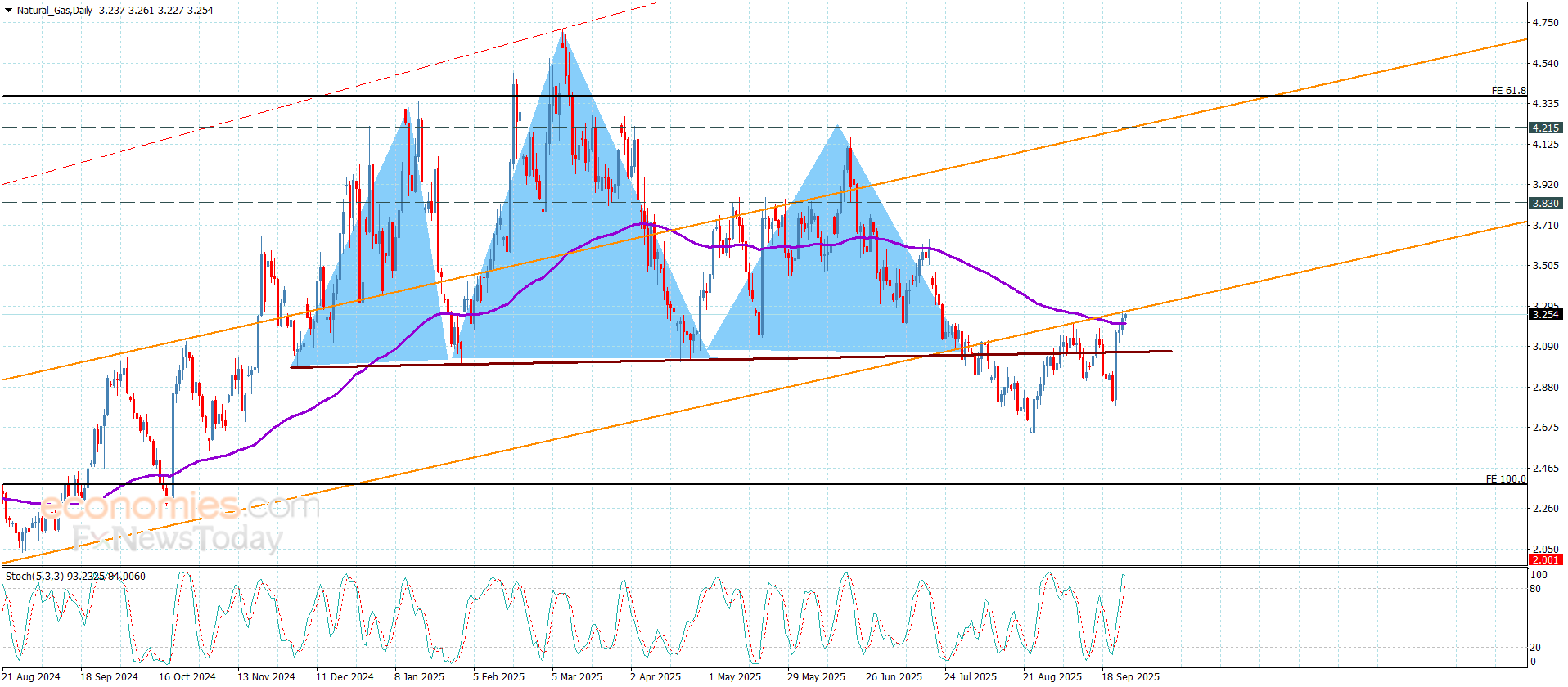
The $3.35 price level carries added weight given that it coincides with the intersection of two significant trendlines — one rising and one falling. Should the market sustain strength through this zone, attention will naturally shift to the next confluence zone, around the 200-Day moving average at $3.49 and the 127.2% Fibonacci projection of the ABCD pattern at $3.51. The alignment of these levels suggests that if buyers can maintain momentum above $3.35, the path toward $3.49–$3.51 will become increasingly viable.
Another bullish development was the 20-Day moving average crossing above the 50-Day line, strengthening the short-term trend outlook. A daily close above either the rising or falling trendline near $3.35 would further validate this momentum shift, likely followed by additional signs of growing demand. On the downside, a healthy pullback could see price revisit the cluster of moving averages between $2.98 and $3.00, where the 10-Day, 20-Day, and 50-Day averages converge. That zone now represents a significant support area and could offer the foundation for a renewed leg higher once buyers return.
On the weekly timeframe, natural gas is on track to close above last week’s high of $3.17, establishing a bullish outside week reversal. Importantly, this week’s price range also encompasses the ranges of the prior three weeks, emphasizing the strength of the move and signaling a clear shift in momentum. This type of price action often precedes sustained advances, particularly when accompanied by improving moving average alignment and strengthening channel dynamics.
Overall, natural gas is showing early signs of turning the corner. A sustained breakout above $3.35 would not only confirm the rising ABCD pattern but also set the stage for a test of the longer-term resistance zone around $3.49–$3.51. Until then, traders will watch for whether the higher swing low established earlier this week holds, as that would further solidify the bullish reversal narrative.
For a look at all of today’s economic events, check out our economic calendar.
3M Company (MMM) declined in recent intraday trading, breaking below a short-term rising trend line. This drop was accompanied by a move under the 50-day SMA, intensifying the negative pressure on the stock. Additional weakness is evident from bearish signals on the RSI, signaling the beginning of a corrective bearish wave in the near term.
Therefore, we expect the stock to extend its decline in upcoming sessions, as long as resistance holds at 159.00, targeting the first support level at 150.40.
Today’s price forecast: Bearish.
Gold is back on its corrective journey below $3,750 in Friday’s Asian trades, after having staged a tepid bounce on Thursday. All eyes now remain on the US core Personal Consumption Expenditures (PCE) Price Index due later in the day for a fresh directional impetus.
Reduced bets for aggressive interest rate cuts by the US Federal Reserve (Fed) this year offset renewed jitters fuelled by US President Donald Trump’s latest round of tariffs, helping the US Dollar (USD) holds its recent uptrend at the expense of Gold.
Encouraging US data released on Thursday highlighted the economic resilience, pouring cold water on aggressive Fed easing expectations.
US Gross Domestic Product rose by an upwardly revised rate of 3.8% from April through June, higher than 3.3% initially reported.
Meanwhile, the Labour Department reported 218,000 seasonally adjusted filings for the week ending September 20, down 14,000 from the prior week’s upwardly revised figure and below the consensus estimate of 235,000.
Additionally, Durable Goods Orders rebounded firmly by 2.9% in August versus the previously revised -2.7% and -0.5% expected.
Trump on Thursday announced tariffs of up to 100% on imports of branded and patented pharmaceutical drugs, starting October 1. Trump also slapped 50% tariffs on imports of kitchen cabinets and bathroom vanities, 30% on upholstered furniture, and 25% on heavy trucks.
Markets weigh the latest Trump’s tariffs, while gearing up for the critical US PCE inflation data due later this Friday. The data will confirm whether the Fed will remain on track for two rate cuts this year.
The Fed’s preferred inflation measure, the core PCE Price Index, is expected to rise by 2.9% in August, at the same pace seen in July. The headline annual PCE inflation is set to tick higher to 2.7% in the same period, against July’s 2.6%.
An upside surprise to the core PCE print could bolster the USD rally and weigh further on the non-interest-bearing Gold price. A sudden increase in price pressure could further temper expectations of more Fed cuts.
On the other hand, a softer-than-expected US core PCE reading would be welcomed by the Fed
In the lead-up to the US PCE showdown, the FXStreet Fed Sentiment Index extends its foothold in the hawkish zone, trading near 114 as of writing, up from around 105 levels seen a day ago.
Technically, the bearish pressures seem to have eased a bit as the 14-day Relative Strength Index (RSI) moves out of the extreme overbought region.
The leading indicator currently trades at 71.50, down from 78 levels seen at the start of the week.
If the pullback regains momentum, the initial support is seen at the $3,700 threshold, below which Monday’s low of $3,684 will offer some comfort.
Further down, the $3,650 psychological barrier could come to the rescue of buyers.
On the other hand, buyers need acceptance above the $3,750 psychological level to revive the record rally.
The next topside hurdle is located at the lifetime high of $3,791, followed by the $3,800 barrier.
A sustained and decisive break above the latter could fuel a fresh advance toward the $3,850 psychological level.
Inflation measures the rise in the price of a representative basket of goods and services. Headline inflation is usually expressed as a percentage change on a month-on-month (MoM) and year-on-year (YoY) basis. Core inflation excludes more volatile elements such as food and fuel which can fluctuate because of geopolitical and seasonal factors. Core inflation is the figure economists focus on and is the level targeted by central banks, which are mandated to keep inflation at a manageable level, usually around 2%.
The Consumer Price Index (CPI) measures the change in prices of a basket of goods and services over a period of time. It is usually expressed as a percentage change on a month-on-month (MoM) and year-on-year (YoY) basis. Core CPI is the figure targeted by central banks as it excludes volatile food and fuel inputs. When Core CPI rises above 2% it usually results in higher interest rates and vice versa when it falls below 2%. Since higher interest rates are positive for a currency, higher inflation usually results in a stronger currency. The opposite is true when inflation falls.
Although it may seem counter-intuitive, high inflation in a country pushes up the value of its currency and vice versa for lower inflation. This is because the central bank will normally raise interest rates to combat the higher inflation, which attract more global capital inflows from investors looking for a lucrative place to park their money.
Formerly, Gold was the asset investors turned to in times of high inflation because it preserved its value, and whilst investors will often still buy Gold for its safe-haven properties in times of extreme market turmoil, this is not the case most of the time. This is because when inflation is high, central banks will put up interest rates to combat it.
Higher interest rates are negative for Gold because they increase the opportunity-cost of holding Gold vis-a-vis an interest-bearing asset or placing the money in a cash deposit account. On the flipside, lower inflation tends to be positive for Gold as it brings interest rates down, making the bright metal a more viable investment alternative.
The EURJPY pair failed to resume the bullish attack, due to its stability below %1.809 Fibonacci extension level, forming an extra barrier at 175.20, providing sideways trading since yesterday by its stability near 174.85.
Reminding you that the bullish scenario will remain valid, due to the stability within the bullish channel’s levels besides the continuation of forming an initial support at 173.40 level, which makes us wait for breaching the current barrier to ease the mission of recording extra gains that might begin at 176.00 and 176.95.
The expected trading range for today is between 174.20 and 175.20
Trend forecast: Sideways until achieving the breach
The (silver) price declined in its last intraday trading, after reaching $44.80 resistance, which represents our expected target in our last forecast, due to the stability of this resistance the price declined to gather the gains of its previous rises, to attempt to gain bullish momentum that might help to breach it and resuming the rise, amid the continuation of the positive pressure that comes from its trading above EMA50, and under the dominance of the main bullish trend on the short-term basis and its trading alongside trendline, besides the emergence of the positive signals on the relative strength indicators, despite reaching overbought levels.
Get high-accuracy trading signals delivered directly to your Telegram. Subscribe to specialized packages tailored for the world’s top markets:
Full VIP signals performance report for September 15–19, 2025:
The (ETHUSD) price rose in its last intraday trading, after breaking the critical support at $4,100, amid the dominance of the main bearish trend on the short-term basis and its trading alongside minor trendline, indicating the big volume of the negative momentum, with the continuation of the negative pressure that comes from its trading below EMA50, attempting to recover its previous losses, and attempting to offload some of its clear oversold conditions on the relative strength indicators, especially with the emergence of the positive signals.
Get high-accuracy trading signals delivered directly to your Telegram. Subscribe to specialized packages tailored for the world’s top markets:
Full VIP signals performance report for September 15–19, 2025: