The main tag of GoldPrice Articles.
You can use the search box below to find what you need.
[wd_asp id=1]
The main tag of GoldPrice Articles.
You can use the search box below to find what you need.
[wd_asp id=1]
Gold price (XAU/USD) trades in positive territory around $3,750 during the early Asian session on Thursday. The precious metal edges higher amid expectations of further US rate cuts from the Federal Reserve (Fed) this year and persistent geopolitical risks.
The Fed cut its benchmark interest rate by 25 basis points (bps) at its September meeting, bringing the Federal Funds Rate to a target range of 4.00% to 4.25%. A Summary of Economic Projections (SEP), or ‘dot-plot’, showed that the median Fed policymakers expect two more rate reductions before the end of 2025, and one more in 2026. Lower interest rates could reduce the opportunity cost of holding Gold, supporting the non-yielding precious metal.
Furthermore, geopolitical uncertainty boosted demand for safe-haven assets like Gold. NATO warned Russia on Tuesday that it would use “all necessary military and non-military tools” to defend itself as it condemned Moscow for violating Estonian airspace in “a pattern of increasingly irresponsible behaviour”.
On the other hand, cautious remarks from Fed Chair Jerome Powell about the timing of the next cut in US interest rates might cap the upside for the yellow metal. Powell said on Tuesday that the US central bank would continue to balance concerns over labour market weakness with worries about inflation, while Fed officials took stances on both sides of the monetary policy path divide.
Gold has played a key role in human’s history as it has been widely used as a store of value and medium of exchange. Currently, apart from its shine and usage for jewelry, the precious metal is widely seen as a safe-haven asset, meaning that it is considered a good investment during turbulent times. Gold is also widely seen as a hedge against inflation and against depreciating currencies as it doesn’t rely on any specific issuer or government.
Central banks are the biggest Gold holders. In their aim to support their currencies in turbulent times, central banks tend to diversify their reserves and buy Gold to improve the perceived strength of the economy and the currency. High Gold reserves can be a source of trust for a country’s solvency. Central banks added 1,136 tonnes of Gold worth around $70 billion to their reserves in 2022, according to data from the World Gold Council. This is the highest yearly purchase since records began. Central banks from emerging economies such as China, India and Turkey are quickly increasing their Gold reserves.
Gold has an inverse correlation with the US Dollar and US Treasuries, which are both major reserve and safe-haven assets. When the Dollar depreciates, Gold tends to rise, enabling investors and central banks to diversify their assets in turbulent times. Gold is also inversely correlated with risk assets. A rally in the stock market tends to weaken Gold price, while sell-offs in riskier markets tend to favor the precious metal.
The price can move due to a wide range of factors. Geopolitical instability or fears of a deep recession can quickly make Gold price escalate due to its safe-haven status. As a yield-less asset, Gold tends to rise with lower interest rates, while higher cost of money usually weighs down on the yellow metal. Still, most moves depend on how the US Dollar (USD) behaves as the asset is priced in dollars (XAU/USD). A strong Dollar tends to keep the price of Gold controlled, whereas a weaker Dollar is likely to push Gold prices up.
Russian refining capacity has been heavily disrupted by Ukrainian drone strikes, with Energy Aspects estimating up to 1 million barrels per day knocked offline. OilX and Vortexa project diesel exports this month will slump to their lowest in five years. Moscow has already maintained a gasoline export ban through most of 2025, citing refinery constraints and domestic financing shortages. While diesel exports have not been formally capped, the physical shortfall is tightening European product balances and sustaining crack spreads above seasonal norms. The result is higher margins for refiners globally and a key factor behind Brent’s resilience above $68.
Turkey’s state energy firm BOTAS secured a 20-year LNG supply contract with Mercuria, committing to roughly 70 bcm of U.S. LNG through 2045. A separate nine-year agreement with Australia’s Woodside adds 5.8 bcm of LNG starting in 2030. These deals reduce Ankara’s dependence on Russian pipeline flows and set the foundation for Turkey to become a European LNG hub. The shift carries long-term consequences for oil-linked gas pricing, eroding Gazprom’s influence and bolstering U.S. export demand. While LNG is not crude, the pivot reshapes energy flows in Europe and adds to geopolitical pressure on Russian oil exports.
Fed Chair Jerome Powell warned that U.S. equity valuations appear “fairly highly valued,” pushing the DXY dollar index to 97.30. The stronger dollar normally weighs on crude, but despite the currency move, both WTI and Brent held firm. This highlights how near-term oil price formation is being driven primarily by physical balances and supply disruptions rather than macro sentiment alone. Traders warn, however, that continued dollar strength could limit Brent’s ability to breach $70 convincingly.
Technically, WTI crude has reclaimed the 50-day EMA at $64.50 and is approaching the $66.00 resistance band. A daily close above $66 could open momentum toward $68, while downside protection sits at $62 and then $60. Brent crude faces a similar setup, with the $69–$70 zone acting as a ceiling. A breakout would clear the way to $72, while $65 remains the critical floor. Indicators confirm improving momentum, with RSI recovering above 50 and MACD signaling a potential bullish crossover.
Geopolitical narratives continue to shape sentiment. President Trump stated at the U.N. that Ukraine’s battlefield performance has “surpassed expectations,” fueling speculation of harsher sanctions on Russian energy. OPEC+ supply is also shifting—Kuwait increased output to 3.2 million barrels per day, its highest in a decade, offsetting some Russian shortfalls. Iraq, too, has been ramping exports as OPEC+ gradually rolls back earlier cuts. This balancing act between OPEC+ increases and Russian constraints defines the push-pull dynamic currently holding crude in the mid-$60s to high-$60s range.
Deals across the energy sector reinforce confidence in elevated pricing. Petrobras awarded TechnipFMC subsea contracts worth $75–$250 million to bolster offshore production. Sempra Energy sold a $10 billion infrastructure stake to KKR, while Exxon and Petrobras jointly challenged a $4.6 billion merger in Brazil’s subsea sector. These moves show upstream and midstream players are positioning aggressively for a decade of resilient oil demand, underscoring why crude prices are finding strong structural support despite recessionary concerns.
With WTI at $64.77 and Brent at $69.00, both benchmarks are trading near critical resistance but remain underpinned by inventory draws, delayed Kurdish flows, and Russian export disruptions. Technicals point to upside toward $70–$72 for Brent and $66–$68 for WTI if momentum holds. The downside remains cushioned by $62 support for WTI and $65 for Brent. Considering the tightening fundamentals and geopolitical backdrop, the balance of risk favors a Buy stance on crude benchmarks, with near-term upside stronger than downside risk into October.
Gold prices retreated from record highs on Wednesday, now changing hands near an intraday low of $3,749.63. The US Dollar (USD) found near-term demand as Federal Reserve (Fed) Chair Jerome Powell commented on monetary policy on Tuesday. His words had no immediate impact on financial markets, but as investors digested the news, a less dovish monetary policy future for the United States (US) surged.
Chair Powell pretty much reiterated what he said following the September monetary policy announcement, sticking to a cautious approach to future interest rate cuts amid risks of inflation gaining fresh momentum. On the labor market, Powell noted it is less dynamic and “somewhat softer,” but did not sound concerned. These comments followed a row of Fed speakers pledging more aggressive action. As a result, the Greenback recovered on relief.
Focus now shifts to the upcoming US data. The country will release the final estimate of the Q2 Gross Domestic Product (GDP) on Thursday and updated Personal Consumption Expenditures (PCE) Price Index figures on Friday. Stable growth and easing inflationary pressures would provide additional strength to the Greenback.
The daily chart for the XAU/USD pair shows it trimmed Tuesday’s gains, but also that it holds at the upper end of its weekly range. In the same chart, technical indicators eased, but remain far above their midlines. In fact, the Relative Strength Index heads marginally lower at around 74, still in extreme readings. At the same time, the pair keeps developing above bullish moving averages, with the 20 Simple Moving Average (SMA) heading firmly south at around $3,617, reflecting the bulls’ dominance.
The near-term picture hints at another leg lower. Technical indicators in the 4-hour chart head south almost vertically, easing from extreme overbought readings and approaching their midlines. A bullish 20 Simple Moving Average (SMA) offers immediate support at $3,736.00, while the 100 and 200 SMAs maintain their strong upward slopes far below the shorter one.
Support levels: 3,736.00 3,722.54 3,707.40
Resistance levels: 3,758.80 3,779.15 3,791.00
U.S. natural gas futures (NG=F) are trading near $2.858 per MMBtu, up 0.2% intraday, after volatile swings in early New York trade. A pickup in LNG feedgas demand is absorbing some of the selling pressure that followed expectations for another large storage build. Traders are closely watching the rollover to the November contract this Friday, which typically injects seasonal volatility as colder weather demand gets priced in. Despite recent pullbacks, NG=F remains supported by the longer-term uptrend line from February 2024, keeping the market within a technically constructive range.
Fundamentals showed a notable shift last week with Cheniere Energy’s third liquefaction train at Corpus Christi coming online. That boost pushed LNG feedgas demand above 15 Bcf/d, even with the Cove Point outage curbing volumes. Forecasts now project total LNG flows surpassing 16 Bcf/d later in Q4, particularly as the Golden Pass facility begins to take gas. The return of incremental export demand has limited downside pressure and continues to position LNG as the dominant growth engine for U.S. gas, offsetting record domestic production.
Across the Atlantic, benchmark Dutch TTF contracts fell 1.1% to €31.90/MWh, extending a 5% monthly decline as inventories remain 82% full, well above the EU’s Nov. 1 target. Demand is down nearly 29% year-over-year, reinforcing the view that Europe’s storage safety net will cap upside price risks this winter. Norway’s pipeline exports are rising again after heavy September maintenance, while LNG imports into Northwest Europe remain exceptionally high for the season. These dynamics temper bullish U.S. export expectations in the near term, as Europe looks comfortably supplied.
The European Commission recently proposed banning Russian LNG imports by the end of 2026, a year earlier than planned. Analysts at Goldman Sachs argue the ban would have “limited impact” on global gas balances, as Russian cargoes would simply be redirected elsewhere. Still, any acceleration of sanctions could alter flows into Asia or Latin America, reshaping U.S. export competitiveness. At the same time, U.S. gas executives are warning that tariffs on oilfield services equipment are raising costs, complicating drilling programs in the Permian and Haynesville. According to the Dallas Fed energy survey, executives expect Henry Hub to average $3.35 in six months, $3.53 in one year, and $4.50 in five years, highlighting a gradual, policy-sensitive climb.
Technically, NG=F is trapped between $2.820 support and $3.220 resistance, with the market attempting to close the August gap near $2.72. The 50-day EMA is sitting around $3.05, and as long as prices remain above it, short-term bearish attacks appear limited. Traders expect an impulsive jump on the next cold-weather forecast, which could test $3.45, the first resistance level flagged by chartists. Seasonality favors upside into November and December, as heating demand rises and storage withdrawals accelerate.
24.09.2025 · TradingNEWS Archive
24.09.2025 · TradingNEWS Archive
24.09.2025 · TradingNEWS Archive
24.09.2025 · TradingNEWS Archive
Spot market data underscores current volatility. El Paso trades at $1.55, Waha at $1.475, and PG&E Citygate slipped $0.245, reflecting localized oversupply and constrained takeaway. Stanfield dropped a sharp $1.305, further signaling regional imbalance. These spot prices remain deeply discounted versus Henry Hub, underscoring that while the futures market holds near $2.85, producers are still facing steep basis differentials in constrained regions.
The U.S. Natural Gas Supply Association (NGSA) projects consumption to hit record highs this winter, even as production stays near peak levels. The EIA’s forecast sees Henry Hub averaging $3.70 in Q4 and $4.30 by 2026, reflecting steady structural demand growth from LNG and data centers. EQT, the largest U.S. gas producer, reiterated its ambition to reclaim the top spot in output by leveraging LNG-linked sales and power demand, signaling confidence in higher long-term pricing.
With natural gas futures holding $2.858, a base is forming above the $2.82–$2.85 range. Short-term downside is limited, given LNG flows above 15 Bcf/d and winter demand on the horizon. The wide disconnect between regional spot weakness and benchmark resilience reflects structural LNG demand offsetting oversupply. Given the seasonal cycle, robust export flows, and bullish five-year projections pointing to $4.50/MMBtu, the market favors a Buy stance on NG=F, with near-term upside toward $3.20–$3.45 and medium-term potential at $4.00+ if winter proves colder than average.
Gold is trading with moderate losses on Wednesday, snapping a three-day winning streak amid a somewhat firmer US Dollar. The Precious metal has returned to the $3,760 area, although it remains at a short distance from the $3,791 record high reached on Tuesday.
The US Dollar is drawing some support from Fed Chair Jerome Powell’s comments on Tuesday, warning against market hopes of a steep monetary easing cycle. Powell reiterated that the Fed is in a challenging position trying to navigate higher inflationary risks and a softening labor market, and that the bank is likely to move slowly on rate cuts.
From a technical perspective, Gold seems ready for a healthy correction, following a nearly 15% rally from mid-August lows. The 4-hour RSI has retreated from overbought levels, and the MACD is crossing below the signal line, suggesting the possibility of a deeper pullback.
Bears, however, will have to push the pair below the intra-day low, at $3,750, and Tuesday’s low, at $3,736. Further down the previous all-time high, in the area of $3,700, would come into focus.
On the upside, Tuesday’s high, at $3,790, and the psychological level at $3,800 are likely to test any potential bullish reaction. Beyond here, the 261.8% Fibonacci retracement of the mid-September pullback, at $3,828, emerges as the next target.
The table below shows the percentage change of US Dollar (USD) against listed major currencies today. US Dollar was the strongest against the Euro.
| USD | EUR | GBP | JPY | CAD | AUD | NZD | CHF | |
|---|---|---|---|---|---|---|---|---|
| USD | 0.54% | 0.41% | 0.52% | 0.28% | -0.15% | 0.36% | 0.46% | |
| EUR | -0.54% | -0.13% | 0.00% | -0.26% | -0.68% | -0.18% | -0.08% | |
| GBP | -0.41% | 0.13% | 0.08% | -0.13% | -0.49% | -0.06% | 0.01% | |
| JPY | -0.52% | 0.00% | -0.08% | -0.26% | -0.67% | -0.24% | -0.09% | |
| CAD | -0.28% | 0.26% | 0.13% | 0.26% | -0.40% | 0.07% | 0.19% | |
| AUD | 0.15% | 0.68% | 0.49% | 0.67% | 0.40% | 0.51% | 0.62% | |
| NZD | -0.36% | 0.18% | 0.06% | 0.24% | -0.07% | -0.51% | 0.13% | |
| CHF | -0.46% | 0.08% | -0.01% | 0.09% | -0.19% | -0.62% | -0.13% |
The heat map shows percentage changes of major currencies against each other. The base currency is picked from the left column, while the quote currency is picked from the top row. For example, if you pick the US Dollar from the left column and move along the horizontal line to the Japanese Yen, the percentage change displayed in the box will represent USD (base)/JPY (quote).
from
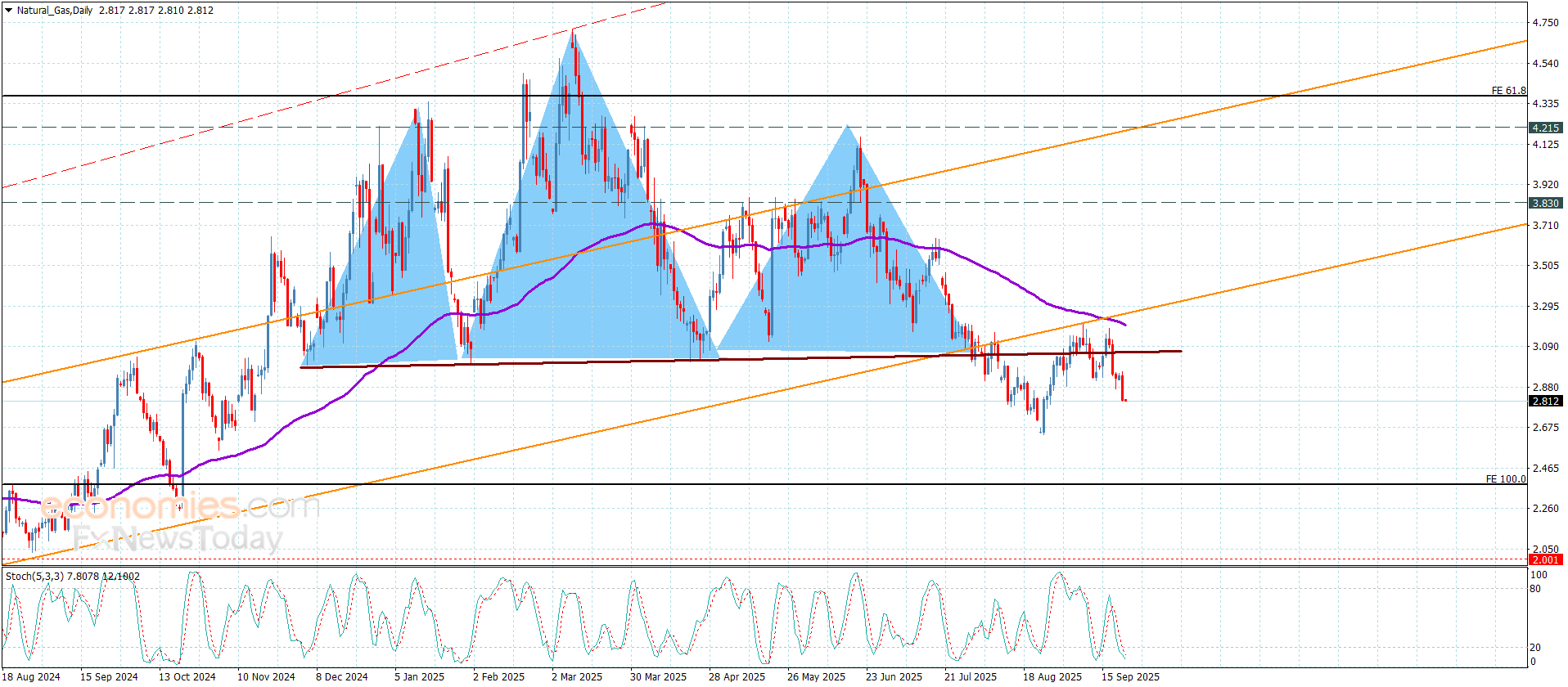
Natural gas price took advantage of the positive momentum that comes from stochastic rally above EMA50 in yesterday’s trading, delaying the negative attack by its stability above $3.050, achieving some gains by its stability near $3.150.
The current rise didn’t affect the main bearish scenario, due to its stability below the main resistance at $2.265, to expect forming sideways trading, then begin forming bearish waves, to press on $2.820 level again, while its success in surpassing the resistance and holding above it will turn the bullish track again, providing strong chance for recording several gains by its rally to $3.450 initially.
The expected trading range for today is between $2.820 and $3.220
Trend forecast: Bearish
The (Brent) price declined in its last intraday trading, gathering the gains of its previous rises, attempting to offload some of its overbought conditions on the relative strength indicators, with the emergence of negative overlapping signals, to gather its positive strength that might help it to recover and rise again, amid the dominance of strong minor bullish wave, taking advantage of the dynamic support that is represented by its trading above EMA50, reinforcing the chances for the price recovery in the upcoming period.
Get high-accuracy trading signals delivered directly to your Telegram. Subscribe to specialized packages tailored for the world’s top markets:
Full VIP signals performance report for September 15–19, 2025:
Silver price (XAG/USD) recovers its daily losses, trading around $44.10 per troy ounce during the European hours on Wednesday. The non-interest-bearing Silver maintains its position near a 14-year high of $44.47, which was reached on Tuesday as traders widely expect a 25-basis-point rate cut by the US Federal Reserve (Fed) at its October policy meeting.
The CME FedWatch tool suggests that money markets are currently pricing in nearly a 93% possibility of a Fed rate cut in October, up from 90% a day earlier. Traders will likely observe the upcoming US Q2 Gross Domestic Product Annualized and Personal Consumption Expenditures (PCE) Price Index data, the Federal Reserve’s preferred inflation gauge, due later in the week.
Safe-haven Silver draws buyers as geopolitical tensions rise, with NATO vowing a “robust” response to Russian airspace violations. Moreover, President Trump warned at the United Nations (UN) General Assembly on Tuesday that the United States (US) is ready to impose a “very strong round of powerful tariffs” if Russia refuses to end the war in Ukraine.
Additionally, Silver found support from strong fundamentals, with tight supply and steady demand from solar, EV, and electronics sectors underpinning prices. India’s silver imports are also set to rise in the coming months, backed by solid investment and industrial demand that has already absorbed last year’s surplus shipments.
Silver is a precious metal highly traded among investors. It has been historically used as a store of value and a medium of exchange. Although less popular than Gold, traders may turn to Silver to diversify their investment portfolio, for its intrinsic value or as a potential hedge during high-inflation periods. Investors can buy physical Silver, in coins or in bars, or trade it through vehicles such as Exchange Traded Funds, which track its price on international markets.
Silver prices can move due to a wide range of factors. Geopolitical instability or fears of a deep recession can make Silver price escalate due to its safe-haven status, although to a lesser extent than Gold’s. As a yieldless asset, Silver tends to rise with lower interest rates. Its moves also depend on how the US Dollar (USD) behaves as the asset is priced in dollars (XAG/USD). A strong Dollar tends to keep the price of Silver at bay, whereas a weaker Dollar is likely to propel prices up. Other factors such as investment demand, mining supply – Silver is much more abundant than Gold – and recycling rates can also affect prices.
Silver is widely used in industry, particularly in sectors such as electronics or solar energy, as it has one of the highest electric conductivity of all metals – more than Copper and Gold. A surge in demand can increase prices, while a decline tends to lower them. Dynamics in the US, Chinese and Indian economies can also contribute to price swings: for the US and particularly China, their big industrial sectors use Silver in various processes; in India, consumers’ demand for the precious metal for jewellery also plays a key role in setting prices.
Silver prices tend to follow Gold’s moves. When Gold prices rise, Silver typically follows suit, as their status as safe-haven assets is similar. The Gold/Silver ratio, which shows the number of ounces of Silver needed to equal the value of one ounce of Gold, may help to determine the relative valuation between both metals. Some investors may consider a high ratio as an indicator that Silver is undervalued, or Gold is overvalued. On the contrary, a low ratio might suggest that Gold is undervalued relative to Silver.
Despite the stability of the GBPJPY pair in the last period below the barrier at 200.45, but the continuation of the main indicators’ contradiction that pushed it to form sideways trading by its repeated stability near 199.60.
We will keep waiting for gathering the extra negative momentum, to ease the mission of forming new correctional waves, to target 198.60 level reaching the extra support at 197.80, while breaching the barrier will turn the bullish track back, to begin recording extra gains by its rally towards 200.90 and 201.55.
The expected trading range for today is between 198.60 and 200.40
Trend forecast: Bearish
U.S. natural gas futures (NG=F) are trading near $2.852 per MMBtu, posting a 1.64% daily gain, yet the contract remains locked in a tight range as traders prepare to roll into November. Price action has been dominated by noise and compressed volatility, with the chart showing a potential retest of the $2.72 gap that formed in late summer. That level is emerging as a pivotal support zone, while resistance continues to cluster at $3.00–$3.10, reinforced by the 50-day EMA. The broader uptrend line that extends back to February 2024 has not yet been broken, maintaining a fragile bullish structure even as sellers test the lower end of the range.
In Europe, Dutch TTF contracts are steady at about €32 per megawatt-hour ($37.75), underpinned by storage levels at 81.6% of capacity across the bloc. Italy’s inventories lead with 91%, France follows at 90.6%, and Germany lags with 76.4%, highlighting regional disparities but still leaving the EU in a comfortable pre-winter position. Analysts note that last winter was the coldest since the war in Ukraine began, which forced significant withdrawals. If the upcoming season mirrors those conditions, inventories could face renewed stress despite their strong starting point.
Traders have begun placing bold bets on a sharp rally. Options priced for April–September 2026 settled near €50/MWh ($59), suggesting expectations of a 60% increase compared to spot pricing. Forward contracts for summer 2026 remain lower at €31/MWh ($36.57), signaling the risk premium is concentrated in the winter period. This divergence reflects the market’s view that storage, weather, and competition with Asia could force Europe into costly bidding wars just as stockpiles need to be refilled.
The European Union has accelerated its timeline, advancing the full ban on Russian LNG imports to January 2027, one year earlier than previously scheduled. While pipeline gas through Ukraine has already been halted since January 2025, Russia continues to deliver cargoes via Arctic LNG routes, many destined for China, which has already taken six shipments this month despite sanctions pressure. This leaves Europe more reliant on alternative suppliers, particularly the U.S. and Qatar. Washington has promised to expand LNG output and send additional flows to Europe, with new capacity entering service in the next 24 months.
Weak demand from Asia this summer has allowed Europe to secure an outsized share of American cargoes, cushioning its balance. However, the possibility of another harsh winter combined with an Asian demand resurgence poses a real risk of diverting flows away from Europe. Freight costs between the Gulf Coast and Asia have already risen, tightening arbitrage windows and reshaping trade routes. Should Asian utilities return aggressively, Europe may be forced to pay premiums well above current forward curves to keep inventories stable.
In the U.S., the Natural Gas Supply Association (NGSA) expects winter demand to climb to a record 115.5 Bcf/d, up 4 Bcf/d year-over-year. Supply is forecast at 108.5 Bcf/d, while Canadian imports add another 6.9 Bcf/d, leaving the market in balance for now. Storage is entering the season at a five-year high, providing a cushion against early cold spells. However, structural demand is shifting — AI data centers and LNG terminals are creating steady baseload consumption. LNG exports, already absorbing a growing share of daily output, could tighten balances further if global spreads widen during the heating season.
Chart signals indicate natural gas is coiling for a move. The RSI sits near 40, reflecting weakness but also approaching oversold territory. The MACD histogram has flattened, neither confirming bearish continuation nor a bullish turn. Bollinger Bands have narrowed between $2.72 and $3.00, pointing to an imminent breakout. A decisive close below $2.72 could expose lows last seen in early 2024, while recovery above $3.00–$3.10 would open the path to $3.40, where the 200-day EMA converges. Traders see the November contract roll as the likely trigger for volatility expansion.
Movements in NG=F are reverberating across related equities. U.S. LNG exporters such as Cheniere Energy (NYSE:LNG) and Tellurian (NYSE:TELL) are closely tied to forward curves, while European majors like Equinor (NYSE:EQNR) benefit from volatility and arbitrage margins. U.S. midstream names with exposure to Gulf Coast export hubs are also trading with heightened correlation to gas futures. Institutional flows into energy-focused ETFs have increased, suggesting investors are positioning for stronger realized margins in 2026 as export volumes rise.
At $2.85 per MMBtu, natural gas sits between its strongest support at $2.72 and resistance around $3.10. Europe’s spot market stability at €32/MWh masks deeper risks, as option bets are already pricing a surge toward €50/MWh by next summer. With U.S. storage levels strong, production near records, and policy tightening on Russian LNG, the backdrop suggests stability in the near term but volatility premiums growing into 2026. Given the balance of factors — high supply, record demand projections, and structural shifts from AI and LNG — the call remains Hold, with risks skewed toward upside if winter proves harsher than expected.