The main tag of GoldPrice Articles.
You can use the search box below to find what you need.
[wd_asp id=1]
The main tag of GoldPrice Articles.
You can use the search box below to find what you need.
[wd_asp id=1]
Gold (XAU/USD) ended the week at $3,643.09, climbing more than 1.5% as markets positioned for a Federal Reserve rate cut at the September 17 meeting. The rally has stretched into a fourth straight weekly gain, with price action consistently defending support levels after a breakout above the $3,500 zone. This level now acts as a strong floor. Technical support also sits at $3,311.56, with the 52-week moving average at $3,025.64 anchoring longer-term structure.
Markets are assigning a 94% probability of a 25bp cut next week, with a smaller chance of 50bp. Jobless claims surged to 263,000, the highest in nearly four years, and the Bureau of Labor Statistics admitted to an overcount of 911,000 jobs between April 2024 and March 2025. Nonfarm payrolls in August showed just 22,000 new jobs, underscoring the softening labor backdrop. These cracks outweigh the stickiness of inflation, where August CPI rose 0.4% month-over-month and 2.9% year-over-year, slightly hotter than forecasts.
Inflation remains elevated with core CPI steady at 3.1%, but markets are discounting short-term price pressures in favor of the Fed’s likely dovish pivot. Traders are betting that weaker employment data will dominate the FOMC narrative, especially as real yields turn lower. Gold’s safe-haven bid strengthens when yields compress, and this dynamic is central to the current rally.
Beyond macro policy, structural demand remains robust. The People’s Bank of China continues to accumulate reserves, signaling sustained sovereign appetite. Beijing has also simplified gold import and export rules, which could lift trading volumes. Institutional flows into gold-backed ETFs have resumed after a brief summer pause, with holdings rising steadily since mid-August. These inflows mirror a broader theme: portfolio managers diversifying against recession risk.
The breakout above $3,500.20 set the stage for a September projection toward $3,879.64 based on swing chart extensions. Resistance lies at $3,666, $3,730, and $3,782, where overbought conditions could spark short-term pauses. Still, momentum remains intact, with bulls defending every retracement. The RSI has normalized from extreme levels, suggesting energy remains for another push higher. If momentum persists, the breakout zone could accelerate gains into the $3,850–$3,880 range before quarter-end.
Traders now turn to the FOMC meeting, but several U.S. data points remain on the radar. Retail sales, the Empire State Manufacturing Index, and jobless claims later this week will all inform growth expectations. Any further deterioration in labor indicators will add conviction to the gold rally, while stronger-than-expected consumer data could briefly strengthen the dollar and cap bullion.
The coupling between gold and Bitcoin has strengthened in 2025. When gold surged past $3,500 in April, Bitcoin followed two months later, peaking at $124,457. Both assets are now consolidating while awaiting Fed guidance. The correlation highlights gold’s continued role as the lead indicator in liquidity-driven rallies.
Verdict: BUY — With XAU/USD holding $3,643 into the Fed meeting, the combination of weak labor data, ETF inflows, and central bank demand supports a bullish continuation. The probability of a breakout toward $3,879 remains high, with support anchored at $3,500 and major downside invalidation only at $3,311. If the Fed confirms easing, gold is positioned for another leg higher into Q4 2025.
Natural gas futures (NG=F) closed the week under intense pressure, struggling to hold the $2.90–$2.95/MMBtu band as supply builds offset fragile demand. The October contract settled at $2.941/MMBtu, a modest +0.24% daily uptick, yet the broader trend remained bearish after repeated failures to sustain above the $3.00 psychological barrier. This price action follows a U.S. EIA storage injection of 71 Bcf, well above the five-year average of 56 Bcf, lifting inventories to 3,343 Bcf, 188 Bcf above the seasonal norm. With just six weeks left in the injection season, the market faces the risk of ending close to 4.0 Tcf in storage, a level that historically weighs heavily on front-month contracts.
From a technical standpoint, natural gas has been trapped between resistance at $3.20–$3.23 and support at $2.87–$2.90. The 20-day moving average at $2.92 has been tested twice, reinforcing this as a pivot zone, while the 61.8% Fibonacci retracement at $2.84 remains the next key downside marker. Momentum signals are weak: the RSI at 44 shows room before oversold conditions, while the MACD remains flat, confirming a market lacking conviction. Weekly charts show a higher high and low but still a net decline, underscoring short-term resilience within a broader downtrend. A decisive break below $2.87 would trigger deeper losses, potentially targeting $2.65.
U.S. production held at 112.3 Bcf/d, just slightly below the prior week, while total demand slipped to 99.5 Bcf/d, down 0.4 Bcf/d. The power sector led the decline as milder September weather capped cooling demand. LNG exports dipped marginally to 16.0 Bcf/d from 16.1 Bcf/d, and pipeline flows to Mexico eased to 7.1 Bcf/d from 7.4 Bcf/d. These marginal changes underscore a market where supply continues to exceed demand. With European TTF benchmark prices around $9.60/MMBtu and Asia’s JKM at $11.35/MMBtu, international markets are providing limited upside pull despite geopolitical risks, as U.S. export terminals are already operating near capacity.
Storage dynamics are the core bearish driver. Inventories now sit 6% above the five-year average and only 1.1% below last year’s level, despite high summer burn rates earlier in 2025. To end injection season at 3.9 Tcf, weekly injections need to average 93 Bcf; to hit 4.0 Tcf, that number jumps to 109 Bcf. Given recent builds, the higher figure is increasingly plausible. End-of-season surpluses of this magnitude typically cap winter rallies unless unexpected cold snaps emerge.
Events abroad offered sparks but no sustained fire. Europe continues to push for reduced Russian gas reliance, with the U.S. pledging LNG support, yet export constraints at U.S. terminals prevent significant new flows. Japanese utility JERA’s 20-year contract with the $44B Alaska LNG project highlights long-term bullish LNG demand, but near-term infrastructure delays keep incremental supply years away. Similarly, Canada’s push to fast-track LNG Canada Phase 2 projects will matter later in the decade, not in Q4 2025. Geopolitical disruptions—such as Israel’s strikes in Qatar—briefly lifted sentiment, but the impact faded as U.S. storage data reasserted dominance.
Regional cash markets confirm the bearish tilt. At Henry Hub, benchmark spot gas added just $0.095 to $2.94, reflecting limited upside. The Waha Hub in West Texas remains severely discounted at -1.905, weighed down by Permian oversupply. Chicago Citygate barely managed a +$0.045 gain, while Algonquin Citygate fell -0.28 amid weak Northeast demand. With regional spreads remaining wide, bottlenecks and infrastructure constraints continue to exaggerate local dislocations, reinforcing the oversupply narrative in key producing basins.
Weather models provide the last hope for bulls. NOAA’s 8–14 day forecast shows below-average temperatures for much of the East, dampening cooling demand, while warmer-than-normal conditions could return in late September, reviving A/C usage. The tropics also remain a risk factor, with systems developing in the Atlantic potentially disrupting Gulf Coast infrastructure. Yet unless storms directly impact LNG terminals or pipelines, their influence is often short-lived.
The forward curve highlights structural weakness. October contracts trade at $2.95, while December fetches $3.80 and January $4.10, reflecting a steep contango as traders price in seasonal winter strength. This spread incentivizes storage injections now, further adding to near-term bearish weight. With inventories already elevated, the curve suggests traders are hedging rather than betting on tightness.
At $2.94/MMBtu, natural gas sits at a crossroads. Elevated storage at 3.343 Tcf, sluggish demand, and production near record levels argue strongly for continued downside. The only bullish lifelines are weather volatility and geopolitical disruption, neither of which has shifted the core balance. With resistance firm at $3.20 and support fragile at $2.87, the risk-reward setup tilts bearish. Based on current fundamentals and technicals, Natural Gas (NG=F) earns a Sell rating, with likely tests of $2.84 and potentially $2.65 before any winter-driven recovery attempt.
The (ETHUSD) price rose in its last intraday trading, attacking the critical resistance at $4,500, which represents our suggested target in our previous analysis, supported by its continuous trading above EMA50, with its trading alongside minor bullish trend on the short-term basis that supports the bullish movement, despite the negative signals that come from the (RSI), after reaching overbought levels, to offload some of this conditions despite the price rise, indicating the strength of the trend and its dominance.
Get high-accuracy trading signals delivered directly to your Telegram. Subscribe to specialized packages tailored for the world’s top markets:
Full VIP signals performance report for September 1–5, 2025:
Oil markets ended the week with volatility driven by geopolitical conflict, sanctions risk, and shifting demand expectations. WTI crude (CL=F) closed at $62.69 per barrel, up 0.51%, while Brent (BZ=F) finished at $66.99, advancing 0.93%. The modest recovery came after Thursday’s slide, when both benchmarks lost close to 2% on soft U.S. demand data. This rebound was largely fueled by a Ukrainian drone strike on Russia’s Primorsk port, one of the country’s largest oil export terminals, which forced a temporary halt in loading operations and added new concerns over supply disruption. The attack coincided with renewed Kremlin announcements suspending peace talks, raising fears that sanctions could intensify, especially as Washington and Brussels weigh broader measures against Russian crude and refined product flows.
Despite these geopolitical shocks, underlying fundamentals still point to a fragile balance. The International Energy Agency (IEA) confirmed global oil supply is set to grow faster than expected this year, driven primarily by OPEC+ capacity increases. The U.S. is also contributing, with the latest EIA report showing weekly U.S. crude production rising to 13.495 million barrels per day, a gain of 72,000 bpd from the previous week. Rig activity has shown a mild uptick, with Baker Hughes reporting the oil rig count climbing by two to 416, though this is still 72 rigs lower year over year. The rebound in supply coincides with weak consumption in the U.S. gasoline market, where gasoline futures barely moved at $1.985/gal, reflecting sluggish demand even as refineries process near record volumes.
OPEC members continue to compete aggressively in Asia. Saudi Arabia deepened discounts to Chinese buyers for October cargoes, a move designed to protect market share as Russian barrels flow at lower costs despite sanctions. Reports confirm Saudi sales to China are set for an October jump, even as state-run producers cut prices. Meanwhile, India remains the largest buyer of Russian seaborne crude, with recent moves by Adani Ports to block Western-sanctioned tankers signaling more selective sourcing. India is also preparing new carbon capture incentives to balance rising coal consumption, underscoring its energy security priority over climate commitments. These shifts reveal how Asia’s energy giants are both beneficiaries of discounted Russian oil and price-setters in today’s market.
While Russia continues to move barrels east, revenues have collapsed. August crude and refined product income fell to multi-year lows under the weight of sanctions and shipping restrictions. With European deadlines set to phase out Russian energy imports fully by 2028, and Trump calling on the G7 to consider tariffs against both China and India for Russian imports, the pressure on Moscow’s fiscal health is building. This dynamic has increased reliance on smaller Asian refiners and gray fleet shipping, both of which carry rising costs and risks of disruption. Russia’s ability to maintain production near 10.8 million bpd is being tested against shrinking cash flows, which could force deeper discounts or curtailments if sanctions tighten further.
The geopolitical premium resurfaced after Israel launched strikes on targets in Qatar, escalating Middle Eastern tensions and pushing oil benchmarks temporarily higher. At the same time, the Trump administration’s tariff threats against China and India have injected another uncertainty, with markets weighing the risk of retaliatory demand cuts. These measures, if enacted, could limit the very Asian demand that underpins the oil market’s resilience. Traders are increasingly cautious as oil remains capped in the mid-$60s despite ongoing conflicts, suggesting that structural oversupply outweighs geopolitical spikes in the short term.
On the corporate side, BP (LSE:BP, NYSE:BP) has been quietly rebuilding momentum. Shares gained 28% since April, trading near 500p, helped by the company’s largest Brazilian discovery in 25 years and a new exploration pact with Egypt. BP targets production of 2.3–2.5 million boe/day by 2030, supported by a three-year LNG deal with Turkey’s BOTAS. With a forward P/E of 12.68 and projected earnings growth of 28.3% annually, BP appears undervalued by up to 52% on forecast cash flows. Its dividend yield remains 5.8%, with guidance to rise above 6% by 2026, keeping income investors engaged. Still, oil price volatility and high-cost exploration risks limit the upside, particularly if Brent remains stuck below $70. The BP recovery highlights how supermajors are pivoting back toward hydrocarbons to secure cash flow, even while scaling back renewable spending.
From a technical perspective, WTI (CL=F) faces firm resistance at $63.50–$64.00, a zone repeatedly rejecting rallies this summer. Support remains near $61.00, and a break below risks a slide toward $58.00, levels last seen in early 2023. Brent (BZ=F) holds stronger relative strength, consolidating above $66.50, but a sustained break above $68.50 is required to challenge the $70 psychological barrier. Indicators show momentum stabilizing, with RSI for both contracts near neutral levels, but volume remains thin—suggesting traders are reluctant to build large positions without a clearer macro signal.
With WTI at $62.69 and Brent at $66.99, the market is caught between geopolitical premiums and oversupply realities. Rising U.S. output, OPEC+ capacity expansion, and weak U.S. demand argue for bearish pressure, while Russia-Ukraine conflict risks and Middle East instability provide only temporary spikes. For traders, this creates a choppy market with limited upside beyond $70 Brent in the near term. BP’s fundamentals show selective opportunity among supermajors, but the broader oil complex remains under pressure. Based on the data, the oil market leans toward a Hold with a bearish tilt, with better entry points likely if WTI dips below $60 and Brent retests $64.
A decisive rally through the $3,675 record high would open the way toward higher targets. The first notable objective sits at $3,734, marked by a 161.8% Fibonacci extension. Beyond that, a key confluence zone comes into play from $3,782 to $3,812. This zone is supported by several overlapping measures, including the symmetrical triangle breakout projection at $3,786, lending greater significance to the area. The strong, low-pullback rally from the triangle breakout further supports the potential for an extension higher.
On the downside, a decisive decline below Thursday’s low of $3,613 could signal the start of a deeper pullback. Initial support would be seen at the 38.2% Fibonacci retracement around $3,537, while the prior trend high at $3,500 represents another key level. Below that, a broader support zone stretches from $3,451 to $3,439, aligned with the 61.8% retracement near $3,452. While a test of these lower levels would not negate the broader bullish trend, it would represent the first deeper retracement since the breakout and would be closely watched as a potential reentry point.
Gold’s sharp $543 rally (18.4%) from the $3,311 swing low prior to the triangle base shows the kind of momentum still in play. A measured move of similar magnitude from the breakout suggests a potential longer-term target closer to $3,966. Even in the short term, the ability to close this week in the upper third of the range, above $3,642, highlights strong demand. The evidence continues to point toward buyers retaining control and higher targets remaining in sight.
For a look at all of today’s economic events, check out our economic calendar.
Silver (XAG/USD) trades under mild pressure on Thursday as a firm US Dollar (USD) keeps the white metal subdued ahead of the highly anticipated US Consumer Price Index (CPI) release. At the time of writing, XAG/USD is consolidating around $41.00, pausing after marking a fresh 14-year peak around $41.67 earlier this week.
All eyes are on the August US CPI report due at 12:30 GMT, which is expected to provide the final policy cue before next week’s Federal Reserve (Fed) meeting.
Headline inflation is expected to pick up modestly, rising 0.3% on the month and pushing the annual rate to 2.9%, while core CPI is seen steady at 0.3% MoM and 3.1% YoY.
A stronger-than-expected print could fuel the US Dollar’s rebound and lift Treasury yields, pressuring precious metals in the short term. Conversely, a softer reading would bolster expectations for a Fed interest rate cut at next week’s meeting, offering renewed support to Silver. Lower borrowing costs reduce the opportunity cost of holding non-yielding assets such as Silver, keeping the broader bullish tone intact.
From a technical perspective, Silver has been consolidating within a tight $41.50–$40.50 range since early September. On the daily chart, a bearish divergence on the Relative Strength Index (RSI) points to fading upside momentum, while the flattening Moving Average Convergence Divergence (MACD) histogram signals weakening bullish pressure.
Immediate support lies at $40.50, with a break below exposing the 21-day Simple Moving Average (SMA) near $39.52. On the upside, a sustained move above $41.50 would reduce the significance of the divergence and open the door toward the $42.00 psychological barrier and beyond.
Silver is a precious metal highly traded among investors. It has been historically used as a store of value and a medium of exchange. Although less popular than Gold, traders may turn to Silver to diversify their investment portfolio, for its intrinsic value or as a potential hedge during high-inflation periods. Investors can buy physical Silver, in coins or in bars, or trade it through vehicles such as Exchange Traded Funds, which track its price on international markets.
Silver prices can move due to a wide range of factors. Geopolitical instability or fears of a deep recession can make Silver price escalate due to its safe-haven status, although to a lesser extent than Gold’s. As a yieldless asset, Silver tends to rise with lower interest rates. Its moves also depend on how the US Dollar (USD) behaves as the asset is priced in dollars (XAG/USD). A strong Dollar tends to keep the price of Silver at bay, whereas a weaker Dollar is likely to propel prices up. Other factors such as investment demand, mining supply – Silver is much more abundant than Gold – and recycling rates can also affect prices.
Silver is widely used in industry, particularly in sectors such as electronics or solar energy, as it has one of the highest electric conductivity of all metals – more than Copper and Gold. A surge in demand can increase prices, while a decline tends to lower them. Dynamics in the US, Chinese and Indian economies can also contribute to price swings: for the US and particularly China, their big industrial sectors use Silver in various processes; in India, consumers’ demand for the precious metal for jewellery also plays a key role in setting prices.
Silver prices tend to follow Gold’s moves. When Gold prices rise, Silver typically follows suit, as their status as safe-haven assets is similar. The Gold/Silver ratio, which shows the number of ounces of Silver needed to equal the value of one ounce of Gold, may help to determine the relative valuation between both metals. Some investors may consider a high ratio as an indicator that Silver is undervalued, or Gold is overvalued. On the contrary, a low ratio might suggest that Gold is undervalued relative to Silver.
The EURJPY pair succeeded in facing stochastic negativity by its stability above 172.00 level yesterday, to form some of the bullish waves to approach from the barrier at 173.50, forming an obstacle against the attempts of resuming the bullish attack.
To confirm the attempts of resuming the bullish attack, we recommend waiting for breaching the barrier and providing positive close above it, to increase the chances for recording extra gains that might extend to 174.25 reaching 1.809%Fibonacci extension level at 175.20, while the price failure to breach this level will force it to provide more of the sideways trading, and there is a new chance to decline towards 171.60.
The expected trading range for today is between 172.60 and 174.25
Trend forecast: Bullish
GameStop Corporation (GME) stock extended its gains in its latest intraday trading, successfully breaking above the key resistance level of 24.50. This significantly increases the chances of extending the short-term corrective bullish trend, especially with the stock continuing to trade above its previous 50-day SMA, which provides renewed positive momentum. Additional support comes from positive signals in the Stochastic indicators, despite being in strongly overbought territory.
High-risk warning: GME belongs to the so-called “meme stocks,” which are characterized by extreme speculative trading. As a result, the stock’s movement often deviates from technical expectations or financial reports and can sometimes be highly unpredictable.
Therefore, we expect the stock to rise in its upcoming trading, provided it confirms the breakout of the mentioned resistance at 24.50 and holds above it, to then target its next resistance at 28.40.
Today’s price forecast: Bullish.
Gold (XAU/USD) continues to press record territory, trading around $3,685 per ounce after reaching an intraday high of $3,695.50. Spot prices climbed 40% year-to-date, making 2025 one of the strongest years in decades for bullion. August CPI rose 0.4% month-on-month and 2.9% annually, while jobless claims surged to 263,000 — the highest since 2021 — fueling stagflation concerns. Nonfarm payroll growth slowed to just 22,000, while unemployment rose to 4.3%. This macro backdrop has investors nearly fully pricing a 25 bps rate cut at the Fed’s September meeting, with a 7% chance of a larger 50 bps cut. Historically, easing cycles have provided powerful support for non-yielding assets like gold.
Major institutions have raised price projections. UBS now expects gold to reach $3,800/oz by year-end and $3,900/oz by mid-2026, citing a 200-basis-point Fed easing cycle and a weaker dollar. Commerzbank also raised its end-2026 target to $3,800, up from $3,600. Goldman Sachs is more aggressive, suggesting a base case of $4,000 by mid-2026 and even a $4,500–$5,000 tail scenario if U.S. political pressures undermine Fed independence. The investment bank notes that if just 1% of privately held Treasuries were reallocated into bullion, it could drive the next leg higher. Analysts emphasize that unlike the volatile spike of 1980 — when gold peaked at $850 ($3,590 inflation-adjusted) — today’s surge is supported by deeper liquidity, ETFs, and institutional allocations.
ETF flows are approaching historic records, with total holdings forecast to exceed 3,900 metric tons by the end of 2025, nearly touching the all-time high of 3,915 tons from October 2020. Weekly inflows have already surpassed 700 tons this year, marking one of the most aggressive institutional accumulation phases on record. Central banks remain net buyers at roughly 900–950 tons in 2025, slightly below last year’s record 1,000 tons. This ongoing official sector demand reflects geopolitical hedging, especially in emerging markets diversifying away from the dollar. The total value of London vault reserves surpassed $1 trillion last month, showing how institutions continue to build long-term gold positions.
The U.S. dollar index sits at 97.7, down on the month, while five-year TIPS yields dropped over 20 bps to their lowest since mid-2022, both of which are historically bullish for gold. Real rates are now projected to fall further into year-end as easing accelerates. With U.S. President Donald Trump repeatedly pressing for lower interest rates, and markets already pricing three cuts before year-end, the environment for gold remains highly favorable. Treasury demand has weakened under this policy backdrop, redirecting flows into bullion as an alternative safe-haven hedge.
On the technical side, gold remains firmly bullish. The 20-day EMA is trending higher at $3,518, while the RSI has surged to 80, bordering on overbought territory but consistent with strong momentum phases. Key resistance sits at $3,700, which if broken could open the path to $3,800 in the near term. Support lies first at $3,500 and deeper around $3,360, but each dip has been consistently absorbed by buyers this year. Year-on-year, gold has climbed from $2,529 in September 2024 to $3,685 now, a 45% gain. Over the past month alone, prices surged 9.4%, highlighting the sustained bid under current macro stress.
Beyond institutions, retail and corporate participation has grown. In the U.S., consumer access through Costco (NASDAQ:COST) has gained traction as the retailer sells gold bars, silver coins, and platinum, broadening exposure for households looking to hedge inflation. In Asia, physical demand has stayed resilient even with higher prices, while in Europe, wealth managers are allocating mid-single-digit portfolio weights to bullion as a defensive anchor. Analysts stress that the current rally is not purely speculative but reflects broad structural allocation shifts.
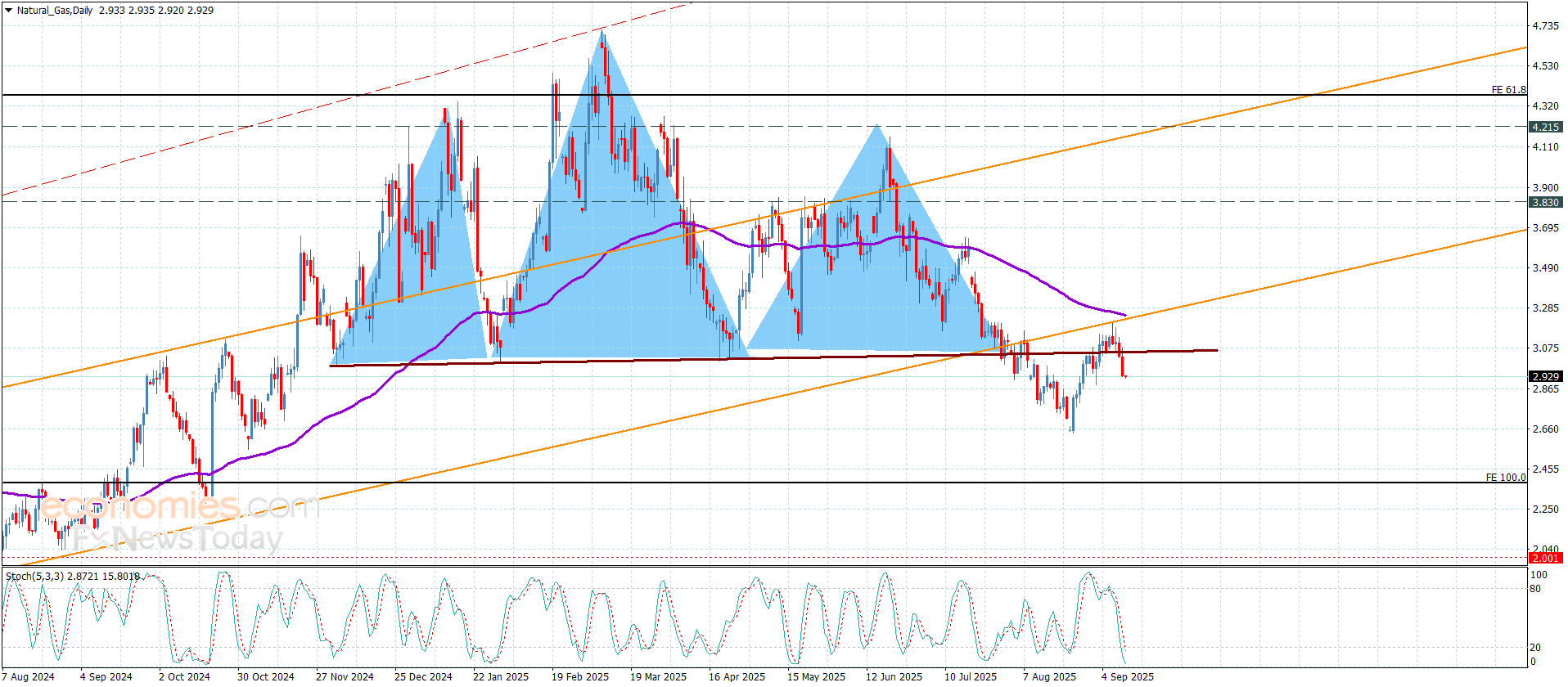
The confluence of the 20-Day moving average at $2.92 and the 50% retracement at $2.91 marks the first notable support area. This zone has contained declines over the past two days, and a bullish reversal could still trigger from here. If today’s low is broken, however, further downside levels come into focus, including the interim swing low at $2.87 and the 61.8% Fibonacci retracement at $2.84. Both align with the midpoint line of the large descending channel highlighted on the chart.
Natural gas continues to respect the structure of the descending channel. The center line was tested as support in March and as resistance in mid-August, and most recently, the upper quarter line capped the September 8 swing high. These repeated interactions reinforce the channel’s importance as a guide. If the 61.8% retracement fails to hold, the lower center line of the channel becomes the next downside target. Certainly, a drop below the Fibonacci level could unfold given the wide range weekly bullish engulfing candle that completed two weeks ago.
The break below the long-term uptrend line on August 11 remains a key bearish development. A subsequent rally into that line was rejected, confirming its role as resistance. While this suggests the larger downtrend may be reasserting itself, price action still needs to be assessed step by step as patterns develop. The current pullback could remain controlled if buyers defend support levels.
On the weekly chart, natural gas is set to close with a higher high and higher low, but still down for the week and below a long-term AVWAP around $2.96. This reflects short-term strength within a broader bearish bias. Heading into next week, a drop below this week’s low of $2.90 would confirm a one-week bearish reversal and keep pressure on towards lower support zones.
For a look at all of today’s economic events, check out our economic calendar.