The main tag of GoldPrice Articles.
You can use the search box below to find what you need.
[wd_asp id=1]
The main tag of GoldPrice Articles.
You can use the search box below to find what you need.
[wd_asp id=1]
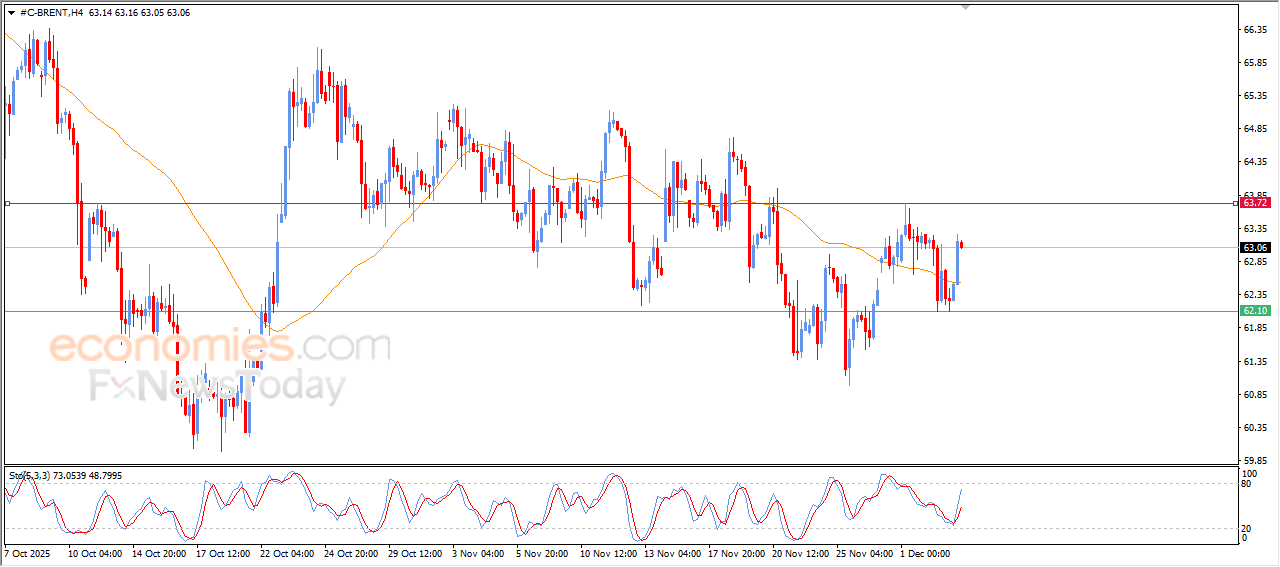
Global oil prices are edging higher today, but the move is modest and still framed by a bigger story of oversupply and cautious forecasts for 2026. Brent crude is trading just under $63 per barrel, while U.S. West Texas Intermediate (WTI) sits around $59 per barrel, after a month of tight ranges and heavy focus on OPEC+ policy, Ukraine–Russia peace talks and fresh downgrades to long‑term price forecasts. [1]
Below is a detailed look at where prices stand today, what’s moving the market, and how new forecasts from Fitch and other analysts are reshaping expectations for 2025–2027.
Spot / front‑month levels
As of late morning in Europe on Thursday, December 4, 2025:
Different data providers show small intraday discrepancies, but they all tell the same story: oil is slightly firmer today after a quiet, range‑bound November.
Performance in context
In short, today’s bounce comes against a clearly bearish 2025 backdrop: prices are higher than the market’s worst moments earlier in the year but still comfortably below 2024 and long‑term averages.
The key news story driving today’s modest gains is renewed Ukrainian attacks on Russian oil infrastructure, paired with frustratingly slow peace negotiations.
Beyond pipelines, Ukraine has ramped up drone strikes on Russian refineries:
These disruptions raise the perceived risk premium in oil, especially in refined products, but because exports and pipeline flows have not been seriously curtailed so far, the impact on crude prices remains contained.
At the same time, Ukraine–Russia peace efforts have stalled:
Earlier optimism about a quick peace deal had pushed prices lower on the assumption that Russian barrels would rush back into an already oversupplied market. The lack of progress now nudges prices higher, not because demand is strong, but because the “bearish peace scenario” looks less imminent.
Put together, the supply risk from attacks and lack of a peace deal are giving crude a gentle lift today, but they are running into a wall of bearish fundamentals.
If geopolitics are leaning bullish, fundamentals are leaning bearish.
Fresh weekly data from the U.S. Energy Information Administration (EIA) show that:
Rising inventories in the world’s largest oil consumer send a clear message: consumption is not strong enough to absorb current supply, let alone additional barrels.
This dynamic—high inventories plus record production—helps explain why today’s geopolitical headlines are producing only a mild bounce instead of a sustained rally.
Another crucial piece of the puzzle is OPEC+ policy, which has now been clarified through the first quarter of 2026.
At meetings held at the end of November, OPEC+ decided to:
Analysts describe the decision as a “stability over ambition” move: the group is accepting flat output in the near term to avoid deepening an expected surplus.
The International Energy Agency (IEA) and various analyst houses see a hefty surplus ahead:
Against that backdrop, OPEC+’s decision to freeze Q1 2026 output looks less like an aggressive support move and more like the bare minimum needed to prevent a deeper price slide.
In a major development for medium‑term expectations, Fitch Ratings has lowered its base‑case oil price assumptions:
Fitch explicitly cites “large market oversupply”, with production growth expected to outpace only modest increases in demand. It forecasts global oil demand growth of about 0.8 million barrels per day in both 2025 and 2026, below historical norms, reflecting slower GDP growth, petrochemical weakness and the energy transition. [19]
Fitch’s stress‑case scenario keeps even lower prices in the outer years but is mainly a risk management framework for corporate credit analysis.
The caution is widespread:
The same poll underscores the oversupply narrative, pointing to increased OPEC+ output since April and robust non‑OPEC supply, with U.S. production near records.
Oilprice.com’s recent macro analysis synthesises this emerging consensus:
The net takeaway: today’s prices near $63 (Brent) and $59 (WTI) are very close to where major institutions expect them to average over the next 12–24 months.
Beyond macro fundamentals, several technical analysts released intraday commentary for December 4:
Meanwhile, brokerage research (e.g., recent notes from Forex‑focused platforms) characterises WTI as “neutral around $60”, with intraday volatility under 0.2% for much of the week—evidence of a tight, indecisive trading range rather than a strong directional trend. [24]
Key technical takeaway:
The charts largely agree with the fundamentals and forecasts: crude looks range‑bound, with $60 for WTI and the low‑to‑mid $60s for Brent acting as important pivot zones rather than launching pads for a new bull market.
In other words, cheap(er) crude does not automatically guarantee cheap fuel, but it is helping central banks and households compared with the peak‑inflation years.
Equity investors are likely to reward discipline and shareholder returns (buybacks, dividends) over aggressive volume growth as long as oversupply dominates the narrative.
Even if oil looks “stuck” near current levels, there are several ways the story could change:
Is oil going up or down today?
Today, prices are up modestly—Brent and WTI are each higher by roughly 0.3–0.6%—mostly on supply‑risk headlines from Ukraine and stalled peace talks, but gains are capped by weak fundamentals and oversupply worries. [30]
Why isn’t oil higher given all the geopolitical risk?
Because stocks are building, U.S. production is near records, and OPEC+ has already moved from deep cuts to cautious increases and now a freeze. The market sees plenty of barrels for 2026, so geopolitical events need to produce actual, sustained supply losses to meaningfully lift prices. [31]
What do major forecasters expect for the next few years?
That means today’s levels are very close to where professionals expect the market to trade on average over the medium term, unless something big changes in supply, demand or policy.
1. www.reuters.com, 2. www.reuters.com, 3. www.reuters.com, 4. tradingeconomics.com, 5. oilprice.com, 6. oilprice.com, 7. www.reuters.com, 8. www.reuters.com, 9. www.reuters.com, 10. www.reuters.com, 11. www.reuters.com, 12. dmarketforces.com, 13. www.reuters.com, 14. www.reuters.com, 15. www.reuters.com, 16. www.reuters.com, 17. www.reuters.com, 18. menafn.com, 19. menafn.com, 20. www.reuters.com, 21. oilprice.com, 22. www.economies.com, 23. www.economies.com, 24. www.forex.com, 25. www.reuters.com, 26. menafn.com, 27. www.reuters.com, 28. www.reuters.com, 29. oilprice.com, 30. www.reuters.com, 31. www.reuters.com, 32. menafn.com, 33. www.reuters.com
West Texas Intermediate (WTI) Oil price falls on Tuesday, early in the European session. WTI trades at $58.45 per barrel, down from Monday’s close at $58.89.
Brent Oil Exchange Rate (Brent crude) is also shedding ground, trading at $62.37 after its previous daily close at $62.86.
WTI Oil is a type of Crude Oil sold on international markets. The WTI stands for West Texas Intermediate, one of three major types including Brent and Dubai Crude. WTI is also referred to as “light” and “sweet” because of its relatively low gravity and sulfur content respectively. It is considered a high quality Oil that is easily refined. It is sourced in the United States and distributed via the Cushing hub, which is considered “The Pipeline Crossroads of the World”. It is a benchmark for the Oil market and WTI price is frequently quoted in the media.
Like all assets, supply and demand are the key drivers of WTI Oil price. As such, global growth can be a driver of increased demand and vice versa for weak global growth. Political instability, wars, and sanctions can disrupt supply and impact prices. The decisions of OPEC, a group of major Oil-producing countries, is another key driver of price. The value of the US Dollar influences the price of WTI Crude Oil, since Oil is predominantly traded in US Dollars, thus a weaker US Dollar can make Oil more affordable and vice versa.
The weekly Oil inventory reports published by the American Petroleum Institute (API) and the Energy Information Agency (EIA) impact the price of WTI Oil. Changes in inventories reflect fluctuating supply and demand. If the data shows a drop in inventories it can indicate increased demand, pushing up Oil price. Higher inventories can reflect increased supply, pushing down prices. API’s report is published every Tuesday and EIA’s the day after. Their results are usually similar, falling within 1% of each other 75% of the time. The EIA data is considered more reliable, since it is a government agency.
OPEC (Organization of the Petroleum Exporting Countries) is a group of 12 Oil-producing nations who collectively decide production quotas for member countries at twice-yearly meetings. Their decisions often impact WTI Oil prices. When OPEC decides to lower quotas, it can tighten supply, pushing up Oil prices. When OPEC increases production, it has the opposite effect. OPEC+ refers to an expanded group that includes ten extra non-OPEC members, the most notable of which is Russia.
Natural gas price continued forming bullish waves, taking advantage of its stability within the bullish channel’s levels, to form a solid support by %38.2 Fibonacci correction level at $4.500, to approach from the initial main target by reaching $5.052 level.
Stochastic stability within the overbought level will increase the efficiency of the bullish track, to pave the way for surpassing $5.180 level, to open the way for recording extra gains that might extend towards $5.250 and $5.710.
The expected trading range for today is between $4.950 and $5.450
Trend forecast: Bullish
Gold has entered a phase of upside consolidation, oscillating in a familiar range around the $4,200 mark, awaiting more US jobs data for fresh hints on the US Federal Reserve’s (Fed) interest rate outlook beyond the December monetary policy meeting.
The top-tier US ADP Employment Change and US Institute for Supply Management (ISM) Services PMI data released on Wednesday failed to impress and served little to alter market expectations for a 25 basis points (bps) rate cut by the Fed next week.
The ISM Services PMI showed little improvement in November at 52.6 versus 52.4 in October, while US private payrolls unexpectedly declined by 32K in November, following a revised 47K increase. Analysts’ estimated a job gain of 5K.
Markets continued to price in around a 90% chance that the Fed will deliver the expected 25 bps rate cut next week, according to the CME Group’s FedWatch Tool.
Dovish Fed expectations kept the downside cushioned in Gold on Wednesday, while the bullish attempts were limited by a bout of profit-taking as sellers once again lurked near the $4,250 region.
Looking ahead, with a December Fed rate cut almost certain, markets are scouting for hints on the US central bank’s easing trajectory for early 2026.
In the absence of any clarity on that front, the incoming US Jobless Claims and the sentiment on Wall Street will continue to drive Gold price action, with moves likely to b restricted.
In the daily chart, XAU/USD trades at $4,197.02. The 21-, 50-, 100-, and 200-day Simple Moving Averages (SMAs) rise in bullish sequence, with the 21-day above the longer tenors. Price holds above all these gauges, keeping the near-term bias upward. The 21-day SMA at $4,126.81 offers nearby dynamic support. The Relative Strength Index (14) stands at 59.83, signaling firm momentum while staying short of overbought.
Measured from the $4,381.17 high to the $3,885.84 low, the 61.8% retracement at $4,191.95 is being reclaimed, and a sustained close above it would weaken the preceding bearish leg. Further strength would put the 78.6% retracement at $4,275.16 in play as resistance. Holding above the short-term average would keep the path skewed to the upside, while a rejection back below the 61.8% retracement could trigger a pullback toward the medium-term trend.
(The technical analysis of this story was written with the help of an AI tool)
Gold has played a key role in human’s history as it has been widely used as a store of value and medium of exchange. Currently, apart from its shine and usage for jewelry, the precious metal is widely seen as a safe-haven asset, meaning that it is considered a good investment during turbulent times. Gold is also widely seen as a hedge against inflation and against depreciating currencies as it doesn’t rely on any specific issuer or government.
Central banks are the biggest Gold holders. In their aim to support their currencies in turbulent times, central banks tend to diversify their reserves and buy Gold to improve the perceived strength of the economy and the currency. High Gold reserves can be a source of trust for a country’s solvency. Central banks added 1,136 tonnes of Gold worth around $70 billion to their reserves in 2022, according to data from the World Gold Council. This is the highest yearly purchase since records began. Central banks from emerging economies such as China, India and Turkey are quickly increasing their Gold reserves.
Gold has an inverse correlation with the US Dollar and US Treasuries, which are both major reserve and safe-haven assets. When the Dollar depreciates, Gold tends to rise, enabling investors and central banks to diversify their assets in turbulent times. Gold is also inversely correlated with risk assets. A rally in the stock market tends to weaken Gold price, while sell-offs in riskier markets tend to favor the precious metal.
The price can move due to a wide range of factors. Geopolitical instability or fears of a deep recession can quickly make Gold price escalate due to its safe-haven status. As a yield-less asset, Gold tends to rise with lower interest rates, while higher cost of money usually weighs down on the yellow metal. Still, most moves depend on how the US Dollar (USD) behaves as the asset is priced in dollars (XAU/USD). A strong Dollar tends to keep the price of Gold controlled, whereas a weaker Dollar is likely to push Gold prices up.
Important DisclaimersFXEmpire is owned and operated by Empire Media Network LTD., Company Registration Number 514641786, registered at 7 Jabotinsky Road, Ramat Gan 5252007, Israel. The content provided on this website includes general news and publications, our personal analysis and opinions, and materials provided by third parties. This content is intended for educational and research purposes only. It does not constitute, and should not be interpreted as, a recommendation or advice to take any action, including making any investment or purchasing any product. Before making any financial decision, you should conduct your own due diligence, exercise your own discretion, and consult with competent advisors. The content on this website is not personally directed to you, and we do not take into account your individual financial situation or needs. The information contained on this website is not necessarily provided in real time, nor is it guaranteed to be accurate. Prices displayed may be provided by market makers and not by exchanges. Any trading or other financial decision you make is entirely your own responsibility, and you must not rely solely on any information provided through the website. FXEmpire does not provide any warranty regarding the accuracy, completeness, or reliability of any information contained on the website and shall bear no responsibility for any trading losses you may incur as a result of using such information. The website may include advertisements and other promotional content. FXEmpire may receive compensation from third parties in connection with such content. FXEmpire does not endorse, recommend, or assume responsibility for the use of any third-party services or websites. Empire Media Network LTD., its employees, officers, subsidiaries, and affiliates shall not be liable for any loss or damage resulting from your use of the website or reliance on the information provided herein.Risk DisclaimersThis website contains information about cryptocurrencies, contracts for difference (CFDs), and other financial instruments, as well as about brokers, exchanges, and other entities trading in such instruments. Both cryptocurrencies and CFDs are complex instruments and involve a high risk of losing money. You should carefully consider whether you understand how these instruments work and whether you can afford to take the high risk of losing your money. FX Empire encourages you to conduct your own research before making any investment decision and to avoid investing in any financial instrument unless you fully understand how it works and the risks involved.
Gold (XAU/USD) remains firmly above $4,200 per ounce as of December 3, 2025, marking one of its strongest runs in modern history. The metal’s momentum is being driven by growing confidence in a Federal Reserve rate cut on December 10, record levels of central-bank accumulation, and expanding institutional forecasts projecting gold’s rise toward $5,000–$10,000 over the next year. Spot gold is consolidating near $4,202, while December futures (GC=F) trade around $4,232, less than 5% below October’s all-time high of $4,398.
The macro environment surrounding gold is decisively supportive. The CME FedWatch Tool places an 88% probability on a 25-basis-point Fed cut, marking the sharpest shift in policy expectations since early 2023. The U.S. 10-year Treasury yield (US10Y) has fallen to 4.06%, while the Dollar Index (DXY) sits at 96.51, its lowest since October, signaling capital rotation out of the greenback. The recent ADP jobs data, showing a loss of 32,000 private-sector positions, confirmed weakening employment and reinforced the case for monetary easing. With inflation readings cooling and real yields declining, global investors are reallocating toward gold as a primary inflation hedge and liquidity anchor.
Technically, XAU/USD remains in a clear ascending channel supported by strong institutional accumulation. Price action has consolidated between $4,175 and $4,260, forming a higher base along the 50-day moving average, which now aligns with $4,166. Momentum indicators remain positive, with the RSI recovering to 58, showing healthy upward bias without overextension. A break above $4,228 could ignite a sharp rally toward $4,300–$4,400, and if that zone is breached, targets at $4,700–$5,000 become attainable. Should the market experience a technical pullback, support remains firm at $4,175, followed by the psychological $4,000 level.
The World Gold Council (WGC) reports that global central banks added 53 tonnes of gold in October, a 36% increase from September, underscoring the metal’s growing strategic role in reserve portfolios. Major buyers include the People’s Bank of China, Turkey’s CBRT, and the National Bank of Poland, reflecting a global shift away from dollar-based reserves. Institutional inflows into gold ETFs have surged 13% year-over-year, confirming sustained investment even at record-high prices. Analysts describe this trend as “inelastic demand,” meaning that buying persists regardless of short-term volatility, tightening global supply and reinforcing long-term price strength.
Across Asia, currency depreciation is amplifying gold’s local rally. In India, the world’s second-largest consumer, the INR/USD has hit ₹90.01, pushing domestic gold futures to ₹1,30,766 per 10 grams, up 0.78% on the day. Spot retail rates in Delhi and Mumbai are averaging ₹1,30,400, while Chennai leads with ₹1,30,800, marking new all-time highs in rupee terms. In Indonesia, 9K gold is priced at IDR 1,199,000 and 18K near IDR 2,115,000, reflecting parallel inflation-driven safe-haven demand. The combination of weaker currencies, rising import costs, and limited local supply is reinforcing the global price uptrend.
Gold’s advance is also being fueled by signs of recession risk across developed markets. The ISM Manufacturing PMI printed at 48.2%, its ninth consecutive contraction, highlighting deepening industrial weakness. Meanwhile, inflation-adjusted retail spending and wage growth remain stagnant, supporting the narrative of a soft landing followed by rate cuts. Political developments add further fuel to gold’s rally, as speculation intensifies that Kevin Hassett, a known monetary dove, may replace Jerome Powell at the Federal Reserve in 2026. The appointment of a dovish chair would all but guarantee prolonged negative real rates, favoring continued gold appreciation.
Long-tail risk forecasts are adding speculative energy to the market. Saxo Bank’s “Outrageous Predictions 2026” report outlined a “Quantum Shock” scenario in which breakthroughs in quantum computing render digital encryption obsolete, effectively destroying confidence in blockchain assets such as Bitcoin (BTC-USD). In that scenario, capital would surge into gold, driving prices as high as $10,000 per ounce. Another model, termed the “Golden Yuan,” envisions China backing the offshore yuan (CNH) with gold reserves, triggering a systemic revaluation of the global monetary order and pushing gold toward $6,000–$7,000. While these remain speculative extremes, they are reinforcing gold’s narrative as the only truly uncorrelated safe-haven asset.
Major institutions continue to raise long-term price projections for gold. Deutsche Bank expects an average 2026 price of $4,450, trading between $3,950–$4,950, supported by central-bank demand. Goldman Sachs holds a $4,900 target, while Bank of America expects a breach of $5,000 by mid-2026. InvestingHaven projects a gradual climb toward $5,600 in 2027 and $6,200 by 2030, calling it the “next monetary supercycle.” Quantitative modelers at CoinCodex forecast gold trading between $8,700 and $10,700 by 2030, reflecting the potential for long-term monetary recalibration. The World Bank anticipates a 41% gain in 2025 followed by 6% growth in 2026, confirming that structural demand remains intact despite potential cyclical pullbacks.
Sentiment data from OANDA shows that 74% of retail traders remain net-long gold, a contrarian indicator that often precedes short-term corrections. However, institutional positioning remains firmly long, with ETF holdings expanding and tokenized gold assets (XAUT) gaining traction among digital investors. Silver (XAG/USD) has climbed to $58.97, up 35% year-to-date, driving the gold-silver ratio to a 12-month low, a historical precursor to the acceleration phase of precious-metal rallies.
Immediate resistance sits between $4,225 and $4,300, with a break above confirming continuation toward $4,400–$4,700. The PCE inflation report and the December 10 FOMC meeting stand as the next two decisive catalysts for volatility. If the Fed confirms a dovish stance, gold could test $4,500 within weeks. On the downside, a stronger-than-expected inflation print could trigger a temporary correction back to $4,100–$4,000, levels that remain strategic re-entry zones for long-term investors.
Gold’s risk-reward profile remains one of the strongest across global markets. The structural support above $4,000, coupled with declining real yields and continued institutional accumulation, reinforces a Buy stance for both tactical traders and long-term holders. The near-term target range stands between $4,700 and $5,000, while the medium-term trajectory points to $5,700–$6,000. In a systemic or monetary shock, extended upside toward $10,000 is not implausible. XAU/USD remains the cornerstone of global risk hedging — a physical, yield-free, and sovereign-proof store of value outperforming every other major asset into 2026.
Select market data provided by ICE Data Services. Select reference data provided by FactSet. Copyright © 2025 FactSet Research Systems Inc.Copyright © 2025, American Bankers Association. CUSIP Database provided by FactSet Research Systems Inc. All rights reserved. SEC fillings and other documents provided by Quartr.© 2025 TradingView, Inc.
Silver declined in its latest intraday trading after the important resistance level at $58.80 held, as the price attempts to acquire positive momentum that may help it break this resistance. At the same time, silver is trying to relieve part of its clear overbought saturation on the RSI indicators, especially with the arrival of negative signal inflows. This comes under the dominance of the main short-term ascending trend, with the price moving alongside both primary and secondary trendlines that support this path.
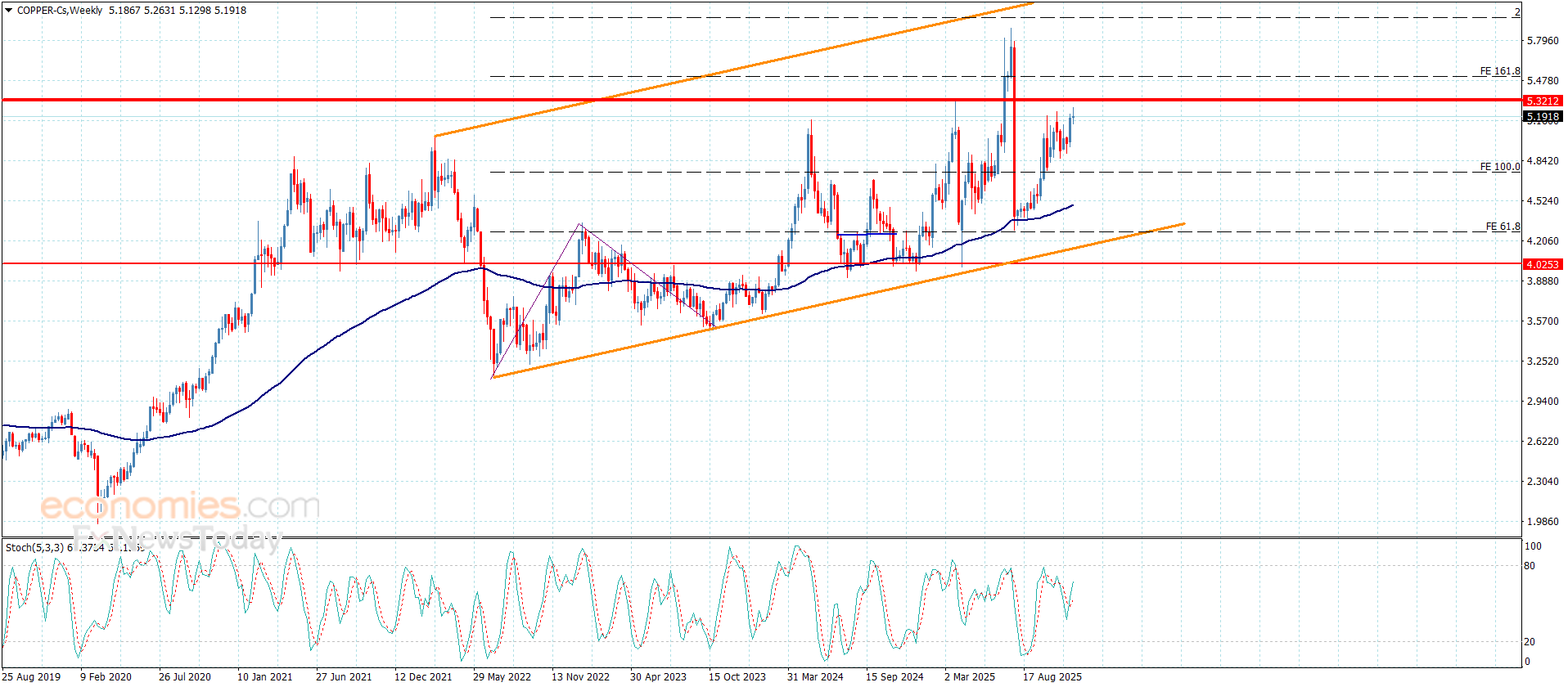
Near $5.2000, while the positive factors—particularly the alignment of major indicators supporting bullish momentum—will increase the chances of breaking this barrier and beginning to target the next positive levels at $5.3200 and $5.5000 respectively.
We note that a decline in the price during current trading below $4.9700 and a negative closing may force it into forming temporary corrective movements, attempting to test the support level at $4.7500 before any new attempt to reach the suggested targets.
Expected trading range for today: between $5.1200 and $5.3200
Price forecast for today: Bullish
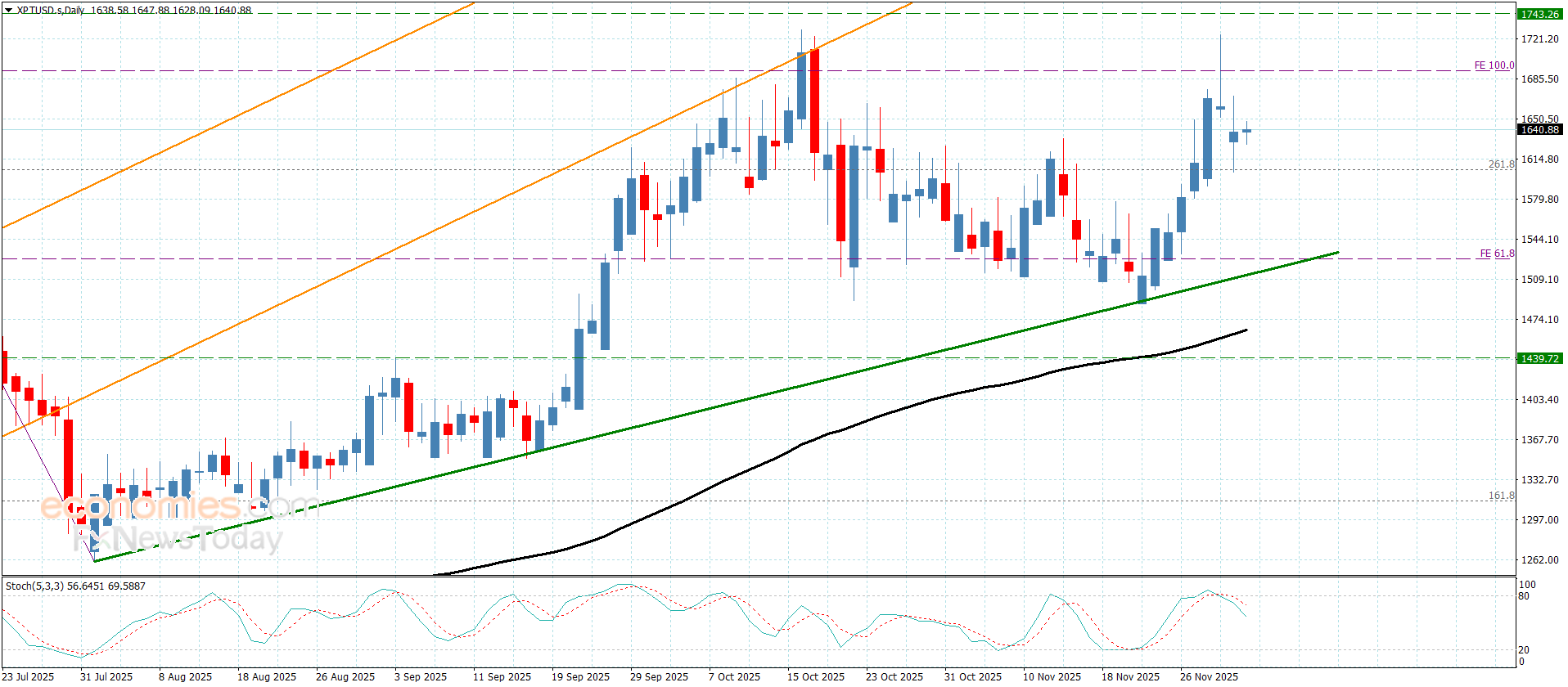
Platinum price maintained its positive stability during yesterday’s trading above the $1,605.00 level, which currently serves as additional support. This reinforces the dominance of the previously suggested bullish trend as the price fluctuates near $1,640.00.
We emphasize the importance of the price accumulating additional bullish momentum, which would enable it to form strong upward waves, allowing it to break through the $1,695.00 level and then extend gains toward the next main target located near $1,745.00.
Expected trading range: between $1,620.00 and $1,695.00
Price forecast for today: Bullish