The main tag of GoldPrice Articles.
You can use the search box below to find what you need.
[wd_asp id=1]
The main tag of GoldPrice Articles.
You can use the search box below to find what you need.
[wd_asp id=1]
The EURJPY pair continued providing weak sideways trading by its repeated fluctuation near 172.00 level, reducing its effect as an extra barrier, taking advantage of providing positive momentum by stochastic rally above 50 level.
Reminding you that resuming the bullish attack requires forming several strong bullish waves, to reach the resistance at 173.40, to begin recording new gains by its rally towards 174.10, reaching the main target at 175.15.
The expected trading range for today is between 171.70 and 173.40
Trend forecast: Bullish
The (silver) price declined in its last intraday trading, after it succeeded in breaching the current resistance at $38.70, gathering the gains of its rises, attempting to gain bullish momentum that might help it to recover and rise again, and it attempts to offload some of its clear overbought conditions on the (RSI), especially with the emergence of negative overlapping signals from there, amid the continuation of the positive support that comes from its trading above EMA50, and under the dominance of the main bullish trend and its trading alongside a minor supportive line for this trend on the near-term basis.
BestTradingSignal.com – Professional Trading Signals with high accuracy. Subscribe now to tailored packages for the world’s leading markets and receive signals instantly via Telegram from an expert team:
Check full VIP signals performance report for the week of August 18–22, 2025: Full Report
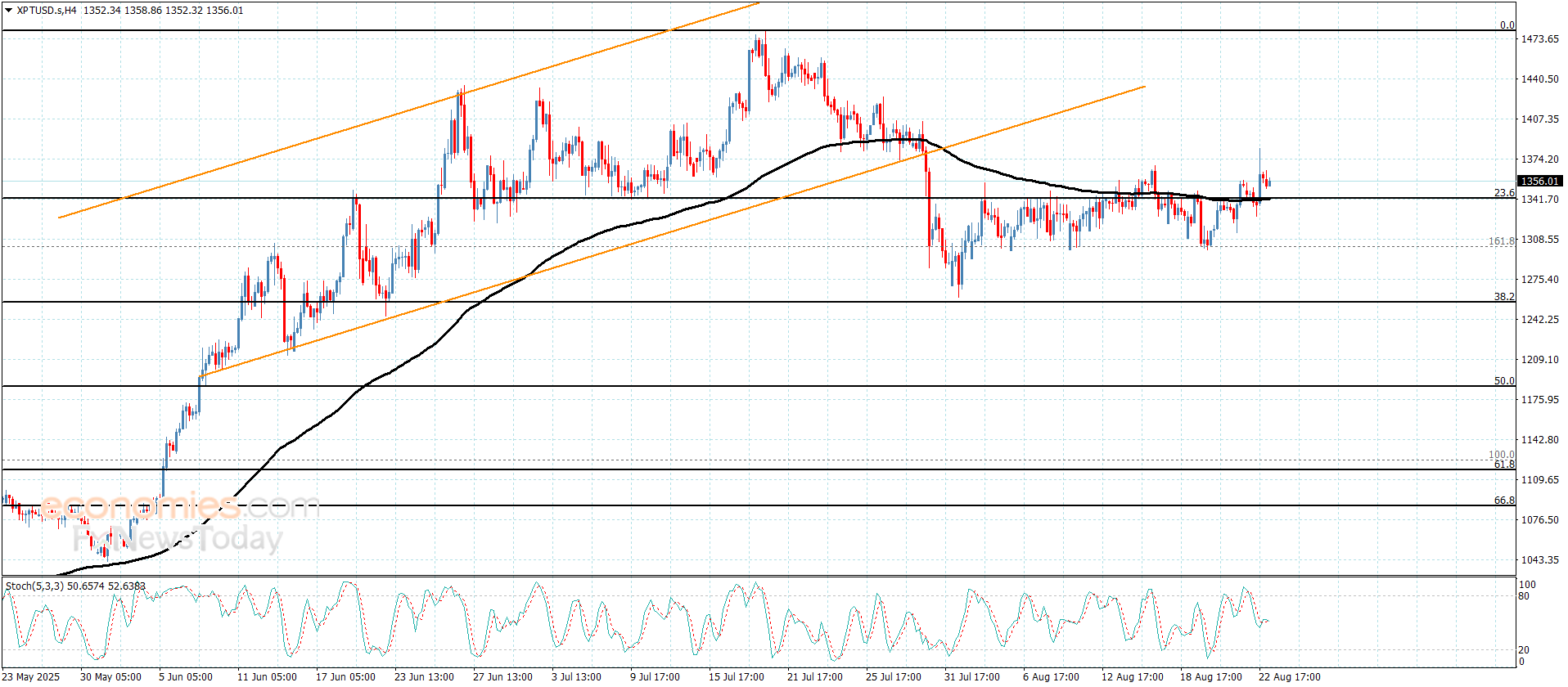
Platinum price took advantage of its repeated positive stability above the breached obstacle level at $1342.00, besides providing positive momentum by the main indicators, achieving the suggested targets by hitting $1383.60, to force it to provide some sideways trading by its fluctuation near $1355.00.
By the above image, we notice the stability of the moving average 55 near $1342.00 level, reinforcing the chances for forming an important extra support level, increasing the efficiency of the bullish track, to expect reaching $1383.00 and surpassing it will form the next main target for the bullish track at $1420.00 level.
The expected trading range for today is between $1340.00 and $1383.00
Trend forecast: Bullish
The Gold price (XAU/USD) edges lower to around $3,365 during the early Asian session on Monday, pressured by a firmer US Dollar (USD). Nonetheless, rising optimism of a September rate cut following comments by Federal Reserve (Fed) Chair Jerome Powell at the Jackson Hole symposium might cap the downside for the yellow metal.
The Fed’s Powell has opened the door to a rate reduction in the September meeting, but that position could become complicated if inflation pressures continue to rise. Powell added that the US economy is facing a “challenging situation,” with inflation risks now tilted to the upside and employment risks to the downside.
Traders are now pricing in nearly an 85% possibility of a 25 basis points (bps) rate cut next month, up from 75% before the speech, according to the CME FedWatch tool. Dovish remarks from Powell could provide some support to the precious metal, as lower interest rates could reduce the opportunity cost of holding Gold.
Additionally, the escalating tensions between Russia and Ukraine might contribute to the gold’s upside. Ukrainian President Volodymyr Zelensky said that the country would continue to fight for its freedom “while its calls for peace are not heard,” in a defiant address to the nation on its independence day, per BBC. His comments came after Moscow said Ukraine had attacked Russian power and energy facilities overnight, blaming drone attacks for a fire at a nuclear power plant in its western Kursk region.
Gold traders will keep an eye on the preliminary reading of the US Gross Domestic Product (GDP) for the second quarter (Q2), which will be released later on Thursday. The US economy is expected to grow at an annual rate of 3.0% in Q2. In case of a stronger-than-expected outcome, this could boost the Greenback and weigh on the USD-denominated commodity price.
Gold has played a key role in human’s history as it has been widely used as a store of value and medium of exchange. Currently, apart from its shine and usage for jewelry, the precious metal is widely seen as a safe-haven asset, meaning that it is considered a good investment during turbulent times. Gold is also widely seen as a hedge against inflation and against depreciating currencies as it doesn’t rely on any specific issuer or government.
Central banks are the biggest Gold holders. In their aim to support their currencies in turbulent times, central banks tend to diversify their reserves and buy Gold to improve the perceived strength of the economy and the currency. High Gold reserves can be a source of trust for a country’s solvency. Central banks added 1,136 tonnes of Gold worth around $70 billion to their reserves in 2022, according to data from the World Gold Council. This is the highest yearly purchase since records began. Central banks from emerging economies such as China, India and Turkey are quickly increasing their Gold reserves.
Gold has an inverse correlation with the US Dollar and US Treasuries, which are both major reserve and safe-haven assets. When the Dollar depreciates, Gold tends to rise, enabling investors and central banks to diversify their assets in turbulent times. Gold is also inversely correlated with risk assets. A rally in the stock market tends to weaken Gold price, while sell-offs in riskier markets tend to favor the precious metal.
The price can move due to a wide range of factors. Geopolitical instability or fears of a deep recession can quickly make Gold price escalate due to its safe-haven status. As a yield-less asset, Gold tends to rise with lower interest rates, while higher cost of money usually weighs down on the yellow metal. Still, most moves depend on how the US Dollar (USD) behaves as the asset is priced in dollars (XAU/USD). A strong Dollar tends to keep the price of Gold controlled, whereas a weaker Dollar is likely to push Gold prices up.
Gold (XAU/USD) has decoupled from traditional supply-demand commodity dynamics, with pricing power increasingly concentrated in the hands of conviction buyers. Goldman Sachs research shows that roughly 70 percent of monthly price swings in gold are explained not by mine output but by central bank accumulation, ETF flows, and speculative positioning. A single block of 100 tonnes of net purchases by these conviction players can directly add upward pressure to gold’s price. This marks a sharp departure from oil or natural gas where higher prices typically spur new supply. In gold, higher prices rarely trigger liquidation because emerging-market households seldom sell, and mine production remains broadly inelastic regardless of price.
Central banks have transitioned from net sellers into structural buyers of gold, a reversal that accelerated after the global financial crisis and intensified following the freezing of Russia’s reserves in 2022. The reasoning is simple: gold held domestically cannot be seized, unlike foreign-held reserves. Emerging-market monetary authorities from Asia to Latin America have multiplied their gold holdings fivefold since then, altering the historical correlation between interest rates and bullion. This shift explains why gold prices have continued to rise despite intermittent ETF outflows, with sovereign demand overwhelming private selling.
The latest catalyst came from Federal Reserve Chair Jerome Powell’s speech at Jackson Hole. By explicitly recognizing labor-market weakness and stating that the balance of risks had shifted, Powell sent markets scrambling to reprice policy expectations. September rate cut odds surged from 72 percent to 91 percent within hours. Gold reacted instantly, rallying 1.07 percent to close the week at $3,371.23, marking a $35.53 daily gain and reclaiming bullish momentum after bouncing from the key pivot at $3,310.48. The U.S. Dollar Index closed at 97.732, down 0.11 percent, while the 10-year Treasury yield fell to 4.256 percent, removing critical headwinds and reinforcing gold’s breakout attempt.
The confirmation of $3,310 as weekly support has shifted traders’ attention to the resistance cluster at $3,409.43. A weekly close above that opens the path toward $3,439, $3,451, and the record peak at $3,500.20. Momentum indicators confirm the bullish undertone, yet sellers remain active around $3,400 where psychological resistance is strongest. If profit-taking triggers a pullback, dip buyers are expected to defend the 50-day moving average near $3,350, followed by the 20-day at $3,345 and the 100-day at $3,309. Downside risks expand if those levels break, exposing $3,268 and potentially $3,120, but so far the price action shows buyers willing to step in above $3,310.
The coming week is critical, with jobless claims and Core PCE inflation scheduled. Traders will watch Thursday’s claims print at 12:30 GMT closely, as Powell has tied future policy to labor stability. A weak claims number could cool easing bets, but a soft PCE on Friday would reignite the rally. Expectations center on a 0.3 percent monthly PCE increase. If inflation cools and claims remain elevated, gold could pierce $3,409 and extend into the mid-$3,400s. Any upside surprise in inflation, however, may stall the breakout.
The $3,400 level has emerged as a battleground. Bears are layering shorts near this threshold, betting on a dollar rebound, while bulls remain emboldened by Powell’s shift. Despite short-term turbulence, gold has gained 3.8 percent in the past month and a stunning 43 percent year-on-year. This performance underscores its safe-haven appeal amid tariff conflicts and global trade friction. Recent commentary from Fed officials including Michelle Bowman, who hinted at three cuts in 2025, further fuels bullish conviction. Futures markets currently price an 89 percent chance of a September cut, reinforcing expectations that dips will be bought aggressively.
Gold’s year-long resilience rests not only on central banks and ETFs but also on opportunistic household demand in emerging markets, which consistently absorbs supply without selling into rallies. That storage behavior creates a sticky demand base that keeps supply off the market. At the same time, ETF flows, though slower to react, magnify Fed policy shifts. With inflation pressures easing and employment data softening, the macro landscape continues to favor bullion over yield-bearing assets. Structurally, the 3,310 support zone remains the key defense line for bulls, while a decisive break of 3,409 would reset targets toward 3,452 and 3,500.
All current data points to a constructive view. Central banks remain net buyers, ETFs are positioned to respond positively to any further dovish tilt, and speculative profit-taking has been absorbed at higher lows. Gold at 3,371 sits comfortably above major support, with upside potential unlocked if $3,409 is cleared. Near term volatility will hinge on PCE and jobless claims, but the structural bull cycle driven by central bank conviction and weakening yields remains intact. The rating is Buy, with targets stretching toward 3,452 and 3,500 provided that the $3,310 floor continues to hold.
The gold market entered the final stretch of August with renewed bullish momentum, as spot gold (XAU/USD) closed the week at $3,373.89 per ounce, while U.S. gold futures settled even stronger at $3,418.50. The move was powered by dovish language from Federal Reserve Chair Jerome Powell at the Jackson Hole symposium, where he emphasized that risks are tilting toward softer growth and possible rate cuts in September. The probability of a 25 basis point cut surged to 85%, up from 75% just hours before Powell’s speech, according to CME FedWatch. That pivot translated immediately into a weaker U.S. dollar, down roughly 1% on the day, which amplified demand for non-yielding safe havens like gold.
The dollar’s sharp decline opened the door for gold to extend its breakout, and the correlation was direct. As yields on the 10-year U.S. Treasury eased to 4.26%, traders rotated capital into metals, lifting gold alongside silver, which spiked 2.2% to $39.01, while platinum and palladium registered firm gains. The RSI on gold rose to 66, showing bullish momentum without flashing overbought, while the MACD printed a bullish crossover, confirming the strength of the rally. Volume supported the upside, with conviction buying accelerating on the breakout above $3,342, where the 50-period SMA had capped previous attempts.
For much of the prior week, gold had consolidated in a triangular range between $3,313 and $3,378. Friday’s breakout candle marked a decisive shift from indecision to conviction. Traders are now eyeing the $3,405 resistance, followed by $3,433, which capped the July advance. Support lies at $3,351–$3,342, the breakout zone, with the next critical floor at $3,313. A daily close above $3,378 solidifies the bullish setup, with targets extending toward $3,500 in the medium term. If gold fails to hold above $3,313, however, momentum could reverse back to sellers, with $3,250 the next defensive line.
U.S. economic data last week painted a mixed picture. Jobless claims climbed to 235,000, the fastest rise in nearly three months, underscoring cracks in the labor market. Meanwhile, PMI readings surprised to the upside, and housing remains soft, pointing to a fragile growth environment. Powell’s acknowledgment of “shifting risks” was a direct nod to balancing full employment with price stability, a comment that markets interpreted as a green light for rate easing. Against this backdrop, gold’s safe-haven function remains intact, especially with upcoming catalysts like U.S. GDP (forecast 3.1% vs. prior 3.0%) and Core PCE inflation (expected +0.3%) set to shape Fed timing. Stronger growth could temporarily weigh on gold by reducing cut expectations, while weaker numbers may accelerate flows into XAU/USD.
Beyond the Fed, one of the strongest structural drivers for gold remains central bank accumulation. Goldman Sachs estimates that 100 tonnes of net central bank purchases translate into a 1.7% rise in gold prices. With global mine output relatively stable and inelastic, flows from conviction buyers like ETFs, sovereigns, and speculators are disproportionately impactful. Emerging-market central banks have been particularly aggressive buyers since the freezing of Russian reserves in 2022, a shift that redefined gold as the “unfreezable reserve asset.” This sovereign accumulation has offset ETF outflows at times, anchoring support under gold even during corrective phases.
Physical demand has shown regional divergences. In India, jewelers resumed restocking ahead of festival season, while demand in China has been tempered by volatility in yuan-denominated prices. Still, Asian retail demand typically reinforces support zones, cushioning pullbacks when Western paper markets trigger liquidations. With total global demand surpassing 4,900 tonnes in 2023, and central banks adding over 1,000 tonnes to reserves, the underlying bid remains firm even when speculative activity fluctuates.
The geopolitical layer cannot be overlooked. Domestically, President Donald Trump has intensified political pressure on the Fed, even threatening to dismiss Governor Lisa Cook, an unusual intervention that highlights institutional strain. Abroad, escalating tensions between Russia and Ukraine, particularly Putin’s demand for full control of Donbas and rejection of NATO expansion, remind investors of the enduring geopolitical hedge value of gold. Historically, such periods of uncertainty push gold well beyond fair-value models, as buyers seek refuge in the only globally liquid asset outside sovereign control.
Gold’s latest move has traders zeroed in on clear inflection points. The wide-bodied bullish candle carved out on Friday at $3,342 signaled a break from weeks of hesitation, shifting sentiment firmly back to the buyers. Momentum gauges back that shift: the RSI is climbing without yet being stretched, and the MACD has swung positive, underscoring strength behind the move. Positioning now favors buying into pullbacks around the breakout zone of $3,351–$3,342, with $3,313 marked as the line that would invalidate the setup. Upside targets are well defined at $3,405 and $3,433, where supply capped previous rallies. ETF flows remain soft, with modest outflows persisting, but the scale of central-bank and sovereign accumulation still sets the tone—big, conviction buyers are dictating direction even when shorter-term sentiment looks uneven.
The market remains above the long-term pivot at $65.38, supported further by the 200-day moving average at $63.99 and the 50-day at $62.10. The crossover of the 200-day above the 50-day signals a bullish bias in the broader trend. Price action continues to consolidate within this structure, awaiting a breakout catalyst.
Traders are closely tracking U.S. President Donald Trump’s tightened ultimatum on Russia, demanding progress toward ending the war in Ukraine within 10 to 12 days. The administration is threatening 100% secondary tariffs on countries continuing to trade Russian oil, a move aimed squarely at China and India—Moscow’s largest customers.
Analysts at JP Morgan expect India to comply with U.S. demands, potentially displacing 2.3 million bpd of Russian barrels. China, on the other hand, is unlikely to bend, raising the risk of tariff escalation. Treasury Secretary Scott Bessent warned that China could face significant duties if it maintains its Russian crude intake.
PVM’s John Evans noted that any resulting gap in global supply would take time to fill, even if Saudi Arabia and OPEC step in. This lag adds further support to near-term prices. Vanda Insights estimates a $4–$5 per barrel risk premium is already baked in.
Adding to supply-side pressure, Mexico’s Pemex slashed exports by 39% year-over-year in June, down to 458,103 bpd—the lowest monthly volume since records began in 1990. The drop aligns with Mexico’s ongoing push for energy “sovereignty,” prioritizing domestic refining. Output remains constrained at 1.6 million bpd, well below the company’s stated goal of 1.8 million.
Pemex also reduced refined product imports by 38% last month as its new Olmeca refinery absorbed more feedstock. While the company aims to boost production via private partnerships, execution remains limited.
Price action confirmed a breakout of a small falling wedge pattern. The initial target from the wedge points to the start of the pattern at the recent swing high of $3,409. A move through that level may lead to testing resistance along the top boundary of a symmetrical triangle consolidation. Traders should watch how gold reacts near $3,409, as it may either encounter resistance or signal a further upside breakout.
The current short-term upswing began at the recent swing low (C), suggesting momentum may not yet be strong enough to breach the triangle boundary decisively. A daily close above $3,439 would serve as a more definitive breakout trigger, confirming a sustained bullish move. Until that occurs, any advance should be viewed with caution, as breakouts are prone to failure without follow-through confirmation.
A breakout above this week’s high would trigger a weekly reversal and add to bullish momentum for gold. Conversely, a drop below $3,268 would undermine the short-term bullish case. On the monthly chart, gold is positioned to potentially end the period at its highest-ever monthly close. Even without a triangle breakout, such a close would be a strong bullish signal for the medium-term trend.
Traders should monitor $3,409 as the initial upside target and $3,439 as the confirmed breakout level. Support near $3,268 remains critical to watch for potential downside risk. Until either a clear breakout or a failure occurs, gold is in a decision zone that could define the next major directional move.
For a look at all of today’s economic events, check out our economic calendar.
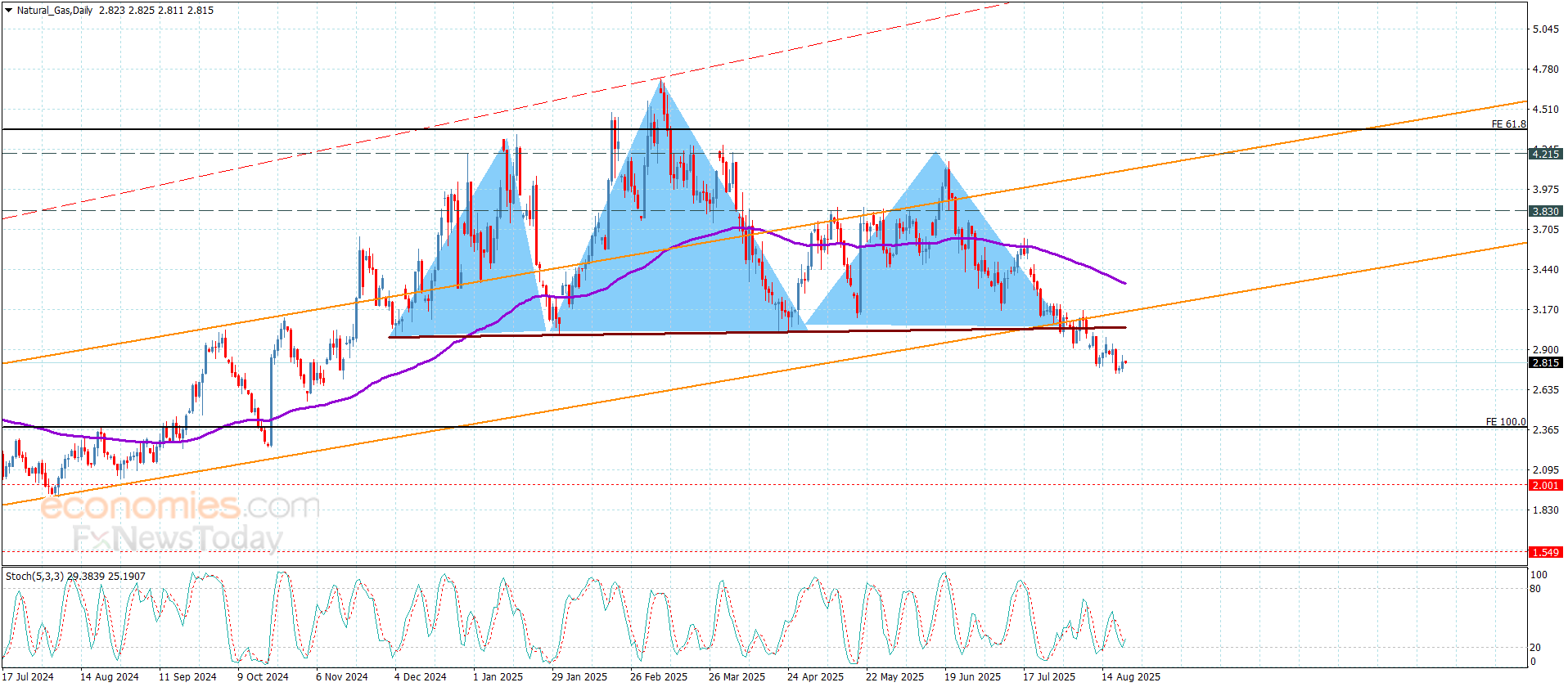
Recent price action shows that natural gas was never able to push through the short downtrend line created during the declining consolidation phase. That failure left the market exposed, and when long-term support finally gave way after multiple tests, it triggered a decisive shift lower. Momentum has since accelerated, reinforcing the dominance of sellers.
The next measured move lower is defined by a falling ABCD pattern, which projects to $2.63. However, given the strength of the decline, that level may offer little more than a temporary pause. A more significant confluence of support lies below, between $2.54 and $2.51. This zone combines both Fibonacci projections and prior swing activity, making it an important area where traders may watch for stabilization or reversal signals.
Natural gas continues to trade beneath the midline of a descending trend channel. This positioning keeps pressure directed toward the channel’s lower boundary, which aligns closely with the $2.54 area. Adding weight to this outlook is a declining trendline drawn from the 2023 peak, which could converge with price zone if weakness extends further. The overlap of channel and trendline support makes the lower zone technically significant.
The weekly chart is turning decisively negative. A close near the lows of the week underscores sustained selling pressure and the lack of meaningful buying interest. Long candles at trend lows often indicate exhaustion, but so far, the bears are clearly in chart. This leaves natural gas vulnerable to additional declines in the near term.
For buyers to regain conviction, natural gas would need to reclaim $2.85, the interim swing high from Thursday. Only a decisive and sustained move above that level would begin to challenge the prevailing bearish structure. Until then, the path of least resistance remains lower, with traders watching for reactions at deeper support.
For a look at all of today’s economic events, check out our economic calendar.
The GBPJPY pair provided temporary positive trading, attempting to recover some of its losses by its rally to 199.35, to begin declining affected by stochastic negativity, approaching from 20 level as appears in the above image.
The attempts of forming an extra barrier at 199.60 level confirms the price confinement within the bearish track, to keep preferring the negative attempts, that might target 198.20 reaching 197.45, to face 61.8%Fibonacci correctional level.
The expected trading range for today is between 198.20 and 199.40
Trend forecast: Bearish