The main tag of GoldPrice Articles.
You can use the search box below to find what you need.
[wd_asp id=1]
The main tag of GoldPrice Articles.
You can use the search box below to find what you need.
[wd_asp id=1]
The (silver) price declined in its last trading on the intraday levels, affected by breaking a minor bullish trend line on the short-term basis, surpassing the support of its EMA50, forming more of the negative pressure on the price, on the other hand, we notice the emergence of the positive signals on the (RSI), after reaching oversold levels, indicating the beginning of forming a positive divergence from there, providing positive momentum that assists it to recover if its current support settles.
Get high-accuracy trading signals delivered directly to your Telegram. Subscribe to specialized packages tailored for the world’s top markets:
Full performance report available here:
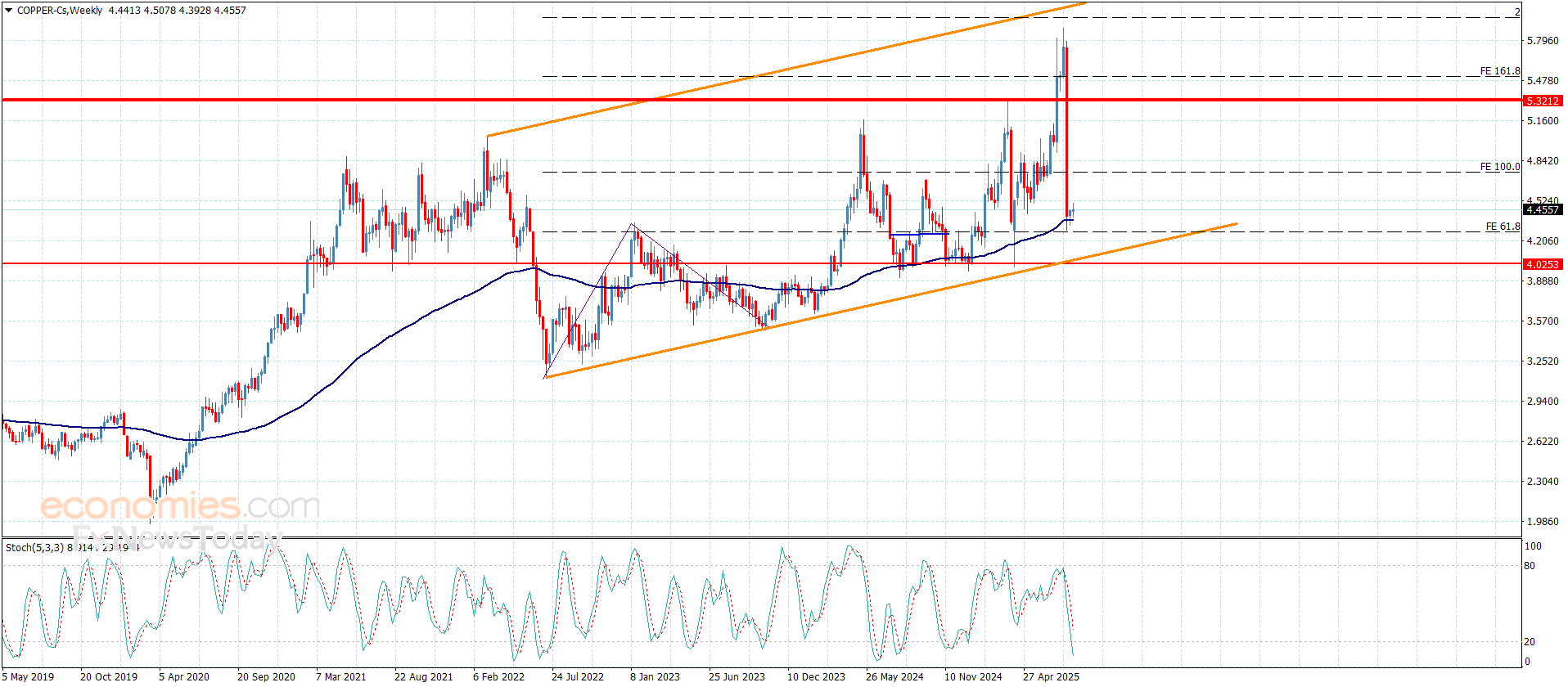
Copper price returned to form weak and sideways trading, attempting to face stochastic negativity that is located within the oversold level, to keep the main stability above the main bullish channel’s support at $4.0500.
The attempt of the moving average 55 to reinforce the stability of the extra support at $4,2600 might help it to provide some positive momentum, to ease the mission of targeting the positive stations near $4.6300 and $4.7400.
The expected trading range for today is between $4.3700 and $4.6300
Trend forecast: Bullish
Despite the stability of the EURJPY pair’s stability until this momentum within the levels on the bullish channel, but there are several negative factors that began from providing negative momentum by stochastic, and the stability below 172.00 that forms an important obstacle against the bullish trading, these factors help to confirm the dominance of the bearish correctional track, to keep waiting for targeting the initial support at 170.45, and breaking it will force the price to suffer new losses by reaching 169.45.
While regaining the bullish bias requires forming strong bullish rally, to step above 172.00, attacking the resistance at 173.40 to find an exit to achieve new gains in the upcoming period trading.
The expected trading range for today is between 170.45 and 172.60
Trend forecast: Bearish
For several days, natural gas has been testing support around the 78.6% Fibonacci retracement of a prior upswing. This appears to be a pause in the downtrend, and the expectation remains that the bear trend will resume once the short-term consolidation phase is complete. If a bounce occurs first, the behavior of price near potential resistance zones should reveal more about shifting supply and demand dynamics.
Tuesday’s sharp decline marked a decisive break below a critical support area that had been tested repeatedly in recent weeks. This zone was defined by the confluence of a long-term uptrend line and an anchored volume-weighted average price (AVWAP) from the 2024 trend low. Also included was the April swing low at $2.86, which served as an extended boundary for the zone.
Once $2.86 was broken, a bearish continuation signal was triggered, confirming the continuation of an ABCD decline from the March trend high. The bearish signal was reinforced by a daily close below $2.86. It will establish longer-term bearish confirmation on the weekly chart if the week finishes below that price.
Downside projections begin with $2.63, the completion of a smaller descending ABCD pattern (purple). Below that, the next target is the 78.6% retracement of a larger upswing than the earlier Fibonacci measure. Given the recent long-term breakdown through major support, the technical bias favors lower levels before the current bearish correction runs its course.
If a rally develops and clears the two-day high of $2.85, natural gas could stage a countertrend move toward a resistance zone between $2.96 and $3.07. The lower end of this zone aligns with the AVWAP level, while the upper boundary is defined by the declining 20-Day moving average. As the 20-Day MA continues to fall, the top of the resistance range will gradually shift lower.
For a look at all of today’s economic events, check out our economic calendar.
International Paper Company (IP) stock rose slightly in its latest intraday trading, attempting to recover part of previous losses while also trying to relieve some of the oversold pressure apparent on the Relative Strength Index indicators, especially as positive signals begin to appear. However, the stock’s recent rise faced resistance from the 50-day SMA, with the medium-term trend still under bearish control.
Therefore, we expect the stock price to decline in its upcoming trading, as long as the 48.50$ resistance holds, targeting the key support level of 43.55$.
Today’s price forecast: Bearish
Spot Gold pressures a fresh weekly low around the $3,330 level in the American session on Thursday, amid resurgent US Dollar (USD) demand. Financial markets were shocked by recent United States (US) inflation-related figures, as, following the release of a benign July Consumer Price Index (CPI) earlier in the week, the Producer Price Index (PPI) in the same period was much hotter than anticipated.
Inflation at wholesale levels in the US surged at an annualised pace of 3.3% in July according to the PPI, while the core annual reading printed at 3.7%, much higher than the 2.6% posted in June or the expected 2.9%. The figures weighed down hopes for an interest rate cut in September, but a rate cut remains on the table. According to the FedWatch Tool, a rate cut of 25 basis points (bps) is 90.4% possible in September, compared to the 94.3% from before the PPI release.
Wall Street turned south with the news, with the three major indexes trading in the red at the time. At the same time, demand for the USD returns, resulting in a modest XAU/USD retracement despite the softer mood.
Friday will bring the US July Retail Sales and the preliminary estimate of the August Michigan Consumer Sentiment Index.
The daily chart for the XAU/USD pair shows that it has been trading within a limited intraday range, just below a flat 20 Simple Moving Average (SMA), providing dynamic resistance at around $3,357. The same chart shows the 100 SMA keeps grinding north, albeit losing its upward momentum at around $3,301.80. Finally, technical indicators remain within neutral levels, with the Relative Strength Index (RSI) indicator turning marginally lower, in line with the ongoing weakness.
In the near-term, and according to the 4-hour chart, the risk skews to the downside. The XAU/USD pair develops below all its moving averages, with the 20 SMA gaining downward traction between directionless 100 and 200 SMAs. At the same time, technical indicators turned flat, although within negative levels, reflecting the latest bounce but far from suggesting additional recoveries.
Support levels: 3,328.10 3,312.25 3,301.80
Resistance levels: 3,350.00 3,372.30 3,389.85
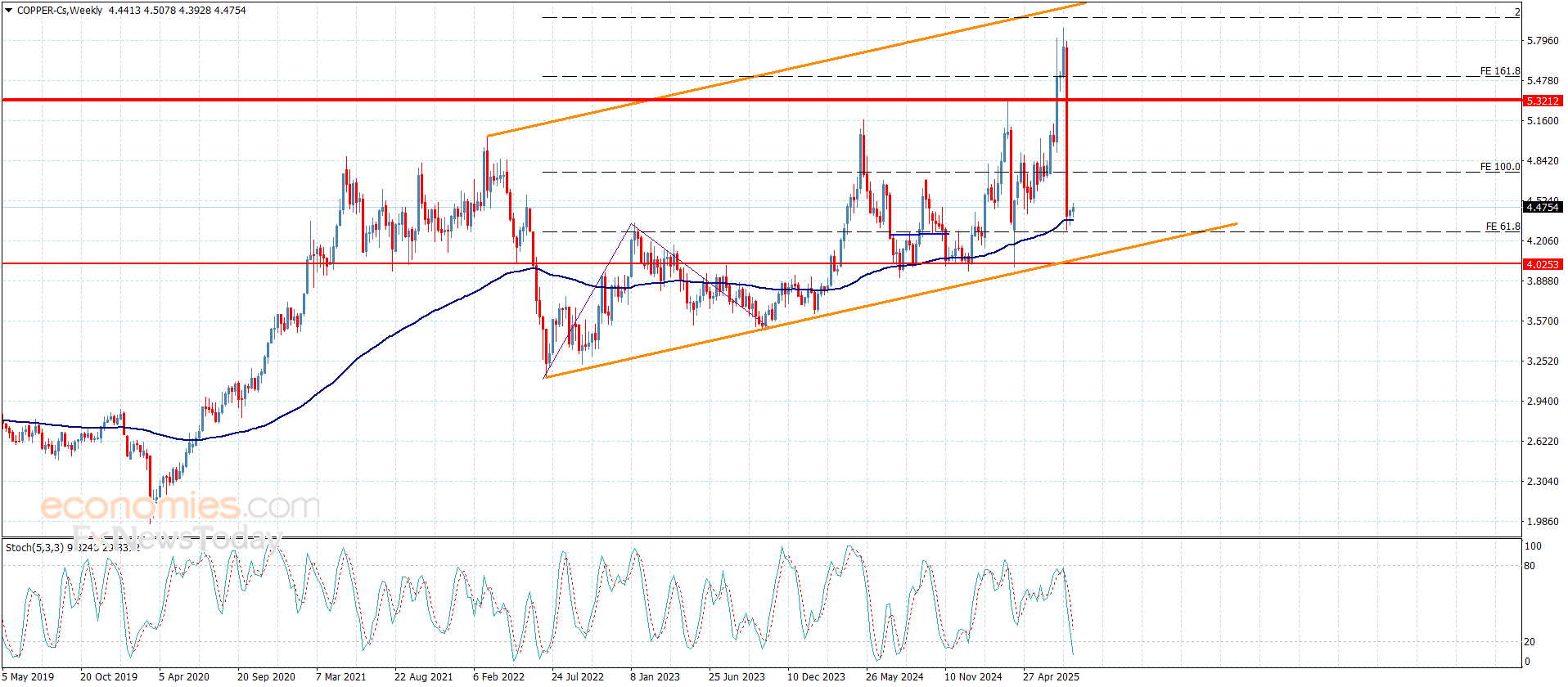
Copper price kept its positive stability above the moving average 55 to keep the continuation of the suggested positivity that depends on the stability of the bullish channel’s support at $4.0500, to notice the weakness of the bullish attempts due to the continuation of stochastic contradiction that is fluctuating now within the oversold level.
Gaining the required extra positive momentum, to motivate the bullish attack, to expect attacking the initial positive target at $4.7400, and surpassing it will make it record several gains in the upcoming period trading.
The expected trading range for today is between $4.3700 and $4.6300
Trend forecast: Bullish
Gold is looking to extend the break above the $3,350 psychological barrier in the Asian trades on Thursday. Gold keeps the green for the third consecutive day, awaiting the US Producer Price Index (PPI) and Jobless Claims data for fresh trading incentives.
Following tame July Consumer Price Index (CPI) and soft labor data from the United States (US), markets have doubled down on their expectations of interest rate cuts by the US Federal Reserve (Fed) this year.
A 25 basis points (bps) rate cut its now fully priced in next month, with some industry experts and even US officials calling for a 50 bps reduction.
On Wednesday, US President Donald Trump called for rates at 1% while Treasury Secretary Scott Bessent on Wednesday called for a “series of rate cuts,” and said the Fed could kick off the policy easing with a half-point cut.
Intensifying dovish sentiment surrounding the Fed keeps the US Dollar (USD) undermined near two-week troughs against its six major currency rivals, providing the much-needed zest to Gold buyers amid a mostly risk-on market environment.
The latest chatter that Trump is considering BlackRock’s Rick Rieder as one of the candidates as new Fed Chairman exacerbated the pain in the Greenback. Rieder argued that he sees scope for a 50 bps Fed cut in September after a downside surprise in the US consumer inflation data.
Additionally, rife concerns over the Fed’s independence and economic prospects remain a drag on the USD, painting a positive picture for the non-yielding/ USD-denominated Gold.
The annual US PPI and core PPI are seen rising by 2.5% and 2.9% in July, respectively while the monthly CPI inflation is expected to tick higher 0.2% in the same period. The core CPI is also seen advancing by 0.2% over the month in July.
An unexpected slowdown in the factory-gate prices could ramp up the odds of a big rate cut, fuelling a fresh rally in Gold while spelling doom for the buck.
The reaction to the US data could be limited as traders turn their attention to Friday’s meeting between Trump and Russian President Vladimir Putin in Alaska on the Ukraine peace deal.
The daily chart leans bullish for Gold as the Relative Strength Index (RSI) remains above the midline.
Buyers need to crack the static resistance near $3,380 to unleash additional upside toward the intermittent highs of $3,440. Ahead of that, the $3,400 round level will be put to the test.
On the downside, 50-day Simple Moving Average (SMA) at $3,350 offers immediate support, a break below which sellers will target the 100-day SMA at $3,302.
Deeper declines will challenge the July 31 low of $3,274.
The oil market could be even more oversupplied at the end of this year than previously expected amid tepid demand growth and surging supply from both OPEC+ and non-OPEC+ producers, the International Energy Agency (IEA) said on Wednesday.
Global oil demand is now expected to rise by just 680,000 barrels per day (bpd) this year, and by 700,000 bpd in 2026, to reach 104.4 million bpd next year, the IEA said in its monthly Oil Market Report out today.
The latest forecasts are a downward revision of 20,000 bpd in demand growth estimates from the July report—the fifth consecutive from the agency, which has slashed its projection for the 2025 oil demand growth by a combined 350,000 bpd since the beginning of the year.
The latest downgrade reflects “lacklustre demand across the major economies and, with consumer confidence still depressed, a sharp rebound appears remote,” the IEA said.
Consumption in emerging and developing economies has been weaker than expected, with China, Brazil, Egypt and India all revised down compared with last month’s report, the Paris-based agency noted.
The only bright spot in demand has been jet fuel demand, which is on track to increase by 2.1% this year, the strongest of any product, said the IEA. But the agency noted that the overall projected jet fuel consumption of 7.7 million bpd in 2025 would still be about 180,000 bpd lower compared to the 2019 pre-Covid level.
While the IEA downgraded its demand growth estimate, again, it hiked its global supply growth forecast by 370,000 bpd to 2.5 million bpd this year, after the eight OPEC+ members agreed earlier in August to boost output by 547,000 bpd in September, fully unwinding their 2.2 million bpd cuts agreed to in November 2023.
The IEA said that sanctions on Russia and Iran could curb supplies from these producers, but noted that “oil market balances look ever more bloated as forecast supply far eclipses demand towards year-end and in 2026.”
As usual, the IEA is much more bearish on oil demand growth than OPEC, which said in its own report on Tuesday that demand in 2026 is set to strengthen on the back of expected stronger economies in key oil-consuming regions.
By Michael Kern for Oilprice.com
More Top Reads From Oilprice.com
The triangle pattern has formed near the top of gold’s long-term uptrend, generally signaling potential for an eventual upside breakout. Yet its clarity also means surprises are possible. A breakout that fails could quickly reverse, leading to a sharp swing in the opposite direction. Traders should remain aware of this scenario, as it has precedent. Last month, a smaller symmetrical triangle broke briefly before reversing, and then a breakdown also failed to follow through.
This led to the expanded current wider consolidation range. Patterns observed near major highs can lead to increased market volatility when false breakouts happen, highlighting the importance of effective risk management.
The triangle boundaries are defined by trendlines connecting recent swing highs and lows. An upside breakout would require a move above $3,409, followed by a push through $3,439. On the downside, a break below the lower boundary, confirmed by a drop beneath the recent higher swing low at $3,268, would show control of the bears and could lead to a deeper retracement.
If $3,268 fails as support, the next area of interest is the 38.2% Fibonacci retracement from the earlier $3,500 record high, which would act as a potential minimum downside target. While this level may hold, traders should be aware that failed breakouts or sudden reversals can push momentum further, making it important to monitor price action closely and adjust strategies as conditions evolve.
For a look at all of today’s economic events, check out our economic calendar.