The main tag of GoldPrice Articles.
You can use the search box below to find what you need.
[wd_asp id=1]
The main tag of GoldPrice Articles.
You can use the search box below to find what you need.
[wd_asp id=1]
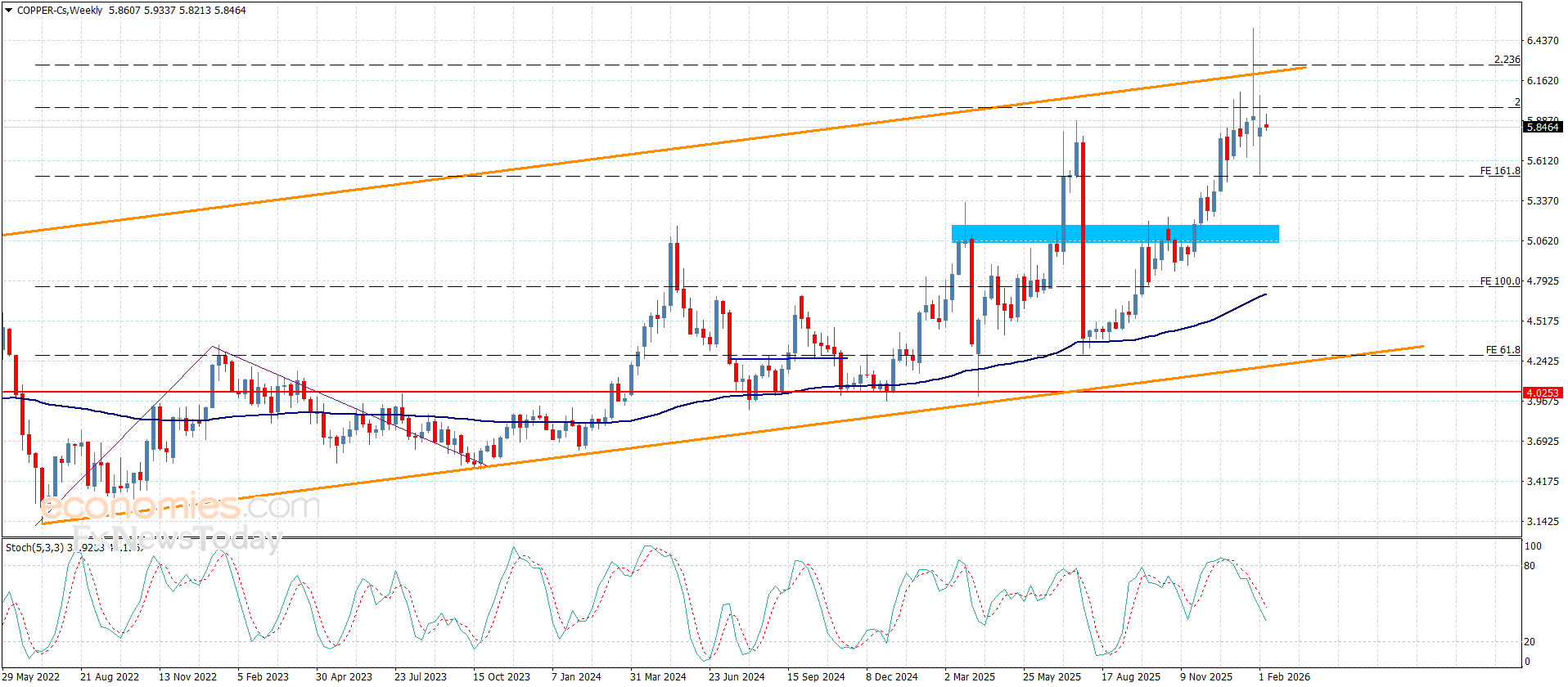
Copper prices forced to provide slow trading recently, due to the contradiction between the main indicators, fluctuating near $5.8500 level without recording any new corrective target.
Reminding you that the stability below $5.9700 barrier makes us keep the bearish corrective scenario, which might target $5.7200 level reaching $5.5100 support, while breaching the barrier will reinforce the chances of forming new bullish waves, to attempt to record extra gains by reaching $6.1200.
The expected trading range for today is between $5.5100 and $5.9500
Trend forecast: Bearish
Silver pulled back sharply from its all-time high near 121.67 in late January, dropping over 40% before finding support around the 64.00 zone in early February. The daily chart shows a falling wedge pattern forming during this correction, with price testing the lower boundary multiple times before bouncing back toward 78.00. The 50-day Simple Moving Average (SMA) sits at 75.65, providing dynamic support, while the 200 SMA at 49.13 remains well below current price action, confirming the longer-term bullish structure still holds. The Relative Strength Index (RSI) recovered from oversold conditions below 30 and now reads 53.69, suggesting neutral momentum as Silver consolidates between 70.00 and 85.00.
The 4-hour timeframe displays a potential bullish reversal setup as price broke above the upper trendline of the descending channel near 78.00. The Moving Average Convergence-Divergence (MACD) crossed above the signal line with a widening positive histogram, signaling strengthening upside momentum. Immediate resistance stands at 86.25 where the 200-period SMA on the 4-hour chart converges with the 38.2% Fibonacci retracement of the recent decline. A clean break above this confluence zone opens the path toward 92.95, the 50% retracement level, with extended targets at 101.64 if bullish momentum accelerates. Key support remains at 75.00, and failure to hold this level would bring 71.30 back into focus.
Silver is a precious metal highly traded among investors. It has been historically used as a store of value and a medium of exchange. Although less popular than Gold, traders may turn to Silver to diversify their investment portfolio, for its intrinsic value or as a potential hedge during high-inflation periods. Investors can buy physical Silver, in coins or in bars, or trade it through vehicles such as Exchange Traded Funds, which track its price on international markets.
Silver prices can move due to a wide range of factors. Geopolitical instability or fears of a deep recession can make Silver price escalate due to its safe-haven status, although to a lesser extent than Gold’s. As a yieldless asset, Silver tends to rise with lower interest rates. Its moves also depend on how the US Dollar (USD) behaves as the asset is priced in dollars (XAG/USD). A strong Dollar tends to keep the price of Silver at bay, whereas a weaker Dollar is likely to propel prices up. Other factors such as investment demand, mining supply – Silver is much more abundant than Gold – and recycling rates can also affect prices.
Silver is widely used in industry, particularly in sectors such as electronics or solar energy, as it has one of the highest electric conductivity of all metals – more than Copper and Gold. A surge in demand can increase prices, while a decline tends to lower them. Dynamics in the US, Chinese and Indian economies can also contribute to price swings: for the US and particularly China, their big industrial sectors use Silver in various processes; in India, consumers’ demand for the precious metal for jewellery also plays a key role in setting prices.
Silver prices tend to follow Gold’s moves. When Gold prices rise, Silver typically follows suit, as their status as safe-haven assets is similar. The Gold/Silver ratio, which shows the number of ounces of Silver needed to equal the value of one ounce of Gold, may help to determine the relative valuation between both metals. Some investors may consider a high ratio as an indicator that Silver is undervalued, or Gold is overvalued. On the contrary, a low ratio might suggest that Gold is undervalued relative to Silver.
The driving force today is the softer U.S. Dollar, which fell to its lowest level since January 30, down about 0.84%. A weaker dollar tends to drive up foreign demand for dollar-denominated assets like gold. The price action in both the dollar and gold suggests growing expectations for weak economic data, especially the labor market.
Last week’s Challenger January layoffs report, the mid-week ADP private-sector hirings report, and the government’s weekly initial claims report all pointed toward a feeble jobs market. This is leading investors to expect a weak U.S. Non-Farm Payrolls report on Wednesday.
According to a Reuters poll, non-farm payrolls are expected to have risen by 70,000 in January. A big miss to the downside will send investors scrambling to price in a rate cut as early as March, and that would be bad news for the dollar but good news for gold bulls. They have been on hold the past two weeks after the Fed implied at its January meeting that the focus had shifted to getting inflation under control and not labor. They felt that a premature cut in rates could boost inflation during a steady labor market period. However, a collapse in the jobs market will surely catch their eye and probably lead to increased speculation that an earlier-than-expected rate cut is forthcoming.
Providing additional support was the news that China’s central bank extended its gold-buying campaign for a 15th month in January, serving as proof that the dollar debasement trade is alive and well.
Finally, geopolitical concerns have kept a steady floor under the market to go along with China’s gold purchases. This is good for the long-term bullish foundation. Short-term, the market seems to be shedding its weaker buyers with excessive price swings, heightened volatility, and margin hikes by the CME Group. The market now looks as if it is getting ready to launch another rally, but buyers aren’t hitting offers yet without near-term catalysts. This extra confidence boost could come from Wednesday’s NFP report and/or Friday’s CPI data.
NEW YORK, Feb 9, 2026, 06:48 EST — Premarket
U.S. natural gas prices slumped nearly 7% early Monday. The March NYMEX contract dropped 25.2 cents, trading near $3.17 per million British thermal units (mmBtu). 1
The drop is significant, with traders still dealing with the aftermath of a sharp winter reversal. Late January’s cold snap squeezed supply, but now shifting weather models are dragging demand lower. Utilities and LNG-linked players? Lately, it’s those two-week temperature forecasts that have been steering the price action above all else.
LSEG reported average gas production in the Lower 48 hitting 106.9 billion cubic feet per day so far in February. Demand — factoring in exports — is set to slide from 159.5 bcfd this week to 141.4 bcfd next week, and then to 132.6 bcfd in two weeks. Meteorologists expect most of the U.S. to stay on the warmer side through Feb. 21, though the Northeast could hang onto colder temps for several days. LSEG also estimated average flows to the eight major U.S. LNG export facilities at 18.5 bcfd for the month. 2
It’s a bearish tilt for traders heading into late February, with supply staying strong, demand losing steam, and LNG prices hovering close to the upper end of their recent band. Sure, storage remains part of the conversation—but as the warmer forecast sticks, that angle is quickly losing its punch.
Commodity Weather Group is calling for warmer-than-usual conditions to stick around the Midwest and South through Feb. 20. Over in drilling, Baker Hughes reported that active U.S. natural gas rigs climbed by five last week, reaching 130—up to a level not seen in two and a half years and reinforcing the ongoing supply story. 3
The market’s still on edge. Any sudden cold snap or new hit to production could tighten things up fast this winter — and while the broader U.S. outlook has softened, the Northeast still isn’t in the clear.
The next key number for traders to watch is Thursday’s U.S. weekly storage report—essentially the market’s go-to gauge for shifts in inventory levels. 4
Looking to the week ahead, shifting weather forecasts could cause the biggest swings—up or down. The next flashpoint: Thursday’s storage report on Feb. 12. Traders are watching closely to see if withdrawals keep topping the usual pace as we get deeper into February.
Copper price reached the corrective target in Friday’s trading by reaching $5.5100 extra support level, rebounding quickly but its stability below $5.9700 barrier by providing negative momentum by stochastic, so that makes us keep the corrective scenario in the near- term trading.
Therefore, we expect renewing the negative attempts to press on $5.5100 level again, and breaking it will ease the mission of targeting new negative stations that might extend towards $5.4100 and $5.2800.
The expected trading range for today is between $5.5100 and $5.9500
Trend forecast: Bearish
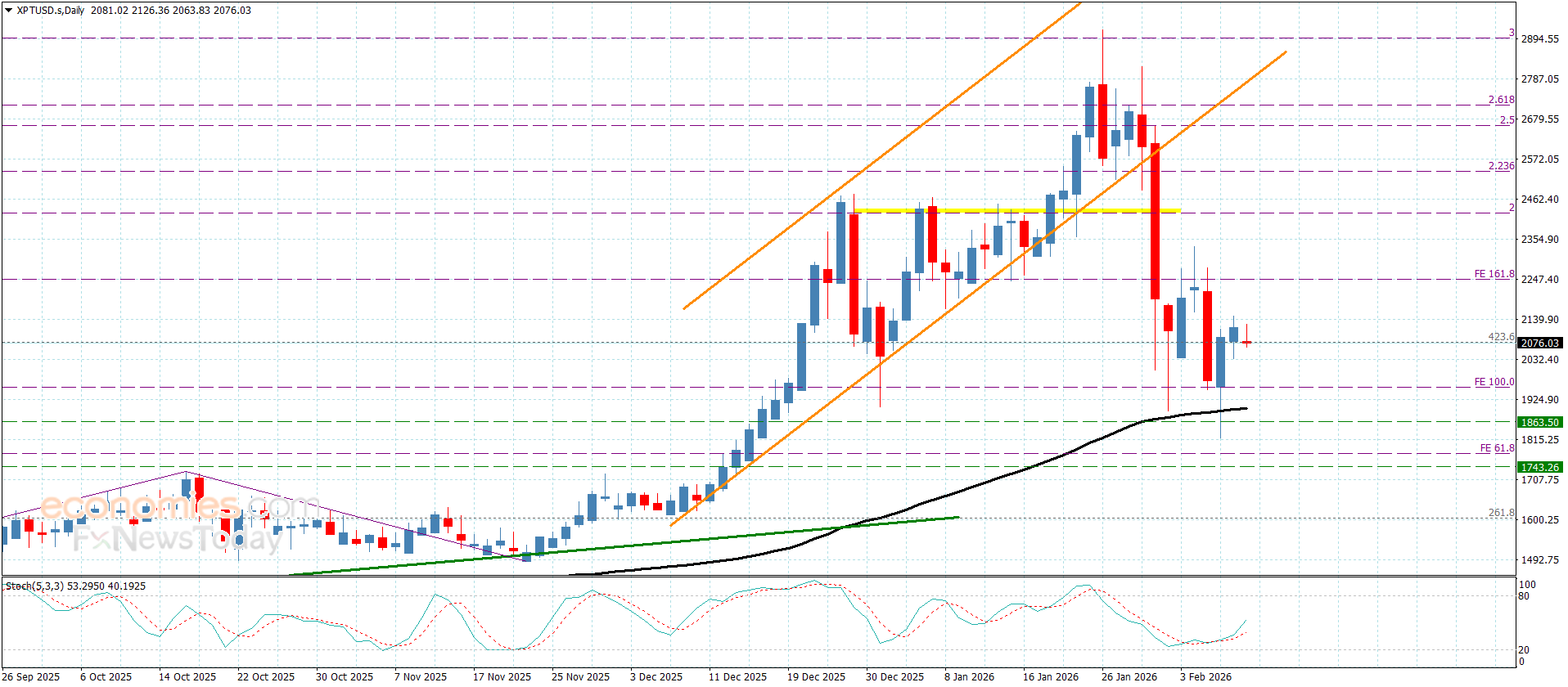
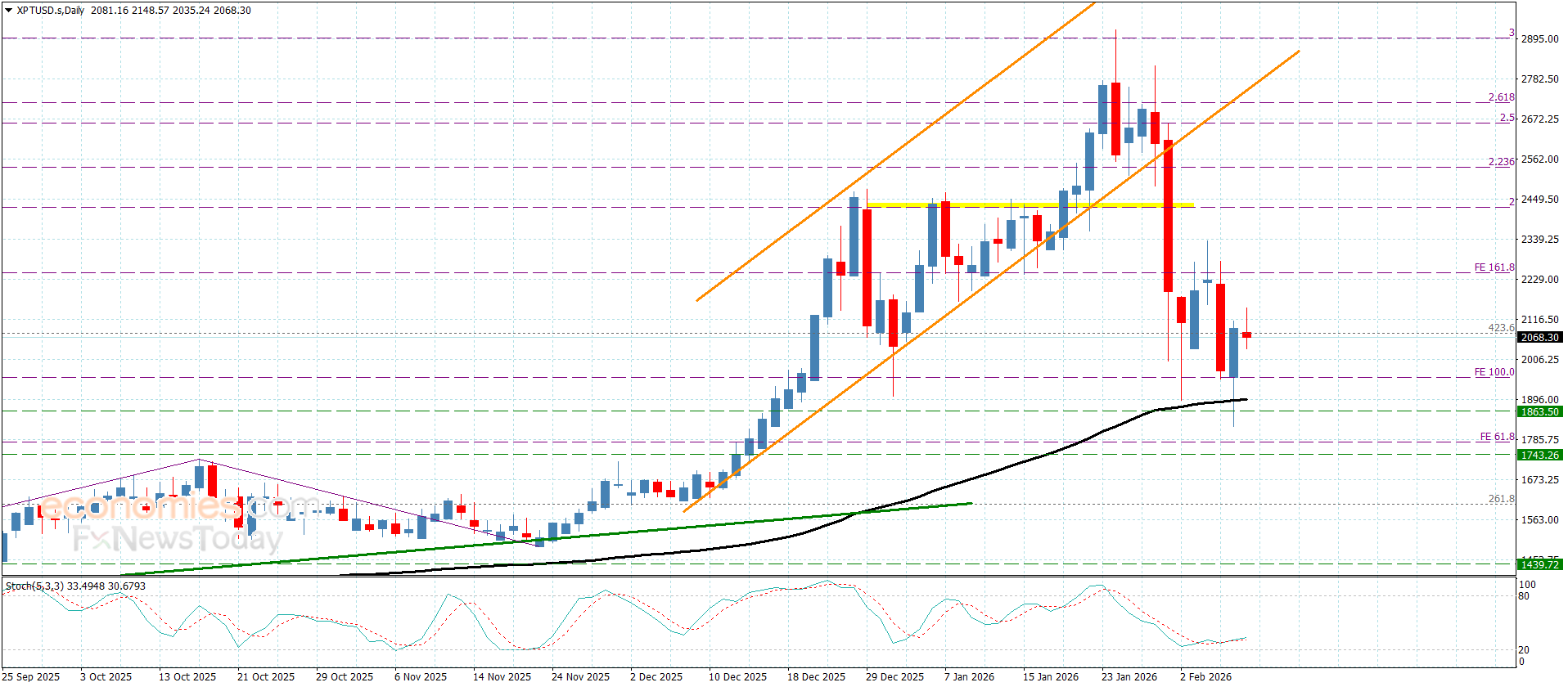
Platinum price attempted to surpass the negative pressures by forming some bullish waves, achieving $2145.00 level to settle above the moving average 55, noting that this rebound will not confirm regaining the bullish trend, due to the continuation of forming an important barrier at $2245.00 level, which makes us prefer the sideways bias dominance in the current period trading until gathering negative momentum, which allows it to decline below $1950.00, to target the corrective stations near $1860.00 and $1740.00.
While breaching the barrier and holding above it, will increase the chances of recording several gains, to expect its rally towards $2340.00 to press on $2425.00 barrier.
The expected trading range for today is between $1780.00 and $2070.00
Trend forecast: Bearish
Gold price (XAU/USD) rises to near $5,035 during the early Asian session on Monday. The precious metal extends its recovery amid a weaker US Dollar (USD) and rising demand from central banks. The delayed release of the US employment report for January will be in the spotlight later on Wednesday.
US Treasury Secretary Scott Bessent on Thursday refused to rule out the possibility of a criminal investigation of Kevin Warsh, President Donald Trump’s nominee for US Federal Reserve (Fed) chair, if Warsh ends up refusing to lower the interest rates. Concerns over the Fed’s independence continue to drag the Greenback lower and provide some support to the USD-denominated commodity price.
The People’s Bank of China (PBOC) extended its gold buying reserve for a 15th consecutive month in January. The Chinese central bank’s gold holdings rose to 74.19 million fine troy ounces by the end of January, up from 74.15 million the previous month. Rising demand from China, the world’s largest gold consumer, might contribute to the Gold’s upside.
Iran’s President Masoud Pezeshkian described the Friday nuclear talks with the United States (US) as “a step forward,” even as he pushed back against any attempts at intimidation. Meanwhile, Iranian Foreign Minister Abbas Araghchi underlined that any dialogue required refraining from threats.
Trump said another meeting would be held early this week, adding that “If they don’t make a deal, the consequences are very steep.” Traders will closely monitor the developments surrounding US-Iran talks. Any positive signs of negotiations could undermine the precious metals in the near term.
Gold has played a key role in human’s history as it has been widely used as a store of value and medium of exchange. Currently, apart from its shine and usage for jewelry, the precious metal is widely seen as a safe-haven asset, meaning that it is considered a good investment during turbulent times. Gold is also widely seen as a hedge against inflation and against depreciating currencies as it doesn’t rely on any specific issuer or government.
Central banks are the biggest Gold holders. In their aim to support their currencies in turbulent times, central banks tend to diversify their reserves and buy Gold to improve the perceived strength of the economy and the currency. High Gold reserves can be a source of trust for a country’s solvency. Central banks added 1,136 tonnes of Gold worth around $70 billion to their reserves in 2022, according to data from the World Gold Council. This is the highest yearly purchase since records began. Central banks from emerging economies such as China, India and Turkey are quickly increasing their Gold reserves.
Gold has an inverse correlation with the US Dollar and US Treasuries, which are both major reserve and safe-haven assets. When the Dollar depreciates, Gold tends to rise, enabling investors and central banks to diversify their assets in turbulent times. Gold is also inversely correlated with risk assets. A rally in the stock market tends to weaken Gold price, while sell-offs in riskier markets tend to favor the precious metal.
The price can move due to a wide range of factors. Geopolitical instability or fears of a deep recession can quickly make Gold price escalate due to its safe-haven status. As a yield-less asset, Gold tends to rise with lower interest rates, while higher cost of money usually weighs down on the yellow metal. Still, most moves depend on how the US Dollar (USD) behaves as the asset is priced in dollars (XAU/USD). A strong Dollar tends to keep the price of Gold controlled, whereas a weaker Dollar is likely to push Gold prices up.
Silver price (XAG/USD) gains ground for the second successive session, trading around $80.80 per troy ounce during the Asian hours on Monday. The grey metal advances amid market caution ahead of key US economic data that could provide clearer guidance on the Federal Reserve’s (Fed) interest-rate outlook. The January jobs report, due Wednesday, is expected to signal stabilization in the labor market, with the US economy forecast to add 70,000 jobs, while the Unemployment Rate is seen holding steady at 4.4%.
Markets currently expect the Fed to keep interest rates unchanged in March, with potential rate cuts anticipated in June and possibly September. San Francisco Fed President Mary Daly said in a LinkedIn post on Friday that the economy may remain in a low-hiring, low-firing environment, though it could also shift toward a no-hiring, higher-firing phase.
Fed Governor Phillip Jefferson said future policy decisions will be guided by incoming data and assessments of the economic outlook, adding on Friday that the labor market is gradually stabilizing. Meanwhile, Atlanta Fed President Raphael Bostic noted that inflation has remained elevated for too long, stressing in a Bloomberg interview on Friday that the Fed cannot lose sight of inflationary risks.
Silver, a traditional hedge against inflation, finds support following the landslide victory of Prime Minister Sanae Takaichi’s ruling coalition in Japan’s weekend elections. This result strengthens the case for expansionary fiscal policies. Such policies tend to lift inflation expectations, underpinning demand for the precious metal.
Safe-haven demand for Silver also remains resilient despite the United States (US)–Iran talks held in Oman on Friday aimed at easing regional tensions. However, Tehran reiterated that it would not suspend nuclear fuel enrichment, with Foreign Minister Abbas Araghchi noting that further negotiations depend on consultations in Washington and Tehran and must proceed without threats. Meanwhile, US President Donald Trump said another round of talks is planned this week, warning of “very steep” consequences if an agreement is not reached.
(The story was corrected on February 9 at 2:40 GMT to say in the title that XAG/USD holds gains near $80.50 due to market caution and due to the Japanese election.)
Silver is a precious metal highly traded among investors. It has been historically used as a store of value and a medium of exchange. Although less popular than Gold, traders may turn to Silver to diversify their investment portfolio, for its intrinsic value or as a potential hedge during high-inflation periods. Investors can buy physical Silver, in coins or in bars, or trade it through vehicles such as Exchange Traded Funds, which track its price on international markets.
Silver prices can move due to a wide range of factors. Geopolitical instability or fears of a deep recession can make Silver price escalate due to its safe-haven status, although to a lesser extent than Gold’s. As a yieldless asset, Silver tends to rise with lower interest rates. Its moves also depend on how the US Dollar (USD) behaves as the asset is priced in dollars (XAG/USD). A strong Dollar tends to keep the price of Silver at bay, whereas a weaker Dollar is likely to propel prices up. Other factors such as investment demand, mining supply – Silver is much more abundant than Gold – and recycling rates can also affect prices.
Silver is widely used in industry, particularly in sectors such as electronics or solar energy, as it has one of the highest electric conductivity of all metals – more than Copper and Gold. A surge in demand can increase prices, while a decline tends to lower them. Dynamics in the US, Chinese and Indian economies can also contribute to price swings: for the US and particularly China, their big industrial sectors use Silver in various processes; in India, consumers’ demand for the precious metal for jewellery also plays a key role in setting prices.
Silver prices tend to follow Gold’s moves. When Gold prices rise, Silver typically follows suit, as their status as safe-haven assets is similar. The Gold/Silver ratio, which shows the number of ounces of Silver needed to equal the value of one ounce of Gold, may help to determine the relative valuation between both metals. Some investors may consider a high ratio as an indicator that Silver is undervalued, or Gold is overvalued. On the contrary, a low ratio might suggest that Gold is undervalued relative to Silver.
Gold starts the week of February 9, 2026, in a tense period of consolidation. Earlier this month, prices dropped sharply from a record $5,600 to a low near $4,400, but have now settled at $4,968 per ounce.
When markets reopen tomorrow, attention will move from selling to a contest between short-term sellers and long-term buyers. With the Chinese Lunar New Year on February 16 and a more aggressive Federal Reserve, high volatility is very likely.
The main reason for the recent $1,200 price swing is the nomination of Kevin Warsh as the next Federal Reserve Chair.
XAU/USD
Even after the sharp drop, gold is still seen as a safe investment because of rising trade and physical conflicts.
On the two-hour chart, gold is starting to form a base near $4,965. The strong rebound from the $4,718 support area, shown by heavy buying, suggests a local bottom might have formed.
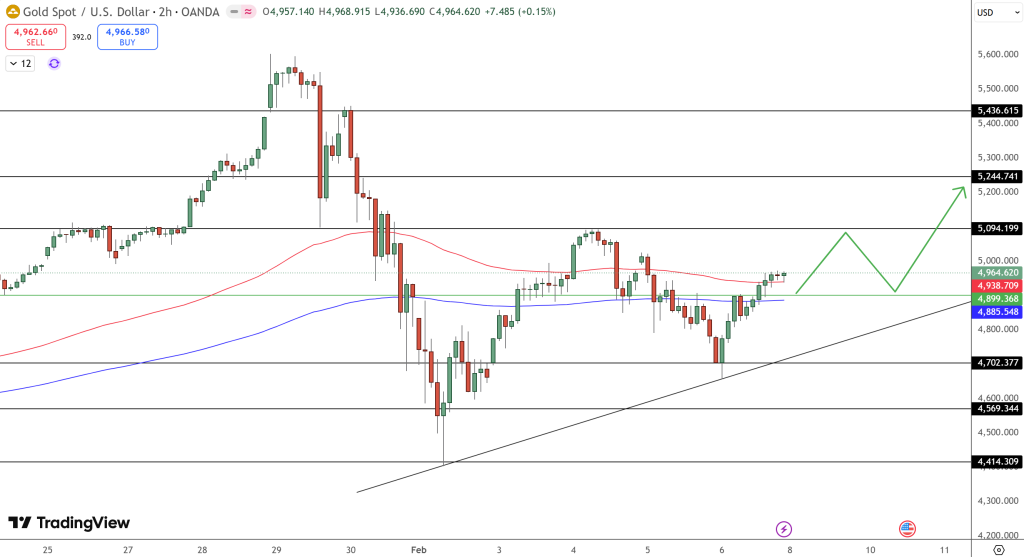
| Level Type | Price Target | Significance |
| Resistance 2 | $5,170 | 61.8% Fibonacci retracement level. |
| Resistance 1 | $5,057 | Immediate psychological barrier and 50 EMA. |
| Pivot Zone | $4,940 – $4,980 | Current consolidation range; must hold for bullish continuation. |
| Support 1 | $4,831 | First line of defense for the week ahead. |
| Support 2 | $4,718 | Major trendline support from January lows. |
Indicators Update:
Trade Strategy for Feb 9 – Feb 13
The long-term trend is still positive, with J.P. Morgan expecting prices above $6,000 by year-end. However, short-term trading needs careful timing.
Risk Management: Tight stops are essential. A daily close below $4,700 invalidates the recovery thesis and suggests a deeper correction toward $4,400.

Arslan Butt
Lead Markets Analyst – Multi-Asset (FX, Commodities, Crypto)
Arslan Butt serves as the Lead Commodities and Indices Analyst, bringing a wealth of expertise to the field. With an MBA in Behavioral Finance and active progress towards a Ph.D., Arslan possesses a deep understanding of market dynamics.
His professional journey includes a significant role as a senior analyst at a leading brokerage firm, complementing his extensive experience as a market analyst and day trader. Adept in educating others, Arslan has a commendable track record as an instructor and public speaker.
His incisive analyses, particularly within the realms of cryptocurrency and forex markets, are showcased across esteemed financial publications such as ForexCrunch, InsideBitcoins, and EconomyWatch, solidifying his reputation in the financial community.
Silver (XAG/USD) is trimming some losses during Friday’s early European session, trading right above $74.00 at the time of writing, after hitting fresh seven-month lows near $64.00 earlier on the day. The pair, however, remains capped below a previous support area, in the vicinity of $75.00.
The white metal has dropped nearly 30% over the last two weeks, weighed down by investors’ relief after US President Trump appointed Kevin Warsh as the replacement for Jerome Powell as the central bank’s chairman, and by easing geopolitical tensions, as the US and Iran opened negotiations to avoid a conflict.
XAG/USD is picking up from lows, with the technical picture showing a bearish scenario. The 50-period Simple Moving Average (SMA), which acted as a dynamic support during the bullish cycle, extends its decline, with the pair holding beneath it. The Moving Average Convergence Divergence (MACD) line has slipped back below the zero line, and the Relative Strength Index (RSI) remains below 50, indicating weak traction.
Silver’s recovery found resistance at the $75.00 area, which is holding bulls for now. Further up, the pair might find resistance at an intraday level around $81.00. Key resistance is at Wednesday’s high in the area of $92.00.
Immediate support is at the daily low of $64.08, below that level, the $60.00 round level, and early December lows, in the $56.00 area, might come into focus
(The technical analysis of this story was written with the help of an AI tool.)
Silver is a precious metal highly traded among investors. It has been historically used as a store of value and a medium of exchange. Although less popular than Gold, traders may turn to Silver to diversify their investment portfolio, for its intrinsic value or as a potential hedge during high-inflation periods. Investors can buy physical Silver, in coins or in bars, or trade it through vehicles such as Exchange Traded Funds, which track its price on international markets.
Silver prices can move due to a wide range of factors. Geopolitical instability or fears of a deep recession can make Silver price escalate due to its safe-haven status, although to a lesser extent than Gold’s. As a yieldless asset, Silver tends to rise with lower interest rates. Its moves also depend on how the US Dollar (USD) behaves as the asset is priced in dollars (XAG/USD). A strong Dollar tends to keep the price of Silver at bay, whereas a weaker Dollar is likely to propel prices up. Other factors such as investment demand, mining supply – Silver is much more abundant than Gold – and recycling rates can also affect prices.
Silver is widely used in industry, particularly in sectors such as electronics or solar energy, as it has one of the highest electric conductivity of all metals – more than Copper and Gold. A surge in demand can increase prices, while a decline tends to lower them. Dynamics in the US, Chinese and Indian economies can also contribute to price swings: for the US and particularly China, their big industrial sectors use Silver in various processes; in India, consumers’ demand for the precious metal for jewellery also plays a key role in setting prices.
Silver prices tend to follow Gold’s moves. When Gold prices rise, Silver typically follows suit, as their status as safe-haven assets is similar. The Gold/Silver ratio, which shows the number of ounces of Silver needed to equal the value of one ounce of Gold, may help to determine the relative valuation between both metals. Some investors may consider a high ratio as an indicator that Silver is undervalued, or Gold is overvalued. On the contrary, a low ratio might suggest that Gold is undervalued relative to Silver.
,