The main tag of GoldPrice Articles.
You can use the search box below to find what you need.
[wd_asp id=1]
The main tag of GoldPrice Articles.
You can use the search box below to find what you need.
[wd_asp id=1]
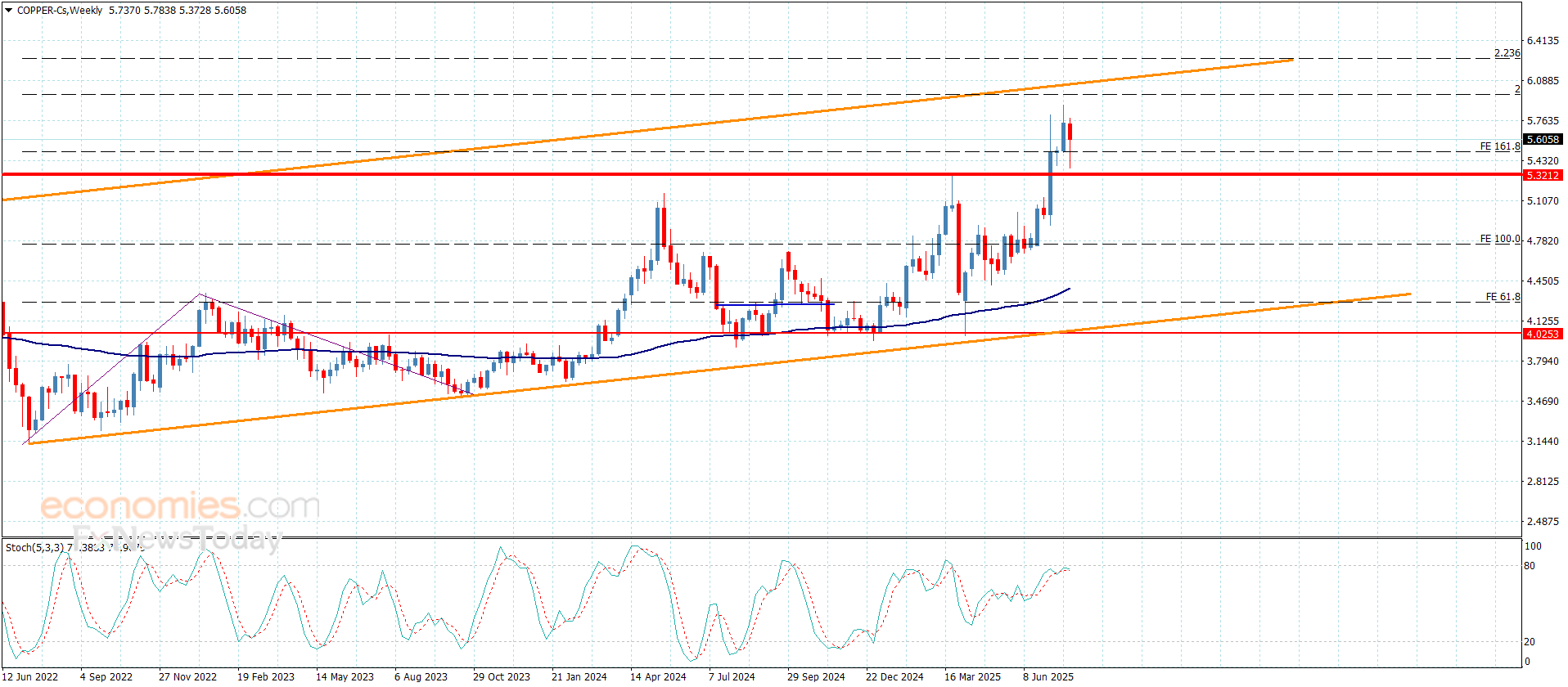
Copper price is under strong bearish pressure to push it to decline below the support at $5.3200, to lose most of its previous gains to reach $4.3900, to face the moving average of 55.
Despite the main stability within the main bullish channel’s levels, the contradiction between the main indicators may increase the chances for suffering extra losses by targeting 161%Fibonacci extension level at $4.2650, while renewing the bullish attempts requires stepping above $4.7400 level, providing chance for recording gains again.
The expected trading range for today is between $4.2600 and $4.5200
Trend forecast: Fluctuated within the bullish track
The decisive breakdown from a consolidation top puts the near-term bull trend in gold at risk of a deeper correction. Unless there is a relatively quick recovery it looks like gold is heading next towards the higher swing low of $3,247 from late-June. If that fails as support, the higher swing low at $3,121 becomes a potential target.
Since the initial pullback from the April record high of $3,500 completed a 38.2% Fibonacci retracement before another advance began, there is a good chance a deeper retracement may be completed in the current correction, given today’s bearish price action. A 50% retracement will be completed at $3,041 and a 61.8% Fibonacci retracement is at $2,933.
Given the clear failure of the 50-Day MA as support for today, the 200-Day MA, now at $3,000, becomes a potential downside target. Since it is rising it will eventually converge and surpass the 50% retracement area. There is also a falling ABCD pattern that has been added to the chart to help assess potential lower targets. It shows an initial downside target of $3,072, a little below the last retracement low (B) and near the 50% level. That is where the decline in price for the falling CD leg matches the decline in the first AB downswing. Once that happens, a potential pivot level is identified.
For a look at all of today’s economic events, check out our economic calendar.
In today’s volatile energy landscape, crude oil prices reflect a complex interplay of geopolitical tensions, supply-demand balances, and emerging market trends. The oil market continues to demonstrate remarkable resilience despite significant headwinds, with prices fluctuating based on immediate events and longer-term structural factors. Recent oil price movements insights have shown that market participants remain vigilant about underlying fundamentals.
As of July 3, 2025, WTI crude trades at $67.25 per barrel, down 0.30%, while Brent crude stands at $69.11, up 2.98%. Murban crude has seen an upward movement of 2.56%, reaching $70.23. These divergent price movements across benchmarks highlight the segmented nature of global oil markets.
The notable spread between premium grades like Bonny Light ($78.62) and the OPEC basket ($68.06) demonstrates how quality characteristics and regional factors create persistent price variations that sophisticated traders can leverage. A comprehensive oil price crash analysis provides deeper insight into these dynamics.
Market Insight: “The current price disparity between benchmarks reveals regional supply-demand imbalances rather than fundamental weakness in oil markets,” notes energy analyst James Peterson. “These differentials provide valuable signals about transportation bottlenecks and quality preferences.”
OPEC+ production strategies continue to function as a primary price stabilization mechanism. Recent announcements indicating planned production increases have created downward pressure on crude oil prices today. According to Standard Chartered analysis, “oil markets can easily absorb extra OPEC+ barrels,” suggesting underlying demand strength despite price reactions to supply increases.
The organization’s evolving approach to market management reflects adaptation to new market realities, including U.S. shale resilience and emerging demand uncertainties in key markets. OPEC market influence currently controls approximately 40% of global oil production, giving its decisions substantial market influence.
Middle East conflicts maintain their historical role as price volatility drivers. The ongoing Israel-Iran tensions have injected risk premiums into current prices, though markets have shown increasing sophistication in pricing these risks. An oil tanker explosion off the Libyan coast recently highlighted the vulnerability of critical supply routes.
According to risk analysis firm Stratfor, “The market has developed a more measured response mechanism to geopolitical disruptions, distinguishing between temporary supply interruptions and systemic threats to global oil flows.”
The U.S. oil sector demonstrates conflicting signals. According to the Dallas Federal Reserve’s latest report, oilfield inflation is surging while shale activity contracts in Q2 2025. This unexpected combination suggests cost pressures may be constraining production growth despite favorable prices.
U.S. crude oil production reached a record high in April 2025, yet a recent surprise build in crude inventories ended a five-week draw streak, contributing to downward price pressure. This inventory reversal suggests potential softening in domestic demand or logistics constraints affecting exports.
European markets face unique challenges as Russia’s natural gas supply to the region has declined significantly, potentially increasing oil demand for alternative energy generation. This dynamic creates localized price support for particular crude grades favored by European refiners.
Middle Eastern producers are strategically positioning to capitalize on Asian demand strength, with Saudi Aramco reportedly planning to raise oil prices to Asia. Meanwhile, Libya’s oil sector revival continues, with its first exploration tender in 18 years attracting bids from major international oil companies including ExxonMobil, TotalEnergies, and Eni.
China’s oil import behavior remains a crucial market driver. Despite international sanctions, Chinese refiners continue substantial purchases of Iranian crude, demonstrating Beijing’s strategic approach to energy security and price sensitivity.
India has doubled U.S. oil imports in recent months, reflecting both economic considerations and geopolitical realignment. The country’s energy diversification extends beyond oil, with wind and solar output growth hitting a three-year high according to recent government data.
Current price charts indicate consolidation patterns forming in WTI crude while Brent shows early signs of breakout potential above the $70 resistance level. The technical divergence between benchmarks suggests different regional forces at work rather than a unified global trend.
Trading volumes show steady institutional participation despite recent price volatility, indicating continued market confidence in oil’s medium-term fundamentals. The current relative strength indicators for major benchmarks remain in neutral territory, suggesting neither overbought nor oversold conditions.
The spread between WTI and Brent crude stands at approximately $1.86, reflecting transportation costs, quality differences, and regional supply-demand balances. This differential has narrowed from earlier this year when it reached nearly $3, indicating improving export capabilities from U.S. production centers.
Other notable differentials include the significant premium commanded by Nigerian Bonny Light ($78.62) over the OPEC basket ($68.06), highlighting how sulfur content and density characteristics create persistent price variations across the crude quality spectrum.
Current price levels represent significant moderation from the extreme volatility of recent years. Historical volatility indicators have declined to 25%, compared to peaks of over 100% during previous geopolitical crises. This relative stability provides a more predictable environment for both producers and consumers despite ongoing regional tensions.
Strategic petroleum reserves continue to influence market psychology. India is reportedly exploring new sites to boost its strategic oil reserves, following the pattern of major consuming nations using reserves as both emergency supply buffers and market intervention tools.
The U.S. Strategic Petroleum Reserve (SPR) currently holds approximately 371 million barrels, down from historical averages of over 600 million barrels, creating potential future buying pressure as governments seek to replenish stocks at favorable price points.
Previous strategic reserve releases have demonstrated limited long-term price effects. Analysis of the 2022 coordinated release shows prices typically returned to fundamentally-driven levels within 60-90 days after the initial announcement impact.
Disclaimer: The analysis of strategic reserve effects on oil prices involves assumptions about market psychology and participant behavior that cannot be definitively proven. Different market conditions may produce varying outcomes from similar policy actions.
Energy security concerns are driving more sophisticated approaches to reserve management. Countries are developing nuanced deployment criteria and coordination mechanisms that may provide more effective market stabilization tools compared to previous ad hoc interventions.
Refining margins have tightened according to recent U.S. data, with crack spreads for gasoline declining from $25 per barrel in summer 2024 to approximately $15 currently. This margin compression affects which crude grades refiners prefer, creating differential pricing pressures across the quality spectrum.
The relationship between crude prices and refined product markets remains crucial for understanding overall oil market dynamics, as refiners adjust crude purchasing based on expected product margins and seasonal demand patterns.
Gasoline prices have fallen to $3.14 per gallon nationally ahead of the July 4th holiday, reflecting both seasonal patterns and reduced Middle East risk premiums. Current gasoline futures prices stand at $2.117, down 0.30%, suggesting stable consumer pricing in the near term.
Distillate inventories remain below five-year averages in key consumption regions, providing support for middle distillate cracks and favoring complex refiners capable of maximizing diesel and jet fuel yields.
Northeast Asia’s jet fuel flows to Europe have surged according to recent shipping data, demonstrating how regional refining imbalances create product trade flows that ultimately influence crude demand patterns. These international product movements help balance regional refining capacity utilization and influence which crude grades command premiums in different markets.
The growth of renewable energy continues to influence long-term oil demand projections. India’s wind and solar output growth has hit a three-year high according to recent government data, reflecting accelerating energy transition in emerging economies.
However, the immediate impact on oil prices remains limited as transportation and petrochemical demand continue to support overall consumption growth. The International Energy Agency projects oil demand growth of 1.2 million barrels per day in 2025, despite renewable capacity expansion.
Electric vehicle market developments show mixed signals. Reports indicate major EV manufacturer BYD is cutting production despite strong sales, highlighting supply chain and profitability challenges in the rapidly evolving sector.
The gradual nature of transportation electrification means oil displacement effects remain modest in the short term. Current global EV penetration of approximately 14% of new vehicle sales limits immediate demand destruction effects on oil markets.
Natural gas markets show modest strength with prices at $3.505, up 0.49%, creating limited fuel-switching pressure on oil demand. Shell’s reported boost in natural gas production at Norway’s Ormen Lange field demonstrates continued investment in gas as a transition fuel.
The interplay between natural gas and oil markets remains most relevant in power generation and industrial applications, with price relationships influencing substitution decisions particularly in markets with flexible fuel capabilities.
Market analysts offer divergent views on future price directions. While some highlight OPEC+’s ability to manage supply, others focus on demand concerns in key markets.
Standard Chartered’s recent analysis suggests oil markets can easily absorb additional OPEC+ production, indicating confidence in underlying demand strength. Meanwhile, Goldman Sachs maintains a more cautious outlook, citing potential economic headwinds in major consuming regions.
Seasonal demand patterns suggest potential strengthening in the coming months as summer driving season continues in the Northern Hemisphere. Historical patterns indicate that current price levels may represent seasonal lows before potential strengthening into the third quarter.
Disclaimer: Future oil price projections involve numerous variables and uncertainties. The seasonal patterns discussed represent historical tendencies rather than guaranteed outcomes. Investors should consider multiple scenarios in their planning.
Longer-term price forecasts must balance multiple factors including energy transition timelines, global economic growth projections, and the pace of new oil field development. The ongoing trade war impact on oil markets remains a key variable for any longer-term analysis.
Capital allocation decisions by major producers indicate confidence in sustained demand for at least the next decade, with development focused on lower-cost, lower-carbon intensity production to remain competitive in an evolving energy landscape.
The current structure of oil futures curves provides important information about market expectations. WTI futures show modest backwardation (where near-term contracts trade at a premium to longer-dated ones), indicating market expectations of adequate near-term supply but potential tightening in later periods.
This curve structure influences storage economics and producer hedging strategies, creating feedback loops that affect physical oil pricing. The reduced degree of backwardation compared to earlier periods suggests more balanced market expectations.
Trading volumes in oil futures markets remain robust, with WTI contracts averaging over 1.2 million contracts daily, indicating active price discovery and diverse market participation. The distribution of open interest across different contract months reveals balanced positioning rather than concentration in near-term contracts.
This liquidity profile supports efficient price discovery and reduces vulnerability to technical squeezes or distortions that can occur in less liquid commodity markets.
Recent reports indicate hedge funds reducing positions in energy stocks amid the oil price moderation. This positioning shift can influence price momentum and volatility in both futures markets and related equities.
The current managed money positioning shows net long positions near five-year averages, suggesting neither excessive bullishness nor bearishness among speculative participants. This balanced positioning may reduce the risk of sharp sentiment-driven price movements.
Current price levels create mixed outcomes for oil-producing economies. Reports indicate that oil-rich Alberta forecasts an unexpected budget surplus despite price moderation, demonstrating effective fiscal management and cost discipline.
Meanwhile, Russia’s oil exports are reportedly stagnating as prices moderate and sanctions constrain market access. These divergent outcomes reflect the varying break-even prices and economic structures across producing nations.
Moderate oil prices provide inflation relief for consuming economies, with current gasoline prices representing a significant decline from previous peaks. This moderation helps support consumer spending in other sectors and reduces pressure on central banks to maintain tight monetary policies.
In the U.S., the current average gasoline price of $3.14 per gallon has contributed to easing inflation pressures, with transportation costs moderating after previous significant contributions to consumer price increases.
Current energy prices influence industrial competitiveness across regions, with moderate oil prices supporting manufacturing activity in energy-intensive sectors. Chemical and plastics producers in particular benefit from stable feedstock pricing, supporting production economics and investment decisions.
The relative stability of prices allows for more predictable production costs and investment planning, particularly important for capital-intensive industries with long planning horizons. The oil price stagnation factors have contributed to this planning stability for many industrial consumers.
WTI (West Texas Intermediate) and Brent crude prices differ due to quality characteristics, transportation costs, and regional supply-demand balances. WTI is lighter and sweeter than Brent, requiring less processing to produce high-value products. Additionally, WTI is primarily traded in the U.S. while Brent serves as an international benchmark, creating different market dynamics. Currently, Brent trades at a premium of approximately $1.86 over WTI, reflecting these fundamental differences.
OPEC+ decisions influence global oil prices by adjusting supply to balance markets. When the organization reduces production quotas, available supply decreases, typically supporting higher prices. Conversely, when OPEC+ increases production, as currently planned, additional supply often creates downward price pressure. Market reactions also depend on whether announcements align with expectations and the organization’s compliance with stated targets. OPEC+ currently represents approximately 40% of global oil production, giving it significant market influence.
Daily oil price fluctuations result from multiple factors including inventory reports, geopolitical developments, currency movements, technical trading patterns, and unexpected supply disruptions. Recent examples include the surprise U.S. crude inventory build that pressured prices downward and Middle East tensions that created temporary price spikes. These short-term movements often reflect immediate market sentiment rather than fundamental changes in supply-demand balances.
Crude oil prices today typically account for about 50-60% of retail gasoline prices, with the remainder coming from refining costs, distribution, marketing, and taxes. There’s usually a lag between crude price changes and retail gasoline adjustments, with the relationship sometimes distorted by refining capacity constraints or seasonal fuel specification changes. Currently, U.S. gasoline prices average $3.14 per gallon, reflecting both moderate crude prices and typical seasonal patterns.
The outlook for oil prices through the rest of 2025 depends on several key factors: OPEC+ production discipline, global economic growth trends, the pace of U.S. shale production increases, and geopolitical developments particularly in the Middle East. According to Market Watch data, most analysts project prices to remain within the $65-75 per barrel range for Brent crude, assuming no major supply disruptions or demand shocks. However, significant uncertainty remains, with both upside and downside risks to this baseline scenario.
Disclaimer: This price outlook represents a consensus view based on current market conditions. Actual prices may vary significantly based on unforeseen events or changes in fundamental factors. This information should not be considered investment advice.
Stay ahead of the market with Discovery Alert’s proprietary Discovery IQ model, which provides instant notifications of significant ASX mineral discoveries and transforms complex data into actionable insights. Explore why major mineral discoveries lead to substantial returns by visiting our dedicated discoveries page and begin your 30-day free trial today.
Gold trades below the $3,300 mark shedding ground on the back of broad US Dollar’s (USD) strength. The Greenback maintained a strong footing ever since the week started, helped by encouraging headlines related to trade deals. However, the USD soared on Wednesday, following the release of unexpectedly encouraging United States (US) data and ahead of the Federal Reserve (Fed) monetary policy announcement.
Speculative interest welcomed news indicating that the US economy grew at a faster than anticipated pace in the second quarter of the year, while inflationary pressures in the same period eased. Even further, employment-related figures kept pointing at a solid labor market, which may be a bit of a concern for the Fed, but in general means the world’s largest economy is much healthier than feared.
The US ADP Employment Change report showed that the private sector added 104K new positions in July, much better than the 78K expected, and well-above the -33K expected. More relevant, the flash estimate of the Q2 Gross Domestic Product surpassed expectations, as the economy expanded at an annual rate of 3% in the second quarter, much better than the 2.4% anticipated or the -0.5% from Q1.
Finally, The core Personal Consumption Expenditures (PCE) Price Index, the Fed’s favorite inflation gauge, indicated easing inflationary pressures as the index rose by 2.5% in the three months to June, down from the 3.5% posted in Q1.
XAU/USD remains pressured as investors gear up for the Fed announcement. The central bank is widely anticipated to keep interest rates on hold, floating between 4.25% and 4.50%. The central bank will release a statement with policymakers reasoning behind the decision. Finally, Chair Jerome Powell will offer a press conference, to further clarify officials’ stance.
Given that the decision has been long ago priced in, the focus will be on Powell’s words, and any hint he may give on future monetary policy decisions.
The daily chart for the XAU/USD pair shows a flat 20 Simple Moving Average (SMA) provides intraday resistance for a third consecutive day, rejecting advances at around $3,345. The 100 SMA, in the meantime, provides support at around $3,263.00, a potential bearish target should the USD keeps gaining ground. Finally technical indicators turned south below their midlines, supporting a downward extension.
The near-term picture is bearish. The 4-hour chart for the XAU/USD shows technical indicators head firmly south within negative levels, while the pair plummeted below all its moving averages, with the 20 SMA currently at around $3,325.00, extending its slide below directionless and converging 100 and 200 SMAs.
Support levels: 3,287.30 3,274.05 3,249.60
Resistance levels: 3,311.15 3,328.60 3,345.00
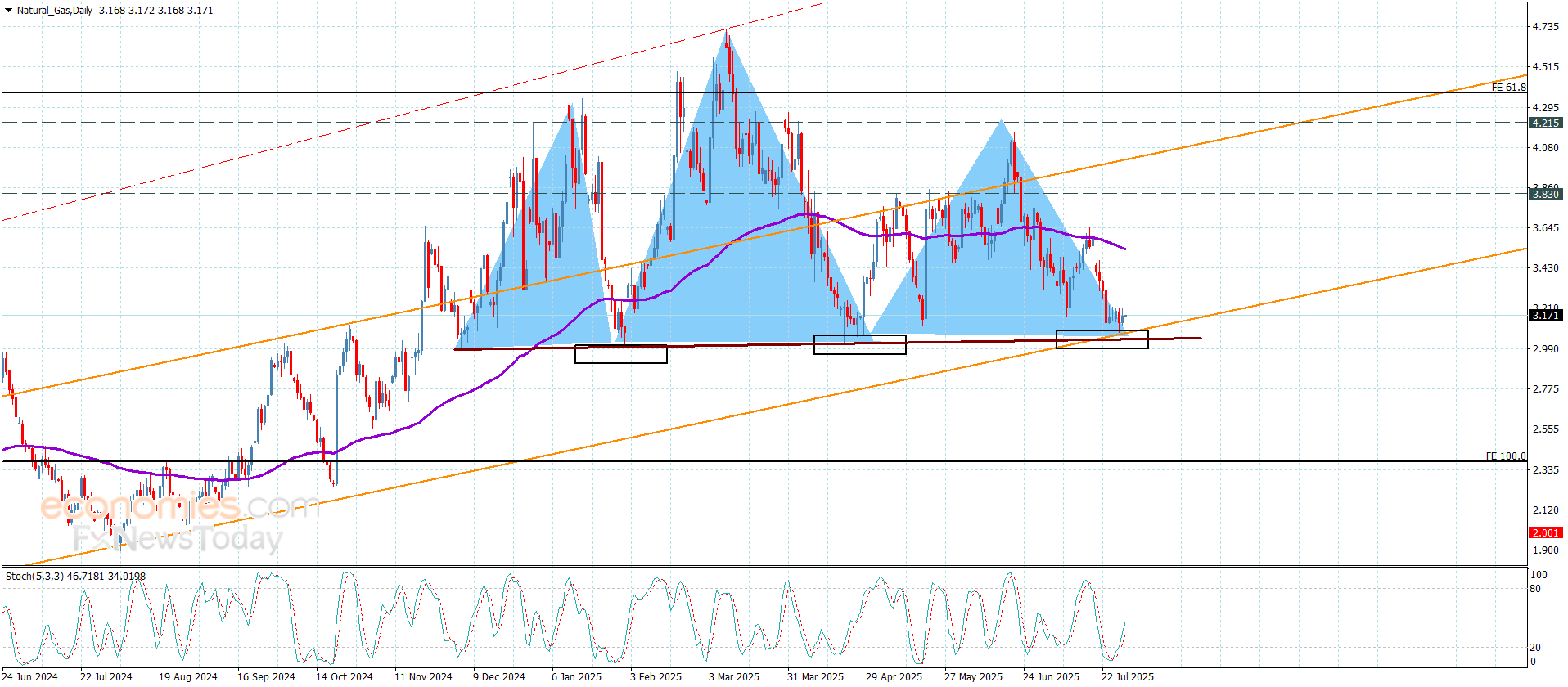
Natural gas prices provided a new positive close above $3.050 level, forming the neckline of the head and shoulders pattern that appears in the above image, taking advantage of stochastic exit from the oversold level and providing positive momentum again.
The price success to settle above $3.050 will decrease the risk of moving to a new bearish station, providing chances to begin recording some of the gains by its rally to $3.320 and $3.450, while breaking the neckline and holding below it will force it to suffer big losses by reaching $2.710 initially.
The expected trading range for today is between $3.10 and 3.320
Trend forecast: Bullish by the stability of $3.050
The 9th OPEC International Seminar was held in Vienna a week ago, wherein participants discussed energy security, investment, climate change, and energy poverty, with a particular emphasis on balancing these competing priorities. According to commodity analysts at Standard Chartered, the summit titled “Charting Pathways Together: The Future of Global Energy” featured significantly greater engagement from international oil companies and consuming country governments, with discussions converging on a more inclusive shared agenda rather than non-intersecting approaches seen in previous years. However, StanChart reported there was a clear mismatch between what energy producers vs. market analysts think about spare production capacity. Unlike Wall Street analysts, who frequently talk about spare capacity of 5-6 million barrels per day (mb/d), speakers from several sectors of the industry noted thatspare capacity is both limited and very geographically concentrated.
StanChart believes this erroneous assumption about spare capacity has been a big drag on oil prices, and the implications for the whole forward curve of oil prices could be potentially profound once traders realize that roughly two-thirds of the capacity they thought was available on demand does not actually exist. This makes the analysts bullish about the general shape of their forecast 2026 price trajectory (Figure 32), i.e., a set of significant upward shifts as opposed to the flat trajectory seen in the market curve and in analyst consensus. In other words, oil prices could have as much as $15/barrel upside from current levels.
Source: Standard Chartered Research
StanChart is not the only oil bull here. Goldman Sachs recently hiked its oil price forecast for H2 2025, saying the market is increasingly shifting its focus from recession fears to potential supply disruptions, low spare capacity, lower oil inventories especially among OECD countries and production constraints by Russia. GS has increased its Brent forecast by $5/bbl to $66/bbl, and by $6 for WTI crude to $63/bbl, slightly lower than current levels of $68.34/bbl and 66.24/bbl for Brent and WTI crude, respectively. However, the Wall Street bank has maintained its 2026 price forecast at $56/bbl for Brent and $52 for WTI, due to “an offset between a boost from higher long-dated prices and a hit from a wider 1.7M bbl/day surplus.’’ Previously, GS had forecast a 1.5M bbl/day surplus for the coming year. Further, Goldman sees a stronger oil price rebound beyond 2026 due to reduced spare capacity.
Bullish On Gas Prices
EU natural gas inventories have climbed at faster-than-average clip in recent times. According to Gas Infrastructure Europe (GIE) data, Europe’s gas inventories stood at 73.10 billion cubic metres (bcm) on 13 July, good for a 2.31 bcm w/w increase. Still, the injection rate is not enough to completely fill the continent’s gas stores, with the current clip on track to take inventories to about 97.9 bcm, or 84.3% of storage capacity, at the end of the injection season.
Europe’s gas demand remains fairly lacklustre despite extremely high temperatures across much of the continent in recent weeks. According to estimates by StanChart, EU gas
demand for the first 14 days of July averaged 583 million cubic meters/day, nearly 3% lower from a year ago but a 10% improvement from the June lows.
However, StanChart is bullish on natural gas prices, saying the market is likely underestimating the likelihood of more Russian gas being taken off the markets.
Back in April, U.S. senators Lindsey Graham (Republican) and Richard Blumenthal (Democrat), introduced ‘Sanctioning Russia Act of 2025’, with the legislation enjoying broad bipartisan support (85 co-sponsors in the Senate out of 100 senators). In a joint statement on 14 July, the two senators noted that President Trump’s decision to implement 100% secondary tariffs on countries that buy Russian oil and gas if a peace agreement is not reached within 50 days but pledged that they will continue to work on “bipartisan Russia sanctions legislation that would implement up to 500 percent tariffs on countries that buy Russian oil and gas”. StanChart has predicted that the Trump administration is unlikely to take actions that risk driving oil prices higher; however, Russian gas remains in the crosshairs, with U.S. LNG likely to see a surge in demand if Russian gas exports are curtailed.
StanChart estimates that the EU’s net imports of Russian pipeline gas averaged 79.8 million cubic metres per day (mcm/d) in the first 14 days of July, with all non-transit flows into the EU coming into Bulgaria through the Turkstream pipeline, with Hungary and Slovakia also receiving Turkstream gas. There was also a flow of about 65 mcm/d of Russian LNG in the first half of July, with Russia providing 18.6% of the EU’s net imports. StanChart has predicted that we could see a strong rally in natural gas prices if Washington slaps Moscow with fresh gas sanctions.
By Alex Kimani for Oilprice.com
More Top Reads From Oilprice.com:
The breakdown of the trendline was confirmed by Monday’s closing price below the line. Then, on Tuesday, gold found resistance at the trendline with the day’s high of $3,334. That showed prior support of the trendline as resistance. The low for the day at $3,308 was almost an exact retest of support at the interim swing low of $3,310. Although that low failed briefly on Monday, as a low for the day of $3,302 hit intraday, the quick recovery shows support being retained around the interim swing low.
A rally above Tuesday’s high of $3,334 will show strength and the potential for a bullish reversal. But a rally above Monday’s high of $3,345 provides clearer confirmation as a three-day high will have been reached and two moving averages reclaimed. It is interesting to note that the 20-Day and 50-Day moving averages are the closest to each other since the last bullish crossover in January. This shows strong potential resistance and the likelihood that volatility is close to expanding rapidly.
The breakdown of the pennant points to possible continuation to the downside. A drop below Tuesday’s low of $3,308 will indicate weakness that will confirm a decline below $3,302. That would put gold in sight of a test of support around the higher swing low of $3,247 (C). The weekly chart supports a bearish scenario, although it is within the context of a consolidation pennant formation and therefore may be less reliable. Last week completed a bearish shooting star candlestick pattern and it triggered this week below $3,325.
For a look at all of today’s economic events, check out our economic calendar.
Important DisclaimersThe content provided on the website includes general news and publications, our personal analysis and opinions, and contents provided by third parties, which are intended for educational and research purposes only. It does not constitute, and should not be read as, any recommendation or advice to take any action whatsoever, including to make any investment or buy any product. When making any financial decision, you should perform your own due diligence checks, apply your own discretion and consult your competent advisors. The content of the website is not personally directed to you, and we does not take into account your financial situation or needs.The information contained in this website is not necessarily provided in real-time nor is it necessarily accurate. Prices provided herein may be provided by market makers and not by exchanges.Any trading or other financial decision you make shall be at your full responsibility, and you must not rely on any information provided through the website. FX Empire does not provide any warranty regarding any of the information contained in the website, and shall bear no responsibility for any trading losses you might incur as a result of using any information contained in the website.The website may include advertisements and other promotional contents, and FX Empire may receive compensation from third parties in connection with the content. FX Empire does not endorse any third party or recommends using any third party’s services, and does not assume responsibility for your use of any such third party’s website or services.FX Empire and its employees, officers, subsidiaries and associates, are not liable nor shall they be held liable for any loss or damage resulting from your use of the website or reliance on the information provided on this website.Risk DisclaimersThis website includes information about cryptocurrencies, contracts for difference (CFDs) and other financial instruments, and about brokers, exchanges and other entities trading in such instruments. Both cryptocurrencies and CFDs are complex instruments and come with a high risk of losing money. You should carefully consider whether you understand how these instruments work and whether you can afford to take the high risk of losing your money.FX Empire encourages you to perform your own research before making any investment decision, and to avoid investing in any financial instrument which you do not fully understand how it works and what are the risks involved.
Natural gas prices provided a new positive close above $3.050 level, forming the neckline of the head and shoulders pattern that appears in the above image, taking advantage of stochastic exit from the oversold level and providing positive momentum again.
The price success to settle above $3.050 will decrease the risk of moving to a new bearish station, providing chances to begin recording some of the gains by its rally to $3.320 and $3.450, while breaking the neckline and holding below it will force it to suffer big losses by reaching $2.710 initially.
The expected trading range for today is between $3.10 and 3.320
Trend forecast: Bullish by the stability of $3.050
The (Brent) price settled with strong gains in its last intraday trading, after breaching the critical resistance at $70.75, supported by its continuous trading above EMA50, and under the dominance of the bullish trend and its trading alongside a minor bias line on the short-term basis, on the other hand, we notice the beginning of negative overlapping signal appearance on the (RSI), after reaching overbought levels, which might reduce the last gains, and it needs to gather gains and gain some bullish momentum.
High-accuracy trading signals delivered directly to your Telegram. Subscribe to specialized packages tailored for the world’s most important markets – all powered by BestTradingSignal.com .
The longer the subscription, the greater the savings and the more value you get.
Weekly performance report available here: Signals Performance – Week of July 21–25, 2025