The main tag of GoldPrice Articles.
You can use the search box below to find what you need.
[wd_asp id=1]
The main tag of GoldPrice Articles.
You can use the search box below to find what you need.
[wd_asp id=1]
Stay informed on platinum price trends in Bangalore. Today’s rates stand at ₹55,420
for 10g, ₹5,54,200 for 100g, and ₹55,42,000 for 1kg. In September, platinum
saw fluctuations. The highest rate for 100g touched ₹5,76,000,
and the lowest fell to ₹5,25,300. For 1kg, prices ranged from
₹52,53,000 to ₹57,60,000.
Global supply chains, mining rates, and geopolitical issues are major drivers of platinum
prices. Demand from the auto and electronics industries adds pressure. Exchange rate
movements, especially against the US dollar, combined with inflation trends and central
bank strategies, contribute significantly to changes in platinum’s market price.
Welcome, my fellow traders! I have prepared a price forecast for US Crude, XAUUSD, and EURUSD using a combination of the margin zones method and technical analysis. Based on the market analysis, I have identified entry signals for intraday traders.
Oil has broken through the key support of the short-term uptrend.
The article covers the following subjects:
The oil price has pierced the key support of 95.55–94.90 within the short-term uptrend. The bearish target is now the lower Target Zone of 89.02–87.71.
Short trades can be considered once the price corrects up to resistance A at 98.02–97.56, with the first target at 95.60 and the second one around 93.20.
Sell near resistance A at 98.02–97.56. TakeProfit: 95.60, 93.20. StopLoss: 99.04.
Gold is trading within a short-term downtrend. Last week, the price tested the trend boundary at 4,415–4,398, but bears managed to defend this zone. Consequently, consider holding short trades today, targeting the 4,325 level. The second downside target will be 4,235.
If the gold price breaks above the 4,415 level, the downtrend may reverse. In this case, consider long trades, with a target in the upper the Target Zone of 4,595–4,562.
Hold short trades opened near resistance B at 4,415–4,398. TakeProfit: 4,325, 4,235. StopLoss: 4,443.
The euro is trading within a short-term downtrend and is attempting to break through the lower Target Zone of 1.1459–1.1434. If it breaches this zone, the next downside target will be the Gold Zone of 1.1375–1.1367.
Consider short trades once the price corrects higher to resistance A at 1.1546–1.1538. The first target will be 1.1500, and the second will be 1.1454.
Sell near resistance A at 1.1546–1.1538. TakeProfit: 1.1500, 1.1454. StopLoss: 1.1565.
Would you like to learn more about technical analysis methods and principles? Explore our comprehensive guide.
P.S. Did you like my article? Share it in social networks: it will be the best “thank you” 🙂
Useful links:
The content of this article reflects the author’s opinion and does not necessarily reflect the official position of LiteFinance broker. The material published on this page is provided for informational purposes only and should not be considered as the provision of investment advice for the purposes of Directive 2014/65/EU.
According to copyright law, this article is considered intellectual property, which includes a prohibition on copying and distributing it without consent.
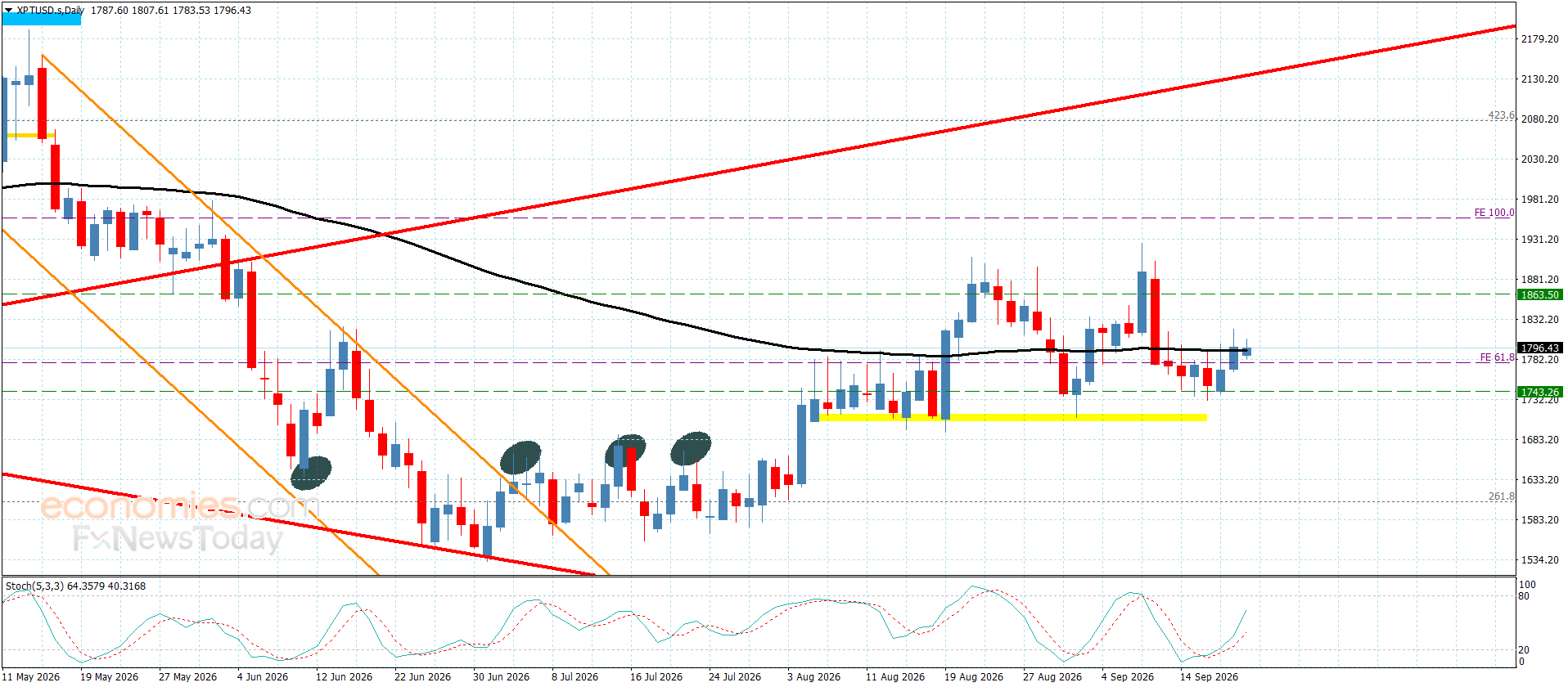
Platinum price remained unchanged up to this moment due to its repeated positioning below the resistance at $1,840.00. The price continues to fluctuate near the 55-period moving average. We note that the bullish scenario remains valid as long as the support level at $1,705.00 holds, which keeps us waiting for the required breakout before the price begins recording further gains, initially targeting $1,880.00 and then attempting to reach the next main target near $1,960.00.
On the other hand, a decline below the support level at $1,705.00 and sustained trading beneath it would confirm a shift into a bearish path, with the price expected to incur significant losses, initially moving toward $1,645.00.
The expected trading range for today is between $1760.00 and $1880.00
Trend forecast: Bullish
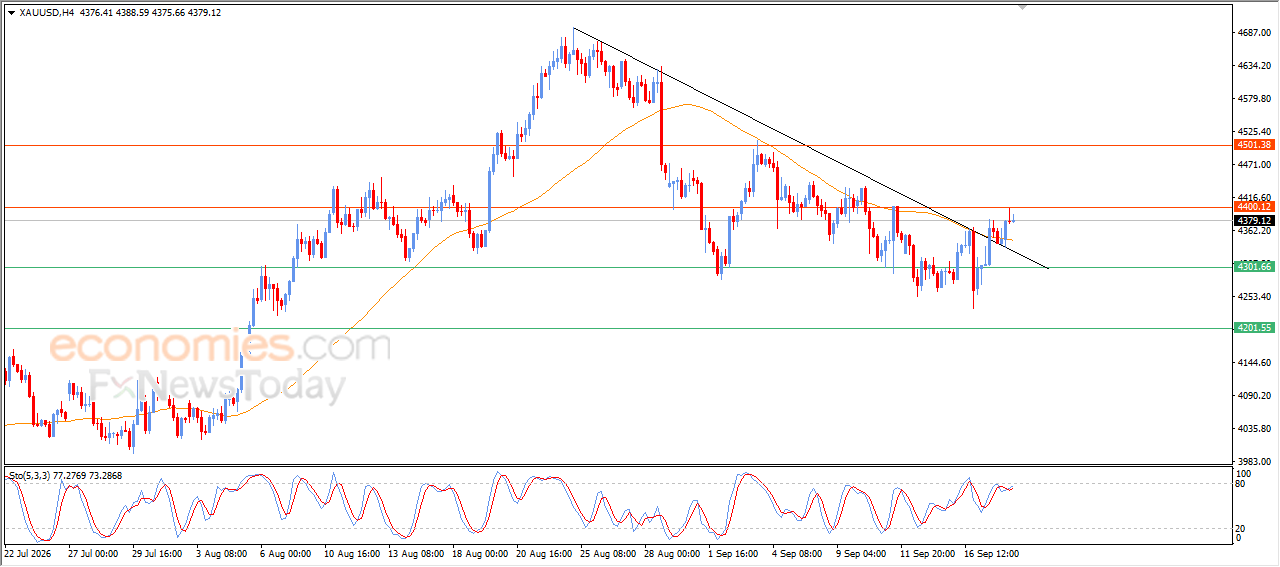
Gold is holding higher during its recent intraday trading, reaching $4,400 resistance level, which was our morning target, supported by the price continuing to trade above EMA50, giving it renewed momentum that strengthens the chances of extending these gains in the near term, particularly if it breaks above this resistance. The price is also benefiting from breaking above a short-term bearish corrective trendline, alongside positive signals from the relative strength indicators.
Domestic coffee prices
Today (September 20), the coffee market ended the price reduction week, currently the purchase price fluctuates in the range of 93,000 – 93,800 VND/kg, down from 1,500-1,700 VND/kg compared to the price range of the previous week. The average purchase price of coffee in the Central Highlands provinces today is 93,700 VND/kg, down 1,500 VND/kg.
The old Dak Nong area is still the province with the highest coffee purchasing price in the Central Highlands region, the difference with the average price is about 100 VND/kg. Compared to the closing price last weekend, the coffee price in this area decreased by 1,200 VND/kg, launched to the market at a price of 93,800 VND/kg.
In Dak Lak and Gia Lai, coffee prices both decreased by 1,100 VND/kg, down to 93,600 VND/kg.
Similarly, Lam Dong also decreased by 1,600 VND/kg, currently trading at a price of 93,000 VND/kg.
World coffee prices
On the London and New York exchanges, the coffee market had a week of price slippage on all terms.
On the online trading floor Robusta, the September 2026 futures contract on the London exchange was traded at 3,361 USD/ton, down 134 USD/ton compared to the previous closing session. The November 2026 contract decreased by 134 USD/ton, to 3,391 USD/ton.
On the New York Stock Exchange, Arabica coffee futures for March 2027 delivery were listed at 268.55 US cents/lb. December 2026 delivery contracts fell 11 cents/lb, reaching 276.5 US cents/lb.
Market outlook
According to the Vietnam Coffee – Cocoa Association (Vicofa), coffee exports in the last months of 2026 are expected to continue to maintain positive momentum. Production for the whole year 2026 is estimated to increase by about 8 – 10% compared to 2025, thanks to additional supply from the new crop year harvested in November.
In order to cope with price reduction pressure as global supply increases, the industry is shifting to focusing on increasing value instead of chasing output.
The coffee market is still under pressure due to increased Arabica inventories on the ICE exchange, Brazil’s exports being boosted and favorable weather conditions in Brazil as well as Vietnam.
At 8 a.m. Eastern Time today, oil was priced at $104.33 per barrel with Brent serving as the benchmark (we’ll explain different benchmarks later in this article). That’s a gain of 35 cents compared with yesterday morning and around $37 higher than the price one year ago.
It’s impossible to forecast oil prices with detailed precision. Many different elements affect the market, but ultimately it boils down to supply and demand. When worries about economic recession, war, and other large-scale disruptions increase, oil’s path can shift fast.
Gas prices at the pump don’t only track crude oil. They also include what it takes to refine and move that fuel, the taxes layered on top, and the extra markup your local station adds to stay in business.
Since crude oil generally makes up a majority of the per-gallon cost, changes in its price have an outsized impact. When oil surges, gas prices typically rise in tandem. But when oil retreats, gas prices often lag on the way down, a trend sometimes described as “rockets and feathers.”
In case of emergency, the U.S. has a store of crude oil known as the Strategic Petroleum Reserve. Its primary purpose is energy security in case of disaster (think sanctions, severe storm damage, even war). But it can also go a long way toward softening crippling price hikes during supply shocks.
It’s not a long-term answer and is more meant to provide temporary relief, assisting consumers and keeping critical parts of the economy running, like key industries, emergency services, public transportation, etc.
Both oil and natural gas are key sources of the energy we use every day. Because of this, a big change in oil prices can affect natural gas. For example, if oil prices increase, some industries may swap natural gas for some segments of their operations where possible, which increases demand for natural gas.
To gauge oil’s performance, we often turn to two benchmarks:
Between these two, Brent better represents global oil performance because it prices much of the world’s traded crude. And, it’s often the best way to track historical oil performance. In fact, even the U.S. Energy Information Administration now uses Brent as its primary reference in its Annual Energy Outlook.
Looking at the Brent benchmark across several decades, oil has been anything but steady. It’s seen spikes due to factors such as wars and supply cuts, and it’s also seen crashes from global recessions and an oversupply (called a “glut”). For example:
All to say, oil’s historical performance has been anything but smooth. Again, it’s hugely affected by wars, recessions, OPEC whims, evolving energy initiatives and policies, and much more.
Looking to stay up-to-date regarding the latest energy developments? Check out our recent coverage:
The current price of oil per barrel depends largely on supply and demand, including news about potential future supply and demand (geopolitics, decisions made by OPEC+, etc.). In the U.S., prices also move based on how friendly an administration is to drilling, as it can affect future supply. For example, 2025 saw the Trump administration move to reopen more than 1.5 million acres in the Coastal Plain of the Arctic National Wildlife Refuge for oil and gas leasing, reversing the Biden administration’s policy of limiting oil drilling in the Arctic.
The price of oil updates constantly when the “futures” markets are open. A futures market is effectively an auction where people agree to buy or sell oil in the future. As long as people and companies are trading contracts, the oil price is changing.
In short, shale is rock that contains oil and natural gas. Think of shale as energy yet to be tapped. The more shale the U.S. accesses, the more energy we’ll have—and the more easily oil prices can keep from spiking as much thanks to a greater supply.
When oil is expensive, it tends to make everyday items cost more. This can be related to energy (your heating, gas utilities, etc.), but it’s also due to the logistics involved with making those items accessible to you. Shipping, for example, can affect the price of things at the grocery store, as it’s more expensive to get those products from warehouses and farms onto the shelf.
The article covers the following subjects:
Consider long positions from corrections above 90.60 with a target of 115.50–125.50.
Breakout and consolidation below 90.60 will allow the asset to continue declining to the levels of 79.30–67.00.
On the weekly chart, a descending correction has likely finished developing as the second wave of larger degree (2) and an ascending third wave (3) is forming. On the daily chart, apparently, the first wave of smaller degree 1 of (3) has formed, a local correction has been completed as wave 2 of (3), and the third wave 3 of (3) is unfolding. Wave i of 3 is developing on the H4 chart; within it, wave (iii) of i is still unfolding. If the presumption is correct, WTI will continue to rise to 115.50–125.50. The level of 90.60 is critical in this scenario as a breakout below it will enable the asset to continue declining to the levels of 79.30–67.00.
This forecast is based on the Elliott Wave Theory. When developing trading strategies, it is essential to consider fundamental factors, as the market situation can change at any time.
The content of this article reflects the author’s opinion and does not necessarily reflect the official position of LiteFinance broker. The material published on this page is provided for informational purposes only and should not be considered as the provision of investment advice for the purposes of Directive 2014/65/EU.
According to copyright law, this article is considered intellectual property, which includes a prohibition on copying and distributing it without consent.
The 10-year hit 5% earlier in the week. By Friday it was sitting near that level without extending. The dollar index held near a multi-week high but was not launching a new leg. Gold has been trading against yields and the dollar all week. Friday was the first session where neither one was actively making a new high while gold was trying to rally. The short side ran out of new ammunition and the result was a move from $4,334.295 to $4,399.67 in one session.
Visible vessel traffic through the Strait of Hormuz remains far below normal. Saudi infrastructure is damaged. The conflict between Iran, Saudi Arabia and the Houthis is active. Washington and Tehran have not restarted peace talks. A more reliable Saudi route through Oman eases the immediate supply panic. It does not guarantee the next attack misses loading infrastructure. The oil correction gave gold its rally Friday. A weekend escalation puts crude right back at the highs and gold would have to deal with the inflation argument all over again on Monday.
Crude has to stay below this week’s highs for gold to keep the ground it gained Friday. A renewed push in oil prices brings the inflation argument back and gives yields a reason to break above 5% again. That would put the entire post-Fed relief trade at risk. The weekend is the immediate threat. The conflict is active and one headline from the Strait can reverse three days of falling crude before Monday’s open.
The bias leans bearish with the main trend still down on the daily swing chart, however, the move through the 50-day moving average at $4,288.76 and the minor trend change have taken the conviction out of the bearish case. The minor retracement zone at $4,373.05 to $4,405.59 is the pivot. Friday stalled there. A sustained push through $4,405.59 opens the larger zone at $4,466.14 to $4,520.65 with the 200-day at $4,541.23 above it and that is where the trend change conversation starts.
Domestic coffee prices
Today’s coffee price in the domestic market maintained a decrease of 600 VND/kg. According to giacaphe. com, the average coffee price on September 19 remained at 93,700 VND/kg, anchored in the price range of 93,000-93,800 VND/kg.
In Gia Lai and Dak Lak, coffee prices were recorded at 93,600 VND/kg, down 600 VND/kg.
In Lam Dong, the listed coffee price is at 93,000 VND/kg, down 500 VND/kg.
The old Dak Nong area recorded the highest price in the whole region at 93,800 VND/kg, down 300 VND/kg.
The USD/VND exchange rate according to Vietcombank was recorded at 25,790 VND/USD, down 5 VND/USD.
World coffee prices
In the world market, coffee prices simultaneously decreased.
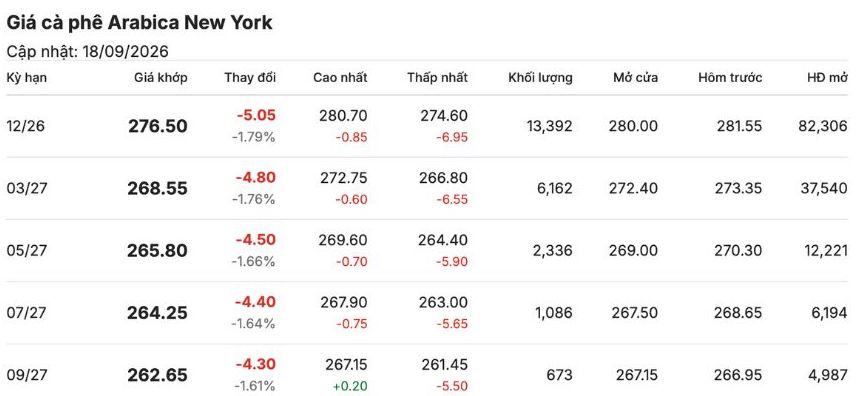
According to Barchart, the September 2026 Robusta futures contract anchored at 3,361 USD/ton, down 39 USD/ton. At the same decrease, the November 2026 futures were listed at 3,391 USD/ton. The term from January 2027 to May 2027 was listed in the price range of 3,343 – 3,360 USD/ton, down the most by 42 USD/ton.
Similarly, the September 2026 Arabica futures contract continued to decline by 5.5 cents/lb, down to 276.50 cents/lb. The December 2026 term is offered to the market at 268.55 cents/lb, down 4.8 cents/lb. Further forwards are anchored in the 262.65 – 265.80 cent/lb range, a decrease of 4.3-4.5 cents/lb.
Assessments and forecasts
Coffee prices have been under pressure in the past 3 weeks due to the prospect of abundant global supply. The International Coffee Organization (ICO) forecasts that global coffee production will reach a record level and the market will have a surplus supply. ICO also said that global coffee production in the 2025/26 crop year increased by 4.4% compared to the same period, reaching a record level of 183.6 million bags, while consumption decreased by 0.9% to 180.6 million bags. This caused the global coffee market to have a surplus of 3 million bags, marking the first surplus supply in 5 years.
Brazilian coffee is being brought to the export market as the harvest in this country ends, supplementing supply for the global market and putting pressure on prices.
Favorable farming conditions in Brazil and Vietnam also put pressure on coffee prices. Rainfall higher than normal in Brazil during the current important flowering period may support the 2026/27 coffee harvest season, thereby becoming a factor causing price reduction pressure.
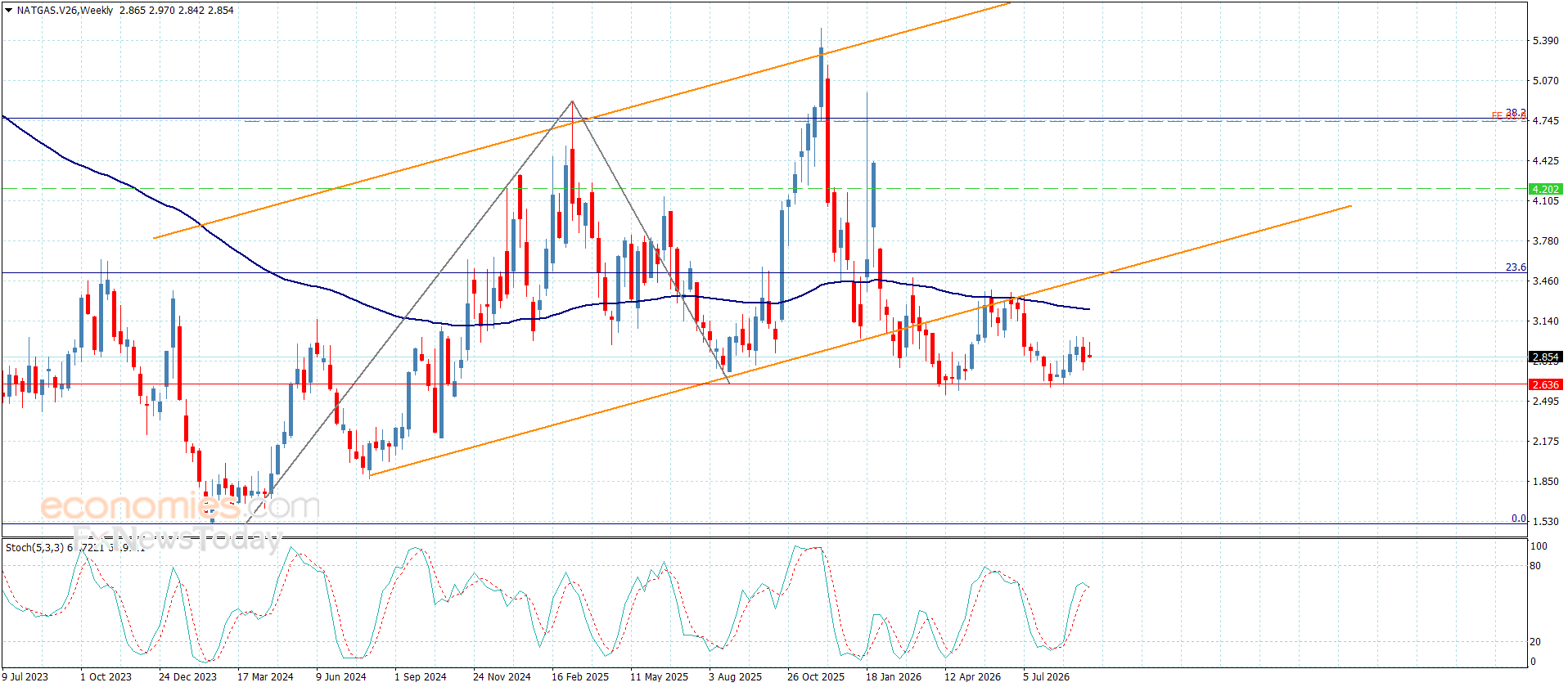
Natural gas price kept providing weak sideways trading by its fluctuation near $2.850 level, affected by the contradiction of the main indicators, specifically by the stability of the moving average 55 above the current trading as appears in the above image.
Reminding you that our bullish scenario depends on the stability of the support level at $2.620, waiting for gathering extra bullish momentum, to confirm breaching $2.920 obstacle, to attempt to reach the next positive target near $3.100.
The expected trading range for today is between $2.760 and $3.100
Trend forecast: Bullish