The main tag of GoldPrice Articles.
You can use the search box below to find what you need.
[wd_asp id=1]
The main tag of GoldPrice Articles.
You can use the search box below to find what you need.
[wd_asp id=1]
Despite Platinum price attempts to provide some positive trading, but its repeated stability below the barrier at $1275.00 level assists to motivate providing new bearish trading, attempting to decline below $1225.00, then targeting $1184.00 level, which represents the initial extra target for the near trading.
By the above image, we notice stochastic reach below 50 level, to increase the chances for gathering the required negative momentum to reach the mentioned negative stations.
The expected trading range for today is between $1185.00 and $1260.00
Trend forecast: Bearish
Today’s advance shows the likely completion of a bottom with a slightly higher swing low established at $3.45. Support was confirmed around the price level by the confluence of the 50-Day MA, the 20-Day MA, a 50% retracement level, and a significant anchored volume weighted average price (AVWAP) support level calculated from the swing low in April. Recently, the 20-Day MA began to rise again and moved away from the 50-Day MA. That dynamic between the two moving averages is a sign of improving underlying demand.
There were essentially three attempts following the April swing low to reclaim the $3.84 price level. Resistance was seen at $3.84, which established a swing high. Two subsequent rallies stopped short at $3.83 and $3.82, respectively. Monday’s advance shows another likely attempt will be made. Notice that the 50-Day MA (orange) was last reclaimed on June 2. Therefore, the recent pullback was a successful test of prior dynamic resistance as support. Since it was followed by a bullish reversal, the bearish correction should be complete, with a new attempt to rise above $3.84 likely to be seen next.
A rally above today’s high of $3.76 will provide the next sign of strength but an advance above the most recent lower swing high of $3.82 will give a more reliable indication. If the $3.84 level is broken a continuation of the rising ABCD pattern will be triggered and increase the chance of eventually reaching the initial target from the pattern at $4.08. That price level can be considered as potential resistance along with the 61.85% Fibonacci retracement level at $4.12.
For a look at all of today’s economic events, check out our economic calendar.
“The break above $3,400 marks a clear shift in sentiment,” said Kelvin Wong, senior market analyst at OANDA. “But the market is pausing here, waiting for signals from the Fed. If we break above $3,500, it opens room for a more extended move.”
Geopolitical tensions, particularly in the Middle East, have contributed to safe-haven demand, though equity markets in Asia remained broadly resilient. This relative calm has capped gold’s upside for now. Meanwhile, the U.S. Dollar Index recovered modestly from recent lows, limiting further gains in non-yielding assets, such as gold.
Silver (XAG/USD) is trading at $36.29, just below its intraday high of $36.39, supported by similar safe-haven flows and dovish expectations from the Fed.
However, mild U.S. dollar strength and risk-on appetite in equity markets have weighed on momentum. Technical resistance at $36.52 remains a key barrier for bulls.
With the Federal Open Market Committee (FOMC) widely expected to leave interest rates unchanged, attention now turns to the language in the statement and updated economic projections.
The CME FedWatch Tool shows a 62% chance of a rate cut by September, a shift that could support gold and silver through the third quarter.
Silver prices (XAG/USD) remain close to the multi-year highs near $37.00 hit last week, despite a moderate decline in demand for safe-haven assets, like precious metals, as fears that the Israel-Iran war might turn into a regional conflict have eased.
Israel and Iran have kept exchanging missile attacks over the weekend in a war that entered its fourth day, but the conflict did not extend to other countries in the area, at least for now. Apart from that, several countries have offered their efforts to mediate between the contenders, and US President Dolanld Trump is pushing them to sit and try to reach a peace deal. All this has translated into a slightly brighter market mood, which is weighing on demand for precious metals
The technical picture remains bullish. The pair has been posting higher highs and higher lows since early June, and the correction from last week’s highs has been contained at $35.50.
The doji candles on the daily chart reflect a hesitant market at current levels, but the 4-Hour RSI remains steady above 50, highlighting the bullish trend.
On the downside, immediate support is at the $36.00 level (June 11 and 13 lows) above $35.50 (June 12 low). A bearish reaction below here would put the bullish trend into question and bring the June 4 low, at $34.20, back into play.
On the upside, the $37.00 area is the 261.8% retracement of the April-May trade range, often a target for bullish and bearish cycles. So far, however, there is no clear sign of a trend shift. Above here, the next target is the 361.8% Fibonacci extension of the same trend, at $39.10.
Silver is a precious metal highly traded among investors. It has been historically used as a store of value and a medium of exchange. Although less popular than Gold, traders may turn to Silver to diversify their investment portfolio, for its intrinsic value or as a potential hedge during high-inflation periods. Investors can buy physical Silver, in coins or in bars, or trade it through vehicles such as Exchange Traded Funds, which track its price on international markets.
Silver prices can move due to a wide range of factors. Geopolitical instability or fears of a deep recession can make Silver price escalate due to its safe-haven status, although to a lesser extent than Gold’s. As a yieldless asset, Silver tends to rise with lower interest rates. Its moves also depend on how the US Dollar (USD) behaves as the asset is priced in dollars (XAG/USD). A strong Dollar tends to keep the price of Silver at bay, whereas a weaker Dollar is likely to propel prices up. Other factors such as investment demand, mining supply – Silver is much more abundant than Gold – and recycling rates can also affect prices.
Silver is widely used in industry, particularly in sectors such as electronics or solar energy, as it has one of the highest electric conductivity of all metals – more than Copper and Gold. A surge in demand can increase prices, while a decline tends to lower them. Dynamics in the US, Chinese and Indian economies can also contribute to price swings: for the US and particularly China, their big industrial sectors use Silver in various processes; in India, consumers’ demand for the precious metal for jewellery also plays a key role in setting prices.
Silver prices tend to follow Gold’s moves. When Gold prices rise, Silver typically follows suit, as their status as safe-haven assets is similar. The Gold/Silver ratio, which shows the number of ounces of Silver needed to equal the value of one ounce of Gold, may help to determine the relative valuation between both metals. Some investors may consider a high ratio as an indicator that Silver is undervalued, or Gold is overvalued. On the contrary, a low ratio might suggest that Gold is undervalued relative to Silver.
Oracle’s stock price extended its gains in latest intraday trading, piercing the pivotal resistance of 198.30, accompanied by a surge in trading volumes, with the dominance of the main upward trend as the price trades alongside the secondary upward trend line, while boosted by trading above the 50-candle SMA, but countered with negative signals streaming out of the Stochastic after reaching overbought levels, hindering upcoming gains.
Therefore we expect more gains for the price as long as it settles above $198.30, targeting the next resistance at $246.70.
Today’s trading range: Bullish
Gold (XAU/USD) is correcting lower after rejection at the $3,440 resistance area on Friday. The pair maintains the upside structure in place, but easing fears that the Iran-Israel conflict might escalate into a regional war have undermined demand for safe havens, like Gold, in favour of riskier-perceived assets.
The war between Israel and Iran entered its fourth day with no signs of an end in sight. The worst fears, however, have not crystallized, the conflict remains limited, and US interests have not been targeted. This led to a risk rally on Monday, retracing most of Friday’s moves, and pushing Gold prices lower.
The pair is on a corrective reversal from a key resistance level at $3,440, where the top of the ascending wedge channel from mid-May lows meets the May 6 high. This is a potentially bearish figure, but technical indicators are still in positive territory.
now
The precious metal is now in a bearish correction from the mentioned $3,440, aiming to a key support level at $3,400 (June 5 high). A bearish continuation below here would bring the wedge bottom into focus, now at $3,350 and June 11 lows at $3,340.
On the upside, a confirmation above $3,440 would clear the path towards the all-time high at $3,500.
Gold has played a key role in human’s history as it has been widely used as a store of value and medium of exchange. Currently, apart from its shine and usage for jewelry, the precious metal is widely seen as a safe-haven asset, meaning that it is considered a good investment during turbulent times. Gold is also widely seen as a hedge against inflation and against depreciating currencies as it doesn’t rely on any specific issuer or government.
Central banks are the biggest Gold holders. In their aim to support their currencies in turbulent times, central banks tend to diversify their reserves and buy Gold to improve the perceived strength of the economy and the currency. High Gold reserves can be a source of trust for a country’s solvency. Central banks added 1,136 tonnes of Gold worth around $70 billion to their reserves in 2022, according to data from the World Gold Council. This is the highest yearly purchase since records began. Central banks from emerging economies such as China, India and Turkey are quickly increasing their Gold reserves.
Gold has an inverse correlation with the US Dollar and US Treasuries, which are both major reserve and safe-haven assets. When the Dollar depreciates, Gold tends to rise, enabling investors and central banks to diversify their assets in turbulent times. Gold is also inversely correlated with risk assets. A rally in the stock market tends to weaken Gold price, while sell-offs in riskier markets tend to favor the precious metal.
The price can move due to a wide range of factors. Geopolitical instability or fears of a deep recession can quickly make Gold price escalate due to its safe-haven status. As a yield-less asset, Gold tends to rise with lower interest rates, while higher cost of money usually weighs down on the yellow metal. Still, most moves depend on how the US Dollar (USD) behaves as the asset is priced in dollars (XAU/USD). A strong Dollar tends to keep the price of Gold controlled, whereas a weaker Dollar is likely to push Gold prices up.
Platinum price activated the bearish correctional track in Friday’s trading after hitting the barrier at $1305.00, to gather some of the gains by reaching $1215.00 achieving the suggested initial target.
The continuation of the main indicators contradiction makes us keep preferring the correctional track, which might target $1185.00 and $1162.00 level, while renewing the bullish attempts requires providing positive closes above $1275.00 level, to increase the chances for reaching new bullish stations.
The expected trading range for today is between $1185.00 and $1260.00
Trend forecast: Bearish
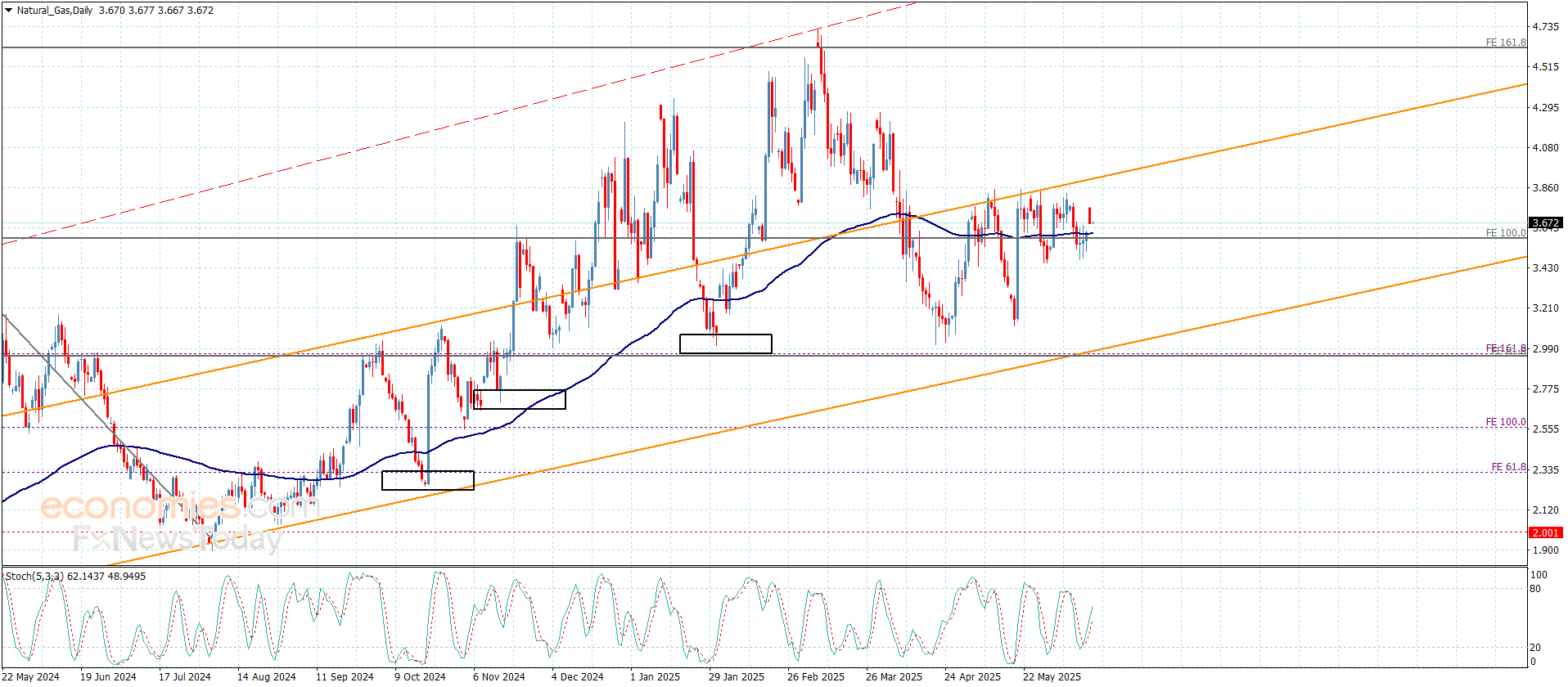
Natural gas prices were affected by the technical circumstances, forming a bullish rally and surpassing the moving average 55 at $3.600, achieving some gains by reaching 43.750 level.
Reminding you that regaining the bullish scenario requires forming a strong bullish rally, to breach the resistance at $3.900, to confirm its readiness to record new gains that might begin at $4.050 and $4.200, while the price return to fluctuate below $3.600 will cancel the positive chances, which forces it to renew the bearish attempts by reaching $3.450 initially.
The expected trading range for today is between $3.600 and $3.900
Trend forecast: Bullish
The Silver price (XAG/USD) edges lower to around $36.20 during the Asian trading hours on Monday. The recovery in the Greenback weighs on the USD-denominated commodity price. However, the potential downside seems limited amid the escalating geopolitical tensions in the Middle East.
The upbeat US economic data released on Friday could provide some support to the US Dollar (USD). The University of Michigan Consumer Sentiment Index improved for the first time in six months, with the index rising to 60.5 in June from 52.2 in the previous reading. This reading came in above the market estimations of 53.5.
On the other hand, markets fear the Israel-Iran conflict could spill over into regional conflict, which boosts safe-haven assets like Silver. Israel started attacks on Iran on Friday, targeting nuclear facilities and missile factories and killing military leaders. Semi-official Iranian media outlet Mehr News reported on Sunday that the fourth phase of Iran’s operation against Israel has begun. Iranian officials underscored that they would “respond firmly to any adventurism” from Israel.
The US Federal Reserve (Fed) policy meeting on Wednesday will be closely watched. The Fed is anticipated to keep interest rates steady at its June meeting. However, futures markets expect two rate cuts by year-end, possibly starting in September, bolstered by tame inflation data last week.
Silver is a precious metal highly traded among investors. It has been historically used as a store of value and a medium of exchange. Although less popular than Gold, traders may turn to Silver to diversify their investment portfolio, for its intrinsic value or as a potential hedge during high-inflation periods. Investors can buy physical Silver, in coins or in bars, or trade it through vehicles such as Exchange Traded Funds, which track its price on international markets.
Silver prices can move due to a wide range of factors. Geopolitical instability or fears of a deep recession can make Silver price escalate due to its safe-haven status, although to a lesser extent than Gold’s. As a yieldless asset, Silver tends to rise with lower interest rates. Its moves also depend on how the US Dollar (USD) behaves as the asset is priced in dollars (XAG/USD). A strong Dollar tends to keep the price of Silver at bay, whereas a weaker Dollar is likely to propel prices up. Other factors such as investment demand, mining supply – Silver is much more abundant than Gold – and recycling rates can also affect prices.
Silver is widely used in industry, particularly in sectors such as electronics or solar energy, as it has one of the highest electric conductivity of all metals – more than Copper and Gold. A surge in demand can increase prices, while a decline tends to lower them. Dynamics in the US, Chinese and Indian economies can also contribute to price swings: for the US and particularly China, their big industrial sectors use Silver in various processes; in India, consumers’ demand for the precious metal for jewellery also plays a key role in setting prices.
Silver prices tend to follow Gold’s moves. When Gold prices rise, Silver typically follows suit, as their status as safe-haven assets is similar. The Gold/Silver ratio, which shows the number of ounces of Silver needed to equal the value of one ounce of Gold, may help to determine the relative valuation between both metals. Some investors may consider a high ratio as an indicator that Silver is undervalued, or Gold is overvalued. On the contrary, a low ratio might suggest that Gold is undervalued relative to Silver.
Gold price has briefly pulled back from fresh two-month highs reached just above $3,450 early Monday. All eyes remain on the deepening Israel and Iran conflict and trade headlines for fresh trading impetus.
The US Dollar (USD) seems to have regained its lost footing in Asian trading on Monday, starting a new week on the front across its major currency rivals amid sagging investors’ confidence, leading to the minor pullback in Gold price.
Intensifying Iranian missiles attacks on Israel over the weekend, which continues well into early Monday, remains a drag on risk sentiment even as markets try to take into their stride and divert their attention to the upcoming central banks’ policy announcements this week.
On Sunday, Israel and Iran launched fresh attacks on Sunday, raising concerns of a broader regional conflict, which could out trade under risks through the Strait of Hormuz.
Israel’s air force attacked surface-to-surface missile sites in central Iran.
Iran told mediators Qatar and Oman that it is not open to negotiating a ceasefire with the US while it is under Israeli attack.
Meanwhile, Reuters reported that Reuters US President Donald Trump had vetoed an Israeli plan in recent days to kill Iran’s Supreme Leader Ayatollah Ali Khamenei, citing two US officials.
Gold buyers also face exhaustion after rising as much as 4% in the previous week as a sense of caution seeps in ahead of the US Federal Reserve (Fed) policy verdict due later on Wednesday.
Markets continue to price in the first interest rate of this year to come in September, still expecting two 25 basis points (bps) rate cuts by year-end.
Dovish Fed expectations continue to lend support to bright metal alongside the Middle East geopolitical crisis, with markets awaiting fresh impetus for the next leg higher.
Monday’s Retail Sales and Industrial Production data from China failed to lift Gold price as the focus now remain on US Retail Sales and the Bank of Japan (BoJ) policy decision on Tuesday.
The BoJ policy announcements could fuel the USD/JPY pair-driven volatility in the Greenback, eventually impacting the USD-denominated Gold price.
Gold price has stalled its recent uptrend, having failed to close the week above the critical resistance near $3,440.
However, the bullish potential remains in place as the 14-day Relative Strength Index (RSI) stays comfortably above the midline, currently near 62.50.
The retreat from two-month highs of could meet initial demand at $3,400, below which the sellers could challenge the previous strong resistance now support at $3,377, the 23.6% Fibonacci Retracement (Fibo) level of the April record rally.
The next downside cushion will be aligned at the 21-day Simple Moving Average (SMA) at $3,336 if the $3,350 psychological barrier gives way.
On the upside, acceptance above the aforesaid static resistance at $3,440 is critical to resuming the advance toward the record highs of $3,500.
The two-month highs of $3,453 could test bearish commitments buyers regain poise.
Gold has played a key role in human’s history as it has been widely used as a store of value and medium of exchange. Currently, apart from its shine and usage for jewelry, the precious metal is widely seen as a safe-haven asset, meaning that it is considered a good investment during turbulent times. Gold is also widely seen as a hedge against inflation and against depreciating currencies as it doesn’t rely on any specific issuer or government.
Central banks are the biggest Gold holders. In their aim to support their currencies in turbulent times, central banks tend to diversify their reserves and buy Gold to improve the perceived strength of the economy and the currency. High Gold reserves can be a source of trust for a country’s solvency. Central banks added 1,136 tonnes of Gold worth around $70 billion to their reserves in 2022, according to data from the World Gold Council. This is the highest yearly purchase since records began. Central banks from emerging economies such as China, India and Turkey are quickly increasing their Gold reserves.
Gold has an inverse correlation with the US Dollar and US Treasuries, which are both major reserve and safe-haven assets. When the Dollar depreciates, Gold tends to rise, enabling investors and central banks to diversify their assets in turbulent times. Gold is also inversely correlated with risk assets. A rally in the stock market tends to weaken Gold price, while sell-offs in riskier markets tend to favor the precious metal.
The price can move due to a wide range of factors. Geopolitical instability or fears of a deep recession can quickly make Gold price escalate due to its safe-haven status. As a yield-less asset, Gold tends to rise with lower interest rates, while higher cost of money usually weighs down on the yellow metal. Still, most moves depend on how the US Dollar (USD) behaves as the asset is priced in dollars (XAU/USD). A strong Dollar tends to keep the price of Gold controlled, whereas a weaker Dollar is likely to push Gold prices up.