The main tag of GoldPrice Articles.
You can use the search box below to find what you need.
[wd_asp id=1]
The main tag of GoldPrice Articles.
You can use the search box below to find what you need.
[wd_asp id=1]
Traders are closely monitoring today’s U.S. consumer price index (CPI) report, scheduled for release at 1230 GMT. The data could clarify the Federal Reserve’s stance on interest rates. A softer CPI would increase the likelihood of rate cuts, which would typically support gold prices. Conversely, a hotter-than-expected reading could dampen gold’s appeal by reinforcing expectations for prolonged high interest rates.
U.S. and Chinese officials announced on Tuesday they had agreed on a framework to restore trade cooperation, including the rollback of China’s export restrictions on rare earths. However, markets showed little enthusiasm, reflecting skepticism over the durability of any agreement. April’s tit-for-tat tariffs and only partial progress since underscore lingering distrust. “Gold should remain supported as long as global trade tensions risk escalating further, or even just staying elevated for longer,” said Han Tan, chief market analyst at Exinity Group.
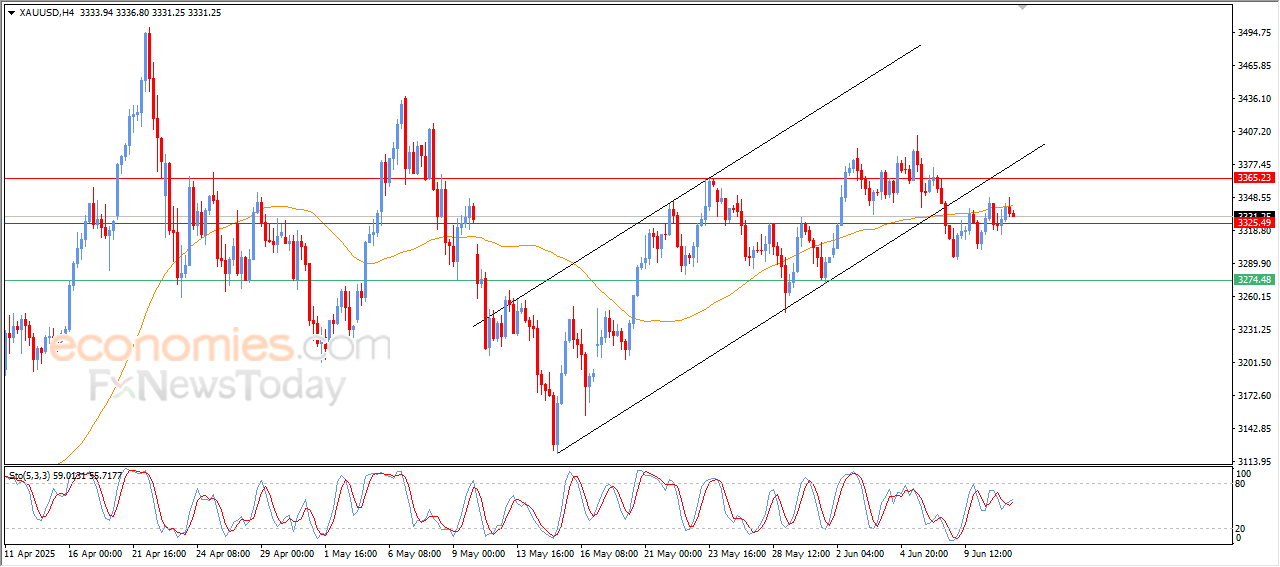
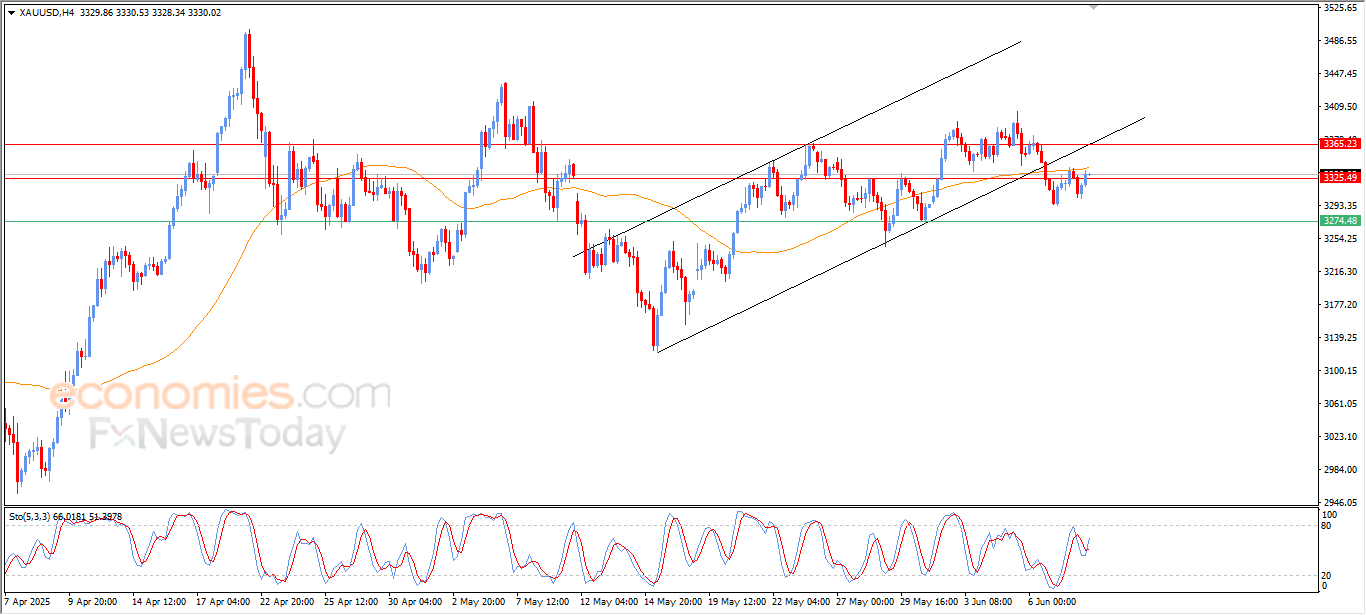
Gold is trading in a tight range, supported by geopolitical risk but held back by technical resistance. The support zone between $3310.48 and $3274.00 will be key—failure to hold above this area could open the door to extended downside. Unless the $3403.63 top is breached, sentiment remains mixed with a neutral-to-bearish near-term bias. Traders should watch both CPI outcomes and trade headlines for confirmation of the next directional move.
More Information in our Economic Calendar.
The EURNZD failed to record any new positive target, due to the continuation of the contradiction between the main indicators, to notice its approach from the moving average 55 at 1.8810, reinforcing the stability of the bullish channel’s support at 1.8785.
Depending on the stability of the previously mentioned main support, we will keep waiting for positive momentum in the near period, to ease the mission of recording positive stations by its rally to 1.8960 initially, then attempt to press on the intraday obstacle at 1.9050.
The expected trading range for today is between 1.8860 and 1.8960
Trend forecast: Bullish
Copper price remains stable until this moment below $4.8900 level, which decelerates the chances for renewing the bullish attempts, to keep preferring the sideways bias domination in the near trading, and there is a possibility to form some correctional waves that target $4.7500 reaching $4.6600 level.
While the price success to breach the mentioned barrier and hold above it will reinforce the chances for renewing the bullish attempts, to expect reaching $5.0300 followed by the next barrier at $5.1000.
The expected trading range for today is between $4.7500 and $4.8900
Trend forecast: Fluctuated within the bullish track
The GBPJPY pair kept its stability within the bullish channel’s levels, taking advantage of forming extra support at 194.50 level, to notice forming some bullish waves and its stability near 195.50, to confirm the continuation of the previously suggested bullish scenario.
The price needs a new positive momentum that allows it to settle above the obstacle at 195.65 level, to begin forming strong bullish waves, targeting 196.30 level reaching 61.8%Fibonacci correction level at 197.35, forming the next main target for the bullish track.
The expected trading range for today is between 194.80 and 196.30
Trend forecast: Bullish
Gold price is gathering strength in Wednesday’s Asian trading, having defended the critical support near $3,300 so far this week. However, the further upside hinges on the US Consumer Price Index (CPI) data due later in the day.
Following the second day of US-China trade talks in London on Tuesday, Bloomberg reported that both sides agreed on a framework for a trade deal that could potentially help resolve a trade war between the world’s two largest economies.
The US-China optimism helped the US Dollar (USD) recover some ground across its major currency rivals. However, the recovery lacks conviction amid the US Appeals court ruling that allows US President Donald Trump’s reciprocal tariffs to stay in place.
This uncertainty over Trump’s trade policies fails to lift risk sentiment, allowing the traditional safe-haven Gold price to gather upside traction.
Traders also remain wary ahead of the all-important US CPI data, which could alter markets’ expectations of a September Federal Reserve (Fed) interest rate cut.
Markets are currently pricing in about 52% odds of the Fed lowering rates by 25 basis points (bps) in September.
The US monthly CPI is forecast to increase by 0.2% and core inflation is expected to tick up to 0.3% in May. The data will likely show the first signs of Trump’s tariffs feeding through into prices.
Hotter-than-expected US monthly CPI reading could push back against markets’ expectations of a Fed rate cut in September, sending the US Dollar higher at the expense of the non-yielding Gold price
On the other hand, a surprise cooldown in the inflation data could reinforce the buying interest around non-yielding Gold price, as the data would reaffirm expectations of two rate cuts by the Fed this year.
However, the Gold price reaction to the US inflation report could be impacted by the trade headlines. Markets also keep a close eye on the US 10-year Treasury bond auction on Wednesday and Thursday.
There are no changes to the short-term technical outlook so long as Gold price holds above the critical $3,297 level.
That level is the confluence of the 21-day Simple Moving Average (SMA) and the 38.2% Fibonacci Retracement (Fibo) level of the April record rally.
Further, the 14-day Relative Strength Index (RSI) has managed to hold its ground above the midline, currently near 54, supporting the bullish potential.
Gold sellers need a daily candlestick closing below the abovementioned strong support at $3,297 to challenge the 50-day SMA cap at $3,262.
The last line of defense for buyers is aligned at $3,232, the 50% Fibo level of the same ascent.
On the flip side, Gold buyers will likely find strong offers at the $3,350 psychological level if the rebound gathers strength.
The next resistance is spotted at the 23.6% Fibo resistance at $3,377, above which the May high of $3,439 could be threatened.
Inflationary or deflationary tendencies are measured by periodically summing the prices of a basket of representative goods and services and presenting the data as The Consumer Price Index (CPI). CPI data is compiled on a monthly basis and released by the US Department of Labor Statistics. The MoM figure compares the prices of goods in the reference month to the previous month.The CPI is a key indicator to measure inflation and changes in purchasing trends. Generally, a high reading is seen as bullish for the US Dollar (USD), while a low reading is seen as bearish.
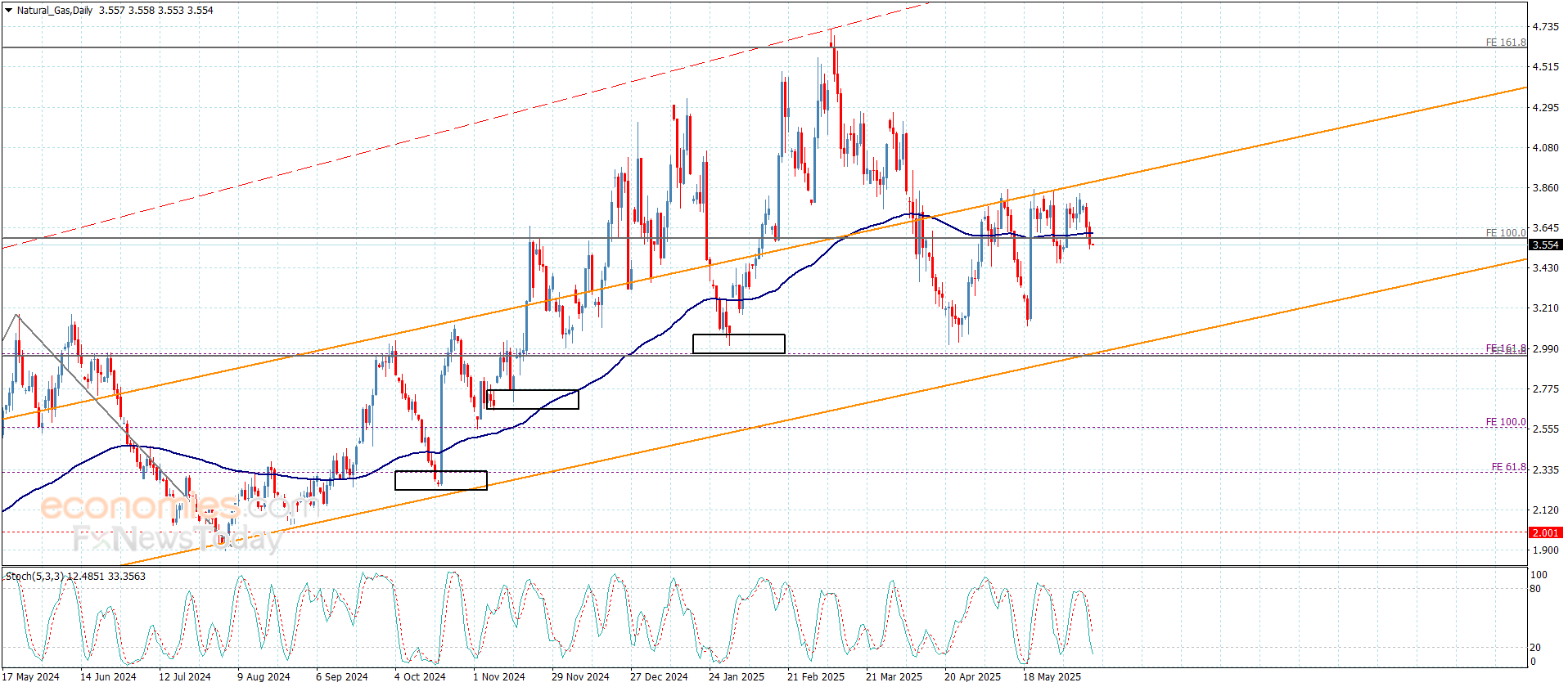
Potential support around the 50-Day MA takes on added significance since it is joined by two other indicators. The 20-Day MA converged with the 50-Day line recently and an anchored volume weighted average price (AVWAP) level is at $3.51 currently. Having said that, last week’s low was $3.50. Since it is a weekly support level, it takes on added significance relative to a daily level. This means two things. Either weekly support is broken to the downside, pointing to still lower prices, or strong support is found at or above the weekly low, that leads to a bullish reversal.
A little lower is key support at $3.44, as it is a higher swing low and therefore part of the price structure for the near-term rising trend that began from the May swing low (C). A drop below it would indicate a potential bearish reversal following two recent lower swing highs, relative to the May swing high (B). If the $3.44 swing low is broken to the downside, then the next lower price levels to watch for support, include the 61.8% Fibonacci retracement at $3.38 and the 200-Day MA, now at $3.29. There were two recent successful tests of support around the 200-Day MA during bearish corrections.
Therefore, a drop to the 200-Day line might be the lowest price level reached if the current pullback continues to weaken. Having said that, given the strengthening relationship with the 200-Day MA, support would more likely be seen a little above the 200-Day line, if not more so. Notice that the decline in April dropped below the 200-Day MA for four days before recovering. In May, the dip below the 200-Day line occurred over two days. Further, the drop below the line in April was greater than what occurred in May.
For a look at all of today’s economic events, check out our economic calendar.
Spot Gold extended its weekly rally on Tuesday, approaching the $3,350 area in the American session. The US Dollar (USD) enjoyed near-term demand during Asian trading hours, and XAU/USD flirted with the $3,300 threshold at the beginning of the day as investors were optimistic about a potential trade deal between the United States (US) and China.
The absence of meaningful headlines and extended talks on Tuesday slowly weighed on the market’s mood, underpinning the bright metal. The USD, however, captured attention after Wall Street’s opening, once again advancing alongside stocks on hopes a trade deal will be announced shortly.
Indeed, easing tensions between Beijing and Washington would mean a firmer USD amid relief about US economic progress. On a positive note, the US reported progress on talks with other major economies, such as India. Still, the main theme remains on how the two world’s largest economy will resolve their conflict.
Coming ahead, investors are looking at the upcoming US Consumer Price Index (CPI) release. Inflation, as measured by the CPI, is expected to have posted a modest advance in May, maybe not enough to twist the Federal Reserve’s (Fed) monetary policy, but enough to fuel ongoing concerns about the US economic health.
The daily chart for the XAU/USD pair shows the pair found buyers around a modestly bullish 20 Simple Moving Average (SMA) for a second consecutive day. The SMA provides support at around $3,302, while developing far above bullish 100 and 200 SMAs. The Momentum indicator eases and aims lower just above its 100 line, suggesting buying interest remains limited. Finally, the Relative Strength Index (RSI) indicator is flat at around 52, in line with the absence of directional strength. The bright metal would need to overcome the mentioned $3,350 region to turn bullish.
The near-term picture suggests XAU/USD could retest the $3,300 mark. The pair briefly surpassed a bearish 20 SMA, but was unable to retain ground above it. A flat 200 SMA at around $3,300, in the meantime, provided intraday support and reinforcing the round figure. Additionally, technical indicators aim modestly lower within negative levels, skewing the risk to the downside.
Support levels: 3,314.30 3,300.00 3,287.45
Resistance levels: 3,349.50 3,361.95 3,375.80
Generally speaking, a trade war is an economic conflict between two or more countries due to extreme protectionism on one end. It implies the creation of trade barriers, such as tariffs, which result in counter-barriers, escalating import costs, and hence the cost of living.
An economic conflict between the United States (US) and China began early in 2018, when President Donald Trump set trade barriers on China, claiming unfair commercial practices and intellectual property theft from the Asian giant. China took retaliatory action, imposing tariffs on multiple US goods, such as automobiles and soybeans. Tensions escalated until the two countries signed the US-China Phase One trade deal in January 2020. The agreement required structural reforms and other changes to China’s economic and trade regime and pretended to restore stability and trust between the two nations. However, the Coronavirus pandemic took the focus out of the conflict. Yet, it is worth mentioning that President Joe Biden, who took office after Trump, kept tariffs in place and even added some additional levies.
The return of Donald Trump to the White House as the 47th US President has sparked a fresh wave of tensions between the two countries. During the 2024 election campaign, Trump pledged to impose 60% tariffs on China once he returned to office, which he did on January 20, 2025. With Trump back, the US-China trade war is meant to resume where it was left, with tit-for-tat policies affecting the global economic landscape amid disruptions in global supply chains, resulting in a reduction in spending, particularly investment, and directly feeding into the Consumer Price Index inflation.
Just as we’ve been reporting to you about declining rig counts across the U.S. and in Oklahoma, now comes a prediction from the U.S. Energy Information Administration of falling oil prices and lower rig counts. It means more stacked oil drilling rigs and oil prices of $60 or lower.
The EIA came out with its prediction this week saying it expects the Brent crude oil price to fall to near $60 per barrel by the end of the year and to average about $59 per barrel in 2026. EIA expects the low price of crude oil to affect both U.S. crude oil production and retail gasoline prices in the short term.
In its June Short-Term Energy Outlook (STEO), EIA forecasts U.S. crude oil production to average about 13.4 million barrels per day this year, just below the record highs earlier this year. For 2026, the forecast is slightly lower than 2025 levels. EIA expects U.S. retail gasoline prices to average below $3.10 per gallon through the end of 2026, which is about 6% lower than the 2024 average price.
|
2024 |
2025 |
2026 |
|
|
Brent crude oil spot price (dollars per barrel) |
$81 |
$66 |
$59 |
|
Retail gasoline price (dollars per gallon) |
$3.30 |
$3.10 |
$3.10 |
|
U.S. crude oil production (million barrels per day) |
13.2 |
13.4 |
13.4 |
|
Natural gas price at Henry Hub (dollars per million British thermal units) |
$2.20 |
$4.00 |
$4.90 |
|
U.S. liquefied natural gas gross exports (billion cubic feet per day) |
12 |
15 |
16 |
|
Shares of U.S. electricity generation |
|
|
|
|
Natural gas |
42% |
40% |
40% |
|
Coal |
16% |
16% |
15% |
|
Renewables |
23% |
25% |
27% |
|
Nuclear |
19% |
19% |
18% |
|
U.S. GDP (percentage change) |
2.8% |
1.4% |
1.7% |
|
U.S. CO2 emissions (billion metric tons) |
4.8 |
4.8 |
4.8 |
|
Data source: U.S. Energy Information Administration, Short-Term Energy Outlook, June 2025 |
|||
Some key highlights from the June STEO include:
Gold (XAU/USD) has reversed course durub¡ng the European trading session on Tuesday, and is showing moderate gains, approaching resistance at $3,340 as the Dollar gives away gains with optimism about the outcome of the US-China meeting wearing off.
seems
A mild enthusiasm on the back of the positive comments from President Trump and US representatives regarding the developments of the negotiation seems to have faded, as the meeting extends for the second day. The US Dollar is giving away gains with investors turning more cautious, boosting demand for safe havens like Gold.
Investors are trimming their US Dollar longs, increasingly cautious about the outcome of the negotiations between the world’s two major economies, amid the lack of progress on trade deals. So far, only the UK has reached a rather modest one, while the clock ticks closer to the July 9 deadline.
The broader trend remains negative, with the precious metal correcting lower following a rally from May 15 lows. Intraday charts, however, show a bullish reaction from $3,290, which looks likely to extend beyond the previous support, now turned resistance at $3,340.,
Elliott Wave analysts would say that the pair has confirmed the completion of a bullish cycle and is on a three-wave correction. In this case, we would be on the A-B leg, which might extend to the reverse trendline, now at $3,370, before extending lower.
On the downside, supports are at the June 9 low, $3,290, and the May 15 and 19 highs, and May 29 lows at $3,245.
The table below shows the percentage change of US Dollar (USD) against listed major currencies today. US Dollar was the strongest against the British Pound.
| USD | EUR | GBP | JPY | CAD | AUD | NZD | CHF | |
|---|---|---|---|---|---|---|---|---|
| USD | 0.00% | 0.34% | 0.01% | -0.00% | 0.05% | 0.00% | -0.06% | |
| EUR | -0.00% | 0.35% | 0.00% | 0.03% | 0.07% | 0.00% | -0.04% | |
| GBP | -0.34% | -0.35% | -0.41% | -0.33% | -0.28% | -0.35% | -0.38% | |
| JPY | -0.01% | 0.00% | 0.41% | 0.00% | -0.01% | -0.10% | -0.16% | |
| CAD | 0.00% | -0.03% | 0.33% | -0.00% | 0.03% | -0.02% | -0.06% | |
| AUD | -0.05% | -0.07% | 0.28% | 0.00% | -0.03% | -0.04% | -0.12% | |
| NZD | 0.00% | -0.00% | 0.35% | 0.10% | 0.02% | 0.04% | -0.04% | |
| CHF | 0.06% | 0.04% | 0.38% | 0.16% | 0.06% | 0.12% | 0.04% |
The heat map shows percentage changes of major currencies against each other. The base currency is picked from the left column, while the quote currency is picked from the top row. For example, if you pick the US Dollar from the left column and move along the horizontal line to the Japanese Yen, the percentage change displayed in the box will represent USD (base)/JPY (quote).
resistance
The NZDCHF kept its stability in the last trading within the bullish channel’s levels, noticing forming weak trading due to the several barriers near the 0.8300 level that decreases the chances for recording any extra gains until now.
The repeated stability below the barrier will increase the efficiency of the bearish correctional track again, to expect reaching 0.8240, then attempt to press on the bullish channel’s support at 0.8210, while motivating the bullish track requires repeated closes above the barrier to reach the positive stations at 0.8375 and 0.8415.
The expected trading range for today is between 0.8210 and 0.8300
Trend forecast: Bearish