The main tag of GoldPrice Articles.
You can use the search box below to find what you need.
[wd_asp id=1]
The main tag of GoldPrice Articles.
You can use the search box below to find what you need.
[wd_asp id=1]
No news for copper price by it continues fluctuation below the extra barrier at $4.8900, which obstacles the chances for resuming the bullish attack, to expect the domination of the sideways track in the near period, and there is a chance for forming some correctional waves, to reach $4.7500 reaching 50%Fibonacci correctional level at $4.6600.
While the price success to confirm breaching the mentioned barrier will reinforce the chances for renewing the bullish attempts, to expect reaching $5.0300 reaching the next barrier at $5.1000.
The expected trading range for today is between $4.7500 and $4.8900
Trend forecast: Fluctuated
Platinum price succeeded to resume the bullish attack yesterday, reaching the last target at $1223.00, facing 2.610% Fibonacci extending level, forming a significant resistance against detecting the main trend in the upcoming trading.
The stability below this resistance and stochastic exit from the overbought level, we expect forming some bearish correctional wave that might target $1180. 00 level reaching extra support at $1162.00, while breaching the resistance and holding above it will reinforce the chances for achieving extra gains that might extend to $1240.00 reaching the main bullish channel’s resistance at $1255.00.
The expected trading range for today is between $1185.00 and $1225.00
Trend forecast: Bearish
Gold price is back to testing the $3,300 threshold early Tuesday amid resurgent US Dollar (USD) demand. However, traders continue to maintain caution, watching the US-China trade talks in London.
Bloomberg reported that trade talks between the United States (US) and China will continue into a second day after the first day of talks were fruitful, per US Commerce Secretary Howard Lutnick.
US President Donald Trump said late Monday that “China is not easy but we are doing well with China,” giving no specifics on the key contention topics of shipments of technology and rare earth elements.
Alongside the US-China trade optimism, the latest leg down in Gold price is fuelled by a solid rebound in the US Dollar (USD).
The Greenback is mainly driven by the upswing in the USD/JPY pair after the Japanese Yen (JPY) tumbled on Bank of Japan (BoJ)Governor Kazuo Ueda’s cautious remarks on the interest rates outlook.
Ueda said: “We will raise interest rates if we have enough confidence that underlying inflation nears 2% or moves around 2%.”
The further upside in the Greenback will likely remain limited as traders refrain from placing fresh bets before any decisive outcome from day 2 of US-China trade talks in London.
Markets will also look forward to Wednesday’s US Consumer Price Index (CPI) data for fresh direction on the USD and Gold price.
On Monday, the latest Survey of Consumer Expectations conducted by the Federal Reserve (Fed) Bank of New York showed that the year-ahead inflation expectation decreased to 3.2% in May from 3.6% in April.
There are no changes to the short-term technical outlook for Gold price so long as the critical $3,297 level is defended.
That level is the confluence of the 21-day Simple Moving Average (SMA) and the 38.2% Fibonacci Retracement (Fibo) level of the April record rally.
Further, the 14-day Relative Strength Index (RSI) has managed to hold its ground above the midline, currently near 51, supporting the bullish bias.
Gold sellers need a daily candlestick closing below the abovementioned strong support at $3,297 to challenge the 50-day SMA cap at $3,262.
The last line of defense for buyers is aligned at $3,232, the 50% Fibo level of the same ascent.
On the flip side, Gold buyers will likely find strong offers at the $3,350 psychological level if the rebound gathers strength.
The next resistance is spotted at the 23.6% Fibo resistance at $3,377, above which the May high of $3,439 could be threatened.
(This report was corrected on June 10 at 04:03 GMT to say that “Gold price is back to testing the $3,300 threshold early Tuesday,” not Thursday.)
Gold has played a key role in human’s history as it has been widely used as a store of value and medium of exchange. Currently, apart from its shine and usage for jewelry, the precious metal is widely seen as a safe-haven asset, meaning that it is considered a good investment during turbulent times. Gold is also widely seen as a hedge against inflation and against depreciating currencies as it doesn’t rely on any specific issuer or government.
Central banks are the biggest Gold holders. In their aim to support their currencies in turbulent times, central banks tend to diversify their reserves and buy Gold to improve the perceived strength of the economy and the currency. High Gold reserves can be a source of trust for a country’s solvency. Central banks added 1,136 tonnes of Gold worth around $70 billion to their reserves in 2022, according to data from the World Gold Council. This is the highest yearly purchase since records began. Central banks from emerging economies such as China, India and Turkey are quickly increasing their Gold reserves.
Gold has an inverse correlation with the US Dollar and US Treasuries, which are both major reserve and safe-haven assets. When the Dollar depreciates, Gold tends to rise, enabling investors and central banks to diversify their assets in turbulent times. Gold is also inversely correlated with risk assets. A rally in the stock market tends to weaken Gold price, while sell-offs in riskier markets tend to favor the precious metal.
The price can move due to a wide range of factors. Geopolitical instability or fears of a deep recession can quickly make Gold price escalate due to its safe-haven status. As a yield-less asset, Gold tends to rise with lower interest rates, while higher cost of money usually weighs down on the yellow metal. Still, most moves depend on how the US Dollar (USD) behaves as the asset is priced in dollars (XAU/USD). A strong Dollar tends to keep the price of Gold controlled, whereas a weaker Dollar is likely to push Gold prices up.
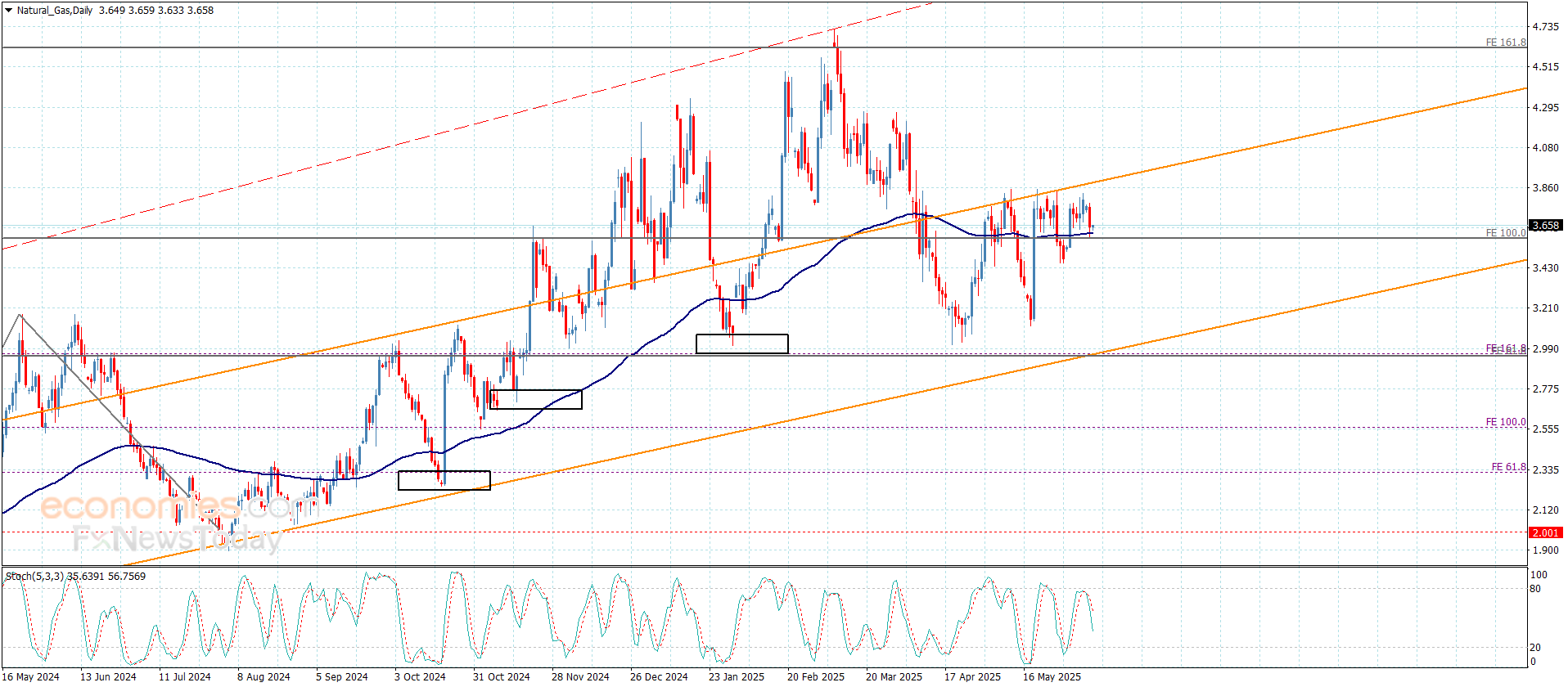
Since there was a failed upside breakout of consolidation on Friday, and it was followed by a drop below the low of the consolidation price range on the next day, the small consolidation pattern may have expanded into a potential broadening formation. Notice that the 50-Day MA was last reclaimed on June 2 with a sharp advance, and it followed a failed breakout of the 50-Day line several days earlier.
Therefore, if weakness persists the 50-Day line marks a key potential support level. Currently it is at $3.51, and it has converged with the 20-Day MA. So, they each represent the same price. Further, an AVWAP level starting from the April swing low (A) is at $3.50 and a weekly low is also at $3.50.
When multiple indicators point to a similar price level, that area of price can take on potentially greater significance. Either by drawing price towards it like a magnet or repelling price and exhibiting signs of strong support. Moreover, if the price zone fails to hold as support, a breakdown could lead to downside momentum spiking, as the chance of an eventual resolution to the upside diminishes. The weekly low in natural gas is most significant as it is part of the weekly bullish price structure.
Last week was an inside week and it followed a potentially bearish shooting star candlestick pattern the week before. Since last week’s high did not exceed the prior week’s high, natural gas remains prone to potential downside risk warned by the shooting star. But it also has potentially strong support not far below from current prices. Further consolidation before natural gas makes another attempt to rise above the May swing high (B) at $3.84, might make that breakout more successful, if it does occur. But only if it stays above last week’s low of $3.50.
For a look at all of today’s economic events, check out our economic calendar.
Last week, silver broke out to a new trend high and confirmed the breakout on a weekly basis, as the week ended above the $34.87 breakout level. There has only been one week up since an inside week breakout triggered last week. That led to the spike in bullish momentum and a decisive rally to new trend highs. The $37.05 potential target is the initial completion of a rising ABCD pattern that started from the April swing low (A).
Might silver continue to rise above $37.05? Given the bullish momentum of the past few days, it looks possible. However, the next upside target recognized by the confluence of several price levels is up at $38.46 to $38.61. That area may act like a magnet for price, but it may be too far to go before at least a pause or minor correction of some degree first. Notice that there is also a trend channel line that represents potential resistance above $37.05.
As of today’s high, the price of silver was up by $8.58, or 30.1%, from the April swing low at $28.32. On a percentage basis, that measured move shows a relationship with the two prior strongest rallies since February 2024. However, each showed slightly stronger performance than the current advance, so far. From August 2024 there was a 31.7% rise and from February 2024 the price of silver rose by 35.9% before seeing a more significant pullback.
Monday’s higher daily low at $35.91 I near-term support for silver. The near-term uptrend is retained above that price level, while a drop below it could lead to a deeper retracement. Although there are potential upside price targets discussed above, they are only a guide as to what might happen. New price action needs to be consistently assessed to identify changing support and demand dynamics. The next decision point will be whether resistance is seen around $3.05, or whether there are signs of an upside breakout, and therefore a continuation of the bull trend.
For a look at all of today’s economic events, check out our economic calendar.
Important DisclaimersThe content provided on the website includes general news and publications, our personal analysis and opinions, and contents provided by third parties, which are intended for educational and research purposes only. It does not constitute, and should not be read as, any recommendation or advice to take any action whatsoever, including to make any investment or buy any product. When making any financial decision, you should perform your own due diligence checks, apply your own discretion and consult your competent advisors. The content of the website is not personally directed to you, and we does not take into account your financial situation or needs.The information contained in this website is not necessarily provided in real-time nor is it necessarily accurate. Prices provided herein may be provided by market makers and not by exchanges.Any trading or other financial decision you make shall be at your full responsibility, and you must not rely on any information provided through the website. FX Empire does not provide any warranty regarding any of the information contained in the website, and shall bear no responsibility for any trading losses you might incur as a result of using any information contained in the website.The website may include advertisements and other promotional contents, and FX Empire may receive compensation from third parties in connection with the content. FX Empire does not endorse any third party or recommends using any third party’s services, and does not assume responsibility for your use of any such third party’s website or services.FX Empire and its employees, officers, subsidiaries and associates, are not liable nor shall they be held liable for any loss or damage resulting from your use of the website or reliance on the information provided on this website.Risk DisclaimersThis website includes information about cryptocurrencies, contracts for difference (CFDs) and other financial instruments, and about brokers, exchanges and other entities trading in such instruments. Both cryptocurrencies and CFDs are complex instruments and come with a high risk of losing money. You should carefully consider whether you understand how these instruments work and whether you can afford to take the high risk of losing your money.FX Empire encourages you to perform your own research before making any investment decision, and to avoid investing in any financial instrument which you do not fully understand how it works and what are the risks involved.
Spot Gold hovers near $3,330 a troy ounce, posting a modest intraday advance at the beginning of the week. XAU/USD recovered from an early low at $3,293.51 and advances after Wall Street’s opening amid renewed US Dollar (USD) weakness and a cautious mood.
Market players await news from trade talks as the United States (US) and China resumed negotiations. Top representatives from Washington and Beijing gather in London to discuss next steps. In the meantime, the Wall Street Journal reported market talks indicating US President Donald Trump authorized Treasury Secretary Scott Bessent to negotiate lifting some of the recent restrictions on a variety of products to China. Trump’s goal is to clinch a deal on rare earth minerals coming from China.
Earlier in the day, China reported a Trade Balance surplus of $103.22 billion in May, with Exports slowing to 4.8% year-on-year (YoY) down from the 8.1% posted in April. Imports shrank even further, down by 3.4% in the same period after shedding 0.2% in the year to April 2025.
Meanwhile, a holiday in Europe kept most pairs within familiar levels on Monday, with the bright metal being no exception. In fact, the macroeconomic calendar has little to offer until Wednesday, when the US will publish the May Consumer Price Index (CPI). Financial markets anticipate a modest uptick in the annual reading, not enough to twist the Federal Reserve’s (Fed) monetary policy stance,
From a technical point of view, the daily chart for the XAU/USD pair shows it bounced from around a flat 20 Simple Moving Average (SMA) at $3,295, while the 100 and 200 SMAs maintain their strong bullish slopes far below the shorter one, in line with the dominant upward trend. At the same time, the Momentum indicator eases within positive levels, reflecting the limited buying interest rather than suggesting a steeper decline ahead. The Relative Strength Index (RSI) indicator hovers at around 52, failing to provide clear directional clues, yet overall suggesting sellers are not interested.
In the near term, XAU/USD aims to extend its recovery, but lacks conviction. The 4-hour chart shows technical indicators recovering within negative levels, still below their midlines. At the same time, the pair is developing below a mildly bearish 20 SMA, yet a mildly bullish 100 SMA advances beyond the 200 SMA while providing near-term support at around $3,3310.
Support levels: 3,310.00 3,295.00 3,278.10
Resistance levels: 3,332.50 3,345.20 3,361.95
The Silver (XAG/USD) price trades in positive territory around $36.00 during the Asian session on Monday. The white metal edges higher despite the stronger-than-expected US employment data for May. Later on Monday, investors will closely watch the developments surrounding US-China trade talks.
Geopolitical and economic uncertainty could provide some support to the Silver price as investors seek more holdings in safe-haven assets. US Treasury Secretary Scott Bessent, Commerce Secretary Howard Lutnick, and Trade Representative Jamieson Greer are set to speak with Chinese officials about trade talks.
Furthermore, industrial demand for applications such as solar panels contributes to the Silver’s upside. The Silver Institute estimated the metal’s supply was 15% below demand in 2024 and is projected to see another deficit in 2025.
On the other hand, the upbeat US May employment report gave the US Federal Reserve (Fed) a way to caution ahead of US-China trade talks, which are set to take place in London later in the day. This, in turn, might boost the Greenback and weigh on the USD-denominated commodities price. Federal Fund Futures pointed to a larger possibility that the Fed may keep its benchmark interest rate steady until the September monetary policy meetings.
(This story was corrected on June 9 at 06:55 GMT, to say in the third paragraph that industrial demand for applications such as solar panels contributes to the Silver’s upside, not the USD’s upside.)
Silver is a precious metal highly traded among investors. It has been historically used as a store of value and a medium of exchange. Although less popular than Gold, traders may turn to Silver to diversify their investment portfolio, for its intrinsic value or as a potential hedge during high-inflation periods. Investors can buy physical Silver, in coins or in bars, or trade it through vehicles such as Exchange Traded Funds, which track its price on international markets.
Silver prices can move due to a wide range of factors. Geopolitical instability or fears of a deep recession can make Silver price escalate due to its safe-haven status, although to a lesser extent than Gold’s. As a yieldless asset, Silver tends to rise with lower interest rates. Its moves also depend on how the US Dollar (USD) behaves as the asset is priced in dollars (XAG/USD). A strong Dollar tends to keep the price of Silver at bay, whereas a weaker Dollar is likely to propel prices up. Other factors such as investment demand, mining supply – Silver is much more abundant than Gold – and recycling rates can also affect prices.
Silver is widely used in industry, particularly in sectors such as electronics or solar energy, as it has one of the highest electric conductivity of all metals – more than Copper and Gold. A surge in demand can increase prices, while a decline tends to lower them. Dynamics in the US, Chinese and Indian economies can also contribute to price swings: for the US and particularly China, their big industrial sectors use Silver in various processes; in India, consumers’ demand for the precious metal for jewellery also plays a key role in setting prices.
Silver prices tend to follow Gold’s moves. When Gold prices rise, Silver typically follows suit, as their status as safe-haven assets is similar. The Gold/Silver ratio, which shows the number of ounces of Silver needed to equal the value of one ounce of Gold, may help to determine the relative valuation between both metals. Some investors may consider a high ratio as an indicator that Silver is undervalued, or Gold is overvalued. On the contrary, a low ratio might suggest that Gold is undervalued relative to Silver.
Buying pressure in gold subsided on Friday last week, as gold dropped more than 1000 points from $3403, courtesy of the NFP data favoring the U.S. dollar.
Russia has launched one of the war’s largest air attacks, and this news may bring more inflow into gold, and prices may rise.
The bias in gold is still buy, and the price has already tapped its buying levels. Let’s discuss the key pivot levels for gold buying and selling in this XAUUSD weekly forecast from June 9th to June 13th, 2025.
In the previous week’s forecast, we marked the weekly level and the opening gap in gold from where the price has moved up 236 points so far.
Now let’s start by discussing the key economic events of this week and their possible impact on the price of XAUUSD.
Some significant U.S. economic reports are scheduled for release this week that are expected to impact XAUUSD.
Wednesday, June 11: CPI Information
Thursday, June 12: Jobs & PPI Data:
Friday, June 13: UoM Information
The HTF level in gold has formed a significant range, with the high end at $3357 and the low end at $3193. A breakout of either side and a retest will confirm the direction of gold in the coming weeks for medium-long-term investors.

Gold is currently bullish in 4h timeframes and above. However, it is showing bearish momentum in 1h and below. Currently, gold is rising after reaching a crucial point of interest (POI), as discussed above. Losing the marked support on the chart below can push it to internal liquidity of $3245, while a breakout above can take it to the external liquidity of $3403.

The first selling opportunity in gold is the golden zone of fib 0.5-0.618 level, which is coming around $3335-$3344, and this level is also the breaker block of the big range gold has broken to the downside. Meanwhile, the second selling opportunity is the POC and the VAH of the ongoing bearish swing, which is coming around $3357-3369.

To conclude, gold can give both buys and sells this week. Lower time frames are suggesting sells, while higher time frames are still favoring a buy position in gold.
Disclosure: This article does not represent investment advice. The content and materials featured on this page are for educational purposes only.
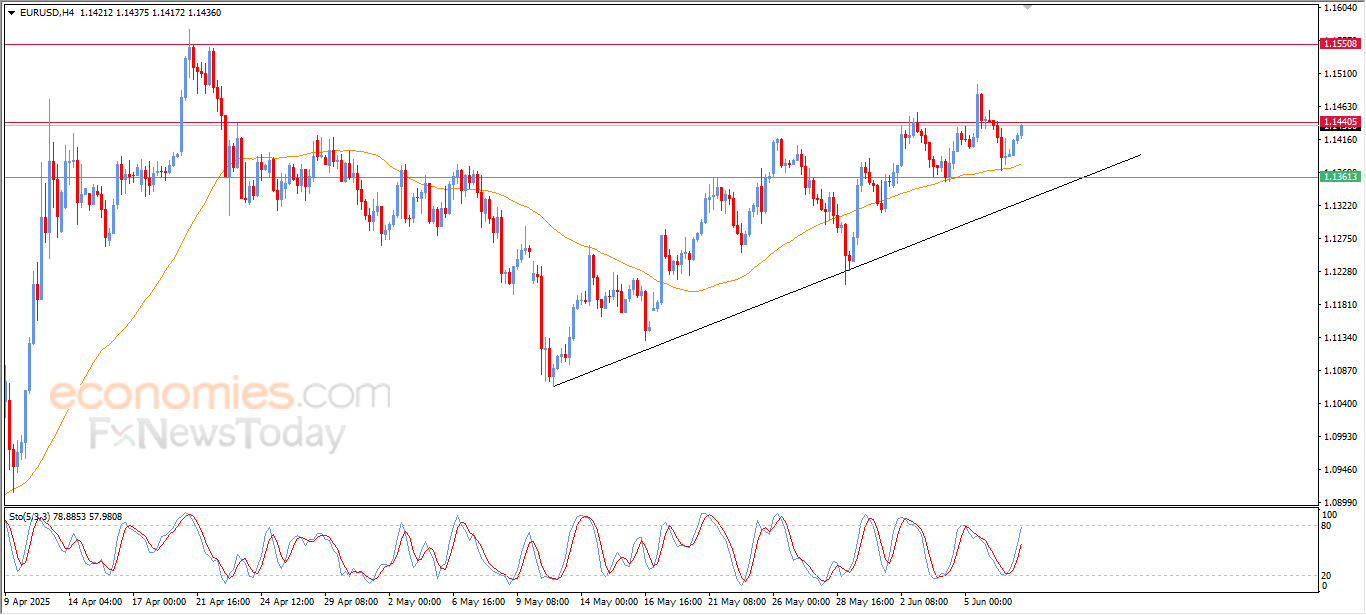
The price of (EURUSD) rose in its recent intraday trading, supported by the emergence of positive signals from the (RSI), after it declined from clear oversold levels, providing bullish momentum, reinforced by the continuation of the trading above the EMA50, besides the stability of the price with a bullish trend line on the short-term basis, alongside a minor supported bias.
This technical support pushed the pair to attack the critical resistance level at 1.1440, which represents an important technical barrier that might limit the next trend, where the price success to confirm breaching this level might open the way towards extending the bullish wave on the near- term basis.