The main tag of GoldPrice Articles.
You can use the search box below to find what you need.
[wd_asp id=1]
The main tag of GoldPrice Articles.
You can use the search box below to find what you need.
[wd_asp id=1]
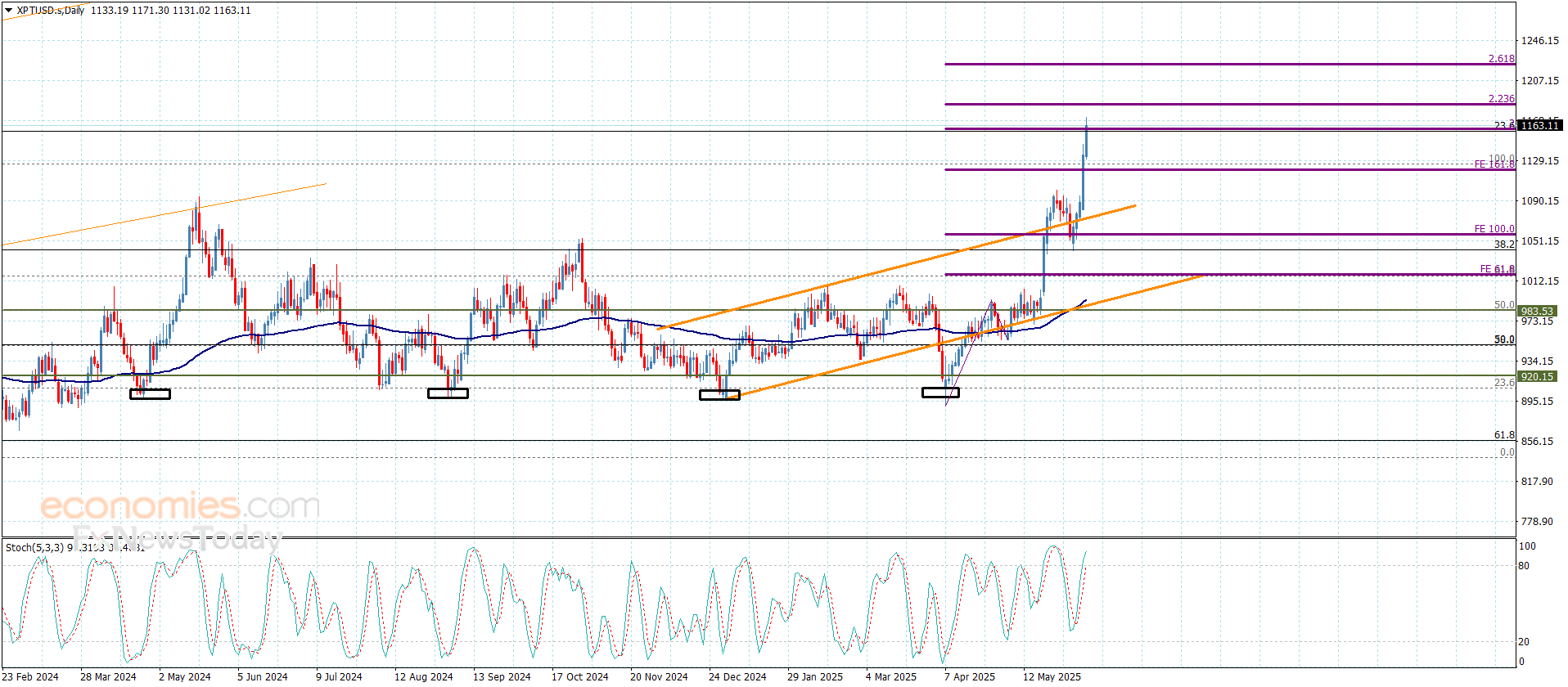
Copper price formed temporary negative rebound after reaching $5.01000 level and recording the waited targets, to fluctuate near 38.1%Fiboancci correctional level at $4.8900.
The current negative rebound won’t represent any threat to the chances of resuming the bullish attack, as there are several bullish factors such as forming a new support at $4.8000 level, to provide the positive momentum for the main indicators, therefore, we will keep waiting for renewing the bullish attempts to target $5.0300 level reaching $5.1000 level.
The expected trading range for today is between $4.8500 and $5.030
Trend forecast: Bullish
Silver prices (XAG/USD) maintain their bullish structure intact, with bulls aiming for the $34.60-$34.80 resistance area, with downside attempts contained above the $34.00 support level.
A US Dollar on its back foot is contributing to keeping the precious metal buoyed. US ISM Services PMI data showed an unexpected contraction in the sector’s activity in May, and the ADP Employment report posted a poor increase in payrolls, which revived fears of an economic recession.
Beyond that, the global trade scenario remains highly uncertain. The negotiations between the US and its trade partners are failing to yield any significant breakthrough, and Trump has complained about the difficulties of cutting a deal with China’s President, Xi, revealing that the world’s two major economies are far from reaching a trade agreement.
The technical picture shows a bullish structure in place, from mid-May lows at $31.75, with price action testing the top of an ascending triangle pattern, which points to an eventual bullish outcome.
Prices are about to test the top of the triangle, at the lower limit of the $34.60-34-80 resistance area, which has been holding the pair over the last few days. Above here, a 261.8% Fibonacci extension awaits at the $36.10 area.
On the downside, a breach of $34.00 would invalidate this view, and add pressure towards the previous top, at $33.65 ahead of the $32.70 level.
Silver is a precious metal highly traded among investors. It has been historically used as a store of value and a medium of exchange. Although less popular than Gold, traders may turn to Silver to diversify their investment portfolio, for its intrinsic value or as a potential hedge during high-inflation periods. Investors can buy physical Silver, in coins or in bars, or trade it through vehicles such as Exchange Traded Funds, which track its price on international markets.
Silver prices can move due to a wide range of factors. Geopolitical instability or fears of a deep recession can make Silver price escalate due to its safe-haven status, although to a lesser extent than Gold’s. As a yieldless asset, Silver tends to rise with lower interest rates. Its moves also depend on how the US Dollar (USD) behaves as the asset is priced in dollars (XAG/USD). A strong Dollar tends to keep the price of Silver at bay, whereas a weaker Dollar is likely to propel prices up. Other factors such as investment demand, mining supply – Silver is much more abundant than Gold – and recycling rates can also affect prices.
Silver is widely used in industry, particularly in sectors such as electronics or solar energy, as it has one of the highest electric conductivity of all metals – more than Copper and Gold. A surge in demand can increase prices, while a decline tends to lower them. Dynamics in the US, Chinese and Indian economies can also contribute to price swings: for the US and particularly China, their big industrial sectors use Silver in various processes; in India, consumers’ demand for the precious metal for jewellery also plays a key role in setting prices.
Silver prices tend to follow Gold’s moves. When Gold prices rise, Silver typically follows suit, as their status as safe-haven assets is similar. The Gold/Silver ratio, which shows the number of ounces of Silver needed to equal the value of one ounce of Gold, may help to determine the relative valuation between both metals. Some investors may consider a high ratio as an indicator that Silver is undervalued, or Gold is overvalued. On the contrary, a low ratio might suggest that Gold is undervalued relative to Silver.
WTI oil prices are set to average $58.30 per barrel this year, amid rising OPEC+ and U.S. production and relatively stable global oil demand, a survey of banks by law firm Haynes Boone showed on Wednesday.
A total of 28 banks – a record high number – participated in Haynes Boone’s Spring 2025 Energy Bank Price Deck Survey, now in its 12th year. The banks on average expect WTI Crude prices to average $58.30 per barrel in 2025, down from $61.89 a barrel expected in Haynes Boone’s Fall 2024 survey.
The banks’ reduction of the forecast could be explained with the $10 a barrel price slump in April, the law firm said.
The Spring 2025 survey shows about a $1.50 a barrel decrease in year-to-year projected prices compared to the Fall 2024 survey, but follows a similar path with average oil prices remaining in the $56.24–$57.24 per barrel range through 2034.
“This general decrease in oil prices may be attributable to increased production volume expectations stemming from enhanced OPEC production and the Trump administration’s pro-production and deregulation agenda, interacting with relatively unchanged global oil demand forecasts,” Haynes Boone said.
Banks are unmoved by the short-term U.S. trade policy and other noise factors and prefer to focus on market fundamentals, according to the law firm.
“The drop in April had to be factored in, but banks are not letting short-term volatility drive their long-term thinking,” Energy Practice Group Partner Kim Mai said.
“The results suggest that banks believe the underlying supply-demand dynamics will generally rebalance over time. It’s a vote of confidence in market fundamentals during a volatile policy environment.”
Moreover, the banks’ price deck “is always a little bit lower than market prices because banks are conservative in their projections,” Mai told Bloomberg, commenting on the survey.
Early on Wednesday, WTI prices were trading at around $63 per barrel, which is about the same as the breakeven price for drilling a new well for many U.S. shale producers.
U.S. shale production will likely plateau if WTI oil prices remain in the low $60s per barrel, and decline at prices in the $50s, ConocoPhillips chairman and CEO Ryan Lance said last month.
Executives said in the Dallas Fed Energy Survey in Q1 indicated that their companies need an average $65 per barrel to profitably drill a new well.
By Charles Kennedy for Oilprice.com
More Top Reads From Oilprice.com
The U.S. dollar rebounded from six-week lows reached on Thursday, as traders adjusted their positions ahead of high-impact macroeconomic data. The Dollar Index (DXY) climbed toward 104.15, supported by improving sentiment surrounding U.S.-China trade negotiations.
This modest rebound capped gold’s upside momentum, keeping prices below the psychologically important $3,400 level.
“Until gold closes decisively above $3,400, bulls may remain hesitant,” said David Lennox, a market strategist at Fat Prophets. “The market is looking for confirmation that inflation and labor weakness will force the Fed’s hand.”
The spotlight now shifts to the U.S. employment report. Economists polled by Reuters expect nonfarm payrolls to have risen by 130,000 in May, down from April’s 177,000 gain. The unemployment rate is expected to hold steady at 4.2%. A weaker-than-expected print could reinforce bets that the Federal Reserve will begin cutting rates as early as September.
CME’s FedWatch tool currently prices in a 72% chance of at least two 25-basis-point rate cuts by year-end. Recent soft labor data, including higher-than-expected jobless claims and slowing wage growth, underpin that dovish tilt.
Gold and silver—both non-yielding assets—remain highly sensitive to rate outlooks. A softer jobs number may offer the breakout trigger precious metals need to clear current resistance levels. Until then, prices are likely to remain range-bound as markets await clarity.
Gold price is reversing a part of the previous sell-off and defends $3,350 early Friday as traders reposition ahead of the all-important US Nonfarm Payrolls (NFP) data release.
Despite staging a minor rebound, Gold price remains in a familiar range seen so far this week as all eyes remain on the critical US labor market report on Friday for a fresh directional impetus.
Trade optimism continues to keep the US Dollar (USD) afloat even as the recent slew of US economic data disappointed and revived dovish Federal Reserve (Fed) expectations. This resurgence in the USD demand limits any upside attempts in Gold price.
Hopes of a sustained US-China trade deal rekindled after US President Donald Trump said on Truth Social on Thursday that he had a “very good phone call” with Chinese President Xi Jinping, during which they discussed the intricacies of the trade deal.
Additionally, the ongoing spat over the spending bill between Trump and Space X founder Elon Musk took an ugly turn on Thursday, fuelling a big sell-off in Tesla shares.
Musk said Trump was in the Epstein files and should be impeached. Trump responded by saying that he was taking away Elon’s subsidies, knocking off Tesla nearly 15% on the day.
This negatively impact risk sentiment and revived the USD’s appeal as a safe-haven currency.
At the moment, the US Dollar is drawing support from profit-taking as traders cash in on their USD shorts heading into the US NFP test.
The Greenback holds its recovery following a steep decline, triggered by the European Central Bank’s (ECB) hawkish policy signal, which sent the EUR/USD pair sharply higher, smashing the USD alongside.
The Nonfarm Payrolls (NFP) data is expected to show the US economy added 130K jobs in May. The April NFP data beat estimates with 177K job creation.
A reading below 100K level could cast doubts on the health of the US labor market, which will likely bring forward bets for a July Fed rate cut, boosting the non-yielding Gold price at the expense of the US Dollar.
If the data surprises with a reading above 200K, Gold price could come under strong bearish pressures. Strong US employment data would justify the Fed’s prudence on interest rates, lending support to the Greenback.
At the moment, the CME Group’s FedWatch Tool shows a 54% chance of the Fed lowering rates by 25 basis points (bps) in September.
Nothing changes for Gold price, technically, as the bullish outlook remains intact.
Buyers continue to hold above the confluence of the 21-day Simple Moving Average (SMA) and the 38.2% Fibonacci Retracement (Fibo) level of the April record rally at $3,297.
Meanwhile, the 14-day Relative Strength Index (RSI) is holding well above the midline, adding credence to the bullish potential.
Gold buyers must yield a daily/ weekly closing above the 23.6% Fibo resistance at $3,377 to resume the recent uptrend toward the lifetime highs of $3,500.
Ahead of that, the May high of $3,439 must be taken out.
Alternatively, sellers could attempt control on a break below the falling trendline resistance-turned-support, now at $3,318.
The next powerful support is seen at the abovementioned confluence of $3,297.
Additional declines will challenge the 50-day SMA at $3,262, below which the last line of defense for buyers is aligned at $3,232, the 50% Fibo level of the same ascent.
The Nonfarm Payrolls release presents the number of new jobs created in the US during the previous month in all non-agricultural businesses; it is released by the US Bureau of Labor Statistics (BLS). The monthly changes in payrolls can be extremely volatile. The number is also subject to strong reviews, which can also trigger volatility in the Forex board. Generally speaking, a high reading is seen as bullish for the US Dollar (USD), while a low reading is seen as bearish, although previous months’ reviews and the Unemployment Rate are as relevant as the headline figure. The market’s reaction, therefore, depends on how the market assesses all the data contained in the BLS report as a whole.
Today’s bearish behavior sets the stage for a potential test of support around the 50-Day MA, now at $3.52, and the 20-Day MA, currently at $3.51. Weekly support from this week is at $3.50. Despite the potential for eventual higher prices, as indicated by the larger price patterns, bearish price action today could postpone the potential advance. The 50-Day MA was reclaimed for a third time since the April breakdown on Monday. So, it represents a key price level to help determine the health of the trend.
Nonetheless, a decisive breakout above this week’s high, prior to a deeper pullback, will provide a new bullish signal. That would put natural gas in a position to likely break out above the $3.84 swing high. A rally above that high will trigger a continuation of the rising ABCD pattern that points to an initial minimum target of $4.08. Since the 61.8% Fibonacci retracement is near at $4.12. The two price levels can be seen as a potential resistance range.
Since the higher swing low in May, natural gas has advanced with two upswings, each followed by a two-day pullback. The most recent pullback found support at the higher swing low of $3.44 and created a higher swing low. That marks a key potential support level as it is part of the near-term price structure. If it is broken to the downside, further bearish behavior might follow. Therefore, it is a maximum low for a deeper bearish pullback before the bullish outlook weakens.
For a look at all of today’s economic events, check out our economic calendar.
Spot Gold eased from its recent high at $3,403.55 and trades near its daily lows in the $3,340 region at the time of writing. The XAU/USD pair eased in the mid-European session following the European Central Bank (ECB) monetary policy decision. The central bank trimmed interest rates as widely anticipated, yet the odds for additional rate cuts dropped sharply after President Christine Lagarde said that policymakers had nearly concluded a monetary policy cycle and sounded pretty optimistic about the economic future.
Optimism further undermined demand for the bright metal after United States (US) President Donald Trump stated that he had a “very good phone call” with Chinese President Xi Jinping, while announcing another round of talks coming soon. At the same time, Trump said the US will have a great relationship with Germany while speaking with Chancellor Friedrich Merz.
Market players seem quite optimistic ahead of the US Nonfarm Payrolls report, scheduled for Friday. The country is expected to have added 130K new job positions in May, while the Unemployment Rate is foreseen steady at 4.2%.
From a technical point of view, the daily chart for the XAU/USD pair shows it holds on to familiar levels, albeit pressuring the lower end of its latest range. Still, the technical picture has not changed from the previous updates, with the risk skewed to the upside. On the one hand, technical indicators remain well above their midlines, lacking directional strength. On the other hand, the pair keeps developing above all its moving averages, with a flat 20 Simple Moving Average (SMA) providing support at around $3,295.40. while the longer ones keep grinding north, far below the shorter one.
The 4-hour chart shows XAU/USD develops below a now flat 20 SMA, while still far above directionless 100 and 200 SMAs. Technical indicators, in the meantime, turned south, yet remain within neutral levels, not enough to anticipate a steeper slide ahead.
Support levels: 3,339.50 3,325.60 3,316.90
Resistance levels: 3,367.10 3,382.60 3,394.05
Gold price (XAU/USD) posts a fresh four-week high, advances to near $3,400 during European trading hours on Thursday. The yellow metal strengthens as uncertainty over potential trade deal between the United States (US) and China has accelerated, technically increasing the demand for safe-haven assets.
On Wednesday, US President Donald Trump signaled in a post on Truth.Social that a trade deal with Beijing is very difficult. “I like President Xi of China, always have, and always will, but he is VERY TOUGH, AND EXTREMELY HARD TO MAKE A DEAL WITH!!!” Trump wrote.
Another reason behind strength in the Gold price is the significant decline in the US bond yields. Theoretically, lower yields on interest-bearing assets increase demand for non-yielding assets, such as Gold. 10-year US Treasury Yields have extended their downside to near 4.35%, the lowest level seen in four weeks.
US bond yields tumbled on Wednesday after an array of disappointing US economic data, notable a sharp slowdown in the private sector labor demand. The ADP reported that the private sector added 37K fresh workers, which were lowest since January 2021. Additionally, the ISM Services PMI report indicated an unexpected decline in the service sector activity and poor demand outlook.
Soft US data has led to a slight increase in dovish expectations for the Federal Reserve’s (Fed) July policy meeting. According to the CME FedWatch tool, the probability for the Fed to reduce interest rates in July has increased to 30% from 22.5% seen a week ago.
Lower interest rates by the Fed bode well for non-yielding assets, such as Gold.
Gold price jumps to near $3,400 on Thursday. The yellow metal gains after stabilizing above the upward-sloping trendline on a daily timeframe around $3,335, which is plotted from December 12 high of $2,726. The near-term trend of the precious metal is bullish as the 20-day Exponential Moving Average (EMA) is sloping higher around $3,317.
The 14-day Relative Strength Index (RSI) rises to near 60.00. A fresh bullish momentum would emerge if the RSI breaks above that level.
Looking up, the Gold price could advance to near the May 7 high around $3,440 and the psychological level of $3,500 after stabilizing above $3,400.
Alternatively, a downside move by the Gold price below the May 29 low of $3,245 would drag it towards the round-level support of $3,200, followed by the May 15 low at $3,121.
Gold has played a key role in human’s history as it has been widely used as a store of value and medium of exchange. Currently, apart from its shine and usage for jewelry, the precious metal is widely seen as a safe-haven asset, meaning that it is considered a good investment during turbulent times. Gold is also widely seen as a hedge against inflation and against depreciating currencies as it doesn’t rely on any specific issuer or government.
Central banks are the biggest Gold holders. In their aim to support their currencies in turbulent times, central banks tend to diversify their reserves and buy Gold to improve the perceived strength of the economy and the currency. High Gold reserves can be a source of trust for a country’s solvency. Central banks added 1,136 tonnes of Gold worth around $70 billion to their reserves in 2022, according to data from the World Gold Council. This is the highest yearly purchase since records began. Central banks from emerging economies such as China, India and Turkey are quickly increasing their Gold reserves.
Gold has an inverse correlation with the US Dollar and US Treasuries, which are both major reserve and safe-haven assets. When the Dollar depreciates, Gold tends to rise, enabling investors and central banks to diversify their assets in turbulent times. Gold is also inversely correlated with risk assets. A rally in the stock market tends to weaken Gold price, while sell-offs in riskier markets tend to favor the precious metal.
The price can move due to a wide range of factors. Geopolitical instability or fears of a deep recession can quickly make Gold price escalate due to its safe-haven status. As a yield-less asset, Gold tends to rise with lower interest rates, while higher cost of money usually weighs down on the yellow metal. Still, most moves depend on how the US Dollar (USD) behaves as the asset is priced in dollars (XAU/USD). A strong Dollar tends to keep the price of Gold controlled, whereas a weaker Dollar is likely to push Gold prices up.
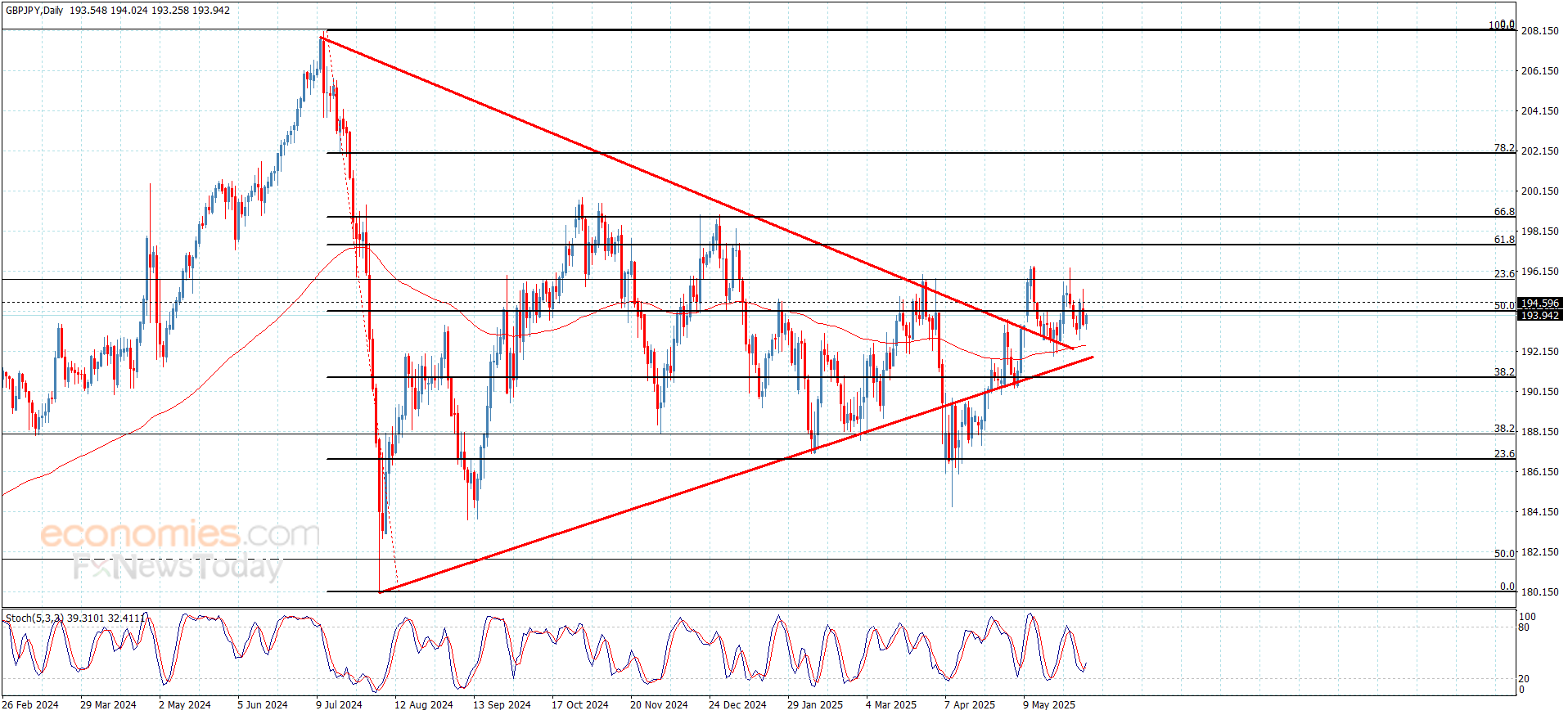
The GBPJPY pair returned to fluctuated below 194.55 level, forming some of the intraday bearish waves, attempting to gather the required positive momentum to reach the main positive stations that are located near 195.70 reaching 196.45.
Depending on forming an important support by the moving average 55 reach to 192.40, to confirm the confinement of the trading within the bullish track, to increase the chances for reaching the suggested targets, while the decline below this support will cancel the bullish suggestion in the current trading, to expect suffering new losses by reaching 191.65 reaching 38.2%Fibonacci correction level at 190.90.
The expected trading range for today is between 193.00 and 195.70
Trend forecast: Bullish
Silver (XAG/USD) followed a similar trajectory, slipping to $34.47 after an early session low of $34.43. Despite the minor retreat, silver remains on a firm footing, buoyed by dovish expectations surrounding the Federal Reserve and a persistent global risk premium.
Expectations of a Federal Reserve rate cut in September have strengthened following disappointing macroeconomic readings. The latest ADP employment report showed just 37,000 private-sector jobs added in May, marking the lowest monthly gain since March 2023.
Meanwhile, the ISM Services PMI fell to 49.9, signaling a contraction in the sector for the first time in nearly a year. These figures triggered a notable decline in US bond yields, with both the 2-year and 10-year Treasury yields sliding to their lowest levels in over a month.
“The soft data reinforces the market’s conviction that the Fed will pivot by Q3,” said Matthew Ryan, Head of Market Strategy at Ebury. This dovish backdrop has continued to support demand for non-yielding assets, such as gold.
Beyond macroeconomics, rising geopolitical tensions and renewed concerns over global trade are keeping risk sentiment fragile. The US has doubled tariffs on steel and aluminum imports to 50%, adding to fears of a re-escalation in trade tensions with major partners.
Investors are also eyeing an upcoming call between US President Donald Trump and China’s President Xi Jinping, seen as pivotal for future trade policy direction. Until clarity emerges, risk aversion is likely to linger, further reinforcing safe-haven flows into gold and silver.