The main tag of GoldPrice Articles.
You can use the search box below to find what you need.
[wd_asp id=1]
The main tag of GoldPrice Articles.
You can use the search box below to find what you need.
[wd_asp id=1]
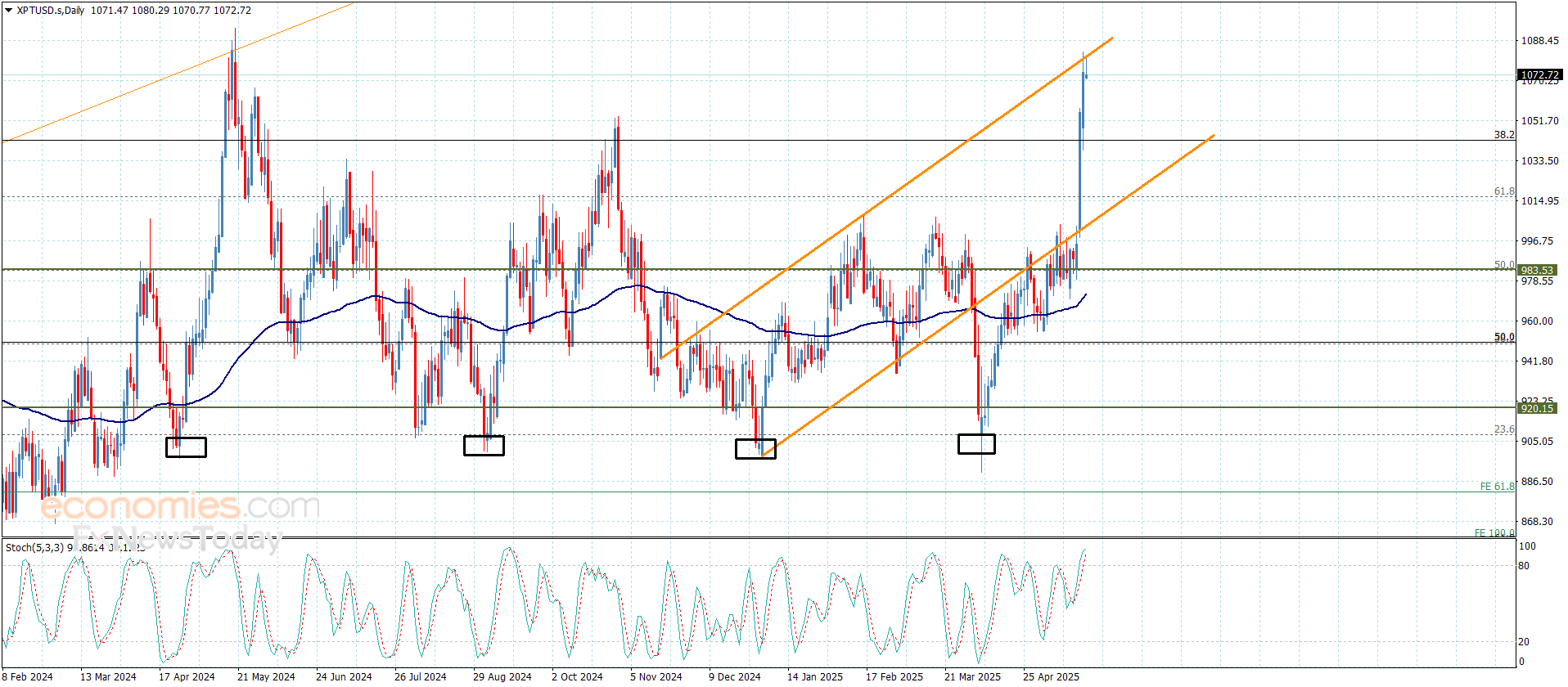
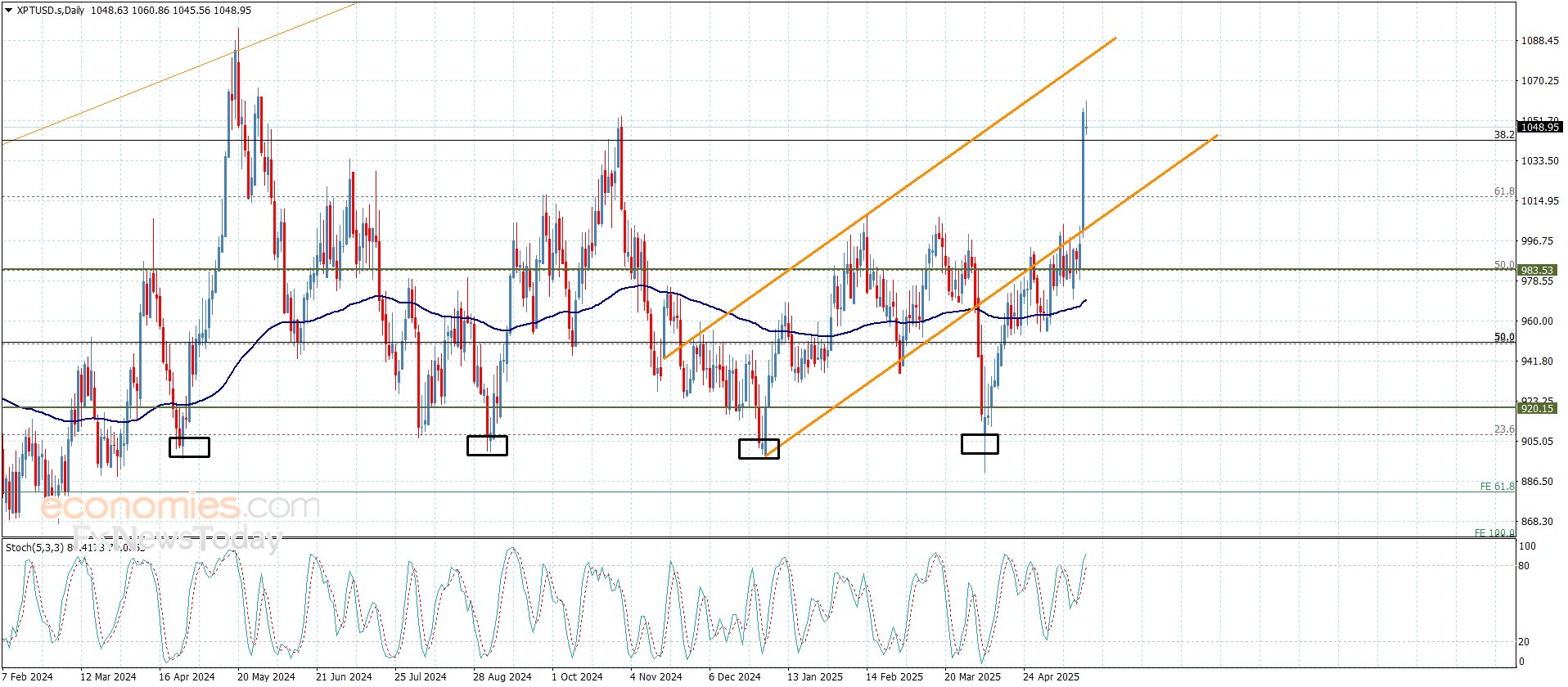
Platinum price resumed the bullish rally to achieve the suggested target, to achieve the suggested target by hitting $1083.00 facing the resistance of the bullish channel that appears in the above image.
Reminding you that stochastic stability within the overbought level might force the price to provide intraday sideways trading, and the continuation of the current resistance stability might force the price to retest the initial support at $940.00, while breaching the resistance and holding above it will open the way for achieving new gains, forming an initial target at $1100,00 level, reaching the recently achieved top at $1125.00.
The expected trading range for today is between $1055.00 and $1083.00
Trend forecast: Sideways
Do you need help in trading decisions? Do you want to learn how to start trading?
Join Economies.com VIP Club and benefit from over 15 years of market analysis expertise and get:
Special Offer: Subscribe to the Economies.com VIP channel and get also a free subscription to a trusted trading signals channel provided by Best Trading Signal.
Gold extended gains beyond the $3,300 mark on Wednesday, still backed by broad US Dollar (USD) weakness. The XAU/USD pair reached a fresh one-week high of $3,320.70, retreating towards the current $3,310 price zone after Wall Street’s opening.
The USD keeps falling on the back of unresolved global trade issues and fresh tax-related concerns. The United States (US) announced a 90-day pause in retaliatory levies a couple of weeks ago, bringing relief and risk appetite back to financial markets. However, as time goes by, deals are nowhere near. Mounting tensions between the country and China and Japan are taking their toll on sentiment.
Meanwhile, US President Donald Trump’s tax bill advances in Congress. The bill aims to make permanent the 2017 tax cuts from Trump’s first term. It would reduce some taxes, while raising others and changing spending amounts. The House is set to discuss it on Thursday.
Thursday will also bring the preliminary estimates of May S&P Global Purchasing Managers’ Index (PMI) for most major economies. The US Manufacturing PMI is foreseen at 50.1 while services output is expected at 50.8, little changed from April’s figures. Still, signs of further contraction in business output will likely add to the broad USD weakness.
The daily chart for the XAU/USD pair shows it extended its advance beyond its 20 Simple Moving Average (SMA), which now acts as support at around $3,289.20. The 100 and 200 SMAs keep advancing well below the current level, while the Momentum indicator maintains its bullish slope above its 100 level, all of which supports another leg higher. The Relative Strength Index (RSI) indicator, however, turned flat at around 54, hinting at some consolidation before the next directional movement.
The 4-hour chart shows the XAU/USD pair consolidates above all its moving averages, with the 20 SMA extending its advance below still flat 100 and 200 SMAs. Technical indicators, however, have lost their upward strength. The Momentum indicator heads marginally lower within positive levels, while the RSI indicator seesaws around 64, reflecting the ongoing pause.
Support levels: 3,289.20 3,271.55 3,252.40
Resistance levels: 3,325.00 3,342.95 3,358.40
Whether that candle pattern occurs or not, a drop through the day’s low of $3.31 will trigger a one-day bearish reversal and a failure to successfully reclaim the 20-Day MA. Nonetheless, key support is around the 200-Day MA, now at $3.20, and the recent higher swing low at $3.10 (C). Given a sharp one-day bullish reversal that triggered yesterday, a minor pullback before moving higher would be healthy for the advance that began from the April swing low (A).
A higher swing low was recently established following a successful test around the 200-Day MA. Although natural gas dipped briefly below the 200-Day line, it quickly recovered, and buyers took charge. In addition, the weekly chart (not shown) had a successful test of the 50-Week MA during the April swing low, and it converged with the 78.6% retracement at $3.07.
Since the 50-Week line was reclaimed in mid-September it has largely represented dynamic support for the trend other than a couple short dips below the line. It provides higher timeframe confirmation that strong support was likely found around the April swing low and that the bull trend should be ready to proceed.
This week’s higher swing low provides further evidence for a continuation of the bull trend. Dynamic support is defined by the internal rising trendline that connects to the April swing low. Notice that the slope is higher than the purple trendline that connects to the August swing low and below the trendline line that broke on the bearish head and shoulders pattern trigger.
For a look at all of today’s economic events, check out our economic calendar.
Via Metal Miner
The Copper Monthly Metals Index (MMI) retraced to the downside with a 4.23% decline from March to April. Looking at copper prices today, analysts seem to be struggling with ongoing trade policy shifts.
Comex copper prices have experienced wild swings over the past few months. First, they hit a new all-time high in March before plunging in April. By mid-May, they entered into a shaky sideways trend.

Source: MetalMiner Insights
Tariffs continue to drive the market. This month, markets have mostly been reacting to the U.S.’s most recent deals with China and the UK. Both appeared to ease concerns that the broad-based tariffs announced over recent months may prove less extreme than expected, resulting in renewed optimism about the global economy.
While mostly stable, the bias appears increasingly to the downside for Comex copper prices today. This is mainly because tariff deals have yet to fully ease the demand concerns that continue to plague the market.
The International Copper Study Group counts itself among those not particularly concerned about supply. Contrary to previous worries that the copper market was on the verge of growing deficit, the ICSG expects the market to maintain its surplus status in both 2025 and 2026.

The group noted “Uncertainty surrounding international trade policy that is likely to weaken the global economic outlook and negatively impact copper demand, usage growth rates have been revised down compared to the Group’s September 2024 forecasts.” As a result, the surplus expectation more than doubled for 2025. Considering the surplus accumulated during 2024, this will leave the market with a significant cushion as trade policy evolves.
While the raw material market remains tight, global growth prospects remain a concern. The U.S. economy shrank by 0.3% in Q1. Meanwhile, deflation remains a lingering problem for China, which is struggling to lean on domestic demand amid trade barriers in the U.S.
The U.S.-China trade deal may have eased some market concerns about the impact of steep tariffs on the world’s two largest economies. However, uncertainty lingers as the current agreement will expire in 90 days and still leaves a steep 30% tariff on Chinese goods.
Global stocks returned to the upside in May, offering no support for copper prices today. While inventory fluctuations do not boast a strong correlation to copper prices, the rise suggests demand conditions appear relatively stable. Both SHFE and LME inventory levels experienced considerable drawdowns over recent months as material moved to the U.S. amid tariff concerns.

Source: MacroMicro
But while LME stocks continue to decline, SHFE stocks have started to rebound. This, alongside the continued rise in Comex stocks, has added a further drag to bullish expectations for copper prices.
Among the other leading indicators for copper prices, the U.S. dollar index appeared to stabilize, halting declines that pushed the index below its long-term range in previous months.

Source: MetalMiner Insights, Chart & Correlation Analysis Tool
The index, which trades inversely to copper prices, has started to move sideways after regaining some of the losses accumulated in recent months. While it has fallen short of rebounding back to where it stood at the start of the year, the modest increase has seemingly weighed on copper prices over recent weeks.
Investor expectations remain mixed on the future direction of the index. Speculation that the White House might favor a weaker dollar relative to other currencies added considerable weight, particularly after the Trump administration noted the strength of the U.S. dollar has come at the expense of U.S. exports. However, U.S. officials have subsequently clarified that currency policy is not part of ongoing trade negotiations.
Meanwhile, the Federal Reserve has yet to blink with regard to rate cuts. Chairman Jerome Powell has remained reluctant to cut rates since last year, as tariff announcements have risked further inflation pressures in the U.S. While the most recent CPI and negotiations with China could incentivize a softer stance from the Fed, Powell has repeatedly cited “uncertainty” as reason to hold rates steady.
A cut from the Fed would add further pressure on the U.S. dollar, potentially dragging it back below its current range. This could stem further losses for copper prices today, tomorrow, and in the near future. Read MetalMiner’s market outlook and copper price forecast here.
By Nichole Bastin
More Top Reads From Oilprice.com
Silver price (XAG/USD) hits a fresh weekly high to near $33.20 during North American trading hours on Wednesday. The white metal strengthens as the US Dollar (USD) extends its downside on the United States (US) credit rating erosion in the wake of large debt levels and escalated fiscal imbalances.
The US Dollar Index (DXY), which tracks the Greenback’s value against six major currencies, slumps to near 99.50, the lowest level seen in two weeks. Technically, a soft US Dollar makes the Silver price a value bet for investors. Additionally, concerns over US credit erosion improve the safe-haven demand of non-yielding assets, such as Silver.
The table below shows the percentage change of US Dollar (USD) against listed major currencies today. US Dollar was the weakest against the Japanese Yen.
| USD | EUR | GBP | JPY | CAD | AUD | NZD | CHF | |
|---|---|---|---|---|---|---|---|---|
| USD | -0.49% | -0.30% | -0.57% | -0.51% | -0.54% | -0.56% | -0.48% | |
| EUR | 0.49% | 0.19% | -0.11% | -0.04% | -0.02% | -0.07% | 0.01% | |
| GBP | 0.30% | -0.19% | -0.29% | -0.21% | -0.20% | -0.25% | -0.19% | |
| JPY | 0.57% | 0.11% | 0.29% | 0.05% | 0.04% | 0.00% | 0.09% | |
| CAD | 0.51% | 0.04% | 0.21% | -0.05% | -0.03% | -0.04% | 0.02% | |
| AUD | 0.54% | 0.02% | 0.20% | -0.04% | 0.03% | -0.04% | 0.04% | |
| NZD | 0.56% | 0.07% | 0.25% | -0.00% | 0.04% | 0.04% | 0.07% | |
| CHF | 0.48% | -0.01% | 0.19% | -0.09% | -0.02% | -0.04% | -0.07% |
The heat map shows percentage changes of major currencies against each other. The base currency is picked from the left column, while the quote currency is picked from the top row. For example, if you pick the US Dollar from the left column and move along the horizontal line to the Japanese Yen, the percentage change displayed in the box will represent USD (base)/JPY (quote).
On Friday, Moody’s downgraded the US Sovereign Credit rating by one notch to Aa1 from Aaa amid concerns over ballooning debt levels to near $36 trillion. The credit rating firm also warned of debt levels widening further, with US President Donald Trump aiming to pass a new tax-cut bill to fulfil his economic agenda.
However, Republican lawmakers didn’t back the new tax bill in a closed-door meeting on Capitol Hill on Tuesday due to disagreement over higher deductions in state and local tax payments, according to a Republican Representative Mike Lawler, Reuters reported.
Meanwhile, investors keep a close eye on the Russia-Ukraine truce talks in the Vatican City. On Monday, US President Trump confirmed immediate ceasefire talks between Moscow and Kyiv through a post on Truth. Social, but didn’t mention any specific timeframe. Trump expressed confidence that talks would be majorly about ending the war and not a temporary truce. Russia and Ukraine will immediately start negotiations toward a Ceasefire and, more importantly, an END to the War,” Trump said. Signs of progress in the Russia-Ukraine truce talks towards ending the war will be unfavorable for safe-haven assets, such as Silver.
Silver price delivers a breakout of the Descending Triangle formation on a daily timeframe, which results in a strong upside move. The near-term trend of the white metal is bullish as it holds the 20-period Exponential Moving Average (EMA), which trades around $32.65.
The 14-period Relative Strength Index (RSI) oscillates inside the 40.00-60.00 range, indicating a sideways trend. Should a fresh bullish momentum emerge if the RSI breaks above 60.00.
Looking up, the March 28 high of $34.60 will act as key resistance for the metal. On the downside, the April 11 low of $30.90 will be the key support zone.
Silver is a precious metal highly traded among investors. It has been historically used as a store of value and a medium of exchange. Although less popular than Gold, traders may turn to Silver to diversify their investment portfolio, for its intrinsic value or as a potential hedge during high-inflation periods. Investors can buy physical Silver, in coins or in bars, or trade it through vehicles such as Exchange Traded Funds, which track its price on international markets.
Silver prices can move due to a wide range of factors. Geopolitical instability or fears of a deep recession can make Silver price escalate due to its safe-haven status, although to a lesser extent than Gold’s. As a yieldless asset, Silver tends to rise with lower interest rates. Its moves also depend on how the US Dollar (USD) behaves as the asset is priced in dollars (XAG/USD). A strong Dollar tends to keep the price of Silver at bay, whereas a weaker Dollar is likely to propel prices up. Other factors such as investment demand, mining supply – Silver is much more abundant than Gold – and recycling rates can also affect prices.
Silver is widely used in industry, particularly in sectors such as electronics or solar energy, as it has one of the highest electric conductivity of all metals – more than Copper and Gold. A surge in demand can increase prices, while a decline tends to lower them. Dynamics in the US, Chinese and Indian economies can also contribute to price swings: for the US and particularly China, their big industrial sectors use Silver in various processes; in India, consumers’ demand for the precious metal for jewellery also plays a key role in setting prices.
Silver prices tend to follow Gold’s moves. When Gold prices rise, Silver typically follows suit, as their status as safe-haven assets is similar. The Gold/Silver ratio, which shows the number of ounces of Silver needed to equal the value of one ounce of Gold, may help to determine the relative valuation between both metals. Some investors may consider a high ratio as an indicator that Silver is undervalued, or Gold is overvalued. On the contrary, a low ratio might suggest that Gold is undervalued relative to Silver.
The U.S. dollar index (.DXY) slipped to a two-week low following Moody’s downgrade of the U.S. government’s credit rating last Friday. The downgrade cited rising fiscal risk and projected deficit expansion under President Trump’s proposed tax cuts. UBS analysts noted that the downgrade triggered a fresh round of dollar selling, supporting gold by making it more attractive to foreign buyers.
In FX markets, the dollar weakened across the board. It fell to 144.095 yen and dropped 0.7% against the Swiss franc. Traders are now watching U.S.-Japan discussions, which may touch on currency management and volatility. With Treasury Secretary Scott Bessent expected to meet his Japanese counterpart this week, any signal favoring a weaker dollar could give gold bulls more fuel.
Long-end Treasury yields jumped on Wednesday, as the 30-year yield topped 5% and the 10-year yield hit 4.5%, spurred by expectations that the Trump administration’s tax bill could deepen the deficit by up to $5 trillion. According to Deutsche Bank, final outcomes on the tax bill will significantly shape near-term deficit projections.
Bridgewater’s Ray Dalio added to the pessimism, warning that the real risk is not default, but inflation triggered by the Federal Reserve potentially printing money to manage debt service. This sentiment, echoed in the bond market, is driving capital into gold as investors seek a hedge against monetary debasement.
The GBPJPY pair remains affected by the contradiction between the main indicators, delaying the bullish rally, to continue providing sideways trading by its stability near 193.00, as the price remains stable above the main support at 191.20, so the bullish suggestion remains valid, to expect renewing the pressure on the obstacle at 194.60 in order to resume the bullish attack, and 195.30 level represents the next main target for the bullish trading.
The attempt of the moving average 55 to form extra support by its fluctuation near 192.00 makes us keep the bullish suggestion until reaching the mentioned targets.
The expected trading range for today is between 192.45 and 194.00
Trend forecast: Fluctuated within the bullish track.
Do you need help in trading decisions? Do you want to learn how to start trading?
Join Economies.com VIP Club and benefit from over 15 years of market analysis expertise and get:
Special Offer: Subscribe to the Economies.com VIP channel and get also a free subscription to a trusted trading signals channel provided by Best Trading Signal.
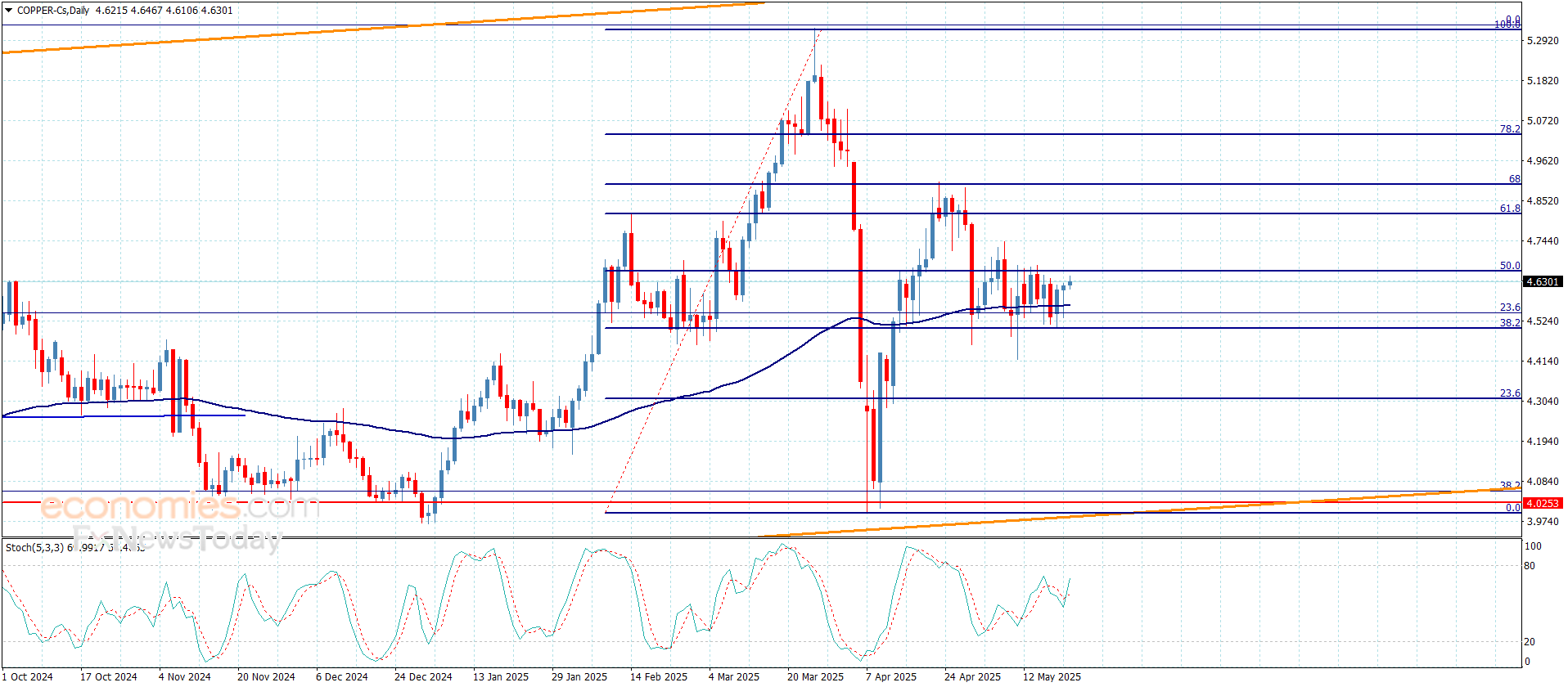
Copper price lost its negative momentum, which forces it to form a new bearish trading, delaying the negative attack by its repeated stability above the extra support at $4.5000, reinforced by the stability of the moving average 55 above it as appears in the above image.
We expect the confinement of the trading between the mentioned support at $4.6600 level as barrier against activating the bullish track, therefore, we will stay aside until surpassing one of these level, which will detect the trend in the near period, note that breaching the barrier will provide chance for achieving some gains by its rally to $4.7500 reaching the resistance near $4.9100.
The expected trading range for today is between $4.5500 and $4.6600.
Trend forecast: Neutral
Do you need help in trading decisions? Do you want to learn how to start trading?
Join Economies.com VIP Club and benefit from over 15 years of market analysis expertise and get:
Special Offer: Subscribe to the Economies.com VIP channel and get also a free subscription to a trusted trading signals channel provided by Best Trading Signal.
Copper price lost its negative momentum, which forces it to form a new bearish trading, delaying the negative attack by its repeated stability above the extra support at $4.5000, reinforced by the stability of the moving average 55 above it as appears in the above image.
We expect the confinement of the trading between the mentioned support at $4.6600 level as barrier against activating the bullish track, therefore, we will stay aside until surpassing one of these level, which will detect the trend in the near period, note that breaching the barrier will provide chance for achieving some gains by its rally to $4.7500 reaching the resistance near $4.9100.
The expected trading range for today is between $4.5500 and $4.6600.
Trend forecast: Neutral
Do you need help in trading decisions? Do you want to learn how to start trading?
Join Economies.com VIP Club and benefit from over 15 years of market analysis expertise and get:
Special Offer: Subscribe to the Economies.com VIP channel and get also a free subscription to a trusted trading signals channel provided by Best Trading Signal.
Silver price soared on Tuesday, climbing past the $33.00 mark per troy ounce as the US Dollar weakened across the board. Uncertainty surrounding US trade policies, Moody’s downgrade of US government debt, and the impending increase in the US budget deficit fueled demand for the safe-haven appeal of the gray metal.
From a technical perspective, Silver trades sideways, though slightly tilted to the upside. Buyers clearing the 50-day Simple Moving Average (SMA) at $32.75 opened the door to surpass the $33.00 mark as they eye a test of the $33.50 figure. It is worth noting that the impulse cleared a resistance trendline drawn from the April and May highs, which were broken at around $32.70/85, confirming the continuation of the trend.
The Relative Strength Index (RSI) favors buyers. Therefore, if the RSI continues to trend higher, it would confirm the continuation of the ongoing upward trend.
On the other hand, Silver’s key support level is $33.00. A break below could send XAG/USD diving towards the 100-day SMA at $31.98, ahead of testing the 200-day SMA at $31.30.
Silver is a precious metal highly traded among investors. It has been historically used as a store of value and a medium of exchange. Although less popular than Gold, traders may turn to Silver to diversify their investment portfolio, for its intrinsic value or as a potential hedge during high-inflation periods. Investors can buy physical Silver, in coins or in bars, or trade it through vehicles such as Exchange Traded Funds, which track its price on international markets.
Silver prices can move due to a wide range of factors. Geopolitical instability or fears of a deep recession can make Silver price escalate due to its safe-haven status, although to a lesser extent than Gold’s. As a yieldless asset, Silver tends to rise with lower interest rates. Its moves also depend on how the US Dollar (USD) behaves as the asset is priced in dollars (XAG/USD). A strong Dollar tends to keep the price of Silver at bay, whereas a weaker Dollar is likely to propel prices up. Other factors such as investment demand, mining supply – Silver is much more abundant than Gold – and recycling rates can also affect prices.
Silver is widely used in industry, particularly in sectors such as electronics or solar energy, as it has one of the highest electric conductivity of all metals – more than Copper and Gold. A surge in demand can increase prices, while a decline tends to lower them. Dynamics in the US, Chinese and Indian economies can also contribute to price swings: for the US and particularly China, their big industrial sectors use Silver in various processes; in India, consumers’ demand for the precious metal for jewellery also plays a key role in setting prices.
Silver prices tend to follow Gold’s moves. When Gold prices rise, Silver typically follows suit, as their status as safe-haven assets is similar. The Gold/Silver ratio, which shows the number of ounces of Silver needed to equal the value of one ounce of Gold, may help to determine the relative valuation between both metals. Some investors may consider a high ratio as an indicator that Silver is undervalued, or Gold is overvalued. On the contrary, a low ratio might suggest that Gold is undervalued relative to Silver.