The main tag of GoldPrice Articles.
You can use the search box below to find what you need.
[wd_asp id=1]
The main tag of GoldPrice Articles.
You can use the search box below to find what you need.
[wd_asp id=1]
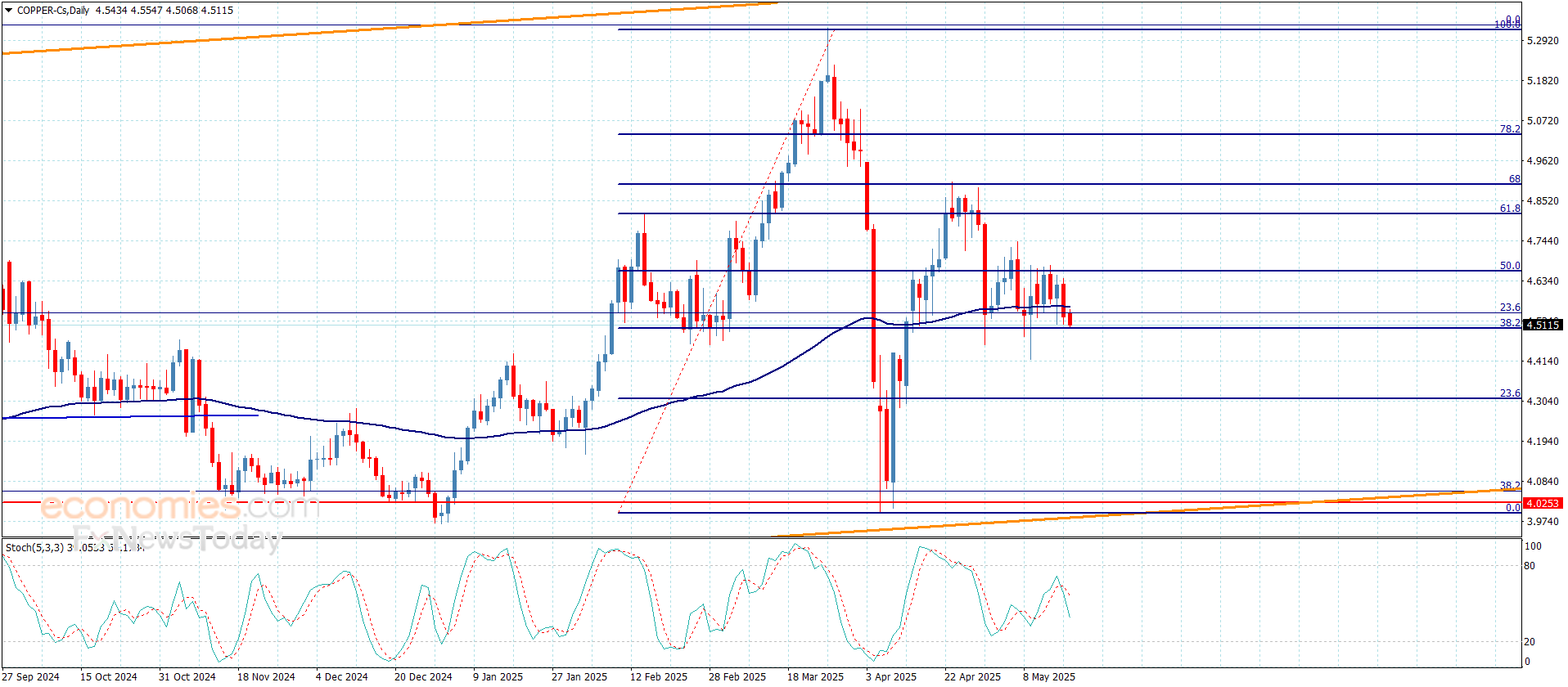
Copper price began forming a negative move, activating with the negativity of the main indicators, to settle near the extra support at $4.5000, facing negative pressures will increase the chances for breaking the current support, to open the way towards targeting extra negative stations, which might begin at $4.4500 reaching $4.3100.
The failure to break the current support might push the price to form mixed trading, and there is a new chance for targeting 50%Fibonacci correction level near $4.6600.
The expected trading range for today is between $4.4500 and $4.5600
Trend forecast: Bearish
Do you need help in trading decisions? Do you want to learn how to start trading?
Join Economies.com VIP Club and benefit from over 15 years of market analysis expertise and get:
Special Offer: Subscribe to the Economies.com VIP channel and get also a free subscription to a trusted trading signals channel provided by Best Trading Signal.
Gold price is up on Monday, with the bright metal peaking at $3,249.84 during Asian trading hours amid broad US Dollar (USD) weakness. The Greenback fell throughout the first half of the day amid discouraging United States (US) news. Moody’s downgraded the US government’s credit rating from Aaa to Aa1 due to concerns about the country´s growing debt.
Asian shares tumbled, further weighed by mixed Chinese data. April Retail Sales were up 5.1% YoY in April, missing expectations, while Industrial Production in the same period was up 6.1%, better than the 5.5% anticipated, although below the previous 7.7%
The USD found some near-term demand after Wall Street’s opening, as US indexes partially shrugged off the downbeat mood and trade mixed. As a result, the XAU/USD pair retreated towards the current $3,230 price zone.
Several US Federal Reserve (Fed) speakers hit the wires at the beginning of the week, but their remarks failed to impress, holding on to their cautiously optimistic stance, still concerned about the impact of tariffs on inflation.
The Reserve Bank of Australia (RBA) will announce its decision on monetary policy in the upcoming Asian session. The RBA is widely anticipated to cut the Official Cash Rate (OCR) by 25 basis points (bps) to 3.85% from the current 4.1%.
The daily chart for the XAU/USD pair shows it trades at the upper end of Friday’s range, with little bullish impulse. Technical indicators turned marginally higher, but remain within negative levels, while a bearish 20 Simple Moving Average (SMA) stands well above the current level, providing resistance at around $3,293. The 100 and 200 SMAs keep advancing far below the current level, suggesting sellers are out of the picture at the time being.
In the near term, and according to the 4-hour chart, XAU/USD is neutral. The pair trades between directionless moving averages, with a flat 20 SMA providing intraday support at $3,204.70. At the same time, the Momentum indicator turned lower while holding above its 100 level, while the Relative Strength Index (RSI) indicator heads nowhere at around 51.
Support levels: 3,215.90 3,204.70 3,187.10
Resistance levels: 3,250.00 3,265.80 3,288.70
In a shocking move that has defused a brutal trade war and boosted international markets, the United States and China decided on May 12, to significantly reduce tariffs on each other’s goods for the first 90 days.
This naturally sparked a continued downward spiral in gold and prices touched $3121 for XAUUSD.
This week, gold is looking to retrace and take out the late sellers in the market. Let’s discuss the key pivot levels for gold buying and selling in this XAUUSD weekly forecast of May 19th to May 23rd, 2025.
In the previous week’s forecast we gave the selling level of gold in 1h, from where gold dumped 1420 points.
We also shared a major buying level of gold in the weekly FVG, from which gold is up 827 points, at the time of writing.

Now let’s start by discussing the key economic events of this week and their possible impact on the price of XAUUSD.
Not many significant U.S. economic reports are scheduled for release this week, but it is still expected to impact XAUUSD.
May 22nd, Thursday: Flash Manufacturing PMI (Purchasing Managers’ Index) and Flash Services PMI
Two early measures of economic health are the Flash Manufacturing PMI and the Flash Services PMI. They have the following effects on the gold vs. US dollar (XAU/USD) pair:
In summary, while negative PMI data can push gold prices higher, positive data tends to push them lower.
Gold has already tested its weekly FVG and closed above it, which is a bullish sign for gold. The next targets according to the weekly timeframe can be $3260 and $3328.86 which signify the untested lows and highs of the previous weekly candles.

Gold is showing bullish momentum in all lower time frames which makes buying an ideal position to enter and hold.
On the 1 hour timeframe the strongest buying level is coming up at the bullish order block of $3129.85-3152.56.

On the 4h timeframe the buying opportunity is much lower around $3098-$3038. This is also the the last daily FVG of this entire bullish rally for which the low is $2956 which can be your invalidation point for buys and flipping towards sells on retracement, but that is far away for now.

In the 4 hour timeframe selling can be expected from the $3284-3325 levels, due to FVG, and structure area of the 4h timeframe.

Below, we’ll take a look at support and resistance levels for XAUUSD this week.
To conclude, the safe strategy in gold is to look for sells in the lower time frame levels and look for buying in the higher time frame levels. You can mark these levels on your chart for easier trading guidance when you trade.
Disclosure: This article does not represent investment advice. The content and materials featured on this page are for educational purposes only.
Keep in mind that the season for natural gas is typically more of a winter season, until you get to the very hottest parts of summer. This is because it is an American base contract more than anything else, and Americans tend to use natural gas to heat their homes, as well as produce extra electricity in order to run air conditioning.

While natural gas of course is important in other parts of the world, the Henry Hub contract is what most people trade, and therefore you have to be aware of what’s going on in America more than anything else.
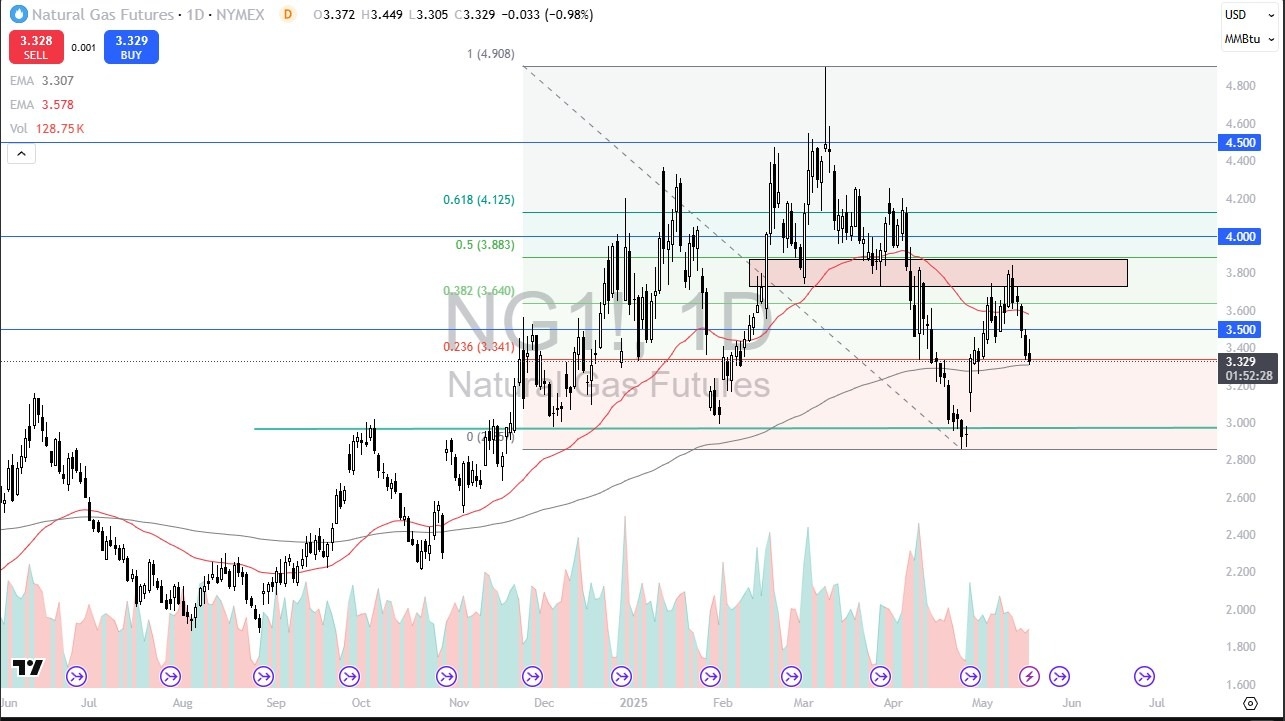
As of late, we have seen the Europeans buying a lot of liquefied natural gas, which of course has a major influence on what we are seeing here. If we break down below the 200 Day EMA, the market is likely to go looking to the $3.00 level, which obviously has a certain amount of psychology attached to it as it is a large, round, psychologically significant figure. Anything below there would be extraordinarily negative and could send the market down to the $2.40 level before it is all said and done.
Short-term rallies are likely, but those should end up being selling opportunities, as natural gas is going to be less in demand for the next couple of months, so I have no interest in buying this market, unless of course there is some type of external factor that drives up the price such as war, or some type of major disruption in supply for some other reason. I remain bearish, and probably will for a few months.
Ready to trade Forex daily analysis and predictions? Here are the best commodity trading platforms to choose from.
Christopher Lewis has been trading Forex and has over 20 years experience in financial markets. Chris has been a regular contributor to Daily Forex since the early days of the site. He writes about Forex for several online publications, including FX Empire, Investing.com, and his own site, aptly named The Trader Guy. Chris favours technical analysis methods to identify his trades and likes to trade equity indices and commodities as well as Forex. He favours a longer-term trading style, and his trades often last for days or weeks.
Gold price is showing some fresh signs of life early Monday, following a weekly decline. The further upside in Gold price depends on the upcoming Fedspeak and talks over potential US trade deals amid rising concerns over US fiscal debt.
Markets have resorted to selling US assets as they respond to the credit blow, marking the start of a new week. Moody’s downgraded the US sovereign credit rating on Friday by one notch from its pristine “Aaa” rating to “Aa1”.
The rating downgrade is based on concerns about the nation’s growing $36 trillion debt pile and higher interest payments amid US President Donald Trump’s erratic economic and trade policies.
The US Dollar (USD) wilted alongside the Treasury bonds and US equity futures, reviving the safe-haven appeal of Gold price. However, rising US Treasury bond yields on economic concerns limit the upside attempts in the yellow metal, leaving the bullion confined in a range above $3,200.
Further, US Treasury Secretary Scott Bessent’s tariff threat on Sunday also keeps markets on the edge, allowing Gold price some sigh of relief. Bessent said, “Trump has put them (trading partners) on notice that if you do not negotiate in good faith, you will ratchet back up to your April 2 level.”
These factors have unnerved markets, and hence, they pay little heed to the news that the House panel approved President Trump’s tax cut bill early Monday, paving the way for possible passage in the House of Representatives later this week.
In the day ahead, Gold price could likely remain supported as the USD could face headwinds from growing economic and fiscal concerns. Data released last week showed that the US Producer Price Index (PPI) in April fell unexpectedly, while Retail Sales growth slowed, and Consumer Price Index (CPI) rose less than expected.
However, any optimistic headlines on the expected US trade agreements with South Korea, India and Japan could refuel the Gold price downside. Cautious remarks from Federal Reserve (Fed) policymakers will likely hinder the rebound in the bright metal.
Technically, Gold price remains exposed to further downside risks as the 14-day Relative Strength Index (RSI) sits beneath the midline, near 48.50.
The bright metal remains capped between the 21-day Simple Moving Average (SMA) at $3,299 and the 50-day SMA at $3,169.
So long as the price stays above the throwback support of the 50-day SMA, a brief recovery toward the 21-day SMA remains in the offing.
Acceptance above that level will add legs to the upswing, exposing the falling trendline resistance at $3,407.
On the downside, if sellers manage to crack the 50-day SMA on a sustained basis, a fresh sell-off could be fuelled toward the $3,100 mark.
The April 10 low of $3,072 would then come to the rescue of buyers.
Tariffs are customs duties levied on certain merchandise imports or a category of products. Tariffs are designed to help local producers and manufacturers be more competitive in the market by providing a price advantage over similar goods that can be imported. Tariffs are widely used as tools of protectionism, along with trade barriers and import quotas.
Although tariffs and taxes both generate government revenue to fund public goods and services, they have several distinctions. Tariffs are prepaid at the port of entry, while taxes are paid at the time of purchase. Taxes are imposed on individual taxpayers and businesses, while tariffs are paid by importers.
There are two schools of thought among economists regarding the usage of tariffs. While some argue that tariffs are necessary to protect domestic industries and address trade imbalances, others see them as a harmful tool that could potentially drive prices higher over the long term and lead to a damaging trade war by encouraging tit-for-tat tariffs.
During the run-up to the presidential election in November 2024, Donald Trump made it clear that he intends to use tariffs to support the US economy and American producers. In 2024, Mexico, China and Canada accounted for 42% of total US imports. In this period, Mexico stood out as the top exporter with $466.6 billion, according to the US Census Bureau. Hence, Trump wants to focus on these three nations when imposing tariffs. He also plans to use the revenue generated through tariffs to lower personal income taxes.
The GBPJPY pair remains affected by the negative pressures, which forces it to fluctuate below the extra support at 193.15 level, which forces it to delay the bullish rally on the current trading, while the stability of the moving average 55 above the support at 191.50, stochastic approach from 20 level, these factors make us wait for gathering the positive momentum, then begin targeting some of the positive stations, by its rally to 194.50 and 195.30.
While the decline below 191.50 and providing a negative close will confirm its move to the bearish track, to expect suffering big losses by reaching 190.40.
The expected trading range for today is between 192.20 and 194.10
Trend forecast: Bullish
Do you need help in trading decisions? Do you want to learn how to start trading?
Join Economies.com VIP Club and benefit from over 15 years of market analysis expertise and get:
Special Offer: Subscribe to the Economies.com VIP channel and get also a free subscription to a trusted trading signals channel provided by Best Trading Signal.
Copper price began forming a negative move, activating with the negativity of the main indicators, to settle near the extra support at $4.5000, facing negative pressures will increase the chances for breaking the current support, to open the way towards targeting extra negative stations, which might begin at $4.4500 reaching $4.3100.
The failure to break the current support might push the price to form mixed trading, and there is a new chance for targeting 50%Fibonacci correction level near $4.6600.
The expected trading range for today is between $4.4500 and $4.5600
Trend forecast: Bearish
Do you need help in trading decisions? Do you want to learn how to start trading?
Join Economies.com VIP Club and benefit from over 15 years of market analysis expertise and get:
Special Offer: Subscribe to the Economies.com VIP channel and get also a free subscription to a trusted trading signals channel provided by Best Trading Signal.
Institutional interest in bullion remains subdued as traders reassess the likelihood of near-term Fed action. Retail sales and PPI data showed enough resilience to keep growth concerns at bay, while sticky inflation expectations may force policymakers to stay cautious. Without a decisive dovish pivot or renewed geopolitical stress, gold is likely to remain under pressure.
Unless upcoming Fed commentary pushes back clearly against rising real rates or reaffirms a near-term policy shift, capital rotation toward risk assets and away from gold will likely persist. With safe-haven demand cooling and inflation uncertainty elevated, gold faces continued headwinds in the short term.
Technically, XAU/USD is still in an uptrend, but momentum has shifted to the downside.
A sustained move under the pivot at $3166.46 is likely to extend the selling pressure this week towards the next major pivot at $3018.52.
Traders are expected to continue to buy the dips into support, but unlike previous similar moves, they are being met by traders selling the rallies.
The major support is the swing bottom at $2956.56. If this price fails then look out to the downside with the 52-week moving average at $2707.24 the next like target.
More Information in our Economic Calendar.
No news for Copper price until this moment by its repeated sideways fluctuation near $4.6200 level, attempting to settle below the initial barrier at $4.6600, reinforcing the chances for activating the suggested negative scenario, reminding you that the initial targets are located near $4.4500 and $4.3100 level.
Note that regaining the bullish bias requires forming strong bullish waves, to surpass the resistance at $4.9100, and holding above it to open the way towards achieving big gains that might begin at $5.0300.
The expected trading range for today is between $4.4500 and $4.6800
Trend forecast: Bearish
Do you need help in trading decisions? Do you want to learn how to start trading?
Join Economies.com VIP Club and benefit from over 15 years of market analysis expertise and get:
Special Offer: Subscribe to the Economies.com VIP channel and get also a free subscription to a trusted trading signals channel provided by Best Trading Signal.
Silver prices edged lower on Friday, with losses of over 1%, set to end the week on a negative note amid rising US Treasury yields, which staged a comeback late during the North American session. XAG/USD trades at $32.26 after hitting a daily peak of $32.68 at the time of writing.
XAG/USD consolidated within the 50 and 100-day Simple Moving Averages (SMAs) at $32.73 and $31.88, respectively, over the last five days, with no apparent bias as depicted in the daily chart. The Relative Strength Index (RSI), although bearish, remains flat near the 50-neutral line, flat.
This confirms the grey metal’s lack of direction, but buyers could regain control if they clear a downslope trendline drawn from the March 28–April 25 peaks, which could be broken near $33.00. A breach of the latter will expose $33.50, followed by the $34.00 mark. Once surpassed, the next stop would be the October 30 peak at $34.51.
Conversely, if XAG/USD falls below $32.00, the first support would be the 100-day SMA, followed by the May 15 low of $31.65. Once this level is cleared, the next stop would be the 200-day SMA at $31.23, followed by the $31.00 figure.
Silver is a precious metal highly traded among investors. It has been historically used as a store of value and a medium of exchange. Although less popular than Gold, traders may turn to Silver to diversify their investment portfolio, for its intrinsic value or as a potential hedge during high-inflation periods. Investors can buy physical Silver, in coins or in bars, or trade it through vehicles such as Exchange Traded Funds, which track its price on international markets.
Silver prices can move due to a wide range of factors. Geopolitical instability or fears of a deep recession can make Silver price escalate due to its safe-haven status, although to a lesser extent than Gold’s. As a yieldless asset, Silver tends to rise with lower interest rates. Its moves also depend on how the US Dollar (USD) behaves as the asset is priced in dollars (XAG/USD). A strong Dollar tends to keep the price of Silver at bay, whereas a weaker Dollar is likely to propel prices up. Other factors such as investment demand, mining supply – Silver is much more abundant than Gold – and recycling rates can also affect prices.
Silver is widely used in industry, particularly in sectors such as electronics or solar energy, as it has one of the highest electric conductivity of all metals – more than Copper and Gold. A surge in demand can increase prices, while a decline tends to lower them. Dynamics in the US, Chinese and Indian economies can also contribute to price swings: for the US and particularly China, their big industrial sectors use Silver in various processes; in India, consumers’ demand for the precious metal for jewellery also plays a key role in setting prices.
Silver prices tend to follow Gold’s moves. When Gold prices rise, Silver typically follows suit, as their status as safe-haven assets is similar. The Gold/Silver ratio, which shows the number of ounces of Silver needed to equal the value of one ounce of Gold, may help to determine the relative valuation between both metals. Some investors may consider a high ratio as an indicator that Silver is undervalued, or Gold is overvalued. On the contrary, a low ratio might suggest that Gold is undervalued relative to Silver.