The main tag of GoldPrice Articles.
You can use the search box below to find what you need.
[wd_asp id=1]
The main tag of GoldPrice Articles.
You can use the search box below to find what you need.
[wd_asp id=1]
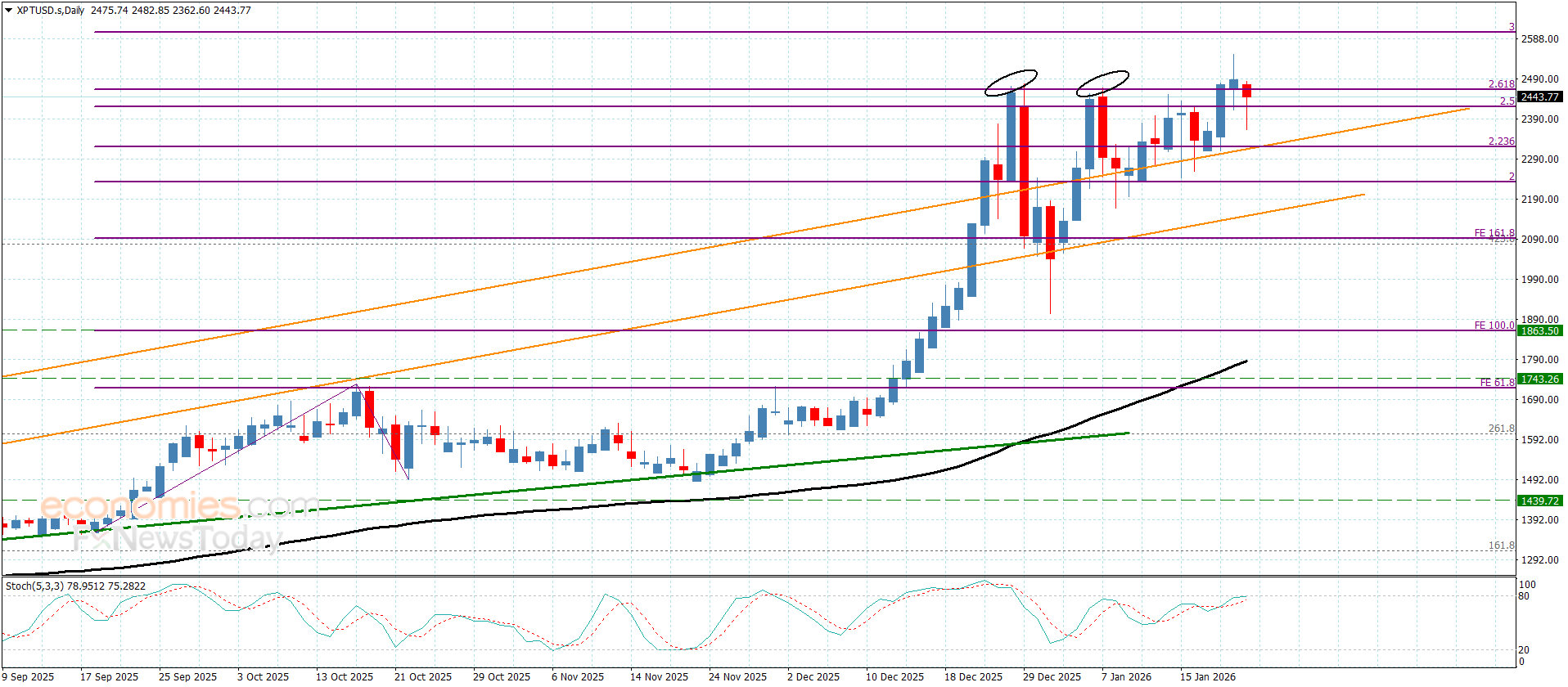
Copper price approached the initial corrective target yesterday at $5.6500, to confirm delaying the attempts to resume the bullish trend due to its stability at $5.9700, besides providing negative momentum by its continued leaning below 80 level as appears in the above image.
Therefore, we will keep preferring the temporary negative attempts, which might target $5.6200 and $5.5100, while regaining the bullish trend requires a positive close above the mentioned barrier, to reinforce the chances of recording new historical gains that might begin at $5.6200 and $5.8500.
The expected trading range for today is between $5.6200 and $5.8500
Trend forecast: Bearish
Silver price (XAG/USD) retreats on Wednesday after reaching a daily high of $95.56 after US President Donald Trump eased his tone in his Davos speech, saying that he is ready to negotiate Greenland with Denmark. At the time of writing, XAG/USD trades at $93.57, down over 1% after reaching a record high of $95.89 on Tuesday.
Silver’s daily chart suggests the grey metal is upward biased, but the parabolic move seems to have paused as the Relative Strength Index (RSI) exited from overbought territory and shows signs of negative divergence.
Despite this, bears are not out of the woods as they must clear the $90.00 figure before challenging the latest cycle low of $86.45 reached on January 15. In that outcome, Silver could dive towards the 20-day SMA at $80.63.
On the flip side, if XAG/USD is to extend its gains, buyers need to push prices above the record high of $95.89, followed by the $100.00 milestone.
(This story was corrected on January 21 at 17:11 to say in the first paragraph that the $95.56 price is a daily high, not an all-time high.)
Silver is a precious metal highly traded among investors. It has been historically used as a store of value and a medium of exchange. Although less popular than Gold, traders may turn to Silver to diversify their investment portfolio, for its intrinsic value or as a potential hedge during high-inflation periods. Investors can buy physical Silver, in coins or in bars, or trade it through vehicles such as Exchange Traded Funds, which track its price on international markets.
Silver prices can move due to a wide range of factors. Geopolitical instability or fears of a deep recession can make Silver price escalate due to its safe-haven status, although to a lesser extent than Gold’s. As a yieldless asset, Silver tends to rise with lower interest rates. Its moves also depend on how the US Dollar (USD) behaves as the asset is priced in dollars (XAG/USD). A strong Dollar tends to keep the price of Silver at bay, whereas a weaker Dollar is likely to propel prices up. Other factors such as investment demand, mining supply – Silver is much more abundant than Gold – and recycling rates can also affect prices.
Silver is widely used in industry, particularly in sectors such as electronics or solar energy, as it has one of the highest electric conductivity of all metals – more than Copper and Gold. A surge in demand can increase prices, while a decline tends to lower them. Dynamics in the US, Chinese and Indian economies can also contribute to price swings: for the US and particularly China, their big industrial sectors use Silver in various processes; in India, consumers’ demand for the precious metal for jewellery also plays a key role in setting prices.
Silver prices tend to follow Gold’s moves. When Gold prices rise, Silver typically follows suit, as their status as safe-haven assets is similar. The Gold/Silver ratio, which shows the number of ounces of Silver needed to equal the value of one ounce of Gold, may help to determine the relative valuation between both metals. Some investors may consider a high ratio as an indicator that Silver is undervalued, or Gold is overvalued. On the contrary, a low ratio might suggest that Gold is undervalued relative to Silver.
Natural gas price continued forming strong bullish waves since yesterday, to notice achieving the suggested targets by reaching $4.00 level, to reach the support of the broken bullish channel’s support, which represents a key resistance.
Noticing that stochastic begins to exit the oversold level, attempting to provide a new bullish momentum, to increase the chances of surpassing the current resistance, and its stability above this level will confirm its readiness to record new gains by its rally towards $4.185, while the failure to breach it will support the dominance of the sideways bias in the current trading, and there is a chance to retest $3.620 level before reaching extra bullish target.
The expected trading range for today is between $3.780 and $4.185
Trend forecast: Bullish
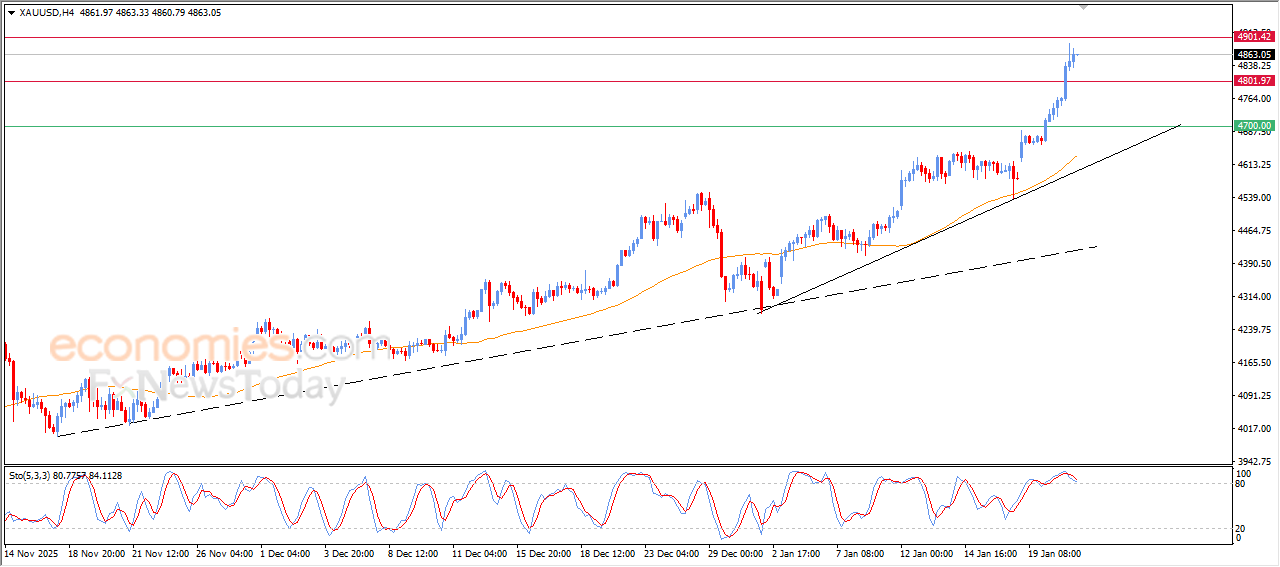
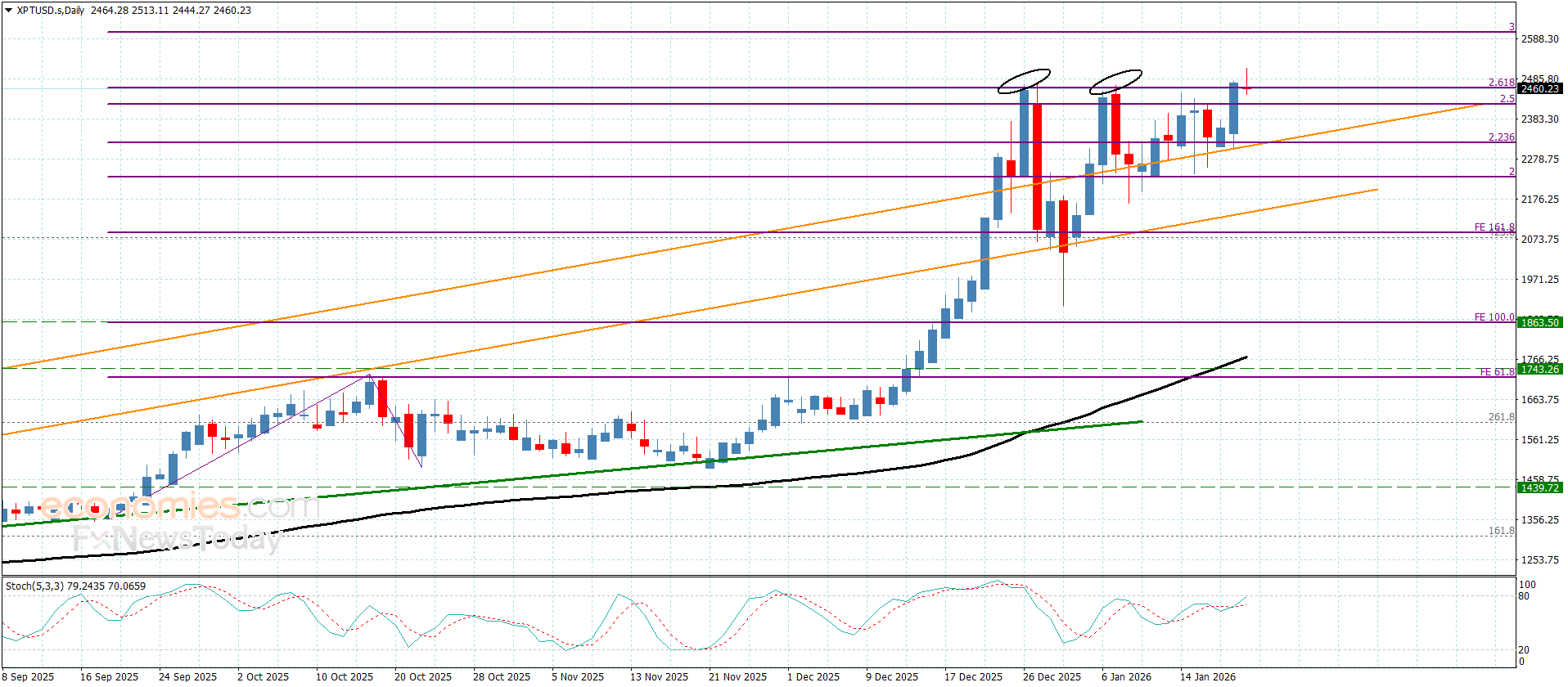
Spot Gold neared $4,890 on Wednesday, clinching yet another record high, as investors continued to seek refuge amid escalating geopolitical tensions triggered by United States (US) President Donald Trump. Trump delivered a speech at the World Economic Forum (WEF) and covered multiple subjects, from the US economy to how the country leads the world across all fronts.
The US Dollar (USD), however, managed to recover some of the ground lost throughout the first half of the day early in the American session, as President Trump noted the US does not want to use excessive force to obtain Greenland. As a result, XAU/USD shed some $70 bucks from its top, and trades around the $4,820 mark.
Uncertainty, however, remains in the background as President Trump did not refrain from praising the positive effects of widespread tariffs on the US economy. It’s clearly a tool he is willing to continue using.
Thursday will bring first-tier US data, although the figures were delayed by the government shutdown the country suffered last October. The American calendar includes a revision of the Q3 Gross Domestic Product (GDP), with annualized growth expected to be confirmed at 4.3%.
The country will also release the Personal Consumption Expenditures (PCE) Price Index, the Federal Reserve’s (Fed) favorite inflation gauge. The data scheduled for release corresponds to October and November, a bit too old to be actually relevant.
Inflation is a key economic indicator in most cases, as it helps shape the central bank’s decisions. In this particular case, however, investors would rather wait for the announcement of Chair Jerome Powell’s replacement before changing bets on what the Fed would or would not do this year.
The near-term picture for XAU/USD shows the pair is correcting overbought conditions, but also that the risk remains skewed to the upside. The 20-period Simple Moving Average (SMA) rises above the 100- and 200-period SMAs, keeping the bullish alignment alive. All three SMAs trend higher, and the price holds above them, sustaining an upward bias. The 20 SMA at $4,724.08 offers initial dynamic support, with the 100 SMA at $4,530.83 as a secondary floor. At the same time, the Momentum indicator remains well above its midline, although it is heading lower. The Relative Strength Index (RSI) indicator does the same, currently standing at 69.
In the daily chart, however, XAU/USD retains its bullish bias. The pair develops above all its moving averages, while the 20-day SMA climbs above the longer ones. Meanwhile, the RSI indicator retains its bullish slope around 76, while the Momentum indicator barely decelerated its advance well into overbought territory. The corrective decline may find buyers at around $4,800, a psychological support, with the speed of the subsequent recovery directly linked to the market’s sentiment.
(The technical analysis of this story was written with the help of an AI tool.)
Traders are blaming the price surge on colder U.S. weather forecasts and short-covering as key factors behind the move. Attention now turns to Thursday’s U.S. government storage report and fresh demand figures due in late January.
After hitting a multi-month low last week, prices consolidated for a couple of days ahead of the weekend. However, a gap higher opening Sunday night set in motion the current price spike. The initial move was fueled by a shift in the 10-15 day forecast over the weekend. The sudden shift is driving traders to rapidly adjust heating demand forecasts, catching some bearish bets off guard.
The rally comes about a week before the near-month futures rollover from the February to March contract. The front or prompt month is crucial because that is where the physical squeeze hits first. When the front-month contract is set off by weather, prices jump because short-sellers, caught on the wrong side of the trade, will pay almost anything to get out of their positions or risk turning winning trades into losing ones. Typically, utilities and industrial buyers, who haven’t hedged their purchases, often face sharp price increases, and are forced to pay up.
On Tuesday, for example, the jump in February futures was its sharpest gain since January 2022. Traders pointed toward short-covering as the main reason for the price spike after U.S. CFTC data revealed speculative short positions hitting their highest level since November 2024.
Not only is total demand, including exports, set to rise next week with some models showing an increase of more than 200 billion cubic feet in implied demand since Friday, but with more cold weather approaching, Energy Intelligence is warning of potential freeze-off risks. This could produce supply disruptions, new price spikes and potential power outages.
Copper price remains affected by the contradiction between the main indicators besides the negative stability below $5.9700 barrier, which obstructs the chances of renewing the bullish attempts, which increases the chances of forming new bearish corrective waves in the near period, to expect targeting $5.6500 level, reaching the initial main support at $5.5100.
While the price success in breaching the barrier and holding above it will open the way for recording new historical gains, to expect reaching the resistance of the bullish channel at $6.1900, and surpassing it will confirm its move to new bullish station in the futuristic trading.
The expected trading range for today is between $5.6500 and $5.9500
Trend forecast: Bearish
Silver price (XAG/USD) turns sideways near the all-time high of 95.90 during the early European session on Wednesday. The white metal consolidates as investors await speech from United States (US) President Donald Trump in the World Economic Forum (WEF) at Davos, scheduled at 13:00 GMT.
Trump’s speech will be closely watched by financial market participants as it will indicate what other measures Washington has at disposal to extend the pressure on European Union (EU) members, who are opposing US intentions to acquire Greenland.
So far, US President Trump has announced 10% tariffs on several EU members and the United Kingdom (UK), which will become effective from February 1, and has threatened that he could raise them further.
The appeal of safe-haven assets, such as Silver, has strengthened, in an uncertain geopolitical environment. However, the appeal of US Dollar (USD) and US assets has diminished amid US-EU disputes. Technically, weak US Dollar makes the Silver price an attractive bet for investors.
In response, EU members have called Trump’s tariff threats as “undesirable” and warned of equal retaliatory measures. French President Emmanuel Macron has condemned Trump’s tariff tactic and has stressed the old continent to invoke “anti-coercion instrument”.
In the daily chart, XAG/USD trades at $94.92. Price holds well above the rising 20-Exponential Moving Average (EMA) at $82.96, keeping the bullish trend intact. The 20-day EMA’s upward slope reinforces positive momentum.
The 14-day Relative Strength Index (RSI) at 73.38 (overbought) underscores strength, though stretched readings could precede brief consolidation.
The distance above the moving average has widened, and trend extension prevails while pullbacks could stall near the rising mean. A close back below the average would weaken the setup, whereas continued acceptance above it would favor further upside. RSI has stayed elevated through recent sessions, confirming momentum; a moderation toward neutral would reset conditions without undermining the broader advance.
(The technical analysis of this story was written with the help of an AI tool.)
Silver is a precious metal highly traded among investors. It has been historically used as a store of value and a medium of exchange. Although less popular than Gold, traders may turn to Silver to diversify their investment portfolio, for its intrinsic value or as a potential hedge during high-inflation periods. Investors can buy physical Silver, in coins or in bars, or trade it through vehicles such as Exchange Traded Funds, which track its price on international markets.
Silver prices can move due to a wide range of factors. Geopolitical instability or fears of a deep recession can make Silver price escalate due to its safe-haven status, although to a lesser extent than Gold’s. As a yieldless asset, Silver tends to rise with lower interest rates. Its moves also depend on how the US Dollar (USD) behaves as the asset is priced in dollars (XAG/USD). A strong Dollar tends to keep the price of Silver at bay, whereas a weaker Dollar is likely to propel prices up. Other factors such as investment demand, mining supply – Silver is much more abundant than Gold – and recycling rates can also affect prices.
Silver is widely used in industry, particularly in sectors such as electronics or solar energy, as it has one of the highest electric conductivity of all metals – more than Copper and Gold. A surge in demand can increase prices, while a decline tends to lower them. Dynamics in the US, Chinese and Indian economies can also contribute to price swings: for the US and particularly China, their big industrial sectors use Silver in various processes; in India, consumers’ demand for the precious metal for jewellery also plays a key role in setting prices.
Silver prices tend to follow Gold’s moves. When Gold prices rise, Silver typically follows suit, as their status as safe-haven assets is similar. The Gold/Silver ratio, which shows the number of ounces of Silver needed to equal the value of one ounce of Gold, may help to determine the relative valuation between both metals. Some investors may consider a high ratio as an indicator that Silver is undervalued, or Gold is overvalued. On the contrary, a low ratio might suggest that Gold is undervalued relative to Silver.
Natural gas price continued forming strong bullish waves since yesterday, to notice achieving the suggested targets by reaching $4.00 level, to reach the support of the broken bullish channel’s support, which represents a key resistance.
Noticing that stochastic begins to exit the oversold level, attempting to provide a new bullish momentum, to increase the chances of surpassing the current resistance, and its stability above this level will confirm its readiness to record new gains by its rally towards $4.185, while the failure to breach it will support the dominance of the sideways bias in the current trading, and there is a chance to retest $3.620 level before reaching extra bullish target.
The expected trading range for today is between $3.780 and $4.185
Trend forecast: Bullish
Gold price ( XAU/USD) climbs to near $4,775 during the early Asian trading hours on Wednesday. The precious metal extends the rally and is poised for another record high amid a time of political and economic uncertainty. The speech by US President Donald Trump at the World Economic Forum in Davos, Switzerland, will be in the spotlight later on Wednesday.
Traders continue to pile into safe-haven assets amid tensions between the US and Europe over Greenland. US President Donald Trump over the weekend threatened to impose tariffs on eight European nations that oppose his plans to take control of Greenland.
The BBC reported on Wednesday that the European Parliament is planning to suspend approval of the US trade deal agreed in July, according to sources close to its international trade committee. The suspension is scheduled to be announced in Strasbourg, France, on Wednesday. Escalation in tensions between the US and Europe could boost traditional safe-haven assets such as Gold in the near term.
Traders push back their bets that the US Federal Reserve (Fed) would cut interest rates later this month after signs of an improving US labour market. Traders are now pricing in the next rate reduction coming in June, the month after Fed Chair Jerome Powell’s tenure ends, with another easing to follow in the fourth quarter. The view that the US central bank can keep interest rates higher for longer generally underpins the US Dollar (USD) and weighs on the non-interest-bearing assets like Gold.
Gold has played a key role in human’s history as it has been widely used as a store of value and medium of exchange. Currently, apart from its shine and usage for jewelry, the precious metal is widely seen as a safe-haven asset, meaning that it is considered a good investment during turbulent times. Gold is also widely seen as a hedge against inflation and against depreciating currencies as it doesn’t rely on any specific issuer or government.
Central banks are the biggest Gold holders. In their aim to support their currencies in turbulent times, central banks tend to diversify their reserves and buy Gold to improve the perceived strength of the economy and the currency. High Gold reserves can be a source of trust for a country’s solvency. Central banks added 1,136 tonnes of Gold worth around $70 billion to their reserves in 2022, according to data from the World Gold Council. This is the highest yearly purchase since records began. Central banks from emerging economies such as China, India and Turkey are quickly increasing their Gold reserves.
Gold has an inverse correlation with the US Dollar and US Treasuries, which are both major reserve and safe-haven assets. When the Dollar depreciates, Gold tends to rise, enabling investors and central banks to diversify their assets in turbulent times. Gold is also inversely correlated with risk assets. A rally in the stock market tends to weaken Gold price, while sell-offs in riskier markets tend to favor the precious metal.
The price can move due to a wide range of factors. Geopolitical instability or fears of a deep recession can quickly make Gold price escalate due to its safe-haven status. As a yield-less asset, Gold tends to rise with lower interest rates, while higher cost of money usually weighs down on the yellow metal. Still, most moves depend on how the US Dollar (USD) behaves as the asset is priced in dollars (XAU/USD). A strong Dollar tends to keep the price of Gold controlled, whereas a weaker Dollar is likely to push Gold prices up.
Overcoming the 50-day moving average and the 50% level at $4.014 could launch another surge into the resistance cluster formed by the 200-day moving average at $4.248 and the intermediate 61.8% retracement level at $4.252. This zone is the last major barrier before the December 5 main top at $5.022.
So far, we’ve been witnessing a massive short-covering rally with some speculative buying. In order to produce a prolonged rally, we’re going to have to see some real buying. This makes the market vulnerable to a pullback into the short-term retracement zone at $3.498 to $3.246.
The question traders are asking is: are we facing a cold snap, which means the current rally is going to be a one-and-done event, or is something bigger developing? This will determine whether traders chase this market higher through resistance, or play for a short-term pullback into the support zone.
Tuesday’s gains are being fueled by intensifying cold weather that is driving heating demand sharply higher. The surprise cold pattern is being shaped by the alignment of two winter storms.
NatGasWeather explains the current situation this way. Prices are higher after the weekend weather trended “massively” colder since the middle of last week. It is said to be capable of bringing a dangerously cold weather system late this week and into early next week with lows of -20°F to 20s, including 10s to 20s deep into Texas and the South.
In addition to the near-term cold, traders are also watching the February 1-3 period, which has trended colder over the past few days as well.