The main tag of GoldPrice Articles.
You can use the search box below to find what you need.
[wd_asp id=1]
The main tag of GoldPrice Articles.
You can use the search box below to find what you need.
[wd_asp id=1]
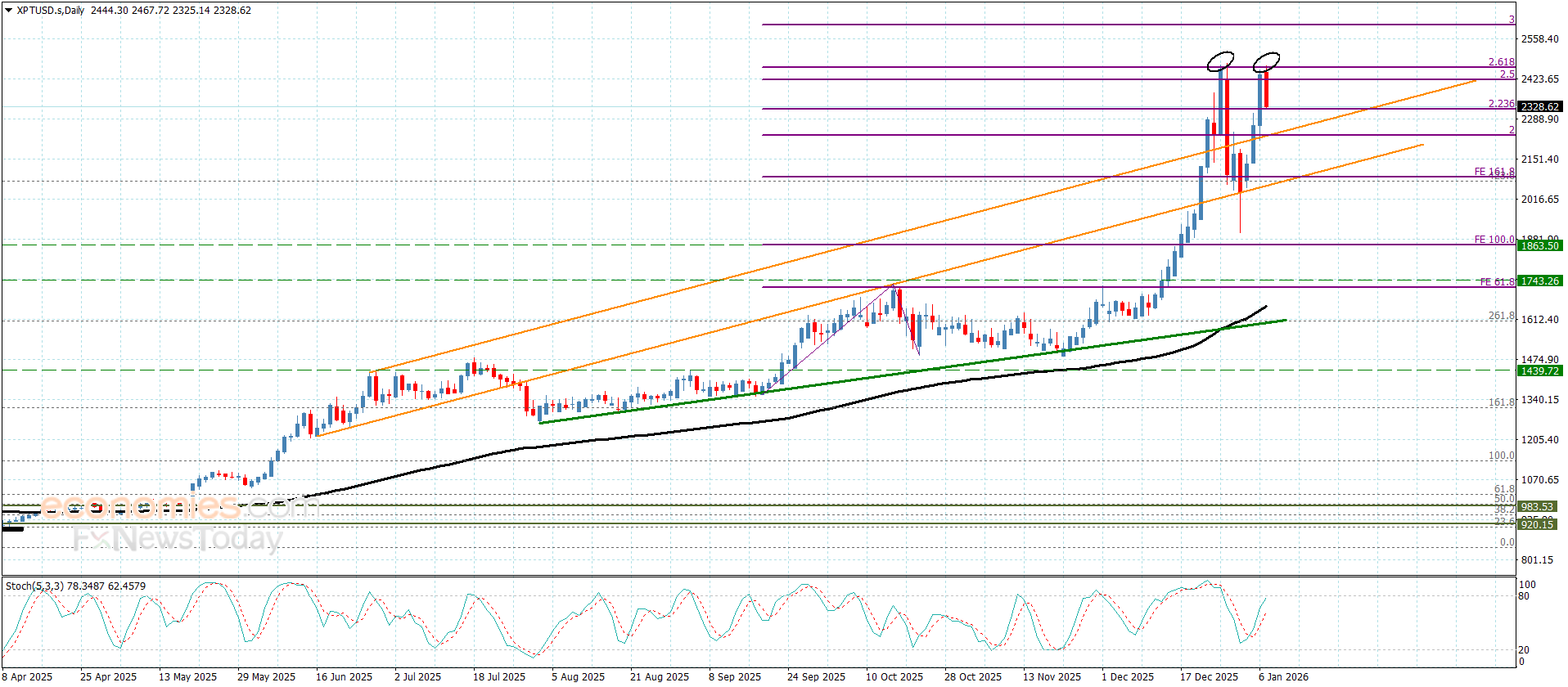
Platinum price ended the last bullish rally by facing the historical high near$2467.70, forming strong resistance to begin forming bearish corrective waves by its stability near $2340.00.
Despite the attempts of the main indicators to provide positive momentum, the continued fluctuation below the current top supports the chances of renewing the corrective attempts, which might target $2260.00 and $2185.00, while breaching the top and holding above it will reinforce the chances of recording historical gains by its rally towards $2525.00.
The expected trading range for today is between $2260.00 and $2410.00
Trend forecast: Bearish
Gold is correcting from weekly highs of $4,500 early Wednesday as buyers take a breather after the recent relentless upsurge, backed by geopolitical flare-ups globally and increased US Federal Reserve (Fed) interest rate cut bets for 2026.
Having climbed nearly 4% so far this week, traders resort to profit-taking on their Gold long positions in a readjustment move after the bright metal ran into the $4,500 barrier.
Traders also gear up for a bunch of high-impact US economic data releases due later on Wednesday, including the ADP monthly Employment Change, JOLTS Job Openings and ISM Services PMI data.
These data will be closely scrutinized to gauge the timing of the next Fed rate cut as markets continue pricing in two rate reductions for this year. Weaker-than-expected jobs and private services sector data could reaffirm bets for two cuts in the coming months, boding well for non-yielding assets like Gold at the expense of the US Dollar (USD).
On Monday, the US ISM Manufacturing PMI declined to 47.9 in December, against the forecast of 48.3, reinforcing dovish Fed expectations and keeping the recovery attempts in the USD short-lived.
The ongoing bearish undertone around the USD, combined with the escalating geopolitical tensions globally, continues to keep the positive momentum intact in Gold, despite the latest retracement.
On the latest geopolitical developments, Russia deployed submarine and other naval vessels to escort an aging oil tanker off the coast of Venezuela, according to the Wall Street Journal (WSJ).
Meanwhile, China ramped up tensions with Japan by banning exports of goods with potential military uses, following Taiwan-related remarks by Japan’s Prime Minister Sanae Takaichi.
In the daily chart, the 21-day Simple Moving Average (SMA) advances above the 50-day, with price holding over both, signaling firm bullish momentum. The 21-day SMA at $4,363.88 acts as nearby dynamic support. The Relative Strength Index (RSI) at 63.41 remains in bullish territory without overbought readings, keeping the bias tilted to the upside.
Broader trend metrics stay supportive as the 100- and 200-day SMAs continue to climb and the market trades above them. The moving average stack shows buyers in control, with secondary support at the 50-day SMA around $4,212.04 and deeper layers near the 100-day at $3,997.46 and the 200-day at $3,653.43. As long as price holds above the 21-day SMA, the uptrend would extend, while pullbacks could be absorbed into the rising averages.
(The technical analysis of this story was written with the help of an AI tool)
The ADP Employment Change is a gauge of employment in the private sector released by the largest payroll processor in the US, Automatic Data Processing Inc. It measures the change in the number of people privately employed in the US. Generally speaking, a rise in the indicator has positive implications for consumer spending and is stimulative of economic growth. So a high reading is traditionally seen as bullish for the US Dollar (USD), while a low reading is seen as bearish.
Next release:
Wed Jan 07, 2026 13:15
Frequency:
Monthly
Consensus:
45K
Previous:
-32K
Source:
ADP Research Institute
Monetary policy in the US is shaped by the Federal Reserve (Fed). The Fed has two mandates: to achieve price stability and foster full employment. Its primary tool to achieve these goals is by adjusting interest rates.
When prices are rising too quickly and inflation is above the Fed’s 2% target, it raises interest rates, increasing borrowing costs throughout the economy. This results in a stronger US Dollar (USD) as it makes the US a more attractive place for international investors to park their money.
When inflation falls below 2% or the Unemployment Rate is too high, the Fed may lower interest rates to encourage borrowing, which weighs on the Greenback.
The Federal Reserve (Fed) holds eight policy meetings a year, where the Federal Open Market Committee (FOMC) assesses economic conditions and makes monetary policy decisions.
The FOMC is attended by twelve Fed officials – the seven members of the Board of Governors, the president of the Federal Reserve Bank of New York, and four of the remaining eleven regional Reserve Bank presidents, who serve one-year terms on a rotating basis.
In extreme situations, the Federal Reserve may resort to a policy named Quantitative Easing (QE). QE is the process by which the Fed substantially increases the flow of credit in a stuck financial system.
It is a non-standard policy measure used during crises or when inflation is extremely low. It was the Fed’s weapon of choice during the Great Financial Crisis in 2008. It involves the Fed printing more Dollars and using them to buy high grade bonds from financial institutions. QE usually weakens the US Dollar.
Quantitative tightening (QT) is the reverse process of QE, whereby the Federal Reserve stops buying bonds from financial institutions and does not reinvest the principal from the bonds it holds maturing, to purchase new bonds. It is usually positive for the value of the US Dollar.
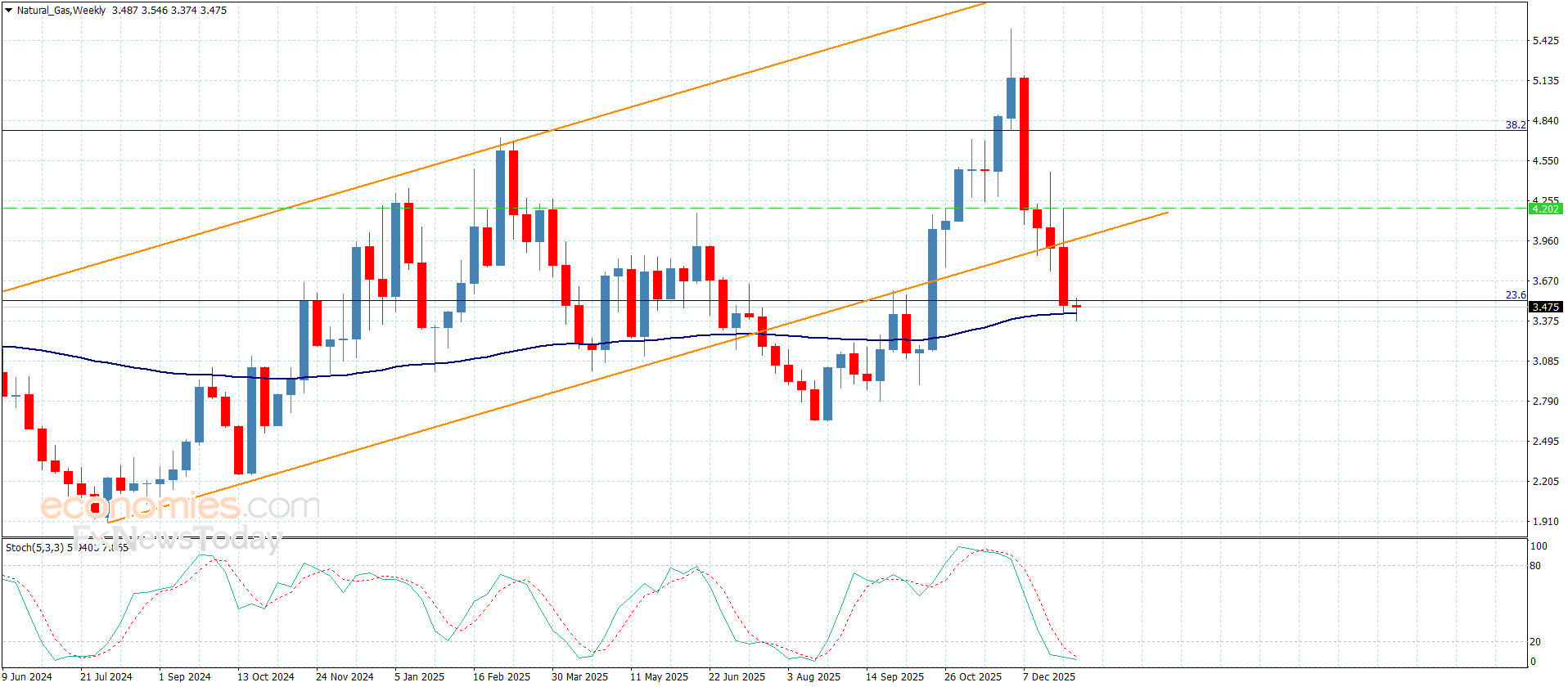
Natural gas fell below the long-term trend indicator, the 200-day average, on Monday and closed below it thereby confirming the breakdown. Today’s clear bearish response shows the sellers continue to dominate despite a potential bullish hammer candle that formed yesterday. A low-end target is at the lower long-term uptrend line, currently at approximately $3.01. Failure of the 200-day average shows selling pressure at a degree that could see the lower uptrend line eventually reached and possibly lower levels.
However, the next lower target zone is around $3.26 to $3.24 (D), consisting of a 78.6% projected target for a falling ABCD pattern and a 78.6% Fibonacci retracement of the full upswing from the August low. Given weakness today, it looks like that target will likely be reached before the bulls take back control. If it fails, then the lower trendline becomes a target. And if that line fails to reverse the descent a 100% projection for the ABCD pattern shows a potential target below the long-term uptrend line at $2.89.
It is interesting to note that the 20-month moving average is at $3.31 currently, near the next potential support zone. That means that the monthly chart also indicates potential support around the next lower price zone and therefore enhances the potential significance of that price zone.
On the upside, a rally above Monday’s high of $3.53 heads towards the 200-day average, now at $3.56. A daily close above the 200-day line would be needed to confirm strength, while Friday’s high of $3.70 being the first upside target, followed by a swing low at $3.80 (B). The 10-day average would then be next. It is now at $3.92 and falling.
For a look at all of today’s economic events, check out our economic calendar.
ASML Holding N.V. (ASML) stock price recorded further gains in its latest intraday trading, confirming a breakout above the key resistance level at $1,141.70. This move comes amid the dominance of the main medium-term upward trend, with price action moving along both major and minor supportive trend lines, alongside dynamic support from trading above its SMA50. In addition, positive signals continue to flow from the RSI, all accompanied by a noticeable increase in trading volumes.
Therefore we expect the stock price to continue rising in upcoming trading, as long as it remains stable above the $1,141.70 level, to target the first resistance at $1,300.
Today’s price forecast: Bullish
Spot Gold extends its advance on Tuesday, hovering around $4,480 a troy ounce in the American afternoon. The XAU/USD pair advanced despite the better market mood, as reflected by the positive tone of global equities. Investors were cautiously optimistic after the release of tepid, yet encouraging growth-related data and ahead of the first batch of United States (US) employment data scheduled for Wednesday.
Throughout the day, S&P Global, alongside local banks, released the Services and Composite Purchasing Manager’s Indexes (PMIs) for major economies, which showed expansion continued in the Eurozone, the United Kingdom, and the US. Nevertheless, the preliminary estimates of the December Composite PMIs were slightly lower than the final November readings.
The EU index eased to 51.5 from 52.8 in November, while in the US, the Composite PMI fell to 52.7 from 54.2 in the previous month. Slower growth rates may not be an immediate concern given continued expansion, yet if the picture persists, it could prompt some fresh concerns among policymakers, and hence, affect monetary policies.
The US calendar will include the December ADP report on Employment Change and November JOLTS Job Openings on Wednesday. Given that the Federal Reserve (Fed) made clear that employment is its major concern, the data will likely shake the USD ahead of the Nonfarm Payrolls (NFP) report on Friday.
In the meantime, Australia will release the November Consumer Price Index (CPI) in the upcoming Asian session. Afterwards, German Retail Sales and the preliminary estimate of the EU HICP will precede US employment reports.
From a technical point of view, XAU/USD is bullish. The 4-hour chart shows the pair holds on to modest intraday gains while advancing above all its moving averages. The 20-period 20 Simple Moving Average (SMA) at $4,404 provides relevant support while rallying beyond the longer ones, in line with the dominant trend. At the same time, the Momentum holds above its midline and advances, reflecting strengthening buying interest. Finally, the Relative Strength Index (RSI) indicator stands at 64.10, keeping room for further upside before the risk of a pause emerges. Should pullbacks occur, the 100 SMA at $4,385.02 would cushion declines, while sustained strength could keep the bias pointed higher toward fresh highs.
In the daily chart, XAU/USD keeps finding buyers on pullbacks to the 20-day SMA, which advances above the 100- and 200-day SMAs, with all three rising as price holds above them, reinforcing a bullish structure. The 20-day SMA stands at $4,357.69, offering immediate dynamic support. Meanwhile, the Momentum indicator advances above its midline, while the RSI also aims north at around 65, hinting at higher highs ahead.
(The technical analysis of this story was written with the help of an AI tool)
New York, Jan 6, 2026, 06:31 EST — Premarket
The United States Natural Gas Fund slipped again in premarket trading on Tuesday as U.S. natural gas futures fell amid forecasts for warmer-than-normal weather. UNG was down 2.2% at $11.37 before the open. StockAnalysis
U.S. natural gas futures were down 2.7% at $3.427 per million British thermal units (mmBtu), a common benchmark unit for gas pricing. The pullback keeps pressure on natural-gas-linked funds that trade like stocks. Investing
The move matters now because winter weather is the main swing factor for U.S. heating demand, and traders have been repricing the balance as temperature models change. UNG is designed to track daily percentage moves tied to Henry Hub natural gas via near-term futures. Hellenicshippingnews
On Monday, front-month natural gas futures for February delivery on the New York Mercantile Exchange (NYMEX) fell 5.7% to $3.41 per mmBtu, marking a fourth straight session of losses, as of mid-morning. Hellenicshippingnews
Meteorologists are calling for warmer-than-average temperatures across the nation through Jan. 20, Reuters reported. Heating Degree Days (HDDs) — a gauge of how much energy is needed to heat buildings — were projected well below the 30-year normal. Hellenicshippingnews
Supply is still running high. LSEG forecast average gas demand, including exports, in the Lower 48 states at 133.0 billion cubic feet per day (bcfd) this week, rising to 134.2 bcfd next week; output averaged 109.2 bcfd so far in January, still below December’s record, it said. Hellenicshippingnews
LNG, or liquefied natural gas, remains the key offset for bulls. Gas flows to the eight large U.S. LNG export plants averaged 18.8 bcfd so far in January, above December’s record of 18.4 bcfd, LSEG said. Hellenicshippingnews
“This market is dropping into fresh new low territory this morning,” consultancy Ritterbusch & Associates said in a note, adding that downside risk in nearby futures extends to the $3.00 area without weather support. Hellenicshippingnews
For investors looking for alternatives, UNG’s sister fund, the United States 12 Month Natural Gas Fund (UNL), spreads exposure across 12 consecutive NYMEX contract months, rather than concentrating in the front month. USCF Investments
Gold (XAU/USD) increased to about $4,440. As the Venezuela crisis introduces geopolitical uncertainty, the precious metal continues to rise and reaches a one-week high due to demand for safe havens.

Traders will keenly watch US economic data, such as Nonfarm Payrolls (NFP), for hints about the direction of monetary policy. After the US Army’s Delta Force attacked Venezuela and captured its President Nicolás Maduro and his wife on Saturday, tensions between the US and Venezuela reached a new high
Maduro began an extraordinary legal battle with significant geopolitical ramifications on Monday when he entered a not guilty plea to US charges in a narco-terrorism case against him. Traditional safe-haven assets are fueled by increased geopolitical tensions and uncertainty in this area.
The upside of the yellow metal is partly due to dovish expectations of the US Federal Reserve (Fed). According to the most recent Federal Open Market Committee (FOMC) Minutes, the majority of Fed officials agreed that additional interest rate cuts were necessary as long as inflation decreased.
Still, they couldn’t agree on when or how much. Lower interest rates could support the non-yielding precious metal by lowering the opportunity cost of holding gold. On Friday, everyone will be watching the US employment report for December.
55,000 new jobs are anticipated to be added to the US economy in December, while the unemployment rate is predicted to drop to 4.5 percent. In the short term, this could strengthen the US dollar (USD) and weaken the price of commodities denominated in USD if the reports indicate a better-than-expected result.

Olumide Adesina
Financial Market Writer
Olumide Adesina is a French-born Nigerian financial writer. He tracks the financial markets with over 15 years of working experience in investment trading.
The EURJPY pair suffered strong negative pressures, reaching below the bullish channel’s support at 183.45 level, to suffer intraday losses by targeting 182.80 level, which forms a key support level to take advantage of its rally towards 183.40.
The confinement between extra support at 182.80 and 183.60 level makes us expect extending the support of the broken bullish channel, to keep the neutrality until confirming the trend by surpassing one of these levels, note that the price rally above 183.60 will reinforce the chances of renewing the bullish attempts, to expect targeting 184.40 barrier, and surpassing it will form next target at 184.90 level in the bullish trading.
The expected trading range for today is between 182.80 and 183.60
Trend forecast: Neutral
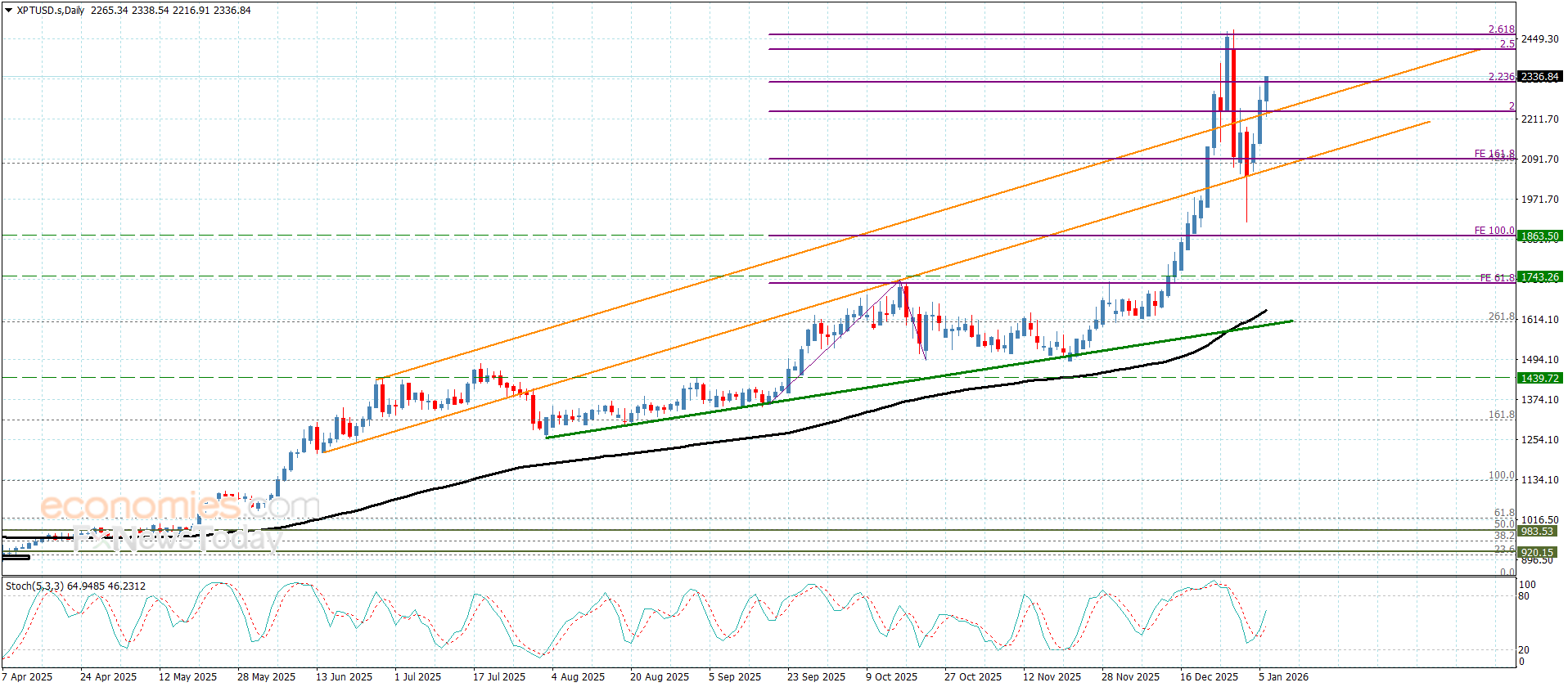
Platinum price succeeded in renewing the bullish attack by its stability above $2085.00 level, activating with the main indicators’ positivity by its rally above $2235.00 barrier, and achieving clear gains by reaching $2335.00.
No escape from resuming the bullish attack, due to the continuation of providing bullish momentum by the main indicators to reach $2380.00, to attempt to press on the barrier at $2430.00 level, reinforcing the chances of reaching new historical stations in the near period.
The expected trading range for today is between $2235.00 and $2380.00
Trend forecast: Bullish
Gold is looking to build on the previous over 2.5% rally early Tuesday, retaking the $4,450 level as prospects of further US Federal Reserve (Fed) interest rate cuts this year continue to act as a headwind to the US Dollar (USD) recovery.
Gold has found fresh buyers, sitting at weekly highs above $4,450, after having dipped to near the $4,430 region earlier on. The latest leg up in Gold could be attributed to the renewed selling interest around the USD amid improving risk sentiment.
Markets shrug off the US-Venezuela geopolitical tensions, now viewing the US intervention as limited, shifting their focus back toward the expectations surrounding future rate cuts by the Fed heading in the US labor data releases due later this week.
The dovish Fed bets returned to the fore on Monday and smashed the USD alongside the US Treasury bond yields after the US ISM Manufacturing PMI declined to 47.9 in December, against the forecast of 48.3.
Slowing US economic momentum and labor market conditions continue to remain a drag on the Greenback, as markets now eagerly await the US ADP monthly Employment Change and JOLTS Job Openings data due on Wednesday before Friday’s Nonfarm Payrolls showdown.
However, if the geopolitical tensions over the US and Venezuela gather steam again, a fresh bout of USD buying could re-emerge on safe haven flows, which will likely cap the Gold price upside. All eyes are on China’s and Russia’s response to the US military aggression.
Meanwhile, the overthrown Venezuelan President Nicolas Maduro pleaded not guilty before a New York Federal court on Monday to multiple charges.
US President Donald Trump’s capture of him on Saturday rattled world leaders and left officials in Caracas scrambling to regroup, per Reuters.
In the daily chart, the 21-day Simple Moving Average (SMA) climbs above the 50-, 100-, and 200-day SMAs, signaling firm bullish alignment. All SMAs advance and the price holds above them, reinforcing buyers’ control. The 21-day SMA at $4,349.26 supports the near-term bias, while the 50-day SMA at $4,201.11 underpins the broader trend.
The 14-day Relative Strength Index (RSI) stands at 64.41, positive and shy of overbought, suggesting momentum favors the upside. Should pullbacks emerge, the rising 21-day SMA could cap losses, while a deeper retracement would look toward the 100-day SMA at $3,985.64. The bullish tone would persist while XAU/USD trades above these moving averages.
(The technical analysis of this story was written with the help of an AI tool)
The ADP Employment Change is a gauge of employment in the private sector released by the largest payroll processor in the US, Automatic Data Processing Inc. It measures the change in the number of people privately employed in the US. Generally speaking, a rise in the indicator has positive implications for consumer spending and is stimulative of economic growth. So a high reading is traditionally seen as bullish for the US Dollar (USD), while a low reading is seen as bearish.
Next release:
Wed Jan 07, 2026 13:15
Frequency:
Monthly
Consensus:
45K
Previous:
-32K
Source:
ADP Research Institute