The main tag of GoldPrice Articles.
You can use the search box below to find what you need.
[wd_asp id=1]
The main tag of GoldPrice Articles.
You can use the search box below to find what you need.
[wd_asp id=1]
Given the long-term nature of the 200-day line there is the potential for a completion of the bearish correction and a bullish reversal from the area around the average. Recent volatility however could result in a short-term failure of the 200-day average and a dip to the 78.6% Fibonacci retracement at $3.45. If that was followed quickly by a reclaim of the 200-day line, the potential for further upside rises.
Bearish momentum spiked following the December $5.50 peak, which was a three-year high. The drop quickly put natural gas below the 20-day average and then the 50-day average. Resistance near the 20-day line was confirmed a week ago Wednesday during the first pullback following a breakdown of the 20-day average. On Tuesday a pullback found resistance a bit below the 50-day average. That led to Friday’s new trend low.
This behavior shows aggressive selling that may still be early in a second leg down from the top. If this pattern plays out like it might, the 78.6% retracement is also at risk of failure. A lower target at $3.26 would then be likely. That’s where the second leg down (CD) is 78.6% of the decline seen in the first leg down (AB). There is the potential for support to be seen near that harmonic relationship between the two downswings.
In the short-term and before further testing of support near the 200-day line, a breakout above today’s high of $3.70 shows strength but within the larger bearish structure. Key resistance to consider would then be around the 10-day average, now at $4.03 and falling. Wednesday’s high at $3.98 is nearby and can be used to assistant in gauging potential short-term resistance.
The bigger picture quarterly chart suggests the potential for an eventual strong bullish recovery once the current correction is complete. In the Q4 2025 natural gas closed at $3.71 – above the prior quarter high of $3.63. That confirmed a bullish breakout of a quarterly bull hammer candlestick pattern and the completion of the first quarterly pullback for the rally begun from the 2024 low.
For a look at all of today’s economic events, check out our economic calendar.
D.R. Horton, Inc. (DHI) showed calm and slightly positive sideways trading in its latest intraday movements, as the stock attempts to recover part of its previous losses. At the same time, it is trying to unwind its clear oversold condition on the RSI, especially with the emergence of early positive signals. This comes amid the dominance of a minor bearish wave in the short term, with price action moving alongside a supporting downward trendline, in addition to ongoing negative pressure from trading below its 50-period SMA.
Therefore we expect the stock price to decline during the upcoming trading sessions, as long as resistance at $151.40 holds, to target the support level at $134.75.
Today’s price forecast: Bearish
Silver price (XAG/USD) rises to near $74.10 per troy ounce during the early European hours on Friday. The price of the grey metal surged 148% in 2025, breaking key levels amid its designation as a critical US mineral, tight supply, low stockpiles, and rising industrial and investment demand.
The non-interest-bearing Silver attracts buyers due to dovish sentiment surrounding the Fed policy outlook. Lower interest rates could reduce the opportunity cost of holding Silver. Traders expect the Federal Reserve (Fed) to deliver two more rate cuts in 2026.
Additionally, Silver prices find support as a softer US Dollar (USD) makes the dollar-denominated metal cheaper for foreign buyers. Markets are bracing for US President Donald Trump to nominate a new Fed chair to replace Jerome Powell when his term ends in May, a move that could tilt monetary policy toward lower interest rates.
The safe-haven metals, including Silver receive support amid heightened geopolitical tensions, fueled by recent exchanges of accusations between Russia and Ukraine over civilian attacks on New Year’s Day and persistent US–Venezuela friction.
Silver gains ground amid a surge in speculative demand in China, driving Shanghai Futures Exchange premiums to record highs. These elevated premiums reflect strong local demand and have tightened global supply chains, echoing earlier inventory squeezes in London and New York vaults.
Silver is a precious metal highly traded among investors. It has been historically used as a store of value and a medium of exchange. Although less popular than Gold, traders may turn to Silver to diversify their investment portfolio, for its intrinsic value or as a potential hedge during high-inflation periods. Investors can buy physical Silver, in coins or in bars, or trade it through vehicles such as Exchange Traded Funds, which track its price on international markets.
Silver prices can move due to a wide range of factors. Geopolitical instability or fears of a deep recession can make Silver price escalate due to its safe-haven status, although to a lesser extent than Gold’s. As a yieldless asset, Silver tends to rise with lower interest rates. Its moves also depend on how the US Dollar (USD) behaves as the asset is priced in dollars (XAG/USD). A strong Dollar tends to keep the price of Silver at bay, whereas a weaker Dollar is likely to propel prices up. Other factors such as investment demand, mining supply – Silver is much more abundant than Gold – and recycling rates can also affect prices.
Silver is widely used in industry, particularly in sectors such as electronics or solar energy, as it has one of the highest electric conductivity of all metals – more than Copper and Gold. A surge in demand can increase prices, while a decline tends to lower them. Dynamics in the US, Chinese and Indian economies can also contribute to price swings: for the US and particularly China, their big industrial sectors use Silver in various processes; in India, consumers’ demand for the precious metal for jewellery also plays a key role in setting prices.
Silver prices tend to follow Gold’s moves. When Gold prices rise, Silver typically follows suit, as their status as safe-haven assets is similar. The Gold/Silver ratio, which shows the number of ounces of Silver needed to equal the value of one ounce of Gold, may help to determine the relative valuation between both metals. Some investors may consider a high ratio as an indicator that Silver is undervalued, or Gold is overvalued. On the contrary, a low ratio might suggest that Gold is undervalued relative to Silver.
The FOMC meeting in December was clear: even though there were some internal disagreements, most of the Fed’s policymakers still think there’s room for further easing if inflation continues to slow. The upshot is lower interest rates, which make holding non-yielding assets like gold much less costly, keeping demand for them afloat.
The ongoing conflicts and tensions between nations have added a big layer of uncertainty to the mix, which in turn has led investors to stick with the tried and true safe haven assets that always seem to do well during times of uncertainty – and gold is no exception.
The big question is: will its price hold at record levels despite the inevitable pullbacks? That said, we do face some near-term headwinds.
The first is that after a gain as sharp as gold’s, some people will want to cash in their profits, which could lead to selling pressure. The CME Group has also decided to up the margin requirements for gold and other metals, which is likely to make it a little more expensive to speculate on the price of gold, and that could also dampen demand.
Looking ahead, gold is likely to remain well-supported as long as rate-cut expectations and geopolitical tensions continue to simmer. However, with US markets set to release a batch of important data, including the final Manufacturing PMI, traders are likely to keep a close eye on how it all plays out, especially its impact on the dollar and the Fed’s next move.
Gold may consolidate between $4,350–$4,450 in the near term, with dips attracting buyers above $4,300, while a break above $4,400 could reopen the path toward $4,475.
NEW YORK, January 1, 2026, 15:17 ET
Banks that lend to the U.S. oil and gas industry trimmed their 2026 natural gas price deck to $3.43 per million British thermal units (mmBtu), a standard unit of heat energy, down from $3.54 in the spring, a Haynes Boone survey of 29 lenders showed. The survey also lowered the 2026 oil assumption to $55.44 a barrel and put a downside gas case at $2.79/mmBtu. MRT
Those assumptions feed directly into borrowing bases and spending plans at producers as they lock in hedges and set drilling budgets for 2026. Even small shifts in the price deck can change how much cash operators expect to generate.
They also matter for consumers because Henry Hub — a Louisiana pricing hub — is the benchmark for most U.S. wholesale gas contracts and a key input for many power markets. The central question in the 2026 natural gas price forecast is whether supply growth can keep up with rising liquefied natural gas (LNG) exports, gas cooled into a liquid for shipping, and electricity demand.
The U.S. Energy Information Administration projected Henry Hub spot gas would average $4.01/mmBtu in 2026, up from a projected $3.56/mmBtu in 2025, in its latest Short-Term Energy Outlook. It forecast dry gas production averaging 109.11 billion cubic feet per day (bcfd) in 2026 and LNG exports rising to 16.3 bcfd. U.S. Energy Information Administration
Energy executives in the Federal Reserve Bank of Dallas’ latest Energy Survey pegged Henry Hub at $4.19/mmBtu by the end of 2026 and put West Texas Intermediate crude around $62 a barrel for the same period. Henry Hub averaged $4.84/mmBtu during the survey collection period, the Dallas Fed said. Federal Reserve Bank of Dallas
U.S. natural gas futures dropped more than 5% on Dec. 31, with February futures around $3.745/mmBtu midday, after weather forecasts turned warmer and federal data showed a 38 billion cubic feet (bcf) storage withdrawal for the week ended Dec. 26, below market expectations. LSEG estimated lower-48 output averaged 110.1 bcfd in December and LNG feedgas about 18.5 bcfd, both records. “We’re about to hit the next wave of the LNG boom,” said Robert DiDona, president of Energy Ventures Analysis. BOE Report
Heating degree days, or HDDs, measure how much heating demand households and businesses face; milder weather usually means fewer HDDs and weaker gas burn. Storage withdrawals matter because they show whether inventories are tightening fast enough to support prices later in winter.
Analysts have increasingly argued that 2026 price moves will be driven less by daily weather swings and more by LNG demand, as new export projects compete for supply, Argus said. The U.S. has about 17.5 bcfd of liquefaction capacity operating and 15 bcfd under construction, and meeting new projects could require roughly 9.9–10.8 bcfd of additional feedgas once processing losses are included, it said. Argus Media
Data-center power demand is another lever that traders are building into 2026 expectations, especially in the U.S. East, where pipeline takeaway has historically constrained regional pricing, Argus said. Range Resources expects 2.5 bcfd of incremental U.S. demand from data centers by the end of the decade and cited a 4 bcfd increase in U.S. LNG export capacity coming online in 2026. Argus Media
Put together, the forecasts sketch a market that is firmer than 2025 but still sensitive to timing. If export ramps and new power loads slip, the lender decks may prove closer to the mark; if they arrive on schedule while production growth stays modest, the higher forecasts get tested quickly.
Globally, the LNG build-out carries its own risk: a Reuters commodities columnist wrote that LNG may come under pressure in 2026 as more U.S. plants are commissioned and the market looks for prices low enough to clear the extra supply. Reuters
For now, the 2026 natural gas price forecast is converging on a mid-$3 to low-$4 Henry Hub range, with winter inventories and the pace of LNG commissioning as the main near-term signposts. Regional basis markets — the premium or discount to Henry Hub — are likely to stay volatile as infrastructure and demand growth play out unevenly.
Brent crude is expected to slide toward $55 a barrel in early 2026 as analysts warn that supply will outpace demand after oil posted its steepest annual fall since 2020.
The forecast matters as governments and central banks start the year watching energy costs for inflation, while producers weigh drilling plans and hedging strategies for 2026.
Traders are also looking to OPEC+ for direction ahead of a January 4 meeting, with the group’s next policy move seen as pivotal if prices drift into the low $50s.
Brent futures settled at $60.85 a barrel on Dec. 31, while U.S. West Texas Intermediate (WTI) ended at $57.42. Brent fell about 19% in 2025 and WTI nearly 20%, extending a multi-year losing streak for benchmarks.
BNP Paribas commodities analyst Jason Ying expects Brent to dip to $55 in the first quarter before recovering to $60 for the rest of 2026. “We think U.S. shale producers were able to hedge at high levels,” Ying said, referring to using derivatives to lock in future selling prices and keep production steady even if spot prices fall. Reuters
Morgan Stanley’s global oil strategist Martijn Rats said OPEC+ would likely respond with cuts only if prices fall substantially further, pointing to the low $50s as the area that could force the group’s hand, according to Reuters.
Most analysts expect a 2026 surplus, with estimates ranging from the International Energy Agency’s 3.84 million barrels per day to Goldman Sachs’ 2 million bpd. A surplus means the world is pumping more oil each day than it consumes, swelling inventories and weighing on prices.
OPEC+, which groups the Organization of the Petroleum Exporting Countries and allies including Russia, paused output hikes for the first quarter of 2026 after releasing about 2.9 million bpd into the market since April, Reuters reported.
U.S. data have also reinforced the market’s focus on demand. The Energy Information Administration said crude stockpiles fell by 1.9 million barrels in the week ended Dec. 26, while gasoline rose by 5.8 million barrels and distillates, including diesel and heating oil, climbed by 5 million barrels on strong refining runs. ( Reuters)
In the same report, “total product supplied” — a widely watched proxy for demand — dropped by 934,000 bpd to 19.38 million bpd, a decline that can signal softer consumption as the holiday period fades.
Geopolitics remains the wild card, analysts said, even with the market leaning bearish on fundamentals. The United States imposed new sanctions on four companies it said were operating in Venezuela’s oil sector and targeted associated tankers, a move Washington said was part of an intensified pressure campaign on President Nicolas Maduro. ( Reuters)
The U.S. action followed a broader push against what officials call a “shadow fleet” — older ships with opaque ownership and limited insurance that transport sanctioned oil — and came after a U.S. blockade announced earlier in December that Reuters said helped cut Venezuela’s exports to about half of November levels.
For now, the tug-of-war is clear: surging supply expectations and swelling inventories point lower, while OPEC+ policy and sanctions-driven disruptions could keep a floor under prices.
The next test comes quickly. Traders will watch the Jan. 4 OPEC+ meeting and early-2026 demand signals for clues on whether Brent stabilizes near $60 — or slips toward the mid-$50s that some banks have penciled in.
NEW YORK, January 1, 2026, 13:00 ET — Market closed
The United States Natural Gas Fund (UNG) sank 6.7% on Wednesday, the last U.S. trading session of 2025, tracking a sharp pullback in U.S. natural gas prices after traders leaned into a warmer weather outlook for early January.
The move matters because winter pricing is still dominated by short-term swings in heating demand, and forecasts can change quickly. A warmer-than-normal pattern typically means less gas burned for heat and fewer withdrawals from storage.
It also lands as U.S. liquefied natural gas (LNG) exports keep running at high levels, tying domestic prices more closely to export demand. That support can be offset in the near term when weather turns milder and production stays high.
UNG closed at $12.26, after trading between $12.18 and $12.69 during the session.
Among gas-heavy producers, EQT fell 1.9%, Antero Resources slid 1.8% and Range Resources dropped 2.3%. LNG exporter Cheniere Energy rose 0.5%.
In the futures market, front-month February Henry Hub contracts were down 5.7% at $3.745 per million British thermal units by 12:41 p.m. ET on Wednesday, pressured by warmer forecasts for next week and a smaller-than-expected storage withdrawal, even as record gas flows to LNG export facilities in 2025 kept the market on track for a second straight annual gain. BOE Report
Meteorologists projected above-normal temperatures across the country through Jan. 14, Reuters reported, and Heating Degree Days — a measure of energy demand to heat buildings — fell to 413 from 439 a day earlier. BOE Report
The Energy Information Administration said utilities withdrew 38 billion cubic feet (bcf) from storage for the week ended Dec. 26. One bcf is a billion cubic feet of gas. BOE Report+1
Working gas in storage stood at 3,375 bcf, the EIA data showed. That left inventories about 58 bcf above the five-year average for this time of year, based on the agency’s historical comparisons. EIA Information Releases
On the supply side, LSEG data showed Lower 48 output averaging 110.1 billion cubic feet per day (bcfd) in December, a record, while average feedgas deliveries to the eight big U.S. LNG export plants reached 18.5 bcfd in December. Feedgas is gas delivered to liquefaction terminals for export. BOE Report
“Given this weather and the drawdown number, there’s really not a whole lot of room for the natural gas prices to go up,” said Zhen Zhu, a managing consultant at C.H. Guernsey and Company in Oklahoma City. BOE Report
Before the next session: U.S. markets reopen on Jan. 2, and traders are likely to keep treating weather model shifts and LNG feedgas flows as the main near-term catalysts. The next weekly storage report from the EIA is scheduled for Jan. 8, following Wednesday’s holiday-shifted release. EIA Information Releases+2EIA Information Releases+2
UNG’s Wednesday low of $12.18 is the first level many short-term traders will watch for signs of another wave of selling, while the day’s high of $12.69 marks the nearby upside hurdle if gas prices rebound.
Safe-haven demand remains a significant long-term tailwind for gold and, of course, there’s lots more going on beyond the Fed’s policy moves that’s keeping gold in demand as a safe-haven asset. The global security situation remains tense, which is keeping people flocking to gold when they get nervous, even as markets are a bit thin and people take profits at the end of the year.
Central Bank Buying has helped keep the longer-term trend going strong and underpinning the whole gold price rally is the fact that central banks have kept buying gold & that the gold-backed ETFs are still holding pretty strong. All this steady demand has really helped absorb any volatility that’s come up and keep prices supported above some key long-term averages.
When the markets finally get back to work after the New Year break, you can bet that traders will be focusing hard on Fed guidance, real interest rates, and geopolitics to see if gold can finally make a move above where it is now or if it just goes sideways for a bit before deciding which way to go next.
Gold holds near $4,310 after the Dec 31 close. On reopening, a break above $4,360 targets $4,400–$4,450, while a slip below $4,280 risks $4,255 support.
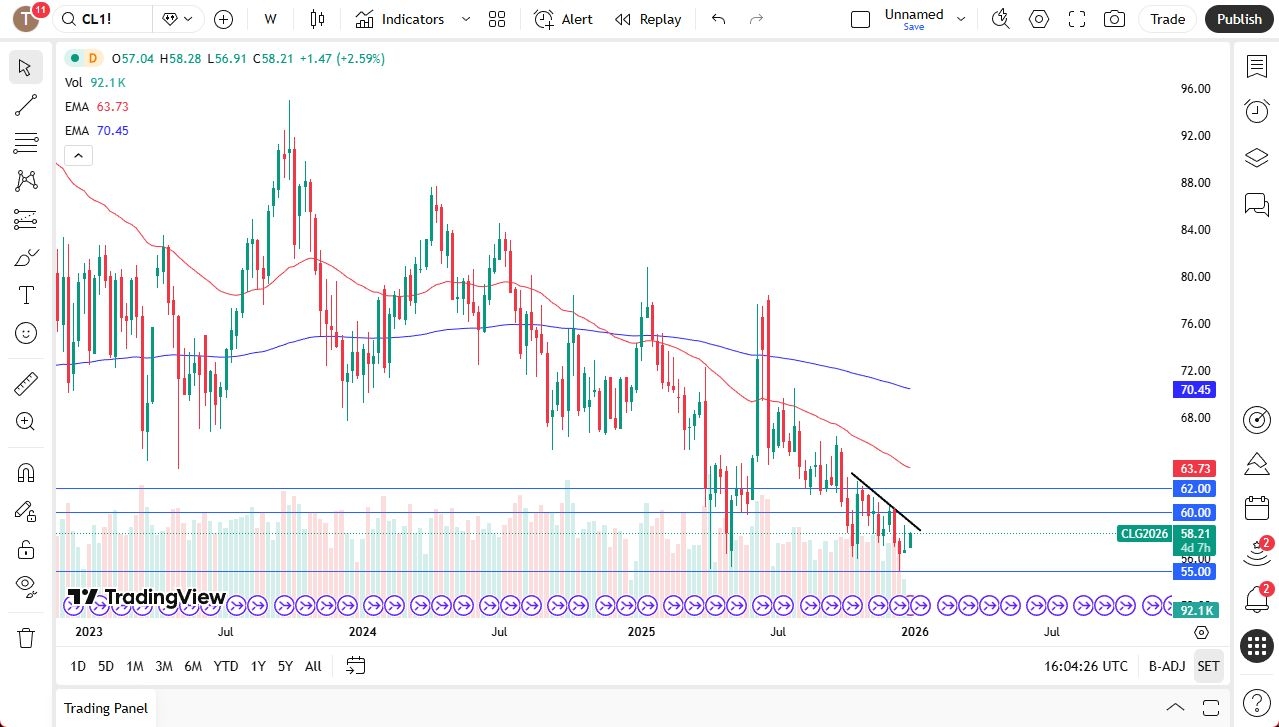
The $55 level has been a major floor in the light sweet crude oil market.
Crude oil markets have been generally negative during December as we continue to pay close attention to a downtrend line. But perhaps more importantly, I think we’re going to continue to pay a lot of attention to the $55 level. The $55 level has been a major floor in the light sweet crude oil market, and I think that continues to be a major battleground.
Whether or not we can break down below, there is still a question that remains to be answered, but I would not be surprised at all to see more of the same action in January that we have seen in both November and December. Quite frankly, the only sign of life in this market over the last couple of months has been due to new sanctions against Russia. And that bullish behavior was squashed almost immediately.
This has shown that the $62 level is a major resistance barrier that I think is going to take some type of external pressure to break above. I also believe that January will end up being fairly weak from a cyclical standpoint as well, as typically speaking, January is somewhat soft. All things being equal, I think that January will behave in the same way we have seen the oil market behave in general, that anytime we get some type of rally, you’re looking to sell the first signs of exhaustion.
I do not want to get long of oil anytime soon because we do have massive amounts of supply coming out of Guyana and the United States, just to name a couple of places. In other words, the market is awash in oil, and therefore, it’s counterintuitive to think that prices will rise anytime soon. Yes, there will be more sanctions against Russia, would be my bet, but really, at the end of the day, Russian oil still ends up in Europe and Asia, and to a lesser extent, even the United States. So, it’s all a shell game. We have plenty of oil out there. I think we continue to see a lot of overhang as far as selling pressure is concerned.
Ready to trade daily crude oil price analysis? We’ve shortlisted the best Forex Oil trading brokers in the industry for you.
Christopher Lewis has been trading Forex and has over 20 years experience in financial markets. Chris has been a regular contributor to Daily Forex since the early days of the site. He writes about Forex for several online publications, including FX Empire, Investing.com, and his own site, aptly named The Trader Guy. Chris favours technical analysis methods to identify his trades and likes to trade equity indices and commodities as well as Forex. He favours a longer-term trading style, and his trades often last for days or weeks.
Conversely, Monday’s sharp bearish retracement to a seven-day low that included a breakdown below the 10-day average. There was a chance that the 10-day average would show signs of support but instead Tuesday’s high successfully tested resistance at the 10-day line, confirming a flip from support to resistance. That is bearish behavior. In addition, a narrow range inside day inverted hammer pattern formed below the 10-day average and in the lower third of Monday’s trading range. That is also bearish behavior, which confirmed today with a breakdown from that inside day, followed by further bearish signs.
This puts gold at a critical support zone that is at risk of failure. The monthly chart adds to that risk, as it shows overhead supply keeping downward pressure on prices. A potentially bearish monthly shooting star candlestick pattern has formed for December. The low for the month and therefore a key pivot is December’s low of $4,164. This is interesting since a sustained drop below today’s low puts gold in a position to challenge support near the 50-day average, now at $4,174, above this month’s low.
Keep in mind that the potentially bearish monthly pattern is not valid until there is a breakdown below December’s low. Until then strong support is anticipated near the 50-day line, now at $4,175. But given the bearish monthly pattern, new trend highs in January seems unlikely, and an inside month more likely.
Alternatively, if support holds near the 20-day average and is followed by bullish signs, the long-term bull trend could reassert itself as a short-term pullback completes. It is interesting to note that Wednesday’s weakness shows a break below the near-term uptrend line, adding to potential downside risk. A sustained advance above today’s high of $4,373 would show a one-day bullish reversal and the potential for further upside.
For a look at all of today’s economic events, check out our economic calendar.