The main tag of GoldPrice Articles.
You can use the search box below to find what you need.
[wd_asp id=1]
The main tag of GoldPrice Articles.
You can use the search box below to find what you need.
[wd_asp id=1]
Silver price (XAG/USD) has pared its nearly a 4.5% gain registered in the previous session, trading around $72.20 during the European hours on Wednesday. However, Silver prices are on track for an annual gain of over 150% in 2025, marking the metal’s strongest yearly performance.
The technical analysis of the daily chart timeframe suggests the price of the precious metal remains within an ascending channel pattern, suggesting a persistent bullish bias. The 14-day Relative Strength Index (RSI) prints 63.53, reinforcing positive momentum after cooling from extreme readings.
Silver price holds above the rising nine-day Exponential Moving Average (EMA) and well above the 50-day EMA, preserving a bullish bias. The short-term average stands firmly above the medium-term gauge, and the spread has widened, underscoring trend strength.
Holding above the short-term average would keep the topside in focus and could open a path toward resistance at the upper boundary of the ascending channel around $80.00. A break above the channel would help the Silver price to approach the record high of $85.87, which was recorded on December 29.
On the downside, the Silver price could test the immediate support at the nine-day EMA of $71.54, followed by the lower ascending channel boundary around $70.00. A daily close below the channel would open a correction toward the 50-day EMA at $59.32.
Silver is a precious metal highly traded among investors. It has been historically used as a store of value and a medium of exchange. Although less popular than Gold, traders may turn to Silver to diversify their investment portfolio, for its intrinsic value or as a potential hedge during high-inflation periods. Investors can buy physical Silver, in coins or in bars, or trade it through vehicles such as Exchange Traded Funds, which track its price on international markets.
Silver prices can move due to a wide range of factors. Geopolitical instability or fears of a deep recession can make Silver price escalate due to its safe-haven status, although to a lesser extent than Gold’s. As a yieldless asset, Silver tends to rise with lower interest rates. Its moves also depend on how the US Dollar (USD) behaves as the asset is priced in dollars (XAG/USD). A strong Dollar tends to keep the price of Silver at bay, whereas a weaker Dollar is likely to propel prices up. Other factors such as investment demand, mining supply – Silver is much more abundant than Gold – and recycling rates can also affect prices.
Silver is widely used in industry, particularly in sectors such as electronics or solar energy, as it has one of the highest electric conductivity of all metals – more than Copper and Gold. A surge in demand can increase prices, while a decline tends to lower them. Dynamics in the US, Chinese and Indian economies can also contribute to price swings: for the US and particularly China, their big industrial sectors use Silver in various processes; in India, consumers’ demand for the precious metal for jewellery also plays a key role in setting prices.
Silver prices tend to follow Gold’s moves. When Gold prices rise, Silver typically follows suit, as their status as safe-haven assets is similar. The Gold/Silver ratio, which shows the number of ounces of Silver needed to equal the value of one ounce of Gold, may help to determine the relative valuation between both metals. Some investors may consider a high ratio as an indicator that Silver is undervalued, or Gold is overvalued. On the contrary, a low ratio might suggest that Gold is undervalued relative to Silver.
(The technical analysis of this story was written with the help of an AI tool.)
Dominion Energy, Inc. (D) declined in its latest intraday trading, amid continued negative and dynamic pressure from trading below its 50-period simple moving average. This comes while a corrective bearish wave dominates the short term, following the stock’s earlier break of a main ascending trendline. In addition, a bearish crossover is beginning to appear on the RSI after reaching extremely overbought levels.
Therefore we expect the stock price to decline further in the upcoming trading sessions, as long as resistance at $60.25 holds, to target the support level at $57.55.
Today’s price forecast: Bearish
Gold price (XAU/USD) edges lower on the final trading day of 2025, trading near $4,310 per troy ounce during the European hours on Wednesday. The non-interest-bearing precious metals, including Gold lose ground as the Federal Open Market Committee (FOMC) December Meeting Minutes, released on Tuesday, indicated a deeply divided committee.
Some Federal Reserve (Fed) officials said it might be best to leave rates unchanged for a while after the committee made three rate reductions this year. However, some policymakers judged that it would likely be appropriate to stand on further rate cuts if inflation declined over time.
Gold price is on track for its strongest annual gain in 2025, up more than 64%, with the rally accelerating in late April after US President Donald Trump’s global tariff rollout. Momentum has been further supported by strong central bank buying and rising holdings in Gold-backed ETFs.
The safe-haven demand for Gold could increase over the geopolitical tensions as investors reassess fading hopes of a Russia-Ukraine peace deal following alleged strikes on Russian President Vladimir Putin’s residence. Russia said it would harden its stance in peace talks after accusing Kyiv of the attack, an allegation Kyiv rejected as baseless and aimed at derailing negotiations.
In the Middle East, Saudi air strikes in Yemen and Iran’s declaration of a “full-scale war” with the United States (US), Europe, and Israel have heightened fears of wider instability, while Trump warned of further strikes if Iran resumes rebuilding its nuclear programme.
Gold has played a key role in human’s history as it has been widely used as a store of value and medium of exchange. Currently, apart from its shine and usage for jewelry, the precious metal is widely seen as a safe-haven asset, meaning that it is considered a good investment during turbulent times. Gold is also widely seen as a hedge against inflation and against depreciating currencies as it doesn’t rely on any specific issuer or government.
Central banks are the biggest Gold holders. In their aim to support their currencies in turbulent times, central banks tend to diversify their reserves and buy Gold to improve the perceived strength of the economy and the currency. High Gold reserves can be a source of trust for a country’s solvency. Central banks added 1,136 tonnes of Gold worth around $70 billion to their reserves in 2022, according to data from the World Gold Council. This is the highest yearly purchase since records began. Central banks from emerging economies such as China, India and Turkey are quickly increasing their Gold reserves.
Gold has an inverse correlation with the US Dollar and US Treasuries, which are both major reserve and safe-haven assets. When the Dollar depreciates, Gold tends to rise, enabling investors and central banks to diversify their assets in turbulent times. Gold is also inversely correlated with risk assets. A rally in the stock market tends to weaken Gold price, while sell-offs in riskier markets tend to favor the precious metal.
The price can move due to a wide range of factors. Geopolitical instability or fears of a deep recession can quickly make Gold price escalate due to its safe-haven status. As a yield-less asset, Gold tends to rise with lower interest rates, while higher cost of money usually weighs down on the yellow metal. Still, most moves depend on how the US Dollar (USD) behaves as the asset is priced in dollars (XAU/USD). A strong Dollar tends to keep the price of Gold controlled, whereas a weaker Dollar is likely to push Gold prices up.
Given Monday’s sharp bearish reversal following a successful test of resistance near the 20-day average the price of natural gas remains under pressure. The reversal generated a lower daily high at $4.59, likely putting an end to the counter-trend rally. Monday’s decline to a lower retracement low shows the potential for a second leg down from the $5.50 trend high reached earlier this month. Symmetry in price between the two downswings is reached at $2.89, providing a potential downside target. However, to reach that lower price level higher key potential support levels would need to fail first.
Support for the retracement has been seen near the 61.8% Fibonacci retracement zone of $3.89, and the top boundary line of a rising trend channel. If a sustained decline triggers below the current low of $3.79, the 61.8% support zone will have failed. Based on Fibonacci analysis, the next lower target would then be $3.45, the 78.6% Fibonacci retracement level. However, the potentially significant 200-day moving average is a little higher, at $3.57 currently.
The current bearish correction is the first pullback towards the 200-day line since it was reclaimed in late-October. Resistance near the 200-day line was seen during two periods in October prior to the upside breakout. So, the expectation is for signs of support to occur near or above the 200-day average if the bearish correction continues to lower prices. If not, the price area around the 78.6% level becomes a key area for support to be seen. Depending on when the lower Fibonacci level is reached, a lower rising channel line might also assist in identify areas of dynamic support.
An alternative scenario is that last week’s outside week shows the potential for a broadening formation to evolve as price consolidates. If so, additional consolidation within a range from around today’s low of $3.79 and up to last week’s high of $4.59.
For a look at all of today’s economic events, check out our economic calendar.
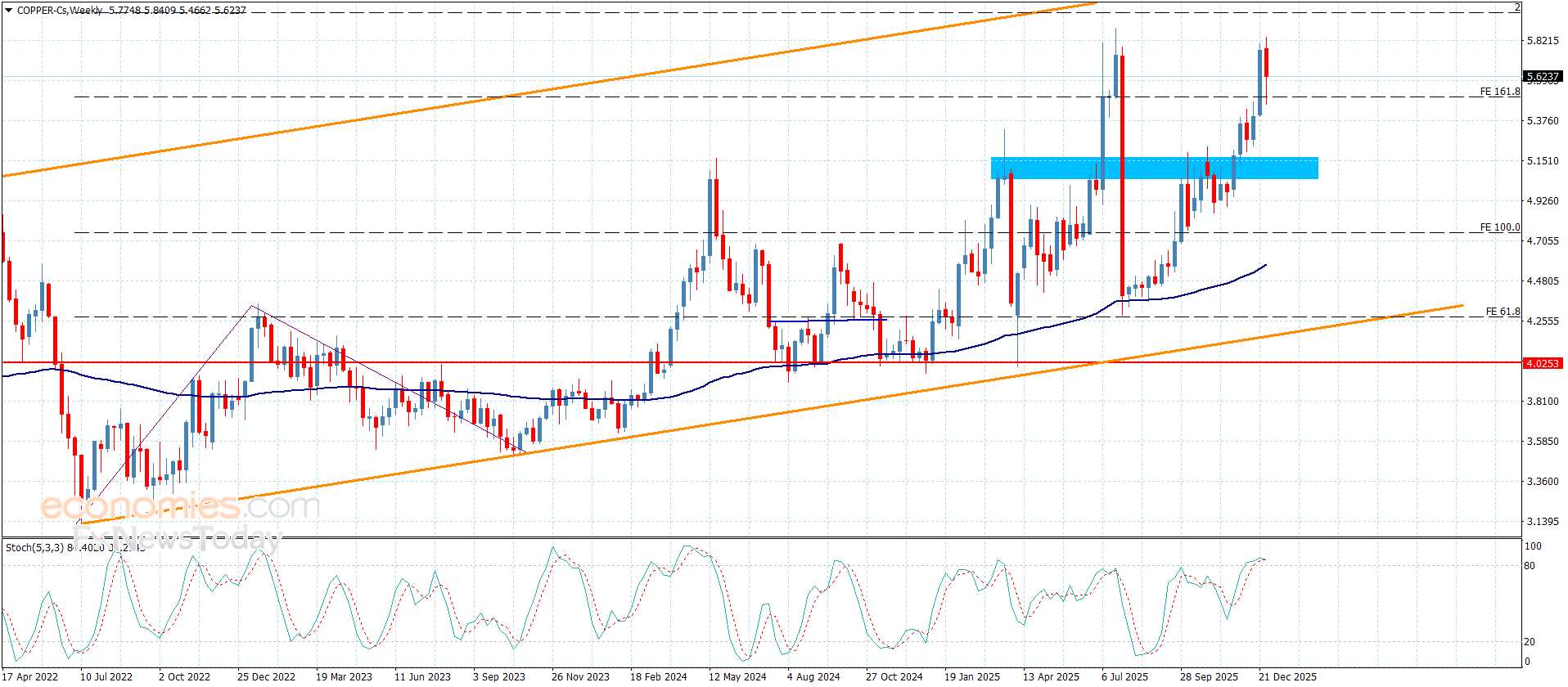
Copper price repeatedly forming weak trading, attempting to surpass stochastic negativity by its fluctuation above EMA50 at $5.5100, the continuation of the sideways bias dominance is expected until gathering the required bullish momentum to resume the bullish attack and achieving extra gains by its rally towards $5.8000 reaching the next resistance at $5.9700.
While the decline below the current support will force it to delay the bullish attack and form bearish waves, which forces it to suffer some losses by reaching $5.3200 followed by the base of the next sport at 5.1500 level.
The expected trading range for today is between $5.5500 and $5.8000
Trend forecast: Bullish
Silver price (XAG/USD) has lost its nearly a 4.5% gain registered in the previous session, trading around $72.50 during the Asian hours on Wednesday. Silver prices came under pressure after the CME raised margin requirements on Silver futures, prompting leveraged traders to reduce positions as prices became technically stretched. Analysts said the pullback reflected position unwinding rather than any deterioration in underlying demand.
However, Silver prices are on track for an annual gain of over 150% in 2025, marking the metal’s strongest yearly performance. The rally accelerated after US President Donald Trump’s global tariff rollout and has been further supported by persistent geopolitical tensions, US rate cuts, and strong industrial demand, especially from the solar, electronics, and data-center sectors.
Silver’s rally has also been driven by a surge in speculative demand in China, pushing Shanghai Futures Exchange premiums to record highs. The elevated premiums signal intense local demand and have tightened global supply chains, mirroring earlier inventory squeezes in London and New York vaults.
Meanwhile, the Federal Open Market Committee’s (FOMC) December Meeting Minutes, released Tuesday, showed most participants favored pausing further rate cuts if inflation continues to ease. Some officials also argued for holding rates steady after three cuts this year aimed at supporting a weakening labor market.
The demand for safe-haven metals, including silver, increases over the geopolitical tensions, Uncertainty over a Russia-Ukraine peace deal, renewed Middle East tensions, and frictions between the US and Venezuela.
Silver is a precious metal highly traded among investors. It has been historically used as a store of value and a medium of exchange. Although less popular than Gold, traders may turn to Silver to diversify their investment portfolio, for its intrinsic value or as a potential hedge during high-inflation periods. Investors can buy physical Silver, in coins or in bars, or trade it through vehicles such as Exchange Traded Funds, which track its price on international markets.
Silver prices can move due to a wide range of factors. Geopolitical instability or fears of a deep recession can make Silver price escalate due to its safe-haven status, although to a lesser extent than Gold’s. As a yieldless asset, Silver tends to rise with lower interest rates. Its moves also depend on how the US Dollar (USD) behaves as the asset is priced in dollars (XAG/USD). A strong Dollar tends to keep the price of Silver at bay, whereas a weaker Dollar is likely to propel prices up. Other factors such as investment demand, mining supply – Silver is much more abundant than Gold – and recycling rates can also affect prices.
Silver is widely used in industry, particularly in sectors such as electronics or solar energy, as it has one of the highest electric conductivity of all metals – more than Copper and Gold. A surge in demand can increase prices, while a decline tends to lower them. Dynamics in the US, Chinese and Indian economies can also contribute to price swings: for the US and particularly China, their big industrial sectors use Silver in various processes; in India, consumers’ demand for the precious metal for jewellery also plays a key role in setting prices.
Silver prices tend to follow Gold’s moves. When Gold prices rise, Silver typically follows suit, as their status as safe-haven assets is similar. The Gold/Silver ratio, which shows the number of ounces of Silver needed to equal the value of one ounce of Gold, may help to determine the relative valuation between both metals. Some investors may consider a high ratio as an indicator that Silver is undervalued, or Gold is overvalued. On the contrary, a low ratio might suggest that Gold is undervalued relative to Silver.
Copper price repeatedly forming weak trading, attempting to surpass stochastic negativity by its fluctuation above EMA50 at $5.5100, the continuation of the sideways bias dominance is expected until gathering the required bullish momentum to resume the bullish attack and achieving extra gains by its rally towards $5.8000 reaching the next resistance at $5.9700.
While the decline below the current support will force it to delay the bullish attack and form bearish waves, which forces it to suffer some losses by reaching $5.3200 followed by the base of the next sport at 5.1500 level.
The expected trading range for today is between $5.5500 and $5.8000
Trend forecast: Bullish
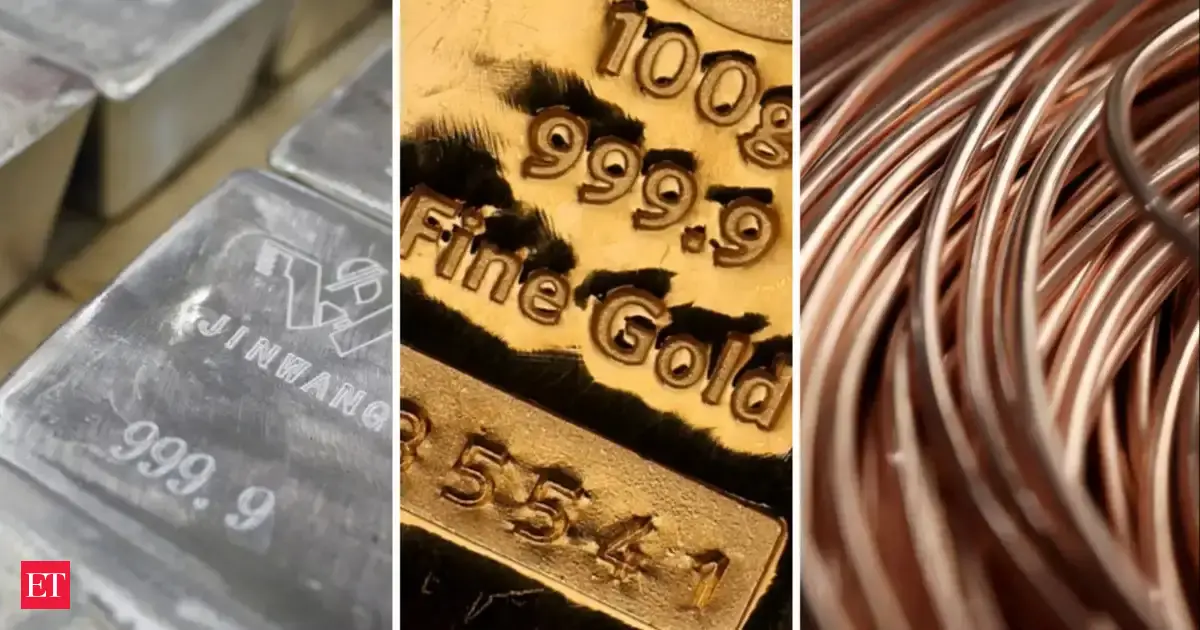
Silver reached $77 per ounce, recovering slightly after a dramatic “flash crash” that saw prices plunge from $84 to below $73 in a single session. Analysts link the decline to a major bank liquidation, rumored to be UBS, and a margin increase by the CME Group. Despite this, silver’s long-term outlook remains bullish due to industrial demand in solar panels, electronics, and the upcoming Chinese export restrictions.
Copper prices are currently around $5.51–$5.80 per pound. The metal has experienced a volatile end to the year but remains up 36% year-over-year. Growth in electrification, AI data center expansion, and green energy infrastructure have fueled strong demand. Supply disruptions in Indonesia and Chile, combined with worker protests in Peru, have tightened global availability, contributing to copper’s 2025 rally.
Gold has traded in a narrow range above $4,300, reflecting moderate easing by the Fed and inflation dynamics. Prices ranged from $4,323.80 to $4,403.90 in the final days of December, closing at $4,400, a 1.58% increase over recent sessions. Market analysts note that central bank purchases and continued safe-haven interest will likely support gold in 2026, with projections from Goldman Sachs and UBS pointing toward $5,000 per ounce.
Investor sentiment has also been influenced by a softer U.S. dollar, which makes gold cheaper for holders of other currencies. Geopolitical tensions and year-end portfolio rebalancing have added momentum, encouraging traders to maintain positions in gold. Overall, gold remains a key hedge against inflation and economic uncertainty heading into 2026.
Silver experienced extreme volatility between December 29–30, dropping from $84 to below $73 per ounce. The sudden decline followed a major bank liquidation and a margin hike on CME silver contracts. Prices have since stabilized near $75–$77. Investors are closely watching China’s new silver export licensing rules, effective January 1, 2026. As the world’s dominant silver processor, China’s policy is expected to tighten global supply, a key factor behind silver’s record-breaking rally earlier this month.
The industrial demand for silver, particularly in solar panels, electronics, and electric vehicles, continues to underpin its value. Analysts highlight that the supply-demand imbalance could persist for months, making silver a potential outperformer in 2026. Market watchers are also noting increased interest from investment funds, which may further amplify price movements.
Copper ended 2025 near $5.6787 per pound, up 2.59% over the last trading session and 36% for the year. Demand is being driven by AI infrastructure, data center buildouts, and global green energy transitions. Supply-side risks remain significant, with halted operations at Freeport-McMoRan’s Grasberg mine in Indonesia, responsible for 3% of global output, and labor unrest in Chile and Peru. Recent threats of US tariffs on copper commodity forms have also shifted flows into US warehouses, tightening markets further.
Long-term demand for copper is expected to strengthen as countries accelerate electrification projects and renewable energy installations. Analysts point to rising copper intensity in electric vehicles, wind turbines, and battery storage as a structural support for prices. The market is likely to remain sensitive to production disruptions, making copper a high-interest commodity for 2026 investors.
Analysts remain bullish for 2026. Gold is expected to continue as a safe-haven asset amid global uncertainties. Silver may test $100 per ounce due to supply deficits and industrial demand. Copper’s outlook is supported by governments’ electrification agendas and rising capital expenditure in AI and clean energy sectors. Investors are closely monitoring both geopolitical developments and supply disruptions as metals enter the new year with strong momentum.
Experts also emphasize the role of central banks, particularly in emerging markets, as continued buyers of gold and silver. Policy shifts, export controls, and infrastructure spending in green technology could create new volatility and opportunities across all three metals. Overall, metals are positioned for strong performance, but investors should prepare for occasional price swings.
As 2025 closes, gold near $4,400, silver around $77, and copper above $5.60 reflect not just cyclical momentum, but deeper structural shifts. Entering 2026, investors are watching whether these forces intensify—or collide—setting the stage for another defining year in global commodities markets.
Q: Why did silver experience a sharp drop at the end of December 2025? A: Silver plunged from $84 to below $73 on December 29–30 due to a major bank liquidation and a CME Group margin hike. The move caused short-term volatility but prices stabilized near $75–$77. China’s upcoming export licensing rules may continue to influence supply and price.
Q: What factors are driving copper and gold prices heading into 2026?
A: Copper remains strong at $5.68 per pound, supported by AI infrastructure, data centers, and green energy demand. Gold trades above $4,400 due to Fed rate cuts, safe-haven buying, and geopolitical tensions. Supply disruptions in Indonesia, Chile, and Peru further tighten global markets. Analysts forecast higher metals prices in 2026.
Silver (XAG/USD) is trimming losses on Tuesday after depreciating beyond 7% amid Monday’s thin liquidity conditions. The escalating tensions in diverse regions of the world, coupled with market expectations that the Fed minutes will cement hopes of further monetary easing in 2026, are providing support to precious metals on Tuesday.
Moscow announced the revision of its stance on the peace talks with Ukraine after an alleged drone attack on one of President Vladimir Putin’s residences, while in the South East China Sea, military drills around Taiwan extend for the second day. Beyond that, US President Trump has threatened another attack on Iran.
Apart from that, the minutes of the last Federal Reserve meeting, due later today, are expected to reflect a wide divergence within the monetary policy committee, and feed hopes that the bank might lower borrowing costs beyond the 25 basis pòints projected in the Dot Plot.
In the 4-hour chart, XAG/USD trades at $75.65, after having bottomed at $70.53 on Monday. The rising 50-period Simple Moving Average (SMA), near $70.89, held bears on Monday and keeps the broader upside trend in play.
Oscillators, however, are mixed. The Moving Average Convergence Divergence (MACD) line remains below the Signal line and under the zero mark, while the Relative Strength Index (RSI) has returned to bullish territory above the key 50 line.
The bearish engulfing pattern in the daily chart is a negative sign that might anticipate a deeper correction. Resistances are at the $76.50 intra-day level, ahead of the $80.00 psychological level and the all-time high, at $85.87.
On the downside, the mentioned 50-period SMA and Monday’s low at $70.53 are likely to provide support on a potential bearish reversal. Further down, the December 18 low, near $64.75, will come into focus.
(The technical analysis of this story was written with the help of an AI tool)
Silver is a precious metal highly traded among investors. It has been historically used as a store of value and a medium of exchange. Although less popular than Gold, traders may turn to Silver to diversify their investment portfolio, for its intrinsic value or as a potential hedge during high-inflation periods. Investors can buy physical Silver, in coins or in bars, or trade it through vehicles such as Exchange Traded Funds, which track its price on international markets.
Silver prices can move due to a wide range of factors. Geopolitical instability or fears of a deep recession can make Silver price escalate due to its safe-haven status, although to a lesser extent than Gold’s. As a yieldless asset, Silver tends to rise with lower interest rates. Its moves also depend on how the US Dollar (USD) behaves as the asset is priced in dollars (XAG/USD). A strong Dollar tends to keep the price of Silver at bay, whereas a weaker Dollar is likely to propel prices up. Other factors such as investment demand, mining supply – Silver is much more abundant than Gold – and recycling rates can also affect prices.
Silver is widely used in industry, particularly in sectors such as electronics or solar energy, as it has one of the highest electric conductivity of all metals – more than Copper and Gold. A surge in demand can increase prices, while a decline tends to lower them. Dynamics in the US, Chinese and Indian economies can also contribute to price swings: for the US and particularly China, their big industrial sectors use Silver in various processes; in India, consumers’ demand for the precious metal for jewellery also plays a key role in setting prices.
Silver prices tend to follow Gold’s moves. When Gold prices rise, Silver typically follows suit, as their status as safe-haven assets is similar. The Gold/Silver ratio, which shows the number of ounces of Silver needed to equal the value of one ounce of Gold, may help to determine the relative valuation between both metals. Some investors may consider a high ratio as an indicator that Silver is undervalued, or Gold is overvalued. On the contrary, a low ratio might suggest that Gold is undervalued relative to Silver.
Spot Gold tries to regain its bullish poise on Tuesday, trading above $4,350 after bottoming at $4,300 on Monday. The XAU/USD pair edged sharply lower after reaching an all-time high at the beginning of the week amid profit-taking ahead of the New Year’s holiday. The bright metal benefits from a risk-averse environment, although the advance is tepid amid resurgent US Dollar (USD) demand.
Wall Street is under pressure for a second consecutive day, although the slide is more linked to the lack of news than to a negative headline. Pretty much, investors are closing their books for the year as most financial markets will be closed on Wednesday, with market activity resuming on January 2.
A pinch of caution adds to the USD near-term advance ahead of the release of the Federal Open Market Committee (FOMC) minutes of the December meeting. The document will be released in the mid-American session and could shed some light on the next Federal Reserve (Fed) monetary policy steps. The release may trigger near-term movements due to the ongoing lack of trading volume, but is unlikely to have a sustained impact, as market players are patiently waiting for United States (US) President Donald Trump to name the next Chair to go full in.
In the 4-hour chart, XAU/USD trades at $4,358.16 and aims to extend its slide. The 20-period Simple Moving Average (SMA) has turned lower above the current level, providing dynamic resistance at $4,445.70. Still, the 100- and 200-period SMAs remain below spot with modest upward slopes, at $4,339.52 and $4,240.55, respectively. At the same time, the Momentum indicator aims lower below its midline, while the Relative Strength Index (RSI) indicator also aims south at 37, in line with a continued slide.
In the daily chart, however, the downward potential of XAU/USD seems limited. The 20-day SMA continues to provide relevant support at $4,315, while rising above the 100- and 200-day SMAs, which maintain their bullish slopes. The Momentum indicator edges higher above its midline, while the RSI indicator advances at around 56, suggesting buyers paused but did not give up. The broader trend backdrop remains positive as the 100- and 200-day SMAs continue to slope higher, and the bullish tone would persist as long as the price holds above the 20-day SMA at $4,315.
(The technical analysis of this story was written with the help of an AI tool)