The main tag of GoldPrice Articles.
You can use the search box below to find what you need.
[wd_asp id=1]
The main tag of GoldPrice Articles.
You can use the search box below to find what you need.
[wd_asp id=1]
The global copper market operates within a complex ecosystem where supply constraints, demand fluctuations, and monetary conditions intersect to create price discovery mechanisms that extend far beyond simple commodity trading. Understanding these economic fundamentals requires analyzing how industrial production cycles, energy transition requirements, and central bank policies converge to influence copper price forecast expectations through 2026.
Global copper mine production faces mounting pressures that extend beyond traditional cyclical patterns. According to the U.S. Geological Survey 2025 Mineral Commodity Summaries, global refined copper production reached approximately 21 million tonnes annually as of 2024, with concentration heavily weighted toward Chile, Peru, China, and Indonesia.
Chile maintains its position as the dominant producer, accounting for roughly 27% of global copper mine output through operations at Escondida, Codelco, and other significant mines. However, the country confronts structural headwinds from declining ore grades and acute water scarcity that constrains expansion capabilities.
Peru, contributing approximately 10-11% of global supply, represents the second-largest producer but faces recurring disruptions from labor disputes and political instability that create supply uncertainty. Recent market analysis indicates copper prices advancing from a four-month low of $5.2463 per pound in March 2026, suggesting underlying supply tightness or demand recovery dynamics.
Furthermore, understanding the US copper production overview provides additional context for North American supply dynamics and their impact on global pricing mechanisms.
Key Supply Chain Constraints:
Energy-intensive refining operations face particular vulnerability to power price fluctuations and fuel availability. Approximately 70-80% of copper production costs derive from energy expenses, creating substantial operational challenges during periods of energy price volatility.
China’s consumption patterns dominate global copper demand dynamics, representing 50-55% of annual refined copper consumption according to International Copper Study Group data. This concentration creates significant sensitivity to Chinese economic performance and policy decisions.
Recent macroeconomic indicators suggest potential demand recovery momentum. China’s Producer Price Index moved back into positive territory for the first time in three years, supported by higher energy costs and improving demand conditions. This development signals potential industrial demand strengthening that could support copper price forecast projections.
Demand Segmentation by Sector:
Manufacturing sector copper intensity has increased approximately 1.5-2.0% annually over the past decade, driven by higher electrical content in products and renewable energy infrastructure requirements. This structural trend supports medium-term demand growth independent of cyclical factors.
The relationship between industrial production indices and copper demand maintains historical correlation coefficients of 0.65-0.75, reinforcing copper’s position as a reliable economic activity indicator. Construction demand shows elasticity to interest rate changes of approximately -1.2 to -1.5 in developed markets, meaning construction copper demand falls 1.2-1.5% for each 1% increase in borrowing costs.
Central bank policy decisions create significant transmission effects on copper valuations through multiple channels. Real interest rates, representing nominal rates minus inflation expectations, serve as primary drivers of copper valuations by influencing opportunity costs of holding non-yielding physical assets.
Current monetary conditions reflect stabilisation following recent volatility. Government bond yields have remained largely steady as investors reassess expectations for central bank rate cuts timing and magnitude. The US dollar traded in narrow ranges while the yen remained weak amid policy divergence, creating a relatively stable currency environment for commodity pricing.
Additionally, the tariff impacts on copper supply demonstrate how trade policy decisions intersect with monetary conditions to influence global pricing mechanisms.
Monetary Transmission Mechanisms:
Markets continue pricing further Bank of England rate cuts as growth indicators remain subdued and inflation trends show moderation signs. This easing bias across major central banks could provide supportive conditions for commodity pricing through reduced opportunity costs and increased liquidity availability.
Economic scenario analysis provides frameworks for understanding potential copper price trajectories under different macroeconomic conditions. These scenarios incorporate GDP growth assumptions, monetary policy paths, and structural demand factors that could influence copper price forecast outcomes through 2026.
The base case scenario assumes moderate global economic growth with GDP expansion of 2.0-2.5% across major economies, representing trend-level performance without significant disruptions. This scenario incorporates steady-state conditions with modest monetary policy easing from 2025 peaks and China economic growth maintaining 4.5-5.5% annually.
Current market pricing suggests alignment with base case assumptions. Copper prices around $5.75-5.80 per pound (approximately $12,680-$12,900/tonne) in April 2026 place valuations within the projected range, indicating market participants are pricing moderately constructive economic conditions.
Base Case Assumptions:
Industrial production stability factors include manufacturing PMI readings above 50 across major economies, indicating expansion rather than contraction in manufacturing activity. China’s Producer Price Index returning to positive territory supports base case assumptions of industrial demand stabilisation.
Bullish scenario conditions require significant acceleration beyond trend growth, driven primarily by infrastructure investment surges and energy transition acceleration. This scenario assumes coordinated fiscal stimulus supporting green energy deployment and electrification infrastructure beyond current policy targets.
Current copper pricing near $12,680-$12,900/tonne already approaches the lower end of the bullish scenario range, suggesting market participants are incorporating some upside potential from infrastructure spending and energy transition investments. Consequently, examining copper investment strategies becomes crucial for positioning ahead of potential bullish developments.
Bullish Scenario Drivers:
Energy transition investment requirements could drive substantial copper demand growth. Electrification trends may generate 60% growth in copper demand from grid and electric vehicle applications by 2035, fundamentally altering supply-demand equilibrium and supporting structurally higher price levels.
Bearish conditions require global economic contraction or significant slowdown with GDP growth below 1%, creating demand destruction across construction and manufacturing sectors. This scenario incorporates inventory overhang from prior production cycles and financial investor liquidation of commodity positions.
Technical analysis suggests copper’s March 2026 low of $5.2463 per pound (approximately $11,560/tonne) represents a key support level. Trading below this threshold could trigger bearish momentum targeting the $5.0000 per pound region ($11,023/tonne), aligning with bearish scenario price projections.
Bearish Risk Factors:
Historical precedent from the 2008-2009 financial crisis and 2015-2016 China slowdown demonstrates how economic contractions can drive copper below $10,000/tonne levels. Demand destruction typically occurs when construction activity falls significantly and manufacturing capacity utilisation drops below 70%.
Financial markets employ multiple mechanisms to price future supply-demand imbalances, incorporating futures market structure, institutional positioning, and options market intelligence. These pricing mechanisms reveal market participants’ collective expectations about copper market evolution and provide insights for copper price forecast analysis.
Futures market structure reveals critical information about market participants’ near-term versus long-term supply-demand expectations. Contango markets, where forward prices exceed near-term prices, suggest adequate current supply and weak immediate demand. Conversely, backwardated markets indicate immediate supply concerns or strong near-term demand.
Current copper pricing around $5.75-5.80 per pound with resistance at $5.8060 and longer-term targets at $5.8585 suggests market structure supporting gradual price appreciation. The recovery from March 2026 lows indicates underlying demand strength or supply constraints supporting higher valuations.
However, recent NY copper price highs demonstrate how regional market dynamics can create temporary price dislocations that ultimately resolve through arbitrage mechanisms.
Term Structure Indicators:
| Futures Analysis Framework | Bullish Signal | Bearish Signal |
|---|---|---|
| Term Structure | Backwardation | Deep Contango |
| Volume Distribution | Near-month concentration | Back-month dominance |
| Open Interest | Rising with prices | Declining with rallies |
| Volatility Surface | Low implied volatility | High implied volatility |
Institutional copper exposure encompasses hedge fund long/short positioning monitored through Commitments of Traders reports, pension fund commodity allocation as inflation hedges, and sovereign wealth fund strategic commodity reserves.
Hedge fund positioning typically leads price movements by 2-4 weeks, as large fund flows create momentum that retail and commercial participants follow. Pension fund allocation shifts toward commodities during inflationary periods can provide sustained buying pressure lasting quarters rather than weeks.
Institutional Flow Categories:
Current market conditions with stabilising bond yields and steady dollar trading suggest institutional positioning may be neutral to slightly constructive. The absence of significant currency volatility reduces hedging costs for international copper exposure.
China’s economic performance represents the single most significant driver of global copper demand, consuming approximately 50-55% of annual refined copper production. Chinese economic trajectory influences copper price forecast projections through multiple transmission mechanisms including manufacturing sector health, policy effectiveness, and regional demand substitution dynamics.
Recent data indicates potential stabilisation in Chinese manufacturing conditions. The Producer Price Index moved back into positive territory for the first time in three years, supported by higher energy costs and improving demand conditions. This development suggests industrial demand recovery that could support copper consumption growth.
Key Chinese Economic Indicators:
Chinese property sector dynamics significantly influence copper demand through building and construction applications. Property sector copper intensity remains elevated due to electrical infrastructure requirements and HVAC system installations. Recovery in housing starts and construction permits provides leading indicators for copper demand acceleration.
Chinese policy effectiveness directly impacts copper demand through stimulus multiplier effects on infrastructure spending and manufacturing investment. Green energy transition investment flows create additional copper demand from renewable energy installation and grid modernisation projects.
Infrastructure spending multiplier effects typically generate 2.5-3.5x copper demand relative to direct government investment due to private sector participation and supply chain requirements. Policy transmission typically occurs with 6-12 month lags between announcement and demand impact.
Policy Impact Channels:
Regional demand patterns outside China provide diversification for global copper consumption. Southeast Asian industrial growth, India’s manufacturing expansion, and Latin American domestic consumption create alternative demand sources reducing dependence on Chinese economic performance.
India’s manufacturing expansion potential includes electronics production, automotive assembly, and infrastructure development that could generate 8-12% annual copper demand growth over the next decade. Southeast Asia industrial development follows similar patterns with electronics manufacturing and urban development driving copper consumption.
Moreover, developments in the Argentina copper system illustrate how emerging producers can alter regional supply-demand dynamics and provide alternatives to traditional copper sources.
Regional Growth Factors:
Energy transition economics create structural demand drivers that could fundamentally alter copper supply-demand dynamics over the next decade. Electrification investment cycles, grid infrastructure requirements, and technology substitution thresholds represent key factors influencing long-term copper price forecast projections.
Global electrification trends drive copper demand through multiple channels including electric vehicle adoption, renewable energy installation, and grid infrastructure modernisation. These investment cycles operate on different timelines but create compounding demand effects supporting structurally higher copper prices.
Electric vehicle adoption requires 3-4 times more copper per unit than traditional internal combustion engine vehicles. Battery electric vehicles typically contain 80-85 kilograms of copper compared to 20-25 kilograms in conventional vehicles. Projected electric vehicle production growth to 30-50 million units annually by 2030 could generate 2-3 million tonnes of additional annual copper demand.
Electrification trends could drive 60% growth in copper demand from grid and electric vehicle applications by 2035, fundamentally altering the supply-demand equilibrium and supporting structurally higher price levels.
Electrification Copper Intensity:
Grid infrastructure modernisation represents a multi-decade investment cycle requiring substantial copper input for transmission lines, distribution systems, and smart grid technologies. Renewable energy integration necessitates grid flexibility and storage capacity that amplifies copper requirements beyond traditional power generation.
Technology substitution risks exist when copper prices reach levels making alternative materials economically viable. Aluminium substitution typically becomes attractive when copper prices exceed aluminium prices by 2.5-3.0x ratios, though technical performance differences limit substitution applications.
Substitution Price Thresholds:
Recycling technology advancement impacts net primary supply requirements by increasing secondary copper availability. Advanced recycling techniques can recover 95-98% of copper content from scrap materials, potentially reducing primary mining requirements as scrap accumulation increases over time.
Economic risk factors create copper price volatility through geopolitical premiums, financial market contagion, and potential black swan events. Understanding these risk factors helps inform copper price forecast uncertainty and portfolio management strategies for copper exposure.
Geopolitical tensions affect copper markets through supply route vulnerabilities, trade policy uncertainty, and resource nationalism risks. Middle East conflicts can disrupt shipping routes used for copper transport, while trade policy changes create demand uncertainty in major consuming regions.
Geopolitical Risk Categories:
Resource nationalism represents long-term risk where producing countries implement higher taxation, export restrictions, or nationalisation policies. Historical precedent includes Chile’s copper royalty increases and Peru’s mining tax proposals that create investment uncertainty and potential supply constraints.
Trade policy uncertainty quantification typically adds 3-8% risk premiums to copper prices during periods of elevated trade tensions. Current stable trade relationships suggest minimal risk premium incorporation, but sudden policy changes could quickly alter this assessment.
Financial market stress can transmit to copper markets through forced liquidation, credit market tightening, and correlation breakdown during crisis periods. Dollar strength correlation patterns show copper typically weakens during USD appreciation phases, while bond market volatility creates commodity price instability.
Contagion Transmission Mechanisms:
Credit market stress indicators include copper financing availability and warehouse financing costs. When credit spreads widen significantly, copper inventory financing becomes expensive, forcing inventory liquidation and creating downward price pressure independent of supply-demand fundamentals.
Black swan events represent low-probability, high-impact scenarios that could create extreme copper price movements. Pandemic-style demand shocks, climate-related supply disruptions, and financial system stress require scenario planning despite low probability outcomes.
Black Swan Scenario Types:
Climate-related supply disruption modelling includes drought conditions affecting Chilean mining operations, extreme weather impacting Peruvian mine transportation, and flooding risks at major facilities. These scenarios could remove 5-15% of global supply for extended periods, creating substantial price spikes.
Investment positioning for copper price uncertainty requires comprehensive portfolio allocation strategies, risk management frameworks, and understanding of various copper exposure vehicles. Investors must balance direct commodity exposure against equity-based copper investments while managing volatility and correlation risks.
Direct commodity exposure through ETFs, futures, or physical copper provides pure price exposure but carries storage costs, contango risks, and roll yield considerations. Equity-based copper exposure through mining companies offers leverage to copper prices but introduces company-specific risks, operational issues, and equity market correlation.
Copper Exposure Vehicles:
Geographic diversification considerations include exposure to different producing regions, various stages of mining operations, and multiple end-user markets. Diversification across Chilean, Peruvian, North American, and Australian operations reduces single-country political and operational risks.
Volatility-adjusted return optimisation requires understanding copper price volatility patterns, correlation relationships, and hedging strategy effectiveness. Copper price volatility typically ranges 25-35% annually, with higher volatility during economic uncertainty periods.
Risk Management Tools:
Correlation breakdown scenario planning prepares portfolios for periods when normal relationships fail. During crisis periods, correlations often approach 1.0 as all risk assets move together, reducing diversification benefits when most needed.
Liquidity provision during stress periods becomes critical when copper markets experience significant volatility. ETF liquidity can deteriorate during market stress, while futures markets typically maintain liquidity but may experience wider bid-ask spreads and increased margin requirements.
Forward curve analysis provides insights into market participant expectations about future supply-demand conditions, storage costs, and risk premiums embedded in copper pricing. The term structure reveals whether markets expect tightness or surplus conditions and helps inform copper price forecast methodologies.
Current copper pricing shows gradual recovery from March 2026 lows with resistance levels at $5.8060 and targets at $5.8585, suggesting market expectations of modest price appreciation. The absence of steep contango or backwardation indicates relatively balanced near-term supply-demand expectations.
Term Structure Interpretation:
Short-term supply tightness indicators include backwardation between prompt and 3-month contracts, elevated warehouse premiums, and low exchange inventory levels. Current market structure suggests moderate supply conditions without extreme tightness or surplus.
Long-term structural demand assumptions embedded in forward pricing reflect energy transition expectations, Chinese demand growth projections, and supply expansion capabilities. Forward curves beyond 12 months typically incorporate structural demand growth from electrification trends.
Options markets provide additional intelligence about tail risk expectations, volatility premiums, and event risk pricing. Implied volatility surfaces reveal market participants’ expectations about future price uncertainty and help identify potential market stress periods.
Furthermore, examining Goldman Sachs’ insights on copper prices alongside copper market trading data provides comprehensive market intelligence for investment decision-making.
Options Market Signals:
Skew patterns reveal whether markets expect more upside or downside risk. Positive skew (higher call option implied volatility) suggests expectations of potential price spikes, while negative skew indicates concerns about significant price declines.
Event risk premium identification helps investors prepare for periods around key economic announcements, Chinese policy decisions, or supply disruption possibilities. Options markets typically price higher volatility around these events, creating potential trading opportunities for volatility-focused strategies.
Disclaimer: This analysis contains forward-looking projections and scenarios that involve inherent uncertainty. Copper price forecasts depend on numerous variables including but not limited to economic growth rates, monetary policy decisions, geopolitical developments, and technological changes. Past performance does not guarantee future results. Investors should conduct thorough due diligence and consider consulting financial professionals before making investment decisions. The scenarios presented are for educational purposes and should not be construed as investment recommendations.
Discovery Alert’s proprietary Discovery IQ model delivers real-time alerts on significant ASX mineral discoveries, instantly empowering subscribers to identify actionable copper and commodity opportunities ahead of the broader market. Understand why major mineral discoveries can lead to substantial returns by exploring historical examples of exceptional outcomes, then begin your 14-day free trial today to position yourself ahead of market-moving announcements.
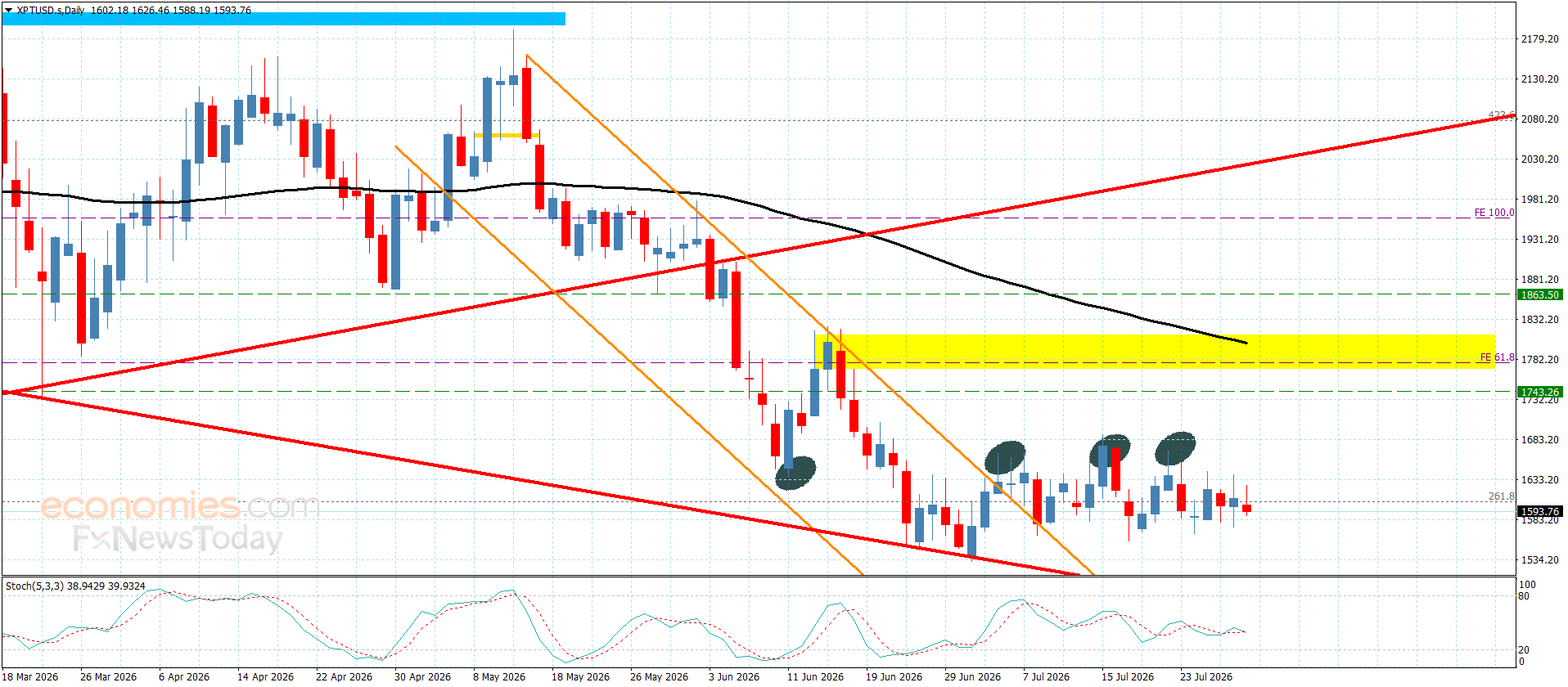
Platinum price approached by its last rally from $2130.00, forming an intraday barrier against the bullish rally, rebounding negatively and its stability near $2065.00, increasing the chances of gathering the positive momentum gain.
The stability above $1950.00 support, by the attempt of providing positive momentum by the main indicators will increase the chances of surpassing $2130.00 level, to begin targeting new positive stations that might begin at $2205.00 and $2205.00.
The expected trading range for today is between $2010.00 and $2205.00
Trend forecast: Bullish
Silver (XAG/USD) struggles to capitalize on a three-day-old modest recovery from levels below the $70.00 psychological mark and oscillates in a narrow band during the Asian session on Friday. The white metal currently trades below the $75.50 level, nearly unchanged for the day, albeit it remains on track to end in the green for the third straight week.
From a technical perspective, the XAG/USD holds below the 200-period Exponential Moving Average (EMA) on the 4-hour chart, keeping the near-term tone capped despite a mildly constructive backdrop in momentum. In fact, the Relative Strength Index (14) hovers around 57, while the Moving Average Convergence Divergence (MACD) indicator is marginally positive. This, in turn, hints at lingering upside attempts but not yet enough to negate the broader bearish bias imposed by the dominant overhead resistance.
Meanwhile, the 200-period EMA on the 4-hour chart, at $76.66, might continue to act as initial resistance. This is followed by the 50.0% Fibonacci retracement level of the March downfall at $78.71, with higher hurdles at the 61.8% retracement at $82.86 and the 78.6% level at $88.76 before the cycle high at $96.28.
On the downside, first support emerges at the 38.2% Fibo. retracement level at $74.57, ahead of deeper floors at the 23.6% level at $69.44 and the structural base around $61.15.
(The technical analysis of this story was written with the help of an AI tool.)
Silver is a precious metal highly traded among investors. It has been historically used as a store of value and a medium of exchange. Although less popular than Gold, traders may turn to Silver to diversify their investment portfolio, for its intrinsic value or as a potential hedge during high-inflation periods. Investors can buy physical Silver, in coins or in bars, or trade it through vehicles such as Exchange Traded Funds, which track its price on international markets.
Silver prices can move due to a wide range of factors. Geopolitical instability or fears of a deep recession can make Silver price escalate due to its safe-haven status, although to a lesser extent than Gold’s. As a yieldless asset, Silver tends to rise with lower interest rates. Its moves also depend on how the US Dollar (USD) behaves as the asset is priced in dollars (XAG/USD). A strong Dollar tends to keep the price of Silver at bay, whereas a weaker Dollar is likely to propel prices up. Other factors such as investment demand, mining supply – Silver is much more abundant than Gold – and recycling rates can also affect prices.
Silver is widely used in industry, particularly in sectors such as electronics or solar energy, as it has one of the highest electric conductivity of all metals – more than Copper and Gold. A surge in demand can increase prices, while a decline tends to lower them. Dynamics in the US, Chinese and Indian economies can also contribute to price swings: for the US and particularly China, their big industrial sectors use Silver in various processes; in India, consumers’ demand for the precious metal for jewellery also plays a key role in setting prices.
Silver prices tend to follow Gold’s moves. When Gold prices rise, Silver typically follows suit, as their status as safe-haven assets is similar. The Gold/Silver ratio, which shows the number of ounces of Silver needed to equal the value of one ounce of Gold, may help to determine the relative valuation between both metals. Some investors may consider a high ratio as an indicator that Silver is undervalued, or Gold is overvalued. On the contrary, a low ratio might suggest that Gold is undervalued relative to Silver.
Gold remains at a crossroads in Friday’s Asian trades, trying to find a clear direction as markets remain cautiously optimistic ahead of the US inflation report and the US-Iran peace negotiations.
Gold buyers cheer the optimism heading into the peace talks between the United States (US) and Iran in Pakistan later on Friday, which is keeping the downside cushioned in the bullion.
However, sellers refuse to give up yet, as markets anticipate a surge in the US Consumer Price Index (CPI) for March, as the war impact on energy prices will likely be reflected, completely reshaping expectations around the US Federal Reserve’s (Fed) interest rate outlook.
The FOMC Minutes on Wednesday showed that the policymakers still expect the Fed to resume cutting rates later this year.
If the data suggests any hints of a potential hawkish Fed pivot, the non-yielding Gold could come under intense selling pressure.
On the other hand, if markets ignore higher inflation readings as a one-off amid the Middle East crisis, that could downplay inflation concerns and retain bets for a Fed rate cut this year. This scenario could be the breakout trigger for Gold buyers.
That being said, any reaction to the US inflation data could be limited or countered by the sentiment surrounding the US-Iran peace talks and its likely outcome.
In the meantime, a lack of de-escalation in the Israel-Lebanon conflict keeps investors on edge and the haven bid for the US Dollar (USD) intact.
Israeli Prime Minister Benjamin Netanyahu said that there is “no ceasefire in Lebanon” and Israel would continue “to strike Hezbollah with full force” as the country’s military launched fresh strikes.
His remarks came after US President Donald Trump asked Netanyahu to be “more low-key” in Lebanon.
Hence, Gold continues to trade with caution early Friday, with traders refraining from placing fresh directional bets.
In the daily chart, XAU/USD trades at $4,742.85, holding a neutral near‑term bias as spot consolidates between short- and medium-term trend signals. Price remains above the 21-day simple moving average (SMA) at $4,692.08 and the 100-day SMA at $4,680.72, which together suggest underlying demand on dips, while staying capped beneath the 50-day SMA at $4,901.95 that limits topside follow-through. The 200-day SMA at $4,178.71 continues to underpin the broader bullish structure, and the Relative Strength Index (14) hovering around 49.2 reflects balanced momentum with neither buyers nor sellers in clear control.
However, risks appear in favor of the downside as the 21-day SMA is looking to cross the 100-day SMA from above. If that is materialized on a daily closing basis, it will confirm the bearish bias.
On the downside, initial support is seen at the 21-day SMA near $4,692, followed closely by the 100-day SMA at roughly $4,681, forming a nearby demand band that, if broken, would expose the deeper medium-term floor around the 200-day SMA at $4,179. On the topside, immediate resistance comes at the 50-day SMA around $4,902; a daily close above this barrier would be needed to revive bullish traction and open the way for a more sustained recovery phase.
(The technical analysis of this story was written with the help of an AI tool.)
Inflation measures the rise in the price of a representative basket of goods and services. Headline inflation is usually expressed as a percentage change on a month-on-month (MoM) and year-on-year (YoY) basis. Core inflation excludes more volatile elements such as food and fuel which can fluctuate because of geopolitical and seasonal factors. Core inflation is the figure economists focus on and is the level targeted by central banks, which are mandated to keep inflation at a manageable level, usually around 2%.
The Consumer Price Index (CPI) measures the change in prices of a basket of goods and services over a period of time. It is usually expressed as a percentage change on a month-on-month (MoM) and year-on-year (YoY) basis. Core CPI is the figure targeted by central banks as it excludes volatile food and fuel inputs. When Core CPI rises above 2% it usually results in higher interest rates and vice versa when it falls below 2%. Since higher interest rates are positive for a currency, higher inflation usually results in a stronger currency. The opposite is true when inflation falls.
Although it may seem counter-intuitive, high inflation in a country pushes up the value of its currency and vice versa for lower inflation. This is because the central bank will normally raise interest rates to combat the higher inflation, which attract more global capital inflows from investors looking for a lucrative place to park their money.
Formerly, Gold was the asset investors turned to in times of high inflation because it preserved its value, and whilst investors will often still buy Gold for its safe-haven properties in times of extreme market turmoil, this is not the case most of the time. This is because when inflation is high, central banks will put up interest rates to combat it.
Higher interest rates are negative for Gold because they increase the opportunity-cost of holding Gold vis-a-vis an interest-bearing asset or placing the money in a cash deposit account. On the flipside, lower inflation tends to be positive for Gold as it brings interest rates down, making the bright metal a more viable investment alternative.
Oil price today is moving rapidly because markets are reacting to real-time geopolitical risks. Brent crude jumped over 12% within just 24 hours recently. WTI crude followed with similar sharp gains across trading sessions. These moves are rare and usually tied to supply shocks or war-like conditions.
The earlier ceasefire announcement briefly cooled prices and triggered a sharp correction. However, renewed doubts erased those gains almost instantly. Oil price today is now driven by uncertainty, not stability. Traders are aggressively pricing in worst-case scenarios.
Volatility is also amplified by algorithmic trading and hedge fund positioning. Large institutions are increasing exposure to oil futures as a hedge against conflict escalation. Oil price today is therefore reacting faster than traditional fundamentals would suggest.
Oil price today is approaching a critical psychological threshold near $100. Historically, once prices stabilize near this level, further spikes become more likely. Brent crude crossing $110 is now a realistic scenario if tensions escalate.
Oil prices surged rapidly, climbing nearly $1 per hour since early trading hours. This sharp rally pushed US crude close to $103 per barrel, marking a dramatic rebound of over 12% within just 24 hours. The sudden move reflects growing skepticism about the durability of the ceasefire announced earlier this week.
The announcement by Donald Trump initially calmed markets, sending oil prices plunging nearly 16%. However, that relief proved short-lived. Fresh geopolitical developments quickly reversed sentiment, driving crude prices back toward triple-digit levels.Investors are now pricing in a significant risk premium. Markets fear that any further breakdown in negotiations could disrupt global oil supply chains, especially through critical shipping routes.
The situation has become more alarming due to restrictions in the Strait of Hormuz. Iran has reportedly limited passage to just 15 vessels per day. This represents only about 10% of normal traffic levels before the conflict escalated.
The Strait of Hormuz is one of the world’s most vital oil transit corridors. Nearly one-fifth of global oil supply passes through this narrow waterway. Any disruption here sends immediate shockwaves across energy markets.
Despite earlier claims of a “complete and immediate” reopening, the reality on the ground suggests otherwise. The restricted flow is tightening global supply expectations and pushing oil prices higher.
Geopolitical tensions intensified after reports of fresh military actions in the region. Strikes in Lebanon have added another layer of uncertainty. Iran has warned it is “on the verge” of responding to alleged ceasefire violations.
Diplomatic efforts, including intervention by Pakistan, have so far prevented immediate escalation. However, the situation remains highly volatile.
Markets are reacting not just to actual disruptions but also to the risk of escalation. Even the possibility of conflict spreading further is enough to push oil prices higher.
The surge in oil prices has begun to ripple across global financial markets. Futures for major indices, including the S&P 500 and NASDAQ Composite, slipped ahead of market open.
Investors are growing cautious as rising energy costs threaten corporate margins and consumer spending. Higher oil prices often act as a tax on the global economy, slowing growth and increasing inflationary pressures.
Despite earlier gains following the ceasefire announcement, market sentiment has turned mixed. Traders are now balancing optimism about diplomacy with fears of renewed conflict.
An interesting trend has emerged in recent weeks. Oil prices and the US dollar are moving closely together. This correlation has reached near-record levels, reflecting the dominant role of energy markets in shaping global financial conditions.
As the world’s largest oil producer, the US benefits from higher crude prices through increased exports. This dynamic strengthens the dollar, especially during periods of geopolitical stress.
At the same time, the dollar remains the primary currency for global oil trade. This reinforces the link between oil prices and currency movements, particularly during volatile periods.
The return of oil prices near the $100 mark is a significant psychological milestone. It signals a shift back to high-volatility conditions that defined earlier phases of the conflict.
Markets are now bracing for further fluctuations. If tensions escalate or supply disruptions worsen, oil prices could easily move beyond current levels.
On the other hand, any meaningful progress in diplomatic talks could stabilize prices. However, given the current trajectory, volatility is likely to remain elevated.
Rising oil prices have far-reaching consequences beyond energy markets. They impact transportation costs, manufacturing, and consumer prices worldwide. For emerging economies, the impact can be even more severe.
Higher crude prices often lead to increased inflation. Central banks may be forced to maintain tighter monetary policies, slowing economic growth. This creates a challenging environment for both policymakers and investors.
In addition, industries heavily dependent on fuel, such as aviation and logistics, face rising operational costs. This could lead to higher prices for goods and services globally.
The future direction of oil prices will largely depend on geopolitical developments. The fragile ceasefire between the US and Iran remains the key factor driving market sentiment.
If negotiations fail and conflict escalates, oil prices could surge well beyond $100 per barrel. Conversely, a stable agreement could ease supply concerns and bring prices down.
For now, markets are in a wait-and-watch mode. Traders, policymakers, and consumers alike are closely monitoring every development.
One thing is clear: oil prices are once again at the center of global economic attention. And as uncertainty persists, volatility is likely here to stay.
Oil prices are climbing rapidly due to rising doubts over the fragile United States–Iran ceasefire and renewed geopolitical risks. Supply concerns have intensified as restrictions in the Strait of Hormuz limit global oil flow significantly. Markets are also adding a risk premium, anticipating possible escalation, which is pushing crude prices back toward triple-digit levels.
The Strait of Hormuz is a critical route handling nearly 20% of global oil supply, making any disruption highly impactful. Iran’s move to restrict vessel movement has tightened supply expectations, directly fueling the surge in oil prices worldwide. This disruption is also increasing volatility across stock markets, currencies, and inflation outlooks globally.
Spot Gold shows some signs of life on Thursday, after temporarily reviving buyers’ enthusiasm on war headlines. The XAU/USD pair topped $4,857 after United States (US) President Donald Trump announced a two-week ceasefire in the Middle East war, claiming diplomatic talks were underway. The ceasefire included Israel, but did not include Lebanon. Continued attacks between the latter and Israel somehow brought back risk aversion, providing support to the US Dollar.
The mood flipped again, turning positive in the current American session, on headlines indicating that Israeli Prime Minister Benjamin Netanyahu had opened negotiations with Lebanon. The Greenback turned south, and XAU/USD approaches the aforementioned weekly high.
Additionally, the US released some discouraging figures. The final estimate of the Q4 Gross Domestic Product (GDP) showed real GDP expanded at an annual rate of 0.5%, down from the preliminary estimate of 0.7% and the previous 4.4%. Weekly unemployment claims, in the meantime, increased to 219K for the week ending April 4, worse than the 210K expected and higher than the previous week’s print of 203K. The dismal numbers added to the broad USD weakness.
Attention remains on war-related headlines, while investors await the release of the US March Consumer Price Index (CPI) scheduled for Friday. Inflation, as measured by the CPI, is forecast to rise 3.3% YoY, up from the 2.4% posted in February. The expected reading is likely to sound some alarms and fuel speculation of an upcoming rate hike in the US.
The near-term picture for XAU/USD is bullish. In the 4-hour chart, the metal holds comfortably above its 20-, 100-period simple moving averages (SMAs), keeping the near-term bias tilted to the upside as the shorter 20-period SMA at roughly $4,725 reinforces immediate trend support. The Momentum indicator remains above its midline, but lacks directional strength, while the Relative Strength Index (RSI) indicator hovers near 60, reflecting buyers’ dominance without confirming another leg north.
On the downside, initial support is at the 20-period SMA around $4,725, which could guide a deeper pullback toward the 100-period SMA near $4,619. Beyond the weekly peak, a significant roof emerges at the 200-period SMA near $4,888.
The wider picture also skews the risk to the upside. In the daily chart, XAU/USD holds above all its moving averages, with the 20-day SMA near $4,690.73, and the 100-day SMA around $4,674.29. Far below, the 200-day SMA stands close to $4,171.91. At the same time, the RSI indicator advances near 51, while the 14-day Momentum indicator has turned modestly positive, hinting at recovering bullish pressure as long as price stays above nearby dynamic supports.
(The technical analysis of this story was written with the help of an AI tool.)
Platinum price forced to provide mixed trading after reaching $2093.00 level, due to the contradiction of the main indicators, specifically by stochastic exit from the overbought level, however, this won’t affect the bullish scenario due to its stability above the moving average 55, reinforcing the stability of the extra support at $1950.00.
Gathering extra positive momentum is important for breaching $2080.00 barrier, to begin targeting new positive stations that might begin at $2130.00 reaching the next resistance at $2205.00.
The expected trading range for today is between $1970.00 and $2130.00
Trend forecast: Bullish
Silver price (XAG/USD) trades calmly near $74.00 during the late Asian trading session on Thursday. The white metal struggles for direction amid uncertainty surrounding the first round of talks on a permanent ceasefire between the United States (US) and Iran in Pakistan on Saturday.
On late Wednesday, White House press secretary Karoline Leavitt stated that US President Donald Trump will send Vice President (VP) JD Vance-led team in Pakistan on Saturday to discuss the 10-point peace proposal shared by Iran as demands for a permanent ceasefire.
Ahead of US-Iran talks, Iran’s parliament speaker and chief negotiator, Mohammad Bagher Qalibaf has criticized the US, through a post on X, for violating three clauses of the 10-point proposal. Qalibaf alleged the US for attacking Lebanon, referring the first clause, which is “an immediate ceasefire everywhere, including Lebanon and other regions, effective immediately”.
The Silver price remained under pressure in the past few weeks, as oil prices gained sharply due to the closure of the Strait of Hormuz by Iran, as part of retaliation against military actions from the US and Israel.
Higher oil prices had prompted traders to raise hawkish bets for global central banks; however, they have eased significantly, following the announcement of the two-week ceasefire between the US and Iran.
According to the CME FedWatch tool, traders see a 76.4% chance that the Fed will keep interest rates steady this year, a sharp turnaround from expectations of two interest rate hikes built during the war.
Rising hopes of tight monetary conditions by the Fed bode poorly for non-yielding assets, such as Silver.
XAG/USD trades almost flat at around $74.00 as of writing, maintaining a bearish near-term bias as it holds beneath the 20-period Exponential Moving Average (EMA) at $74.89. The metal continues to consolidate near recent lows, with the modestly soft 14-day Relative Strength Index (RSI) around 46 suggesting subdued bullish momentum and leaving the path of least resistance tilted to the downside while price remains capped by the overhead EMA.
On the topside, initial resistance is defined by the 20-period EMA at $74.89, and a sustained break above this level would be needed to ease immediate downside pressure and open the way for a more meaningful recovery toward the April 2 high of $81.13. But until price reclaims the EMA, rallies are likely to be viewed as corrective within a weak short-term structure.
Looking down, the psychological level of $70.00 is the key support for the price, followed by the March 26 low of $66.70.
(The technical analysis of this story was written with the help of an AI tool.)
Silver is a precious metal highly traded among investors. It has been historically used as a store of value and a medium of exchange. Although less popular than Gold, traders may turn to Silver to diversify their investment portfolio, for its intrinsic value or as a potential hedge during high-inflation periods. Investors can buy physical Silver, in coins or in bars, or trade it through vehicles such as Exchange Traded Funds, which track its price on international markets.
Silver prices can move due to a wide range of factors. Geopolitical instability or fears of a deep recession can make Silver price escalate due to its safe-haven status, although to a lesser extent than Gold’s. As a yieldless asset, Silver tends to rise with lower interest rates. Its moves also depend on how the US Dollar (USD) behaves as the asset is priced in dollars (XAG/USD). A strong Dollar tends to keep the price of Silver at bay, whereas a weaker Dollar is likely to propel prices up. Other factors such as investment demand, mining supply – Silver is much more abundant than Gold – and recycling rates can also affect prices.
Silver is widely used in industry, particularly in sectors such as electronics or solar energy, as it has one of the highest electric conductivity of all metals – more than Copper and Gold. A surge in demand can increase prices, while a decline tends to lower them. Dynamics in the US, Chinese and Indian economies can also contribute to price swings: for the US and particularly China, their big industrial sectors use Silver in various processes; in India, consumers’ demand for the precious metal for jewellery also plays a key role in setting prices.
Silver prices tend to follow Gold’s moves. When Gold prices rise, Silver typically follows suit, as their status as safe-haven assets is similar. The Gold/Silver ratio, which shows the number of ounces of Silver needed to equal the value of one ounce of Gold, may help to determine the relative valuation between both metals. Some investors may consider a high ratio as an indicator that Silver is undervalued, or Gold is overvalued. On the contrary, a low ratio might suggest that Gold is undervalued relative to Silver.
Domestic coffee prices
The domestic coffee market this morning, April 9, recorded green again after a series of consecutive declines.
According to surveys in key growing areas of the Central Highlands, coffee prices simultaneously increased from 600 to 700 VND/kg, bringing the average price level of the whole region to the threshold of 85,900 VND/kg.
In Dak Nong province (old), the purchase price recorded an increase of 700 VND, pushing the price to the highest level in the region at 86,000 VND/kg.
Dak Lak and Gia Lai localities both had an increase of 600 VND, currently trading stably at the 85,800 VND/kg mark.
In Lam Dong province alone, coffee prices also recovered by 600 VND, currently listed at 85,300 VND/kg.
World coffee prices
On the international market, futures exchanges also recorded positive changes in last night’s trading session. The New York Stock Exchange led the upward momentum when the price of Arabica futures for May 2026 surged 7.95 cents (equivalent to 2.78%), closing at 294.05 cents/lb.
At the same time, the London exchange also witnessed the Robusta flush recover slightly by an additional 13 USD (equivalent to 0.39%), closing the session at 3,328 USD/ton. The main driving force for the coffee price to break through came from the fact that the Brazilian Real unexpectedly increased sharply to the highest level in 23 months against the USD. The strengthening of the Brazilian domestic currency has directly limited export sales activities from farmers in this country, and at the same time triggered a wave of short buys from speculative funds on the exchange.
Market outlook
In addition to the exchange rate factor, the market also received support from reports of a decrease in actual supply. The Brazilian Ministry of Commerce has just released data showing that coffee exports of this country in March decreased by 31% compared to the same period last year, reaching only about 151,000 tons.
For the Robusta line, the inventory shortage monitored by the ICE exchange continued to tighten when it fell to its lowest level in 3.75 months, with only 4,005 lots left. This information has temporarily eased the oversupply pressure that has weighed heavily on the market for the past two weeks.
However, the recovery momentum still faces major resistance from long-term macroeconomic forecasts. StoneX organization gave a cautious assessment when saying that the global coffee surplus in 2026 will expand to 10 million bags, marking the largest surplus in the last 6 years.
The prospect of a “super crop” in Brazil with expected output reaching a record 75.9 million bags from Marex Group Plc is still the main factor holding back Arabica prices. In Vietnam, the growth momentum of coffee exports in the first quarter reached 14% (equivalent to 585,000 tons) is also a barrier that prevents Robusta prices from breaking through too strongly.
In the current context, geopolitical and weather factors still play a role as price supporting variables. The continued closure of the Strait of Hormuz is still putting pressure on shipping costs, insurance and fuel costs for global roasters.
In addition, rainfall in key farming areas of Brazil such as Minas Gerais last week only reached 47% of the historical average, raising concerns about actual yield compared to theoretical figures on paper.
The actual price at the purchasing yards may differ depending on the quality of the seeds and the actual transaction agreement.
World oil prices today
World gasoline and oil prices fluctuated sharply. At the end of yesterday’s trading session, WTI oil prices decreased by 16.41%, and Brent oil decreased by 13.29%.
By this morning’s session, both oil commodities reversed to increase. At 7:30 am (Vietnam time), WTI crude oil price was at 97.04 USD/barrel, up 2.63 USD/barrel, equivalent to an increase of 2.79 percent. WTI oil closed the previous trading session at 94.41 USD/barrel and opened today’s session at 96.63 USD/barrel.
Brent oil price was at 97.10 USD/barrel, up 0.715 USD/barrel, equivalent to an increase of 0.74%. Brent oil price closed the previous trading session at 96.30 USD/barrel and opened today’s session at 96.40 USD/barrel.
According to analysts, developments related to the Strait of Hormuz are causing strong fluctuations in world oil prices.
After President Donald Trump announced a 2-week postponement of Iran’s civilian infrastructure attack plan, oil prices fluctuated sharply. This move was described by him as part of a “two-way ceasefire agreement”, depending on Iran reopening the Strait of Hormuz.
The US has received a 10-point proposal from Tehran, which is seen as the basis for negotiations, and emphasized the delay to create more time to complete a potential agreement. Iran agreed to reopen the Strait of Hormuz temporarily if hostilities are stopped, with transportation activities coordinated by its armed forces. Israel is also said to have accepted this agreement.
Previously, the near-closure of the Strait of Hormuz – a shipping route transporting about 20% of global oil supplies – had significantly disrupted the energy market.
Domestic gasoline prices today
On April 9, retail gasoline and oil prices according to the price list announced by Petrolimex in region 1 and region 2 are as follows:
Gasoline and oil discount today
– Hoang Trong General Trading Co., Ltd.:
+ Hai Linh Warehouse, Petec, Dinh Vu: Diesel Oil 0.05S: 8,000 VND/liter; RON 95 – III gasoline: 3,000 VND/liter.
+ Bac Ninh Warehouse: Diesel Oil 0.05S: 7,850 VND/liter; RON 95 – III gasoline: 2,850 VND/liter.
+ Nghi Son Warehouse: Diesel Oil 0.05S: 8,000 VND/liter; RON 95 – III gasoline: 3,000 VND/liter.
– Tu Luc Petroleum Joint Stock Company 1:
+ Diesel oil 0.05S – II: 5,500 VND/liter;
+ Diesel oil 0.001S-V: 5,200 VND/liter;
+ RON 95 – III gasoline: 1,500 VND/liter;
+ E5 gasoline: 1,500 VND/liter.
– MIPEC Petroleum Trading and Trading Co., Ltd. – MIPEC Petro (applied to the Northern region):
+ RON 95 – III gasoline: 1,500 VND/liter.
+ Diesel oil 0.05S-II: 1,500 VND/liter.
+ Diesel oil 0.05S: 13,000 VND/liter.
Domestic gasoline and oil price forecast for the next period
According to a representative of a gasoline and oil business, domestic gasoline and oil prices will fluctuate according to the world gasoline and oil situation. According to current market developments, it is predicted that in the next price adjustment period, retail gasoline and oil prices may decrease. In which, oil prices are forecast to decrease very sharply.
Today’s gasoline and oil prices are for reference only and may change according to market developments.
Refer to more articles about gasoline and oil prices HERE.