The main tag of GoldPrice Articles.
You can use the search box below to find what you need.
[wd_asp id=1]
The main tag of GoldPrice Articles.
You can use the search box below to find what you need.
[wd_asp id=1]
Starbucks Corporation stock (NASDAQ: SBUX) is trading slightly lower on Friday, December 19, 2025, as investors balance a “turnaround-in-progress” narrative against real-world crosscurrents: elevated coffee costs, labor disruption risk, and a still-evolving international strategy—especially in China.
As of early afternoon, Starbucks shares were $88.77, down $0.65 (-0.72%). [1]
Below is a full, up-to-the-minute look at the news flow, forecasts, and analyst views shaping SBUX today—plus the specific issues Wall Street is watching into 2026.
After a strong stretch of “green shoots” optimism around CEO Brian Niccol’s operational reset, SBUX is seeing modest profit-taking into the end of the week. The intraday dip also comes as the broader conversation around coffee prices—one of Starbucks’ most important input costs—has re-entered headlines today.
Market data trackers showed SBUX near $88.77 by early afternoon. [2]
A major macro theme for beverage and restaurant names today is the reality that retail coffee prices can remain elevated even if tariff-related pressure eases, because price transmission through the supply chain can lag by months.
In a Reuters report published today, analysts and industry sources pointed to prior supply tightness and timing lags as reasons consumer coffee prices may not quickly fall—even after recent tariff changes. [3]
This matters for Starbucks because recent company results already highlighted how commodities and related cost items can squeeze profitability. In Starbucks’ late-October earnings coverage, Reuters reported that coffee prices and tariffs were among the factors pressuring margins, alongside investment costs tied to the turnaround. [4]
Why investors care: if Starbucks stays cautious on menu price increases (to protect traffic), sustained coffee inflation can make margin recovery slower—and the stock tends to trade on the pace and credibility of that recovery.
Starbucks is in a multi-quarter effort to make stores feel less transactional and more like the brand’s original “third place,” while also improving throughput and labor deployment.
Reuters has described Niccol’s strategy as a cost-and-experience reset that he calls “Back to Starbucks.” [5]
That plan has included operational changes such as menu simplification, faster service goals, and store upgrades. [6]
Recent reporting also described Starbucks piloting new store designs and committing meaningful staffing/labor-hour investments to support execution at scale. [7]
Market takeaway: Starbucks bulls generally argue the stock can re-rate higher if “throughput + experience” improvements translate into sustainably higher transactions. Bears tend to argue it’s difficult to fix speed, service, and staffing economics simultaneously—especially with commodity and wage pressures.
Starbucks’ strategy in China has been one of the most consequential moving pieces for the equity story in 2025.
Reuters reported that Starbucks agreed to sell control of its China operations to Boyu Capital in a deal valuing the business at $4 billion, with Boyu holding up to 60% and Starbucks 40%, while Starbucks continues to license brand/IP to the venture. [8]
The same Reuters report also highlighted the competitive reality in the market, including Starbucks’ declining China market share and the rise of lower-priced competitors. [9]
Earlier in the process, Reuters also reported that bidders had valued Starbucks China as high as $5 billion, with offers often framed around an EBITDA multiple approach. [10]
What investors are debating now:
A clear near-term uncertainty for SBUX is labor disruption risk and reputational overhang.
Reuters reported on December 11 that hundreds of baristas walked off the job in 34 U.S. cities, escalating a month-long strike. The union said over 3,800 baristas had participated and that the strike had spread to more than 180 stores across 130 cities. [11]
Starbucks, in the same Reuters report, argued the impact was limited—stating that fewer than 1% of its roughly 17,000 U.S. coffeehouses had been affected at any point. [12]
On the regulatory front, New York City announced a $38.9 million settlement with Starbucks related to alleged violations of the city’s Fair Workweek Law, describing it as the largest worker-protection settlement in city history. [13]
The city said the settlement requires over $35.5 million in restitution to workers plus $3.4 million in civil penalties and costs, and applies to hourly workers in NYC across a multi-year period. [14]
Investor relevance: these items don’t necessarily change Starbucks’ long-term brand power, but they can influence risk perception, operating leverage assumptions, and how much “execution discount” the market applies to the stock.
A Reuters report on December 18 said Cuisine Solutions—known for producing Starbucks’ egg bites—hired Morgan Stanley and Rothschild to explore a potential sale process, with a valuation that could exceed $2 billion, according to sources. [15]
This isn’t a direct Starbucks corporate action, but it’s relevant in two ways:
Starbucks is also leaning into cultural collaborations as part of brand re-energizing.
Modern Retail reported this week that Starbucks hired Neiv Toledano (previously at e.l.f. Cosmetics) as a senior marketing manager of fashion and beauty, described as a first-of-its-kind dedicated role focused on partnerships/collabs. [16]
Why it matters for the stock: These initiatives are unlikely to move near-term EPS by themselves, but they speak to management’s push to rebuild relevance and traffic—especially among younger, trend-driven consumers.
Analyst communities still skew constructive on SBUX—but targets are dispersed, reflecting uncertainty about how quickly the turnaround can convert into earnings power.
StockAnalysis reports:
It also lists notable recent rating actions (examples include reiterated/maintained ratings and price-target changes from firms such as TD Cowen, Citi, RBC, and Piper Sandler across Oct–Dec). [19]
TipRanks shows:
How to interpret the spread:
When one aggregator shows a ~$95 target and another shows ~$101+, it’s usually methodology and coverage differences—not a sudden change in core sentiment. The more important signal is that targets cluster around “modest upside,” while the wide high/low range signals a market still debating Starbucks’ medium-term earnings trajectory.
The next major scheduled inflection point is earnings.
MarketBeat lists Starbucks’ upcoming Q1 earnings date as “Jan. 27 after market closes (estimated).” [21]
Separately, Reuters reporting around Starbucks’ recent results indicated the company expected to provide a financial outlook at an investor event in January (context: Starbucks suspended guidance shortly after Niccol took the helm). [22]
1. www.marketbeat.com, 2. www.marketbeat.com, 3. www.reuters.com, 4. www.reuters.com, 5. www.reuters.com, 6. www.reuters.com, 7. www.reuters.com, 8. www.reuters.com, 9. www.reuters.com, 10. www.reuters.com, 11. www.reuters.com, 12. www.reuters.com, 13. www.nyc.gov, 14. www.nyc.gov, 15. www.reuters.com, 16. www.modernretail.co, 17. www.marketbeat.com, 18. stockanalysis.com, 19. stockanalysis.com, 20. www.tipranks.com, 21. www.marketbeat.com, 22. www.reuters.com, 23. www.reuters.com, 24. www.reuters.com, 25. www.marketbeat.com, 26. www.reuters.com, 27. www.reuters.com, 28. www.nyc.gov
Friday’s closing price is on track to be the third day out of four where natural gas closed below prior support at the 200-day average, now at $3.75, and a long-term rising trendline. Daily closes below the 200-day line and trendline is bearish behavior as prior dynamic support switches to resistance. Now the 20-day average has touched the 50-day average, and it will soon cross below it, further confirming bearish sentiment.
Despite being possibly extended to the downside, bearish price action shows the potential for further downside. Given the current chart pattern, unless natural gas can rise above and then close above Thursday’s lower swing high of $3.93, downside pressure remains. However, given Thursday’s relatively large range, natural gas could continue to consolidate at support seen near the 61.8% retracement.
A decisive drop below today’s low, also a weekly low, at $3.60, triggers a continuation of the bearish retracement. If price then continues to weaken, the next lower potential support zone around $3.48 to $3.44 becomes the next downside target. The beginning of the range is a 78.6% Fibonacci retracement of an internal upswing, while the lower boundary was resistance at the swing high in early-September. If that price zone fails to attract buyers and natural gas continues to weaken, the 78.6% Fibonacci retracement of the last full upswing becomes a potential target at $3.48.
On the upside, if a rally above $3.93 can be sustained, then potential resistance from prior support at $4.09 to the 38.2% Fibonacci retracement at $4.15 is identified as the first potential resistance zone. But the also significant 20-day average presents dynamic resistance, and it is at $4.24 currently and falling.
Natural gas remains under bearish pressure with multiple closes below the 200-day average and trendline, but the hammer off the 61.8% Fib and hold above $3.60 offers early hope for consolidation or bounce. Clearance of $3.93 targets $4.09–$4.15; failure to defend $3.60 opens $3.44–$3.48 and keeps the retracement alive.
For a look at all of today’s economic events, check out our economic calendar.
Silver price today is holding close to historic highs, extending a year of unusually strong momentum for the “white metal” as investors weigh a cooler U.S. inflation read against a rebounding U.S. dollar.
In early trade on Friday, December 19, spot silver was trading around $65.8–$65.9 per ounce, up modestly on the day, with the session range still brushing near the week’s peak levels. [1]
Silver’s latest move is small in percentage terms, but big in context:
The bigger headline: silver is on track for a ~6% weekly gain after printing a record high around $66.88 earlier this week, according to market reports. [5]
And 2025 has been exceptional: silver is up roughly 128% year-to-date, dramatically outperforming gold. [6]
Friday’s trading backdrop is a classic push-pull for precious metals:
1) Softer U.S. inflation supports rate-cut expectations
A lower-than-expected U.S. inflation print reinforced market expectations that the Federal Reserve could cut rates again, which tends to support non-yielding assets like precious metals. [7]
2) A firmer dollar can cap upside
At the same time, the U.S. dollar firmed near short-term highs, which can make dollar-priced commodities more expensive for non-U.S. buyers and, in turn, cool demand at the margin. [8]
This tension helps explain why silver can be “up on the day” while still struggling to extend decisively above record territory: traders are simultaneously pricing in easier policy and a currency headwind.
Silver is often described as “gold with a turbocharger”—it can rally harder, and sell off faster. What’s made 2025 different is that silver’s strength has been fed by a combination of macro drivers and market-structure catalysts.
A Reuters analysis this week highlighted three dominant supports:
In that same report, analysts pointed to how silver’s rally has been amplified by trading behavior and global participation—particularly when rising prices attract incremental speculative flows. [10]
Another recurring theme across 2025 coverage: silver’s inclusion on the U.S. critical minerals list has become a market narrative that goes beyond symbolism. Officials’ critical-minerals framework explicitly includes silver in the 2025 list, a change that market participants have linked with reshaped trade expectations and hedging against future policy/tariff risks. [11]
Reuters reporting has also connected tariff concerns to earlier flows of metal toward the U.S. and tighter liquidity dynamics in the London market at points during the year. [12]
With silver near record highs, forecasts now span a wide range—from “still room to run” to “late-stage melt-up risk.”
Several analysts cited in recent market reporting have framed $70/oz as a psychologically important next milestone:
Notably, not all institutional forecasts keep pace with the current market:
A market summary of BMO’s outlook described a scenario where BMO expects silver to peak around $60/oz in Q4 2026, with a 2026 average forecast near $56.30/oz—levels that are below today’s spot price. The same outlook also flagged overbought conditions and the possibility that supply deficits could narrow. [15]
This gap between spot and some forward averages matters: it signals that even bullish institutions may be modeling mean-reversion after a period of extraordinary upside volatility.
With silver consolidating near the highs, technical analysts are increasingly focused on whether price action is pausing for a “healthy reset” or preparing for a breakout.
Two widely followed technical takes published today point to similar zones:
One Investing.com technical note also emphasized that, after a sharp climb, silver may not move “in a straight line”—calling out stepwise upside objectives near the mid-$66s and upper-$66s while warning that pullbacks can be part of normal consolidation. [19]
Silver’s reputation for violent reversals is part of why it can outperform so dramatically on the way up. That same trait is why risk warnings tend to intensify near record highs.
A Barron’s report highlighted that silver-linked ETFs are showing extreme “stretch” versus key moving averages—conditions that research cited by the outlet suggested have historically preceded sharp pullbacks (including prior episodes where silver dropped more than 20% after similarly extended moves). [20]
Reuters has also repeatedly underscored silver’s volatility and the potential for steep corrections, even while acknowledging that supportive fundamentals (deficits, industrial demand, and investment flows) remain in play. [21]
With silver already pricing in a lot of optimism, traders are increasingly focused on catalysts that can justify either a breakout or a reset:
Silver price today remains firm near $66/oz, supported by a powerful 2025 trend and continued attention to supply tightness, industrial demand narratives, and shifting rate expectations. [26]
But with overbought warnings rising and forecasts split between “$70–$75 next” and “cooling toward ~$60 later”, the next decisive move will likely depend on whether macro conditions (the dollar, yields, and Fed expectations) turn into a tailwind—or a brake—during the final stretch of the year. [27]
1. www.kitco.com, 2. www.kitco.com, 3. www.reuters.com, 4. www.jmbullion.com, 5. www.reuters.com, 6. www.reuters.com, 7. www.reuters.com, 8. www.reuters.com, 9. www.reuters.com, 10. www.reuters.com, 11. www.federalregister.gov, 12. www.reuters.com, 13. www.reuters.com, 14. www.reuters.com, 15. news.futunn.com, 16. www.fxempire.com, 17. www.fxempire.com, 18. www.fxempire.com, 19. www.investing.com, 20. www.barrons.com, 21. www.reuters.com, 22. www.reuters.com, 23. www.reuters.com, 24. www.reuters.com, 25. www.investing.com, 26. www.kitco.com, 27. www.reuters.com
Lower inflation strengthens the case for easier policy over time, even if near-term rate cuts remain uncertain. Futures markets currently assign a 26.6% probability of a rate reduction at the next Federal Reserve meeting, based on CME FedWatch data.
Economists argue that direction matters more than timing. “The inflation trend improves the outlook for policy easing beyond the near term,” said Sal Guatieri, senior economist at BMO Capital Markets.
Beyond interest rates, demand dynamics continue to underpin both metals. Central banks have maintained elevated gold purchases compared with historical averages, while investment demand remains resilient amid uncertainty around global growth and fiscal policy.
Silver, meanwhile, continues to draw support from its industrial role, particularly in energy transition applications, alongside its monetary characteristics. This dual demand profile has helped limit downside volatility during periods of shifting macro expectations.
Geopolitical tensions tied to energy markets and global supply routes have also sustained interest in defensive assets, even as broader risk sentiment stabilizes. Investors are now turning to forward-looking indicators, including consumer confidence data, to assess whether easing inflation is feeding into economic expectations.
For now, gold and silver appear anchored by fundamentals, with macro forces continuing to shape medium-term demand rather than short-term market noise.
NEW YORK / LONDON / SINGAPORE — December 19, 2025 (9:39 a.m. ET) — U.S. natural gas prices are trying to steady after a choppy December stretch that saw early-month spikes fade into a late-week pullback. As of 9:39 a.m. ET, Henry Hub natural gas futures were around $3.92 per mmBtu, edging above the prior close after opening near $3.94, with the session range roughly $3.84 to $3.96 so far. [1]
The story behind today’s tape is global: Asian spot LNG has slipped to a fresh 20‑month low, Europe’s hub prices are ticking up on weaker wind output, and traders everywhere are weighing one key question—whether late‑December weather stays mild enough to cap heating demand, or turns just cold enough (and long enough) to tighten balances into early 2026. [2]
The benchmark U.S. contract is being pulled in opposite directions:
On the screen this morning, market data show Natural Gas futures near $3.92/mmBtu with a “Strong Sell” technical signal on daily indicators—an illustration of how quickly sentiment has swung from early‑December enthusiasm to late‑week caution. [3]
A broader macro snapshot also reflects that cooling tone: Trading Economics shows U.S. natural gas around $3.91/mmBtu on Dec. 19. [4]
In winter, weather isn’t just another variable—it’s the variable. Heating demand dominates short-term consumption, and the market tends to reprice quickly when model runs shift.
A recent industry note from the American Gas Association highlighted that Henry Hub prompt-month futures traded above $5.20/mmBtu early in December before dropping back as forecasts for late December trended warmer—an important reminder that even a few mild runs can knock the risk premium out of the front of the curve. [5]
For traders, the setup into the Christmas-to-New Year window typically comes down to three weather-linked questions:
The most telling global headline today is in LNG.
A Reuters-reported Global LNG assessment published today says Asian spot LNG prices slipped to a fresh 20‑month low, with the average price for February delivery into Northeast Asia estimated at about $9.50/mmBtu, down from roughly $10 the prior week and the lowest since April 2024. [6]
What’s driving the softness?
Why this matters to U.S. natural gas: when Asia and Europe LNG benchmarks soften, the global arbitrage that supports marginal U.S. LNG flows can narrow—especially once shipping, fuel, and regas costs are included. That doesn’t automatically shut off exports, but it can reduce the market’s willingness to pay up for U.S. feedgas during mild-demand periods.
Europe’s gas market sent a different signal Friday morning.
A Reuters update published via TradingView reported that Dutch and British wholesale gas prices edged higher as forecasts called for lower wind power output, which typically increases gas burn for power generation. [10]
Key datapoints from that European session:
Trading Economics also shows Europe’s benchmark TTF gas around €27.98/MWh on Dec. 19 (up modestly on the day), underscoring how the European market is moving more on power-sector variability and storage pace than on panic about supply. [15]
Europe may be “well supplied” right now, but the market is also looking beyond the next few days.
In the same Reuters-reported LNG coverage published today, the Northwest Europe LNG Marker for February deliveries was assessed around $8.881/mmBtu on Dec. 18, at a discount to hub pricing, with other price assessments in a similar neighborhood. [16]
That report also noted a balancing act Europe is living with:
One of the more practical “tell” signals in global gas is freight and route economics.
The Reuters-reported LNG market update published today said LNG freight rates softened again, and that front-month arbitrage economics to Northeast Asia were pointing toward Europe via common routes—another sign that, for now, Europe remains the marginal sink for flexible supply. [18]
For U.S. natural gas bulls, that’s a mixed message:
The U.S. Energy Information Administration’s Short‑Term Energy Outlook (Dec. 9, 2025) says the Henry Hub spot price in its forecast rises to an average of almost $4.30/mmBtu this winter (November–March), driven primarily by expectations of higher space-heating demand tied to colder weather. [19]
That’s a crucial framing point for today: even if the market is soft this morning, the official baseline still assumes winter averages in the low‑$4s.
In a separate Reuters report on major commodity forecasts this week, Goldman Sachs projected 2026 European TTF natural gas prices around €29/MWh and U.S. gas prices around $4.60/mmBtu, with lower prices in 2027 to encourage supply/demand adjustments. [20]
Whether or not traders agree with those precise levels, the message is clear: banks are increasingly treating gas as a structurally “tighter” commodity than the post-2022 shock period might suggest—especially with power demand growth and LNG dynamics reshaping the long-run call on U.S. supply.
From a short-term, trading-oriented lens, one technical forecast published today flagged:
Technical views vary widely—and fundamentals usually win over time—but those levels align closely with what the market is already expressing: rallies are being sold into resistance, while dips are being measured against support in the high‑$3s.
One more piece of “bigger picture” LNG news still rippling through the market: Energy Transfer announced it was suspending development of its Lake Charles LNG export project in Louisiana amid rising costs and what Reuters described as a global LNG supply glut. [22]
This matters for natural gas traders because U.S. LNG capacity decisions shape the long-term demand “floor” for feedgas. A high-profile pause reinforces that the next wave of LNG growth may not be linear—even in a policy environment that is generally supportive of permitting.
Heading into the final stretch of 2025, natural gas traders will typically focus on a tight set of catalysts:
As of 9:39 a.m. ET on Dec. 19, U.S. natural gas is trading like a market trying to find balance: prices near $3.92 suggest the front end has cooled from early-December highs, but the global picture—Europe’s wind-driven demand swings, Asia’s lower spot LNG prices, and the ever-present risk of winter volatility—means complacency can be costly. [26]
1. www.investing.com, 2. www.brecorder.com, 3. www.investing.com, 4. tradingeconomics.com, 5. www.aga.org, 6. www.brecorder.com, 7. www.brecorder.com, 8. www.brecorder.com, 9. www.brecorder.com, 10. www.tradingview.com, 11. www.tradingview.com, 12. www.tradingview.com, 13. www.tradingview.com, 14. www.tradingview.com, 15. tradingeconomics.com, 16. www.brecorder.com, 17. www.brecorder.com, 18. www.brecorder.com, 19. www.eia.gov, 20. www.reuters.com, 21. www.economies.com, 22. www.reuters.com, 23. www.tradingview.com, 24. www.brecorder.com, 25. www.brecorder.com, 26. www.investing.com
Silver (XAG/USD) attracts some dip-buying near mid-$64.00s during the Asian session on Friday and stalls the previous day’s modest retracement slide. The white metal climb back closer to the $66.00 round figure in the last hour and remain well within the striking distance of the all-time peak touched on Wednesday.
The XAG/USD once again finds decent support near the upward-sloping 100-hour Simple Moving Average (SMA), keeping buyers in control. It offers dynamic support at $64.75, and holding above this rising average would preserve the bullish tone. The Moving Average Convergence Divergence (MACD) histogram has turned positive and is expanding, suggesting the MACD line has crossed above the Signal line near the zero level. Momentum improves, and a sustained push further into positive territory would bolster the upside bias.
The Relative Strength Index (RSI) stands at 56, neutral-to-bullish and below overbought, supporting scope for further gains if buyers maintain control. However, the daily RSI is flashing overstretched conditions, which makes it prudent to wait for some near-term consolidation or a modest pullback before positioning for any further appreciating move. This, in turn, suggests that the XAG/USD could face some intermediate hurdle near the $66.50-$66.55 region.
This is followed by the record high, around the $67.00 neighborhood, which should cap the upside for the XAG/USD. A sustained strength beyond the said handle, however, will be seen as a fresh trigger for bullish traders and reaffirm the near-term positive outlook.
On the flip side, the $65.40-$65.35 region now seems to protect the immediate downside ahead of the $65.00 psychological mark. This is closely followed by the 100-hour SMA pivotal support, around the $64.75 region, which, if broken decisively, might prompt some technical selling and pave the way for a deeper corrective decline. The XAG/USD might then accelerate the downfall towards testing sub-$64.00 levels before eventually dropping to the $63.35 intermediate support en route to the $63.00 mark.
(A part of the technical analysis of this story was written with the help of an AI tool)
Silver is a precious metal highly traded among investors. It has been historically used as a store of value and a medium of exchange. Although less popular than Gold, traders may turn to Silver to diversify their investment portfolio, for its intrinsic value or as a potential hedge during high-inflation periods. Investors can buy physical Silver, in coins or in bars, or trade it through vehicles such as Exchange Traded Funds, which track its price on international markets.
Silver prices can move due to a wide range of factors. Geopolitical instability or fears of a deep recession can make Silver price escalate due to its safe-haven status, although to a lesser extent than Gold’s. As a yieldless asset, Silver tends to rise with lower interest rates. Its moves also depend on how the US Dollar (USD) behaves as the asset is priced in dollars (XAG/USD). A strong Dollar tends to keep the price of Silver at bay, whereas a weaker Dollar is likely to propel prices up. Other factors such as investment demand, mining supply – Silver is much more abundant than Gold – and recycling rates can also affect prices.
Silver is widely used in industry, particularly in sectors such as electronics or solar energy, as it has one of the highest electric conductivity of all metals – more than Copper and Gold. A surge in demand can increase prices, while a decline tends to lower them. Dynamics in the US, Chinese and Indian economies can also contribute to price swings: for the US and particularly China, their big industrial sectors use Silver in various processes; in India, consumers’ demand for the precious metal for jewellery also plays a key role in setting prices.
Silver prices tend to follow Gold’s moves. When Gold prices rise, Silver typically follows suit, as their status as safe-haven assets is similar. The Gold/Silver ratio, which shows the number of ounces of Silver needed to equal the value of one ounce of Gold, may help to determine the relative valuation between both metals. Some investors may consider a high ratio as an indicator that Silver is undervalued, or Gold is overvalued. On the contrary, a low ratio might suggest that Gold is undervalued relative to Silver.
Gold (XAU/USD) is posting marginal losses on Friday, but it keeps hovering without a clear bias above $4,300, with upside attempts capped below $4,355. The long wicks seen on the daily chart highlight a hesitant market, and the moderate US Dollar recovery is acting as a headwind for precious metals.
The US Dollar Index, which measures the value of the Greenback against a basket of currencies, is trading at one-week highs above 98.50, unfazed by the weak US inflation data released on Thursday. That said, market expectations that the US Federal Reserve (Fed) will cut rates further in 2026 are likely to keep US dollar rallies limited, and support Gold near record highs.
The 4-hour chart shows XAU/USD trading at $4,325, little changed on the daily chart, with price action trapped below an ascending triangle, with its top at the $4,355 area.
Technical indicators are mixed. The Moving Average Convergence Divergence (MACD) stays below zero, with the histogram flattening, which hints at a fading bearish pressure. The Relative Strength Index (RSI) prints 54.64, holding above the 50 midline and supporting a mild bullish tilt.
The $4,300 level has been supporting the pair over the last two days. ahead of the triangle bottom, around $4,290. Further down, the target is the December 12 low, at $4,257. To the upside, above the mentioned $4,355, the 127.2% Fibonacci extension of the December 9-12 rally is at $4,400. The Triangle’s measured target is at $4,450.
(The technical analysis of this story was written with the help of an AI tool.)
(This story was corrected on December 19 at 09:55 GMT to say that $4,357 is the December 12 low, and not the December 123 low as previously reported)
The table below shows the percentage change of US Dollar (USD) against listed major currencies today. US Dollar was the strongest against the Japanese Yen.
| USD | EUR | GBP | JPY | CAD | AUD | NZD | CHF | |
|---|---|---|---|---|---|---|---|---|
| USD | 0.08% | 0.01% | 0.94% | 0.10% | 0.08% | 0.43% | 0.13% | |
| EUR | -0.08% | -0.06% | 0.86% | 0.03% | 0.00% | 0.36% | 0.05% | |
| GBP | -0.01% | 0.06% | 0.95% | 0.09% | 0.06% | 0.42% | 0.11% | |
| JPY | -0.94% | -0.86% | -0.95% | -0.82% | -0.86% | -0.52% | -0.82% | |
| CAD | -0.10% | -0.03% | -0.09% | 0.82% | -0.03% | 0.31% | 0.02% | |
| AUD | -0.08% | -0.00% | -0.06% | 0.86% | 0.03% | 0.35% | 0.03% | |
| NZD | -0.43% | -0.36% | -0.42% | 0.52% | -0.31% | -0.35% | -0.30% | |
| CHF | -0.13% | -0.05% | -0.11% | 0.82% | -0.02% | -0.03% | 0.30% |
The heat map shows percentage changes of major currencies against each other. The base currency is picked from the left column, while the quote currency is picked from the top row. For example, if you pick the US Dollar from the left column and move along the horizontal line to the Japanese Yen, the percentage change displayed in the box will represent USD (base)/JPY (quote).
The GBPJPY pair settled above 208.10 level, forming new bullish waves and achieving some previously suggested targets by reaching 209.00, then waiting for providing new sideways trading by its stability near 208.50.
Reminding you that the bullish scenario will remain valid due to the stability within the bullish channel’s levels besides the stability of the initial main support at 206.95, therefore, we will keep preferring our bullish scenario, to expect attacking the bullish channel’s resistance at 209.30 then attempts to hit the next main target near 209.85.
The expected trading range for today is between 208.00 and 209.85
Trend forecast: Bullish
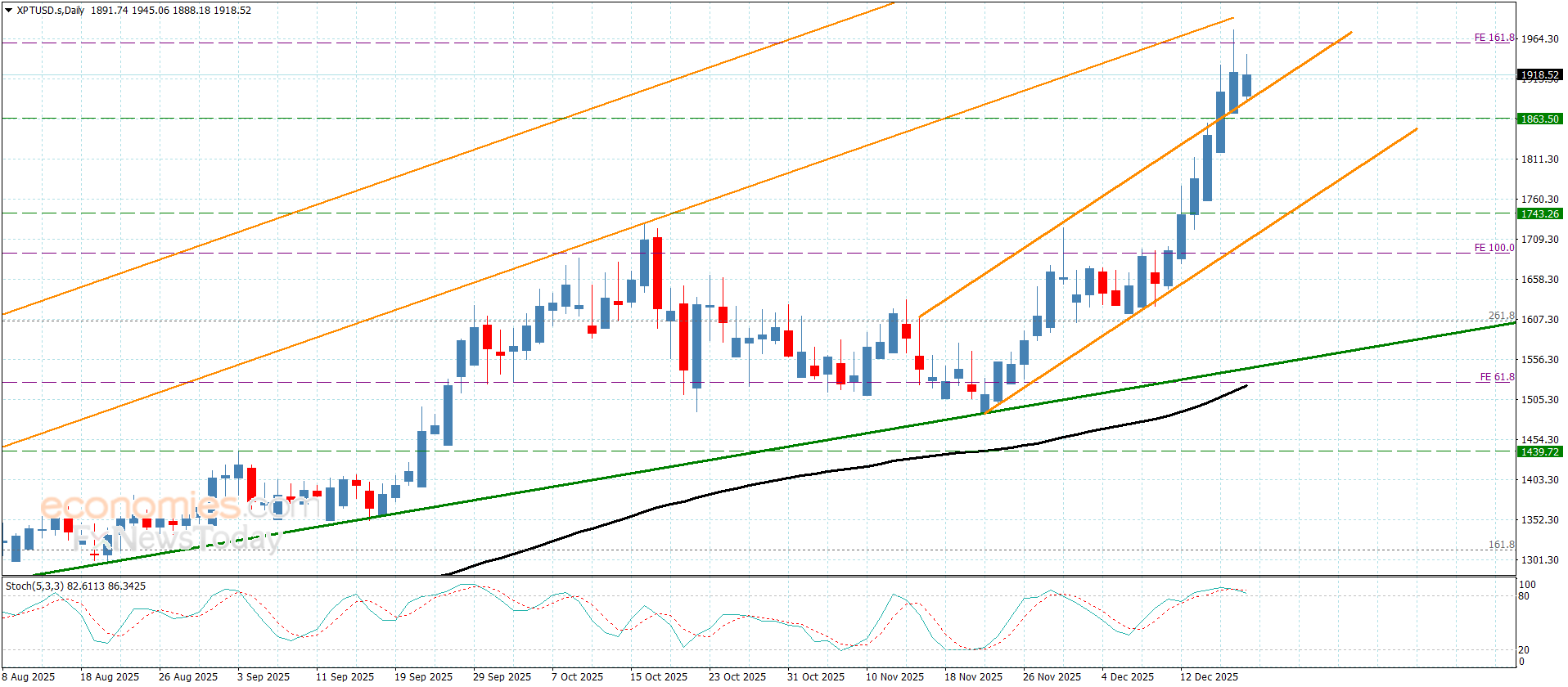
Platinum price provided sideways trading due to its stability below the barrier of $1960.00, which forms %161.8 Fibonacci extension level, forcing it to decline temporarily towards $1890.00.
The continuation of providing mixed trading is expected until breaching the barrier, to confirm its readiness to achieve new historical gains that might begin from $2000.00 psychological barrier, while breaking the extra support at $1860.00 level will force it to provide strong corrective trading, to expect reaching $1835.00 and $1790.00.
The expected trading range for today is between $1870.00 and $ 1960.00
Trend forecast: Fluctuated within the bullish track
Gold (XAU/USD) extends the previous day’s late pullback from the vicinity of the record high and attracts some follow-through selling during the Asian session on Friday. The US Consumer Price Index (CPI) report released on Thursday pointed to cooling of inflationary pressure. This turns out to be a key factor undermining demand for the previous metal, which is seen as a hedge against rising prices. Furthermore, renewed US Dollar (USD) buying interest and a positive risk tone exert additional downward pressure on the commodity.
A delayed report published by the US Bureau of Labor Statistics on Thursday showed that the headline CPI rose by the 2.7% YoY rate in November against 3.1% expected. Moreover, the core CPI, which excludes volatile food and energy prices, also missed consensus estimates and climbed 2.6% last month. Economists, however, warned that the figures were likely distorted on the back of the longest-ever US government shutdown. This, in turn, assists the USD in attracting for the third straight day and climbs back closer to the weekly top, touched on Wednesday. A firmer Greenback tends to dent demand for USD-denominated commodities, including Gold.
Nevertheless, the crucial inflation data did little to temper expectations of further policy easing by the US Federal Reserve (Fed). Traders are still pricing in a 63 basis points (bps) of rate cuts in 2026. Adding to this, US President Donald Trump said the next Fed chair will be someone who backs sharply lower interest rates. This, in turn, could offer support to the non-yielding Gold. Meanwhile, the prospects for lower US interest rates revive investors’ appetite for riskier assets. This is evident from a generally positive tone around the equity markets and offsets the supporting factor, backing the case for a further near-term depreciating move for the XAU/USD pair.
Traders now look to the US economic docket – featuring Existing Home Sales and the revised University of Michigan Consumer Sentiment Index. This, along with comments from influential FOMC members, might provide some impetus to the USD and produce short-term opportunities around the Gold. Meanwhile, the XAU/USD pair still seems poised to register modest gains for the second straight week. The fundamental backdrop, however, suggests that the path of least resistance for the bullion is to the downside and warrants caution for bullish traders, though a break and acceptance below the $4.300 mark is needed to reaffirm the negative outlook.
The overnight fake breakout through the $4,350-$4,355 supply zone and a subsequent fall below the 100-hour Simple Moving Average (SMA) on Friday favor the XAU/USD bears. However, mixed oscillators on hourly and daily charts make it prudent to wait for some follow-through selling below the $4,300 mark before positioning for deeper losses. The bullion might then fall to the $4,272-4,271 region, or the weekly low. This is followed by the $4,260-4,255 horizontal resistance breakpoint-turned-support, which, if broken, would suggest that the Gold price has topped out and expose the $4,200 round figure.
On the flip side, the $4,338-4,340 zone now seems to act as an immediate hurdle, above which the XAU/USD pair could make a fresh attempt towards challenging the all-time peak, around the $4,380 region, touched in October. Some follow-through buying, leading to a move beyond the $4,400 mark, will be seen as a fresh trigger for bullish traders and allow the Gold price to prolong its recent well-established trend from sub-$3,900 levels, or the October swing low.