The main tag of GoldPrice Articles.
You can use the search box below to find what you need.
[wd_asp id=1]
The main tag of GoldPrice Articles.
You can use the search box below to find what you need.
[wd_asp id=1]
Silver continues to trade near all-time highs, showing resilience even as other precious metals experience rotational pullbacks. Unlike gold, which is predominantly driven by monetary policy expectations and geopolitical hedging, silver benefits from a dual demand profile—acting both as a precious metal and a critical industrial input.
This unique positioning allows silver to sustain momentum during periods when gold consolidates. Current price behavior reflects acceptance at elevated levels, not rejection. Rather than sharply selling off from the highs, silver has transitioned into controlled consolidation, a hallmark of strong trending markets.
From a broader macro perspective, silver’s strength remains supported by:
As a result, silver has been able to hold premium pricing, keeping it near record levels while gold digests earlier gains.
Silver’s outperformance relative to gold is structural, not coincidental.
Silver plays a crucial role in:
This means silver demand persists even during periods of macro stabilization. Gold, by contrast, relies more heavily on fear-based or policy-driven flows.
Silver supply growth remains structurally constrained, with mine output struggling to keep pace with demand. Gold markets are deeper and more liquid, making silver more responsive to demand shocks and allowing trends to persist longer once momentum builds.
While both metals respond to inflation expectations, silver tends to outperform when growth and inflation risks coexist. Gold typically leads during crisis hedging phases; silver leads during inflationary expansion phases, which better describes the current environment.

Previous expectations for silver emphasized continuation rather than reversal, with pullbacks expected to remain corrective as long as structure held.

That view has been validated:
This confirms that recent price action reflects acceptance at higher value, not speculative excess.

From a technical standpoint, silver continues to validate bullish structure.
After the most recent impulsive rally, XAG/USD retraced into a clearly defined 4-hour Fair Value Gap (FVG) and reacted precisely as expected. Buyers stepped in aggressively, rejecting lower prices and pushing the market back into balance above the FVG.
This reaction confirms that:
Following the bounce, silver entered a tight consolidation just below recent highs. Rather than breaking down, price is coiling—suggesting liquidity absorption and position building, not exit.
As long as silver continues to hold above the 4-hour FVG, the probability favors directional expansion, not deeper rotation.

The bullish scenario remains favored if silver:
In this scenario:
This outcome aligns with:
A clean upside resolution would reinforce silver’s role as the higher-beta expression of precious metals strength.

The bearish scenario only develops if silver fails to hold the 4-hour FVG and price begins accepting below it.
If that occurs:
Importantly, this would still be viewed as rebalancing, not reversal, unless daily structure breaks decisively. As long as silver remains above major breakout levels on the daily chart, downside moves remain corrective in nature.
|
Factor |
Silver |
Gold |
|---|---|---|
|
Industrial Demand |
High |
Minimal |
|
Inflation Sensitivity |
High |
Moderate |
|
Supply Constraints |
Tight |
More Flexible |
|
Volatility |
Higher |
Lower |
|
Trend Acceleration |
Faster |
Slower |
This structural advantage explains why silver continues to hold near all-time highs while gold consolidates.
Silver’s strength is not accidental. It is driven by structural demand, constrained supply, and favorable macro conditions.
The clean reaction from the 4-hour FVG and ongoing consolidation near highs suggest the market is preparing for its next expansion, not rolling over. As long as price holds above key value zones, the broader bullish narrative remains intact.
Silver continues to lead—not lag—the precious metals complex.
A new higher swing high for the short-term advance at $4,353 was reached last Friday, resulting in three tight days of consolidation near that high. Wednesday’s high of $4,349 marked the third recent test of that resistance zone. A decisive breakout above triggers resolution of the four-day range and continuation of the short-term uptrend. Retained bullish momentum thereafter positions gold for a new trend high breakout above $4,381.
The bull trend in gold has been rebounding from an October retracement low of $3,886 with strength confirmed by breakouts above the 20-day and 10-day averages, subsequently defended as support during pullbacks. The advance also delivered a second bull breakout of two rising trend channels—one long-term and the other measuring the advance begun in March 2024—after the first October attempt failed and produced the brief bearish correction.
Gold is expected to resolve to the upside if it remains above the key dynamic support area. The 10-day average at $4,256 is rising and about to advance above the top of the shorter channel. Momentum has been lacking overall during the recent advance, but momentum could be triggered once the 10-day average meets up with price. In its current location, it represents potential support along with the top channel line and near-term uptrend line, which cross in a day. Three indicators identifying a similar potential support area strengthens its significance either as support or a pivot that breaks to the downside.
Gold’s persistent tight range near the $4,353 high and advancing averages keep the bull case dominant with buyers positioned to deliver the strongest close in months. Clearance of $4,353–$4,381 unlocks new record territory; hold the converging 10-day/channel/uptrend support on any weakness and the path of least resistance stays higher.
For a look at all of today’s economic events, check out our economic calendar.
Tuesday’s decline was confirmed with a daily close below both dynamic trend indicators, but Wednesday’s swift response turned it into a potential false breakdown. The completion of the key Fibonacci retracement, together with this quick reclaim, suggests a counter-trend rally may have started. Tuesday marked the seventh consecutive day of lower daily highs and lows that followed a minor three-year high of $5.02 reached earlier this month.
The 50-day average was broken a week ago Tuesday, followed by a drop through the lower trendline of a rising channel that accelerated the decline to the 200-day average. Sharp moves commonly follow failed breakouts, and the rapid recovery on Wednesday fits that classic pattern.
The most obvious potential resistance zone if natural gas continues strengthening short-term spans from a November swing low of $4.09 up to the 50% retracement at $4.32. Included within that band is the 50-day average at $4.26 currently, while the falling 20-day average at $4.34 will soon enter the range. The 38.2% Fibonacci retracement also sits inside at $4.15. A swing back to test prior support areas as resistance is a natural progression following the breakdown of an advancing trend channel.
Key near-term support now rests at Wednesday’s low of $3.69; a drop below shows weakness rather than additional strength. A rally above Monday’s high of $3.92 further confirms the bullish reversal and raises odds that the higher resistance zone gets tested on this bounce.
Natural gas has flipped from a confirmed breakdown of the 200-day average with Tuesday’s close below the average, to a potential false breakdown with the rapid reclaim of the 200-day average and trendline off the 61.8% Fib completion. Hold $3.69 and push above $3.92 to target $4.09–$4.32; failure to defend current lows re-exposes deeper correction, while the counter-trend rally case stays favored until proven otherwise.
For a look at all of today’s economic events, check out our economic calendar.
Silver extended its explosive 2025 rally on Wednesday, December 17, 2025, pushing deeper into record territory as momentum traders, industrial buyers, and macro investors piled into the “white metal” at the same time.
At roughly 12:17 (time-stamp on live pricing feeds), spot silver (XAG/USD) traded around $66.35 per ounce, up about 4% on the session, with the day’s range stretching from roughly $63.68 to $66.56. [1]
That move came after silver briefly cleared $66 and set a fresh all-time high around $66.52/oz, according to Reuters, as markets reacted to a softer labor-market narrative, shifting rate expectations, and a broader bid across precious metals. [2]
The live tape tells the story of a market in “price discovery” mode:
Silver’s surge is also happening in a broader “white metals” upswing: Reuters reported platinum hitting a 17-year high and palladium moving higher in the same risk-on/rate-cut setup, reinforcing the sense that investors are rotating across the complex rather than treating this as a silver-only story. [7]
Silver is unusual because it trades like both a precious metal and an industrial input. This week’s price action reflects all of that “dual identity” firing at once.
Silver doesn’t pay interest, so the metal tends to benefit when markets expect lower policy rates and easier financial conditions.
Reuters tied Wednesday’s push to renewed expectations of U.S. Federal Reserve easing after signs of labor-market softening and investor positioning for additional 2026 cuts. The same Reuters report also pointed to safe-haven support stemming from heightened geopolitical tension around Venezuela. [8]
A major theme in the latest round of analysis is that silver’s rally isn’t only “paper-driven.” Analysts argue the physical side is strained—then gets even tighter when investment products absorb metal.
An Investing.com analysis highlighted how silver-backed ETPs (exchange-traded products) have added an estimated 187 million ounces in 2025 (an ~18% increase in holdings), and emphasized that metal held in ETPs is effectively removed from the pool available to industry and some settlement flows. [9]
Trefis echoed the same core mechanism: once ETF flows flip positive, “paper demand” can turn into a real-world price accelerant because physical inventory has to be sourced and warehoused. [10]
Beyond the macro and flows story, silver’s bullish case still leans heavily on industrial use—especially as electrification and “green tech” expand.
A key policy tailwind in the background: the U.S. Geological Survey notes that the final 2025 U.S. critical minerals list adds silver among the newly included minerals, tying the metal more explicitly to supply-chain security and strategic planning. [11]
That designation doesn’t automatically change supply/demand overnight, but it can reshape how market participants talk about silver—particularly around inventories, sourcing, and the longer-run importance of reliable supply.
Below is the clearest “through-line” from the most recent coverage and commentary published since December 15, 2025—the window you requested.
Forecast chatter turned more aggressive. Technical and macro-focused market commentary argued that silver’s momentum was being reinforced by supportive macro conditions and policy narratives.
How this mattered for price: Dec. 15 reads like the point where a lot of market commentary stopped treating silver as a “catch-up trade” and started treating it as a standalone leadership trade—which can feed momentum when positioning is underbuilt.
As silver consolidated and traders debated how much of the move is “fundamental” versus “flow-driven,” bank research introduced an important counterweight:
Meanwhile, mainstream market trackers continued to anchor the move in eye-catching spot levels: Fortune’s commodity snapshot (Dec. 16) put silver at about $63.37/oz at 8:30 a.m. ET, underscoring how elevated prices already were even before Wednesday’s fresh highs. [17]
How this mattered for sentiment: When a market is ripping higher, the most important “bearish” inputs often aren’t outright negative calls—they’re reasons the upside might slow. Morgan Stanley’s argument effectively says: even if precious metals stay strong, silver’s 2026 incremental demand may not be as one-way as the 2025 narrative suggests. [18]
On Wednesday, silver moved from “strong” to “headline” again:
In short: Dec. 15 built the narrative, Dec. 16 introduced pushback, and Dec. 17 confirmed the market still wants higher prices.
Forecasting silver right now is less about pinning down a single number and more about mapping scenarios—because silver’s volatility cuts both ways.
Two separate strands of coverage converged on the same milestone:
What would likely support a push to $70: cooling inflation surprises, weaker real yields, continued ETF/ETP inflows, and sustained physical tightness.
What could block it: a sharp rebound in the U.S. dollar, hotter inflation prints that force repricing of rate cuts, or aggressive profit-taking after such a rapid run.
This is where forecasts start to diverge.
The bullish camp:
INN’s Dec. 15 forecast roundup emphasizes the idea of a persistent structural supply deficit and argues that even if deficits shrink, they can still underpin prices—especially if investment demand remains firm. [23]
A separate, more aggressive public-market forecast surfaced via Barron’s reporting from a December 2025 event: strategist Mary Ann Bartels (Sanctuary Wealth) floated $80–$100/oz as a potential silver range in her 2026 outlook remarks. [24]
The cautious institutional view:
Morgan Stanley’s note (via Reuters) is a reminder that silver’s 2025 setup may not repeat cleanly: the bank expects silver to underperform gold and flags the possibility that the supply deficit peaks in 2025, partly due to falling solar installations in 2026. [25]
How to reconcile these:
Silver’s addition to the U.S. critical minerals list is not a day-to-day trading signal—but it can influence policy focus, permitting priorities, and the way investors frame long-term supply risk.
USGS explains that the final list identifies minerals vital to the U.S. economy and national security that face potential supply disruption risks, and that the 2025 update added silver among other minerals. [26]
That policy backdrop is one reason the metal is increasingly discussed in the same breath as other strategic inputs used in electrification and advanced manufacturing—even as it remains a traditional precious metal.
Silver is now so headline-driven that the next major macro print can matter as much as physical-market signals.
1) U.S. inflation data (CPI and PCE)
Reuters notes markets are looking to upcoming releases—CPI and PCE—as the next major inputs into rate expectations and, by extension, precious metals pricing. [27]
2) The path of Fed cuts into 2026
Reuters reported that investors are pricing two 25-basis-point cuts in 2026, reinforcing the macro tailwind for non-yielding metals. [28]
3) ETP/ETF flows and inventory signals
If the “ETP absorption” story continues at scale, it can keep the market tight. If flows reverse, the same channel can amplify downside volatility. [29]
4) Industrial demand signals (especially solar-linked)
Morgan Stanley’s caution about solar installations in 2026 is a reminder that not all industrial demand is guaranteed to accelerate indefinitely. [30]
As of 12:17 today, silver is trading like a market where macro tailwinds (rate-cut bets), policy narratives (critical mineral status), and real-world constraints (tight physical supply plus investment absorption) are reinforcing each other—pushing XAG/USD to fresh records above $66/oz. [31]
The near-term “number” most analysts and traders keep circling is $70/oz, but forecasts for 2026 are increasingly split between very bullish upside cases and more cautious bank research that argues silver’s strongest deficit dynamics may cool. [32]
1. www.investing.com, 2. www.reuters.com, 3. www.investing.com, 4. www.investing.com, 5. www.reuters.com, 6. www.reuters.com, 7. www.reuters.com, 8. www.reuters.com, 9. www.investing.com, 10. www.trefis.com, 11. www.usgs.gov, 12. www.fxleaders.com, 13. www.investing.com, 14. investingnews.com, 15. www.trefis.com, 16. www.reuters.com, 17. fortune.com, 18. www.reuters.com, 19. www.reuters.com, 20. www.reuters.com, 21. www.reuters.com, 22. www.fxleaders.com, 23. investingnews.com, 24. www.barrons.com, 25. www.reuters.com, 26. www.usgs.gov, 27. www.reuters.com, 28. www.reuters.com, 29. www.investing.com, 30. www.reuters.com, 31. www.investing.com, 32. www.reuters.com
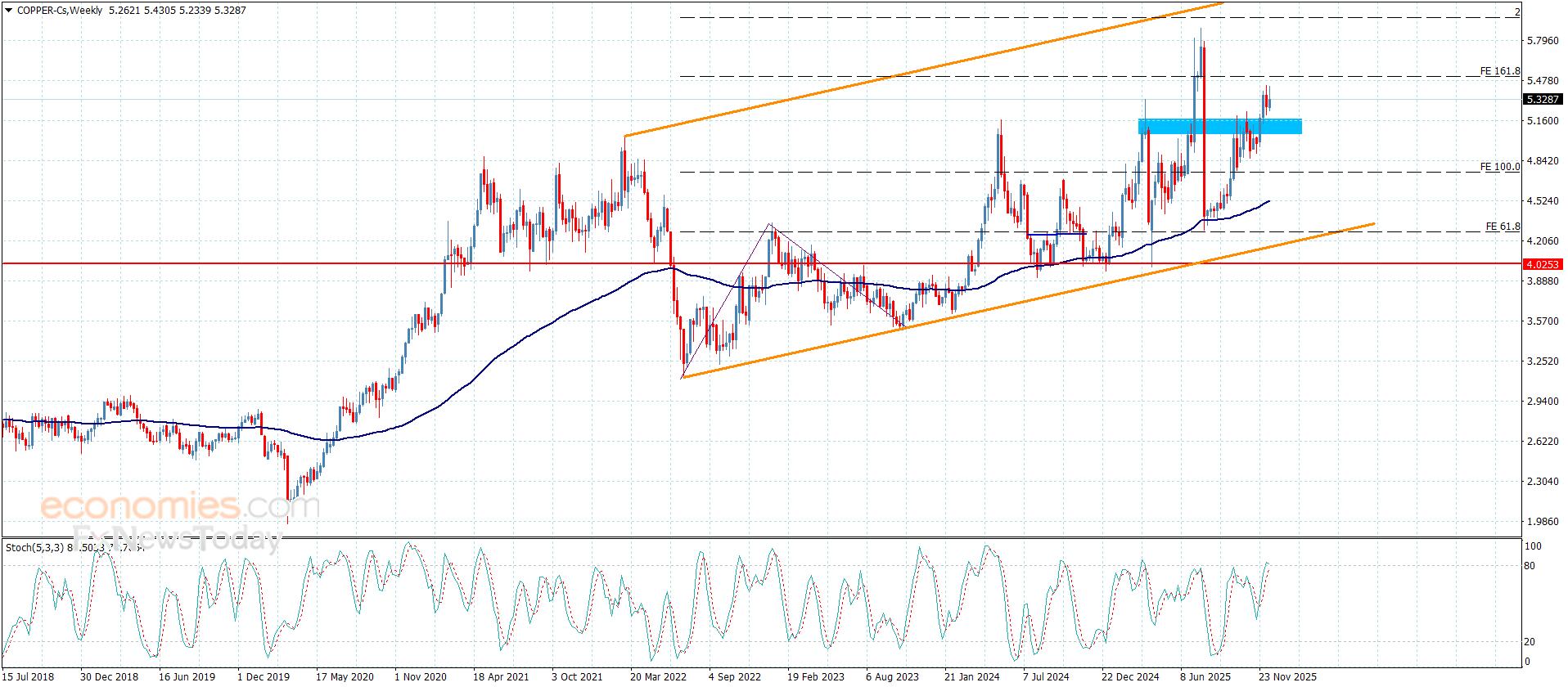
Copper price continued providing positive closing, taking advantage of its stability within the main bullish channel levels, surpassing the negativity of the intraday indicators by its stability above $5.1300 support.
Stochastic fluctuating near 80 level makes us expect to begin forming bullish waves to reach $5.5000, and surpassing it will open the way for achieving extra gains that may begin at $5.6300 and $5.7400.
The expected trading range for today is between $5.2000 and $5.5000
Trend forecast: Bullish
Gold (XAU/USD) is posting marginal gains on Wednesday, but price action remains contained within previous ranges. Upside attempts remain capped below all-time highs at $4,350, and bears are contained above the $4,260-$4,270 so far. The doji candles in the daily chart highlight a hesitant market.
The US Dollar Index (DXY) is trimming some losses on Wednesday, and that is limiting Gold upside attempts so far. US data released on Tuesday maintain fears about a deteriorating labour market intact, but traders are waiting for Thursday’s US Consumer Prices Index report to reassess their expectations of further interest rate cuts by the Fed.
XAU/USD trades at $4,316.73, little changed daily, with recent price action forming a triangle pattern roughly around the $4,300 level, with an ascending parallel channel framing the broader uptrend. Triangles are considered continuation patterns and, in this case, they would signal a positive outcome.
Technical indicators, however, show mixed signals. The Moving Average Convergence Divergence (MACD) remains below zero with the histogram contracting, suggesting fading bearish pressure, while the Relative Strength Index (RSI) prints 57.77, maintaining a modest bullish tone.
Immediate resistance is at the top of the triangle, at $4,340 area and the December 12 and 15 highs, at $4,350 area. Further up, the top of the ascending channel, now around $4,385, emerges as the next target. Supports are at the $4,300 intraday low, ahead of the triangle bottom of $4,280 and the base of the channel, near $4,240.
(The technical analysis of this story was written with the help of an AI tool.)
Gold has played a key role in human’s history as it has been widely used as a store of value and medium of exchange. Currently, apart from its shine and usage for jewelry, the precious metal is widely seen as a safe-haven asset, meaning that it is considered a good investment during turbulent times. Gold is also widely seen as a hedge against inflation and against depreciating currencies as it doesn’t rely on any specific issuer or government.
Central banks are the biggest Gold holders. In their aim to support their currencies in turbulent times, central banks tend to diversify their reserves and buy Gold to improve the perceived strength of the economy and the currency. High Gold reserves can be a source of trust for a country’s solvency. Central banks added 1,136 tonnes of Gold worth around $70 billion to their reserves in 2022, according to data from the World Gold Council. This is the highest yearly purchase since records began. Central banks from emerging economies such as China, India and Turkey are quickly increasing their Gold reserves.
Gold has an inverse correlation with the US Dollar and US Treasuries, which are both major reserve and safe-haven assets. When the Dollar depreciates, Gold tends to rise, enabling investors and central banks to diversify their assets in turbulent times. Gold is also inversely correlated with risk assets. A rally in the stock market tends to weaken Gold price, while sell-offs in riskier markets tend to favor the precious metal.
The price can move due to a wide range of factors. Geopolitical instability or fears of a deep recession can quickly make Gold price escalate due to its safe-haven status. As a yield-less asset, Gold tends to rise with lower interest rates, while higher cost of money usually weighs down on the yellow metal. Still, most moves depend on how the US Dollar (USD) behaves as the asset is priced in dollars (XAU/USD). A strong Dollar tends to keep the price of Gold controlled, whereas a weaker Dollar is likely to push Gold prices up.
Natural gas price confirmed its surrender to the negative pressure by providing repeated closing below $4.200 level, suffering clear losses by approaching the initial negative target at $3.750 then rebounding to settle above the bullish channel’s support at $3.950.
We recommend waiting to confirm breaking the current break to confirm moving to the negative track, then attempts to target more negative stations by reaching $3.620 and $3.480, while its rally above $4.200 will cancel the negative overview, providing chance to begin forming bullish waves, to target $4.510 level initially.
The expected trading range for today is between $3.620 and $4.150
Trend forecast: Bearish by the stability of $4.200
Fortescue Ltd (ASX:FMG) stock is ending 2025 in a familiar-but-weird place: near a 52-week high on the back of resilient iron ore prices, while investors simultaneously debate whether the next leg of the story is copper diversification, green metals, or a downcycle risk as new global supply looms. The result is a share price that looks strong in the rear-view mirror, but faces a forward-looking tug-of-war between commodity forecasts, project execution, and capital allocation.
Below is what matters for Fortescue shares right now—covering the latest price action, the Alta Copper acquisition, operational and decarbonisation updates, dividend outlook, and where analysts are landing on forecasts as of December 17, 2025.
Fortescue shares rose in the latest session, with FMG closing around A$22.42 on Dec. 17, 2025 (up ~1.45%), after opening near A$21.74 and trading up to about A$22.45. [1]
On Financial Times’ market data, FMG was trading around A$22.39 with a day range of roughly A$21.70–A$22.46, putting the stock about 4% below its 52-week high of A$23.38 set on Dec. 11, 2025. [2]
Those levels matter because they frame the current debate: is FMG priced for “iron ore stays firm,” or for “iron ore mean-reverts lower in 2026”? Analysts’ average price targets (covered below) suggest the market is leaning toward the second interpretation.
Fortescue confirmed it has entered a binding agreement to acquire the remaining 64% of Alta Copper Corp it does not already own, via a Canadian plan of arrangement. The offer is C$1.40 per share in cash, implying a total equity value of about C$139 million for Alta Copper. [3]
In the same ASX release, Fortescue highlighted that Alta Copper owns the Cañariaco Copper Project in northern Peru and cited a reported mineral resource of 1.1 billion tonnes at 0.42% copper equivalent (measured & indicated) and 0.9 billion tonnes at 0.29% copper equivalent (inferred), referencing an NI 43-101 technical report. [4]
Reuters reported the deal value at roughly $101 million, noting Fortescue’s offer price represents a premium and placing the move in the broader mining trend of diversifying into copper amid energy-transition demand. Reuters also noted Fortescue shares dipped after the announcement. [5]
Alta Copper’s own release adds two investor-relevant details: the deal is expected to be funded from Fortescue’s existing cash reserves, and the transaction was expected to close in February 2026 (subject to approvals). [6]
Fortescue’s ASX release, meanwhile, targeted closing in the March quarter of 2026 and laid out the voting thresholds and court approval process typical for this structure. [7]
Strategically, the Alta deal is small relative to Fortescue’s market value—but it’s large in “signal” terms. It reinforces a narrative that Fortescue is:
Copper prices have been highly volatile but strong, with reporting in December describing record-level pricing dynamics (including stockpiling and tariff uncertainty) that could influence miners’ appetite for copper exposure. [8]
The catch: early-stage copper projects can be long-dated, permitting-heavy, and politically sensitive. Investors will likely demand evidence that Fortescue can apply its execution discipline outside its Pilbara iron ore engine.
One of the clearest “show me” developments this month is Fortescue’s move from decarbonisation slide decks to physical kit on the ground.
Fortescue says it delivered its first large-scale Battery Energy Storage System (BESS) to North Star Junction in the Pilbara, using BYD Blade Battery technology. The installation is described as 250 MWh of storage delivering up to 50 MW for five hours, and the first step in a planned 4–5 GWh storage rollout to decarbonise Fortescue’s operational energy supply. [9]
Mining Weekly’s coverage aligns on the key specs (48 containers, 250 MWh, 50 MW) and describes the system’s role: storing renewable energy generated during the day and feeding power into the Pilbara Energy Connect network at night to displace diesel and gas generation. [10]
For investors, the battery rollout is important because it reframes “green ambition” away from speculative revenue and toward cost, reliability, and emissions reduction inside the core iron ore business—the part of Fortescue that actually pays dividends.
Fortescue’s most strategically interesting pathway isn’t necessarily hydrogen-as-a-product. It may be hydrogen-as-a-process—specifically, using hydrogen-based methods to produce lower-emissions metals.
Reuters reported that Fortescue agreed to work with Taiyuan Iron and Steel Group (TISCO), a subsidiary of China Baowu, on a trial project involving hydrogen-based plasma-enhanced metallurgical technology. The project includes designing and operating a trial line capable of producing 5,000 metric tons of hot metal, and Fortescue said it would provide capital for the project while using its Pilbara iron ore. [11]
Why investors should care: Reuters also pointed out that steel decarbonisation is expected to increase demand for higher-grade iron ore, which is a known strategic pressure point for Australian miners that largely supply low-to-medium grades. [12]
That helps explain why Fortescue continues to talk about “green iron” even as it has stepped back from some large hydrogen project timelines.
Another fresh data point: Renewables Now reported that Statkraft and Fortescue revised their power purchase agreement (PPA) for Fortescue’s planned Holmaneset green hydrogen/ammonia development in Norway.
Key details reported:
This fits a pattern investors have been watching: Fortescue is still keeping some green-fuels options alive, but stretching timelines and gating progress behind feasibility, permitting and financial close.
The sharper pivot came earlier in 2025. Reuters reported in July that Fortescue scrapped two green hydrogen projects (Arizona in the US and a Gladstone project in Australia) after a strategic review, flagging an expected ~$150 million preliminary pre-tax writedown related to those projects and investments. [14]
In the same report, Reuters noted Fortescue posted record iron ore shipments for fiscal 2025 and provided fiscal 2026 guidance (details below), which helped frame the market’s reaction: investors liked the operating performance and discipline, and were less enthusiastic about open-ended green capex. [15]
Fortescue shipped 198.4 million tonnes of iron ore in fiscal 2025 (record), and guided to 195–205 million tonnes in fiscal 2026, including up to 12 million tonnes from its Iron Bridge magnetite operation. Reuters also reported Fortescue’s FY26 metals capex guidance at $3.3–$4.0 billion. [16]
Fortescue itself highlights FY25 performance metrics including 198.4 Mt shipped, US$7.9bn underlying EBITDA, US$3.4bn NPAT, and A$3.4bn dividends paid. [17]
Argus reported earlier in 2025 that Fortescue expected Iron Bridge shipments to rise, with 10–12 million wet metric tonnes forecast for 2025–26 (up from prior expectations), as the company works toward a larger ramp-up. [18]
For FMG investors, Iron Bridge matters because it’s part of the response to the “grade problem” (global steel decarbonisation favors higher quality feedstock), but it has also been an execution-sensitive asset historically.
Benchmark iron ore prices have been holding above the psychological US$100/t level in late 2025. Reuters noted Singapore iron ore futures ended at $104.60 a ton in mid-November and traded in a relatively narrow $100–$108 range since early August. [19]
Market data sources in mid-December show iron ore around US$106/t. [20]
Westpac IQ’s December commodities update forecasts iron ore could fall ~20% to about US$83/t by end-2026, citing declining Chinese steel production trends, rising inventories, and conditions that historically preceded price corrections. [21]
ING’s commodity analysis also highlights the supply side: Simandou in Guinea made its first shipment in November and is expected to ship around 20 million tonnes in 2026, with full capacity of 120 million tonnes per year by 2030—a supply ramp that could shift market balance and pricing power over time. [22]
Reuters has similarly pointed to the widespread view that iron ore prices are likely to head lower in 2026 as Simandou ramps up, even while China’s imports remain robust and sentiment-driven at times. [23]
China’s steel sector affects iron ore demand—directly and brutally.
Reuters reported that China will introduce an export licence system starting Jan. 1, 2026 covering around 300 steel products, amid global trade barriers and protectionist pressures. Reuters also noted China’s steel exports were up 6.7% year-on-year to 107.72 million metric tons in the first 11 months of 2025, putting the country on track for a record year. [24]
For Fortescue shareholders, the key takeaway is not “licences equal lower iron ore demand tomorrow.” It’s that steel is increasingly political—and policy can move faster than mines can.
Fortescue remains one of the ASX’s most watched dividend stocks—because when iron ore prices are strong, the cash returns can be enormous. The company says it has delivered more than A$45 billion in dividends since inception. [25]
But dividends are ultimately downstream of iron ore pricing and costs, and the forward consensus is more conservative than the pandemic-era peak.
Translation: income investors are still watching FMG, but the market is no longer pricing “maximum payout forever.” It’s pricing a cycle.
Analyst targets are not destiny, but they are a useful mirror of what assumptions brokers are embedding—particularly around iron ore prices and Fortescue’s longer-run capital spend.
Investing.com’s consensus snapshot (based on 16 analysts) rates Fortescue “Neutral”, with an average 12‑month price target around A$19.08, a high estimate around A$23.03, and a low estimate around A$16.27—implying downside from the current ~A$22+ trading level. [29]
TradingView shows a similar shape, citing an average target around A$19.51 (range roughly A$16.28–A$23.02). [30]
MarketScreener’s timeline of broker actions highlights how divided views have been, including items such as an earlier UBS upgrade to Neutral from Sell with a stated target, and other upgrades/downgrades across 2025. [31]
This gap—stock near 52-week highs, consensus targets below spot—usually means one of two things:
Fortescue has a busy catalyst calendar in early 2026:
Beyond scheduled reporting, the swing factors are straightforward—even if the outcomes aren’t:
As of Dec. 17, 2025, Fortescue Ltd stock is being pulled by three forces:
The uncomfortable truth for both bulls and bears is that FMG remains, first and foremost, an iron ore equity—so the sharpest near-term driver is still whether iron ore holds its late‑2025 resilience, or whether 2026 brings the price correction that several forecasters are now openly modelling. [41]
1. www.investing.com, 2. markets.ft.com, 3. content.fortescue.com, 4. content.fortescue.com, 5. www.reuters.com, 6. altacopper.com, 7. content.fortescue.com, 8. www.businessinsider.com, 9. www.fortescue.com, 10. www.miningweekly.com, 11. www.reuters.com, 12. www.reuters.com, 13. renewablesnow.com, 14. www.reuters.com, 15. www.reuters.com, 16. www.reuters.com, 17. investors.fortescue.com, 18. www.argusmedia.com, 19. www.reuters.com, 20. tradingeconomics.com, 21. www.westpaciq.com.au, 22. think.ing.com, 23. www.reuters.com, 24. www.reuters.com, 25. investors.fortescue.com, 26. markets.ft.com, 27. www.fool.com.au, 28. fnarena.com, 29. www.investing.com, 30. www.tradingview.com, 31. www.marketscreener.com, 32. investors.fortescue.com, 33. www.westpaciq.com.au, 34. think.ing.com, 35. content.fortescue.com, 36. www.fortescue.com, 37. www.reuters.com, 38. www.reuters.com, 39. www.fortescue.com, 40. content.fortescue.com, 41. www.westpaciq.com.au
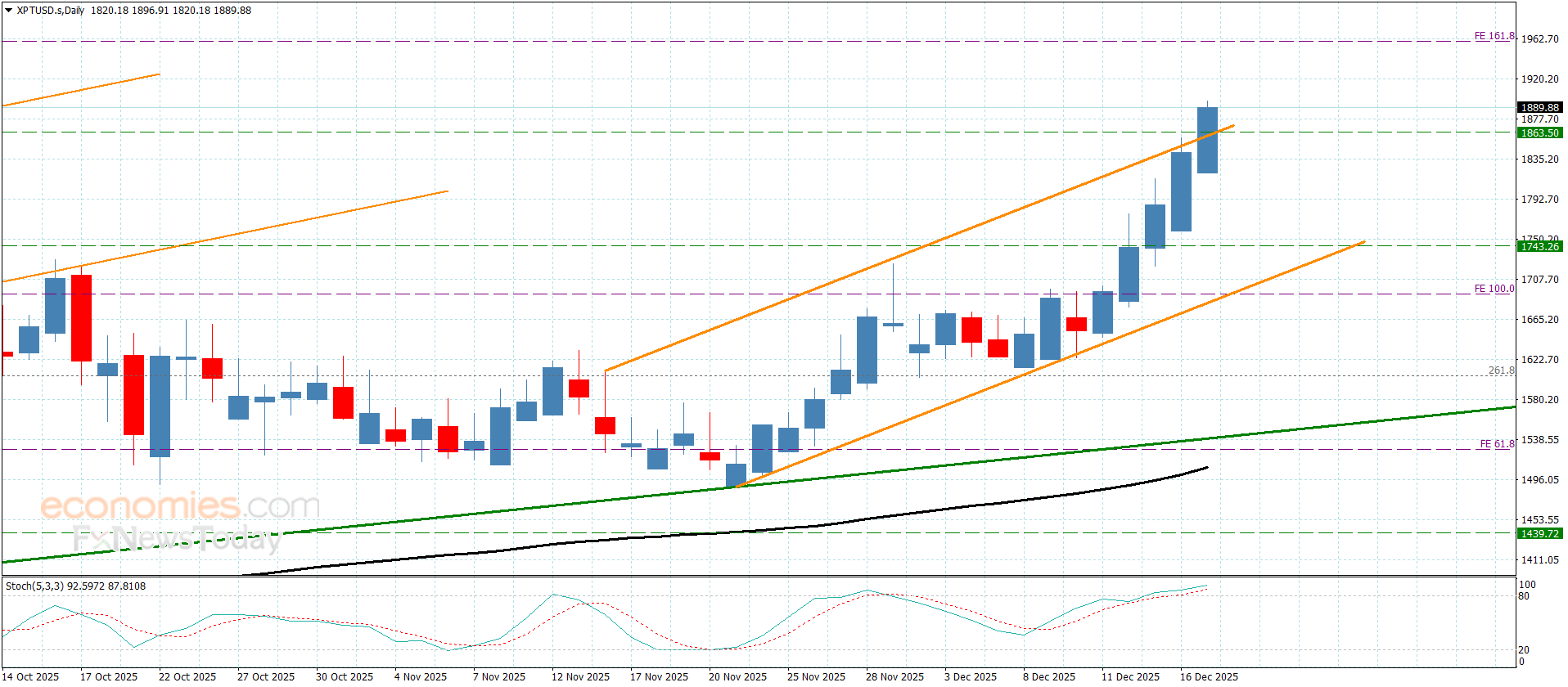
Platinum price began this morning trading with strong positive trading, surpassing the minor bullish channel’s resistance at $1865.00 level, taking advantage of the bullish momentum from the main indicators, to notice recording new historical gains by hitting $1898.00 level.
Note that forming extra support at $1860.00 level and providing bullish momentum by the main indicators, these factors confirm the continuation of the positivity in the near period, attempting to achieve extra gains by reaching $1925.00 followed by 161.8%Fibonacci extension level at $1959.00.
The expected trading range for today is between $1825.00 and $1925.00
Trend forecast: Bullish
Silver price (XAG/USD) posts a fresh all-time high near $66 during the Asian trading session on Wednesday. The white metal extends its bull run as weak United States (US) employment data, Retail Sales, and flash S&P Global Purchasing Managers’ Index (PMI) data raise economic concerns.
The US Nonfarm Payrolls (NFP) report showed on Tuesday that the Unemployment Rate rose to 4.6% in November, the highest level seen since September 2021. In the same period, the economy created 64K fresh jobs, higher than estimates of 50K, but after firing 105K payrolls in October.
Month-on-month Retail Sales remained flat in October, while it was expected to grow steadily by 0.1%. Meanwhile, preliminary S&P Global PMI landed at 53.0, sharply lower than 54.2 in November.
Escalating US economic jitters have raised demand for safe-haven assets, such as Silver.
The broader outlook of the Silver price has remained upbeat due to expectations that the Federal Reserve (Fed) will deliver more interest rate cuts in 2026 than one projected by officials in December’s policy meeting. According to the CME FedWatch tool, there is a 67.6% chance that the Fed will deliver at least two interest rate cuts next year.
Silver price trades almost 3% higher around $66.00 during Asian trading hours. The 20-period Exponential Moving Average (EMA) rises at $63.28, with price holding above the average and keeping the short-term tone positive.
The 14-period Relative Strength Index (RSI) at 69.16 sits near the overbought threshold, signaling that momentum could cool before the next leg higher.
Bias remains firm while the market stays above the rising EMA, where pullbacks would be cushioned. A break below the 20-period EMA would turn the intraday bias down, making Silver fragile towards the psychological level of $60.00. While a persistent hold above it would preserve upside, and keep the odds of further upside towards $70.00
(The technical analysis of this story was written with the help of an AI tool)
Silver is a precious metal highly traded among investors. It has been historically used as a store of value and a medium of exchange. Although less popular than Gold, traders may turn to Silver to diversify their investment portfolio, for its intrinsic value or as a potential hedge during high-inflation periods. Investors can buy physical Silver, in coins or in bars, or trade it through vehicles such as Exchange Traded Funds, which track its price on international markets.
Silver prices can move due to a wide range of factors. Geopolitical instability or fears of a deep recession can make Silver price escalate due to its safe-haven status, although to a lesser extent than Gold’s. As a yieldless asset, Silver tends to rise with lower interest rates. Its moves also depend on how the US Dollar (USD) behaves as the asset is priced in dollars (XAG/USD). A strong Dollar tends to keep the price of Silver at bay, whereas a weaker Dollar is likely to propel prices up. Other factors such as investment demand, mining supply – Silver is much more abundant than Gold – and recycling rates can also affect prices.
Silver is widely used in industry, particularly in sectors such as electronics or solar energy, as it has one of the highest electric conductivity of all metals – more than Copper and Gold. A surge in demand can increase prices, while a decline tends to lower them. Dynamics in the US, Chinese and Indian economies can also contribute to price swings: for the US and particularly China, their big industrial sectors use Silver in various processes; in India, consumers’ demand for the precious metal for jewellery also plays a key role in setting prices.
Silver prices tend to follow Gold’s moves. When Gold prices rise, Silver typically follows suit, as their status as safe-haven assets is similar. The Gold/Silver ratio, which shows the number of ounces of Silver needed to equal the value of one ounce of Gold, may help to determine the relative valuation between both metals. Some investors may consider a high ratio as an indicator that Silver is undervalued, or Gold is overvalued. On the contrary, a low ratio might suggest that Gold is undervalued relative to Silver.