The main tag of GoldPrice Articles.
You can use the search box below to find what you need.
[wd_asp id=1]
The main tag of GoldPrice Articles.
You can use the search box below to find what you need.
[wd_asp id=1]
On Tuesday, US natural gas price extended losses from the previous session in reaction to forecasts of warmer weather in most parts of the country. Near-record output and ample inventories have further fueled the pullback, even as the bulls remain in control. Meanwhile, European prices are under selling pressure as investors weigh the prospects of a peace deal and subsequent easing of Russian sanctions.
Europe Vs US natural gas prices: The paradox that lies within
This time of the year is usually marked by higher natural gas prices as investors price in increased warming demand during the Northern Hemisphere’s winter season. In fact, weather forecast is one of the bullish factors that bolstered US natural gas prices to a three-year high late last week. Besides, record LNG exports to Europe have fueled the months-long rally.
While the short-term outlook remains positive, investors appear to weigh on whether the recent surge is the onset of a larger bullish trend or just a weather-driven spike that will soon fade. Indeed, this dilemma, coupled with the expected profit-booking, explains the pullback recorded since the start of the week.
According to the updated weather forecast, most parts of the US are expected to experience warmer temperatures in the near term. Atmospheric G2 has indicated that the eastern and southern US will be colder for the period between 18th and 22nd December, while other regions remain warmer.
In its latest weekly report, EIA highlighted a draw of 12 Bcf compared to the expected 15 Bcf. Subsequently, the surplus surged from 160 Bcf to 191 Bcf. In addition to the ample amount of natural gas in storage, the near-record output is weighing on the prices.
Nonetheless, steady LNG exports continue to offer support to US natural gas prices while exerting selling pressure in the European market. In the current month, the natural gas flows to the eight major LNG export plants within the US are averaging at 18.9 Bcf/per day compared to the monthly record high hit in November at 18.2 Bcf/per day.
Meanwhile, prospects of a peace deal that could see the return of Russian gas have pushed the benchmark for European prices, Dutch TTF, to the lowest level since April 2024.
US natural gas price technical analysis
Late last week, the Henry Hub natural gas futures rallied to a three-year high at $5.50 per MMBtu as it marked seven consecutive weeks of gains. Since late September, it has recorded higher highs and higher lows as a positive demand outlook fuels the bullish sentiment.
On Tuesday, it extended losses from the previous session, having pulled back below the psychologically crucial zone of $5.00. At the time of writing, the US natural gas was trading at $4.81.
Despite the pullback, the bulls are still in control as the asset continues to trade above the 25 and 50-day EMAs. Indeed, the decline can be perceived as a cool-off rather than trend reversal.
In the immediate term, the range between Monday’s intraday high of $5.20 and the resistance-turn-support zone of $4.70 will be worth watching. Below that zone, the bulls will be keen on defending the crucial support at $4.50 as they gather enough momentum for a rebound. On the flip side, a bounceback past the range’s upper limit will give buyers a chance to retest the 3-year high at $5.50.
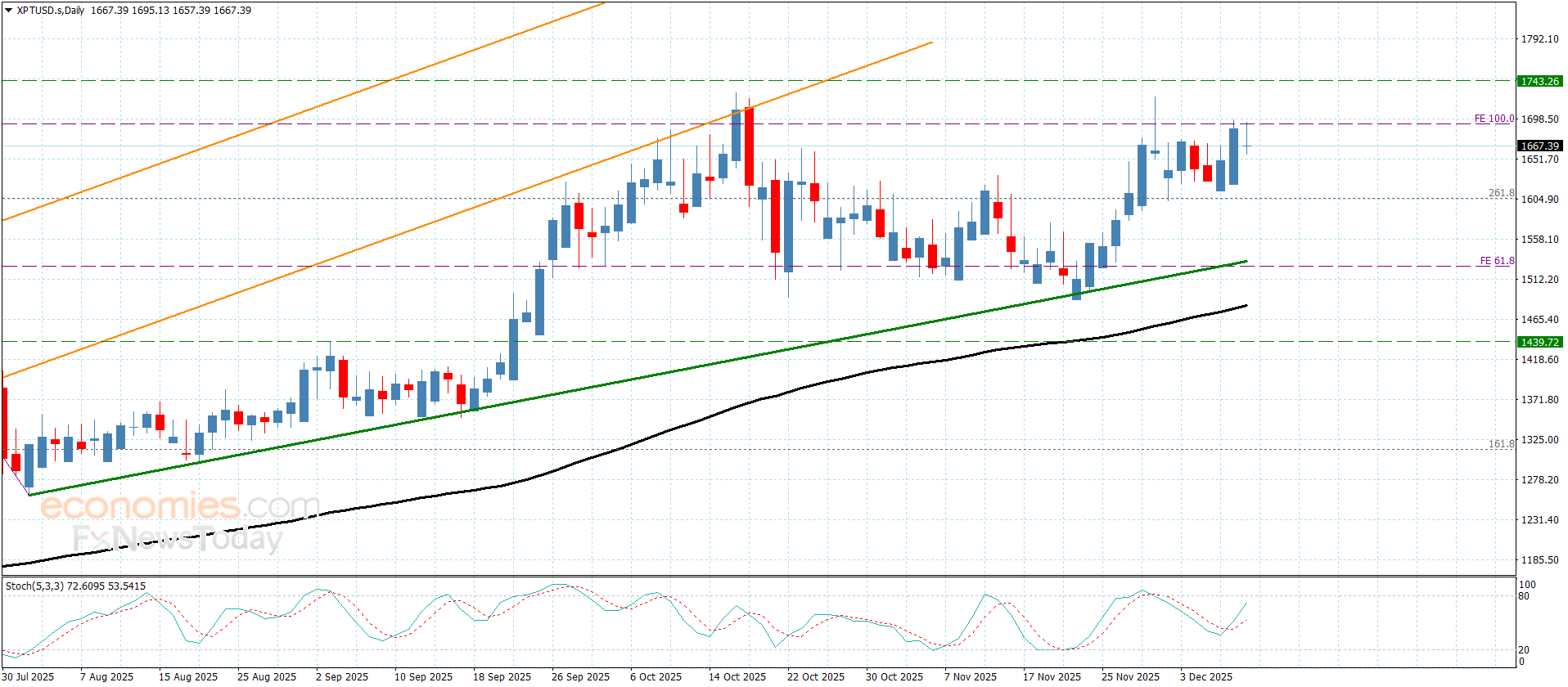
There is no change on copper price, despite forming mixed trading due to its stability above the extra support near $5.1300, increasing the chances of its activation with the positivity of the main indicators.
Stochastic stability within the overbought level will provide new positive momentum to ease the mission of resuming the bullish attack, reminding you that the stability of the next main target near $5.5000, while the decline below the current support might force it to form temporary corrective trading, and there is a chance for the decline towards $4.9500 reaching the main support near $4.7500.
The expected trading range for today is between $5.1850 and $5.5000
Trend forecast: Bullish
Silver (XAG/USD) enters a bullish consolidation phase during the Asian session and oscillates in a narrow range near the all-time peak, around the $61.00 neighborhood, touched this Wednesday. Meanwhile, the broader technical setup suggests that the path of least resistance for the white metal remains to the upside.
The overnight breakout through the monthly trading range hurdle, around the $58.80-$58.85 region, was seen as a fresh trigger for the XAG/USD bulls. However, the Relative Strength Index (RSI) is flashing overbought conditions on 4-hour/daily charts, which, in turn, is holding back traders from placing fresh bullish bets. Hence, it will be prudent to wait for some near-term consolidation or a modest pullback before positioning for a further appreciating move.
Meanwhile, any corrective slide below the $60.30-$60.20 immediate support could attract fresh buyers and find decent support near the $60.00 psychological mark. A convincing break below the said handle, however, might prompt some long-unwinding and drag the XAG/USD towards the trading range resistance breakpoint, around the $58.80-$58.85 region. The latter should act as a key pivotal point, which, if broken, could pave the way for further losses.
On the flip side, momentum above the $61.00 mark will reaffirm the near-term constructive outlook and set the stage for an extension of the XAG/USD’s recent strong move up from the vicinity of mid-$45.00s, or late October swing low.
Silver is a precious metal highly traded among investors. It has been historically used as a store of value and a medium of exchange. Although less popular than Gold, traders may turn to Silver to diversify their investment portfolio, for its intrinsic value or as a potential hedge during high-inflation periods. Investors can buy physical Silver, in coins or in bars, or trade it through vehicles such as Exchange Traded Funds, which track its price on international markets.
Silver prices can move due to a wide range of factors. Geopolitical instability or fears of a deep recession can make Silver price escalate due to its safe-haven status, although to a lesser extent than Gold’s. As a yieldless asset, Silver tends to rise with lower interest rates. Its moves also depend on how the US Dollar (USD) behaves as the asset is priced in dollars (XAG/USD). A strong Dollar tends to keep the price of Silver at bay, whereas a weaker Dollar is likely to propel prices up. Other factors such as investment demand, mining supply – Silver is much more abundant than Gold – and recycling rates can also affect prices.
Silver is widely used in industry, particularly in sectors such as electronics or solar energy, as it has one of the highest electric conductivity of all metals – more than Copper and Gold. A surge in demand can increase prices, while a decline tends to lower them. Dynamics in the US, Chinese and Indian economies can also contribute to price swings: for the US and particularly China, their big industrial sectors use Silver in various processes; in India, consumers’ demand for the precious metal for jewellery also plays a key role in setting prices.
Silver prices tend to follow Gold’s moves. When Gold prices rise, Silver typically follows suit, as their status as safe-haven assets is similar. The Gold/Silver ratio, which shows the number of ounces of Silver needed to equal the value of one ounce of Gold, may help to determine the relative valuation between both metals. Some investors may consider a high ratio as an indicator that Silver is undervalued, or Gold is overvalued. On the contrary, a low ratio might suggest that Gold is undervalued relative to Silver.
Gold is defending the $4,200 mark early Wednesday, having staged a decent comeback on Tuesday from near the $4,170 region. Traders gear up for the all-important US Federal Reserve (Fed) policy announcements.
Gold is tracking the renewed record-setting rally in Silver, in anticipation of the upcoming 25 basis points (bps) interest rate cut by the Fed, following the conclusion of its two-day monetary policy meeting later on Wednesday.
The odds of such a move currently stand at about 90%, as traders eagerly await cues on the number of Fed rate reductions likely to be projected by the Federal Open Market Committee (FOMC) board members for 2026.
Fed Chairman Jerome Powell’s words and tone during the post-policy meeting press conference will be closely scrutinized to understand whether the expected December cut is just a risk-management move or the start of an aggressive easing cycle.
The FOMC board vote split, between the hawks and doves, will also play a pivotal role in the central bank’s guidance on interest rates.
The CME Group’s FedWatch Tool shows a little over 20% chance of another Fed rate cut in January, especially after Tuesday’s upbeat US JOLTS Job Openings data for September and October.
Job openings, a measure of labor demand, were up 12,000 to 7.670 million by the last day of October, Reuters reported, citing the Labor Department’s Bureau of Labor Statistics.
Looking ahead, Gold’s next big move will play out on the Fed meeting’s outcome, with a hawkish tone and future rate projections to fuel a steep decline in non-yielding assets such as Gold.
On the contrary, if doves hold the upper hand, with the Fed’s message of more rate cuts needed to alleviate the labor market stress, Gold could see a fresh uptrend toward the record highs of $4,382.
In the daily chart, XAU/USD trades at $4,217.02. The 21-day Simple Moving Average (SMA) rises above the 50-, 100- and 200-day SMAs, underscoring a bullish alignment. All SMAs slope higher and price holds above them, with the 21-day SMA at $4,155.85 offering nearby dynamic support. The Relative Strength Index (RSI) sits at 61, signaling firm positive momentum without overbought conditions.
Measured from the $4,381.17 high to the $3,885.84 low, the 61.8% retracement at $4,191.95 has been reclaimed, shifting focus toward the 78.6% retracement at $4,275.16 as resistance. A daily close above that barrier would strengthen the upside bias, while failure to extend could see the advance stall and price drift back to test rising averages for support.
(The technical analysis of this story was written with the help of an AI tool)
The Federal Reserve (Fed) deliberates on monetary policy and makes a decision on interest rates at eight pre-scheduled meetings per year. It has two mandates: to keep inflation at 2%, and to maintain full employment. Its main tool for achieving this is by setting interest rates – both at which it lends to banks and banks lend to each other. If it decides to hike rates, the US Dollar (USD) tends to strengthen as it attracts more foreign capital inflows. If it cuts rates, it tends to weaken the USD as capital drains out to countries offering higher returns. If rates are left unchanged, attention turns to the tone of the Federal Open Market Committee (FOMC) statement, and whether it is hawkish (expectant of higher future interest rates), or dovish (expectant of lower future rates).
Next release:
Wed Dec 10, 2025 19:00
Frequency:
Irregular
Consensus:
3.75%
Previous:
4%
Source:
Federal Reserve
Tuesday’s move decisively sliced through the 20-day average at $4.68, with a daily close below set to confirm the breakdown. Combined with the sharp reversal from last week’s $5.50 extreme, this failure points squarely to continued downside momentum.
The decline also triggered a one-week bearish reversal below last week’s $4.76 low, breaking the multi-month pattern of higher weekly highs and lows. A close beneath that level locks in the weekly shift and reinforces bearish dominance across timeframes.
The trajectory now favors a relatively swift test of the next major support zone around the recent swing low at $4.24 and the rising 10-week average near $4.18, with nearby June levels around $4.15 adding potential reinforcement.
After the prolonged and extended rally from late-October, corrective action looks warranted. A confirmed 20-day break opens the 50-day average at $4.01—currently converging with a rising top channel line—as the next logical downside price magnet. Should that fail, the 200-day average at $3.58, aligned with a long-term uptrend line untouched since late-October, enters focus as significant deeper support.
Two days of heavy selling have flipped the short-term structure firmly bearish with the 20-day and weekly breakdowns confirming momentum now favors lower prices. Look for $4.24–$4.18 first, then $4.01 and potentially $3.58 on continued weakness; only a rapid reclaim of the 20-day average would begin to neutralize the current bearish shift.
For a look at all of today’s economic events, check out our economic calendar.
(Platts)–09Dec2025/441 pm EST/2141 GMT **Agency to ‘modernize’ Short-Term Energy Outlook **EIA raises Q1 gas marketed production forecast by 1.1 Bcf/d The US Energy Information Administration raised its forecast for US spot natural gas prices in late 2025 and early 2026, citing a December cold snap that pushed up its estimate of gas used for space heating this winter. The agency, in its December Short-Term Energy Outlook, lifted its forecast for Q4 Henry Hub natural gas spot prices by 36 cents to $3.87/MMBtu. The Q1 forecast also rose 37 cents from the previous month’s estimates to $4.35 /MMBtu. The agency said the cold hitting the US this December will drive Henry Hub spot prices to average nearly $4.30/MMBtu this winter, more than 40 cents/MMBtu above the November forecast. “Because of the colder weather, we now forecast the residential and commercial sectors will consume 6% more natural gas in December than we forecast last month, reducing the amount of natural gas held in storage.” While the US started the winter season with 4% more working gas in storage than the five-year average, the EIA expects withdrawals in December to be 580 Bcf, or 28% above the five-year-average. However, the EIA expects rising production to continue into 2026, which will help moderate prices, compared to the expectations in the November outlook. “We expect the Henry Hub spot price to average almost $4.50/MMBtu in 4Q26, down 5% from last month’s forecast,” the report said. The agency forecast Henry Hub natural gas prices would average $3.56/MMBtu for full-year 2025 and $4.01/MMBtu in 2026, compared with the previous month’s estimates of $3.47/MMBtu in 2025 and $4.02 /MMBtu in 2026. On the supply side, the agency raised its gas production forecast from November estimates, citing its changed assumptions about gas-to-oil ratios (GORs). “Specifically, we raised our expectations of GORs in the Permian region based on recent production trends, leading to more overall natural gas production in our forecast for 2026.” Dry gas production is forecast to average 109.1 Bcf/d in 2026, up from the November estimate of 107.8 Bcf/d. The agency raised by 700 MMcf/d to 120.6 Bcf/d its natural gas marketed production estimate for the US in the fourth quarter of 2025. The Q1 2026 production forecast increased by 1.1 Bcf/d to 119.6 Bcf/d. Gas inventories are now forecast to conclude the winter season at 2 Tcf, topping the five-year average by 9%. On the demand side, the EIA raised the natural gas consumption estimates by 500 MMcf/d to 94.3 Bcf/d for Q4, but lowered the estimate by 700 MMcf/d to 105.6 Bcf/d for Q1. The increased natural gas price forecast also prompted the EIA to update its estimates for winter heating costs, with higher total costs expected for homes heated primarily by gas. Average fuel expenditures for those heating with gas are now estimated to average a total of $671 for the November-March period, 3% above last winter’s costs. Those heating with electricity are estimated to pay an average of $1,144 this winter, up 5% from last year, according to the update. REVAMPING THE OUTLOOK Alongside the STEO, the agency also announced plans to “modernize” its “core short-term forecast model,” including “modern data architecture with automated data flows, internal visualization tools, and comprehensive documentation,” according to a release. The agency noted that the current model underpinning the outlook was “built a quarter-century ago.” It plans to undergo the modernization process in stages, beginning with a new upstream model in the spring of 2026 and “full completion” in 2027. “EIA is decisively accelerating toward a more integrated and timely forecasting system that better reflects the evolving role of the United States in global energy markets,” EIA Administrator Tristan Abbey said in a statement. The news came days after Abbey, appointed by US President Donald Trump and sworn in as the 11th EIA Administrator Sept. 25, outlined his wider plans for changes at the agency. Speaking in an interview at the Center for Strategic and International Studies Dec. 4, Abbey said the EIA had “too many” products and “quite a bit of redundancy.” He asserted the agency needed to update and streamline its data collection processes and discard unused tools, but reiterated the importance of the agency’s monthly forecasts, market surveys, and Annual Energy Outlook. “There are lots of things EIA does because we were asked to do so 10 years ago, 20 years ago, and we still do it, because that’s what we do,” Abbey said in the interview. “I think people have kicked the can down the road on modernizing our system architecture for far too long.” “EIA is very good about collecting missions like barnacles on the hull of a ship,” he continued. “It is not so good at discarding them.” ELECTRICITY The EIA forecasts that nationwide electricity generation will grow by 2.4% in 2025 and by 1.7% in 2026. The generation growth forecast for 2026 is down from a roughly 3% year-over-year increase predicted in the previous month’s STEO, a reduction driven by how much large-load electricity demand has come online so far this year and its implications for near-term growth, the agency said. The updated projections for generation growth in 2025-26, should they come to fruition, would continue an upward trend seen in recent years after a decade of relatively flat growth, the EIA said. US electric power sector generation has grown by around 2% each year since 2021 after falling by an average of 0.3% annually between 2010 and 2020. The bulk of the generation growth is a result of increasing power demand from data centers and other large-load customers in the Electric Reliability Council of Texas and the PJM Interconnection markets. The EIA forecasts that PJM power demand will increase by 3.3% in both 2025 and 2026, while ERCOT demand will rise by 5.0% in 2025 and 9.6% in 2026. The ERCOT demand growth forecast was notably revised downward from 6.0% in 2025 and 15.7% in 2026 in the November outlook. The surging demand in these regions is expected to have a significant effect on the mix of sources for power generation. Most of the growing demand in PJM is expected to be met by increasing generation from coal and solar, up 23% and 63%, respectively, between 2024 and 2026, the EIA said. The agency forecasts that solar power will be the fastest growing source of energy in ERCOT at an increase of 92% from 2024-26. Natural gas is the large source of generation in both ERCOT and PJM and is expected growth by 2% in each between 2024 and 2026, the EIA said. — Maya Weber, maya.weber@spglobal.com; Eamonn Brennan, eamonn.brennan@spglobal.com; Ronnie Turner, ronnie.turner@spglobal.com– Edited by Sarah Smith, newsdesk@spglobal.com–Platts Electricity Alert–
March arabica coffee (KCH26) today is down -10.45 (-2.70%), and January ICE robusta coffee (RMF26) is down -47 (-1.03%).
Coffee prices are retreating today on the prospects for rains in Brazil, which are supportive for coffee crop development and bearish for prices. Climatempo today forecasts heavy showers toward the end of the week and into next week for Brazil’s coffee-growing regions.
Don’t Miss a Day: From crude oil to coffee, sign up free for Barchart’s best-in-class commodity analysis.
Coffee prices had moved higher over the past two sessions as Brazilian coffee remains subject to substantial US tariffs. The Trump administration announced last Friday that it dropped tariffs on commodities not grown in the US, including coffee, but that relief only applied to 10% reciprocal tariffs. Brazil’s vice president said that Brazilian coffee exports to the US are still subject to the separate 40% tariff imposed by the Trump administration on Brazil on “national emergency” grounds related in part to Brazil’s prosecution of former President Bolsonaro. The Trump administration has yet to clarify whether US coffee importers are exempt from paying the 40% tariffs.
Shrinking ICE coffee inventories are also supportive of prices. The US tariffs imposed on US coffee imports from Brazil have led to a sharp drawdown in ICE coffee inventories. ICE-monitored arabica inventories fell to a 1.75-year low of 396,513 bags on Tuesday. ICE robusta coffee inventories fell to a 4-month low of 5,648 lots on Monday. American buyers are voiding new contracts for Brazilian coffee purchases due to the tariffs on US imports from Brazil, thereby tightening US supplies, as about a third of America’s unroasted coffee comes from Brazil. US purchases of Brazilian coffee from August through October, during which President Trump’s tariffs took effect, dropped by 52% from the same period last year to 983,970 bags.
Coffee prices also had support from Monday’s news from Somar Meteorologia that Brazil’s largest arabica coffee-growing area, Minas Gerais, received 19.8 mm of rain during the week ended November 14, or 42% of the historical average.
In a bearish factor, StoneX forecast last Wednesday that Brazil will produce 70.7 million bags of coffee in the new 2026/27 marketing year, including 47.2 million bags of arabica, a +29% y/y increase.
Increased Vietnamese coffee supplies are bearish for prices. On November 6, the Vietnam National Statistics Office reported that Vietnam’s Jan-Oct 2025 coffee exports rose +13.4% y/y to 1.31 MMT. Also, Vietnam’s 2025/26 coffee production is projected to climb +6% y/y to 1.76 MMT, or 29.4 million bags, a 4-year high. In addition, the Vietnam Coffee and Cocoa Association (Vicofa) said on October 24 that Vietnam’s coffee output in 2025/26 will be 10% higher than the previous crop year if weather conditions remain favorable. Vietnam is the world’s largest producer of robusta coffee.
Signs of tighter global coffee supplies are supportive of prices, as the International Coffee Organization (ICO) on November 7 reported that global coffee exports for the current marketing year (Oct-Sep) fell 0.3% y/y to 138.658 million bags.
Coffee prices found support after Conab, Brazil’s crop forecasting agency, cut its Brazil 2025 arabica coffee crop estimate on September 4 by -4.9% to 35.2 million bags from a May forecast of 37.0 million bags. Conab also reduced its total Brazil 2025 coffee production estimate by 0.9% to 55.2 million bags, from a May estimate of 55.7 million bags.
The USDA’s Foreign Agriculture Service (FAS) projected on June 25 that world coffee production in 2025/26 will increase by +2.5% y/y to a record 178.68 million bags, with a -1.7% decrease in arabica production to 97.022 million bags and a +7.9% increase in robusta production to 81.658 million bags. FAS forecasted that Brazil’s 2025/26 coffee production will increase by +0.5% y/y to 65 million bags and that Vietnam’s 2025/26 coffee output will rise by 6.9% y/y to a 4-year high of 31 million bags. FAS forecasts that 2025/26 ending stocks will climb by +4.9% to 22.819 million bags from 21.752 million bags in 2024/25.
On the date of publication,
did not have (either directly or indirectly) positions in any of the securities mentioned in this article. All information and data in this article is solely for informational purposes.
For more information please view the Barchart Disclosure Policy
here.
The views and opinions expressed herein are the views and opinions of the author and do not necessarily reflect those of Nasdaq, Inc.
(Platts)–09Dec2025/102 pm EST/1802 GMT **Q1 gas marketed production raised to 119.6 Bcf/d **Lowers Q1 gas demand forecast to 105.6 Bcf/d The US Energy Information Administration Dec. 9 raised by 700 MMcf/d to 120.6 Bcf/d its natural gas marketed production estimate for the US in the fourth quarter. The EIA, in its December Short-Term Energy Outlook, also raised its Q1 2025 production forecast by 1.1 Bcf/d to 119.6 Bcf/d. The agency raised its natural gas consumption estimates by 500 MMcf/d to 94.3 Bcf/d for Q4, but lowered the estimate by 700 MMcf/d to 105.6 Bcf/d for Q1. The EIA raised its forecast for Q4 Henry Hub natural gas spot prices by 36 cents to $3.87/MMBtu. The Q1 forecast also rose 37 cents from the previous month’s estimates to $4.35 /MMBtu. “In its December STEO, EIA forecasts the cold snap hitting the United States this month will drive the Henry Hub natural gas spot price to average almost $4.30/MMBtu this winter, which is more than 40 cents/MMBtu higher than its November forecast,” the agency said in a statement. “The price increase is driven by increased natural gas consumption for space heating.” The EIA forecast Henry Hub natural gas prices would average $3.56/MMBtu for full-year 2025 and $4.01/MMBtu in 2026, compared with the previous month’s estimates of $3.47/MMBtu in 2025 and $4.02 /MMBtu in 2026. — Maya Weber, maya.weber@spglobal.com– Edited by Richard Rubin, newsdesk@spglobal.com–Platts Electricity Alert–
Gold prices are up on Tuesday, with the bright metal now hovering around $4,215 a troy ounce. A better market mood undermines near-term demand for the US Dollar (USD), despite the improved sentiment surging from upbeat United States (US) data.
On the one hand, ADP reported that for the four weeks ending November 22, US private employers added an average of 4,750 jobs per week, an improvement from the previous negative readings. Also, the Job Openings and Labor Turnover Survey (JOLTS) released by the Bureau of Labor Statistics (BLS) showed that the number of job openings on the last business day of September stood at 7.658 million, while for October it rose to 7.67 million. The news initially triggered USD demand, but the Greenback quickly changed course on sentiment.
Now, the focus shifts to the US Federal Reserve (Fed). The central bank is widely anticipated to trim the benchmark interest rate by 25 basis points (bps) after its two-day meeting and announce it on Wednesday. The Fed will also release a fresh Summary of Economic Projections (SEP) in which policymakers share their perspectives on economic and monetary policy developments.
Additionally, the focus is on the upcoming Fed Chair. Jerome Powell will end his mandate in May 2026, and the long-lasting battle with President Donald Trump will come to an end. President Trump has demanded the Fed cut rates at a much faster pace, and the upcoming Chair will likely align with his thinking. Market players are looking for clues in a more aggressive monetary loosening with the new Fed head. Lower borrowing costs are likely to fuel demand for stocks while sending the USD into a selling spiral.
XAU/USD trades at $4,211.37, and the 4-hour chart shows that the 20-period Simple Moving Average (SMA) stabilizes above the 100- and 200-period SMAs, while the longer averages edge higher below the current level, suggesting that buyers have regained control. Price holds just above the shorter one, keeping the near-term tone firm. Technical indicators, however, show that the bullish potential remains limited. The Momentum indicator sits below 0 and falls, while the Relative Strength Index (RSI) stands directionless at 53. A pause in the advance could find initial support at the 20-period SMA at $4,205.76, with a deeper setback exposing the 100-period SMA at $4,150.61.
In the daily chart, XAU/USD remains confined to familiar levels. The 20-day Simple Moving Average (SMA) advances above the 100- and 200-day SMAs, with all three rising while price holds above them. Meanwhile, the Momentum indicator ticks higher within positive levels, while the RSI stands at 60, both keeping the near-term tone positive. A sustained hold over the 20-day SMA would keep the path tilted higher. A break lower would expose the 100-day SMA at $3,792.65 and, if extended, the 200-day SMA at $3,515.46.
(The technical analysis of this story was written with the help of an AI tool)
The EURNZD continued forming clear negative movement, affected by the continuation of forming strong barrier at 2.0335 level, suffering some losses by its stability near 2.0120, noting that the continuation of stochastic stability within the oversold level will increase the negative pressure on the current trading, to pave the way for reaching the initial target at 2.0060. Breaking this barrier might extend the losses towards 1.9955 directly, to face the moving average of 55.
While the stability above 2.0060 level will force it to form mixed trading, and there is a chance for recovering some losses by its rally towards 2.0210 before any attempt to reach the previously suggested negative target.
The expected trading range for today is between 2.0060 and 2.0175
Trend forecast: Bearish