The main tag of GoldPrice Articles.
You can use the search box below to find what you need.
[wd_asp id=1]
The main tag of GoldPrice Articles.
You can use the search box below to find what you need.
[wd_asp id=1]
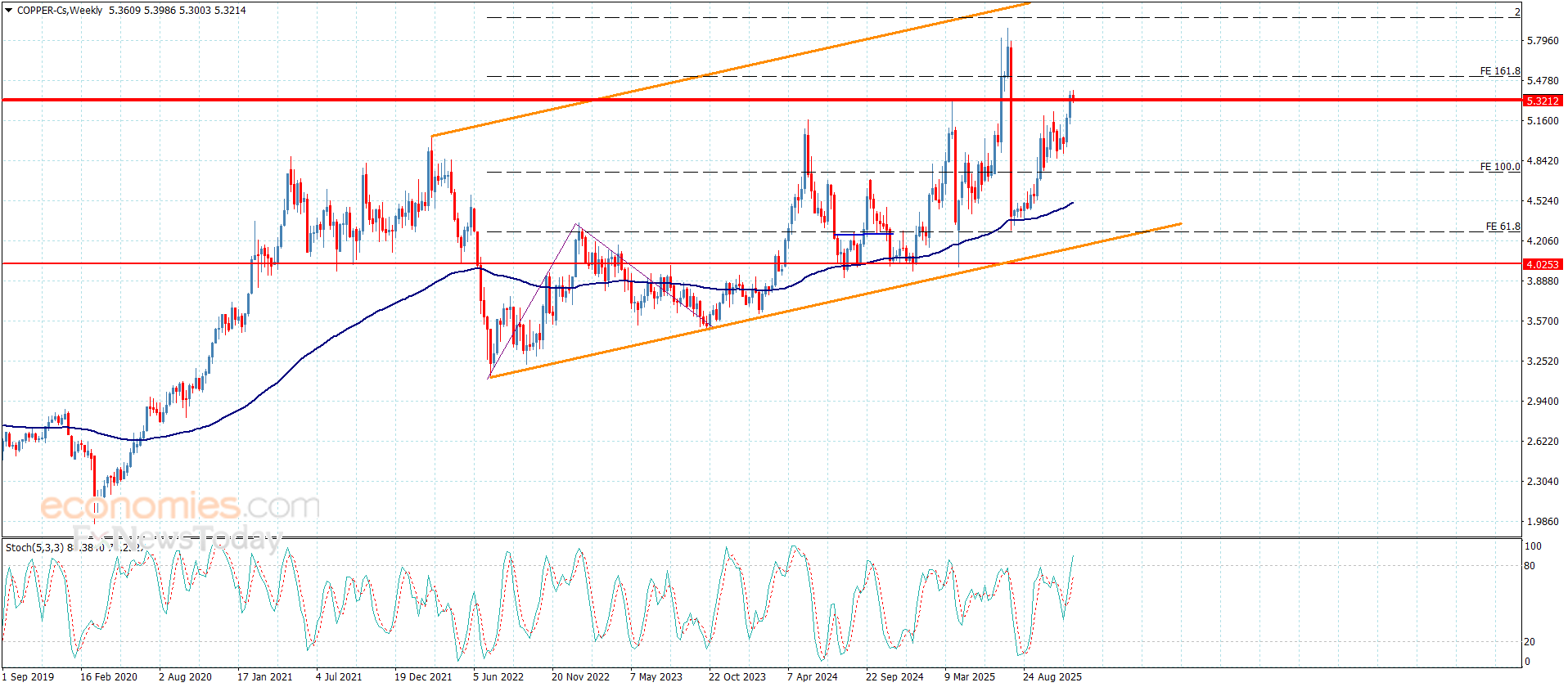
Copper price ended yesterday’s trading by providing new closure near $5.3200 level, taking advantage of stochastic positivity by providing chances for resuming the bullish attack that depends on several factors, one of them is the stability within the bullish channel levels besides forming extra support at $5.1300.
Therefore, we keep the bullish scenario, waiting for reaching %161.8 Fibonacci extension level at $5.5000, and surpassing it will open the way for achieving extra gains in the upcoming period.
The expected trading range for today is between $5.2500 and $5.5000
Trend forecast: Bullish
Copper price ended yesterday’s trading by providing new closure near $5.3200 level, taking advantage of stochastic positivity by providing chances for resuming the bullish attack that depends on several factors, one of them is the stability within the bullish channel levels besides forming extra support at $5.1300.
Therefore, we keep the bullish scenario, waiting for reaching %161.8 Fibonacci extension level at $5.5000, and surpassing it will open the way for achieving extra gains in the upcoming period.
The expected trading range for today is between $5.2500 and $5.5000
Trend forecast: Bullish
Oil prices are set to average below $60 per barrel next year, investment banks have said in their latest forecasts in recent weeks.
In 2026, both Brent Crude and WTI Crude are expected to slip from current levels of $63 per barrel and $60 a barrel, respectively, as the emerging oversupply will overwhelm the market, analysts say.
Geopolitical factors will certainly play into the price of oil next year, and these will be centered on Venezuela, Russia, and Iran.
Despite the many geopolitical uncertainties, the U.S. Energy Information Administration (EIA) and Wall Street banks are looking at the fundamentals and remain bearish on oil for the next year, forecasting prices to average below $60 per barrel in 2026.
The EIA expects, in its latest Short-Term Energy Outlook (STEO), that global oil inventories will continue to rise through 2026, putting downward pressure on oil prices in the coming months. The EIA forecasts the Brent crude oil price will dip to an average of $54 per barrel in the first quarter of 2026, and average $55 a barrel for all of 2026. Still, the EIA’s Brent forecast for 2026 is $3 per barrel higher than in the previous month’s outlook, due to Chinese stockpiling and the intensified sanctions on Russia.
“First, we now assess that China’s ongoing purchases of oil for strategic stockpiling will place more upward pressure on oil prices than we had assumed previously. Second, this forecast recognizes that the recent round of sanctions on Russia’s oil sector could result in less oil production next year than we are currently forecasting,” the EIA said.
Macquarie Group also sees lower oil prices next year, but notes that sanctions on Russia, uncertainty about Venezuela, and U.S. winter weather could slow price declines.
Macquarie analysts believe that OPEC+ would have to implement production cuts in the second half of 2026 to steady the market amid an expected drop in prices, according to the bank’s latest quarterly forecast carried by World Oil.
ABN AMRO Bank said in its Energy Market Outlook 2026 that weak global demand growth and rising OPEC+ and non-OPEC+ supply have resulted in an oversupplied market. Prices haven’t plunged due to China’s stockpiling efforts and geopolitical uncertainties, said Moutaz Altaghlibi, senior energy economist at ABN AMRO Bank.
“All in all, we anticipate the supply glut—caused by weaker demand growth and increasing supply—to persist throughout 2026, with its impact steadily pushing crude prices lower,” Altaghlibi said.
ABN AMRO forecasts Brent crude to average $58 per barrel in the first quarter of 2026, gradually falling to $52 a barrel as the glut worsens, and ultimately reaching $50 per barrel by the end of the year, with a year average of $55 per barrel.
Ole Hvalbye, commodities analyst at SEB bank, said last week, “We continue to see the path of least resistance as skewed to the downside.”
“Rising tension between Washington and Venezuela is adding a small geopolitical premium, although not enough to offset the broader bearish backdrop of rising supply and a market leaning deeper into surplus,” Hvalbye said.
Other banks and analysts concur that the glut will be the key theme in fundamentals next year.
Related: OPEC+’s Strategic Pause Signals a Shifting Oil Power Balance
Oversupplied markets will keep oil prices under pressure next year, and the U.S. benchmark will average below $60 per barrel, the monthly Reuters poll of analysts and economists showed at the end of November.
WTI Crude is expected to average $59 per barrel in 2026, and Brent Crude, the international benchmark, is set to average $62.23 per barrel next year, down from $63.15 forecast in the Reuters poll in October.
Goldman Sachs sees a large surplus on the market, with WTI Crude expected to average $53 per barrel in 2026.
The oil market is set to rebalance in 2027 as 2026 will see “the last big oil supply wave the market has to work through,” Daan Struyven, co-head of global commodities research at Goldman Sachs, told CNBC last month.
Fundamentals point to lower oil prices next year, but geopolitical shocks are lurking around the corner, from Russia to Venezuela.
A loss of Venezuelan oil production in case of a U.S. military intervention will materially impact global benchmark prices as the market will have to replace Venezuela’s heavy crude—the bulk of Caracas’ crude exports, according to Rystad Energy. A potential tightening of the global heavy crude market could push up the price of the Dubai benchmark against ICE Brent as China will scramble to replace the lost Venezuelan barrels, the analysts said last week.
By Tsvetana Paraskova for Oilprice.com
More Top Reads From Oilprice.com
Gold is testing bullish commitments at around the $4,200 mark early Tuesday, as the recent trade range gets squeezed in the lead-up to Wednesday’s US Federal Reserve (Fed) showdown.
Gold buyers are trying their luck for the third consecutive day, coming up for some air amid the latest tariff threats by US President Donald Trump, which fuels a renewed downtick in the US Dollar (USD).
Trump said that he will impose severe tariffs on fertilizer from Canada if he deems it necessary to boost domestic production, per Reuters. Meanwhile, Trump also threatened to impose a 5% tariff on Mexico if it doesn’t immediately provide additional water to help US farmers.
Traders also assess the impact of a 7.2 magnitude earthquake that hit the northeastern coast of Japan on Monday, allowing the safe-haven Gold to find some demand.
However, buyers remain wary and refrain from placing any big bets on the bright metal as the Fed is set to begin its two-day monetary policy meeting later in the day.
Markets are speculating that the US central bank could deliver a hawkish message after delivering the expected 25 basis points (bps) interest rate cut to 3.5%-3.75%.
This narrative seemed to have powered the recent advance in US Treasury bond yields, with the benchmark 10-year yields sitting above the 4% key level. The uptick in the US Treasury bond yields drove the USD higher alongside on Monday, rendering as negative for Gold.
Looking ahead, Gold traders will closely scrutinize the JOLTS Job Openings data for September and October, which will likely provide fresh insights on the health of the US labor market and the Fed’s path forward on rates next year. Any meaningful deviations from the expectations could trigger a big reaction in Gold.
In the daily chart, XAU/USD trades at $4,195.06. The 21-, 50-, 100- and 200-day Simple Moving Averages (SMA) advance, with the shorter ones positioned above the longer ones and price holding above all of them, reinforcing a bullish backdrop. The 21-day SMA stands at $4,150.88 and offers nearby dynamic support. The Relative Strength Index (RSI) prints 59.06, positive and below the overbought threshold. Measured from the $4,381.17 high to the $3,885.84 low, the 61.8% retracement at $4,191.95 acts as initial resistance, with the 78.6% retracement at $4,275.16 above; a sustained break could extend the recovery toward the latter.
Momentum remains aligned to the upside as the price holds above its rising averages. The 50-day SMA at $4,090.76 offers follow-up support, while the 100-day SMA at $3,792.49 and the 200-day SMA at $3,515.38 underpin the broader trend. RSI stays above 50 and supports the bullish bias, though a push toward 70 would warn of overbought conditions. Overall, dips could be contained by these ascending SMAs, keeping the path of least resistance pointing higher.
(The technical analysis of this story was written with the help of an AI tool)
JOLTS Job Openings is a survey done by the US Bureau of Labor Statistics to help measure job vacancies. It collects data from employers including retailers, manufacturers and different offices each month.
Important DisclaimersFXEmpire is owned and operated by Empire Media Network LTD., Company Registration Number 514641786, registered at 7 Jabotinsky Road, Ramat Gan 5252007, Israel. The content provided on this website includes general news and publications, our personal analysis and opinions, and materials provided by third parties. This content is intended for educational and research purposes only. It does not constitute, and should not be interpreted as, a recommendation or advice to take any action, including making any investment or purchasing any product. Before making any financial decision, you should conduct your own due diligence, exercise your own discretion, and consult with competent advisors. The content on this website is not personally directed to you, and we do not take into account your individual financial situation or needs. The information contained on this website is not necessarily provided in real time, nor is it guaranteed to be accurate. Prices displayed may be provided by market makers and not by exchanges. Any trading or other financial decision you make is entirely your own responsibility, and you must not rely solely on any information provided through the website. FXEmpire does not provide any warranty regarding the accuracy, completeness, or reliability of any information contained on the website and shall bear no responsibility for any trading losses you may incur as a result of using such information. The website may include advertisements and other promotional content. FXEmpire may receive compensation from third parties in connection with such content. FXEmpire does not endorse, recommend, or assume responsibility for the use of any third-party services or websites. Empire Media Network LTD., its employees, officers, subsidiaries, and affiliates shall not be liable for any loss or damage resulting from your use of the website or reliance on the information provided herein.Risk DisclaimersThis website contains information about cryptocurrencies, contracts for difference (CFDs), and other financial instruments, as well as about brokers, exchanges, and other entities trading in such instruments. Both cryptocurrencies and CFDs are complex instruments and involve a high risk of losing money. You should carefully consider whether you understand how these instruments work and whether you can afford to take the high risk of losing your money. FX Empire encourages you to conduct your own research before making any investment decision and to avoid investing in any financial instrument unless you fully understand how it works and the risks involved.
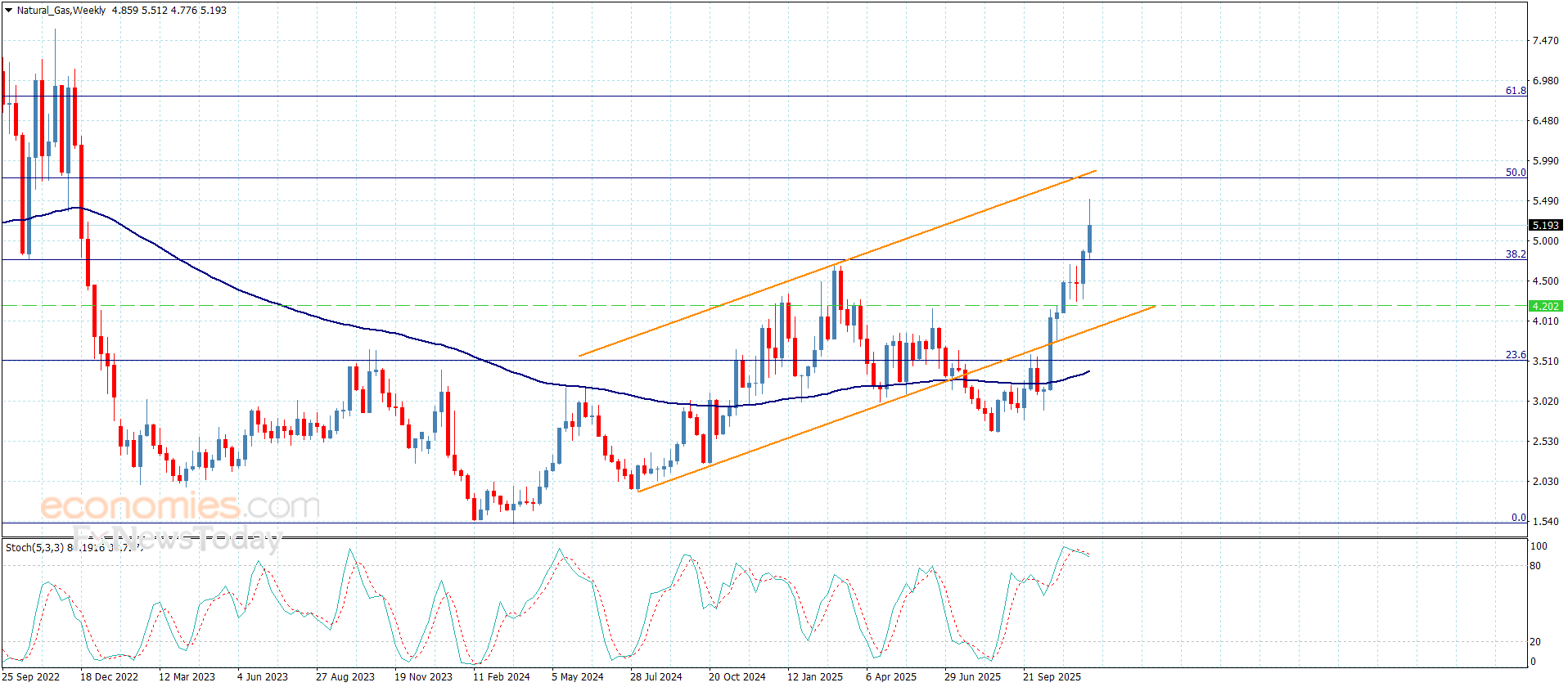
Natural gas price reached $5.510 level in Friday’s trading, to record the previously suggested initial main target, which forces it to form quick rebound towards $5.150, affected by stochastic attempt to exit the overbought level.
This will not threaten the main bullish scenario due to the stability within the bullish channel, besides the continuation of forming extra support at $4.750 level against the current trading, therefore, we will keep waiting for gathering extra bullish momentum, to ease the mission of its stability above $5.450 level, then wait for recording the next main target near $5.710.
The expected trading range for today is between $5.000 and $5.450
Trend forecast: Bullish
Occidental Petroleum Corporation (OXY) declined slightly in its latest intraday trading after the stock collided with the resistance of its previous 50-day SMA, as it attempts to acquire positive momentum that may help it overcome its negative pressure. This comes under the dominance of a short-term corrective ascending trend, with the price moving alongside a supporting trendline, accompanied by positive signals from the RSI indicators.
Therefore we expect the stock to rise in its upcoming trading, but only if it first breaks the resistance level of $43.45, targeting thereafter its next resistance at $46.00.
Today’s price forecast: Neutral
Spot Gold trades with a soft tone in the American session on Monday, easing from an early peak of $4,219 a troy ounce and currently hovering in the $4,190 region. The US Dollar (USD) shed some ground at the beginning of the day amid mounting speculation that the Federal Reserve (Fed) will deliver a dovish monetary policy decision.
Back when policymakers met in October, Chairman Jerome Powell noted a December interest rate cut was not to be taken for granted, due to the uncertainty related to the lack of official data throughout the federal government shutdown. The government reopened, and data is slowly back, but that’s not behind speculation of an upcoming rate cut: Market participants believe the Fed will act on the back of a deteriorated labor market.
Some clues on the employment situation will appear on Tuesday, as ADP will release the 4-week average Employment Change, while the Bureau of Labor Statistics (BLS) will publish the JOLTS Job Openings reports for September and October. The Fed is scheduled to announce its decision on monetary policy on Wednesday. As investors gear up for the announcements, price action across the FX board remains subdued.
XAU/USD losses steam in the near term, and the 4-hour chart shows it trades at $4,190.24, below the day’s opening price by $19.89. The 20-period Simple Moving Average (SMA) turned marginally lower but remains above rising 100- and 200-period SMAs, preserving a broader positive bias. Price holds above the medium- and long-term averages yet sits beneath the 20 SMA, keeping the immediate tone capped; the 20 SMA provides near-term resistance at $4,206.92. At the same time, the Momentum indicator slips below 0 and extends lower, while the Relative Strength Index (RSI) indicator heads south at around 44, supporting the ongoing bearish case. A recovery through the short-term average would ease pressure and open room for a rebound, while failure to reclaim it would keep sellers in control.
In the daily chart, XAU/USD trades above all its moving averages, with the 20-day SMA advancing well above the 100- and 200-day SMAs, reflecting buyers’ control. At the same time, the Momentum indicator holds above its midline but has eased from recent highs, indicating buying interest is losing steam. Finally, the RSI eases but stands at 58, limiting the bearish potential in the wider perspective. As long as price remains above the 20-day SMA, an upside extension could follow, while a pullback would eye the 100-day SMA at $3,784.84 as next support.
(The technical analysis of this story was written with the help of an AI tool)
Prices ran hot last week on colder outlooks and anticipation of hefty draws in the next three EIA storage reports. But over the weekend, the European (EC) weather model shifted notably warmer for the 8–15 day period, blunting the bullish narrative. The GFS model still leans colder, but even that has moderated.
That’s not what bulls wanted to see. Traders betting on sustained winter demand were leaning heavily on those extended forecasts to keep the rally going. Instead, the shift back toward seasonal or above-average temps later this month throws cold water on the idea of a sustained push above $5.50.
Last week’s EIA report showed a 12 Bcf draw — modest, but expected for the week ending Nov 28. Total stocks now sit at 3,923 Bcf, still 191 Bcf above the five-year average. With three bigger draws on deck due to this week’s frigid system sweeping across the northern U.S., bulls are counting on storage to tighten quickly.
But positioning is tricky here. The market wants to price in those stronger withdrawals — and there’s a decent case for it — but if weather models continue to lean mild into late December, the risk is that even strong EIA prints get faded. Especially if buyers start questioning how long the cold sticks around.
Technically, the retreat from $5.496 isn’t just profit-taking — it’s a sentiment shift. The 50% retracement at $4.953 is being tested right now, and it’s a line in the sand. A clean break could trigger momentum selling toward $4.73. On the flip side, if models trend back colder and $4.953 holds, dip buyers may re-emerge.
Bottom line: the weather premium is under review. Models have turned against the bulls for now, and the price action reflects that. If we get another round of milder updates, the selloff likely deepens. But if the cold snaps back into the 8–15 day window, traders could chase another leg higher.
Select market data provided by ICE Data Services. Select reference data provided by FactSet. Copyright © 2025 FactSet Research Systems Inc.Copyright © 2025, American Bankers Association. CUSIP Database provided by FactSet Research Systems Inc. All rights reserved. SEC fillings and other documents provided by Quartr.© 2025 TradingView, Inc.