The main tag of GoldPrice Articles.
You can use the search box below to find what you need.
[wd_asp id=1]
The main tag of GoldPrice Articles.
You can use the search box below to find what you need.
[wd_asp id=1]
Technically, gold held the level it needed to. The settlement at $4,198.68 is comfortably above the $4,133.95 pivot — the 50% retracement of $3,886.46 to $4,264.70. Staying above that zone keeps buyers in control and keeps a retest of $4,264.70 in play. A breakout through the weekly high would open the door to $4,381.44, the record high.
If sellers push through $4,133.95, the first real support sits at $4,075.58. A deeper pullback would target $3,886.46 — the main bottom that halted October’s slide and matches the top of the $3,846.50–$3,720.25 intermediate retracement zone. That zone remains the best long-term value area, though reaching it would require the narrative to shift materially.
Next week’s FOMC meeting is the entire focus. The committee is split, and Powell has avoided committing to a move. Doves like Williams and Waller argue for more easing; hawks like Collins want to hold steady. Desks expect at least two dissents — rare, and a reminder that the policy debate is far from settled.
Gold (XAU/USD) remains resilient after touching an intraday high of $4,259.34 and closing near $4,198.69 per ounce, down only 0.24% as profit-taking set in ahead of the upcoming Federal Reserve meeting on December 9–10. Traders booked gains following a powerful rally that has driven the metal more than 60% higher year-to-date, placing it 20% above its 200-day moving average. The current correction appears technical rather than structural, with support forming near $4,192.36, a critical Fibonacci retracement zone that continues to attract institutional interest.
Markets now price an 87% probability of a 25 bps Fed rate cut in December, as inflation indicators soften. Core PCE inflation eased to 2.8%, and job data revealed a sharp 32,000 decline in private payrolls, signaling labor market cooling. While the U.S. dollar remains firm, its inability to rally despite weaker employment data suggests underlying vulnerability. Lower yields are supporting the gold narrative, with the 10-year Treasury yield hovering near 3.88%, down from 4.45% last month. The mix of easing policy and slowing inflation keeps gold’s safe-haven appeal intact.
Global gold accumulation by central banks has reached its highest level in modern history. Ventura Capital projects gold could advance to $4,600–$4,800 in 2026, citing aggressive central bank buying, persistent inflation, and widening U.S. fiscal deficits. Deutsche Bank lifted its 2026 forecast to $4,450, maintaining a bullish stance through 2027 with targets near $5,150. Morgan Stanley sees $4,500 per ounce by mid-2026, expecting continued ETF inflows and steady official-sector purchases even if buying moderates. Together, these institutional forecasts point to structural strength rather than speculative excess.
From a charting perspective, XAU/USD shows immediate support at $4,200, reinforced by the 50-day moving average at $4,076.14. A breakdown below that level could open the door toward $4,056–$3,950, though momentum remains constructive above $4,192. Resistance zones lie between $4,255–$4,300, with further upside capped near $4,381–$4,441. A clean breakout above $4,300 would signal renewed buying power capable of driving gold toward the $4,500 psychological barrier.
Gold’s nine consecutive quarterly gains mark the strongest streak in over five decades, reflecting declining faith in fiat stability. The metal has appreciated over 59% year-to-date, outpacing global equity indices. Analysts attribute this surge to what Ventura described as a “systemic deterioration in fiat value”, intensified by expanding U.S. deficits and trade imbalances. The narrative of gold as the second most important reserve asset after the dollar is gaining momentum, with sustained buying from Asian and Middle Eastern central banks, including China and India.
In India, gold trades roughly 15% higher than Dubai, a spread caused by high import duties and rupee weakness. The domestic market’s structural premium underscores ongoing demand despite policy friction. In China, retail gold buying has softened slightly as traders await corrections, but institutional accumulation remains steady. This divergence keeps the global market balanced, with physical shortages emerging in key bullion hubs such as Singapore and Zurich.
After reaching an all-time peak near $4,398 on October 20, 2025, gold corrected to $3,891, an 11% pullback before rebounding sharply to $4,299 in early December. This pattern reflects controlled profit-taking amid optimism for a December Fed rate cut, not structural weakness. Gold’s recovery from its November low demonstrates investor conviction that policy easing will underpin higher prices into 2026.
At the corporate level, Gold.com (NYSE:GOLD) has seen its average one-year price target raised 29.7% to $35.02, with the upper range near $47.85 per share. Institutional positioning remains strong despite quarterly portfolio rotations — Royal Bank of Canada, First Eagle, and Ameriprise collectively hold over 70 million shares in gold-related equities and funds. The put/call ratio of 0.16 on GOLD signals bullish sentiment in derivative markets. ETF inflows, especially in the SPDR Gold Trust and iShares Gold ETF, have mirrored spot gold’s trajectory, reinforcing the underlying bid from institutional portfolios.
The Relative Strength Index (RSI) stands near 58, indicating a moderate uptrend with room to extend. ADX around 37 suggests a sustained trend, while MACD remains slightly bullish, confirming that the recent dip is consolidation, not reversal. The 50-day EMA at $4,120 is converging toward the 100-day EMA, setting up a potential golden cross that could mark the start of the next leg higher if the Fed delivers the anticipated policy pivot.
Forecasts from Ventura, Deutsche Bank, and Morgan Stanley converge around a $4,600–$4,800 target for 2026, citing inflation persistence, central-bank demand, and ETF inflows. HDFC Securities recommends investors maintain a 5–10% portfolio allocation in gold and silver, given the asset’s role as a hedge against geopolitical volatility and monetary uncertainty. The medium-term bias remains upward, supported by real rate compression and continued structural demand.
With gold holding firm above $4,190 and fundamentals aligning across monetary, institutional, and technical fronts, XAU/USD remains in a confirmed bull cycle. The bias is Bullish, favoring BUY on dips toward $4,150–$4,200, targeting $4,450–$4,600 by mid-2026. Unless the Fed surprises with hawkish commentary or central banks abruptly scale back purchases, gold’s trajectory remains intact, positioning it as one of the few assets bridging monetary policy, inflation protection, and systemic risk hedging into the next cycle.
A failed move keeps gold trapped inside a five-day tight range between $4,164 and $4,264. The rising 10-day average at $4,186—successfully defended this week—remains the primary near-term dynamic support alongside this week’s $4,164 low. As long as gold holds above the 10-day line, the bias stays bullish.
A daily close above Thursday’s $4,219 high would show minor strength, but true breakout validation requires settlement above last week’s high and the six-week peak at $4,245. A decisive push and sustained trade above $4,264 is ultimately needed to prove buyers are back in charge.
The recent correction ended with a higher swing low at $3,886, followed by a repeating sequence: inside week to upside breakout to inside week to upside breakout. This week has deviated slightly with a very narrow range mostly near last week’s highs instead of a fresh advance, yet the relative strength is clear, and gold is on track for its third-highest weekly close in history.
Friday’s bounce off the 10-day average reinforces its short-term importance. Should it fail, the 20-day average at $4,144—currently converging with the late-November uptrend line—steps up as the next significant dynamic defense.
Gold continues flashing higher-price potential, but momentum remains conspicuously absent. Hold the 10-day average and deliver a close above $4,241–$4,245 to keep the bull case intact and target $4,264+; failure to do so risks another leg lower toward the 20-day/trendline confluence while the larger uptrend stays safe with price above the 50-day average, now at $4,076.
For a look at all of today’s economic events, check out our economic calendar.
Gold price (XAU/USD) gains 0.4% to near $4,230 during the European trading session on Friday. The yellow metal trades firmly, but is confided in a tight range between $4,164 and $4,265 for the last four trading days.
The outlook of the precious metal remains bullish as the Federal Reserve (Fed) is widely anticipated to cut interest rates in its monetary policy announcement on Wednesday. Lower interest rates by the Fed bode well for non-yielding assets, such as Gold.
According to the CME FedWatch tool, the probability of the Fed cutting interest rates by 25 basis points (bps) to 3.50%-3.75% in the December policy meeting is 87%. Fed dovish expectations are prompted by weakening United States (US) labor market conditions.
With expectations pointing to a 25-bps interest rate reduction, investors will pay more attention to the monetary policy guidance of 2026. Fed officials are expected to adopt a restrictive monetary policy outlook as inflation remains well above the 2% target for months.
During the European session, the US Dollar (USD) strives to hold its immediate lows, with the US Dollar Index (DXY) trading cautiously near the five-week low around 98.75.
In the daily chart, XAU/USD trades around $4,190 during Friday’s European trading hours. The 20-day Exponential Moving Average (EMA) at $4,147.96 rises, with price holding above it to maintain a positive bias. Pullbacks toward the 20-day EMA would find support while its slope stays higher.
The 14-day Relative Strength Index (RSI) rebounds after bending to near 60.00, suggesting that the momentum will remain in play until it holds that level.
The 20-day EMA remains positively aligned, keeping dip-buying interest in play. The rising trend line from the October 28 low of $3,933.90 underpins the bias, offering support near $4,110. A daily close below that line would flag a deeper pullback towards the psychological level of $4,000, while holding above it would leave scope for an extension of the advance.
(The technical analysis of this story was written with the help of an AI tool)
Gold has played a key role in human’s history as it has been widely used as a store of value and medium of exchange. Currently, apart from its shine and usage for jewelry, the precious metal is widely seen as a safe-haven asset, meaning that it is considered a good investment during turbulent times. Gold is also widely seen as a hedge against inflation and against depreciating currencies as it doesn’t rely on any specific issuer or government.
Central banks are the biggest Gold holders. In their aim to support their currencies in turbulent times, central banks tend to diversify their reserves and buy Gold to improve the perceived strength of the economy and the currency. High Gold reserves can be a source of trust for a country’s solvency. Central banks added 1,136 tonnes of Gold worth around $70 billion to their reserves in 2022, according to data from the World Gold Council. This is the highest yearly purchase since records began. Central banks from emerging economies such as China, India and Turkey are quickly increasing their Gold reserves.
Gold has an inverse correlation with the US Dollar and US Treasuries, which are both major reserve and safe-haven assets. When the Dollar depreciates, Gold tends to rise, enabling investors and central banks to diversify their assets in turbulent times. Gold is also inversely correlated with risk assets. A rally in the stock market tends to weaken Gold price, while sell-offs in riskier markets tend to favor the precious metal.
The price can move due to a wide range of factors. Geopolitical instability or fears of a deep recession can quickly make Gold price escalate due to its safe-haven status. As a yield-less asset, Gold tends to rise with lower interest rates, while higher cost of money usually weighs down on the yellow metal. Still, most moves depend on how the US Dollar (USD) behaves as the asset is priced in dollars (XAU/USD). A strong Dollar tends to keep the price of Gold controlled, whereas a weaker Dollar is likely to push Gold prices up.
Important DisclaimersFXEmpire is owned and operated by Empire Media Network LTD., Company Registration Number 514641786, registered at 7 Jabotinsky Road, Ramat Gan 5252007, Israel. The content provided on this website includes general news and publications, our personal analysis and opinions, and materials provided by third parties. This content is intended for educational and research purposes only. It does not constitute, and should not be interpreted as, a recommendation or advice to take any action, including making any investment or purchasing any product. Before making any financial decision, you should conduct your own due diligence, exercise your own discretion, and consult with competent advisors. The content on this website is not personally directed to you, and we do not take into account your individual financial situation or needs. The information contained on this website is not necessarily provided in real time, nor is it guaranteed to be accurate. Prices displayed may be provided by market makers and not by exchanges. Any trading or other financial decision you make is entirely your own responsibility, and you must not rely solely on any information provided through the website. FXEmpire does not provide any warranty regarding the accuracy, completeness, or reliability of any information contained on the website and shall bear no responsibility for any trading losses you may incur as a result of using such information. The website may include advertisements and other promotional content. FXEmpire may receive compensation from third parties in connection with such content. FXEmpire does not endorse, recommend, or assume responsibility for the use of any third-party services or websites. Empire Media Network LTD., its employees, officers, subsidiaries, and affiliates shall not be liable for any loss or damage resulting from your use of the website or reliance on the information provided herein.Risk DisclaimersThis website contains information about cryptocurrencies, contracts for difference (CFDs), and other financial instruments, as well as about brokers, exchanges, and other entities trading in such instruments. Both cryptocurrencies and CFDs are complex instruments and involve a high risk of losing money. You should carefully consider whether you understand how these instruments work and whether you can afford to take the high risk of losing your money. FX Empire encourages you to conduct your own research before making any investment decision and to avoid investing in any financial instrument unless you fully understand how it works and the risks involved.
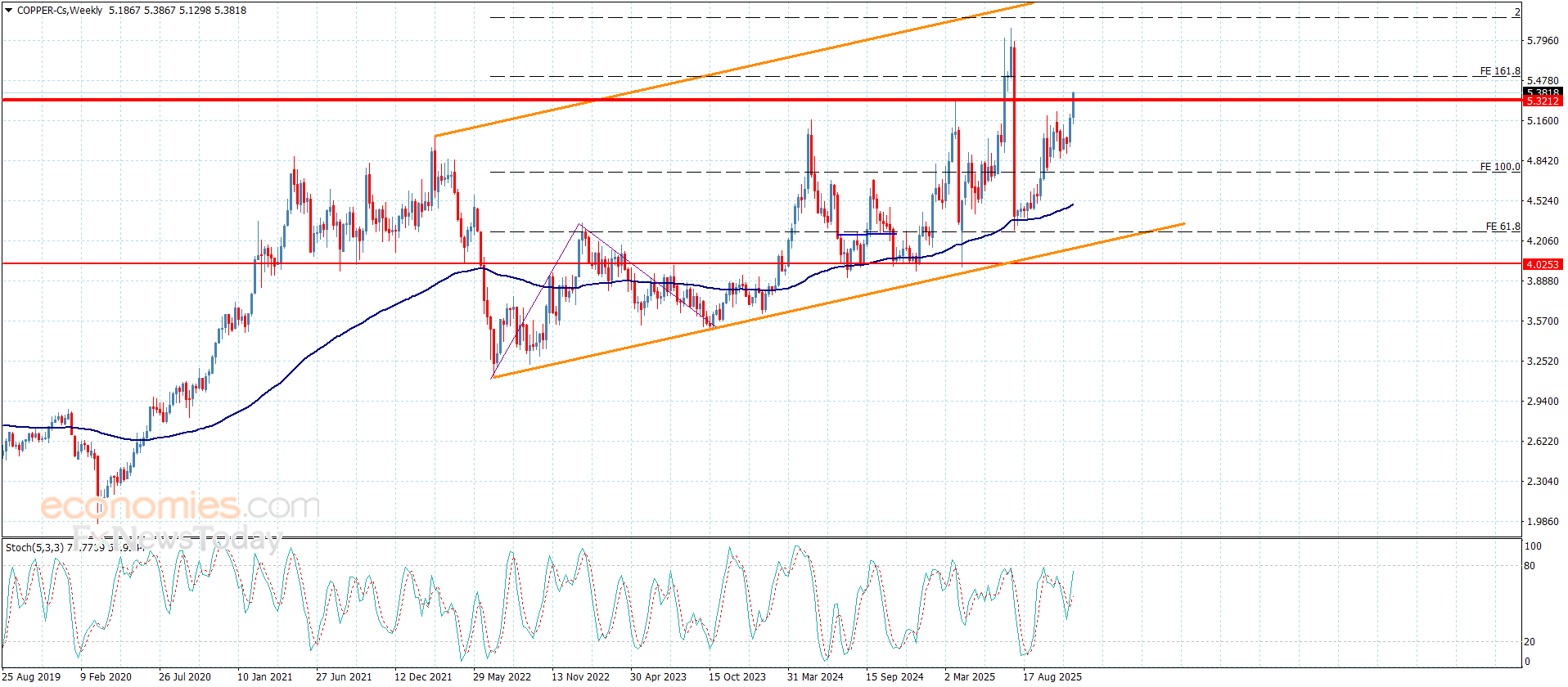
Copper price continued forming bullish trading, attempting to settle above $5.3200 level, to open the way for achieving more gains as we expected, the unionism of providing positive momentum by the main indicators will reinforce the chances of reaching $4.5000, which might form a key barrier against the current trading.
While the fluctuation below $5.2000 might force it to delay the bullish attack temporarily, which forces it to activate the bearish corrective track by targeting $4.9500 level before any attempt to record more positive targets.
The expected trading range for today is between $5.2500 and $5.5000
Trend forecast: Bullish
Prices climbed 1.36% on Thursday, recovering from early session losses to hit their highest level in nearly three years. The driver? Fresh forecasts from Atmospheric G2 showing sub-normal temperatures across the eastern U.S. from December 9–13. That’s pushing expectations for stronger heating demand, a key seasonal tailwind. Traders have seen this pattern before — winter risk premium creeping in fast, and positioning tends to follow.
Still, not all the data was bullish. The EIA reported a storage draw of just 12 bcf for the week ending November 28, well below expectations for an 18 bcf drop. The five-year average draw for this week is 43 bcf. That’s a miss, and it shows inventories remain comfortable — now 5.1% above the five-year average, even if they’re slightly below last year’s levels. Bottom line: storage isn’t screaming scarcity.
On the production front, dry gas output hit 111.5 bcf/day on Thursday, up more than 6% from a year ago. And despite the cold snap, supply hasn’t flinched. In fact, active rigs climbed to 130 last week, a 2.25-year high. That supply confidence might cap upside in the near term unless weather turns severe.
Demand is holding up. Thursday’s lower-48 consumption hit 118.1 bcf/day — a 12% jump year-over-year. Meanwhile, LNG flows ticked down slightly to 17.7 bcf/day, but that’s still a historically strong level. Power burn is also supportive: U.S. electricity output rose 2.1% y/y last week, with a 3% gain over the trailing 12 months. Traders are watching for whether this demand can keep pace with elevated production — or if another storage miss cools the rally.
The global coffee market is projected to reach USD 486.2 billion by 2035, recording an absolute increase of USD 201.4 billion over the forecast period. The market is valued at USD 284.8 billion in 2025 and is set to rise at a CAGR of 5.5% during the assessment period.
The market is expected to grow by nearly 1.7 times during the same period, supported by increasing consumer preferences for premium coffee experiences and specialty coffee consumption across retail channels, foodservice establishments, and home brewing segments worldwide, driving demand for roasted coffee products, single-serve capsule systems, and ready-to-drink beverage formats across both developed and emerging markets.
Growing application diversity in coffeehouse chains, convenience retail outlets, and e-commerce distribution platforms creates expanding opportunities for coffee product implementations and specialized brand positioning strategies. Rising disposable incomes in emerging economies, coupled with expanding coffee culture penetration through specialty coffee shops and artisanal roasting operations, further accelerate market growth across diverse consumer segments.
The growing global appreciation for coffee variety and brewing innovation, particularly in developed regions, generates sustained interest in premium roasted coffee and single-origin offerings containing arabica beans and specialty processing methods.
Consumer research demonstrating lifestyle integration of coffee consumption, social gathering facilitation, and functional beverage benefits reinforces market confidence in coffee product adoption, while retail industry trends toward premiumization and convenience formats expand addressable market opportunities beyond traditional commodity coffee categories.
Coffee retailers and foodservice operators increasingly incorporate specialty coffee programs into menu offerings, retail merchandising strategies, and customer experience initiatives, creating mainstream consumption channels that extend beyond basic commodity coffee into premium lifestyle categories. Climate change impacts on coffee cultivation regions and price volatility in commodity coffee markets may pose challenges to supply chain stability.
Agricultural challenges involving disease resistance requirements, water availability constraints, and sustainable farming practice adoption in certain production regions also influence supply dynamics, requiring industry stakeholders to develop comprehensive sustainability programs catering to specific environmental requirements across different geographical contexts.
Supply chain complexity during green coffee sourcing and the technical requirements for quality maintenance and freshness preservation protocols may limit market accessibility among smaller coffee roasters in developing regions with constrained capabilities for advanced logistics management and quality control systems.
Between 2025 and 2030, the coffee market is projected to expand from USD 284.8 billion to USD 372.5 billion, resulting in a value increase of USD 87.7 billion, which represents 43.6% of the total forecast growth for the decade. This phase of development will be shaped by rising demand for premium coffee experiences and convenience-oriented consumption formats, product innovation in single-serve capsule technologies and cold brew formulations, as well as expanding integration with digital ordering platforms and subscription-based delivery services. Companies are establishing competitive positions through investment in sustainable sourcing programs, brand differentiation strategies, and strategic market expansion across specialty retail segments, foodservice channels, and direct-to-consumer platforms.
From 2030 to 2035, the market is forecast to grow from USD 372.5 billion to USD 486.2 billion, adding another USD 113.7 billion, which constitutes 56.4% of the overall ten-year expansion. This period is expected to be characterized by the commercialization of innovative coffee formats, including functional coffee beverages and plant-based coffee alternatives tailored for specific consumer preferences, strategic collaborations between coffee brands and retail partners, and an enhanced focus on traceability initiatives and carbon-neutral production practices. The growing emphasis on experiential consumption and ethical sourcing will drive demand for transparent supply chain solutions across diverse retail and foodservice applications.
| Metric | Value |
|---|---|
| Market Value (2025) | USD 284.8 billion |
| Market Forecast Value (2035) | USD 486.2 billion |
| Forecast CAGR (2025-2035) | 5.5% |
The coffee market grows by enabling retailers, foodservice operators, and beverage companies to access diverse product portfolios that support consumer demand while meeting lifestyle integration requirements for daily consumption rituals. Food and beverage companies face mounting pressure to develop differentiated coffee offerings with proven quality attributes, with premium coffee products typically commanding 30-50% price premiums compared to commodity alternatives, making these products essential for margin optimization positioning in specialty beverage categories. The beverage industry’s need for brand differentiation and consumer loyalty creates demand for coffee products that can provide distinctive flavor profiles, maintain consistent quality across production batches, and ensure supply reliability without compromising sustainability credentials or ethical sourcing standards.
Consumer lifestyle changes promoting coffee culture adoption and workplace consumption patterns drive demand in retail stores, coffeehouse establishments, and office coffee services, where coffee product selection has a direct impact on customer satisfaction and repeat purchase behavior. The foodservice industry’s growing focus on specialty coffee programs and premium beverage menus further expands market opportunities, with consumer research demonstrating measurable willingness to pay for quality coffee experiences, convenience formats, and brand authenticity. However, supply chain complexity during sourcing operations and the agricultural requirements for climate adaptation and sustainable farming practices may limit production scalability among coffee growers and developing regions with vulnerable agricultural systems facing environmental pressures.
The market is segmented by product, distribution channel, and region. By product, the market is divided into roasted, instant, ready-to-drink, pods and capsules, and whole beans. Based on distribution channel, the market is categorized into B2C and B2B. Regionally, the market is divided into North America, Europe, Asia Pacific, Latin America, and mea.
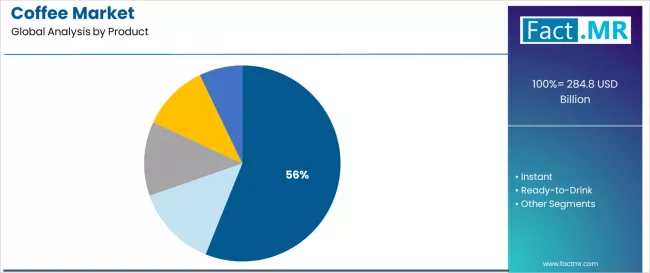
The roasted segment represents the dominant force in the coffee market, capturing a 56.1% of total market share in 2025. This established product category encompasses solutions featuring ground coffee and whole bean formats from coffee roasting operations, including light, medium, and dark roast profiles that enable diverse brewing applications and consistent quality standards across all consumption occasions.
The roasted coffee segment’s market leadership stems from its versatility, with products capable of meeting diverse preparation methods while maintaining flavor complexity and operational compatibility across demanding consumer environments. Within the roasted segment, medium roast profiles account for significant share, driven by balanced flavor characteristics and broad consumer appeal.
The instant segment maintains a substantial 18.0% market share, serving consumers who require convenient preparation with rapid dissolution for time-sensitive consumption occasions and travel applications. These products offer accessibility for emerging markets and workplace settings while providing sufficient quality characteristics to meet everyday consumption needs and budget-conscious purchasing requirements. The instant segment serves established price-sensitive markets and convenience-oriented applications.
Key advantages driving the roasted segment include:
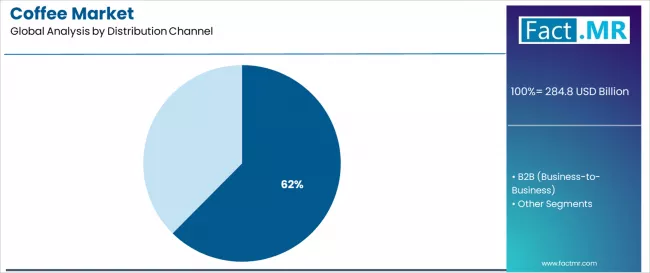
B2C dominates the distribution channel segment with approximately 62.4% market share in 2025, reflecting the critical role of consumer retail channels in supporting coffee consumption and household purchasing patterns worldwide. The B2C segment’s market leadership is reinforced by established retail infrastructure, diverse product selection capabilities, and rising consumer preferences for at-home coffee preparation and premium product exploration across developed and emerging consumer markets. Within the B2C segment, supermarkets and specialty retailers account for significant share, driven by product variety and shopping convenience.
The B2B segment represents the second-largest distribution category, capturing 37.6% market share through foodservice establishments, office coffee services, and hospitality sector operations. This segment benefits from commercial consumption patterns that meet workplace productivity requirements, hospitality service expectations, and institutional catering protocols in competitive foodservice markets.
Key market dynamics supporting distribution channel growth include:
The market is driven by three concrete demand factors tied to lifestyle trends and consumption habits. First, increasing urbanization and workplace culture evolution creates growing demand for coffee products, with global coffee consumption expanding by 2-3% annually in major consumer markets worldwide, requiring comprehensive supply chain infrastructure. Second, premiumization trends and specialty coffee appreciation drive increased consumer spending on quality coffee products, with consumers in developed markets allocating 15-20% higher budgets toward premium coffee purchases compared to commodity alternatives. Third, convenience format innovations in single-serve capsules and ready-to-drink beverages enable more accessible consumption occasions that reduce preparation barriers while improving portability and on-the-go consumption capabilities.
Market restraints include climate change impacts affecting coffee-growing regions that can disrupt production volumes and quality consistency, particularly in vulnerable origins where temperature variations and precipitation changes threaten arabica cultivation. Price volatility in commodity coffee markets poses another significant challenge, as coffee prices experience cyclical fluctuations based on harvest conditions and currency movements, potentially causing margin pressure and consumer price sensitivity. Competition from alternative beverages and changing consumption preferences creates additional market challenges for sustained volume growth, demanding ongoing investment in product innovation and marketing programs.
Key trends indicate accelerated consumption growth in Asia Pacific markets, particularly China and India, where coffee culture adoption and Western lifestyle influence drive comprehensive market development. Product innovation trends toward functional coffee formulations with added wellness benefits, cold brew format expansion with extended shelf life capabilities, and sustainability certification programs enable differentiated positioning approaches that optimize brand value and minimize environmental impact. However, the market thesis could face disruption if significant advances in synthetic caffeine alternatives or major shifts in consumer beverage preferences reduce reliance on traditional coffee consumption patterns.
| Country | CAGR (2025-2035) |
|---|---|
| India | 7.2% |
| China | 6.8% |
| Vietnam | 6.4% |
| USA | 5.1% |
| Brazil | 4.7% |
| Germany | 3.9% |
| Saudi Arabia | 3.3% |
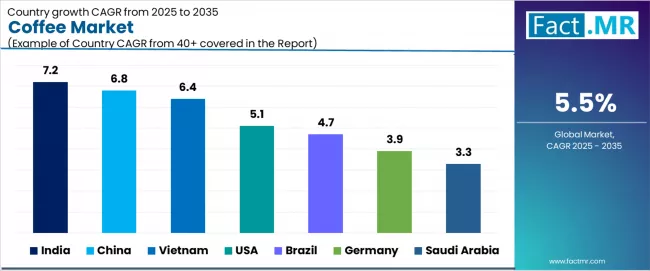
The coffee market is expanding steadily, with India leading at a 7.2% CAGR through 2035, driven by coffee culture adoption among young urban consumers, cafe chain expansion, and increasing disposable incomes. China follows at 6.8%, supported by rapid specialty coffee market development, international brand penetration, and evolving beverage consumption patterns. Vietnam records 6.4%, reflecting domestic consumption growth and specialty coffee segment emergence.
USA posts 5.1%, anchored by specialty coffee innovation and premium product proliferation. Brazil grows at 4.7%, with expanding domestic consumption and quality coffee appreciation. Germany advances at 3.9%, emphasizing established coffee culture and premium product preferences, while Saudi Arabia grows steadily at 3.3%, focusing on cafe culture development and lifestyle modernization trends.
India demonstrates the strongest growth potential in the coffee market with a CAGR of 7.2% through 2035. The country’s leadership position stems from coffee culture adoption among young urban consumers, cafe chain expansion across major metropolitan centers, and increasing disposable incomes enabling premium product purchasing.
Growth is concentrated in major cities, including Mumbai, Delhi, Bangalore, and Hyderabad, where international coffee chains and domestic cafe operators are implementing specialty coffee programs for aspirational consumer segments and workplace consumption occasions.
Product distribution through modern retail formats, e-commerce platforms, and branded cafe networks expands access across urban consumer populations and emerging middle-class demographics. The country’s evolving coffee culture provides market momentum for consumption growth, including cafe socialization trends and home brewing adoption.
Key market factors:
In major urban centers including Shanghai, Beijing, Guangzhou, and Shenzhen, the adoption of coffee consumption is accelerating across cafe establishments and retail channels, driven by rapid specialty coffee market development and international brand presence. The market demonstrates strong growth momentum with a CAGR of 6.8% through 2035, linked to rapid specialty coffee market growth, international brand penetration establishing coffee culture, and evolving beverage consumption patterns among younger demographics.
Chinese consumers are implementing coffee consumption into daily routines and social activities to embrace Western lifestyle trends while exploring premium product categories and experiential consumption formats. The country’s expanding urban middle class creates persistent demand for quality coffee products, while increasing cafe density in major cities drives regular consumption habit formation.
Key development areas:
Vietnam’s market expansion is driven by diverse consumption demand, including traditional coffee culture in Ho Chi Minh City and Hanoi, and specialty coffee segment emergence across urban regions. The country demonstrates promising growth potential with a CAGR of 6.4% through 2035, supported by domestic consumption growth beyond production-focused activities, specialty coffee segment development, and increasing quality appreciation among urban consumers.
Vietnamese consumers face market evolution challenges related to premium product accessibility, requiring retail infrastructure development and international brand entry. However, growing urbanization and rising incomes create compelling market expansion cases for coffee consumption, particularly in cities where lifestyle modernization has a direct impact on beverage preference evolution and consumption frequency.
Market characteristics:
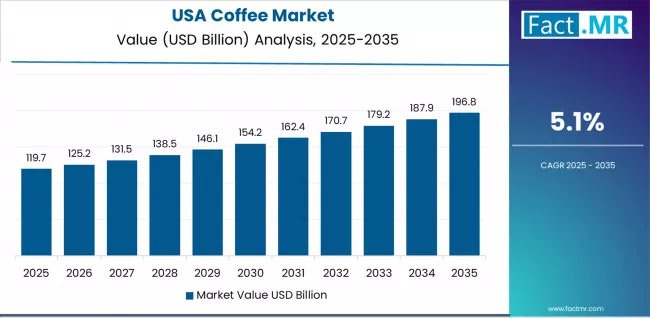
The USA market leads in specialty coffee innovation based on integration with established coffee culture and comprehensive retail infrastructure. The country shows steady potential with a CAGR of 5.1% through 2035, driven by specialty coffee innovation programs, premium product proliferation, and the expansion of artisanal roasting operations in major urban centers, including New York, Los Angeles, Seattle, and San Francisco.
American consumers are implementing diverse coffee consumption patterns for workplace productivity and lifestyle integration, particularly in metropolitan regions with advanced coffee culture and consumption occasions demanding comprehensive product variety. Product deployment channels through specialty retailers and coffeehouse chains expand coverage across premium consumer segments and convenience-focused operations.
Leading market segments:
Brazil’s market expansion is driven by evolving consumption patterns, including quality coffee appreciation in São Paulo and Rio de Janeiro, and domestic market development across coffee-producing regions. The country demonstrates promising growth potential with a CAGR of 4.7% through 2035, supported by expanding domestic consumption beyond export focus, quality coffee appreciation programs, and growing consumer sophistication in major urban centers.
Brazilian consumers face market transformation related to premium product availability, requiring retail development and domestic brand positioning. However, coffee culture heritage and production expertise create compelling consumption growth cases, particularly in urban areas where domestic consumption has a direct impact on market value addition and coffee industry diversification.
Market characteristics:
In major consumer markets including Berlin, Munich, Hamburg, and Frankfurt, consumers are maintaining comprehensive coffee consumption patterns supporting market stability and premium product adoption, with documented per capita consumption showing 165 liters annually through established coffee culture integration. The market shows steady potential with a CAGR of 3.9% through 2035, linked to established coffee culture traditions, premium product preferences, and comprehensive retail infrastructure in major consumer regions.
German consumers utilize diverse coffee products and brewing methods to maintain daily consumption rituals while supporting quality standards demanded by sophisticated coffee culture and heritage consumption patterns. The country’s mature market infrastructure creates sustained demand for quality coffee products that integrate with existing consumption habits.
Market development factors:
Saudi Arabia’s coffee market demonstrates evolving consumption landscape focused on cafe culture development and Western lifestyle adoption, with documented growth in coffeehouse establishments, achieving 40% year-over-year expansion in major cities through lifestyle modernization programs.
The country maintains steady growth momentum with a CAGR of 3.3% through 2035, driven by cafe culture development initiatives, lifestyle modernization trends, and youth population preferences that align with social gathering expectations. Major urban centers, including Riyadh, Jeddah, Dammam, and Makkah, showcase expanding deployment of international coffee chains where cafe operators integrate seamlessly with shopping mall developments and comprehensive hospitality programs.
Key market characteristics:

The coffee market in Europe is projected to grow from USD 85.4 billion in 2025 to USD 142.1 billion by 2035, registering a CAGR of 5.5% over the forecast period. Germany is expected to maintain its leadership position with a 22.5% market share in 2025, supported by its established coffee culture, comprehensive retail infrastructure, and strong per capita consumption rates across major consumer centers.
Italy follows with a 19.0% share in 2025, driven by comprehensive espresso culture in major regions implementing traditional consumption patterns and premium product integration. France holds a 16.5% share through the ongoing development of cafe culture and specialty coffee adoption. UK commands a 15.0% share, while Spain accounts for 12.0% in 2025.
The rest of Europe maintains a 15.0% collective share, attributed to increasing coffee consumption in Nordic countries and emerging Eastern European market development implementing coffee culture programs. By 2035, Germany is projected to hold 22.0% share, Italy 19.2%, France 17.0%, UK 15.5%, Spain 12.3%, and Rest of Europe 14.0%, reflecting sustained growth momentum across all major European markets.
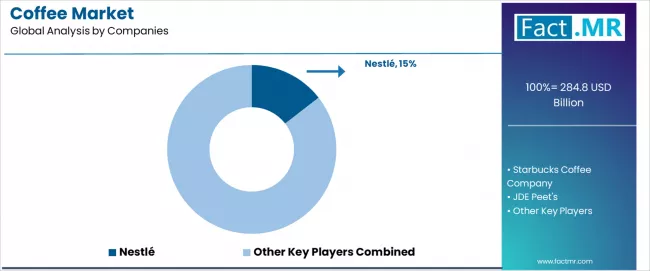
The coffee market features approximately 30-40 meaningful players with moderate concentration, where the top three companies control roughly 25-30% of global market value through established brand portfolios and extensive distribution networks. Competition centers on brand positioning, product quality, and distribution reach rather than price competition alone.
Market leaders include Nestlé, Starbucks Coffee Company, and JDE Peet’s, which maintain competitive advantages through comprehensive product portfolios, global brand recognition, and deep expertise in the coffee sourcing and consumer marketing sectors, creating strong brand loyalty among consumers.
These companies leverage established distribution networks and ongoing product innovation programs to defend market positions while expanding into adjacent premium segments and emerging market applications. Nestlé commands a 14.5% market share through vertical integration capabilities and comprehensive brand portfolio coverage.
Challengers encompass Tchibo GmbH and Luigi Lavazza S.p.A., which compete through regional market strength and premium brand positioning in key consumer markets. Coffee specialists, including Strauss Coffee BV, The J.M. Smucker Company, and Melitta Group, focus on specific product categories or distribution channels, offering differentiated capabilities in instant coffee, retail brands, and filter systems.
Regional roasters and specialty coffee companies create competitive pressure through artisanal positioning and local market presence, particularly in high-growth markets including China and India, where emerging consumer preferences provide advantages in specialty segment development.
Market dynamics favor companies that combine sustainable sourcing practices with comprehensive brand marketing programs that address the complete consumer journey from product awareness through purchase decision and consumption experience. Strategic collaborations between coffee companies and retail partners accelerate market penetration, while sustainability certification initiatives enable differentiation and premium positioning across consumer segments.
Coffee products represent critical beverage offerings that enable retailers, foodservice operators, and beverage companies to deliver consumer satisfaction without excessive complexity, typically providing 40-60% gross margins in specialty formats compared to commodity alternatives while maintaining consistent quality expectations.
With the market projected to grow from USD 284.8 billion in 2025 to USD 486.2 billion by 2035 at a 5.5% CAGR, these products offer compelling advantages – lifestyle integration, premium positioning, and consumption versatility – making them essential for retail merchandising (growing segment), foodservice menus (established adoption), and diverse consumption applications seeking proven beverage category alternatives. Scaling market penetration and sustainability programs requires coordinated action across agricultural policy organizations, coffee industry associations, roasting companies, retail partners, and certification bodies.
| Items | Values |
|---|---|
| Quantitative Units | USD 284.8 Billion |
| Product | Roasted, Instant, Ready-to-Drink, Pods & Capsules, Whole Beans |
| Distribution Channel | B2C, B2B |
| Regions Covered | North America, Europe, Asia Pacific, Latin America, mea |
| Country Covered | India, China, Vietnam, USA, Brazil, Germany, Saudi Arabia, and 40+ countries |
| Key Companies Profiled | Nestlé, Starbucks Coffee Company, JDE Peet’s, Tchibo GmbH, Luigi Lavazza S.p.A., Strauss Coffee BV, The J.M. Smucker Company, Melitta Group, UCC Ueshima Coffee Co. Ltd., Massimo Zanetti Beverage Group |
| Additional Attributes | Dollar sales by product and distribution channel categories, regional consumption trends across Asia Pacific, North America, and Europe, competitive landscape with coffee roasters and beverage companies, product specifications and quality standards, integration with retail systems and foodservice platforms. |
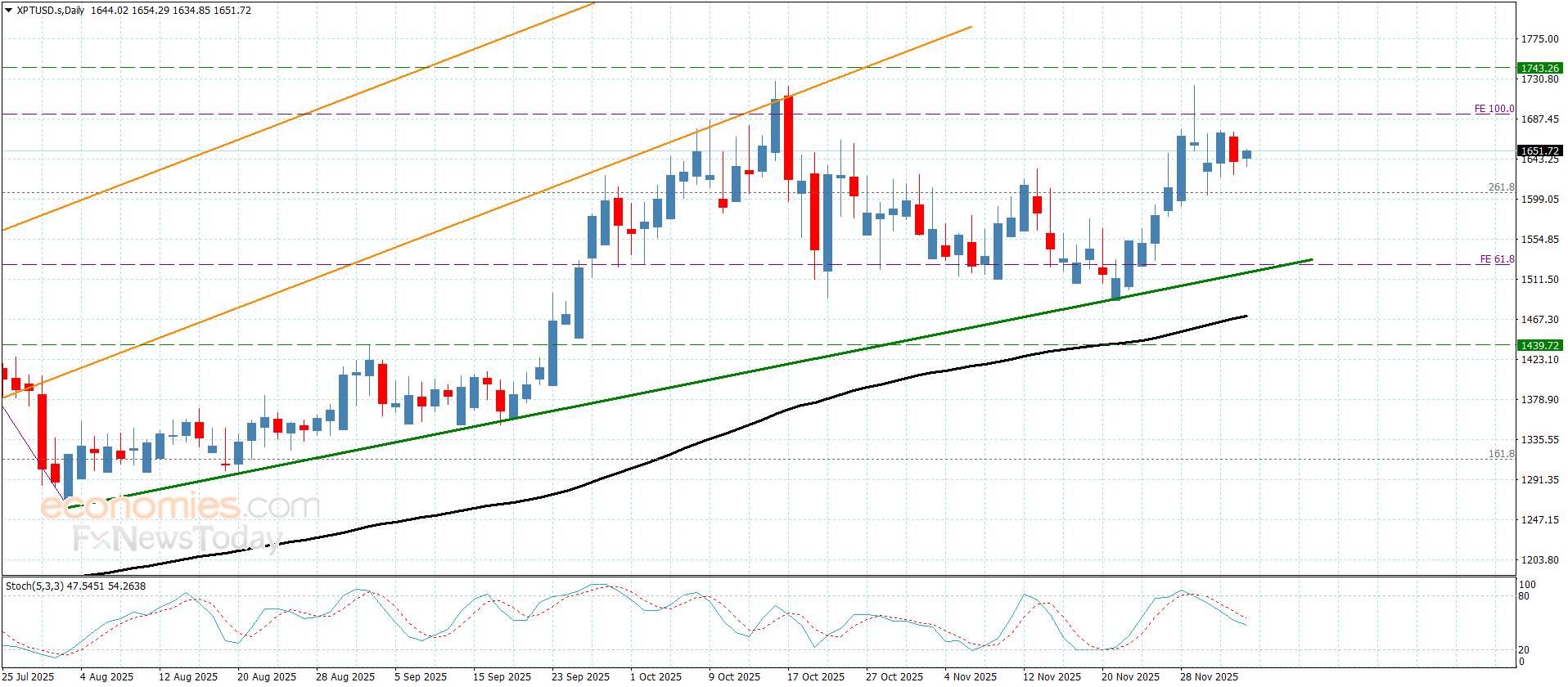
No news for platinum price until this moment, providing weak sideways trading by its stability near$1650.00, due to the continuation of the main indicators’ contradiction, specifically by stochastic reaching below 50 level.
The sideways trading might continue for today, but the stability above the extra support at $1605.00 forms extra factor to confirm the dominance of the bullish track, therefore we will keep waiting to gather extra bullish momentum to surpass the $1695.00 level, then begin recording extra gains by reaching $1715.00.
The expected trading range for today is between $1620.000 and $1695.00
Trend forecast: Bullish
Important DisclaimersFXEmpire is owned and operated by Empire Media Network LTD., Company Registration Number 514641786, registered at 7 Jabotinsky Road, Ramat Gan 5252007, Israel. The content provided on this website includes general news and publications, our personal analysis and opinions, and materials provided by third parties. This content is intended for educational and research purposes only. It does not constitute, and should not be interpreted as, a recommendation or advice to take any action, including making any investment or purchasing any product. Before making any financial decision, you should conduct your own due diligence, exercise your own discretion, and consult with competent advisors. The content on this website is not personally directed to you, and we do not take into account your individual financial situation or needs. The information contained on this website is not necessarily provided in real time, nor is it guaranteed to be accurate. Prices displayed may be provided by market makers and not by exchanges. Any trading or other financial decision you make is entirely your own responsibility, and you must not rely solely on any information provided through the website. FXEmpire does not provide any warranty regarding the accuracy, completeness, or reliability of any information contained on the website and shall bear no responsibility for any trading losses you may incur as a result of using such information. The website may include advertisements and other promotional content. FXEmpire may receive compensation from third parties in connection with such content. FXEmpire does not endorse, recommend, or assume responsibility for the use of any third-party services or websites. Empire Media Network LTD., its employees, officers, subsidiaries, and affiliates shall not be liable for any loss or damage resulting from your use of the website or reliance on the information provided herein.Risk DisclaimersThis website contains information about cryptocurrencies, contracts for difference (CFDs), and other financial instruments, as well as about brokers, exchanges, and other entities trading in such instruments. Both cryptocurrencies and CFDs are complex instruments and involve a high risk of losing money. You should carefully consider whether you understand how these instruments work and whether you can afford to take the high risk of losing your money. FX Empire encourages you to conduct your own research before making any investment decision and to avoid investing in any financial instrument unless you fully understand how it works and the risks involved.