The main tag of GoldPrice Articles.
You can use the search box below to find what you need.
[wd_asp id=1]
The main tag of GoldPrice Articles.
You can use the search box below to find what you need.
[wd_asp id=1]
The EURJPY pair is forced to provide weak sideways trading, affected by the contradiction between the main indicators, keeping its stability near 180.80, reminding you that the negative stability below 181.75 barrier forms main factors to motivate the dominance of the bearish corrective trend, to expect the attempt of pressing on 179.40 level, where surpassing it will form next main target at 178.60 for the bearish trading.
While breaching the mentioned barrier and holding above it will increase the chances of resuming the main bullish trend, to expect recording extra gains by its rally towards 182.30 and 183.05.
The expected trading range for today is between 179.30 and 181.10
Trend forecast: Bearish
Airbnb (ABNB) saw a slight uptick in its latest intraday trading, even as the stock continues to face negative pressure while trading below its 50-day simple moving average. The medium-term downtrend remains dominant, with the price moving along a descending trendline. These recent gains appear to be an attempt to recover part of its previous losses, while the stock also works on easing its clear oversold conditions on the Relative Strength Indicators, especially as early positive signals begin to appear.
Therefore, we expect the stock to decline in the upcoming sessions, as long as it remains below $117.30, targeting the support level at $105.40.
Today’s price forecast: Bearish
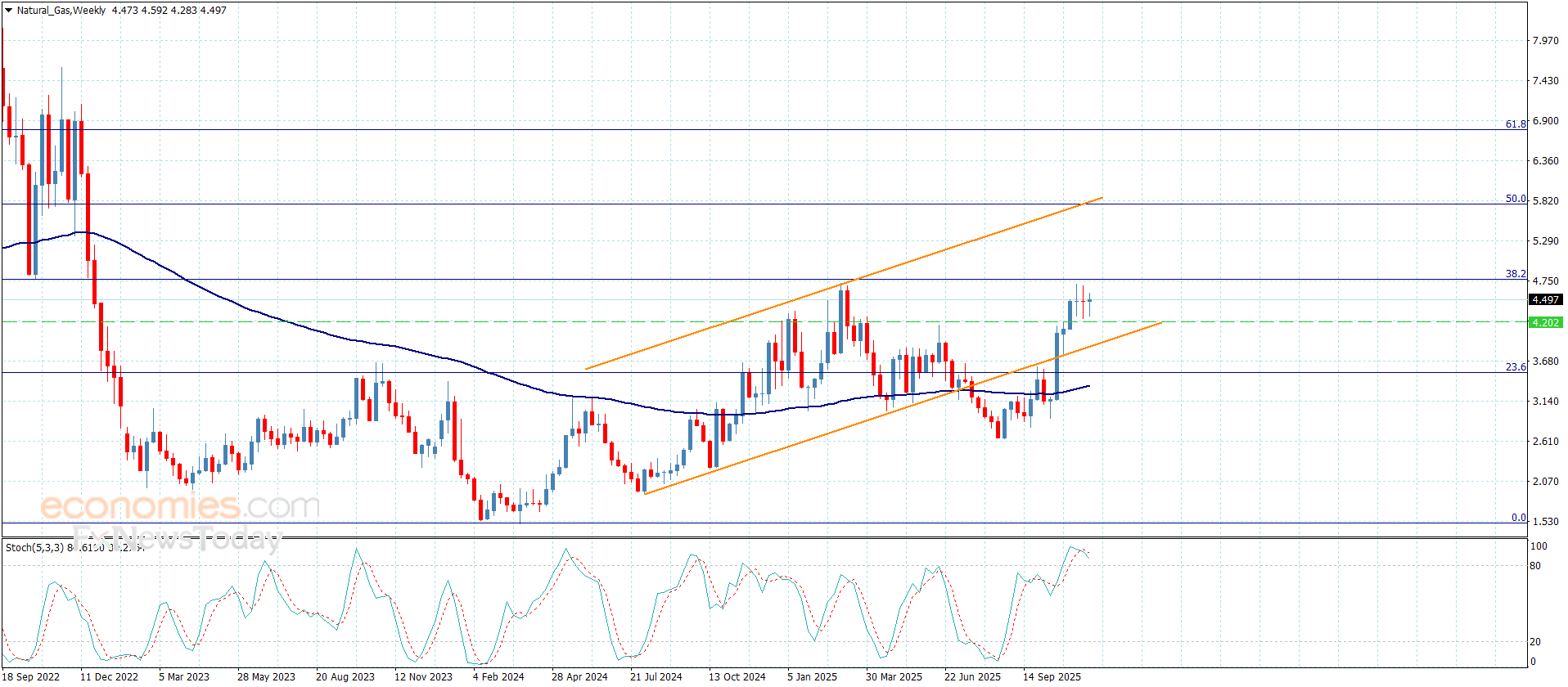
This is the third consecutive week of consolidation near the recent trend high of $4.68. The prior two weeks closed in the top half of their ranges, indicating buyers have retained underlying control. Resistance continues near the 88.6% Fibonacci retracement at $4.64. A daily close below $4.44 would confirm short-term weakness and a three-day breakdown. Until a decisive breakout above $4.69 occurs, risk of continued consolidation or a deeper bearish correction remains. Below the recent $4.24 swing high lies the June $4.15 swing high, then the 38.2% retracement at $4.00 and 50% level at $3.79.
Although buyers have kept a degree of control in recent weeks, the sharp slope of the advance since the October interim swing low—up as much as $1.80 or 62.1% to the recent high—matches the 63.9% gain from the January $2.99 low to the March $4.90 peak, which was followed by a multi-month correction. The RSI has begun retreating from overbought territory, leaving natural gas vulnerable to a corrective pullback.
The 20-day average at $4.37 is the critical pivot. Holding above it keeps upside potential alive toward $4.69 and higher; a decisive drop below opens $4.24–$4.15 initially, with deeper support at the measured retracements. Until the $4.69 high is cleared, consolidation or correction risk stays elevated.
For a look at all of today’s economic events, check out our economic calendar.
Gold (XAU/USD) is trading practically flat on Tuesday, holding most of the gains taken on Monday. Price action remains capped below the $4,150 area, yet with downside attempts contained above a previous resistance, at $4,100, as growing hopes that the Federal Reserve will cut interest rates in December are hurting the USD.
Fed Governor Christopher Waller called for an interest rate cut in December at a Fox Interview on Monday, echoing Friday’s comments by the New York Fed President John Williams, who said that a December rate cut was possible. This has increased pressure on US Treasury yields, acting as a headwind for US Dollar rallies.
Gold is consolidating gains above a previous resistance area at $4,100 on Tuesday, after bouncing from the 78.6% Fibonacci retracement of the early November rally, near $4,000, a common target for corrective moves.
The 4-Hour Relative Strength Index (RSI) is consolidating above the 60 level, and the Moving Average Convergence Divergence (MACD) has crossed above the 0 level and is printing green bars on the histogram, revealing a moderate bullish momentum.
A break above the mentioned $4.150 area (Intraday high, November 13 low), would confirm that the correction from the $4,250 area has completed, and bring the November 14 high, at $4,210, to the focus, ahead of the mentioned November peak, at $4,245.
A bearish reaction below $4,100, on the contrary, might increase pressure towards the November 21 and 24 lows, in the area between $4,020 and $4,040 ahead of the November 18 and the, $4,000 psychological level.
Gold has played a key role in human’s history as it has been widely used as a store of value and medium of exchange. Currently, apart from its shine and usage for jewelry, the precious metal is widely seen as a safe-haven asset, meaning that it is considered a good investment during turbulent times. Gold is also widely seen as a hedge against inflation and against depreciating currencies as it doesn’t rely on any specific issuer or government.
Central banks are the biggest Gold holders. In their aim to support their currencies in turbulent times, central banks tend to diversify their reserves and buy Gold to improve the perceived strength of the economy and the currency. High Gold reserves can be a source of trust for a country’s solvency. Central banks added 1,136 tonnes of Gold worth around $70 billion to their reserves in 2022, according to data from the World Gold Council. This is the highest yearly purchase since records began. Central banks from emerging economies such as China, India and Turkey are quickly increasing their Gold reserves.
Gold has an inverse correlation with the US Dollar and US Treasuries, which are both major reserve and safe-haven assets. When the Dollar depreciates, Gold tends to rise, enabling investors and central banks to diversify their assets in turbulent times. Gold is also inversely correlated with risk assets. A rally in the stock market tends to weaken Gold price, while sell-offs in riskier markets tend to favor the precious metal.
The price can move due to a wide range of factors. Geopolitical instability or fears of a deep recession can quickly make Gold price escalate due to its safe-haven status. As a yield-less asset, Gold tends to rise with lower interest rates, while higher cost of money usually weighs down on the yellow metal. Still, most moves depend on how the US Dollar (USD) behaves as the asset is priced in dollars (XAU/USD). A strong Dollar tends to keep the price of Gold controlled, whereas a weaker Dollar is likely to push Gold prices up.
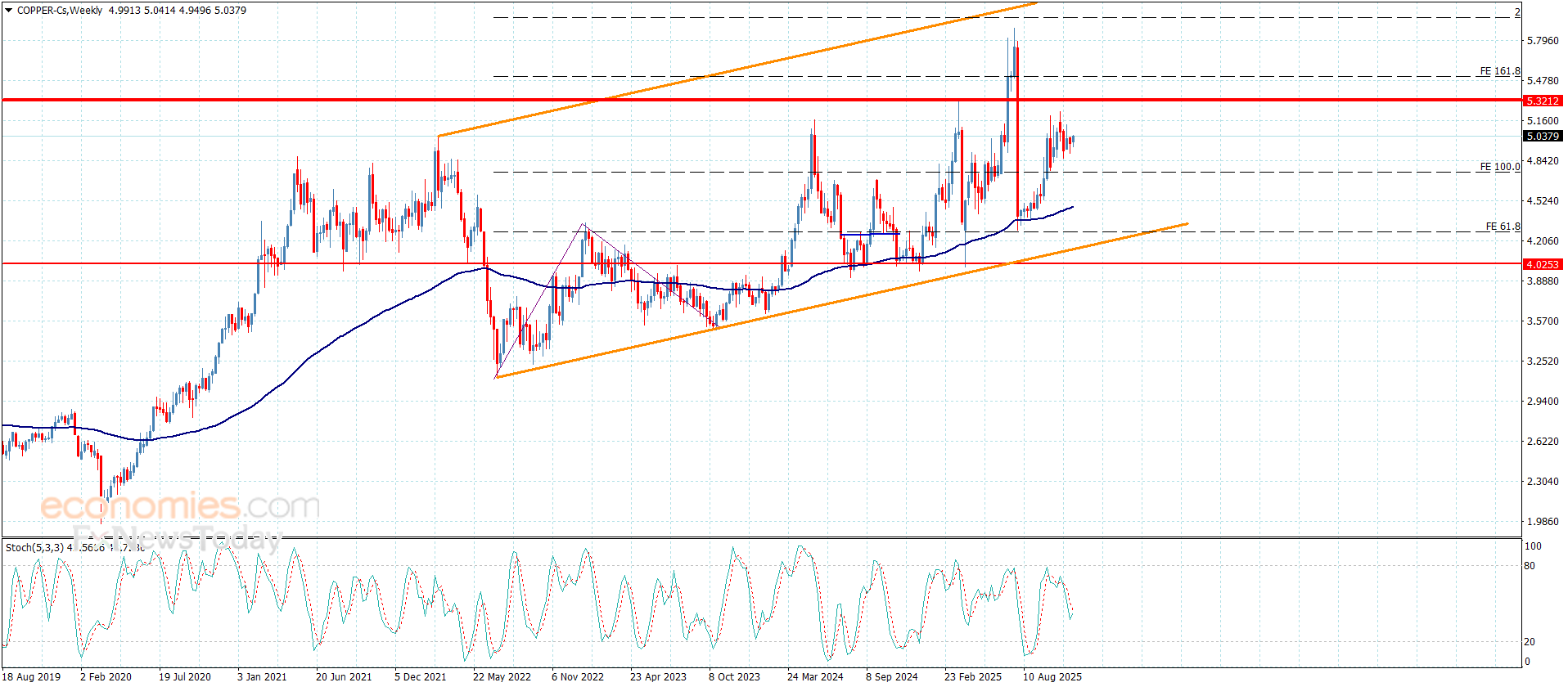
Copper price began forming bullish waves yesterday, attempting to face the temporary negative pressure to reinforce the dominance of the main bullish scenario, to fluctuate near $5.0500 level now.
We expect to provide mixed trading, noting that the attempt to resume the bullish attack requires breaching the initial barrier near $5.2000, while the stability below it might force it to form corrective wave to reach towards the initial support at $4.7500.
The expected trading range for today is between $4.9500 and $5.2000
Trend forecast: Fluctuated
Silver (XAG/USD) holds steady around the $51.45 region during the Asian session on Tuesday, nearly unchanged for the day. Meanwhile, the broader technical setup favors bullish traders and backs the case for an extension of the recent bounce from a two-week low, around the $48.65-$48.60 zone, touched last Friday.
On the 4-hour chart, the XAG/USD stands above the rising 200-period Exponential Moving Average (EMA), currently pegged around the $49.35-$49.30 region, which supports the recovery and keeps the near-term bias pointing higher. Furthermore, the Moving Average Convergence Divergence (MACD) rises above the Signal line and sits in positive territory, while the histogram expands positively, suggesting strengthening bullish momentum.
Meanwhile, the Relative Strength Index (RSI) on the said chart stays above its midline and is mildly bullish, consistent with an upswing. This reinforces an improving tone and favors upside extension while the XAG/USD holds above the trend base. The white metal seems poised to surpass the $52.00 mark and climb further towards last week’s swing high, around the $52.45 zone, before aiming towards reclaiming the $53.00 round figure.
On the flip side, pullbacks below the Asian session low, around the $51.00 mark, would stay contained and attract fresh buyers ahead of the $50.00 psychological mark. A convincing break below the latter could drag the XAG/USD to the 200-EMA, around the $49.30 region. A decisive break below the said EMA anchor would soften the outlook, whereas holding above it could pave the way for further gains in the 4-hour space.
(The technical analysis of this story was written with the help of an AI tool)
Silver is a precious metal highly traded among investors. It has been historically used as a store of value and a medium of exchange. Although less popular than Gold, traders may turn to Silver to diversify their investment portfolio, for its intrinsic value or as a potential hedge during high-inflation periods. Investors can buy physical Silver, in coins or in bars, or trade it through vehicles such as Exchange Traded Funds, which track its price on international markets.
Silver prices can move due to a wide range of factors. Geopolitical instability or fears of a deep recession can make Silver price escalate due to its safe-haven status, although to a lesser extent than Gold’s. As a yieldless asset, Silver tends to rise with lower interest rates. Its moves also depend on how the US Dollar (USD) behaves as the asset is priced in dollars (XAG/USD). A strong Dollar tends to keep the price of Silver at bay, whereas a weaker Dollar is likely to propel prices up. Other factors such as investment demand, mining supply – Silver is much more abundant than Gold – and recycling rates can also affect prices.
Silver is widely used in industry, particularly in sectors such as electronics or solar energy, as it has one of the highest electric conductivity of all metals – more than Copper and Gold. A surge in demand can increase prices, while a decline tends to lower them. Dynamics in the US, Chinese and Indian economies can also contribute to price swings: for the US and particularly China, their big industrial sectors use Silver in various processes; in India, consumers’ demand for the precious metal for jewellery also plays a key role in setting prices.
Silver prices tend to follow Gold’s moves. When Gold prices rise, Silver typically follows suit, as their status as safe-haven assets is similar. The Gold/Silver ratio, which shows the number of ounces of Silver needed to equal the value of one ounce of Gold, may help to determine the relative valuation between both metals. Some investors may consider a high ratio as an indicator that Silver is undervalued, or Gold is overvalued. On the contrary, a low ratio might suggest that Gold is undervalued relative to Silver.
Airbnb (ABNB) saw a slight uptick in its latest intraday trading, even as the stock continues to face negative pressure while trading below its 50-day simple moving average. The medium-term downtrend remains dominant, with the price moving along a descending trendline. These recent gains appear to be an attempt to recover part of its previous losses, while the stock also works on easing its clear oversold conditions on the Relative Strength Indicators, especially as early positive signals begin to appear.
Therefore, we expect the stock to decline in the upcoming sessions, as long as it remains below $117.30, targeting the support level at $105.40.
Today’s price forecast: Bearish
The international crude benchmark, Brent, could dip to the $30s per barrel handle by 2027 as oversupply could overwhelm the market, according to a JP Morgan forecast posted by users on X.
Brent Crude prices have dropped by 14% year to date, and traded relatively stable at $62.59 per barrel early on Monday, as the oil market awaits news from the renewed negotiations on peace in Ukraine.
The U.S. and Ukraine held on Sunday in Geneva what the two sides described as “highly productive” talks and agreed to continue intensive work on a “refined” peace plan, which the U.S. first proposed last week.
Despite the fears of a glut, analysts and investment banks don’t see oil prices moving down to $40 or below, even as oil is set to decline in the near term with strong supply from OPEC+ and the non-OPEC producers in the Americas.
Peace in Ukraine could also weigh on energy prices as some sanctions and restrictions on Russia could be eased, analysts say.
Oil prices are set to further drop into next year from current levels amid a large surplus on the market, with the U.S. benchmark WTI Crude expected to average $53 per barrel in 2026, according to Goldman Sachs.
The investment bank’s call for next year is that oil prices are on track for further declines and investors should short oil right now, Daan Struyven, co-head of global commodities research at Goldman Sachs, told CNBC last week.
The surplus next year will be 2 million bpd on average, Goldman reckons, but notes that 2026 will be the last year of the current big supply wave hitting the market.
The oil market is set to rebalance in 2027 as 2026 will see “the last big oil supply wave the market has to work through,” Goldman’s Struyven added.
By Michael Kern for Oilprice.com
More Top Reads From Oilprice.com
Copper price began forming bullish waves yesterday, attempting to face the temporary negative pressure to reinforce the dominance of the main bullish scenario, to fluctuate near $5.0500 level now.
We expect to provide mixed trading, noting that the attempt to resume the bullish attack requires breaching the initial barrier near $5.2000, while the stability below it might force it to form corrective wave to reach towards the initial support at $4.7500.
The expected trading range for today is between $4.9500 and $5.2000
Trend forecast: Fluctuated