The main tag of GoldPrice Articles.
You can use the search box below to find what you need.
[wd_asp id=1]
The main tag of GoldPrice Articles.
You can use the search box below to find what you need.
[wd_asp id=1]
Spot Gold trades with a soft tone on Monday, although confined to a well-limited intraday range. The bright metal hovers around $4,070 a troy ounce in the American session, trading at the lower end of Friday’s range, as investors await fresh clues about the United States (US) economic health.
The US Dollar (USD) is mixed across the FX board, but stable, as investors await the release of US figures delayed by the government shutdown. Among other things, the Building Permits, Housing Starts, and Goods Trade balance will be released on Wednesday, while the country will publish the September Nonfarm Payrolls (NFP) report on Thursday.
US data will be critical ahead of the US Federal Reserve (Fed) monetary policy meeting in mid-December. The central bank trimmed the benchmark interest rate in October, but raised doubts about a similar movement in December. Currently, the odds of an on-hold decision are above 55%. Such a picture could change once speculative interest assesses fresh macro data.
Other than that, the earnings season kicks in: Several tech-related companies will report in the upcoming days, including the AI giant NVIDIA. As a result, Wall Street is also in a wait-and-see mode, with the three major indexes trading mixed, yet not far from their daily opening levels.
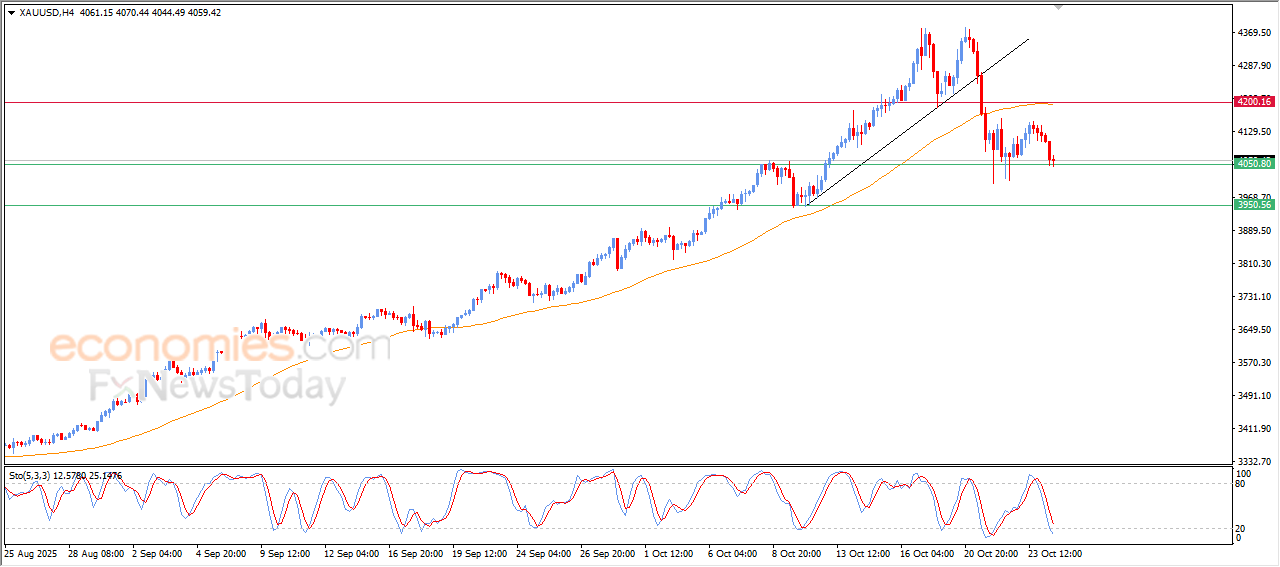
XAU/USD trades at $4,075.18, and the 4-hour chart shows the risk skews to the downside, although chances of a steeper decline seem limited. The pair is trading below a bearish 20-period Simple Moving Average (SMA), currently at $4,144, but holds above the 100 and 200 SMAs, signaling a near-term correction against a still positive longer-term slope. At the same time, the Momentum indicator and the Relative Strength Index (RSI) indicator both hold within negative levels, although aiming marginally higher, suggesting limited selling interest. A break below the 100-period SMA at $4,043.20 should hint at a steeper decline, while a close above the 20-period SMA at $4,144.05 would lift the bias back to the upside.
In the daily chart, XAU/USD is correcting lower, but it is far from being bearish. The 20-day SMA has turned lower but remains above the rising 100- and 200-day SMAs, while the pair continues to develop above them. The 20-day SMA at $4,051.62 offers nearby dynamic support. At the same time, the Momentum stands above its midline and rising, while the RSI eases at around 53 (neutral), hinting at a slower upside pace.
(The technical analysis of this story was written with the help of an AI tool)
Silver price (XAG/USD) trades in positive territory near $51.00 during the Asian trading hours on Monday. The white metal edges higher amid uncertainty following the end of the US government’s shutdown. Federal Reserve officials are set to speak later on Monday, including John Williams, Philip Jefferson, Neel Kashkari and Christopher Waller.
Markets are bracing for a flood of delayed economic reports that could signal a slowing US economy. The US Nonfarm Payrolls (NFP) will take center stage later on Thursday. This report could offer clarity to the Fed rate outlook in December. Any signs of weakness in the US labor market could drag the US Dollar (USD) lower and underpin the USD-denominated commodity price.
“I think the risk is definitely skewed to a weaker payrolls print, and that would just reignite market expectations about a December FOMC rate cut and send the U.S. dollar down,” said Carol Kong, a currency strategist at Commonwealth Bank of Australia (CBA).
On the other hand, hawkish remarks from Fed policymakers ahead of a deluge of US economic data spooked traders and could weigh on the white metal. Kansas City Fed President Jeffery Schmid said on Friday that monetary policy should lean against demand growth, adding that current Fed policy is “modestly restrictive,” which he believes is appropriate.
Markets are now pricing in nearly a 40% possibility of a 25 basis points (bps) rate cut in the Fed’s December meeting, down from over 60% earlier this month, according to the CME FedWatch tool.
Silver is a precious metal highly traded among investors. It has been historically used as a store of value and a medium of exchange. Although less popular than Gold, traders may turn to Silver to diversify their investment portfolio, for its intrinsic value or as a potential hedge during high-inflation periods. Investors can buy physical Silver, in coins or in bars, or trade it through vehicles such as Exchange Traded Funds, which track its price on international markets.
Silver prices can move due to a wide range of factors. Geopolitical instability or fears of a deep recession can make Silver price escalate due to its safe-haven status, although to a lesser extent than Gold’s. As a yieldless asset, Silver tends to rise with lower interest rates. Its moves also depend on how the US Dollar (USD) behaves as the asset is priced in dollars (XAG/USD). A strong Dollar tends to keep the price of Silver at bay, whereas a weaker Dollar is likely to propel prices up. Other factors such as investment demand, mining supply – Silver is much more abundant than Gold – and recycling rates can also affect prices.
Silver is widely used in industry, particularly in sectors such as electronics or solar energy, as it has one of the highest electric conductivity of all metals – more than Copper and Gold. A surge in demand can increase prices, while a decline tends to lower them. Dynamics in the US, Chinese and Indian economies can also contribute to price swings: for the US and particularly China, their big industrial sectors use Silver in various processes; in India, consumers’ demand for the precious metal for jewellery also plays a key role in setting prices.
Silver prices tend to follow Gold’s moves. When Gold prices rise, Silver typically follows suit, as their status as safe-haven assets is similar. The Gold/Silver ratio, which shows the number of ounces of Silver needed to equal the value of one ounce of Gold, may help to determine the relative valuation between both metals. Some investors may consider a high ratio as an indicator that Silver is undervalued, or Gold is overvalued. On the contrary, a low ratio might suggest that Gold is undervalued relative to Silver.
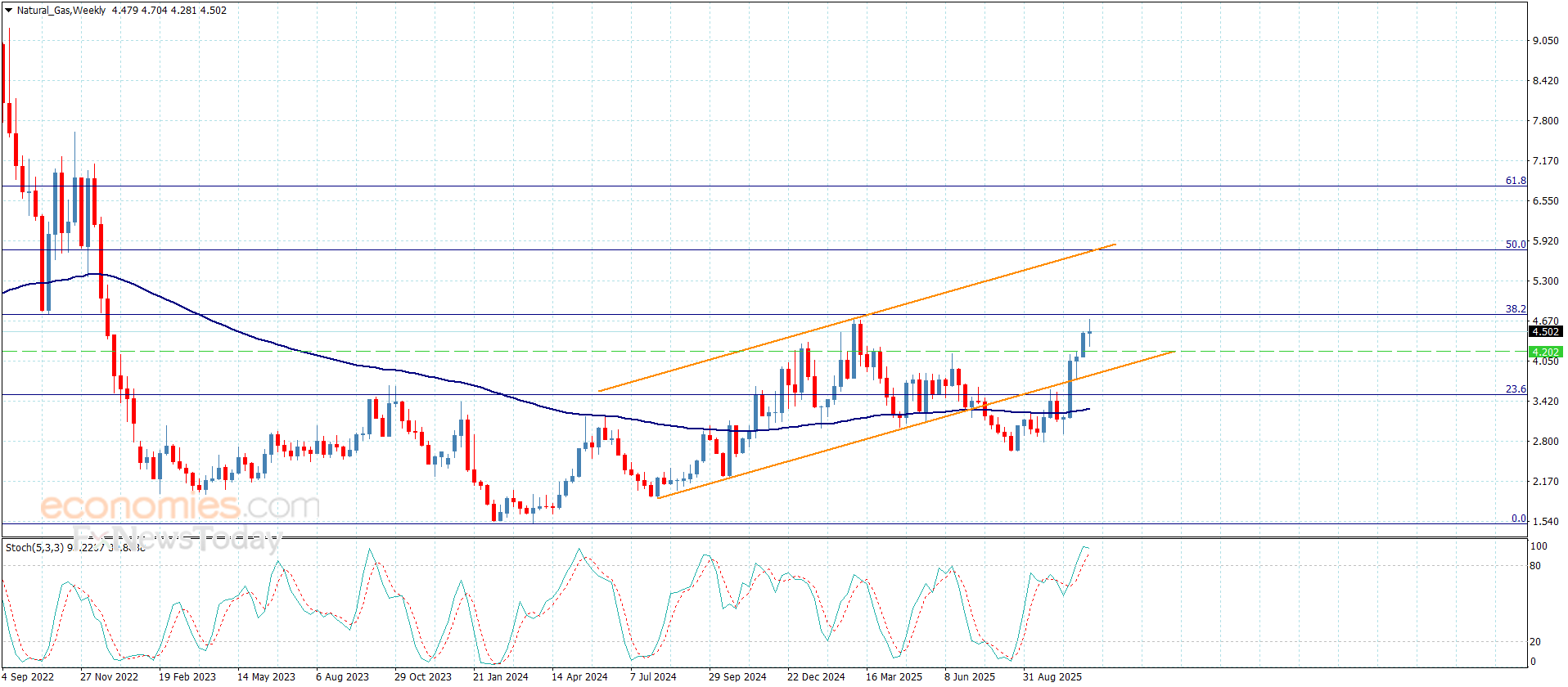
Natural gas prices formed temporary corrective trading on Friday, keeping their positive stability above the extra support at $4.200, to confirm the previously suggested bullish scenario.
The price might be forced to provide more mixed trading, to keep waiting for extra bullish momentum, to ease the mission of pressing on %38.2 Fibonacci level at $4.770 and surpassing it will lead the price to record extra gains by its rally towards $4.910 and $5.150.
The expected trading range for today is between $4.330 and $4.700
Trend forecast: Fluctuated
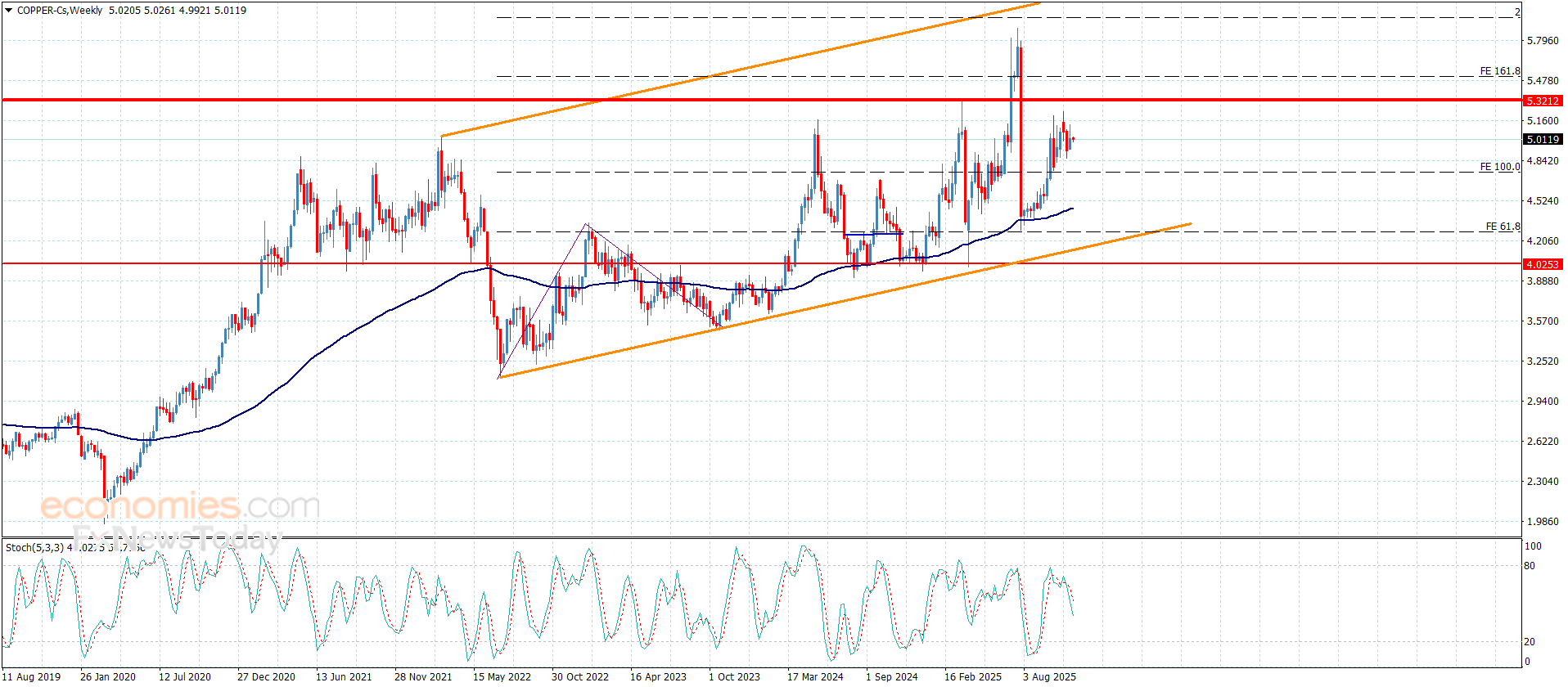
Copper price returned to form weak sideways trading due to the contradiction between the main indicators, by stochastic reach below 50 level, which forces it to settle below $5.2000, announcing its readiness to activate the bearish corrective trend again.
Facing negative pressure in the current period might force it to attack the extra support near $4.7500 and surpassing it might extend the losses towards $4.6300 reaching the moving average 55 at $4.4600.
The expected trading range for today is between $4.7500 and $5.1200
Trend forecast: Bearish
The (ETHUSD) price rose in its last trading on the intraday levels, amid the continuation of negative dynamic pressure that is represented by its trading below EMA50, reinforcing the stability and the dominance of the main bearish trend on the short-term basis, especially with its trading alongside minor trendline, besides the emergence of the negative signals on the relative strength indicators, after the stability of the key support at $3,060, this support represents potential target in our previous reports, which helped it to achieve these cautious gains.
Gold price (XAU/USD) recovers some lost ground to near $4,105, snapping the two-day losing streak during the early European session on Friday. The precious metal edges higher on the softer US Dollar (USD). Traders will take more cues from the Fedspeak later on Monday. The Fed’s John Williams, Philip Jefferson, Neel Kashkari and Christopher Waller are set to speak.
Improved market sentiment after the federal government reopened undermined the safe-haven assets, such as the Gold price. The US government has reopened after US President Donald Trump signed a funding bill into law last week, ending the longest shutdown in US history, which lasted 43 days. Federal employees were directed to return to work on Thursday.
However, investors continue to grapple with uncertainty over the release of delayed economic data following the record-long shutdown. Analysts believe that the resumption of US economic data will show job market weakness and a potential slowdown. This, in turn, could weigh on the Greenback and lift the USD-denominated commodity price. Non-yielding yellow metal tends to perform well during periods of economic uncertainty and in a low-interest-rate environment.
The upside for the yellow metal might be limited due to hawkish remarks from US Federal Reserve (Fed) officials, dimming hopes for a December interest rate cut. Kansas City Fed President Jeffery Schmid said on Friday that monetary policy should “lean against demand growth,” adding that current Fed policy is “modestly restrictive,” which he believes is appropriate.
Financial markets are now pricing in a nearly 54% chance that the Fed will cut its benchmark overnight borrowing rate by 25 basis points (bps) at its December meeting, down from 62.9% probability that markets priced in earlier last week, according to the CME FedWatch Tool.
Gold has played a key role in human’s history as it has been widely used as a store of value and medium of exchange. Currently, apart from its shine and usage for jewelry, the precious metal is widely seen as a safe-haven asset, meaning that it is considered a good investment during turbulent times. Gold is also widely seen as a hedge against inflation and against depreciating currencies as it doesn’t rely on any specific issuer or government.
Central banks are the biggest Gold holders. In their aim to support their currencies in turbulent times, central banks tend to diversify their reserves and buy Gold to improve the perceived strength of the economy and the currency. High Gold reserves can be a source of trust for a country’s solvency. Central banks added 1,136 tonnes of Gold worth around $70 billion to their reserves in 2022, according to data from the World Gold Council. This is the highest yearly purchase since records began. Central banks from emerging economies such as China, India and Turkey are quickly increasing their Gold reserves.
Gold has an inverse correlation with the US Dollar and US Treasuries, which are both major reserve and safe-haven assets. When the Dollar depreciates, Gold tends to rise, enabling investors and central banks to diversify their assets in turbulent times. Gold is also inversely correlated with risk assets. A rally in the stock market tends to weaken Gold price, while sell-offs in riskier markets tend to favor the precious metal.
The price can move due to a wide range of factors. Geopolitical instability or fears of a deep recession can quickly make Gold price escalate due to its safe-haven status. As a yield-less asset, Gold tends to rise with lower interest rates, while higher cost of money usually weighs down on the yellow metal. Still, most moves depend on how the US Dollar (USD) behaves as the asset is priced in dollars (XAU/USD). A strong Dollar tends to keep the price of Gold controlled, whereas a weaker Dollar is likely to push Gold prices up.
Coffee price formed the inverted head and shoulders pattern in its last trading, and 424.20 level forms the main neckline as appears in the above image, noticing the attempt to surpass the neckline at 437.40 in yesterday trading, to bounce quickly towards 410.00.
The price needs new positive momentum that allows it to settle above extra support towards 393.25, then wait for breaching 424.20 level, to confirm activating the bullish pattern, to target 457.50 and 486.00 level.
The expected trading range for today is between 400.50 and 457.50
Trend forecast: Bullish
West Texas Intermediate (WTI) Oil price advances on Friday, early in the European session. WTI trades at $59.42 per barrel, up from Thursday’s close at $58.56.
Brent Oil Exchange Rate (Brent crude) is also up, advancing from the $62.69 price posted on Thursday, and trading at $63.52.
WTI Oil is a type of Crude Oil sold on international markets. The WTI stands for West Texas Intermediate, one of three major types including Brent and Dubai Crude. WTI is also referred to as “light” and “sweet” because of its relatively low gravity and sulfur content respectively. It is considered a high quality Oil that is easily refined. It is sourced in the United States and distributed via the Cushing hub, which is considered “The Pipeline Crossroads of the World”. It is a benchmark for the Oil market and WTI price is frequently quoted in the media.
Like all assets, supply and demand are the key drivers of WTI Oil price. As such, global growth can be a driver of increased demand and vice versa for weak global growth. Political instability, wars, and sanctions can disrupt supply and impact prices. The decisions of OPEC, a group of major Oil-producing countries, is another key driver of price. The value of the US Dollar influences the price of WTI Crude Oil, since Oil is predominantly traded in US Dollars, thus a weaker US Dollar can make Oil more affordable and vice versa.
The weekly Oil inventory reports published by the American Petroleum Institute (API) and the Energy Information Agency (EIA) impact the price of WTI Oil. Changes in inventories reflect fluctuating supply and demand. If the data shows a drop in inventories it can indicate increased demand, pushing up Oil price. Higher inventories can reflect increased supply, pushing down prices. API’s report is published every Tuesday and EIA’s the day after. Their results are usually similar, falling within 1% of each other 75% of the time. The EIA data is considered more reliable, since it is a government agency.
OPEC (Organization of the Petroleum Exporting Countries) is a group of 12 Oil-producing nations who collectively decide production quotas for member countries at twice-yearly meetings. Their decisions often impact WTI Oil prices. When OPEC decides to lower quotas, it can tighten supply, pushing up Oil prices. When OPEC increases production, it has the opposite effect. OPEC+ refers to an expanded group that includes ten extra non-OPEC members, the most notable of which is Russia.
West Texas Intermediate (WTI) Oil price falls on Tuesday, early in the European session. WTI trades at $59.78 per barrel, down from Monday’s close at $60.06.
Brent Oil Exchange Rate (Brent crude) is also shedding ground, trading at $63.69 after its previous daily close at $63.96.
WTI Oil is a type of Crude Oil sold on international markets. The WTI stands for West Texas Intermediate, one of three major types including Brent and Dubai Crude. WTI is also referred to as “light” and “sweet” because of its relatively low gravity and sulfur content respectively. It is considered a high quality Oil that is easily refined. It is sourced in the United States and distributed via the Cushing hub, which is considered “The Pipeline Crossroads of the World”. It is a benchmark for the Oil market and WTI price is frequently quoted in the media.
Like all assets, supply and demand are the key drivers of WTI Oil price. As such, global growth can be a driver of increased demand and vice versa for weak global growth. Political instability, wars, and sanctions can disrupt supply and impact prices. The decisions of OPEC, a group of major Oil-producing countries, is another key driver of price. The value of the US Dollar influences the price of WTI Crude Oil, since Oil is predominantly traded in US Dollars, thus a weaker US Dollar can make Oil more affordable and vice versa.
The weekly Oil inventory reports published by the American Petroleum Institute (API) and the Energy Information Agency (EIA) impact the price of WTI Oil. Changes in inventories reflect fluctuating supply and demand. If the data shows a drop in inventories it can indicate increased demand, pushing up Oil price. Higher inventories can reflect increased supply, pushing down prices. API’s report is published every Tuesday and EIA’s the day after. Their results are usually similar, falling within 1% of each other 75% of the time. The EIA data is considered more reliable, since it is a government agency.
OPEC (Organization of the Petroleum Exporting Countries) is a group of 12 Oil-producing nations who collectively decide production quotas for member countries at twice-yearly meetings. Their decisions often impact WTI Oil prices. When OPEC decides to lower quotas, it can tighten supply, pushing up Oil prices. When OPEC increases production, it has the opposite effect. OPEC+ refers to an expanded group that includes ten extra non-OPEC members, the most notable of which is Russia.