The main tag of GoldPrice Articles.
You can use the search box below to find what you need.
[wd_asp id=1]
The main tag of GoldPrice Articles.
You can use the search box below to find what you need.
[wd_asp id=1]
Gold is building on Friday’s rebound in Asian trades on Monday, having briefly regained the $4,050 psychological barrier to hit ten-day highs. Traders await fresh cues on the end to the record US government shutdown amid mounting economic concerns.
Gold consolidates its latest leg higher, with buyers taking a breather amid a positive shift in risk sentiment as markets stay hopeful about the US government reopening.
US Senate voted 60-40 in the first approval on extending the enhanced Affordable Care Act subsidies early Monday, passing the government funding bill to end the shutdown.
Additionally, risk flows dominate as China announced on Sunday the temporary suspension of its ban on approving exports of dual-use items related to gallium, germanium, antimony and super-hard materials to the United States, per Reuters.
Despite the broader market optimism, investors remain wary as the amended package would still have to be passed by the House of Representatives and sent to President Donald Trump for his signature, a process that could take several days.
This, combined with growing concerns over the US economy amid the fallout of the record government shutdown continues to lend support to the traditional store of value, Gold.
The University of Michigan (UoM) released data on Friday, which showed that the preliminary Consumer Sentiment Index dropped to 50.3 in early November, the lowest in nearly three-and-a-half years.
Weakening consumer sentiment followed the data published by the executive outplacement firm Challenger, Gray & Christmas on Thursday, revealing that corporations announced a 183.1% monthly surge in layoffs, the worst October in over two decades, per Reuters.
Against this backdrop, markets continue to price in about a 66% chance of the US Federal Reserve (Fed) lowering interest rates in December.
Gold also draws support from rising metal holdings by China. China’s Gold Exchange-Traded Funds (ETF) surged 164% in the first nine months of 2025, while the People’s Bank of China (PBOC) boosted its Gold purchases for an 11th straight month, raising reserves to 2,303.5 tons.
Looking ahead, Gold’s price action will likely be determined by the US shutdown news and the probable publication timeline of the missed economic data releases. In the time, market sentiment and Fed rate cut expectations will continue providing sone trading incentives in Gold.
The daily chart suggests that upside risks prevail in the near term for Gold as the 14-day Relative Strength Index (RSI) points north of the midline.
Gold now looks for acceptance above the $4,050 psychological level to take on the 21-day Simple Moving Average (SMA) at $4,081.
A sustained move above the latter will expose the 23.6% Fibonacci Retracement level of the parabolic rise to the record high that began on August 19 at $4,129.
On the downside, the initial hurdle is seen at $3,973, the 38.2% Fibo level of the same advance.
Next on sellers’ radars will be the intermittent lows near $3,930, a break below which would expose the $3,900 figure.
Gold has played a key role in human’s history as it has been widely used as a store of value and medium of exchange. Currently, apart from its shine and usage for jewelry, the precious metal is widely seen as a safe-haven asset, meaning that it is considered a good investment during turbulent times. Gold is also widely seen as a hedge against inflation and against depreciating currencies as it doesn’t rely on any specific issuer or government.
Central banks are the biggest Gold holders. In their aim to support their currencies in turbulent times, central banks tend to diversify their reserves and buy Gold to improve the perceived strength of the economy and the currency. High Gold reserves can be a source of trust for a country’s solvency. Central banks added 1,136 tonnes of Gold worth around $70 billion to their reserves in 2022, according to data from the World Gold Council. This is the highest yearly purchase since records began. Central banks from emerging economies such as China, India and Turkey are quickly increasing their Gold reserves.
Gold has an inverse correlation with the US Dollar and US Treasuries, which are both major reserve and safe-haven assets. When the Dollar depreciates, Gold tends to rise, enabling investors and central banks to diversify their assets in turbulent times. Gold is also inversely correlated with risk assets. A rally in the stock market tends to weaken Gold price, while sell-offs in riskier markets tend to favor the precious metal.
The price can move due to a wide range of factors. Geopolitical instability or fears of a deep recession can quickly make Gold price escalate due to its safe-haven status. As a yield-less asset, Gold tends to rise with lower interest rates, while higher cost of money usually weighs down on the yellow metal. Still, most moves depend on how the US Dollar (USD) behaves as the asset is priced in dollars (XAU/USD). A strong Dollar tends to keep the price of Gold controlled, whereas a weaker Dollar is likely to push Gold prices up.
Production growth continues to be a key headwind. U.S. (lower-48) dry gas output was estimated at 110.0 bcf/day on Friday, up 8.1% from a year ago. Baker Hughes reported an increase in active U.S. natural gas rigs, pushing the count to a 2.25-year high. The EIA recently raised its 2025 production forecast to 107.14 bcf/day, up 0.5% from the previous estimate, reinforcing the supply-heavy outlook.
Thursday’s EIA report did little to shift sentiment. The +33 bcf injection matched expectations but was below the five-year average build of +42 bcf, offering mild support. Still, inventories remain ample—up 0.4% year-over-year and 4.3% above the five-year seasonal average. Meanwhile, gas demand across the lower-48 dropped 2.7% year-over-year to 77.0 bcf/day, while LNG export flows edged down 0.8% week-over-week to 17.3 bcf/day, according to BNEF.
Electricity usage showed modest strength. Edison Electric Institute data revealed U.S. power output rose slightly by 0.05% year-over-year for the week ending November 1 and is up nearly 3% over the past year. While helpful, this uptick is unlikely to offset the bearish weight from strong supply and softening seasonal demand.
Gold (XAU/USD) remains the dominant asset in global markets, trading near $3,978 per ounce after setting an all-time high of $4,381.21 on October 20 2025. The metal’s surge from $1,617 in October 2022 marks a 170% gain in just three years, ranking as the third-strongest rally in half a century. While its magnitude trails the historic explosions of 643% (2001–2011) and 518% (1976–1980), the structure of today’s advance is fundamentally different. Rather than speculative fervor, this rally is anchored in structural demand from central banks, fiscal stress in the United States, and a shift in the balance of global reserve power. These forces suggest the current uptrend in XAU/USD is more resilient and durable than any speculative spike of the past.
Between July 1976 and February 1980, gold soared from $134 to $692, delivering a 518% rise during an era defined by inflation above 13%, oil embargoes, and the collapse of Bretton Woods. The subsequent twenty-year correction drove the metal down 63% to $256 by 2001, but gold’s monetary role endured.
The next super-cycle began in February 2001 and peaked in September 2011, climbing from $256 to $1,902, a 643% increase. The dot-com collapse, the 9/11 attacks, and the Federal Reserve’s quantitative easing created a decade of fear that drove gold to new prominence. Even after falling 44% to $1,052 in 2015, its floor remained multiple times higher than in the prior century.
Today’s move from $1,617 to $4,381 since late 2022—though smaller in percentage terms—reflects an entirely different foundation: institutional accumulation, reserve diversification, and distrust of fiat credibility. It is a rally powered not by panic but by policy evolution.
The structural engine of this bull market is relentless central-bank accumulation. Since 2022, official institutions have bought more than 1,000 metric tons annually, maintaining a fourth consecutive record year. The World Gold Council’s Q3 2025 data confirm 220 tons added in the quarter, up 28% from Q2 and 47% above the same period in 2024. Nations such as China, India, Turkey, Singapore, and Poland are reshaping reserve composition by reducing exposure to U.S. Treasuries.
Quarterly purchasing patterns illustrate this transformation: 2022 — 1,087 t, 2023 — 958 t, 2024 — ≈1,043 t, and 2025 — on pace for 1,080 t. Such persistence at record price levels underscores a strategic shift away from dollar reliance. The result is a structural floor in XAU/USD unseen in previous cycles.
Institutional and retail investment behavior in 2025 has diverged from historic norms. Instead of tapering as prices rose, investment demand accelerated. Physical and ETF holdings expanded to 220 tons in Q3 2025, while jewelry consumption fell 19% to 371 tons. Investors now view gold as systemic insurance against sovereign debt excess, not merely a hedge against inflation.
Institutional portfolios treat gold as protection against U.S. fiscal fragility and potential political interference with the Federal Reserve. Retail enthusiasm, particularly among high-net-worth investors in Europe and the Middle East, has intensified, with allocations exceeding 10% of assets. Physical premiums in Asia continue to widen, reflecting a tight global supply chain.
India’s market, historically the world’s largest consumer of physical gold, faces pronounced price sensitivity. With spot prices above $4,000, jewelry demand has weakened sharply, festival-season sales have diminished, and consumers are turning toward lighter ornaments and gold-plated substitutes.
China exhibits a contrasting pattern. Jewelry sales have softened, yet investment gold bars and coins are selling briskly, supported by the yuan’s depreciation and state narratives promoting gold as a defensive reserve. These dual dynamics—soft retail but strong institutional buying—define the present rally’s balance.
Technically, XAU/USD trades within an orderly bullish structure. The 200-day moving average near $3,650 acts as structural support, while the upper resistance band lies between $4,400 and $4,500. Momentum oscillators remain stretched but not extreme, confirming controlled strength. Daily volatility averages 1.1%, far below the 4% swings typical of 1979, indicating that the rally is institutionally guided rather than speculative.
Support levels cluster at $3,800–$3,900, deeper demand zones around $3,600–$3,700, and potential breakout resistance near $4,800 if momentum resumes. This tight, disciplined structure mirrors the liquidity and algorithmic order of modern ETF trading, not the chaos of earlier booms.
Forecasts for gold’s trajectory diverge widely among global banks. The bullish cohort, targeting $4,500–$6,000, anticipates persistent central-bank purchases above 1,000 tons yearly and continued fiscal deterioration in the United States. The moderate group, clustered around $3,800–$4,500, expects normalization of ETF flows and a gradual easing of U.S. rates through 2026. The conservative camp, projecting $3,200–$4,000, warns of potential demand destruction in Asia and speculative profit-taking.
Across these perspectives, consensus emerges around a structural support floor at $3,500, reflecting conviction that gold’s retracements will remain shallow unless monetary policy shifts sharply.
The Trump administration’s $2 trillion fiscal stimulus and renewed tariff policy are inflating expectations for sustained deficit spending. Annual U.S. interest payments exceeding $1 trillion—now larger than the defense budget—highlight systemic debt fragility. Simultaneously, fears over political interference in Federal Reserve operations are reviving long-dormant credibility concerns.
Foreign holdings of U.S. Treasuries have dropped to a twelve-year low as central banks pivot toward bullion. In parallel, BRICS nations advance alternative settlement systems using gold-linked instruments, a development that could redefine international liquidity flows and maintain elevated structural demand for XAU/USD well into the decade.
Gold’s ~50% year-to-date gain represents its strongest annual performance since 1979, easily outperforming the S&P 500’s 18% and the NASDAQ’s 21% advances. Adjusted for inflation, equities deliver negative real returns, while gold preserves purchasing power. The correlation between XAU/USD and the U.S. Dollar Index has fallen to -0.78, emphasizing gold’s hedge role. Silver trades near $48.40, platinum around $1,391, and palladium at $1,193, leaving gold the undisputed leader among precious metals in 2025.
Two risks could interrupt the uptrend. A decisive Federal Reserve pivot to hawkishness could lift real yields and strengthen the dollar, pressuring gold. Additionally, Asian jewelry demand erosion could deepen if prices remain above $4,000. ETF liquidations during equity corrections might create short-term volatility, though such dips are typically absorbed by central-bank buying. Historical analogues show that drawdowns in similar phases averaged -13% before trend resumption, underscoring resilience rather than reversal.
Conservative portfolios may maintain 5–10% exposure through physical or low-cost ETFs. Aggressive investors can pursue leveraged strategies in miners or derivatives, targeting the $4,800–$5,000 band over the next twelve months. Accumulation zones remain between $3,800–$3,850, with profit-taking advised above $4,400–$4,500. Monitoring real yields, Treasury spreads, and dollar strength remains critical for timing re-entries.
This rally is not a speculative anomaly but part of a global monetary re-architecture. Central banks are re-monetizing gold as neutral collateral in an era of fragmented geopolitics and escalating fiscal imbalance. Mine production growth of only 1.2% year-over-year fails to meet this new structural demand. The era of surplus supply has ended, replaced by systemic scarcity reinforced by policy realignment.
All quantitative and structural indicators point to continued strength in XAU/USD. The asset retains firm support around $3,600–$3,700, with potential to challenge $4,500–$4,800 and possibly $5,000 during 2026 if fiscal and monetary instability persist.
This is not the speculative fever of 1980 nor the liquidity panic of 2008—it is a calculated, institution-driven reallocation of global capital. Based on fundamentals, technical resilience, and geopolitical currents, the stance on XAU/USD remains BUY (Medium-Term Bias – Bullish).
Platinum price didn’t change anything due to its fluctuation between the levels of the current sideways track, that are represented by $1605.00, and $1525.00, which represents a key support for reducing the chances of suffering extra losses.
Note that stochastic attempt to provide positive momentum might push the price to form bullish trading, to attempt to renew the pressure on the previously mentioned barrier, to find an exit to record extra gains in the upcoming period, while breaking the support and holding below it will force it to suffer several losses that begin at $1485.00.
The expected trading range for today is between 985.00 and 1040.00
Trend forecast: Bullish
Gold (XAU/USD) is consolidating just above the $4,000 per ounce mark following one of its sharpest corrections of 2025. After hitting an all-time high above $4,356, the metal plunged 8.7% over recent weeks, reaching an intraday low of $3,886 before recovering. The latest weekly close near $4,000.57 marks the third consecutive decline, but also the smallest trading range since mid-September — a sign that selling pressure is fading as markets digest macro and geopolitical shocks. Despite the retracement, gold remains up over 19% year-to-date, supported by relentless central bank buying, fiscal stress in major economies, and the return of the currency devaluation trade, which continues to attract investors seeking shelter from the erosion of fiat value.
Persistent U.S. political paralysis and the 38-day government shutdown have revived safe-haven flows into bullion. The delay of the non-farm payrolls report and broader macro data disruptions have amplified uncertainty, pushing traders to reduce risk exposure in equities and the dollar. The CME FedWatch Tool now prices a 66% probability of a December rate cut, compared to 48% just two weeks earlier. The U.S. Dollar Index (DXY) has retreated to 99.55, down 0.14%, while 10-year Treasury yields eased to 4.09%, both developments supporting gold’s resilience above key support. Traders note that each time the shutdown extends past a month, gold tends to outperform equities by an average of 4.2%, reinforcing its defensive appeal during policy dysfunction.
One of the most powerful forces underpinning the market is central bank accumulation. According to the World Gold Council, sovereign institutions are on track to purchase over 1,000 tons of gold in 2025 — the fourth consecutive year exceeding that threshold. Countries including China, India, Turkey, and Singapore have expanded reserves aggressively to diversify away from the dollar. These purchases are not speculative; they are part of a long-term structural hedge against currency depreciation and sovereign debt expansion. Analysts estimate that Asian central banks alone have absorbed nearly 70% of global gold flows this year. The People’s Bank of China, for example, added 27 tons in October, bringing its total holdings to 2,270 tons, the highest in its modern history.
Strategists such as Stephen Innes of SPI Asset Management emphasize that gold’s long-term bull thesis remains tied to a “slow-burning currency devaluation trade.” With U.S. fiscal deficits projected to surpass $2 trillion in 2026, investors continue rotating out of fiat and into hard assets like gold and Bitcoin. The combination of rising interest costs, surging debt issuance, and a looming wave of Treasury monetization has reignited long-duration inflation hedging. Even if the devaluation trade appears “dormant” in the short term, it remains a dominant theme in macro portfolios. As Peter Spina of GoldSeek.com notes, gold’s pullback could merely be “a calibration phase” before another explosive move — potentially to $5,000 per ounce if inflation expectations remain anchored above the Fed’s target and monetary stimulus resumes globally.
From a technical standpoint, XAU/USD continues to respect the $4,000 psychological threshold, with buyers consistently defending the zone between $3,847 and $3,878, corresponding to the 50-day moving average and 50% retracement of the late-August rally. The latest weekly doji pattern on the chart indicates indecision, signaling that a potential exhaustion low is forming. Momentum, however, remains fragile: the RSI has retreated from overbought levels to 58, and weekly MACD readings show fading bullish momentum. Key resistance lies near $4,080 (median-line) and $4,192, representing the 61.8% retracement of the October decline. A close above $4,192 would confirm a bullish reversal, opening the path toward $4,356 and $4,553, the next Fibonacci extensions. Conversely, a sustained break below $3,847 could target $3,720, the 61.8% retracement of the August–October uptrend — a line technicians identify as the medium-term bullish invalidation level.
Physical market trends are diverging across regions. In India, high volatility and record rupee-adjusted prices have curbed jewelry demand, forcing dealers to offer steep discounts of $30–$40 per ounce against global benchmarks. By contrast, China’s bullion appetite has strengthened following policy shifts that allowed state banks to expand import quotas. The country’s retail gold ETFs recorded net inflows of $1.4 billion in October alone, reversing three months of outflows. Beijing’s planned reform of its rare earth export licensing framework may indirectly boost domestic liquidity, further supporting gold buying among institutional and household investors. The broader Asia-Pacific demand remains robust, especially from emerging markets seeking protection against regional currency instability.
The upcoming Federal Reserve pivot — with markets expecting quantitative easing to resume on December 1, 2025 — could prove decisive for gold’s next major move. The policy shift, driven by slower U.S. growth and the need to fund persistent deficits, will likely weaken the dollar further while reigniting commodity inflation. Gold’s correlation with real yields has reasserted itself: every 10-basis-point decline in the U.S. 10-year TIPS yield historically lifts gold by about $25. With real rates now oscillating near 1.6%, well above post-pandemic averages, the metal retains significant headroom. Meanwhile, the World Bank projects that global government debt-to-GDP ratios will exceed 102% in 2026, reinforcing gold’s role as the ultimate fiscal hedge.
Today’s projected close above the 10-day average at $3,978 marks the first such occurrence since the line flipped from support to resistance on October 21. This development signals improving short-term demand and raises odds for a continued push toward the 20-day average, currently $4,082 and range-bound over the past week.
The 20-day average has traded sideways recently, making gold’s reaction to it key in the current environment. A rally into $4,082 is expected to encounter selling pressure, potentially triggering a bearish reversal that retests recent lows as support—consistent with the broader consolidation phase.
A drop below Friday’s $3,974 low would flash weakness and target the interim swing low at $3,929. Further downside exposes the recent swing low at $3,886, now increasingly significant with the rising 50-day average at $3,878 converging nearby.
The 50% retracement at $3,846 aligns closely with the 50-day line and $3,886 zone. Watch for a potential undercut-and-run scenario: a brief violation of the prior swing low followed by swift recovery and renewed strength—classic false breakdown behavior.
The 50-day average has not been tested as support since gold reclaimed it in the second half of August, marking the start of the latest rally leg. An eventual pullback to this level remains anticipated and would represent a healthy development for the bull trend, especially after the 20-day already failed as support.
Short-term strengthening via the 10-day close supports a probe toward the $4,082 20-day average, where a bearish response is possible. Failure to hold $3,974 opens the path to $3,929–$3,886, with the 50-day/50% confluence at $3,846–$3,878 as the high-probability bounce zone. A false breakdown there could catalyze the next upside leg; sustained weakness below flips the focus to lower prices.
Gold hovered near $3,998 per ounce, steadying after a volatile week marked by China’s new tax oversight, U.S. silver-tariff discussions, and mounting pressure on the Federal Reserve to clarify its policy stance amid a historic government shutdown. The metal has moved within its tightest range since September, fluctuating only about $100 high-to-low, and sits roughly 8.6% below October’s record high of $4,381 per ounce. This consolidation reflects a tug-of-war between safe-haven demand and a firmer dollar that continues to test investors’ conviction.
Beijing’s newly announced value-added tax reform marked one of the most aggressive structural changes to China’s bullion market in over a decade. The new rule requires banks and gold retailers to link their systems directly to the national tax network, giving authorities real-time visibility over all bullion transactions. The Shanghai Gold Exchange closed the week near ¥919 per gram, unchanged from the prior week, suggesting stability despite tighter regulation. Analysts inside China note that the move formally separates gold’s dual role as a financial asset and consumer product, improving transparency while likely raising costs for jewelry manufacturers and retail buyers. The World Gold Council anticipates this change will temper short-term jewelry sales but strengthen long-term investment flows as households treat gold more like a financial asset.
Across the Pacific, the U.S. Geological Survey added silver to its 2025 “critical minerals” list, setting the stage for potential Section 232 import tariffs under national-security provisions. The move aligns silver with copper and metallurgical coal in Washington’s campaign to secure domestic supply chains. Traders fear that if tariffs materialize, they could distort global bullion trade by redirecting silver flows away from U.S. refiners. Yet, despite the political noise, silver (XAG/USD) held near $48.25 per ounce, about 10.8% below last month’s record peak above $54, while gold (XAU/USD) maintained composure around $3,995.
The narrowing volatility band highlights a temporary equilibrium between bulls and bears. On one side, risk-averse investors continue allocating to gold as the shutdown delays key data releases; on the other, a resilient U.S. dollar and mildly higher Treasury yields cap momentum. The 10-year yield rose slightly to 4.089%, while the Dollar Index (DXY) edged up to 99.81, trimming some speculative positions in the metal. Still, total daily gold volume averaged $67.2 billion, showing strong institutional participation even in a sideways tape.
The macro driver remains the Federal Reserve’s rate-cut trajectory. According to the CME FedWatch Tool, the probability of a December rate cut now stands at 67%, down from 90% earlier in the month, after the Challenger report revealed 153,074 job cuts in October—triple September’s total and the worst October reading since 2003. With official employment data frozen by the shutdown, private reports have become the only guidepost for policymakers. The uncertainty around inflation and labor conditions amplifies gold’s appeal as a non-yielding hedge against both monetary missteps and macro stagnation.
Spot gold (XAU/USD) trades comfortably above its 50-day moving average of $3,878.37, preserving a short-term bullish bias. Primary support sits at $3,928.68 and $3,886.46, while the broader floor remains the $3,846.50 pivot. A breakout above $4,046.60 would open the door to the next resistance band at $4,133.95–$4,192.36, an area of dense option open interest and prior selling pressure. Conversely, a decisive close below $3,846 would negate the uptrend and trigger momentum-based liquidation toward $3,750.
The prolonged U.S. government shutdown, now the longest in modern history, has paralyzed federal data collection, leaving traders without official benchmarks. This “information blackout” reinforces gold’s role as a crisis proxy, especially with market chatter of stagflation returning to the fore. Inflation remains sticky even as output slows, and with the Fed’s real policy rate near neutral, the metal benefits from diminishing real yields. Chicago Fed President Austan Goolsbee remarked that the lack of data “accentuates the need to move cautiously,” effectively signaling a pause. Investors have translated that caution into renewed allocation toward tangible assets.
Gold’s stability near $4,000 per ounce continues to deliver record cash flow for producers. Perseus Mining Ltd. reported $837 million in cash and bullion with zero debt as of September 2025, ensuring flexibility to hedge at favorable levels. The company’s management maintains downside protection via put options, securing margins even if prices dip toward $3,000.
Integra Resources Corp., operating the Florida Canyon heap-leach mine, guides 70,000–75,000 ounces for 2025 and channels proceeds to its DeLamar Project, now entering feasibility. Its long-term plan values production at a conservative $2,175/oz assumption, rendering the current market near $4,000 almost double its base case.
Cabral Gold Ltd. advances construction in Brazil’s Cuiú Cuiú District, targeting 25,000 ounces annually at an AISC of $1,210/oz. At today’s prices, that translates to nearly $3,000 profit per ounce or $70 million annual free cash flow on just $37.7 million in initial capex—a margin profile unmatched in the junior space.
Meanwhile, U.S. Gold Corp. progresses its CK Gold Project, fully permitted and designed for a gold-to-copper revenue split of roughly 80/20. Its February 2025 PFS estimated AISC at $937/oz, positioning it as one of North America’s most efficient upcoming mines.
A stronger dollar pressures global miners that report in local currencies but can also generate offsetting benefits. Serabi Gold and Cabral Gold in Brazil benefit from a weaker real, which boosts local-currency revenue while tempering input inflation. Serabi expects 44,000–47,000 ounces in 2025 with steady margins, citing favorable FX trends. Chief Executive Mike Hodgson** noted that “the combination of high gold prices and real-to-dollar dynamics has created an economic tailwind for Brazilian operations.”
North American newcomers are leveraging existing infrastructure to scale efficiently. i-80 Gold Corp. in Nevada, now transitioning from developer to mid-tier producer, recorded 8,400 ounces sold in Q2 2025 at an average realized price of $3,301, generating $28 million in revenue. As it refurbishes the Lone Tree Autoclave, expected online by 2028, recovery rates could rise from 55–60% to 92%, nearly doubling operating leverage. In Ontario, West Red Lake Gold Mines successfully restarted the Madsen Mine, producing 12,800 ounces in Q1-Q3 2025 with ambitions to exceed 100,000 ounces by 2029.
The March 2025 Executive Order on mineral independence has accelerated permitting in the U.S., reducing project timelines for Nevada-based developers. This domestic push may offset global trade disruptions caused by China’s tax reform or potential silver tariffs. The synergy between policy and commodity demand underpins a long-term bullish structure for gold: while tariffs might distort short-term pricing, they indirectly validate bullion’s strategic value as a secure asset class.
Broader precious metals mirrored gold’s consolidation. Platinum (XPT/USD) fell 2% to $1,557/oz, palladium (XPD/USD) slid 4.6% below $1,400/oz, and silver (XAG/USD) stabilized near $48.25/oz. Liquidity shortages in London’s white-metal markets have widened spreads, but the relative strength of gold underscores its dominance as the default store of value.
On the chart, momentum indicators suggest accumulation near current levels. The Relative Strength Index holds near 54, neutral but tilting positive, while stochastic oscillators remain above oversold territory. Open interest in COMEX gold futures has risen 5% week-on-week, implying fresh long exposure rather than liquidation. Options skews show growing demand for upside strikes around $4,100–$4,200, indicating traders still expect an eventual breakout once the Fed path clarifies.
Institutional flows show rotation rather than exit. Gold ETFs saw modest inflows this week after two consecutive weeks of redemptions, hinting that large investors view the sub-$4,000 region as an attractive accumulation zone. With the Dollar Index capped below 100 and real yields near 1.7%, the opportunity cost of holding gold remains historically moderate. The key narrative has shifted from inflation hedge to policy-risk hedge—gold now functions as insurance against data opacity, fiscal uncertainty, and political intervention.
The structure of XAU/USD remains robust. Prices above $3,878 preserve the bullish bias, and safe-haven flows continue amid policy paralysis. With supply from key mining regions steady, and demand from central banks and ETFs stabilizing, the market appears positioned for another upward leg once macro clarity returns.
Verdict: BUY / BULLISH — The data justifies a Buy stance on Gold (XAU/USD). The confluence of tightening U.S. labor conditions, rate-cut repricing, and structural geopolitical risk reinforces the case for holding and expanding gold exposure. Short-term consolidation between $3,920–$4,050 is likely, but a confirmed breakout above $4,046.60 targets $4,192–$4,250, while downside risk remains cushioned above $3,846.
For the second consecutive session, the 78.6% Fibonacci retracement at $4.41 has capped upside, just shy of the 161.8% projected target of the rising ABCD pattern at $4.45. This creates a defined $4.41–$4.45 resistance band. The extended top channel line runs straight through the heart of the current four-day consolidation range as well, adding another indicator showing of overhead supply.
The intraday reversal today strongly favors an inside day close heading into next week, fully contained within a developing four-day topping pattern. A drop below Friday’s $4.27 low would flash immediate weakness, but a bearish reversal only confirms on a decisive break beneath the four-day range support at $4.18.
Natural gas continues to demonstrate resilience near the highs while repeatedly challenging resistance, reflecting sustained buyer interest. This dynamic raises the possibility that one more push higher could materialize before any pullback unfolds. And when correction does arrive, it may remain shallow and short-lived. This is not a prediction, merely a scenario to keep in view.
Strength reasserts on any rally above the $4.42 trend high established Friday, with the $4.45 ABCD completion as the immediate next objective. A clean, decisive advance through $4.45 would signal the rising trend retains momentum and may have additional upside legs ahead.
First dynamic support arrives at the 10-day moving average, currently $4.01 and rising. Just below sits the 38.2% Fibonacci retracement at $3.94, converging with the original rising channel top line—previously resistance and now an untested potential support zone following the recent breakout above it.
The $4.41–$4.45 resistance zone holds the near-term key. Persistent failure here likely forces a deeper test of support the four-day range toward $4.18, with $4.01–$3.94 as the follow-on support cluster. A breakout above $4.45, however, validates continuation within the broader channel and opens higher targets. The inside day resolution may provide the next critical directional signal.
The gold market reclaimed ground on Thursday, with spot XAU/USD trading near $4,012 per ounce, up 0.8% intraday, after rebounding from an early Asian-session dip to $3,970. The yellow metal has stabilized above the $4,000 psychological threshold, defying recent profit-taking and positioning shifts, as macro forces—from a weakening dollar to record central bank demand—reassert gold’s dominance as the most resilient asset of 2025.
Gold’s immediate rebound was triggered by the U.S. Dollar Index (DXY) slipping 0.3% to 106.04, down from a four-month high earlier this week, and the 10-year Treasury yield declining over 5 basis points to 4.106%, while the 2-year yield slid to 3.578%. This easing in yields restored appetite for non-yielding assets such as gold, which surged back above $4,000 for the first time since late October.
The broader catalyst came from deteriorating U.S. labor data. The Challenger, Gray & Christmas report revealed 153,074 job cuts in October, the highest October total since 2003, amplifying concerns over a slowing U.S. economy and reinforcing speculation of renewed Federal Reserve easing into early 2026. Although the ADP report posted a surprise +42,000 job gain, the private data’s optimism was offset by a 37-day federal shutdown delaying official statistics. This combination of mixed labor signals and fiscal paralysis has created a volatile yet gold-supportive environment.
Technically, gold is attempting to clear a critical resistance area near $4,046.60, which corresponds to the October 31 swing high. A successful breakout above this zone would activate the 50%–61.8% Fibonacci retracement range between $4,133.95 and $4,192.36, unlocking potential upside targets at $4,200 (UBS base case) and $4,700–$5,000 in extended scenarios.
Support remains solid between $3,867.95 and $3,846.50, anchored by the 50-day moving average and prior double-bottom pattern formed at $3,928.68 and $3,886.46. As long as price action holds above these pivot levels, the primary trend remains bullish, even amid short-term consolidations.
From a momentum standpoint, RSI readings near 54–56 on the daily chart indicate a recovery from oversold conditions observed last week. Volume analysis confirms renewed accumulation, with COMEX futures open interest rising 2.4% after a week of heavy liquidation. This shift marks an early re-entry of institutional traders after October’s correction.
Institutional sentiment across global banks remains overwhelmingly bullish despite the recent drawdown. UBS, in its November 3 report, reaffirmed a base target of $4,200/oz and an optimistic path toward $4,700/oz in Q1 2026, citing lower real rates, weaker dollar prospects, and persistent geopolitical risk. Strategist Sagar Khandelwal emphasized that “outside of technical factors, there is no fundamental justification for the sell-off.”
ING’s Ewa Manthey echoed the stance, stressing that “key supports, including central bank and safe-haven demand, remain fully intact.” ING projects an average price of $4,000 in Q4 2025 and $4,100 in Q1 2026, with downside “limited and short-lived.” The Dutch bank sees 70% odds of a December Fed rate cut, which would enhance gold’s non-yielding appeal.
Meanwhile, Goldman Sachs expects $5,055 by Q4 2026, Bank of America targets $5,000 with $4,400 average, and HSBC forecasts $5,000 by end-2026, all citing de-dollarization and record physical demand. The World Gold Council (WGC) reported 1,313 tonnes of global demand in Q3 2025, a record quarter driven by 222 tonnes of ETF inflows and 316 tonnes of bar and coin investment—a 47% year-over-year surge.
Gold’s long-term floor is underpinned by massive institutional and sovereign accumulation. Central banks purchased over 800 tonnes of gold in 2024, following the record 1,136 tonnes in 2022, while UBS now forecasts 900–950 tonnes for 2025. This buying spree, led by China, India, and Turkey, reflects a broader structural trend of de-dollarization as nations hedge against U.S. fiscal uncertainty and sanctions exposure.
ETF participation confirms the same pattern. In Q3 alone, inflows reached $24 billion, the strongest quarter in history, with North America leading with 346 tonnes and Europe adding 148 tonnes. Cumulative 2025 inflows now exceed 619 tonnes ($64 billion). The World Gold Council’s data shows retail bar and coin demand at 316 tonnes, while jewelry demand, though down 19% YoY to 371 tonnes, increased 13% in value to $41 billion, underscoring how high prices are not deterring overall wealth allocation to gold.
Across Asia, physical markets remain firm. In India, gold prices climbed on November 6 to ₹11,225 per gram for 22K and ₹11,786 per gram for 24K, up ₹40–₹42 day-over-day, confirming that consumer demand remains strong despite elevated levels. In China, premium spreads between Shanghai and London gold prices exceeded $65/oz, indicating supply tightness amid record retail buying during Diwali and year-end festival demand.
This strength in Asia offsets temporary softness in Western ETF reallocation, keeping the global demand base balanced. With India’s imports surging and jewelry fabrication margins stable, analysts expect South Asian markets to remain pivotal in absorbing supply even if speculative flows waver in futures.
The U.S. government shutdown, now in its 37th day, has distorted economic data visibility and delayed official inflation and employment reports. Traders are forced to rely on private indicators like ADP and ISM, both of which have shown resilience. However, with core CPI still above 3.5% YoY and fiscal uncertainty persisting, real yields are trending lower—a historically bullish condition for gold.
Fed fund futures currently price a 63% probability of a December rate cut, down from 90% last week, but markets broadly agree that the Fed’s hiking cycle is over. Lower real yields combined with global geopolitical strains—from Middle East tensions to Europe’s energy crunch—create an environment favoring continued safe-haven demand.
Applying Fibonacci projections to the August–October uptrend suggests a 100% extension target near $5,000/oz and a 161.8% level at $5,600/oz, implying over 40% potential upside from current levels. The $3,800–$3,900 area remains a historically strong accumulation zone, confirmed by multiple retests and alignment with the 50-day EMA.
Volatility in COMEX gold options has contracted to 13.8% implied volatility, near a three-month low, signaling that the market may be coiling for a major directional move. Option traders are positioning for a volatility breakout, with call open interest surging at the $4,200 and $4,500 strikes—consistent with institutional forecasts of a year-end rally.
Sentiment analysis shows 70% of institutional portfolios remain underweight gold, leaving room for reallocation. UBS explicitly recommended “buying the dip,” advising 3–7% portfolio exposure to gold and select exposure to mining equities, which they expect to outperform bullion over the next six months due to operating leverage.
From a trading perspective, maintaining long exposure above $3,950 with stop-loss below $3,870 and profit targets at $4,130–$4,190 aligns with short-term bullish momentum. Options traders are accumulating December $4,100 calls and selling $3,900 puts, reflecting confidence that the downside remains contained.
All structural indicators point toward strength rather than fragility. The correction from $4,381 to $3,970 represented a mere 8.4% decline, well within normal retracement parameters following a 47% YTD surge. With Treasury yields falling, ETF inflows accelerating, and central banks accumulating, the medium-term trajectory remains decisively bullish.
Gold’s immediate bias: BUY above $3,950, target range $4,200–$4,700, and extended objective $5,600 by late 2026. The longer the government shutdown persists and liquidity tightens in equities, the stronger the magnet toward higher gold valuations becomes.
XAU/USD remains the cornerstone of global risk hedging—and as fundamentals align, it’s again proving why every dip in the world’s oldest asset becomes a launchpad for the next rally.
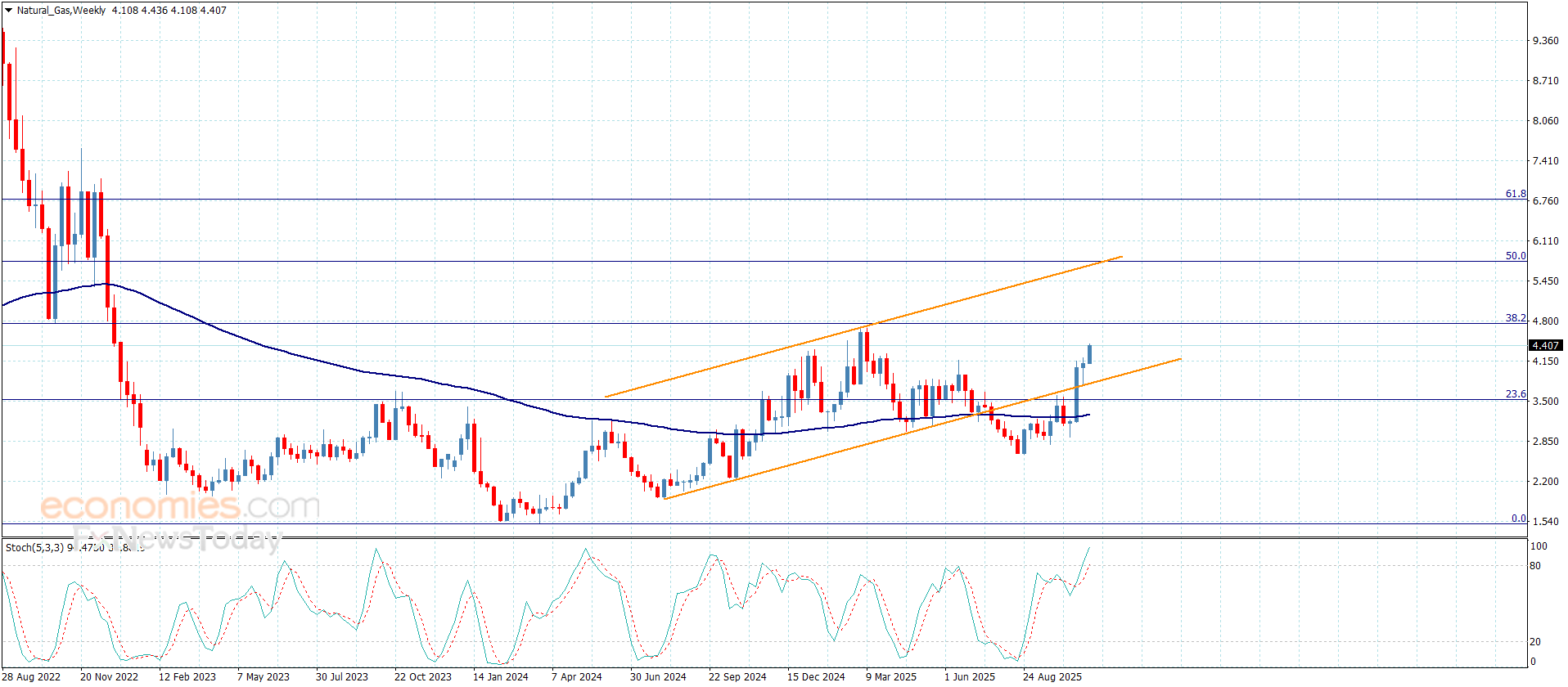
Natural gas prices began forming new bullish waves, to settle near $4.415 level, affected by the bullish momentum of the main indicators, to keep its stability within the bullish channel that appears in the above image.
We expect attacking 38.2%Fibonacci correction level at $4.750, to form the initial main target in the current trading, noting that surpassing this barrier will open the way for recording extra gains in the near period by its rally towards $4.910 and $5.150.
The expected trading range for today is between $4.300 and $4.750
Trend forecast: Bullish