The main tag of GoldPrice Articles.
You can use the search box below to find what you need.
[wd_asp id=1]
The main tag of GoldPrice Articles.
You can use the search box below to find what you need.
[wd_asp id=1]
Gold is replicating Tuesday’s Asian bounce toward the $4,000 mark early Wednesday as traders look to cash in on the recent sharp correction from record highs of $4,382 ahead of the critical US Federal Reserve (Fed) monetary policy decision.
Having lost another 3.5% of its value so far this week, Gold is attempting a tepid recovery on profit book, as markets resort to pre-Fed repositioning.
However, the further upside in Gold appears capped by easing US-China trade concerns and the ongoing risk rally on global stocks.
Heading into the crucial meeting between US President Donald Trump and his Chinese counterpart Xi Jinping, Trump said that he expects to lower fentanyl linked tariffs on China, while reiterating, “I think we are going to have a great meeting with Xi.”
The near-term direction in Gold could be driven by the Fed policy announcements and the outcome of the Trump-Xi meeting.
The Fed is widely expected to lower the key interest rates by another 25 basis points (bps), following the “risk management cut” in September. As the rate decision is fully priced in, the focus will be on the voting composition and any hints from Fed Chair Jerome Powell on future rate reductions.
Markets expect a 9-3 vote split, as Fed Governor Stephen Miran is again expected to dissent in favor of a 50 bps cut, while board members Goolsbee and Musalem are seen leaning in favor of rates on hold.
In case the vote count surprises with 10-2 or 11-1 in favor of a 25 bps rate cut and/ or Powell underscores the increasing downside risks to the labor market, that is likely to be perceived as dovish. This scenario is set to revive the record-setting rally for the non-yielding bullion.
However, Gold could accelerate its corrective downside if the vote split comes out hawkish, watering down hopes of further rate cuts, especially for the December meeting.
All in all, the Fed statement and Powell’s words will be closely scrutinized for the central bank’s outlook on inflation, growth and labor market amid the US government shutdown-driven data drought.
But markets could continue to remain wary ahead of Thursday’s Trump-Xi meeting.
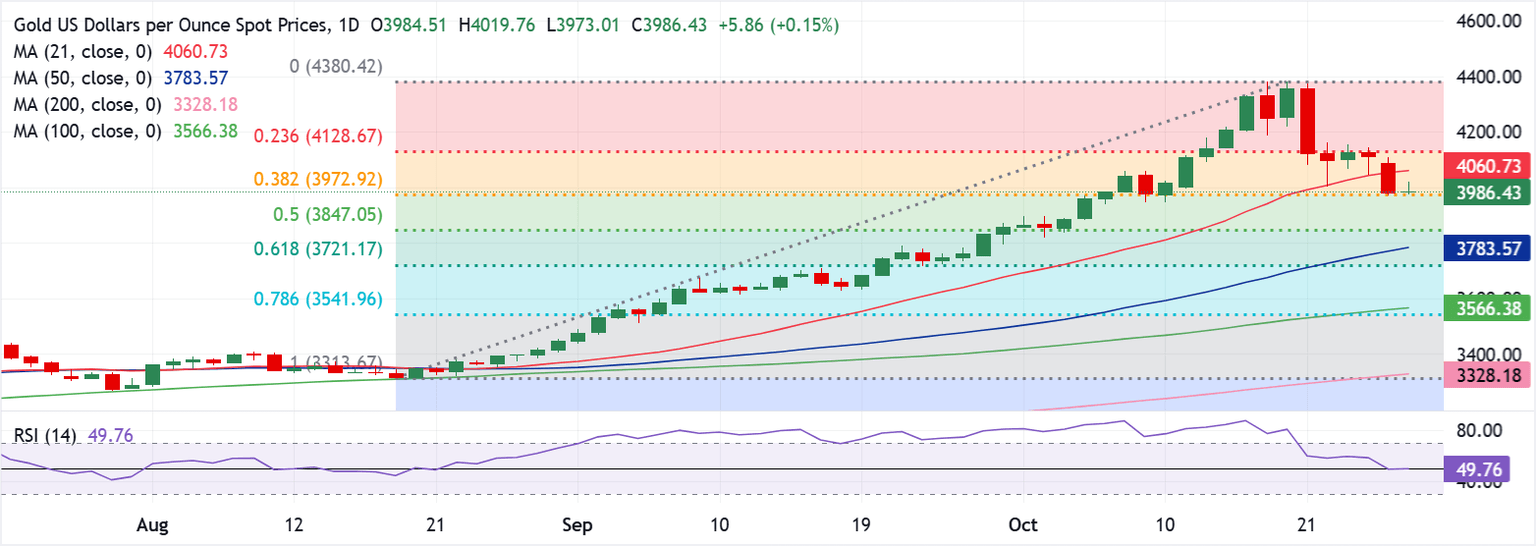
The daily chart shows that Gold price has sustained its rebound from near the critical support at $3,847, which is the 50% Fibonacci Retracement (Fibo) level of the parabolic rise that began in mid-August.
However, it is critical for buyers to recapture the $4,000 round figure to negate the near tern bearish bias.
The important resistance levels to watch out for on a dovish Fed are $4,000 and the 21-day Simple Moving Average (SMA) at $4,064, followed by $4,129 – the 23.6% Fibo level of the same ascent.
In case of a less dovish Fed outcome, Gold could once again challenge the abovementioned 50% Fibo support at $3,847, below which the 50-day SMA at $3,795 aligns.
The last line of defense for buyers is seen at the $3,721, which the 61.8% Fibo level (Golden ratio).
The 14-day Relative Strength Index (RSI) is flatlining close to the 50 threshold, suggesting a lack of clear trading incentives in the bright metal.
The Federal Reserve (Fed) deliberates on monetary policy and makes a decision on interest rates at eight pre-scheduled meetings per year. It has two mandates: to keep inflation at 2%, and to maintain full employment. Its main tool for achieving this is by setting interest rates – both at which it lends to banks and banks lend to each other. If it decides to hike rates, the US Dollar (USD) tends to strengthen as it attracts more foreign capital inflows. If it cuts rates, it tends to weaken the USD as capital drains out to countries offering higher returns. If rates are left unchanged, attention turns to the tone of the Federal Open Market Committee (FOMC) statement, and whether it is hawkish (expectant of higher future interest rates), or dovish (expectant of lower future rates).
Next release:
Wed Oct 29, 2025 18:00
Frequency:
Irregular
Consensus:
4%
Previous:
4.25%
Source:
Federal Reserve
Last week’s $4.21 high formed a lower swing high, testing mid-June’s $4.23 interim peak. Short-term weakness suggests another test of support near the 200-day average at $3.61 and recent swing low at $3.60.
A decisive rally above $4.21 targets the 78.6% Fibonacci retracement at $4.47, provided $4.23 holds. An early strength signal comes on a rally above last week’s $4.14 high.
A break below $3.83 could trigger a weekly bearish reversal, with the 50-day line at $3.55 as key support. This average aligns with the short-term uptrend, rising above the long-term uptrend line and lower boundary of a small rising channel, forming a significant support zone. The 50-day at $3.52 marks the lower end. A bounce is expected here given the confluence.
Last week’s $4.14 high tested resistance at the top rising channel line. Today’s bearish reversal makes the lower channel line a potential target, increasing odds of reaching the 50-day line. Support near the 200-day is bolstered by two rising trendlines, one declining, and the 50-day average.
The $3.82 close decides—below it opens $3.55, above it defends structure. A short downward trendline, confirmed at today’s high, signals new highs if broken. The channel target and support confluence favor a bounce at $3.55—watch for reversal strength or further downside.
For a look at all of today’s economic events, check out our economic calendar.
Spot Gold extended its bearish run on Tuesday, bottoming at $3,886.62 during European trading hours, then bouncing to the current $3,960 price zone. A better market mood weighed on safe-haven demand throughout the day, equally affecting the US Dollar (USD) and the precious metal.
The improvement in market sentiment was the result of easing global trade concerns after the United States (US) and Japan announced a trade deal that included rare earths and reaffirmed their previous agreement. Other than that, US President Donald Trump is meant to meet his Chinese counterpart Xi Jinping later in the week, and speculative interest believes they will find a way to avoid an escalation of tensions between the two economies.
Meanwhile, financial markets gear up for the Federal Reserve (Fed) monetary policy announcement. Officials will unveil their decision on Wednesday, and are widely anticipated to cut the benchmark interest rate by 25 basis points (bps). The focus will be on whether officials will provide additional hints on what’s next in monetary policy. Ahead of the announcement, investors have priced in one additional interest cut in December and one more in 2026.
From a technical point of view, and according to the 4-hour chart, XAU/USD is currently trading at around $3963, down for the day, and poised to extend its slide. A bearish 20 SMA slides beneath the 100 SMA and continues to post lower lows; the 20 SMA stands at $4,041, while the 100 SMA is directionless, flattening at $4,111 and capping the upside. Finally, the 200 SMA keeps advancing at $3,937, sitting below spot and offering initial support. Resistance aligns at $4,041/$4,111, whereas support is located at $3,937. The Momentum indicator remains well below the 100 mid-line, preserving a bearish tilt while the RSI indicator has recovered from an extreme oversold trough at 28 to 36 but is stabilizing below the 50 line, indicating sellers retain the upper hand and the bounce lacks conviction. A decisive break below the 200 SMA at $3,937 would likely reinforce the bearish bias and open the door to additional weakness, while a recovery through the falling 20 SMA at $4,041 is needed to ease immediate pressure and allow a subsequent test of the 100 SMA resistance at $4,111.
On the daily chart, XAU/USD is trading around $3,962. A bullish 20 SMA rallies above the current level, now providing resistance at around $4,070. Furthermore, the 100 SMA is bullish, below the current level of $3,566, while the 200 SMA continues to edge higher at $3,328. Finally, the Momentum indicator has slid decisively below its 100- hinting at increased selling pressure and an elevated risk of oversold conditions. Meanwhile, the RSI has retreated to 48, slipping beneath the 50 midline after prior extreme readings above 75, underscoring fading upside strength and a mild bearish tilt. Unless Momentum stabilizes and the RSI reclaims 50, corrective pressures may persist, with the 20-day SMA at $4,070 capping the upside, while the rising 100- and 200-day SMAs at $3,566 and $3,328 should continue to act as support on dips.
(This content was partially created with the help of an AI tool)
The gold price (XAU/USD) has fallen below the key $4,000 mark, extending a three-day decline as global investors rotate out of safe-haven assets. Spot gold was last seen trading near $3,927 per ounce, while futures fell to $3,940, marking a 10% correction from the October peak at $4,381.29. The fall follows a sharp 3% plunge on Monday — the steepest single-day drop since 2020 — as optimism over a U.S.–China trade truce reduced demand for protection assets. Despite the decline, gold remains up 42% year-to-date, highlighting how stretched bullish positions had become before the selloff.
The biggest catalyst behind the selloff was the breakthrough framework deal struck at the ASEAN conference in Malaysia, where U.S. and Chinese negotiators agreed to remove the threat of 100% tariffs on Chinese exports and delay rare earth export restrictions. Treasury Secretary Scott Bessent confirmed that proposed tariffs were “off the table,” eliminating a core driver of geopolitical risk that had pushed gold to record highs above $4,380 earlier this month. President Donald Trump is now expected to finalize the agreement with Chinese President Xi Jinping later this week, further weakening the safe-haven bid for gold.
Attention has now shifted to the Federal Reserve’s two-day FOMC meeting, where markets price a 98.3% probability of a 25-basis-point rate cut, bringing the target range to 3.75%–4.00%. Typically, lower rates are supportive of gold by reducing opportunity costs, but with the decision already priced in, traders expect limited upside in the near term. The U.S. Dollar Index (DXY) remains broadly flat at 98.47, suggesting the recent decline stems more from reduced geopolitical stress than from currency strength.
Gold’s daily chart confirms a clear bearish reversal after failing to hold above the $4,010 support earlier this week. The next immediate support sits at the 50-day EMA near $3,830, representing roughly 3.4% downside from current levels. A deeper correction could target the $3,270–$3,440 zone, where the 200-day EMA aligns with historical highs from April to August — a region that could act as a strong reaccumulation area. A drop into this zone would represent a 17% retracement from current levels, potentially setting up long-term buying opportunities if RSI reaches oversold territory.
Institutional profit-taking has amplified the recent correction. Last Friday recorded the largest gold ETF outflows since May, ending a ten-week streak of inflows that had lifted gold nearly $1,000 from summer levels. Analysts note this was the first weekly decline in ETF holdings since August, signaling active profit realization by funds. However, the technical structure remains intact above the $3,800–$3,900 range, indicating this may be a controlled pullback rather than a full trend reversal.
Risk appetite surged across global markets, with the Dow Jones and S&P 500 both closing at record highs. Asian equities followed suit after Trump’s comments on cooperation with Japan and China regarding rare earth supply chains, which soothed fears of prolonged trade disruption. Canada’s S&P/TSX index fell 0.3% Monday due to lower materials demand, while gold miners such as Agnico Eagle Mines (NYSE:AEM) lost over 5% amid the broader commodity selloff.
Traders are watching the $3,880–$3,830 zone as a tactical buy area. Technical setups suggest a rebound could occur if prices stabilize above $3,900, with upside targets at $4,080 and $4,140. On the downside, failure to hold $3,830 could open a path toward $3,700 and eventually $3,440. The Relative Strength Index (RSI) has now returned near neutral, indicating room for further downside before oversold conditions appear.
Despite near-term weakness, major institutions remain structurally bullish on gold heading into 2026.
JP Morgan projects an average of $5,055/oz in Q4 2026, maintaining a long-term target of $6,000 by 2028.
Goldman Sachs forecasts $4,900/oz by December 2026, citing inflation hedging demand.
Bank of America maintains a $5,000/oz end-2026 projection, expecting renewed central bank accumulation.
Reuters’ median forecast among 39 analysts shows a $4,275/oz 2026 average, marking the first time annual consensus exceeds $4,000.
Analysts highlight the Fed’s pivot toward sustained easing, persistent fiscal deficits, and robust central bank buying as structural supports for gold’s long-term uptrend.
Silver, often considered gold’s leveraged counterpart, also retreated sharply to $46.72/oz, down 2%, but remains up 60% year-to-date. The synchronized correction across metals suggests broad profit-taking rather than a collapse in industrial demand. Analysts expect volatility to remain elevated until the Trump–Xi summit concludes, after which attention will shift to the Fed’s December decision and updated inflation forecasts.
While XAU/USD has broken below $4,000, the broader trend remains bullish as long as the price holds above the 200-day EMA near $3,300. The recent decline likely represents a technical reset after extreme overbought conditions. Momentum indicators are cooling off, positioning the market for a potential rebound in November once the rate decision is absorbed.
Verdict: Hold/Buy on dips.
A drop into the $3,830–$3,440 range could present strategic accumulation opportunities ahead of the next inflation cycle and further Fed easing. The long-term structural case for gold remains intact, supported by macroeconomic uncertainty, currency debasement fears, and continued central bank diversification.
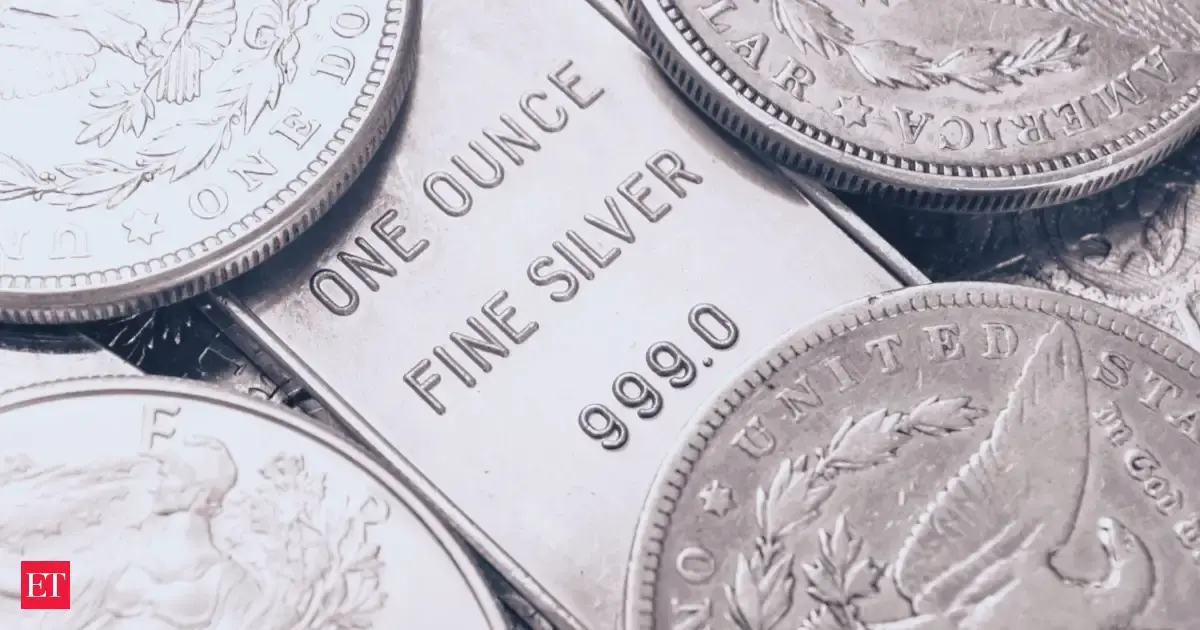
Analysts have revised their forecasts for 2025 and 2026, highlighting how international economic conditions, inflation expectations, and monetary strategies continue to shape the silver platinum palladium price rate today and its long-term outlook.
The silver platinum palladium price rate today reflects the changing global market sentiment as hopes rise for a U.S.-China trade agreement. Precious metal prices have seen a decline as investors shift towards riskier assets.
Spot gold prices dropped 1% to $3,941.65 per ounce as of 0652 GMT, reaching their lowest level since October 10. U.S. gold futures for December delivery also fell 1.5% to $3,957.50 per ounce.
KCM Trade Chief Market Analyst Tim Waterer said that easing tensions between the U.S. and China have weakened safe-haven demand, leading to a fall in gold prices.
Over the weekend, top economic officials from China and the United States discussed the framework for a potential trade agreement. The proposal is expected to be reviewed later this week by Presidents Donald Trump and Xi Jinping.
Waterer added that if both leaders reach a positive outcome, gold prices may continue facing downward pressure. However, he noted that any dovish tone from the U.S. Federal Reserve could support prices later in the week. During his Asia trip, President Trump announced several trade and critical minerals deals with Malaysia, Thailand, Vietnam, and Cambodia. He also expressed optimism about reaching an agreement with China.
Asian stock markets remained steady, supported by expectations of eased trade tensions. Investors are closely watching the U.S. Federal Reserve, which is expected to cut interest rates this week.
Market participants are awaiting comments from Fed Chair Jerome Powell for any signals about future policy direction.
The European Central Bank and the Bank of Japan are expected to maintain current rates in their upcoming meetings.
Gold has gained about 53% in 2025, reaching an all-time high of $4,381.21 per ounce on October 20. The increase was supported by economic uncertainty, rate-cut expectations, and consistent central bank buying.
Other precious metals followed a similar trend. Spot silver declined by 0.8% to $46.51 per ounce, platinum dropped 2.6% to $1,549.85, and palladium slipped 1.2% to $1,385.50.
These metals have also been influenced by global trade shifts and changing investor sentiment.
Citi Bank recently lowered its short-term forecasts for both gold and silver. The bank cut its gold price target to $3,800 per ounce from $4,000 and silver forecast to $42 per ounce from $55.
Citi said this revision reflects reduced market uncertainty after progress in trade discussions involving the U.S., Malaysia, Thailand, Vietnam, and Cambodia, as well as signals from China about potential cooperation.
The bank noted that falling inflation expectations and easing geopolitical risks could slow the metal rally. However, the medium-term case for gold as a hedge against global instability remains intact.
| Agency/Bank | 2025 Forecast ($/oz) | 2026 Forecast ($/oz) | Outlook Summary |
| Citi | 3,400 | 3,250 | Short-term cut due to trade progress |
| JP Morgan | 3,468 | 4,753 | Sees recovery by late 2026 |
| HSBC | 3,455 | 4,600 | Stable year-end view |
| ANZ | 3,494 | 4,445 | Expect steady gains by 2026 |
| Bank of America | 3,352 | 4,438 | Raised 2026 target to $5,000 |
| Societe Generale | – | 5,000 | Expects rise by end of 2026 |
| Standard Chartered | – | 4,488 | Gradual increase |
| Goldman Sachs | 3,400 | 4,525 | Predicts $4,900 by December 2026 |
| Commerzbank | 4,000 | – | Sees $4,200 by end of 2025 |
| Deutsche Bank | 3,291 | 4,000 | Forecasts $4,300 by Q4 2026 |
| UBS | – | – | Expects lower real rates to support gold |
Silver platinum palladium price rate today prediction analysis and forecast indicate continued market adjustments based on global policy and trade decisions. The overall outlook depends on interest rate trends, inflation data, and geopolitical stability.
If global trade cooperation strengthens, prices may remain under pressure. However, any slowdown in growth or dovish central bank signals could renew investor interest in safe-haven metals.
Q1. What is the current silver platinum palladium price rate today?
Spot silver is $46.51 per ounce, platinum $1,549.85, and palladium $1,385.50, reflecting a general decline amid optimism about a potential U.S.-China trade deal.
Q2. What factors could influence silver platinum palladium prices in the coming months?
Prices will depend on central bank policies, global trade developments, inflation data, and investor sentiment regarding risk and safe-haven assets.
Investors are watching closely for signals from Fed Chair Jerome Powell’s press conference on Wednesday, where markets expect a more dovish tone amid slowing economic momentum. The Richmond Manufacturing Index and CB Consumer Confidence data due today will offer early clues on the health of the US economy, with consumer sentiment projected to edge down to 93.4 from 94.2.
Tomorrow’s Pending Home Sales data, forecast at 1.7% versus 4.0% previously, could further shape expectations about the Fed’s policy path.
Analysts at HSBC noted that “the Fed remains under pressure to strike a balance between curbing inflation and avoiding an unnecessary slowdown,” adding that dovish commentary could extend the rally in defensive assets like gold and silver.
Beyond the Fed, central banks in Europe and Japan are also expected to maintain policy stability, while improving signs of US–China trade cooperation have helped limit volatility.
Officials from both nations reportedly finalized the framework of a trade agreement ahead of a meeting between Presidents Trump and Xi later this week, an event markets hope will de-escalate tensions that have weighed on global trade flows.
Gold’s resilience this week reflects renewed hedging against macro uncertainty, while silver’s correlation with industrial demand remains a key focus. With traders balancing optimism over trade with caution ahead of policy shifts, both metals appear poised for moderate upside, contingent on the Fed’s tone and whether easing inflation expectations translate into sustained rate cuts through year-end.
Natural gas price provided mixed trading due to the contradiction between the main indicators, but its main stability within the bullish channel’s levels, by the continuation of forming extra support at $3.830 level, these factors support confirming the continuation of the positivity in the upcoming trading.
Therefore, we will keep waiting for gathering bullish momentum in the current period, reinforcing the chances of its rally towards the positive stations that are located near $4.210 reaching $4.330 resistance, while reaching below the extra support and holding below it might force it to provide strong corrective trading, forcing it to suffer big losses by reaching $3.550 initially.
The expected trading range for today is between $3.850 and $4.215
Trend forecast: Bullish
The (ETHUSD) price declined in its last intraday trading, amid the emergence of the negative signals on the relative strength indicators, after reaching overbought levels previously, to gather the gains of its previous rises, attempting to gain bullish momentum that might help it to recover and rise again, amid the dominance of the bullish corrective trend on the short-term basis and its trading alongside trendline that reinforces the stability of this track, especially with the relative strength indicates reaching exaggerated oversold levels compared to the price move, as a signal for the negative pressure decline.
Get high-accuracy trading signals delivered directly to your Telegram. Subscribe to specialized packages tailored for the world’s top markets:
Full VIP signals performance report for 13-17, October 2025:
View Full Performance Report Telegram (https://t.me/besttradingsignalstocksbot?start=p88d632b0-66dd-11f0-a948-13815052d5ae)
Gold is revering a part of the previous decline, challenging the $4,000 mark as safe-haven flows return heading into the two-day US Federal Reserve (Fed) monetary policy meeting.
Markets seem to have turned risk-averse, biding time before the Fed policy announcements on Wednesday. Further, nervousness sets in as key US tech titans are due to release their earnings reports later this week.
Meanwhile, the US Dollar (USD) is languishing in weekly lows against its six major currency rivals, as traders look to reposition amid the US-China trade deal optimism and ahead of the Fed event risk.
These factors offer fresh support to Gold, helping the bright metal stage a comeback after having fallen for two trading days in a row.
Gold tumbled over 3% on Monday, as markets ignored the traditional safe haven in search of higher returns on renewed hopes that the US and China will reach a trade deal when US President Donald Trump and his Chinese counterpart Xi Jinping meet on Thursday in South Korea.
All eyes are now on the Fed’s monetary policy verdict and the daily technical setup for fresh trading impetus, as the US government shows no signs of reopening.
Markets are almost fully pricing in two interest rate cuts this year, with a 25 basis points (bps) cut seen on Wednesday. Therefore, the main focus will be on the language in the policy statement and Fed Chairman Jerome Powell’s words for fresh hints on the central bank’s path forward on rates.
The daily shows that Gold price defends the critical support at $3,973, which is the 38.2% Fibonacci Retracement (Fibo) level of the parabolic rise that kicked off in mid-August.
So long as the abovementioned level is held, Gold buyers will likely remain hopeful.
Meanwhile, the 14-day Relative Strength Index (RSI) flirts with the midline, struggling to find acceptance above it.
If the 50 level is reclaimed on a sustained basis, Gold’s rebound could gather traction toward the 21-day Simple Moving Average (SMA) at $4,061.
Recapturing the latter is critical to stretch the recovery to near the $4,100 hurdle, where a bunch of healthy resistance levels align.
Additional upside will challenge the $4,150 psychological barrier.
Conversely, a daily candlestick closing below the 38.2% Fibo support at $3,973 will initiate a fresh downtrend toward the 50% Fibo level of $3,847.
Further south, the upward-sloping 50-day SMA at $3,784 could rescue buyers.
Gold has played a key role in human’s history as it has been widely used as a store of value and medium of exchange. Currently, apart from its shine and usage for jewelry, the precious metal is widely seen as a safe-haven asset, meaning that it is considered a good investment during turbulent times. Gold is also widely seen as a hedge against inflation and against depreciating currencies as it doesn’t rely on any specific issuer or government.
Central banks are the biggest Gold holders. In their aim to support their currencies in turbulent times, central banks tend to diversify their reserves and buy Gold to improve the perceived strength of the economy and the currency. High Gold reserves can be a source of trust for a country’s solvency. Central banks added 1,136 tonnes of Gold worth around $70 billion to their reserves in 2022, according to data from the World Gold Council. This is the highest yearly purchase since records began. Central banks from emerging economies such as China, India and Turkey are quickly increasing their Gold reserves.
Gold has an inverse correlation with the US Dollar and US Treasuries, which are both major reserve and safe-haven assets. When the Dollar depreciates, Gold tends to rise, enabling investors and central banks to diversify their assets in turbulent times. Gold is also inversely correlated with risk assets. A rally in the stock market tends to weaken Gold price, while sell-offs in riskier markets tend to favor the precious metal.
The price can move due to a wide range of factors. Geopolitical instability or fears of a deep recession can quickly make Gold price escalate due to its safe-haven status. As a yield-less asset, Gold tends to rise with lower interest rates, while higher cost of money usually weighs down on the yellow metal. Still, most moves depend on how the US Dollar (USD) behaves as the asset is priced in dollars (XAU/USD). A strong Dollar tends to keep the price of Gold controlled, whereas a weaker Dollar is likely to push Gold prices up.
The (Brent) price settled high during its last intraday trading, attempting to breach the current resistance level at $65.55, this resistance represents our expected target in our previous analysis, taking advantage of the dynamic support that is represented by its trading above EMA50, and under the dominance of strong bullish corrective wave on the short-term basis, noticing that the relative strength indicators have reached exaggerated oversold levels compared to the price move, providing big chance for forming positive divergence, intensifying the positive momentum in its upcoming trading.
Get high-accuracy trading signals delivered directly to your Telegram. Subscribe to specialized packages tailored for the world’s top markets:
Full VIP signals performance report for 13-17, October 2025:
View Full Performance Report Telegram (https://t.me/besttradingsignalstocksbot?start=p88d632b0-66dd-11f0-a948-13815052d5ae)