The main tag of GoldPrice Articles.
You can use the search box below to find what you need.
[wd_asp id=1]
The main tag of GoldPrice Articles.
You can use the search box below to find what you need.
[wd_asp id=1]
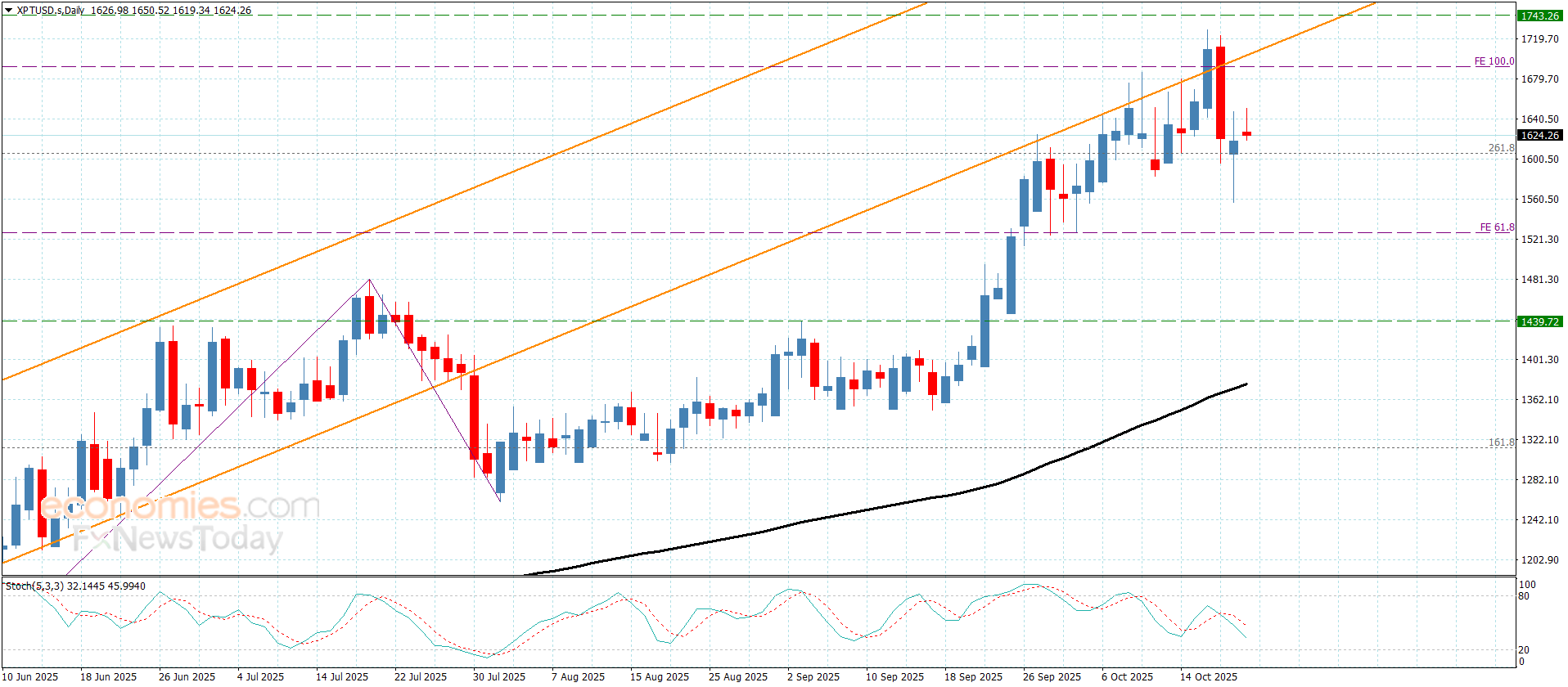
Platinum price reached $1557.00 level in its last corrective decline, then rallies again to settle above the extra support level at $1605.00, but this will not confirm its readiness to activate the bullish track again, due to its fluctuation below the resistance at $1695.00.
The continuation of providing negative momentum by stochastic will increase the efficiency of the bearish corrective track, to expect reaching $1575.00 and facing extra pressure might force it to target $1525.00 level, which forms an extra support against the current trading.
The expected trading range for today is between $1575.00 and $1670.00
Trend forecast: Bearish
Silver has entered a tension-filled holding pattern — not weak, just waiting for ignition.
After rallying to $54/oz, its highest in more than a decade, the market is now consolidating just below that level, mirroring gold’s earlier pattern before its own explosive breakout.
The reason? The metal is balancing order flow inside a critical 4-hour Fair Value Gap (FVG) between $51.118–$52.395 — a zone where prior selling created inefficiency.
Price currently sits at $50.75, testing buyers’ commitment as volume compresses and liquidity builds.
This “pause before propulsion” could define silver’s next major phase — and traders are watching whether it repeats gold’s parabolic move.
Silver’s dual role — industrial metal and monetary hedge — keeps it in demand. The solar and EV sectors continue to consume record levels of silver, straining mine output in Mexico, Peru, and China.
Physical silver inventories at London and COMEX remain near multi-year lows, forcing refiners to reroute supply from Asia. This supply squeeze underpins the spot premium and keeps futures backwardated.
With the U.S. shutdown dragging on and investors bracing for further Fed cuts, funds are once again rotating into metals. As gold flirts with $4,500, silver is attracting renewed speculative inflows aiming to catch “the next gold-style breakout.”
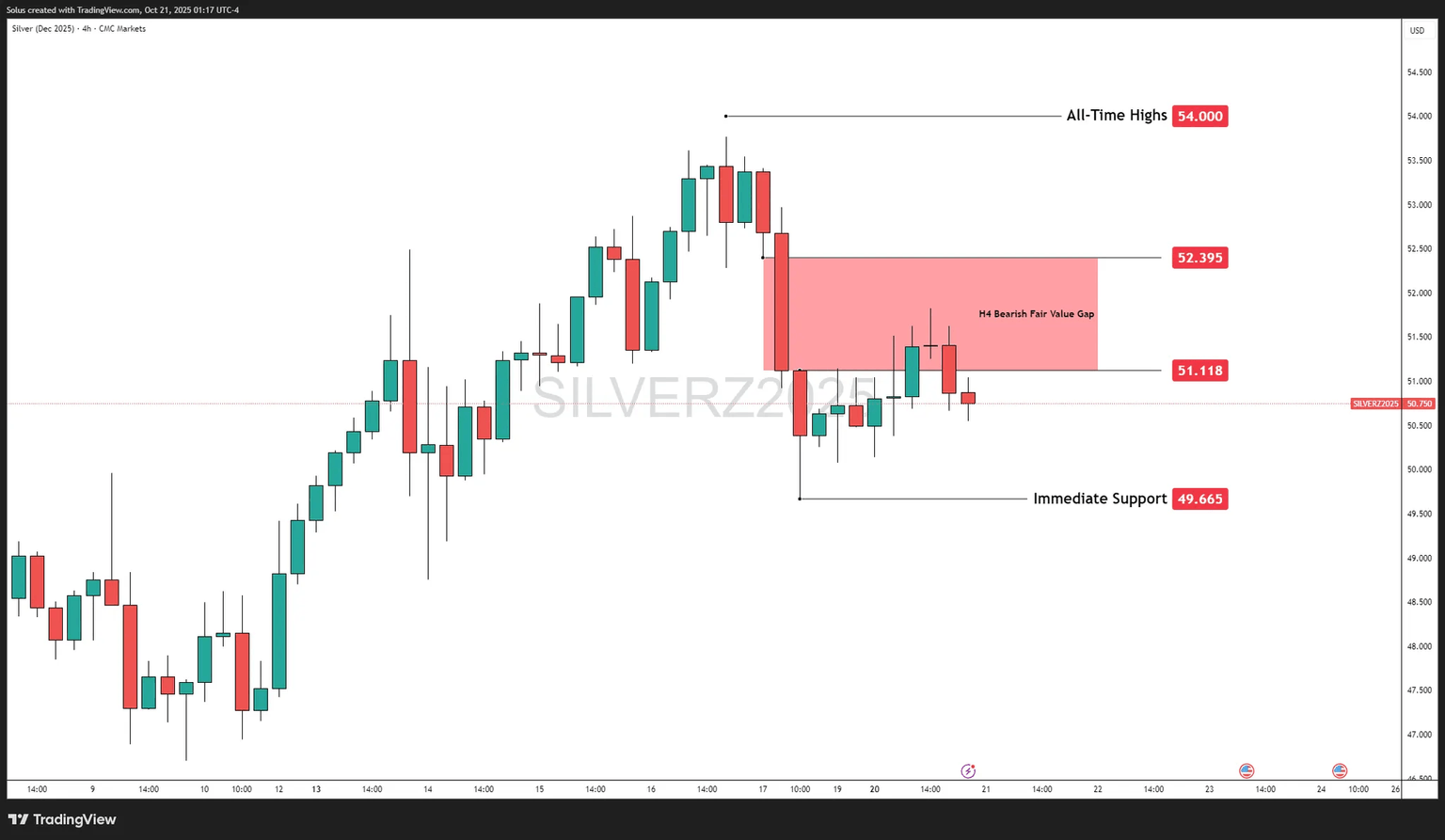
Silver’s structure remains constructively bullish, though tactically neutral within the current balance.
The 4-hour volume imbalance ($51.118–$52.395) acts as the pivot — a zone where supply met demand but delivery remains unfinished.
Price is compressing between this imbalance and immediate support at $49.665.
When that compression breaks, momentum should accelerate sharply.
|
Type |
Price Zone |
Technical Role |
|---|---|---|
|
All-Time High |
$54.000 |
Liquidity target |
|
H4 Volume Imbalance (FVG) |
$51.118 – $52.395 |
Control zone / re-pricing area |
|
Immediate Support |
$49.665 |
Short-term liquidity base |
|
Bullish Targets |
$53 → $54 → $55 |
Expansion levels |
|
Bearish Targets |
$49.00 → $47.80 |
Re-pricing zones |
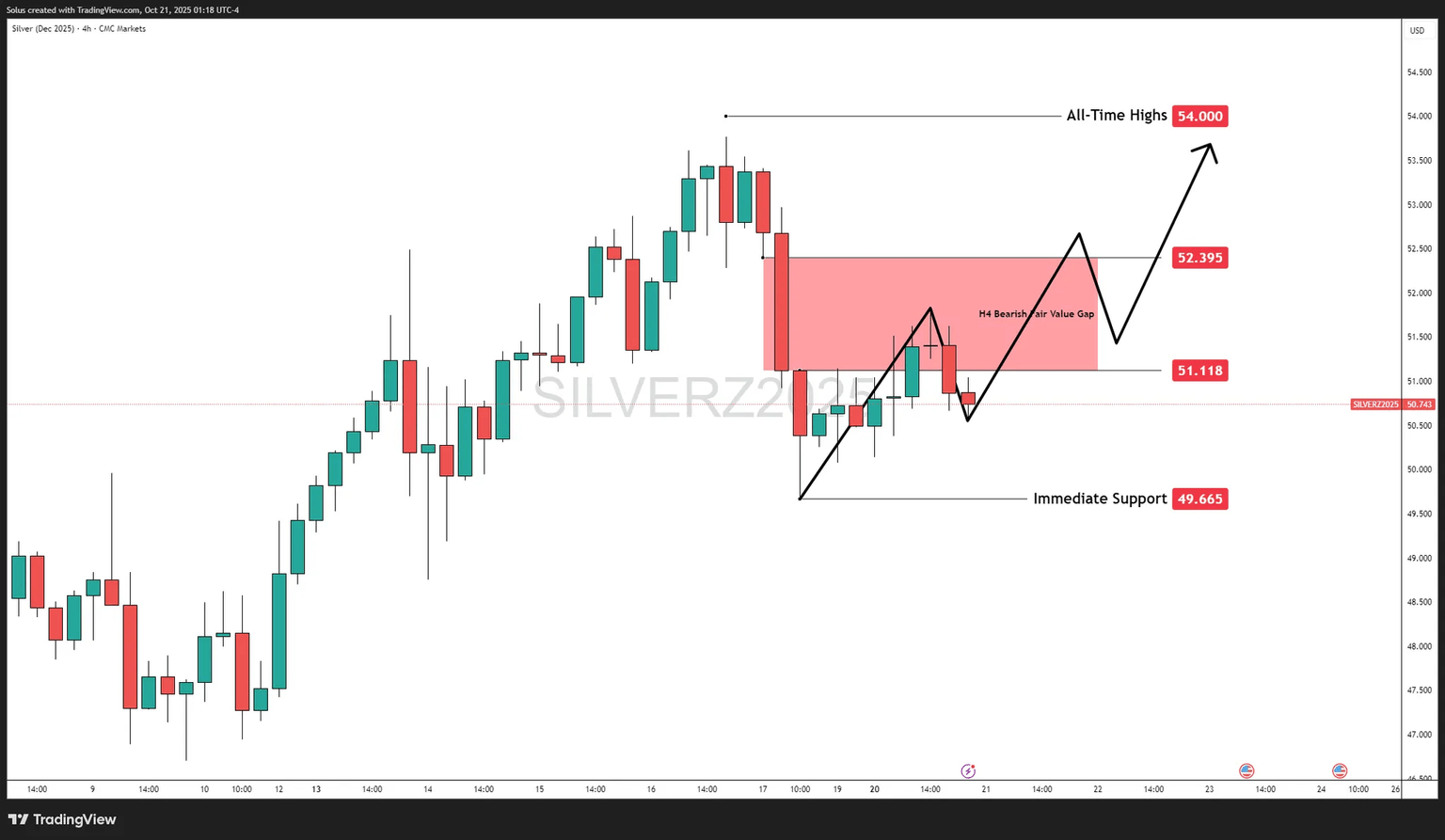
Silver’s repeated defense of $50–$50.70 shows buy-side absorption.
If price reclaims $51.118, it signals demand stepping back into imbalance territory.
Trigger:
A 4H close above $51.118 followed by a break through $52.395 confirms that sellers’ inefficiency has been filled and flipped to support.
Targets:
Narrative:
This would mark a bullish re-balancing of volume, restoring buy-side delivery similar to gold’s prior structure.
A successful FVG reclaim transforms the zone into demand — often the prelude to a sustained breakout.
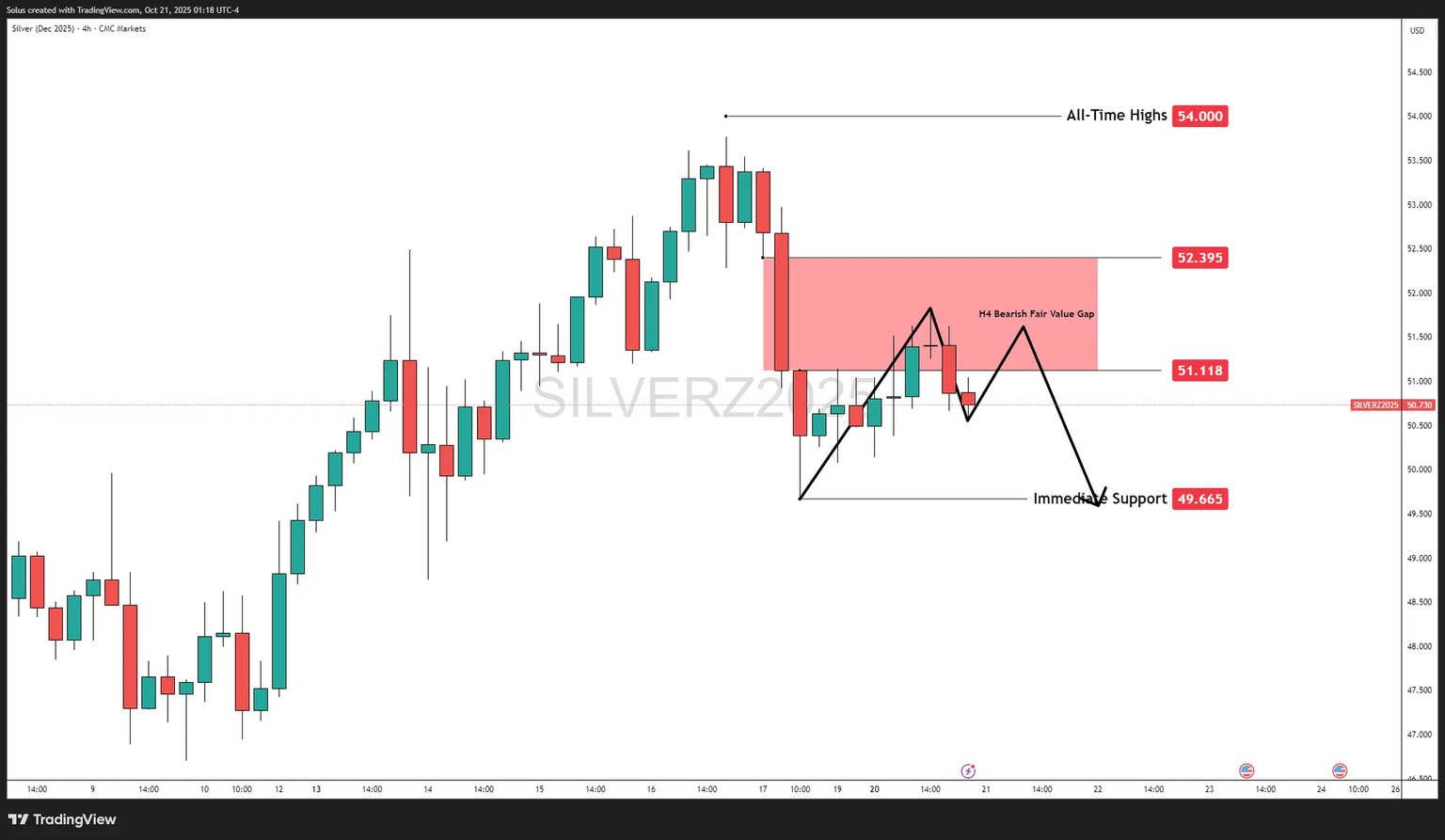
Failure to close above $52.395 or repeated rejections inside the FVG suggest sellers are still defending overhead liquidity.
Trigger:
A 4H close below $50.60 signals renewed sell-side control and continuation toward liquidity resting below $49.60.
Targets:
Narrative:
As long as $51.118 remains unclaimed, the imbalance stays bearish.
Price could slide into discount levels before rebuilding another leg higher.
The $51.118–$52.395 zone is the line in the sand.
Volume is evenly balanced — neither bulls nor bears hold control — but this balance is unstable.
This equilibrium reflects a coiled-spring structure: energy building beneath resistance, similar to gold’s pre-breakout profile earlier this quarter.
Silver is standing at a technical crossroads that echoes gold’s structure weeks ago — tight compression, rising demand, and a visible imbalance zone waiting to break.
Reclaiming $52.395 could unleash a fast leg toward $54–$55, validating the idea that silver is becoming “the next gold.”
Failing to do so simply extends the accumulation window around $50–$49, where long-term buyers likely reload for the next wave.
Gold continues to defy gravity. Prices surged beyond $4,300, printing a fresh all-time high at $4,400, and remain elevated as traders weigh a U.S. government shutdown against the prospect of deeper Federal Reserve rate cuts.
This rally isn’t just sentiment-driven – it’s underpinned by real shifts in macro positioning. The longer the U.S. stays in fiscal limbo, the stronger the bid for havens like gold becomes. Treasury yields are easing, the dollar is softening, and global fund flows are rotating back into metals.
At the same time, institutional forecasts are rising. Several banks, including HSBC, now envision scenarios reaching $4,700–$5,000/oz by 2026. This bullish conviction is showing up in price structure itself – higher lows, expanding imbalances, and repeated demand rejections that reveal ongoing accumulation.
“Every dip is being bought; every pause becomes a platform,” one analyst noted.
Gold’s behavior mirrors that – shallow pullbacks, aggressive reclaims, and clean Fair Value Gaps tell the story.
Together, these drivers reinforce one message: the gold bull cycle is not done.
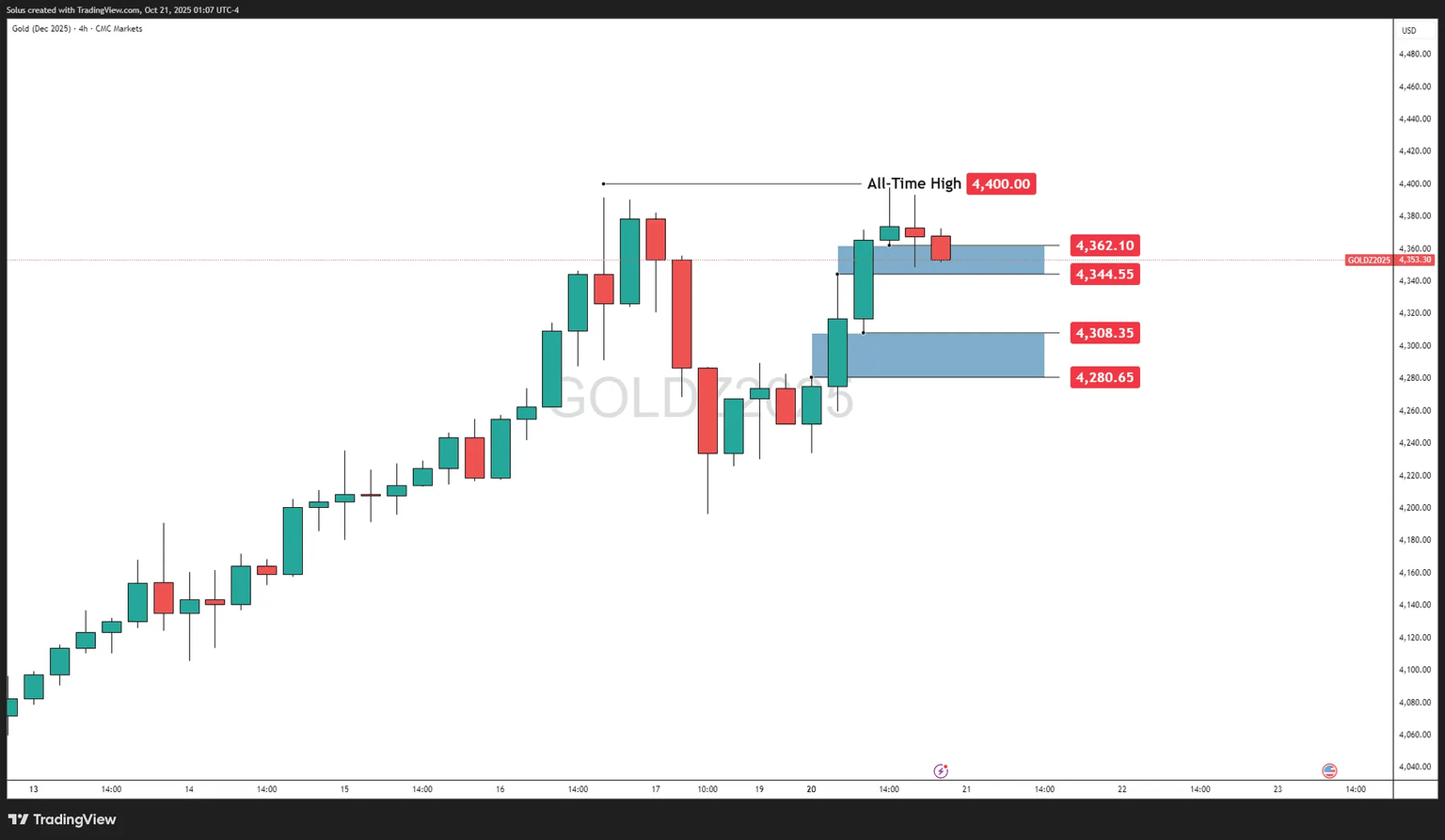
Gold’s 4H structure remains clean and bullish. After printing the $4,400 all-time high, price has pulled back modestly into a tight $4,340–$4,360 consolidation zone, resting just above two well-defined Fair Value Gaps (FVGs).
These volume-weighted imbalances are telling a consistent story: buyers remain in control of delivery. Each time gold retraces into these zones, aggressive bidding emerges – proof of institutional absorption and bullish imbalance continuity.
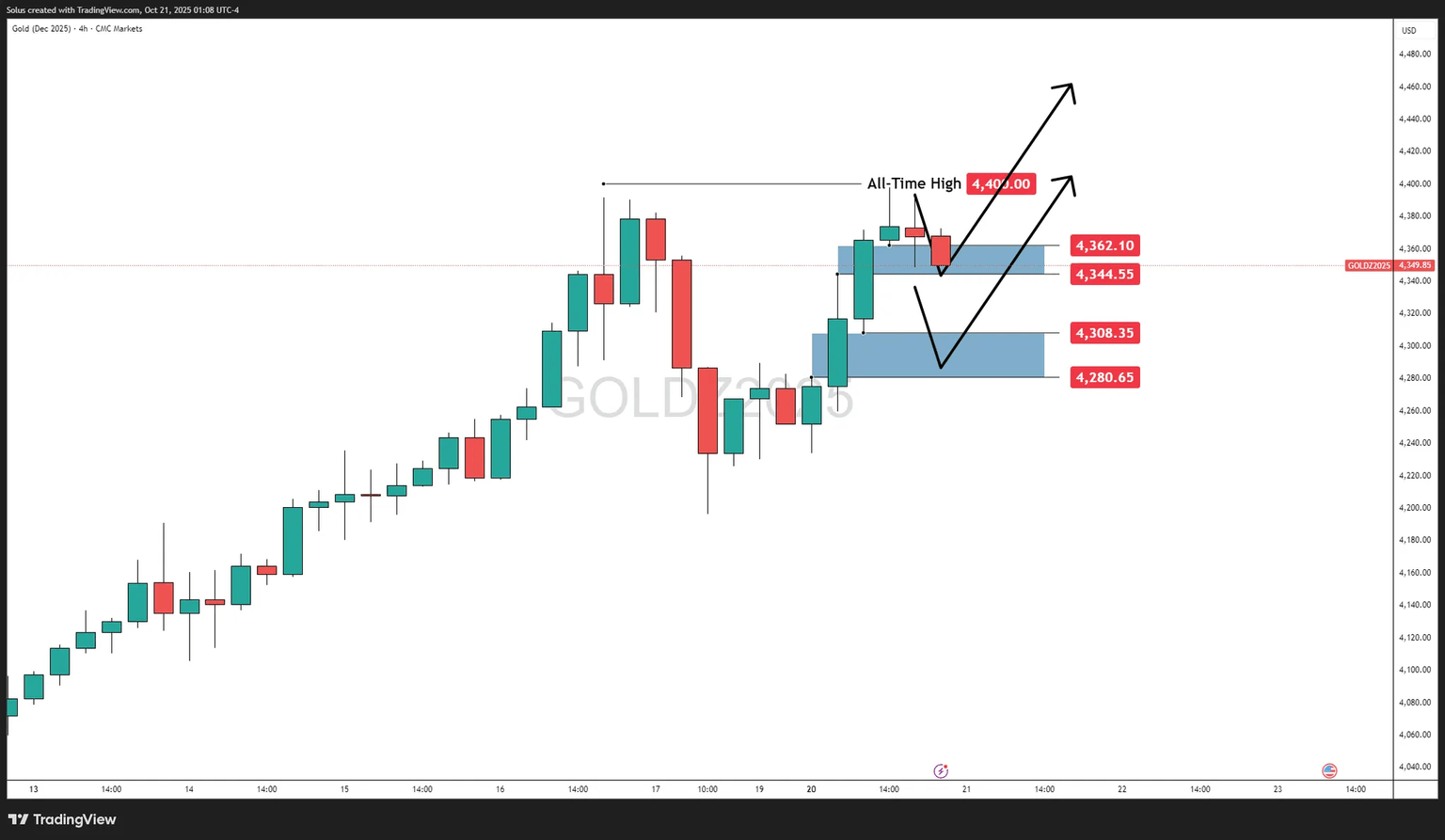
Price consolidates above the upper FVG ($4,344–$4,362) while respecting the $4,308 demand base. The structure shows higher lows and a compression pattern under resistance – classic signs of reaccumulation before expansion.
Trigger:
A decisive close above $4,380–$4,400 confirms a liquidity sweep and continuation phase.
Targets:
The current imbalances act as launchpads, not exhaustion points. Volume profiles reveal sustained buy-side inefficiency – meaning supply hasn’t caught up. As long as $4,344 holds, gold remains in bullish delivery targeting $4,500.
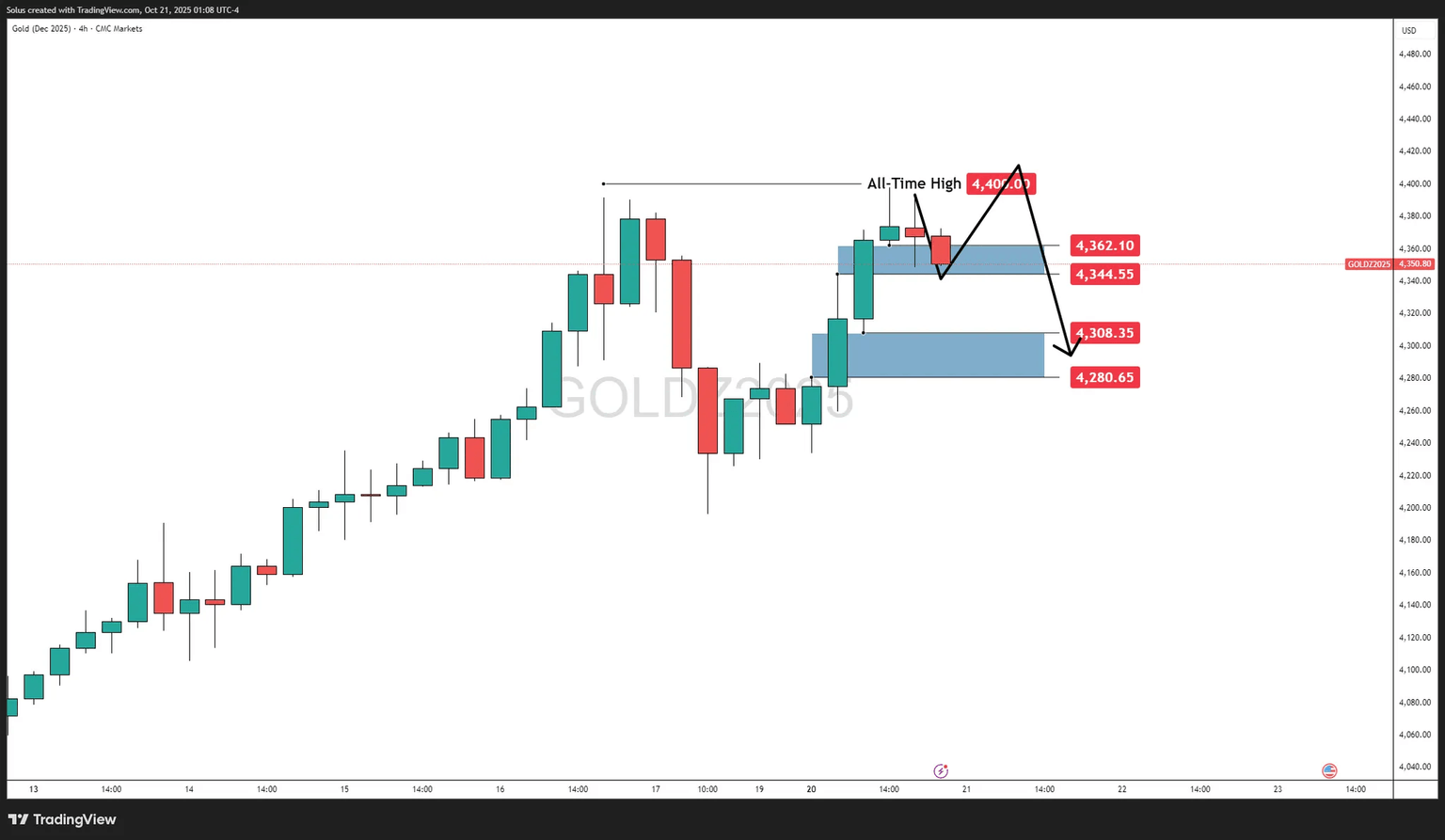
If gold fails to defend the upper imbalance ($4,344–$4,362), the market could engineer a deeper pullback into the lower FVG ($4,280–$4,308) for liquidity mitigation.
Trigger:
A clean close below $4,344 signals a short-term correction toward the lower zone.
Targets:
Continuation Risk:
Only a decisive breakdown below $4,280 would suggest a deeper retracement to $4,240–$4,210. Otherwise, this scenario represents a liquidity grab and reload opportunity for bullish continuation back toward $4,500.
Gold’s current structure is not showing exhaustion; it’s showing controlled aggression.
The story told by the charts – through price gaps, imbalances, and failed breakdowns – is one of institutional continuation.
As long as price holds above $4,280–$4,300, every pullback remains an opportunity within the broader bullish delivery cycle.
The next big psychological magnet sits at $4,500 – and unless macro sentiment shifts dramatically, the path there looks more like a question of “when,” not “if.”
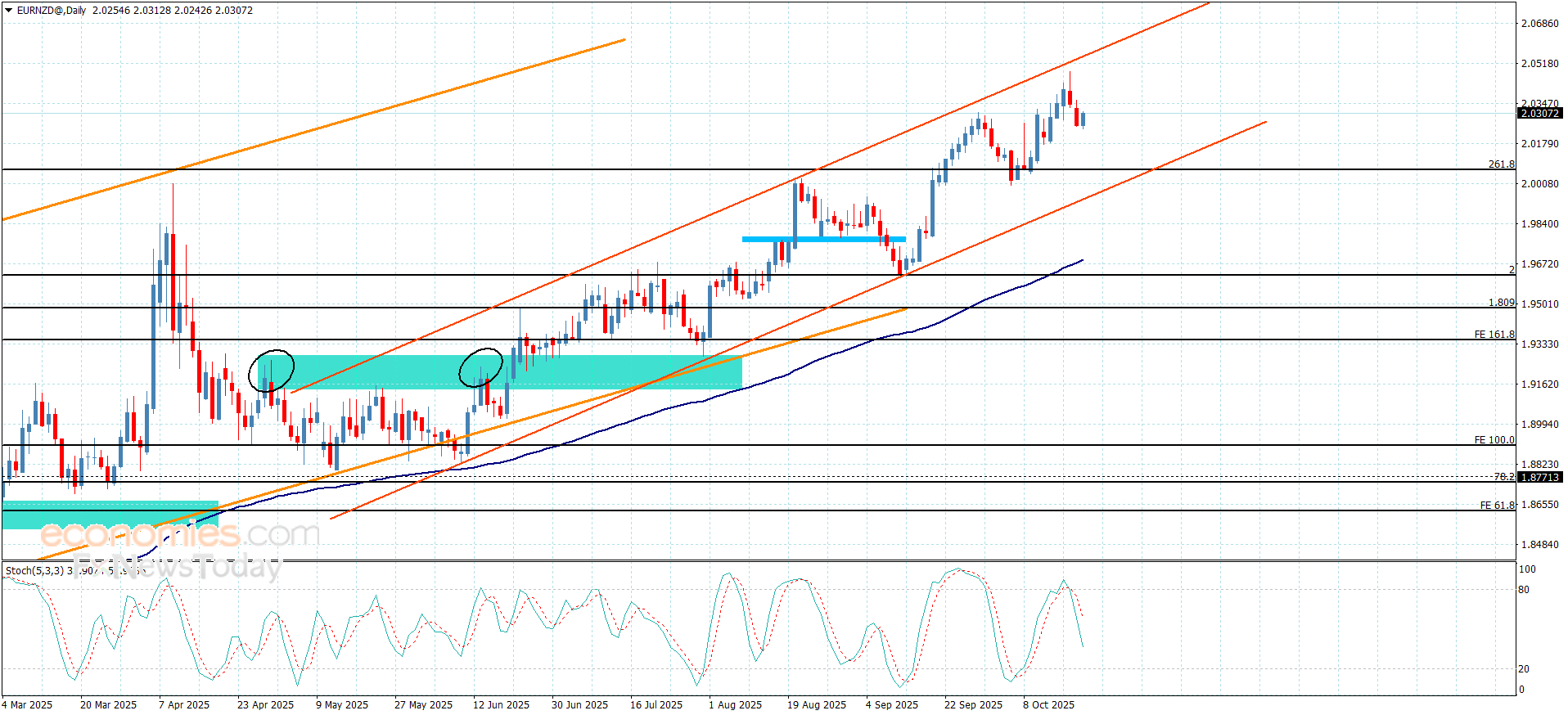
The EURNZD approached by its last bullish rally from the resistance of the bullish channel by hitting 2.04840 level, forcing it to form temporary bearish correction, affected by stochastic exit from the overbought level, activating the attempts of taking the profits by reaching 2.02425.
Note that the stability of the price within the bullish channel’s levels mainly by forming extra support at 2.01850 level, make us wait for gathering bullish momentum then begin forming strong bullish waves, to target 2.04185 level re205420 resistance, which forms the main target in the current period trading.
The expected trading range for today is between 2.02245 and 2.04285
Trend forecast: Bullish
Platinum price reached $1557.00 level in its last corrective decline, then rallies again to settle above the extra support level at $1605.00, but this will not confirm its readiness to activate the bullish track again, due to its fluctuation below the resistance at $1695.00.
The continuation of providing negative momentum by stochastic will increase the efficiency of the bearish corrective track, to expect reaching $1575.00 and facing extra pressure might force it to target $1525.00 level, which forms an extra support against the current trading.
The expected trading range for today is between $1575.00 and $1670.00
Trend forecast: Bearish
Silver price (XAG/USD) declines near $52.35 during the early Asian session on Tuesday. The white metal retreat from last week’s record high due to the safe-haven demand eased as trade tensions between the US and China softened. Traders will take more cues about the US interest rate path from the speech of Federal Reserve (Fed) Bank Governor Christopher Waller later on Tuesday.
Analysts believe that Silver might decline on profit-booking, as traders cash in on their gains. Additionally, US President Donald Trump on Friday sought to ease trade tensions with China, saying that his proposed 100% tariff on goods from China would not be sustainable. His softer tone and confirmation of his intention to meet with Chinese President Xi Jinping this week help to mitigate trade tensions between the world’s two largest economies. This, in turn, dampens the safe-haven demand and drags the Silver price lower.
On the other hand, Fed rate cut expectations and dovish comments from Fed officials might lift the white metal. Fed Governor Christopher Waller said that he is on board for another interest rate cut at the Fed’s meeting later this month, citing the mixed readings on the state of the job market.
Meanwhile, St. Louis Fed President Alberto Musalem said that he could support a path with another rate cut if more risks to jobs emerge and inflation is contained. Lower interest rates could reduce the opportunity cost of holding Silver, supporting the non-yielding precious metal.
Silver is a precious metal highly traded among investors. It has been historically used as a store of value and a medium of exchange. Although less popular than Gold, traders may turn to Silver to diversify their investment portfolio, for its intrinsic value or as a potential hedge during high-inflation periods. Investors can buy physical Silver, in coins or in bars, or trade it through vehicles such as Exchange Traded Funds, which track its price on international markets.
Silver prices can move due to a wide range of factors. Geopolitical instability or fears of a deep recession can make Silver price escalate due to its safe-haven status, although to a lesser extent than Gold’s. As a yieldless asset, Silver tends to rise with lower interest rates. Its moves also depend on how the US Dollar (USD) behaves as the asset is priced in dollars (XAG/USD). A strong Dollar tends to keep the price of Silver at bay, whereas a weaker Dollar is likely to propel prices up. Other factors such as investment demand, mining supply – Silver is much more abundant than Gold – and recycling rates can also affect prices.
Silver is widely used in industry, particularly in sectors such as electronics or solar energy, as it has one of the highest electric conductivity of all metals – more than Copper and Gold. A surge in demand can increase prices, while a decline tends to lower them. Dynamics in the US, Chinese and Indian economies can also contribute to price swings: for the US and particularly China, their big industrial sectors use Silver in various processes; in India, consumers’ demand for the precious metal for jewellery also plays a key role in setting prices.
Silver prices tend to follow Gold’s moves. When Gold prices rise, Silver typically follows suit, as their status as safe-haven assets is similar. The Gold/Silver ratio, which shows the number of ounces of Silver needed to equal the value of one ounce of Gold, may help to determine the relative valuation between both metals. Some investors may consider a high ratio as an indicator that Silver is undervalued, or Gold is overvalued. On the contrary, a low ratio might suggest that Gold is undervalued relative to Silver.
The sharp advance cleared multiple hurdles, including a breakout above a downtrend line, likely confirmed with a close above it today. A long-term uptrend line was also reclaimed, adding weight to the bullish shift following last week’s $2.89 swing low, which found footing at the rising channel’s lower boundary. These breakouts mark a clear end to the recent bearish correction, setting the stage for further gains.
Today’s rally past resistance zones like the downtrend line boosts the odds of a third upswing within the rising channel, triggered by a break above the $3.59 swing high. First, the 200-day moving average at $3.46—tested twice as resistance in October—looms as the next key test. A third attempt could break through, but expect some pullback before a sustained reclaim, given its prior rejections.
The extent of any pullback will shed light on the pattern’s strength. A minor dip toward $3.18 could reinforce support, but a deeper drop would question the breakout’s staying power. The weekly chart’s one-week bullish reversal, with minimal overlap into last week’s range, adds to the optimistic outlook.
Symmetry between the current upswing and prior measured moves points to a $3.71 pivot, where advances align. For now, $3.18 support and $3.46 resistance frame the trade. A close above $3.18 locks in bullish momentum, while $3.59 is the gateway to higher targets. Watch today’s close for confirmation—buyers are back, but the 200-day line will test their resolve.
For a look at all of today’s economic events, check out our economic calendar.
The 10-day average has anchored the uptrend, and today’s low finding support there reinforces its role. A decisive drop below $51.28 signals weakness, with a break past Friday’s $50.62 low paving the way for a deeper pullback. The 20-day average at $48.77, rising and positioned above the short-term rising channel’s top, emerges as a logical next support. Only a failure there would flag a more significant correction, so watch these levels closely.
Last week’s close in the lower half of the weekly range—after five weeks of upper-third finishes—suggests fading bullish momentum. The Relative Strength Index (RSI) dipped below 70 after a month in overbought territory, further supporting this cooling. The outside week’s aggressive selling hints at an early sentiment shift, making any rally suspect without clearing key hurdles.
A push above today’s $52.78 high would signal short-term strength, but only a sustained break past $54.49 confirms renewed upside conviction. Until then, rallies face resistance, with sellers poised to counter. The prior overbought run amplifies correction risks, though the bullish structure holds for now.
Silver’s trend remains upward if $51.28 support persists, but the RSI pullback and weekly weakness warrant caution. A close above $52.78 keeps bulls in play, while a drop below $50.62 targets $48.77. Monitor today’s close for directional cues—$54.49 is the gateway to higher prices, but a deeper breather looms if support gives way.
For a look at all of today’s economic events, check out our economic calendar.
Spot Gold trades near its all-time high of $4,379.76 a troy ounce, up on a daily basis on Monday. The positive tone of global equities limits XAU/USD’s near-term bullish potential, but underlying political and trade woes keep the bright metal afloat.
Market participants are keeping an eye on the United States (US) – China trade relationship. US President Donald Trump demanded that Beijing buy additional soybeans and take action on fentanyl to take back the threat of additional levies. Beijing, however, seems less worried.
According to data released at the beginning of the day, the Chinese Gross Domestic Product (GDP) rose 1.1% in the three months to September, beating the market’s expectations of 0.8%. The annualized figure posted a healthy 4.8%, as expected. Other than that, the country reported that Retail Sales in the year to September were up 3%, while Industrial Production in the same period increased 6.5%, both beating expectations of 2.9% and 5% respectively.
The figures suggest China has little to worried about what the US may or may not do, as the economy is doing well regardless of the White House actions and threats.
Meanwhile, the macroeconomic calendar has little to offer these days, although the United Kingdom (UK), Canada, and the US will release fresh Consumer Price Index (CPI) data. The US CPI will be released regardless of the government shutdown on Friday, according to the Bureau of Labor Statistics (BLS).
The XAU/USD pair is hovering around $4,350, and the daily chart shows bulls are in full control of the metal. In the mentioned time frame, technical indicators resumed their advances within overbought territory after correcting extreme readings. At the same time, the pair is far above all bullish moving averages, with the $3,0 SMA currently at around $3,983.
In the near term, the risk skews to the upside, although the momentum faded. Technical indicators stand far above their midlines, but lack directional strength. Meanwhile, intraday slides below a bullish 20 SMA were quickly reversed, with the pair currently well above the indicator. The 20 SMA provides support in the $4,278 price zone.
Support levels: 4,323.80 4,311.40 4,300.00
Resistance levels: 4,355.60 4,367.10 4,379.80
Gold price (XAU/USD) trades in a tight range around $4,250.00 during the European trading session on Monday. The precious metal stabilizes after Friday’s corrective move, which pushed it lower from the all-time high of $4,380 to near $4,200.
The yellow faced intense selling pressure on Friday after comments from United States (US) President Donald Trump signaled that an additional 100% tariffs announced by Washington on imports from China will not be sustained for long.
The scenario of easing global trade tensions diminishes the appeal of safe-haven assets, such as Gold.
“High tariffs were not sustainable though it could stand,” Trump said in an interview with Fox Business over the weekend. Trump expressed optimism that he could reach a fair deal with Chinese leader Xi Jinping in the meeting scheduled later this month in October.
Broadly, the outlook of the Gold price is upbeat as traders remain highly confident that the Federal Reserve (Fed) will cut interest rates in the policy meeting later this month. According to the CME FedWatch tool, traders are almost certain that the Fed will reduce interest rates by 25 basis points (bps) to 3.75%-4.00% in the October policy meeting.
Ahead of the Fed’s policy meeting, investors will pay close attention to the US Consumer Price Index (CPI) data for September, which will be released on Friday.
Lower interest rates by the Fed bode well for non-yielding assets, such as Gold.
Gold price corrects from its all-time high near $4,380 posted on Friday. The overall trend of the Gold price remains bullish as the 20-day Exponential Moving Average (EMA) slopes higher around $4,011.89. The upward-sloping trendline from the August 22 low around $3,321.50 will act as key support for the Gold price.
The 14-day Relative Strength Index (RSI) stays above 60.00 for a long period, suggesting a strong bullish momentum.
On the upside, the Gold price would struggle to extend its upside above the fresh all-time high of $4,380. Looking down, the psychological level of $4,000 would act as key support.
Gold has played a key role in human’s history as it has been widely used as a store of value and medium of exchange. Currently, apart from its shine and usage for jewelry, the precious metal is widely seen as a safe-haven asset, meaning that it is considered a good investment during turbulent times. Gold is also widely seen as a hedge against inflation and against depreciating currencies as it doesn’t rely on any specific issuer or government.
Central banks are the biggest Gold holders. In their aim to support their currencies in turbulent times, central banks tend to diversify their reserves and buy Gold to improve the perceived strength of the economy and the currency. High Gold reserves can be a source of trust for a country’s solvency. Central banks added 1,136 tonnes of Gold worth around $70 billion to their reserves in 2022, according to data from the World Gold Council. This is the highest yearly purchase since records began. Central banks from emerging economies such as China, India and Turkey are quickly increasing their Gold reserves.
Gold has an inverse correlation with the US Dollar and US Treasuries, which are both major reserve and safe-haven assets. When the Dollar depreciates, Gold tends to rise, enabling investors and central banks to diversify their assets in turbulent times. Gold is also inversely correlated with risk assets. A rally in the stock market tends to weaken Gold price, while sell-offs in riskier markets tend to favor the precious metal.
The price can move due to a wide range of factors. Geopolitical instability or fears of a deep recession can quickly make Gold price escalate due to its safe-haven status. As a yield-less asset, Gold tends to rise with lower interest rates, while higher cost of money usually weighs down on the yellow metal. Still, most moves depend on how the US Dollar (USD) behaves as the asset is priced in dollars (XAU/USD). A strong Dollar tends to keep the price of Gold controlled, whereas a weaker Dollar is likely to push Gold prices up.