The main tag of GoldPrice Articles.
You can use the search box below to find what you need.
[wd_asp id=1]
The main tag of GoldPrice Articles.
You can use the search box below to find what you need.
[wd_asp id=1]
Gold’s spectacular 2025 ascent momentarily stalled after touching unprecedented levels above $4,378 per ounce, as shifting global risk sentiment and the easing of U.S.–China tariff fears prompted investors to take profits. Spot XAU/USD fell as much as 2.2% to $4,220.10, while December futures on the Comex closed around $4,236.20, down 1.6% intraday. The correction came just hours after the metal had posted its biggest two-day climb since the financial crisis of 2008 and remains roughly 8% higher for the week, up 66% year-to-date, far outpacing other major asset classes.
The pullback coincided with President Donald Trump’s reassurance that the planned 100% tariffs on Chinese imports “will not stand”, a statement that defused a surge of geopolitical anxiety responsible for gold’s latest record run. Earlier panic over escalating trade conflict had driven investors to abandon equities and pile into bullion, pushing spot prices from $4,214 to $4,314 per ounce intraday on October 16 before exhaustion set in. Equity indices rebounded once Trump confirmed that negotiations with Beijing would resume, paring risk-off flows and cooling the safe-haven rush that had characterized the week.
Wall Street’s earlier turbulence—sparked by a sell-off in regional U.S. bank stocks amid credit concerns—had briefly revived memories of 2008 and sent traders scrambling for protection. As sentiment normalized, gold’s defensive bid weakened, revealing just how leveraged speculative positioning had become after months of relentless inflows.
Behind the volatility lies a structural story of global reallocation. According to analysts at Société Générale, central bank accumulation and ETF inflows remain the dominant drivers of gold’s 2025 surge. “Resilient and huge ETF flows are pulling prices up,” said the bank’s commodity head Michael Haigh, whose team projects gold reaching $5,000 per ounce by 2026. HSBC raised its own 2025 average forecast by $100 to $3,455 per ounce, acknowledging that sovereign diversification and de-dollarization trends are accelerating.
The World Gold Council’s latest data shows ETF holdings at record levels, with institutional demand outpacing jewelry and industrial usage by more than 3:1. Investors are also betting on dovish monetary policy: Fed funds futures now imply two 25-basis-point cuts, one expected at the October 29–30 FOMC meeting and another in December, supporting non-yielding assets like gold against the weakening U.S. dollar (DXY 98.22).
Comex contracts settled 2.47% higher at $4,280.20 on October 16, cementing the highest close ever recorded for gold futures. The day’s range—$4,214.50 low to $4,314.50 high—reflected extreme intraday volatility as geopolitical headlines drove algorithmic flows. The year-on-year increase now exceeds 59%, a rally unmatched since the early 1970s gold-standard unraveling. Analysts attribute the rise to synchronized global uncertainty: trade disputes, slowing growth in China, and rising speculation of an end to the Federal Reserve’s tightening cycle.
Market veterans compared the move to the 2006 blow-off top pattern, where gold spiked 36% in two months before retracing 25% in four weeks. This analog has drawn technical warnings that the current advance may be unsustainable without a period of consolidation.
Chart analysis reveals gold trading more than 75% above its 200-week moving average, a threshold historically associated with intermediate peaks. During prior bull cycles — 2006, 2008, and 2011 — similar extensions were followed by corrections of 20%–25% before the longer-term trend resumed. The latest move mirrors that geometry: prices overshooting the upper trendline near $4,400–$4,600 could precede a retracement toward $3,500, where the 200-day moving average now sits.
FXEmpire’s technical strategist A.G. Thorson notes that the parabolic nature of recent gains fits the textbook definition of a “blow-off top,” in which speculative euphoria and leverage push markets far beyond equilibrium. Still, he emphasizes that such corrections often mark healthy resets inside enduring secular uptrends. Should history rhyme with 2006, the next multi-month consolidation could set the stage for a longer-term rally toward $6,500 by 2027 and potentially $10,000 by 2030, consistent with expanding monetary debasement and record fiscal deficits.
Gold’s vertical climb has dragged the entire precious-metals complex higher. Silver (XAG/USD) broke through its 45-year cup-and-handle formation, touching $54.14 before pulling back. Adjusted for inflation, analysts see long-term fair value near $200, underpinned by solar-panel and AI-chip demand. Platinum (PL=F) hit a new peak above $1,800 and could retrace to $1,300 if gold corrects 20%.
Mining equities mirrored the metal’s advance. The VanEck Gold Miners ETF (NYSE: GDX) reached $85, fulfilling a four-year rounded-bottom target, while the Junior Miners ETF (NYSE: GDXJ) remains in a strong uptrend with an additional 5–10% upside possible if spot gold retests $4,400–$4,600. Silver-focused miners (NYSEARCA: SILJ) hit fresh highs as speculative capital flooded the sector. These valuations, however, are now tightly coupled to gold’s short-term path; any bullion retracement is likely to produce amplified percentage declines across mining shares.
In Asia, physical demand has re-emerged despite record prices. Philippine gold rose from ₱8,086.72 to ₱8,147.66 per gram on October 17, equivalent to ₱253,420.80 per troy ounce, illustrating how local markets are adjusting rapidly to global benchmarks. Similar strength is observed in India and Thailand, where jewelry purchases continue even at historically high levels due to cultural affinity and currency depreciation.
Meanwhile, Amaroq Minerals (CVE: AMRQ) announced the first sales of traceable Greenlandic gold, a milestone for ethical sourcing. Regional miners from Endeavour Silver (NYSE: EXK) to BHP Group (NYSE: BHP) are expanding exploration budgets in response to sustained profitability at current price levels. The Northern Miner Top-50 Index reported aggregate miner valuations surging $450 billion in a quarter, lifting the group’s combined capitalization near $2 trillion—the highest ever.
The macro backdrop continues to favor bullion structurally. The U.S. economy’s deceleration, coupled with a government shutdown and rising Treasury yields around 4.0%, has pushed investors toward real-asset hedges. Simultaneously, global central banks led by China, Turkey, and India have added more than 140 tons of gold to reserves in the last quarter, diversifying away from the dollar.
Traders increasingly view gold not merely as a crisis hedge but as a strategic allocation amid de-globalization and the fracturing of trade systems. Trump’s easing rhetoric provided short-term relief to risk assets, yet the longer-term implications—volatile trade policy and potential sanctions cycles—continue to underpin the metal’s appeal.
The near-term landscape points to heightened volatility. RSI readings above 80 on weekly charts confirm overbought conditions, while futures open interest suggests crowded speculative longs. Analysts expect consolidation between $4,100 and $4,400 before directionality returns. A failure to hold $4,200 could expose $3,850, followed by $3,500, while sustained closes above $4,450 would resume the parabolic extension.
Despite the risk of a 20% pullback, macro models built on real yields, Fed expectations, and liquidity trends maintain a bullish long-term slope. With global debt surpassing $340 trillion and fiscal policy increasingly expansionary, gold’s historical inverse correlation with real rates remains intact.
XAU/USD – Rating: Hold / Long-Term Bullish.
The metal’s short-term tone is overextended, vulnerable to profit-taking toward $3,800–$3,500, but the structural forces of central-bank demand, ETF inflows, and geopolitical fragmentation justify higher medium-term targets. The market has likely entered a late-stage blow-off phase within a secular bull run that still points toward $5,000–$6,000 by 2026–2027. For disciplined investors, weakness remains an opportunity to accumulate, not capitulate.
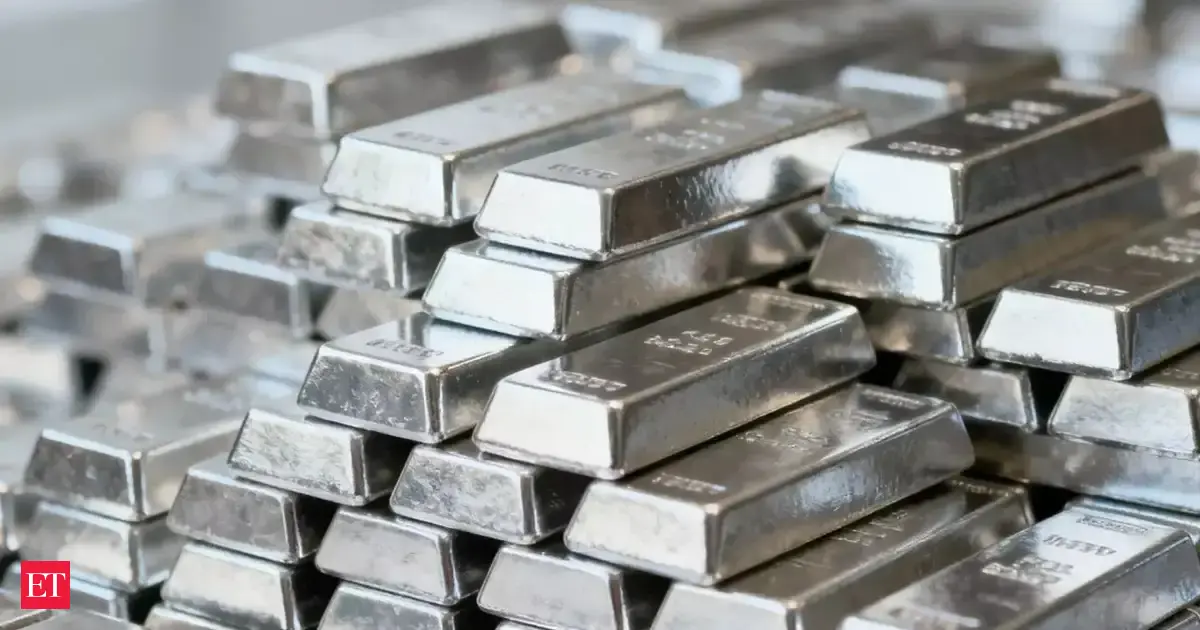
Silver price prediction shows XAG/USD easing on Friday after hitting a new all-time high near $54.86 on Thursday. At the time of writing, Silver trades around $53.20, down over 1.80% on the day and below the intraday high of $53.68. Traders booked partial profits, but ongoing physical demand and institutional interest limit further downside.
The broader uptrend in Silver remains intact. On the 4-hour chart, the market shows a series of higher highs and higher lows. Bulls are defending the $53.00 psychological level, which aligns closely with the 21-period Simple Moving Average (SMA) at $52.93. A decisive break below this mark could lead to a deeper correction. Strong support exists near the $51.00-$51.20 zone, reinforced by the 50-SMA at $51.18. Buyers are likely to enter at this level, maintaining the bullish structure.
Momentum indicators indicate a mild pause after the recent rally. The Relative Strength Index (RSI) eased to around 56, suggesting waning momentum and a mild bearish divergence from the recent price highs. This points to a potential consolidation phase before Silver attempts another upward move.
Meanwhile, the Moving Average Convergence Divergence (MACD) shows a bearish crossover. The MACD line has slipped below the signal line, and the histogram turned negative. This indicates a short-term loss of bullish momentum and suggests a temporary pause or pullback before the broader uptrend resumes.
The Average Directional Index (ADX) remains near 31, confirming that the prevailing uptrend is still strong. As long as Silver holds above $53.00, the path of least resistance is upward. A break above $54.86 could lead to further gains toward the next resistance levels at $55.50 and $56.00.
Silver price prediction shows that traders are closely watching technical levels. Support at $53.00 is critical for short-term stability. If prices fall below this, $51.00-$51.20 becomes the next key support. Resistance exists at $54.86, with further levels at $55.50 and $56.00. Momentum indicators like RSI and MACD provide early signals of potential short-term pauses or pullbacks.
Silver prices react to multiple factors. Geopolitical risks or fears of recession often increase demand for safe-haven assets like Silver, though less than Gold. Interest rates also influence prices. Lower rates generally support higher Silver prices, while a stronger US Dollar may reduce XAG/USD levels. Investment demand, mining supply, and recycling rates also affect the price.
Industrial use of Silver impacts its market price. Electronics, solar panels, and other industries require Silver due to its high conductivity. Changes in industrial demand in the US, China, and India can influence prices.
Silver prices also move in relation to Gold. When Gold rises, Silver often follows. The Gold/Silver ratio helps investors understand relative valuation. A high ratio may indicate undervalued Silver, while a low ratio may indicate undervalued Gold relative to Silver.
Silver serves as a store of value and investment hedge. Investors buy physical Silver or trade through ETFs to diversify portfolios and protect against inflation.
Industrial demand in electronics, solar energy, and other sectors can raise or lower Silver prices. Large markets like China, the US, and India significantly influence these movements.
This may signal the onset of a correction, fueled by the recent sharp ascent and growing extension from the 10-day moving average at $4,098. A sustained breach below today’s low points to a test of support at this key dynamic support line. The bearish candle aligns near a predefined target from a rising measured move, matching the rally from May’s swing low to the prior upswing from November’s bottom. Symmetry in these advances often breeds resistance, evident in today’s reversal.
Bounces into today’s range should meet eventual resistance, reversing lower amid emerging seller dominance—the most bearish daily action since the rally ignited around August 22. Despite this, gold’s underlying demand stays robust, potentially fostering a consolidation correction near highs above the 10-day line.
Recent upside breaches of two rising trend channels underscore strength, offering potential support on pullbacks. The long-term bullish channel’s top line activated last Wednesday, following a smaller channel breakout Monday. The long-term bull trend holds firm, yet the RSI lingers in extreme overbought territory, amplifying speculative acceleration in the rise.
A correction would prove beneficial, realigning with a more sustainable ascent rate. Overbought readings and parabolic moves heighten this likelihood, even as breakouts affirm momentum.
Bears gain footing short-term, with $4,098 as the litmus test—hold for consolidation, break for deeper retracement. Watch the close for engulfing confirmation; channel lines could cushion falls, but symmetry resistance suggests caution until support is proven.
For a look at all of today’s economic events, check out our economic calendar.
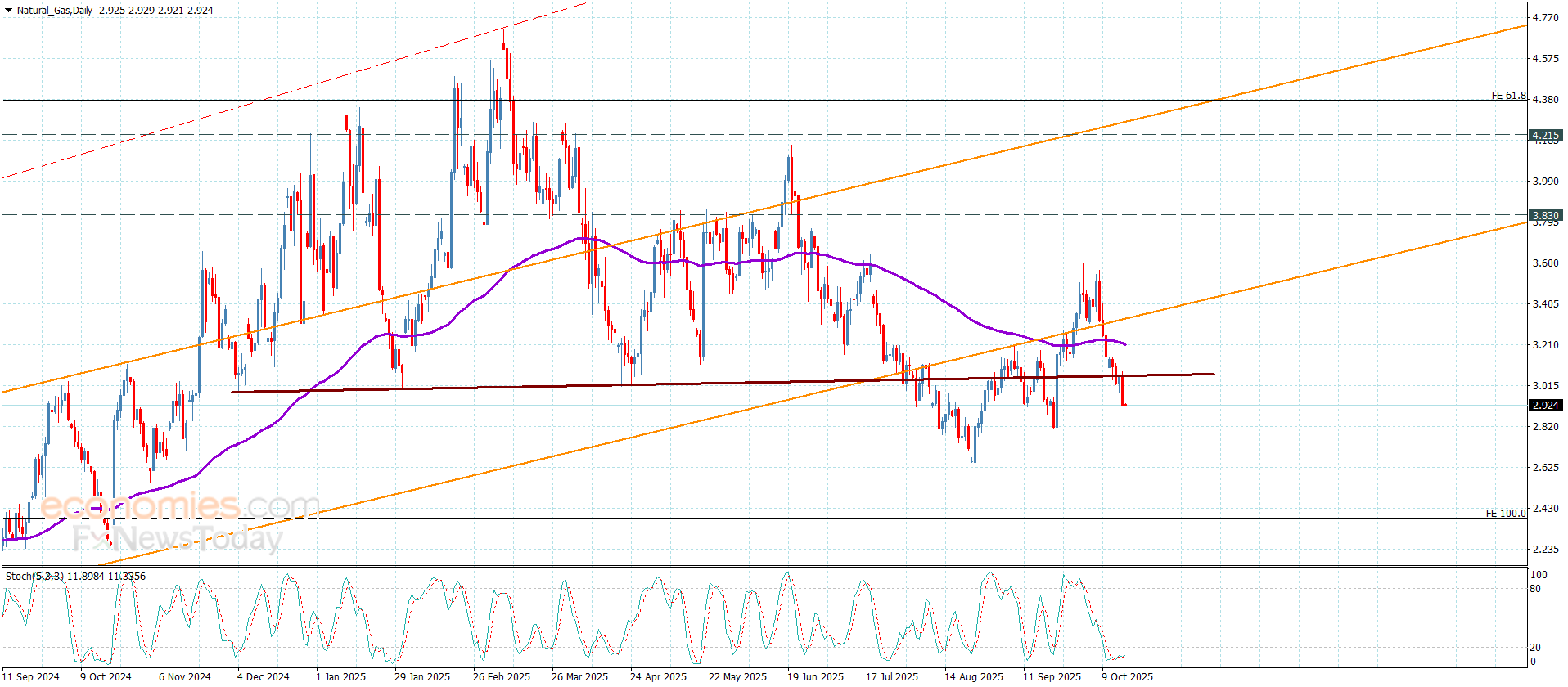
The support cluster—breached earlier – was reclaimed as prices climbed above the open. Key elements include the 78.6% Fibonacci retracement at $2.95, a long-term anchored Volume Weighted Average Price (AVWAP) line, and the top quarter line of a large falling trend channel. This recovery highlights a bullish buyer response but doesn’t erase the broader correction’s grip.
More telling is the reaction at the 50-day average: today’s range marks the first full session below it since September 26’s reclaim. A drop below today’s low would reinforce this; otherwise, upside reversal potential lingers via a breakout above $3.02 and the 50-day line. Sustained gains above Thursday’s $3.07 high would bolster confidence.
Initial upside aims at the 20-day average ($3.16), converging with the falling 10-day average ($3.17) and the rising channel’s top centerline. Channel vibrations could propel natural gas toward the top boundary, though the falling channel’s upper line resulted in resistance and a double top.
An intersection of two lines at $2.95 arrives Tuesday, potentially signaling timing for resolution or retest.
The channel floor hold favors a pause in selling, but 50-day rejection caps enthusiasm. Watch $3.02 for breakout validity or $2.89 for renewed downside. A close above $2.98 strengthens the rebound case, while the $3.16 cluster tests conviction—Tuesday’s line cross adds intrigue to the unfolding setup.
For a look at all of today’s economic events, check out our economic calendar.

The gold silver platinum price forecast indicates that precious metals may soon face a turning point after sharp gains in recent months. Technical indicators suggest a possible blow-off top, followed by corrections similar to those seen in past bull market cycles.
Gold prices have risen by more than 25% in two months. Analysts see similarities with 2006 when gold peaked and then dropped 25% within a month. Current signals point to an imminent top, with a possible pullback to around $3,500.
The surge began in early 2024, and experts believe a peak could occur between now and the end of October. Gold has now extended more than 75% above its 200-week moving average, a level that in past cycles led to 20% or more corrections.
If gold follows the same path as in the last bull market, it could reach $6,500 by 2027 and possibly $10,000 by 2030. However, short-term technicals suggest caution as the price nears $4,400–$4,600 before a likely correction.
In 2005, gold entered a strong uptrend when it broke above $500. Prices never returned to that level. A blow-off top followed in 2006, with a 36% surge in two months and a 25% correction soon after. This historical trend shows how extreme rallies often lead to sharp pullbacks. Gold is again moving beyond its trendline resistance, indicating a similar pattern could be forming. Analysts expect that after reaching $4,400–$4,600, gold may quickly correct to $3,500.
Silver has officially broken out of a 45-year cup-and-handle formation. Analysts believe this marks the beginning of a long-term repricing. Silver reached a new inflation-adjusted high and could eventually move toward $200 per ounce.
Supply deficits and industrial demand from sectors like artificial intelligence and solar are key drivers. Over the next decade, silver could surpass its 1980 inflation-adjusted high and set a new price floor around $50.
Recently, silver hit $54.14, with a possible surge toward $60 if gold continues higher. However, if gold corrects 20% or more, silver could also pull back toward $40.
Platinum prices have reached a new high and could briefly move above $1,800 before correcting toward $1,300. The move reflects a temporary spike driven by investor momentum and market sentiment.
While gold and silver dominate headlines, platinum is also showing volatility, suggesting the entire precious metals sector may be nearing a peak before stabilizing.
Gold miners (GDX) have reached the $85 target projected from a four-year rounded bottom pattern. Any further gains are expected to be limited. If gold rises to $4,400–$4,600, that could mark a near-term top, leading to a 20%–25% correction.
Junior miners (GDXJ) could still rise by 5%–10% if gold enters a final blow-off phase. Silver juniors (SILJ) have also hit new highs, but their gains are likely to end when gold and silver peak.
Despite possible near-term corrections, analysts remain positive about long-term prospects. The gold silver platinum price forecast for the decade suggests higher levels by 2030 as inflation, currency weakness, and industrial demand support metal prices.
The 2024–2025 rally has confirmed a new bull phase. Corrections in late 2025 may create opportunities before the next growth cycle begins.
What is the gold price forecast for the next few months?
Gold could rise toward $4,600 before correcting to around $3,500, following a possible blow-off top similar to the 2006 pattern.
How high can silver and platinum go by 2030?
Silver may reach $200 or higher, while platinum could see levels above $2,000 as long-term demand trends continue.
Market analysts attribute this surge to persistent safe-haven flows, as traders hedge against volatility in equities and currencies. “Markets are increasingly pricing in policy easing and slower growth, which keeps demand for non-yielding assets like gold strong,” said a commodities strategist at OANDA.
Concerns over a prolonged U.S. government shutdown and weakening macro indicators have amplified demand for precious metals. The Senate’s continued failure to pass a short-term funding bill has deepened fears of reduced consumer confidence and delayed economic data, clouding the outlook for growth.
At the same time, the Federal Reserve is signaling a dovish tilt. Chair Jerome Powell recently acknowledged labor market softening, while Governor Christopher Waller said inflation is nearing the central bank’s 2% target. These comments fueled expectations of back-to-back 25-basis-point rate cuts at the Fed’s October and December meetings. A weaker U.S. dollar, which has fallen to a one-week low, has further supported gold and silver prices.
Renewed trade friction between the U.S. and China is another driver of bullion demand. Recent tariff threats and export restrictions have intensified concerns about global supply chains. Meanwhile, broader geopolitical tensions across Eastern Europe and other regions have reinforced gold’s role as a hedge against instability.
Gold (XAU/USD) is expected to consolidate between $4,280 and $4,400 before attempting another breakout, while Silver (XAG/USD) may retest $53.40 support before targeting $54.50 and $55.40. Traders are now watching upcoming Fed communications, U.S. labor data, and global trade updates for cues on the next directional move.
The EURJPY pair forced it to form slow sideways trading, to face stochastic negativity which keeps its positive stability above the extra support at 175.20 level, confirming the continuation of the suggested bullish attempts.
Gathering the positive momentum is important to ease the mission of forming bullish waves, to help it surpass the obstacle at 176.40, then targeting the next positive station at 177.05, while breaking the current support will force it to activate the bearish corrective trend, to suffer extra losses by reaching 174.25.
The expected trading range for today is between 175.20 and 176.45
Trend forecast: Bullish
The American Petroleum Institute (API) estimated that crude oil inventories in the United States increased by a large 7.36 million barrels in the week ending October 10. Analysts had forecast a much smaller 120,000-barrel build for the week. Today’s build comes after the IEA predicted a smaller global oil demand growth estimate for this year, along with a higher supply growth, which would, according to the agency, result in a rather large supply overhang globally.
But crude oil inventories in the United States are not showing signs of an inventory overhang, with net crude oil inventories just 7.9 million barrels higher than they were at the beginning of the year, according to Oilprice calculations of API data.
Earlier this week, the Department of Energy (DoE) reported that crude oil inventories in the Strategic Petroleum Reserve (SPR) have risen by 700,000 barrels to 407.7 million barrels in the week ending October 10 as the government attempts to replenish stockpiles that were eaten into by the previous administration.
US production has reached an all-time high for the week of October 3, of 13.629 million bpd, according to the EIA.
At 4:14 pm ET, Brent crude was trading down again, by $0.28 (-0.45%) on the day, reaching $62.11 $65.73. Brent prices are now down $3.60 per barrel from this time last week following a fragile ceasefire and hopes of a lasting peace deal, on top of the IEA’s gloomy predictions of a bearish market. WTI was also trading down on the day, by $0.26 (-0.44%) at $58.44.
Gasoline inventories also saw a build, of 2.99 million barrels in the week ending October 10, after falling by 1.245 million barrels in the week prior. As of last week, gasoline inventories were about 1% below the five-year average for this time of year, according to the latest EIA data.
Distillate inventories fell in the reporting period, losing 4.79 million barrels on top of the week prior’s 1.822-million-barrel drawdown. Distillate inventories were already 6% below the five-year average as of the week ending October 3, the latest EIA data shows.
Cushing inventory data was not available at the time of writing.
By Julianne Geiger for Oilprice.com
More Top Reads From Oilprice.com:
The EURJPY pair forced it to form slow sideways trading, to face stochastic negativity which keeps its positive stability above the extra support at 175.20 level, confirming the continuation of the suggested bullish attempts.
Gathering the positive momentum is important to ease the mission of forming bullish waves, to help it surpass the obstacle at 176.40, then targeting the next positive station at 177.05, while breaking the current support will force it to activate the bearish corrective trend, to suffer extra losses by reaching 174.25.
The expected trading range for today is between 175.20 and 176.45
Trend forecast: Bullish
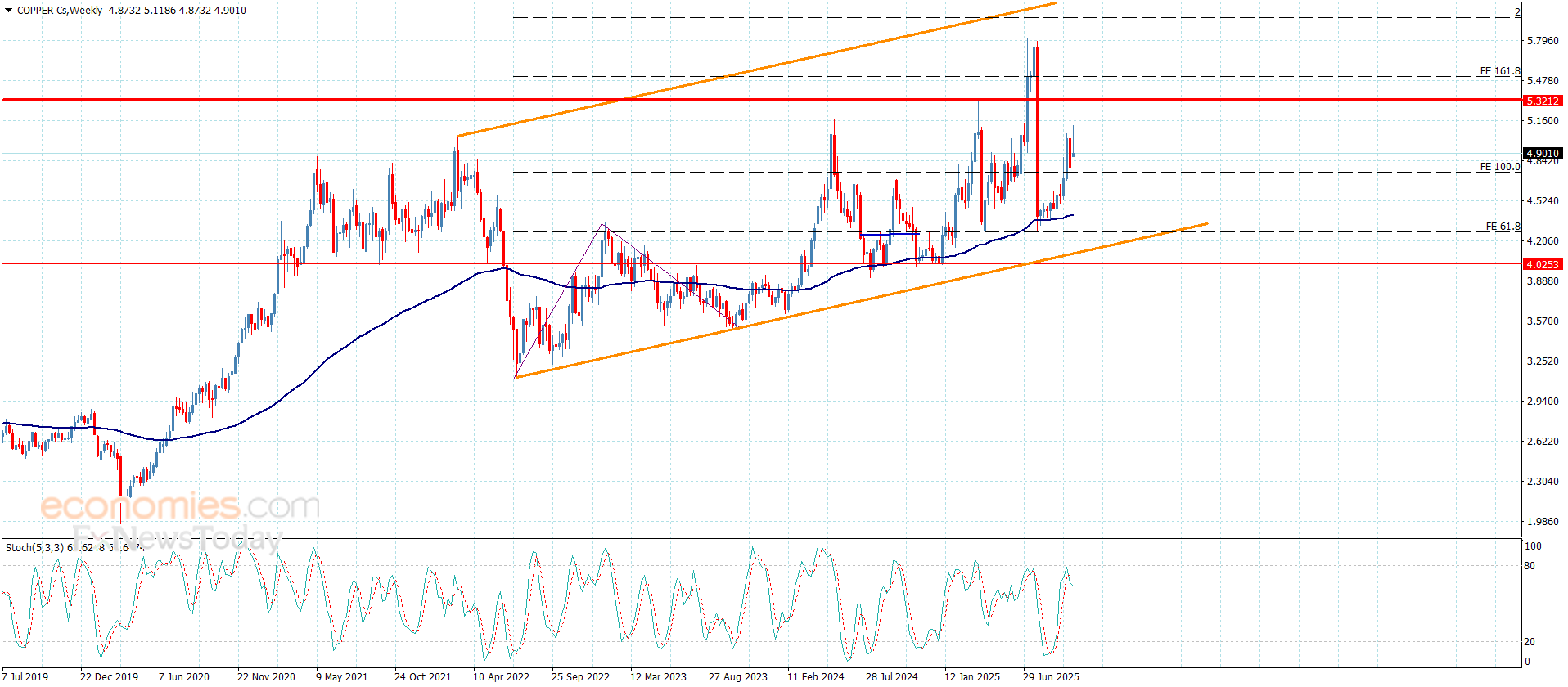
Copper price remains needs positive momentum, which forces it to delay the previously waited bullish attack, to keep providing sideways trading near $4.9000, note that the stability above $4.7500 support is important, to keep waiting for gathering extra positive momentum to pave the way for surpassing the barrier near $5.0600, then begin recording some gains by its rally towards $5.2000 and $5.3200.
While facing new negative pressures and reaching below the current support might force it to form correctional trading, to suffer intraday losses by reaching $4.6200 followed by the moving average 55 near $4.4000.
The expected trading range for today is between $4.7500 and $5.2000
Trend forecast: Bullish