The main tag of GoldPrice Articles.
You can use the search box below to find what you need.
[wd_asp id=1]
The main tag of GoldPrice Articles.
You can use the search box below to find what you need.
[wd_asp id=1]
The (ETHUSD) price rose in its last trading on the intraday basis, in an attempt to recover some of its previous losses, and attempting to offload its clear oversold conditions on the relative strength indicators, with the emergence of positive overlapping signals, and the dominance of bearish wave on the short-term basis, with the continuation of the negative pressure due to its trading below EMA50, reducing the chances of its recovery in the upcoming period.
Get high-accuracy trading signals delivered directly to your Telegram. Subscribe to specialized packages tailored for the world’s top markets:
Full VIP signals performance report for 6-10, October 2025:
The (Brent) price fluctuated in its last intraday levels, attempting to recover some of its previous losses, amid the continuation of the negative pressure due to its trading below EMA50, reinforcing the dominance of the main bearish track on the short-term basis and its trading alongside trendline that represents dynamic resistance that prevent the recovery on a near-term basis, on the other hand, we notice the emergence of positive crossover on the relative strength indicators, which makes us witness some temporary corrective rebounds.
Get high-accuracy trading signals delivered directly to your Telegram. Subscribe to specialized packages tailored for the world’s top markets:
Full VIP signals performance report for 6-10, October 2025:
Gold maintains its record-setting advance early Thursday, after having settled Wednesday above the $4,200 threshold.
Amidst sustained US Dollar (USD) weakness and persistent demand for safe havens, Gold – a traditional store of value – extends its record run into the fourth consecutive day on Thursday.
Gold buyers remain defiant as the ongoing trade spat between the United States (US) and China keeps investors on edge, while uncertainty over the US economic prospects in the face of the government shutdown also dent the sentiment around the Greenback.
US Trade Representative Jamieson Greer on Wednesday said that “China’s export restrictions were a “global supply-chain power grab” and the US and its allies would not accept the restrictions,” per Reuters.
Meanwhile, a US Treasury official noted that the government shutdown could cost the economy $15 billion per week.
Furthermore, markets’ affirmation of two Federal Reserve (Fed) interest rate cuts this year and concerns about the US labor market amongst the Fed officials bolster the non-yielding Gold at the expense of the buck.
Markets continue to price in roughly 95% probabilities of rate cuts at the Fed’s October and December monetary policy meetings, the CME Group’s FedWatch Tool shows.
Looking ahead, speeches from Fed policymakers remain of note in the absence of high-impact US economic releases.
Meanwhile, US-China trade developments and shutdown talks could be closely eyed for further trading incentives in Gold.
The short-term technical outlook for Gold remains more or less the same, with the ‘hot run’ triggering timely bouts of profit-taking, justified by the 14-day Relative Strength Index (RSI) lurking within the extreme overbought zone, currently near 85.
Meanwhile, Gold settled on Wednesday above the upper boundary of the month-long rising channel, then at $4,184.
However, it remains to be seen if the uptrend sustains, as the natural tendency of the rising channel formation is a break to the downside.
As buyers seem unstoppable for now, the $4,250 psychological level will be next on tap, above which doors will open toward $4,300.
Conversely, rejection at higher levels could trigger a pullback toward the channel support at $4,062.
Ahead of that, the previous day’s low of $4,140 could lend temporary support to buyers.
Generally speaking, a trade war is an economic conflict between two or more countries due to extreme protectionism on one end. It implies the creation of trade barriers, such as tariffs, which result in counter-barriers, escalating import costs, and hence the cost of living.
An economic conflict between the United States (US) and China began early in 2018, when President Donald Trump set trade barriers on China, claiming unfair commercial practices and intellectual property theft from the Asian giant. China took retaliatory action, imposing tariffs on multiple US goods, such as automobiles and soybeans. Tensions escalated until the two countries signed the US-China Phase One trade deal in January 2020. The agreement required structural reforms and other changes to China’s economic and trade regime and pretended to restore stability and trust between the two nations. However, the Coronavirus pandemic took the focus out of the conflict. Yet, it is worth mentioning that President Joe Biden, who took office after Trump, kept tariffs in place and even added some additional levies.
The return of Donald Trump to the White House as the 47th US President has sparked a fresh wave of tensions between the two countries. During the 2024 election campaign, Trump pledged to impose 60% tariffs on China once he returned to office, which he did on January 20, 2025. With Trump back, the US-China trade war is meant to resume where it was left, with tit-for-tat policies affecting the global economic landscape amid disruptions in global supply chains, resulting in a reduction in spending, particularly investment, and directly feeding into the Consumer Price Index inflation.
Silver (XAG/USD) extends its record-breaking advance on Wednesday, trading near $52.60 and up over 2.50% on the day after erasing the previous day’s losses. On Tuesday, Silver posted a fresh all-time high near $53.77 before a sharp pullback triggered brief profit-taking, snapping a four-day winning streak.
The white metal continues to benefit from persistent physical tightness in the London market, where inventories have plunged to record lows, fueling an aggressive short squeeze. This means there’s simply not enough physical Silver to meet demand. Borrowing costs and lease rates have surged as refiners and ETF custodians rush to secure a limited supply, driving prices even higher.
The situation has created a rare gap between London spot and US Comex futures prices. Analysts warn that the London market is operating under severe stress, with some calling it “on the brink of seizure.”
In a recent forecast revision, Bank of America now expects Silver to reach $65 per ounce by 2026, citing deepening structural deficits and continued investor demand. HSBC, meanwhile, lifted its 2025 average price forecast to $38.56 from $31, pointing to tight supply and resilient industrial consumption in key sectors such as solar, electric vehicles, and semiconductors.
From a technical perspective, the broader uptrend remains firmly intact, supported by a clear pattern of higher highs and higher lows. On the 4-hour chart, prices remain comfortably above the short-term moving averages, keeping the bullish bias intact. Immediate support is seen around $51.50, which closely aligns with the 21-period Simple Moving Average (SMA), followed by the $50.00 psychological level reinforced by the 50-SMA. Each minor pullback continues to attract fresh buying interest, suggesting strong dip-buying appetite as traders position for the next leg higher.
The Relative Strength Index (RSI) has eased from overbought territory to around 64, signaling a brief cooldown in momentum after the record run, with bulls likely taking a breather before attempting another push higher. On the upside, resistance is seen at the all-time high near $53.77, and a clear break above this zone could open the door toward the $55.00 handle, taking Silver deeper into uncharted territory.
Silver is a precious metal highly traded among investors. It has been historically used as a store of value and a medium of exchange. Although less popular than Gold, traders may turn to Silver to diversify their investment portfolio, for its intrinsic value or as a potential hedge during high-inflation periods. Investors can buy physical Silver, in coins or in bars, or trade it through vehicles such as Exchange Traded Funds, which track its price on international markets.
Silver prices can move due to a wide range of factors. Geopolitical instability or fears of a deep recession can make Silver price escalate due to its safe-haven status, although to a lesser extent than Gold’s. As a yieldless asset, Silver tends to rise with lower interest rates. Its moves also depend on how the US Dollar (USD) behaves as the asset is priced in dollars (XAG/USD). A strong Dollar tends to keep the price of Silver at bay, whereas a weaker Dollar is likely to propel prices up. Other factors such as investment demand, mining supply – Silver is much more abundant than Gold – and recycling rates can also affect prices.
Silver is widely used in industry, particularly in sectors such as electronics or solar energy, as it has one of the highest electric conductivity of all metals – more than Copper and Gold. A surge in demand can increase prices, while a decline tends to lower them. Dynamics in the US, Chinese and Indian economies can also contribute to price swings: for the US and particularly China, their big industrial sectors use Silver in various processes; in India, consumers’ demand for the precious metal for jewellery also plays a key role in setting prices.
Silver prices tend to follow Gold’s moves. When Gold prices rise, Silver typically follows suit, as their status as safe-haven assets is similar. The Gold/Silver ratio, which shows the number of ounces of Silver needed to equal the value of one ounce of Gold, may help to determine the relative valuation between both metals. Some investors may consider a high ratio as an indicator that Silver is undervalued, or Gold is overvalued. On the contrary, a low ratio might suggest that Gold is undervalued relative to Silver.
The next key upside zone sits around $4,305, where the advance from May’s swing low mirrors the prior 37.8% rally that peaked in April. While not a guaranteed stop, gold’s trajectory—fueled by strong buyer interest—puts this measured move firmly in play. Notably, today’s low of $4,140 successfully tested the top channel line, which flipped from resistance to support after yesterday closed right at it. This seamless transition underscores the breakout’s validity, keeping the path upward clear for now.
Gold can grind higher while overbought, and that’s the situation here: the Relative Strength Index (RSI) hovers at elevated levels, paired with a steepening slope in the advance. Behavior near $4,305 will reveal if demand stays robust enough for further gains—watch aggressively for any softening there. If strength persists, an extension of the measured move could redefine higher targets, extending the rally’s reach.
Near-term support anchors at today’s low of $4,140; a failure there could spark a pullback. The rising 10-day moving average at $4,018 offers the first dynamic defense, consistently holding as support in this leg up. This marks the eighth straight week of higher highs and higher lows, a testament to the trend’s resilience but also a nod to potential exhaustion—unsustainable momentum often follows such streaks.
The breakout confirmation keeps bulls in the driver’s seat, with $4,305 as a logical next step. Yet, overbought readings and the trend’s maturity warrant caution; a close below $4,140 flags risks to $4,018. Today’s session will sharpen the focus—strength here sustains the ascent, while cracks could prompt a healthy breather in this run.
For a look at all of today’s economic events, check out our economic calendar.
Spot Gold briefly surpassed the $4,200 mark on Wednesday, hitting yet another all-time high. The XAU/USD pair topped at $4,218.22 early in the European session, now changing hands at around $4,190.00. The demand for safety continues amid the United States (US) government shutdown, which is entering its third week. The US Senate was unable to pass a temporary funding bill on Tuesday, and despite ongoing talks, there are no signs of progress towards an agreement.
Other than that, concerns about escalating trade tensions between the US and China receded somewhat, putting modest pressure on the US Dollar (USD). In turn, Gold keeps piling gains.
Meanwhile, the absence of relevant US data leaves the focus on Federal Reserve (Fed) officials’ words two weeks ahead of the October monetary policy meeting. So far, Fed Governor Stephen Miran noted that the economy is more vulnerable to shocks because policy is restrictive, and urged “to get to a more neutral policy.” Miran added that the only difference between his view and the rest of the Federal Open Market Committee (FOMC) members is on the speed of the trip to neutral.
Miran later added that the current Fed’s policy is more restrictive than what people think, because the neutral rate has fallen. Also, Fed Governor Christopher Waller noted that layoffs and lower hiring due to AI is expected to increase, foreseeing a weaker labor market ahead.
From a technical point of view, the XAU/USD is overbought, yet without signs of upward exhaustion. Technical indicators in the daily chart keep heading north despite being at extreme levels, in line with the dominant bullish trend. At the same time, the current price stands far above all bullish moving averages, which have lost their relevance as potential supports but still reflect buyers’ strength.
The near-term picture, however, is giving the first signs of upward exhaustion. On the 4-hour chart, the Momentum indicator shows some bearish divergences. In the 4-hour chart, the Momentum indicator posted a lower high despite higher highs in XAU/USD, and currently heads south within positive levels. At the same time, the Relative Strength Index (RSI) indicator is marginally lower at around 67, still above the weekly bottom. Meanwhile, moving averages are still heading north below the current level, with the 20 Simple Moving Average (SMA) currently hovering around $4,120.
Support levels: 4,164.00 4,152.80 4,139.80
Resistance levels: 4,204.10 4,218.30 4,230.00
Silver price (XAG/USD) trades around $52.30 per troy ounce during the Asian hours on Wednesday after recovering losses registered in the previous session. The technical analysis of the daily chart timeframe suggests the price of the precious metal moves upwards within an ascending channel pattern, strengthening the bullish bias.
Additionally, the XAG/USD pair remains above the nine-day Exponential Moving Average (EMA), indicating that short-term price momentum is stronger. The 14-day Relative Strength Index (RSI) is positioned above the 70 level, suggesting that the Silver price is trading within overbought territory and a potential for a downward correction on technical terms. However, macroeconomic factors such as limited supply and strong safe-haven demand could continue to keep the precious metal elevated.
On the upside, the XAG/USD pair may target the new record high of $53.77, which was recorded on October 14, followed by the upper boundary of the ascending channel around $54.30. A break above the channel would strengthen the bullish bias and lead the Silver price to explore the region around the psychological level of $55.00.
Silver price may find its initial support at the ascending channel’s lower boundary, aligned with the nine-day EMA of $50.01. A break below this confluence support zone would weaken the short-term price momentum and put downward pressure on the Silver price to navigate the region around the 50-day EMA of $43.93.
Silver is a precious metal highly traded among investors. It has been historically used as a store of value and a medium of exchange. Although less popular than Gold, traders may turn to Silver to diversify their investment portfolio, for its intrinsic value or as a potential hedge during high-inflation periods. Investors can buy physical Silver, in coins or in bars, or trade it through vehicles such as Exchange Traded Funds, which track its price on international markets.
Silver prices can move due to a wide range of factors. Geopolitical instability or fears of a deep recession can make Silver price escalate due to its safe-haven status, although to a lesser extent than Gold’s. As a yieldless asset, Silver tends to rise with lower interest rates. Its moves also depend on how the US Dollar (USD) behaves as the asset is priced in dollars (XAG/USD). A strong Dollar tends to keep the price of Silver at bay, whereas a weaker Dollar is likely to propel prices up. Other factors such as investment demand, mining supply – Silver is much more abundant than Gold – and recycling rates can also affect prices.
Silver is widely used in industry, particularly in sectors such as electronics or solar energy, as it has one of the highest electric conductivity of all metals – more than Copper and Gold. A surge in demand can increase prices, while a decline tends to lower them. Dynamics in the US, Chinese and Indian economies can also contribute to price swings: for the US and particularly China, their big industrial sectors use Silver in various processes; in India, consumers’ demand for the precious metal for jewellery also plays a key role in setting prices.
Silver prices tend to follow Gold’s moves. When Gold prices rise, Silver typically follows suit, as their status as safe-haven assets is similar. The Gold/Silver ratio, which shows the number of ounces of Silver needed to equal the value of one ounce of Gold, may help to determine the relative valuation between both metals. Some investors may consider a high ratio as an indicator that Silver is undervalued, or Gold is overvalued. On the contrary, a low ratio might suggest that Gold is undervalued relative to Silver.
West Texas Intermediate (WTI) Oil price falls on Wednesday, early in the European session. WTI trades at $58.19 per barrel, down from Tuesday’s close at $58.22.
Brent Oil Exchange Rate (Brent crude) is also shedding ground, trading at $62.00 after its previous daily close at $62.07.
WTI Oil is a type of Crude Oil sold on international markets. The WTI stands for West Texas Intermediate, one of three major types including Brent and Dubai Crude. WTI is also referred to as “light” and “sweet” because of its relatively low gravity and sulfur content respectively. It is considered a high quality Oil that is easily refined. It is sourced in the United States and distributed via the Cushing hub, which is considered “The Pipeline Crossroads of the World”. It is a benchmark for the Oil market and WTI price is frequently quoted in the media.
Like all assets, supply and demand are the key drivers of WTI Oil price. As such, global growth can be a driver of increased demand and vice versa for weak global growth. Political instability, wars, and sanctions can disrupt supply and impact prices. The decisions of OPEC, a group of major Oil-producing countries, is another key driver of price. The value of the US Dollar influences the price of WTI Crude Oil, since Oil is predominantly traded in US Dollars, thus a weaker US Dollar can make Oil more affordable and vice versa.
The weekly Oil inventory reports published by the American Petroleum Institute (API) and the Energy Information Agency (EIA) impact the price of WTI Oil. Changes in inventories reflect fluctuating supply and demand. If the data shows a drop in inventories it can indicate increased demand, pushing up Oil price. Higher inventories can reflect increased supply, pushing down prices. API’s report is published every Tuesday and EIA’s the day after. Their results are usually similar, falling within 1% of each other 75% of the time. The EIA data is considered more reliable, since it is a government agency.
OPEC (Organization of the Petroleum Exporting Countries) is a group of 12 Oil-producing nations who collectively decide production quotas for member countries at twice-yearly meetings. Their decisions often impact WTI Oil prices. When OPEC decides to lower quotas, it can tighten supply, pushing up Oil prices. When OPEC increases production, it has the opposite effect. OPEC+ refers to an expanded group that includes ten extra non-OPEC members, the most notable of which is Russia.
Gold is trading higher for the fifth consecutive day on Wednesday, attempting to confirm the breach of the $4,200. The precious metal is trading at $4,193 at the time of writing, after having hit a fresh all-time high at $4,218 earlier on the day.
Bullion is drawing support from a softer US Dollar on Wednesday, following dovish comments by the Fed Chairman Jerome Powell at a speech in Philadelphia. Powell reiterated that the labour market deterioration is more concerning than inflation right now, which practically confirms a rate cut in October and raises expectations of another one in December.
The technical picture shows Gold skyrocketing. The pair has rallied an eye-watering 27% in less than two months, which normally leads to a correction. The 4-hour RSI is way within overbought territory. So far, however, downside attempts remain limited.
Above the $4,200 level, the 172.2% Fibonacci extension of the October 1.14 rally is at $4,235, and the 161.8% Fibonacci extension of the same cycle is at $4,300; these are the following potential targets.
Downside attempts remain contained at the previous all-time high near $4170 (Tuesday’s high). Further down, Tuesday’s low at $4,090 and the October 8, 9 highs at $4.050 area would come into focus.
Gold has played a key role in human’s history as it has been widely used as a store of value and medium of exchange. Currently, apart from its shine and usage for jewelry, the precious metal is widely seen as a safe-haven asset, meaning that it is considered a good investment during turbulent times. Gold is also widely seen as a hedge against inflation and against depreciating currencies as it doesn’t rely on any specific issuer or government.
Central banks are the biggest Gold holders. In their aim to support their currencies in turbulent times, central banks tend to diversify their reserves and buy Gold to improve the perceived strength of the economy and the currency. High Gold reserves can be a source of trust for a country’s solvency. Central banks added 1,136 tonnes of Gold worth around $70 billion to their reserves in 2022, according to data from the World Gold Council. This is the highest yearly purchase since records began. Central banks from emerging economies such as China, India and Turkey are quickly increasing their Gold reserves.
Gold has an inverse correlation with the US Dollar and US Treasuries, which are both major reserve and safe-haven assets. When the Dollar depreciates, Gold tends to rise, enabling investors and central banks to diversify their assets in turbulent times. Gold is also inversely correlated with risk assets. A rally in the stock market tends to weaken Gold price, while sell-offs in riskier markets tend to favor the precious metal.
The price can move due to a wide range of factors. Geopolitical instability or fears of a deep recession can quickly make Gold price escalate due to its safe-haven status. As a yield-less asset, Gold tends to rise with lower interest rates, while higher cost of money usually weighs down on the yellow metal. Still, most moves depend on how the US Dollar (USD) behaves as the asset is priced in dollars (XAU/USD). A strong Dollar tends to keep the price of Gold controlled, whereas a weaker Dollar is likely to push Gold prices up.
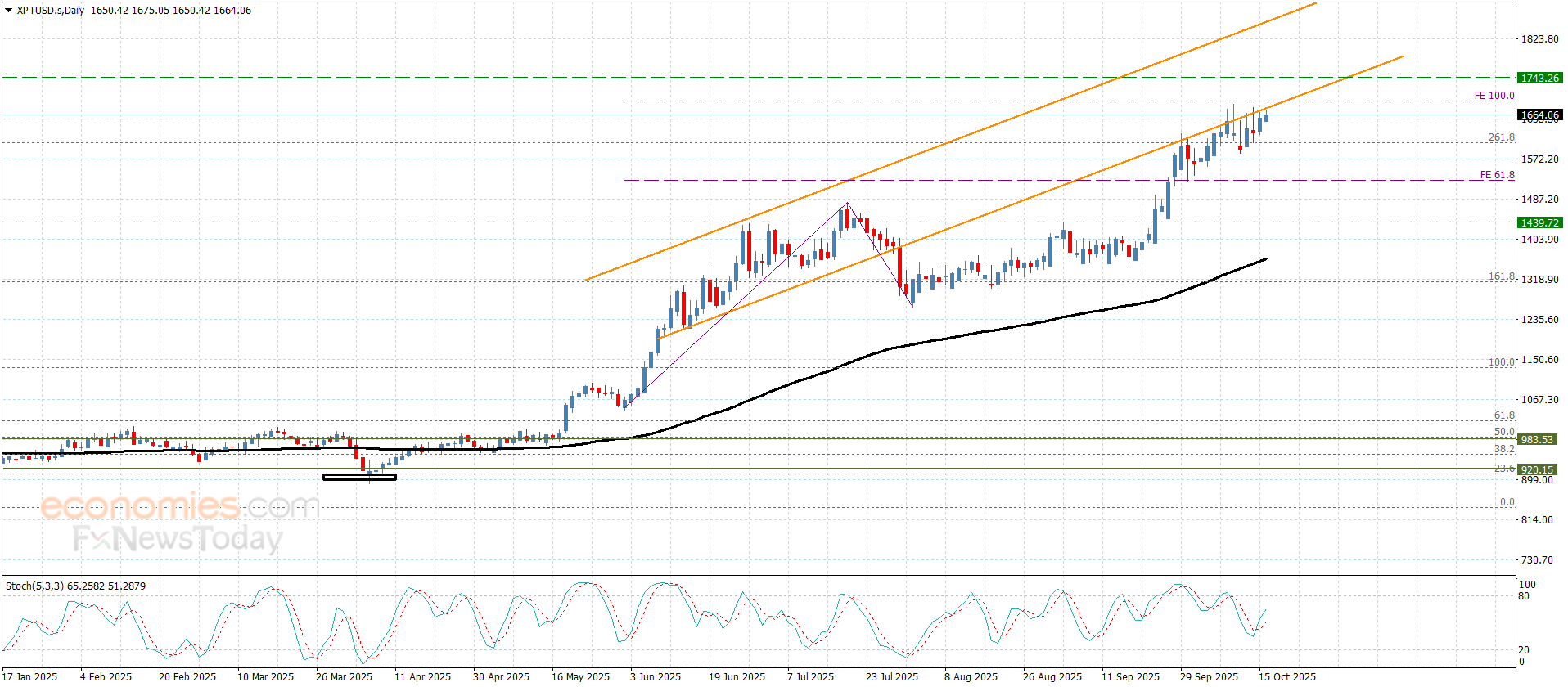
Platinum price is affected by the stability of the barrier near $1690.00, despite the attempt to provide positive momentum by the main indicators, which forces it to provide new sideways trading near $1650.00 level, attempting to settle above the extra support at $1600.00.
Reminding you that the bullish scenario will remain valid by the stability of the price above 61.8% Fibonacci extension level that is located near $1625.00, which makes us wait to breach the current barrier, then targeting new historical stations that might begin at $1745.00 reaching the next main target near $1835.00.
The expected trading range for today is between $1610.00 and $1690.00
Trend forecast: Sideways until achieving the breach