The main tag of GoldPrice Articles.
You can use the search box below to find what you need.
[wd_asp id=1]
The main tag of GoldPrice Articles.
You can use the search box below to find what you need.
[wd_asp id=1]
Occidental Petroleum Corporation (OXY) rose slightly in its latest intraday trading, attempting to recover part of its previous losses. However, the stock remains pressured after breaking a short-term corrective uptrend line earlier, while continuing to trade below the 50-day simple moving average, which reinforces the prevailing bearish momentum. In addition, the RSI shows ongoing negative signals despite reaching heavily oversold areas.
Therefore, we expect the stock to decline in upcoming trading sessions, especially if it breaks below the key support level of 42.35, targeting the next support at 40.15.
Today’s price forecast: Bearish.
Gold’s reversal from all-time highs near $4,180 found support at $4,090 earlier on Tuesday. The precious metal trimmed losses in risk-off markets amid simmering tensions between the US and China, returning to the $4,125 area during the European trading session.
News that the US and China were rolling out new fees for cargo vessels entering their ports has shattered expectations of a de-escalation of the trade rift between the world’s two major economies, and provided fresh demand to traditional safe-havens like Gold.
The 4-hour chart shows the RSI coming down from oversold levels, although, in the current fundamental context, downside attempts are likely to remain limited.
Bears have been contained at $4,090 (intraday low) on Tuesday. Further down, the previous all-time high, at $4.050 area (October 8, 9 highs is likely to challenge bears ahead of the $4,000 psychological level, and the October 7 and 10 lows, at the $3,940 area.
To the upside, the intraday high at $4,080 is the closest resistance, although the $4,200 round level might attract bulls. Beyond here, a Fibonacci extension tool shows the 461.8% extension of the mid-September rally, at $4,278.
Gold has played a key role in human’s history as it has been widely used as a store of value and medium of exchange. Currently, apart from its shine and usage for jewelry, the precious metal is widely seen as a safe-haven asset, meaning that it is considered a good investment during turbulent times. Gold is also widely seen as a hedge against inflation and against depreciating currencies as it doesn’t rely on any specific issuer or government.
Central banks are the biggest Gold holders. In their aim to support their currencies in turbulent times, central banks tend to diversify their reserves and buy Gold to improve the perceived strength of the economy and the currency. High Gold reserves can be a source of trust for a country’s solvency. Central banks added 1,136 tonnes of Gold worth around $70 billion to their reserves in 2022, according to data from the World Gold Council. This is the highest yearly purchase since records began. Central banks from emerging economies such as China, India and Turkey are quickly increasing their Gold reserves.
Gold has an inverse correlation with the US Dollar and US Treasuries, which are both major reserve and safe-haven assets. When the Dollar depreciates, Gold tends to rise, enabling investors and central banks to diversify their assets in turbulent times. Gold is also inversely correlated with risk assets. A rally in the stock market tends to weaken Gold price, while sell-offs in riskier markets tend to favor the precious metal.
The price can move due to a wide range of factors. Geopolitical instability or fears of a deep recession can quickly make Gold price escalate due to its safe-haven status. As a yield-less asset, Gold tends to rise with lower interest rates, while higher cost of money usually weighs down on the yellow metal. Still, most moves depend on how the US Dollar (USD) behaves as the asset is priced in dollars (XAU/USD). A strong Dollar tends to keep the price of Gold controlled, whereas a weaker Dollar is likely to push Gold prices up.
The EURJPY pair continued providing temporary trading, affected by the stability of the barrier at 177.05 to reach 175.95 again, to announce delaying the bullish attack in the current period.
Stochastic reach below 50 level might force the price to provide more of the corrective trading, to test the extra support at 175.20 to confirm monitoring the price behavior, as monitoring the price behavior is important due to the importance of the support by detecting the expected targets in the near and medium period trading.
The expected trading range for today is between 175.20 and 176.50
Trend forecast: Fluctuated within the bullish track
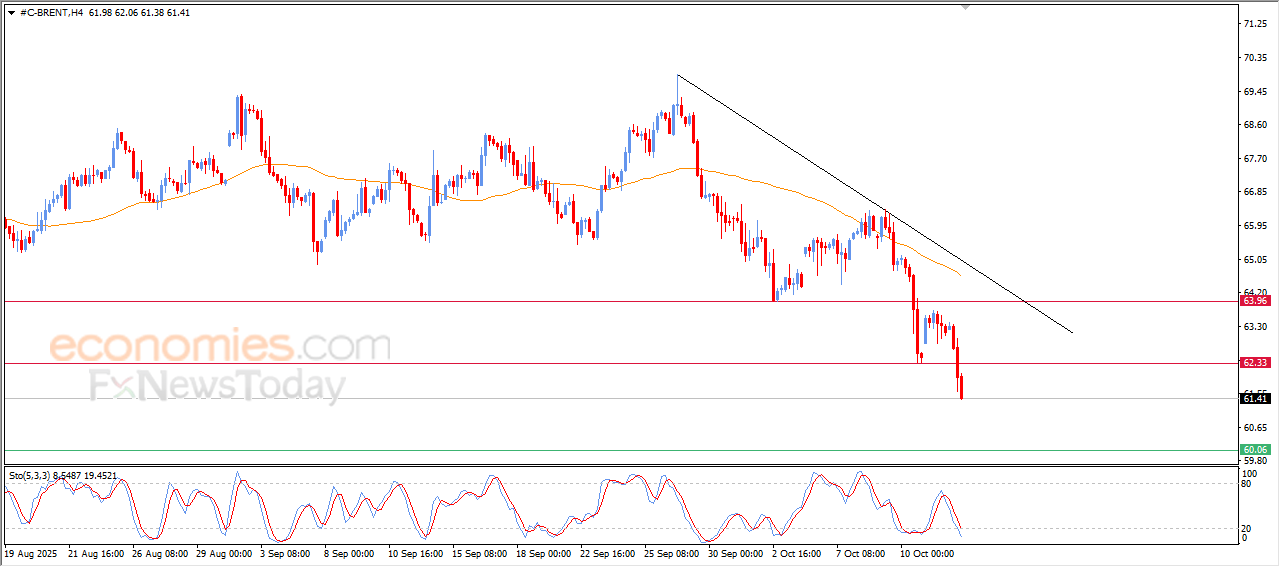
The (Brent) price witnessed fluctuated trading on its last intraday trading, amid the dominance of the main bearish trend on the short-term basis and its trading alongside steep bearish trendline that supports this track, with the continuation of the negative pressure due to its trading below EMA50, reducing the chances of the price’s recover on the near-term basis, besides the emergence of the negative signals on the relative strength indicators, after offloading its oversold conditions, opening the way for recording more of the losses in the upcoming period.
Get high-accuracy trading signals delivered directly to your Telegram. Subscribe to specialized packages tailored for the world’s top markets:
Full VIP signals performance report for 6-10, October 2025:
Gold is stretching its record-setting run early Tuesday, as the bullish sentiment remains unabated amid looming US-China trade risks and in anticipation of US Federal Reserve (Fed) Chair Jerome Powell’s speech later in the day.
Amidst a pause in the US Dollar’s (USD) overnight rebound and ongoing US-China trade talks, Gold buyers flex their muscles.
China’s Commerce Ministry confirmed early Tuesday that it had notified the US. in advance of its new rare earth export controls and held working-level talks on Monday under existing trade consultation channels.
Meanwhile, US Treasury Secretary Scott Bessent said on Monday that President Donald Trump remains on track to meet Chinese leader Xi Jinping in South Korea in late October.
The underlying positive factors, such as persistent expectations that the Fed will deliver two interest rate cuts this year, the extended US government shutdown and potential US-China trade war escalation continue to lend support to buyers.
Gold’s record-setting advance remains powered by the bullish inertia, in the absence of any bearish fundamentals.
Traders now look forward to a slew of speeches from the Fed officials, including Chairman Jerome Powell’s, for fresh hints on the scope of rate cuts by the year-end.
Powell is due to speak about the “Economic Outlook and Monetary Policy” at the National Association for Business Economics (NABE) Annual Meeting, Philadelphia.
The daily chart shows that the 14-day Relative Strength Index (RSI) is back into the extreme overbought zone, currently near 82.50,
Meanwhile, Gold buyers are once again challenging the upper boundary of the month-long rising channel, now at $4,162.
Gold could see a brief corrective pullback if it faces rejection at the abovementioned level amid heavily overbought RSI conditions.
In that case, sellers could attack the lower boundary of the rising channel at $4,014.
A daily candlestick closing basis below the latter would confirm a downside break from the channel, fuelling further correction toward the $3,950 psychological mark.
Further south, the $3,895 supply zone (October 1 and 2 highs) could come into play.
However, if buyers manage to take out the topside hurdle of the channel at $4,162 on a sustained basis, the record-setting rally could extend toward the $4,200 round level.
Jerome H. Powell took office as a member of the Board of Governors of the Federal Reserve System on May 25, 2012, to fill an unexpired term. On November 2, 2017, President Donald Trump nominated Powell to serve as the next Chairman of the Federal Reserve. Powell assumed office as Chair on February 5, 2018.
Next release:
Tue Oct 14, 2025 16:20
Frequency:
Irregular
Consensus:
–
Previous:
–
Source:
Federal Reserve
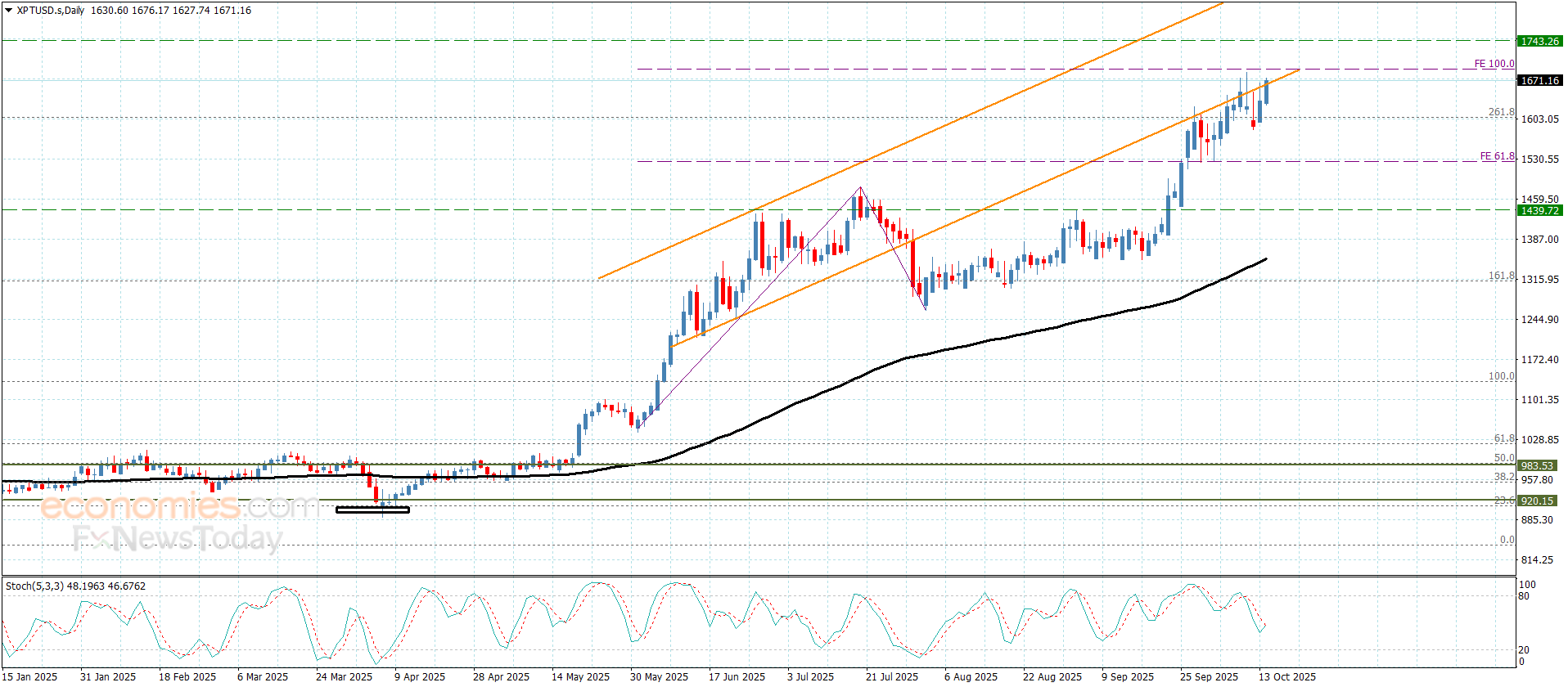
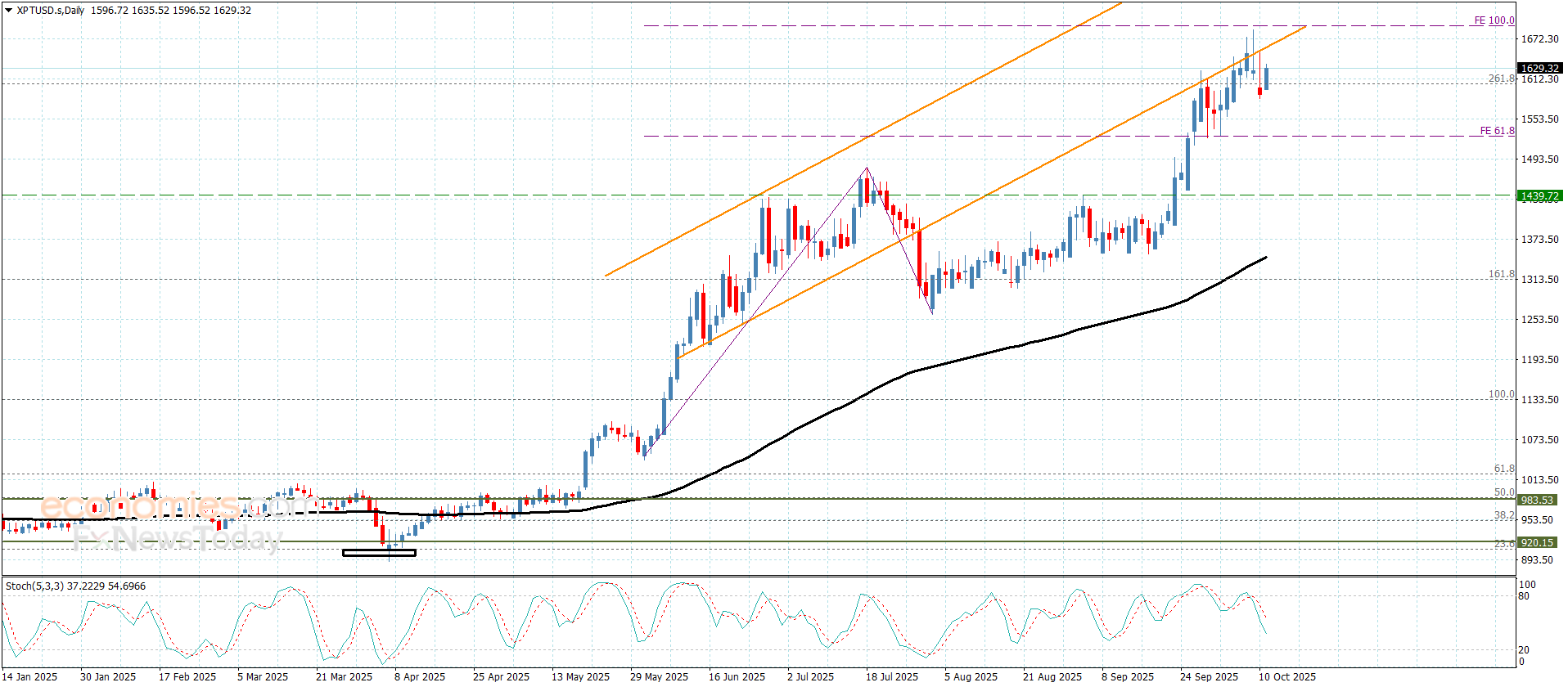
Platinum price provided mixed trading on Friday due to the contradiction between the main indicators, targeting 1583.00 level, then attempts to form bullish wave confirming the continuation of the suggested bullish scenario.
Reminding you that holding above $1525.00 support confirms the price surrender to the bullish bias dominance, to expect gathering positive momentum, to form new bullish rally and press on the barrier at $1690.00, and surpassing it will make the price record extra gains that might begin at $1745.00.
The expected trading range for today is between $1580.00 and $1690.00
Trend forecast: Bullish
Silver price (XAG/USD) attracts some buyers to near $52.60 during the early Asian session on Tuesday. The white metal has reached a fresh all-time high, surpassing its previous peak from 1980, as a historic short squeeze in London intensified.
The rally in Silver price is bolstered by concerns over a depleting silver inventory in London, which drove prices to a premium over those seen in New York and prompted traders to ship metals across the Atlantic for a profit.
Additionally, global trade uncertainties have fueled safe-haven demand, supporting the precious metal. US President Donald Trump on Friday threatened an additional 100% tariff on Chinese goods from November 1 in retaliation for new export controls Beijing is planning for valuable rare earth minerals.
Dovish remarks from the Federal Reserve (Fed) officials also lift the Silver price. Philadelphia Fed new President Anna Paulson said on Monday that rising risks to the job market argue for more interest rate cuts by the US central bank, as trade tariffs now appear unlikely to push up inflation as much as expected. Lower interest rates could reduce the opportunity cost of holding Silver, supporting the non-yielding precious metal.
On the other hand, renewed US Dollar (USD) demand and improved risk sentiment could weigh on the USD-denominated commodity price in the near term. Trump changed his rhetoric on China on Sunday, saying that China’s economy “will be fine” and that the US wants to “help China, not hurt it.”
Silver is a precious metal highly traded among investors. It has been historically used as a store of value and a medium of exchange. Although less popular than Gold, traders may turn to Silver to diversify their investment portfolio, for its intrinsic value or as a potential hedge during high-inflation periods. Investors can buy physical Silver, in coins or in bars, or trade it through vehicles such as Exchange Traded Funds, which track its price on international markets.
Silver prices can move due to a wide range of factors. Geopolitical instability or fears of a deep recession can make Silver price escalate due to its safe-haven status, although to a lesser extent than Gold’s. As a yieldless asset, Silver tends to rise with lower interest rates. Its moves also depend on how the US Dollar (USD) behaves as the asset is priced in dollars (XAG/USD). A strong Dollar tends to keep the price of Silver at bay, whereas a weaker Dollar is likely to propel prices up. Other factors such as investment demand, mining supply – Silver is much more abundant than Gold – and recycling rates can also affect prices.
Silver is widely used in industry, particularly in sectors such as electronics or solar energy, as it has one of the highest electric conductivity of all metals – more than Copper and Gold. A surge in demand can increase prices, while a decline tends to lower them. Dynamics in the US, Chinese and Indian economies can also contribute to price swings: for the US and particularly China, their big industrial sectors use Silver in various processes; in India, consumers’ demand for the precious metal for jewellery also plays a key role in setting prices.
Silver prices tend to follow Gold’s moves. When Gold prices rise, Silver typically follows suit, as their status as safe-haven assets is similar. The Gold/Silver ratio, which shows the number of ounces of Silver needed to equal the value of one ounce of Gold, may help to determine the relative valuation between both metals. Some investors may consider a high ratio as an indicator that Silver is undervalued, or Gold is overvalued. On the contrary, a low ratio might suggest that Gold is undervalued relative to Silver.
Gold price (XAU/USD) jumps to a fresh record high near $4,130 during the early Asian session on Tuesday. The precious metal extends the rally as renewed US-China trade tensions send investors flocking to safe-haven assets. The Federal Reserve’s (Fed) Chair Jerome Powell is scheduled to speak later on Tuesday.
Escalating trade tensions between the US and China reignited fears of a trade war between the world’s two largest economies, boosting safe-haven assets like the Gold price. US President Donald Trump announced on Friday that he will impose new trade measures against Beijing, including 100% tariffs on all Chinese goods and export controls on critical US-developed software, due to take effect by 1 November.
Nonetheless, Trump adopted a less strident stance on Sunday, saying that everything would be “fine” and that the US was not looking to “hurt” China.
Expectations mounted for further interest rate cuts by the US Fed, which contributes to Gold’s upside. Markets are currently pricing in an almost certain 25 basis points (bps) rate cut at the Fed’s October meeting, with another reduction expected in December, according to the CME FedWatch tool. Lower interest rates could reduce the opportunity cost of holding Gold, supporting the non-yielding precious metal.
Further consolidation or correction cannot be ruled out in the near term, as the yellow metal has climbed over 56% year-to-date so far this year. “Given the carousel of drivers, and how short-lived dips have been, this rally has legs in our view, but a near-term correction would be healthier for a longer-term uptrend,” said Suki Cooper, global head, commodities research at Standard Chartered Bank.
Gold has played a key role in human’s history as it has been widely used as a store of value and medium of exchange. Currently, apart from its shine and usage for jewelry, the precious metal is widely seen as a safe-haven asset, meaning that it is considered a good investment during turbulent times. Gold is also widely seen as a hedge against inflation and against depreciating currencies as it doesn’t rely on any specific issuer or government.
Central banks are the biggest Gold holders. In their aim to support their currencies in turbulent times, central banks tend to diversify their reserves and buy Gold to improve the perceived strength of the economy and the currency. High Gold reserves can be a source of trust for a country’s solvency. Central banks added 1,136 tonnes of Gold worth around $70 billion to their reserves in 2022, according to data from the World Gold Council. This is the highest yearly purchase since records began. Central banks from emerging economies such as China, India and Turkey are quickly increasing their Gold reserves.
Gold has an inverse correlation with the US Dollar and US Treasuries, which are both major reserve and safe-haven assets. When the Dollar depreciates, Gold tends to rise, enabling investors and central banks to diversify their assets in turbulent times. Gold is also inversely correlated with risk assets. A rally in the stock market tends to weaken Gold price, while sell-offs in riskier markets tend to favor the precious metal.
The price can move due to a wide range of factors. Geopolitical instability or fears of a deep recession can quickly make Gold price escalate due to its safe-haven status. As a yield-less asset, Gold tends to rise with lower interest rates, while higher cost of money usually weighs down on the yellow metal. Still, most moves depend on how the US Dollar (USD) behaves as the asset is priced in dollars (XAU/USD). A strong Dollar tends to keep the price of Gold controlled, whereas a weaker Dollar is likely to push Gold prices up.
The 50-day average’s defense is a bullish signal, yet downside risks linger. Natural gas is caught in a short-term rising trend channel, contrasting with a broader declining channel. Recent highs stalled near the 200-day moving average at $3.38, aligning with the top of the falling channel, where resistance triggered a double top bearish reversal last Thursday. The rejection also coincided with the upper boundary of the rising channel, extended by 25%. A reversal from this level typically targets the channel’s lower boundary, a scenario still in play if today’s support falters.
Should the $3.03 low give way, a deeper support zone at $2.95 emerges as a key target. This level, projected for October 21, marks the intersection of the rising channel’s lower line and the falling quarter channel line of the larger bearish trend. Reinforcing its significance, a gap fill at $2.95 aligns with an anchored Volume Weighted Average Price (VWAP) at $2.98, rooted in the February 2024 lows. This convergence of technical markers makes $2.95 a high-probability floor if selling resumes.
Today’s rally suggests buyers are defending $3.03, but the broader bearish channel keeps pressure on. A close above $3.09 strengthens the bullish case, while a break below $3.03 targets $2.95. Monitor today’s close for confirmation of support or renewed weakness—$3.38 resistance remains a hurdle for any sustained recovery.
For a look at all of today’s economic events, check out our economic calendar.
Spot Gold’s run into unexplored territory continues on Monday, with the bright metal overcoming the $4,100 threshold early in the American session. Multiple factors are pushing the safe-haven metal higher.
On the one hand, the United States (US) government shutdown continues, with a resolution to the stalemate still out of the picture. The country is celebrating a holiday, Columbus Day, which further delays any agreement in the Senate. On the other hand, US President Donald Trump revived trade-war concerns late on Friday, accusing China of “strange” behaviour and threatening fresh, massive tariffs on Chinese imports. Trump was scheduled to speak with his Chinese counterpart, Xi Jinping, in the coming days, but the talks have been postponed.
Right now, the US President’s attention is on the Middle East. The first stages of a peace agreement between Israel and Hamas are underway. Hamas has freed the remaining hostages, hostilities have been interrupted, and people are slowly returning to Gaza. The peace could be fragile, but it is a major Trump victory.
From a technical point of view, the XAU/USD pair is bullish. In the daily chart, technical indicators resumed their advance within overbought levels after correcting extreme conditions, still reflecting that buyers are in control. Meanwhile, the pair develops far above all its moving averages, with the 20 Simple Moving Average (SMA) far above the longer ones and at around $3,841.
The near-term picture is pretty similar. In the 4-hour chart, the Momentum indicator aims firmly north within positive levels, while the Relative Strength Index (RSI) indicator advances at around 70, although with a limited upward slope. Meanwhile, the XAU/USD pair extends its recovery above all its moving averages, with a mildly bullish 20 SMA currently at around $4,026.
Support levels: 4,100.00 4,086.20 4,071.55
Resistance levels: 4,117.00 4,130.00 4,150.00