The gaming ecosystem Versus has joined the Ice Open Network ecosystem by announcing its partnership with the blockchain network. Online+, the rapidly growing social ecosystem of Ice blockchain, will now be accessible to Versus as well. Through this strategic collaboration, the joint venture will transform the Web3 gaming and social integration. Versus disclosed this integration through its official social media platform, X account
🚀 We’re thrilled to announce our partnership with @ice_blockchain and their fast-growing social ecosystem – Online+! ❄️🌐
Online+ is a dynamic Web3 hub for digital explorers of all kinds – and now, Versus is joining the party!🕹💬
As per an official announcement made by Versus on the social media platform X today, the gaming ecosystem has joined the social ecosystem of Ice Open Network known as Online+, a digital web 3.0 hub for all kinds of explorers around the world.
The company says in its official tweet that by partnering with Ice blockchain network, they will now be able to experience different advantages such as the community growth, visibility, and new integrations as well. This will also help them get access to a wider web3 audience. As soon as the company announced its partnership with the Ice blockchain, the ION community started welcoming Versus.
An Opportunity for Versus to Enter into The Community of Creators and Gamers
After partnering with the decentralized gaming platform Versus, Ice Open Network also confirmed the new of partnership with Versus in its official tweet and welcome the firm to its rapidly growing web3 ecosystem.
The company says Versus will be able to leverage a lot of opportunities by joining the social ecosystem of Online+. The major advantage of this partnership for Versus is that they can now enter into the community of cryptocurrency enthusiasts, digital creators, and gamers as well. Moreover, a larger web3 audience will also get connected to the gaming ecosystem of Versus.
The partnership of Versus and Ice Open Network will also be beneficial for the later as the decentralized gaming platform will ensure competitive gaming by bringing its on-chain wagering. This will let players from the community to participate in AAA titles.
Crypto journalist with years of experience providing in-depth analysis and news on blockchain and decentralized finance. With a keen eye for detail, Shahzaib delivers insightful articles that explore the latest trends, market movements, and innovations within the crypto and blockchain ecosystem. His work focuses on educating readers while offering expert commentary on the evolving landscape of digital assets, DeFi protocols, and the broader impact of blockchain technology.
BOCA RATON, FL, May 07, 2025 (GLOBE NEWSWIRE) — DeFi Development Corp. (Nasdaq: DFDV) (“DeFi Dev Corp” or the “Company”), or formally known as Janover Inc. (Nasdaq: JNVR), the leading public-market vehicle for Solana (“SOL”) accumulation, today announced that its Board of Directors has approved a 7-for-1 forward stock split of the Company’s issued and outstanding common shares.
The stock split will result in each shareholder of record as of the close of business on May 19, 2025, receiving six additional shares for every one share held. The implementation of the stock split is subject to the filing of an amendment to the Company’s Amended and Restated Certificate of Incorporation with the Secretary of State of the State of Delaware, which the Company expects to file on May 19, 2025. Subject to final approval by the Nasdaq Capital Market, trading is expected to begin on a post-stock split adjusted basis at market open on May 20, 2025.
Following the split, the Company’s outstanding shares will increase from 2,011,887 to approximately 14,083,209. The Company’s authorized share capital will remain unchanged.
The stock split is intended to enhance liquidity in the market for DeFi Dev Corp.’s common stock and make the shares more accessible to a broader base of investors as the Company continues to execute its corporate treasury strategy centered on SOL accumulation and infrastructure ownership.
There will be no change to the Company’s name, CUSIP or its current trading symbol in connection with the stock split.
No action is required by shareholders in connection with the stock split. Shareholders who hold their shares through a brokerage account will have their shares automatically adjusted to reflect the stock split. Registered shareholders will receive their additional shares through the Company’s transfer agent.
About DeFi Development Corp.
DeFi Development Corp. (Nasdaq: DFDV) has adopted a treasury policy under which the principal holding in its treasury reserve on the balance sheet will be allocated to Solana (SOL). In adopting its new treasury policy, the Company intends to provide investors a way to access the Solana ecosystem. The Company’s treasury policy is expected to provide investors economic exposure to SOL investment.
We are an AI-powered online platform that connects the commercial real estate industry by providing data and software subscriptions as well as value-add services to multifamily and commercial property professionals as we connect the increasingly complex ecosystem that stakeholders have to manage.
We currently serve more than one million web users annually, including multifamily and commercial property owners and developers applying for billions of dollars of debt financing per year, professional service providers, and thousands of multifamily and commercial property lenders including more than 10% of the banks in America, credit unions, real estate investment trusts (“REITs”), debt funds, Fannie Mae® and Freddie Mac® multifamily lenders, FHA multifamily lenders, commercial mortgage-backed securities (“CMBS”) lenders, Small Business Administration (“SBA”) lenders, and more. Our data and software offerings are generally offered on a subscription basis as software as a service (“SaaS”).
Forward-Looking Statements
This release contains “forward-looking statements” within the meaning of the safe harbor provisions of the U.S. Private Securities Litigation Reform Act of 1995. Forward-looking statements can be identified by words such as: “anticipate,” “intend,” “plan,” “believe,” “project,” “estimate,” “expect,” strategy,” “future,” “likely,” “may,”, “should,” “will” and similar references to future periods. Forward-looking statements are neither historical facts nor assurances of future performance. Instead, they are based only on our current beliefs, expectations and assumptions regarding the future of our business, future plans and strategies, projections, anticipated events and trends, the economy and other future conditions. Because forward-looking statements relate to the future, they are subject to inherent uncertainties, risks and changes in circumstances that are difficult to predict and many of which are outside of our control. Our actual results and financial condition may differ materially from those indicated in the forward-looking statements. Therefore, you should not rely on any of these forward-looking statements. Important factors that could cause our actual results and financial condition to differ materially from those indicated in the forward-looking statements include, among others, the following: (i) fluctuations in the market price of SOL and any associated impairment charges that the Company may incur as a result of a decrease in the market price of SOL below the value at which the Company’s SOL are carried on its balance sheet; (ii) the effect of and uncertainties related the ongoing volatility in interest rates; (iii) our ability to achieve and maintain profitability in the future; (iv) the impact on our business of the regulatory environment and complexities with compliance related to such environment including changes in securities laws or other laws or regulations; (v) changes in the accounting treatment relating to the Company’s SOL holdings; (vi) our ability to respond to general economic conditions; (vii) our ability to manage our growth effectively and our expectations regarding the development and expansion of our business; (viii) our ability to access sources of capital, including debt financing and other sources of capital to finance operations and growth and (ix) other risks and uncertainties more fully in the section captioned “Risk Factors” in the Company’s most recent Annual Report on Form 10-K and other reports we file with the SEC. As a result of these matters, changes in facts, assumptions not being realized or other circumstances, the Company’s actual results may differ materially from the expected results discussed in the forward-looking statements contained in this press release. Forward-looking statements contained in this announcement are made as of this date, and the Company undertakes no duty to update such information except as required under applicable law.
After reaching record highs in early 2022, the market dropped dramatically and landed with an annual revenue near $2.5 billion.
But the market showed signs of recovery in 2023. NFT trading volume hit $946 million in January 2023, the highest volume since June 2022 and a large increase over the final three months of 2022.
However, NFT is off to a disappointing start in 2025 when it went down 24% from $901 million compared to December 2024.
What lies ahead in this space? Take a look at our list of the five biggest trends in the NFT space and see what’s expected to change in the next 12-18 months.
Instantly Analyze Any Market
1. Major Companies Affirm Their Commitment to NFTs
Although NFT trading is dramatically down from its high in January 2022, several major companies still see potential in the market and have recently announced new NFT strategies.
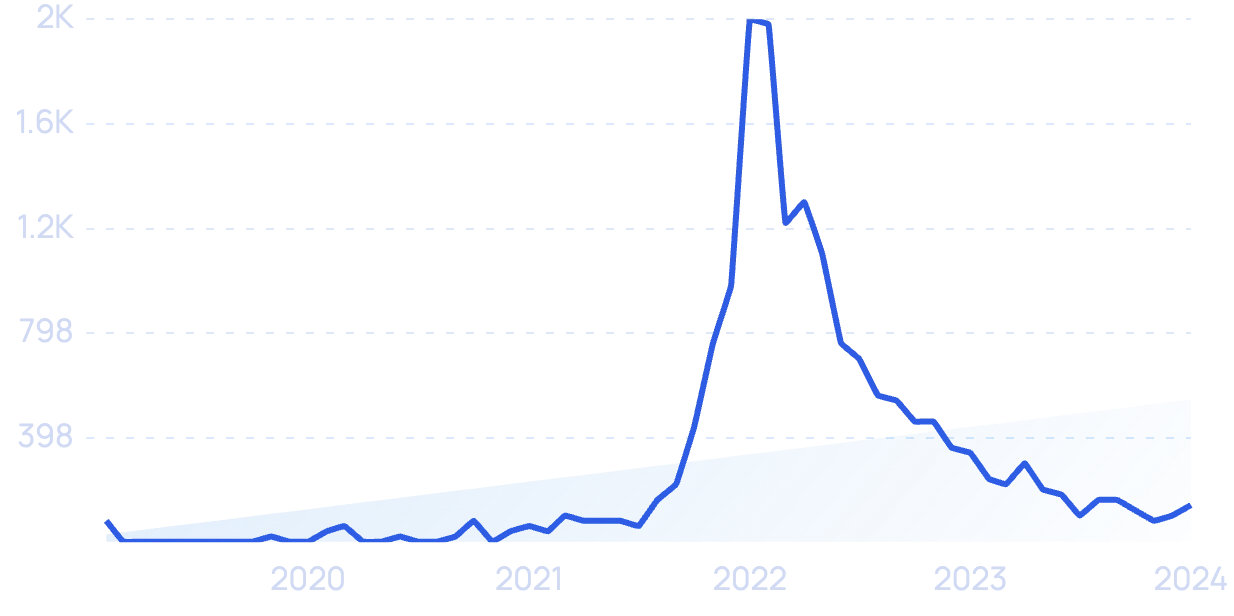
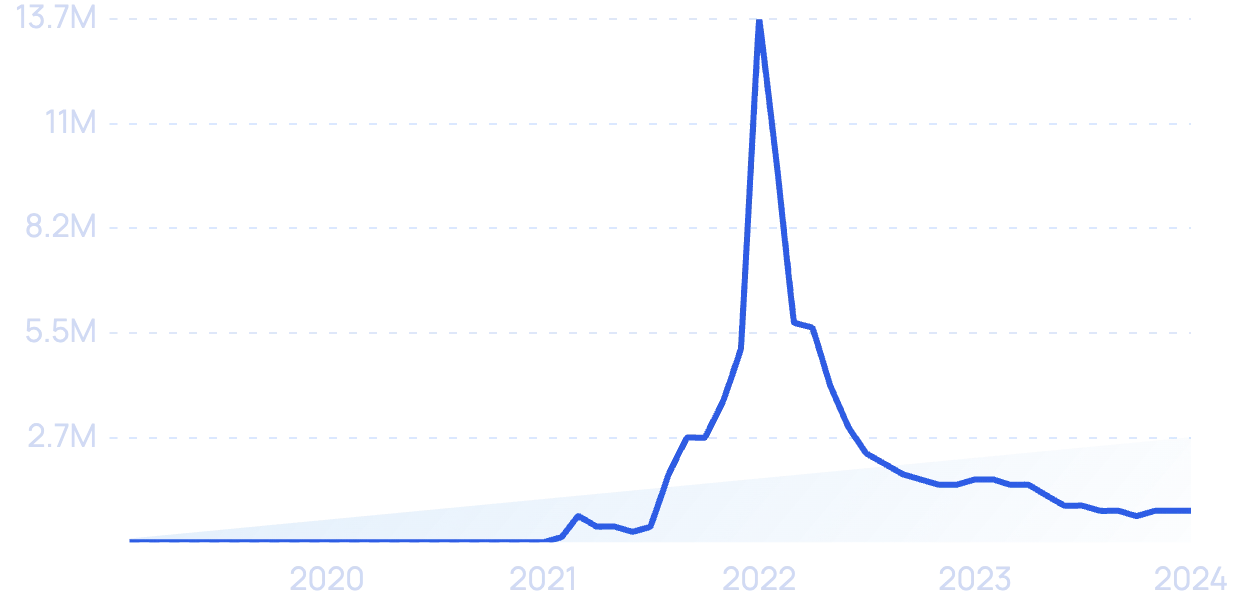
Search interest in Amazon NFTs increased dramatically in 2022.
The focus is on fashion NFTs linked to real-world products and blockchain-based gaming.
In addition, the marketplace doesn’t require a crypto wallet — customers can simply pay with a credit or debit card. Amazon hopes this will draw more non-tech people into the marketplace.
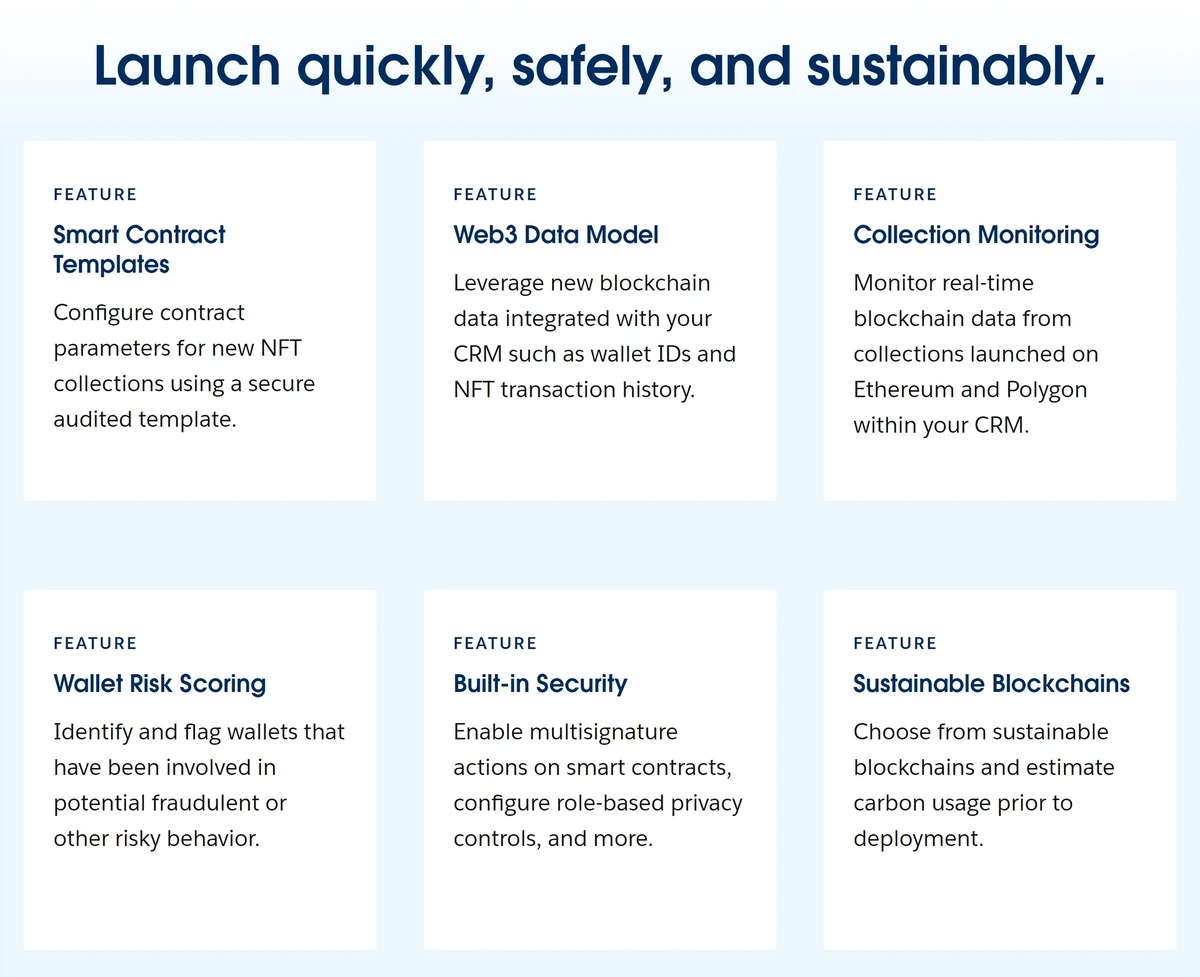
The company already has a Web3 integration that businesses can use in order to deploy smart contracts and manage blockchain data.
Salesforce gives businesses a ready-to-go platform for launching NFT loyalty programs.
The NFT portion of this will enable companies to create tokens and monitor performance through the Salesforce platform.
The new feature has already been tested with customer-facing corporations like Mattel and Crown Royal.
Starbucks is already seeing successful results from its late 2022 NFT launch, branded Starbucks Odyssey.
The NFT program is a Web3-oriented reboot of the coffee chain’s loyalty program.
Customers log in as usual, but now, they’re able to go on “journeys,” like playing games or signing up for challenges. As they complete journeys, they earn “journey stamps” (NFTs). These stamps unlock benefits for the customers.
The first direct-purchase NFTs from Starbucks were released under The Siren Collection.
The NFTs are now being sold on the secondary market for nearly $2,000 apiece.
The blockchain technology on the Salesforce and Starbucks platforms is powered by Polygon, a $20-billion tech company that provides Ethereum scaling.
Search interest in Polygon Technology is up 83% over the past 5 years.
2. Consumers Look to Rare and Tangible NFTs for Long-term Value
Like other collectibles, a NFT has value because a community of people believe it has value.
With the recent downturn of the crypto market, however, many have taken notice that the value of NFTs can be quite unstable.
Still, some are betting on long-term value and purchasing certain NFTs with the hopes that they will deliver financial gains over time.
Scarcity is a critical factor in determining the long-term value of an NFT.
Rare NFTs are inherently more valuable than others.
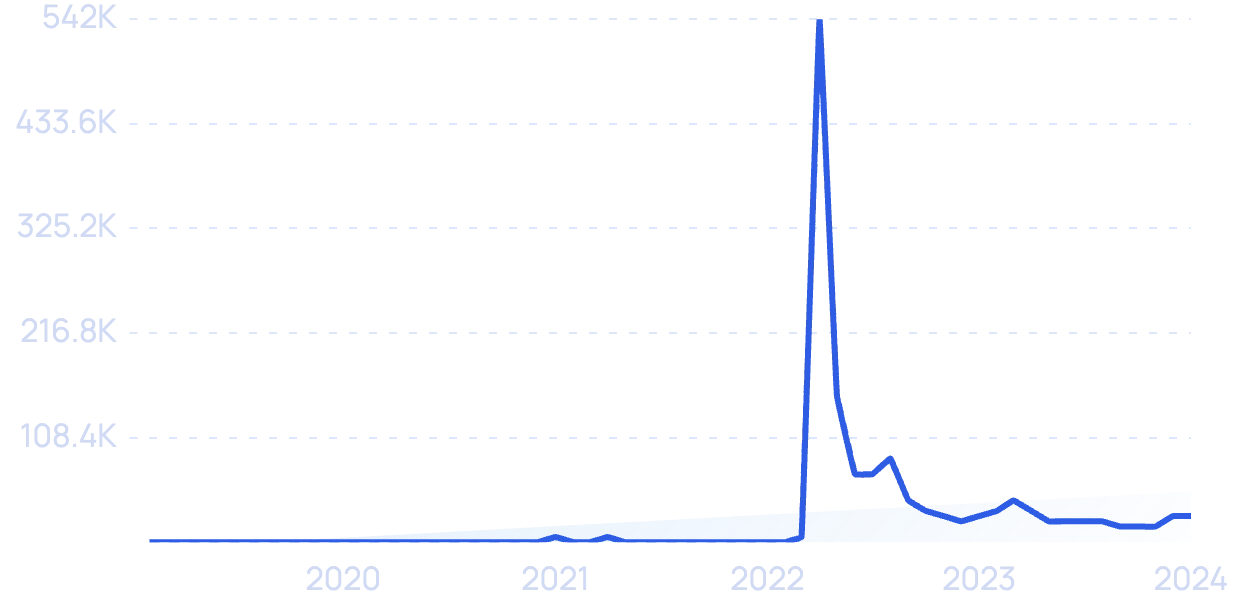
For example, Moonbirds launched an NFT collection in April 2022 that featured 10,000 digital owls. The project was led by internet entrepreneur Kevin Rose.
Search volume spiked in 2022 when Moonbirds released NFTs.
The first 2,000 NFTs were reserved for members of Proof Collective, a private group of NFT collectors and artists.
The remaining owls were released via a raffle, which required individuals to have at least 2.5 ETH already in their wallets.
The sale of these NFTs netted Moonbirds about $60 million and the secondary sales had already totaled $300 million just a few days after the launch.
Build a winning strategy
Get a complete view of your competitors to anticipate trends and lead your market
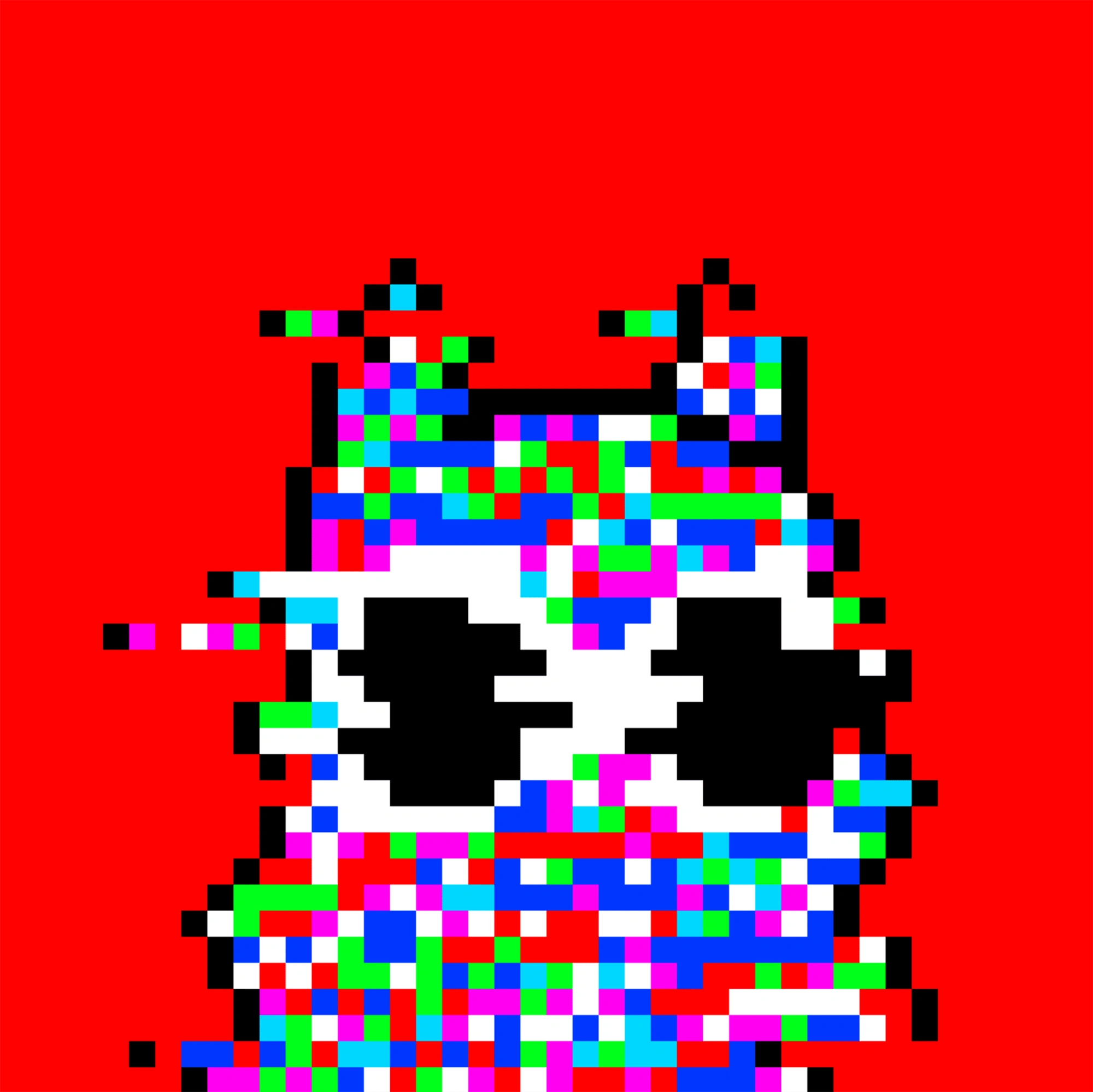
Among the NFTs was Moonbird #668, the rarest Moonbird of them all.
It’s a glitch NFT with the feather trait, two features that make it truly one-of-a-kind in this sought-after collection.
The NFT originally sold for $7,239.
Moonbird #668 is one of only six to have a glitch red background.
Tangibility and long-term utility are two other qualities that underpin the value of an NFT.
In essence, the NFT is more valuable if it provides access to something desirable in the real world.
These are aptly called utility NFTs.
Search volume for “utility NFT” is up more than 75%.
Many companies are granting NFT holders access to private events or limited-release products.
Cocky NFTs connect people to exclusive concert events.
The Cocky NFT takes the form of a soda can. The lid color designates VIP status.
The company plans to release 10,000 NFTs that will take the form of uniquely designed soda cans.
The more events NFT holders attend, the more unique (and valuable) they can become. This increases the rarity, and thus the value, of the NFT.
Cocky is also setting up a second-hand NFT marketplace on their site in order to drive demand.
The pre-mint sale began in September 2022 and the first event took place in 2023.
Cuvée Collective is applying a very similar business model in selling NFTs to wine lovers.
The Collector NFTs provide holders with access to concierge services, a Sommelier hotline, exclusive wines, events, and giveaways.
They also offer NFTs dedicated to specific partner wineries. These NFTs come with access to exclusive tasting events and tours.
Some NFTs provide access to real-life events like wine tastings and tours.
3. AI NFTs on the Rise
The market is counting on AI to inject a much-needed impetus to the NFT market.
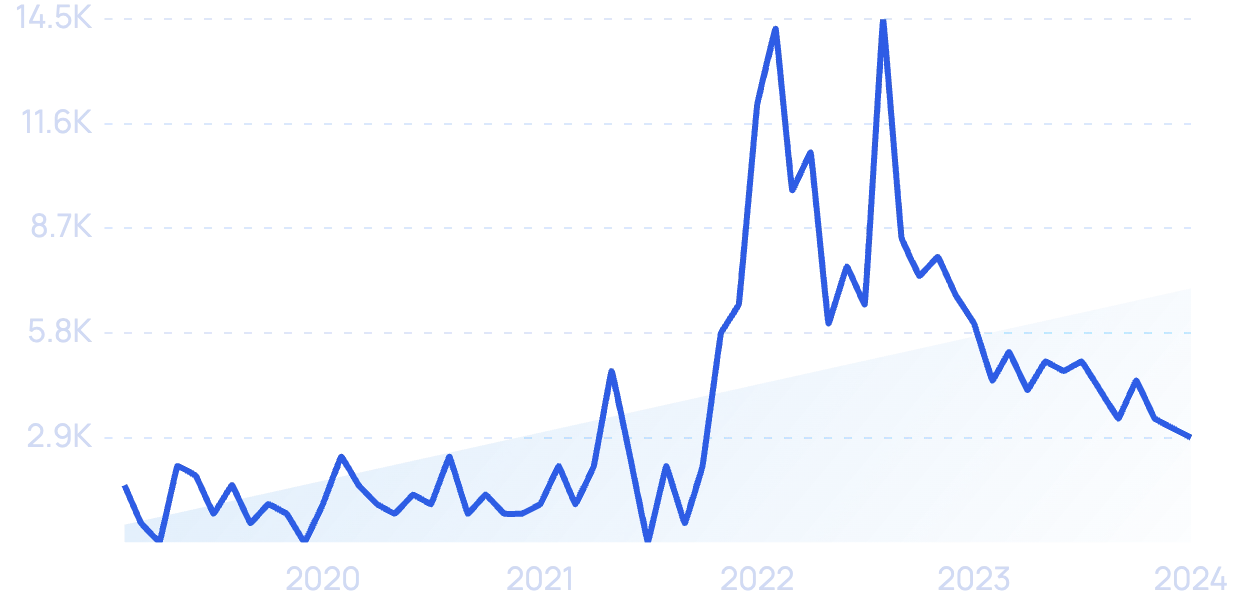
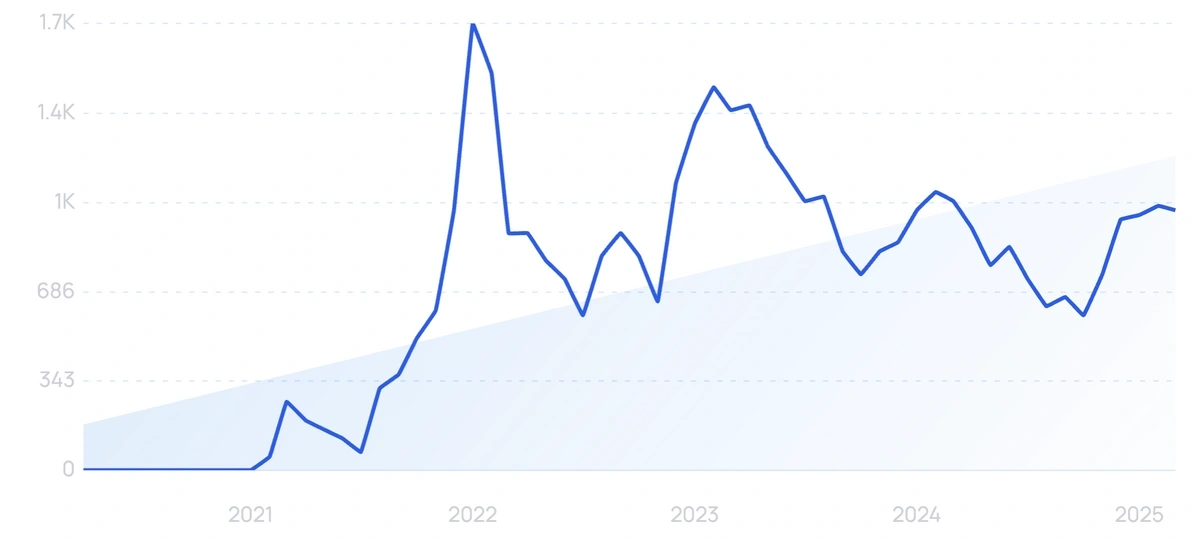
In the past few years, searches for “AI NFT” have surged into popularity, a trend that’s unlikely to vanish any time soon.
In 2025, the AI NFT trends looks well on its way to recover from its decline in 2024.
Search interest for “ai nft” is picking up again in 2025
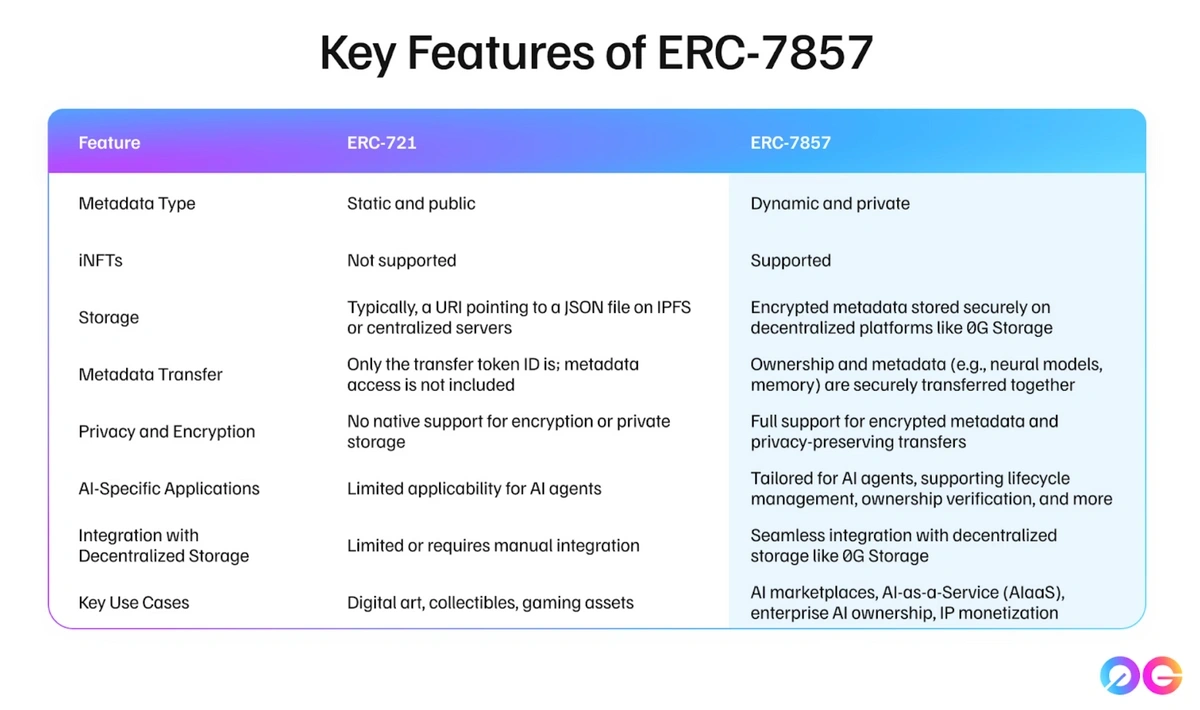
The 0G Lab announced a new ERC-7857 standard for intelligent NFTs (iNFTs) in January 2025.
If widely adopted, ERC-7857 could significantly impact AI ownership and decentralized technology.
Key features of the ERC-7857 standard for iNFTs
That’s because ERC-7857 allows for secure transfer of AI agents, re-encrypting sensitive data for the new owner (0G Labs).
This means we might see new AI marketplaces emerge that give reators more control over earnings.
Besides, more and more AI NFT generator websites have started surfacing on the web.
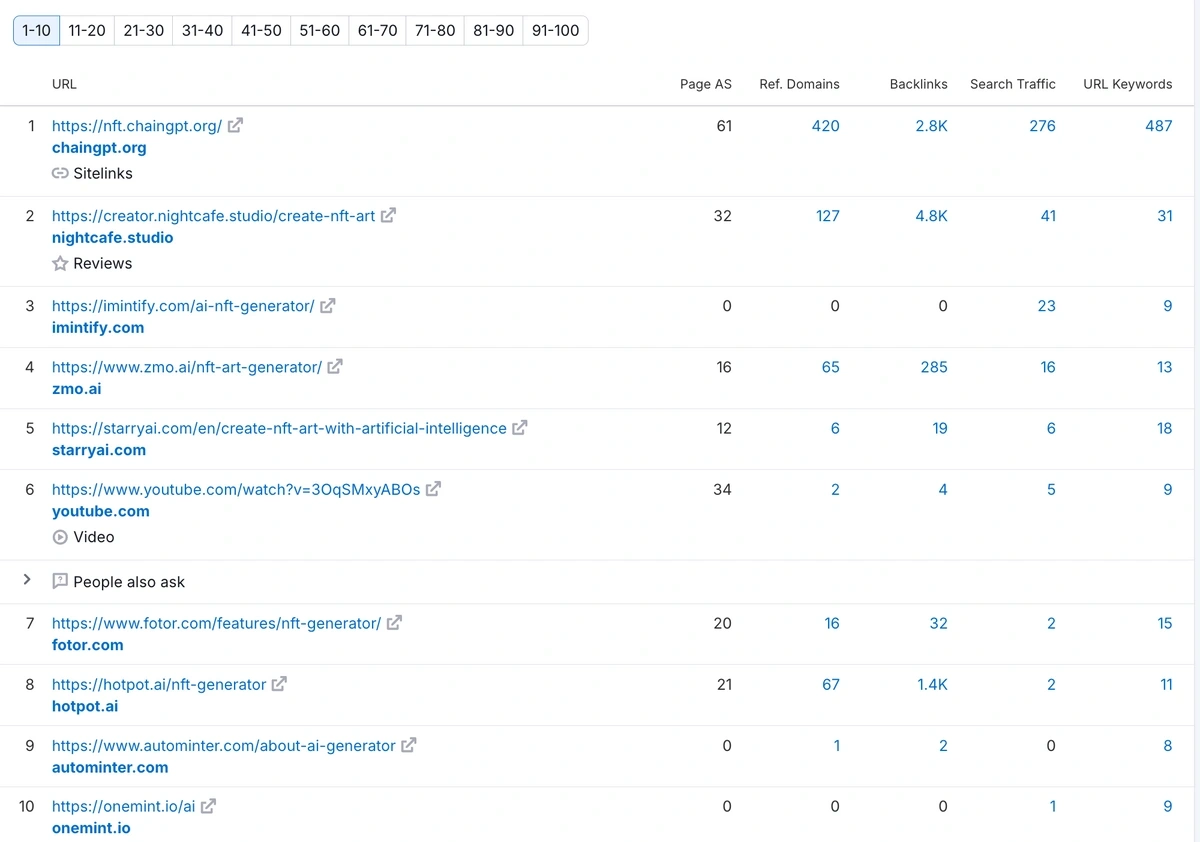
SERP Analysis data from Semrush for the keyword ‘ai nft generator’ displays mixed results with both strong and weak domains ranking.
SERP Overview for “ai nft generator”
It’s a clear indication that this space is still emerging and there’s room for more players to join this space to compete for dominance.
Websites that offer strong AI NFT generators would likely have a clear advantage to establish their authority in this emerging niche.
4. Real Estate Industry Uses NFTs to Cut Out Middlemen
Some companies are investing in transformational new ways to use NFTs in business.
The blockchain technology behind NFTs makes them ideal for certain business operations that are inefficient or document-heavy.
NFTs can be used in various ways in the real estate industry.
NFTs make real estate transactions faster and easier. A process that usually takes months can now be completed almost instantaneously.
And, selling via NFT is much more cost-effective.
Nearly 10% of a property’s price goes to the actual cost of selling it. This includes document fees, processing fees, recording fees, and more.
With NFTs, most of these processes and fees are automated via blockchain.
[Free] Steal Your Competitor’s Strategy
There’s also more transparency when using NFTs.
Potential buyers or investors can see a wealth of information on the blockchain: previous owners, pricing history, tax records, legal disputes, and other useful details.
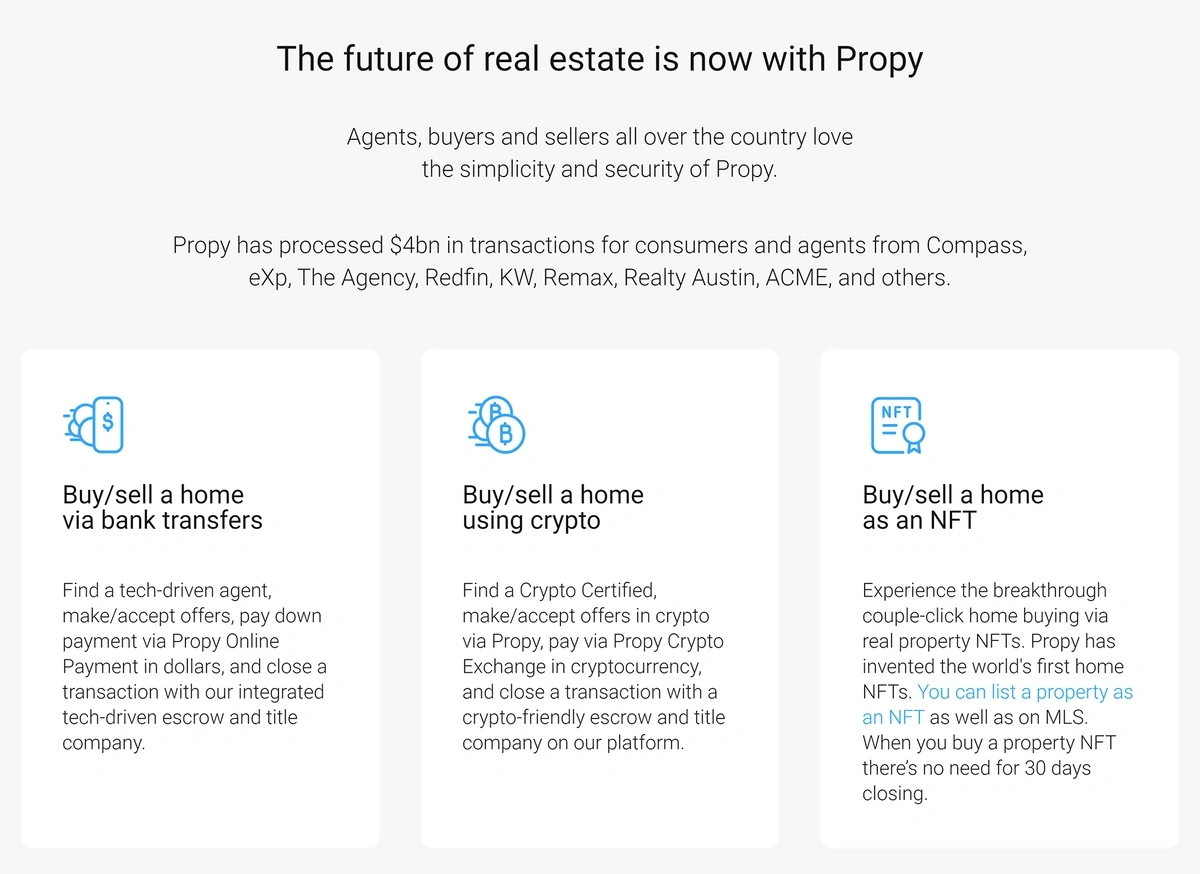
Propy is one startup that’s built its brand on automating real estate sales using NFTs and cryptocurrency.
Propy enables homeowners to buy or sell a home with just a few clicks.
Since launching in 2016, the company has brought in $5 billion in property transactions and raised nearly $17 million in VC funds.
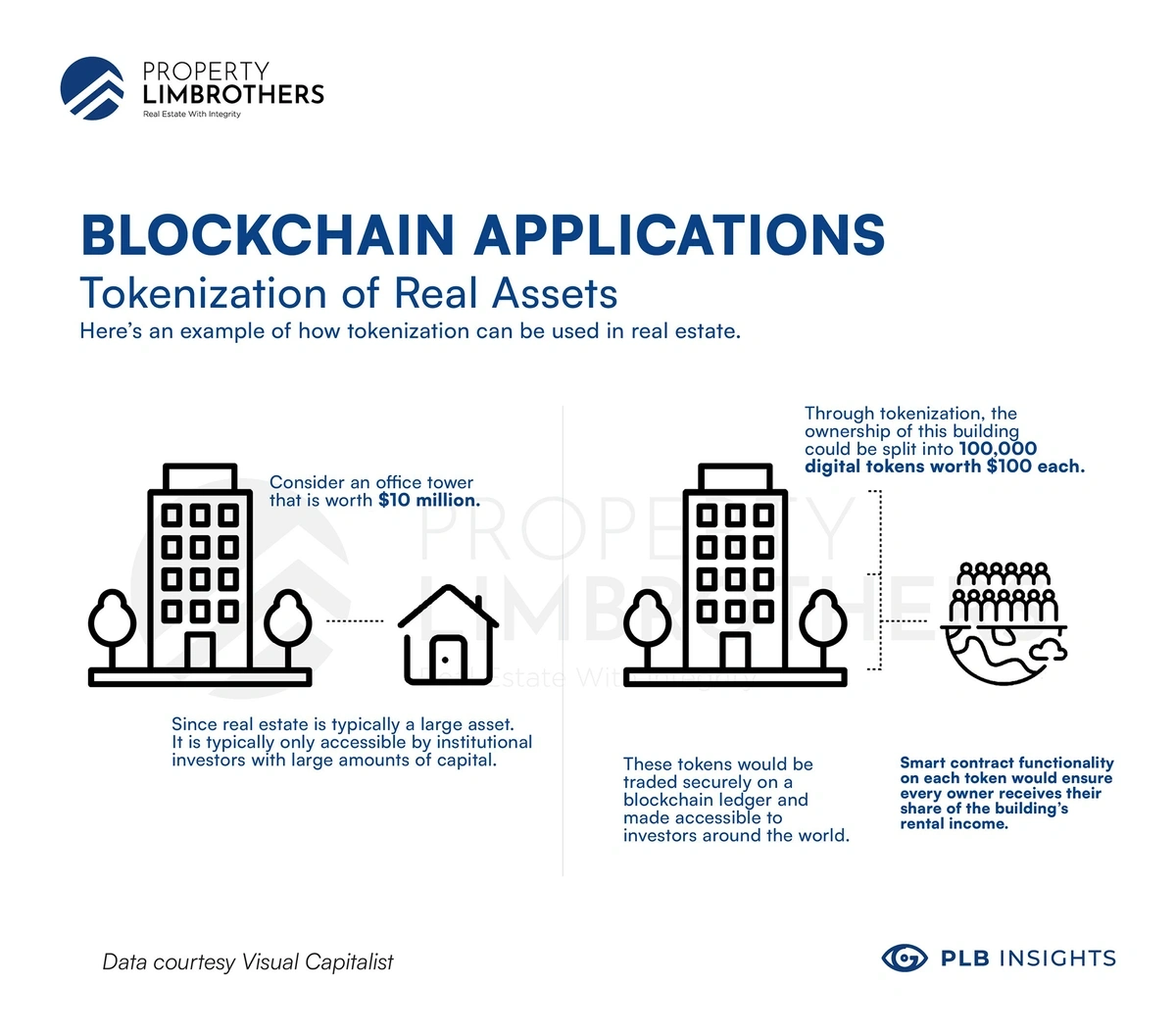
Even though it is currently possible to sell a full home as an NFT, the most popular way NFTs are being used in real estate today is through fractionalization.
Consumers are essentially buying shares in a piece of real estate.
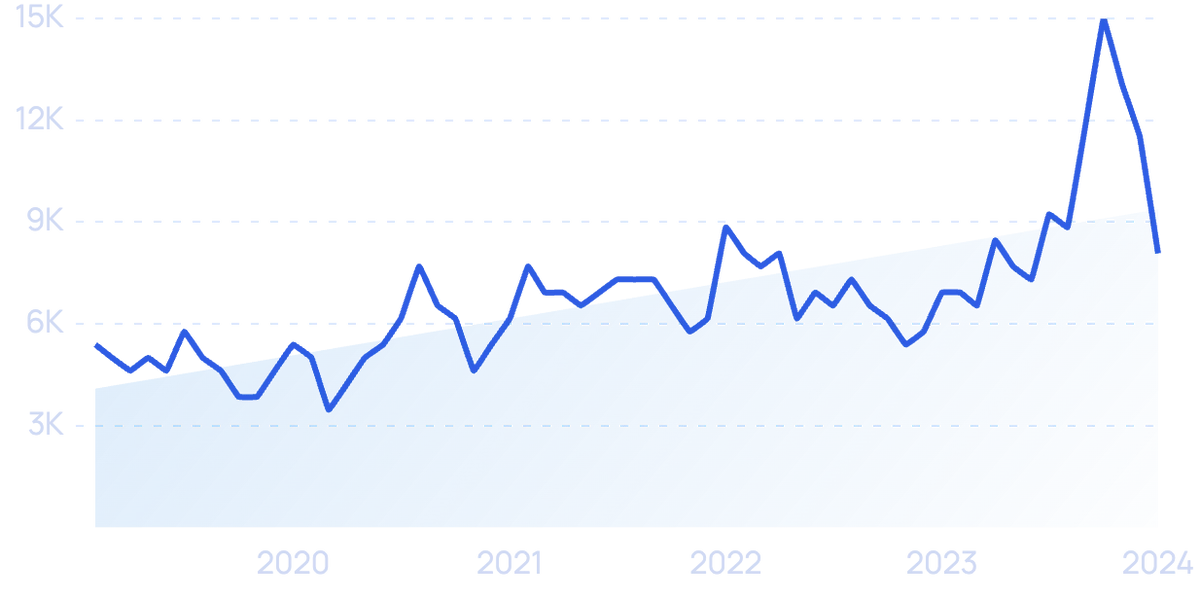
Search volume for “fractional ownership” is up 50%.
Holders can receive financial benefits from that NFT when they sell it, or they may also earn rental income or profit splits from the property.
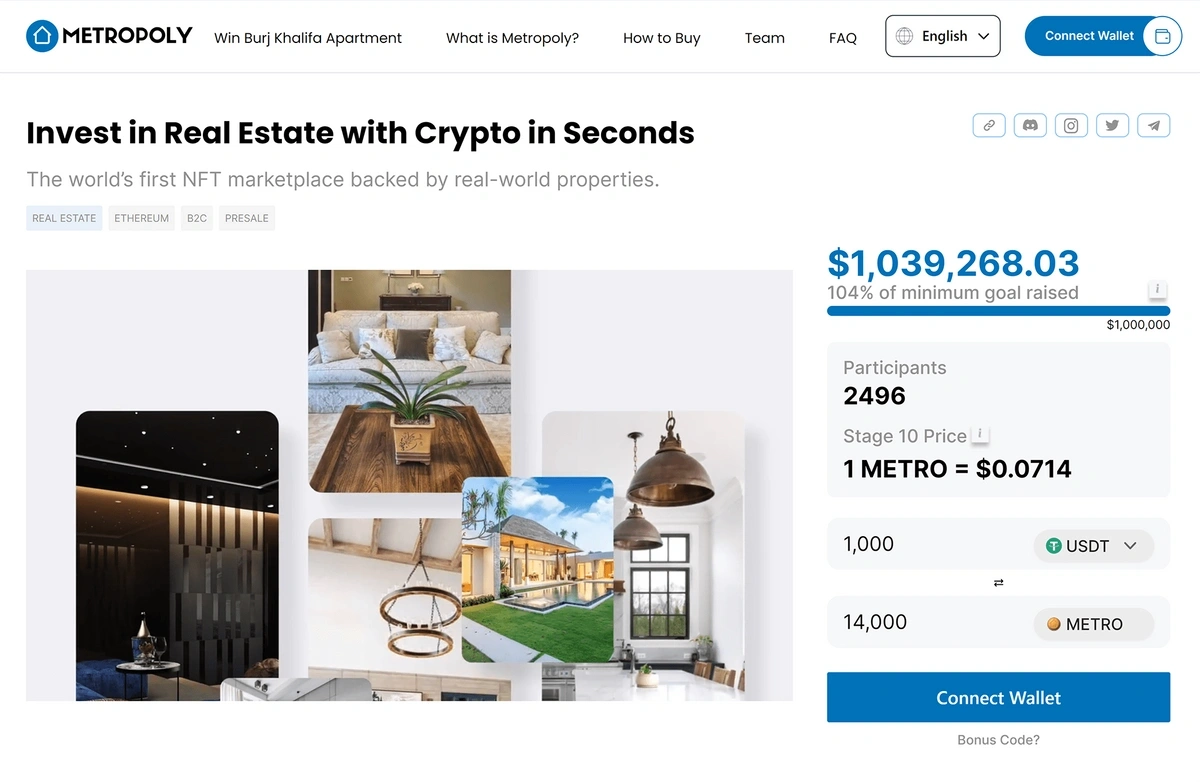
Metropoly is an example of a company facilitating the sale of fractionalized tokens in the real estate industry.
Metropoly offers fractionalized ownership of real estate via NFTs. In total, $19 million has been paid out to users so far.
Individuals can purchase a share in a property for as little as $100. The NFTs can also be bought and sold on their marketplace.
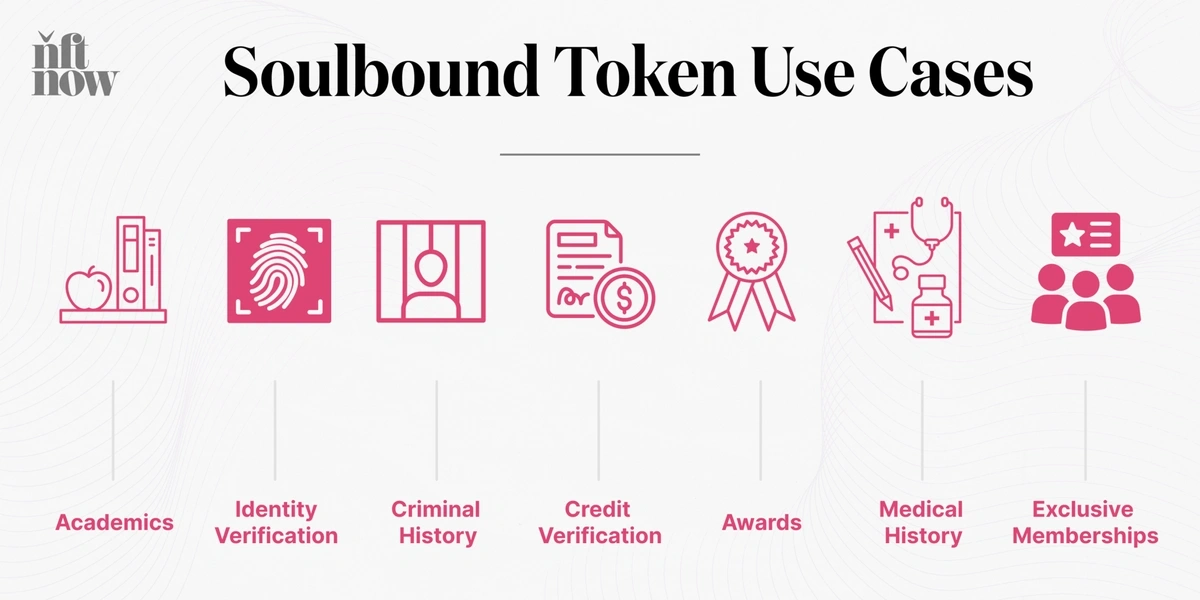
5. Soulbound Tokens Present a Different Type of NFT
These NFTs are given to people who’ve attended a certain event like a concert or a conference. They’re mostly used in loyalty and rewards programs.
They are stored in an individual’s crypto wallet but, as of now, they’re still transferable.
SBTs could add a layer of security to POAP and potentially eliminate ticket scalping and forging.
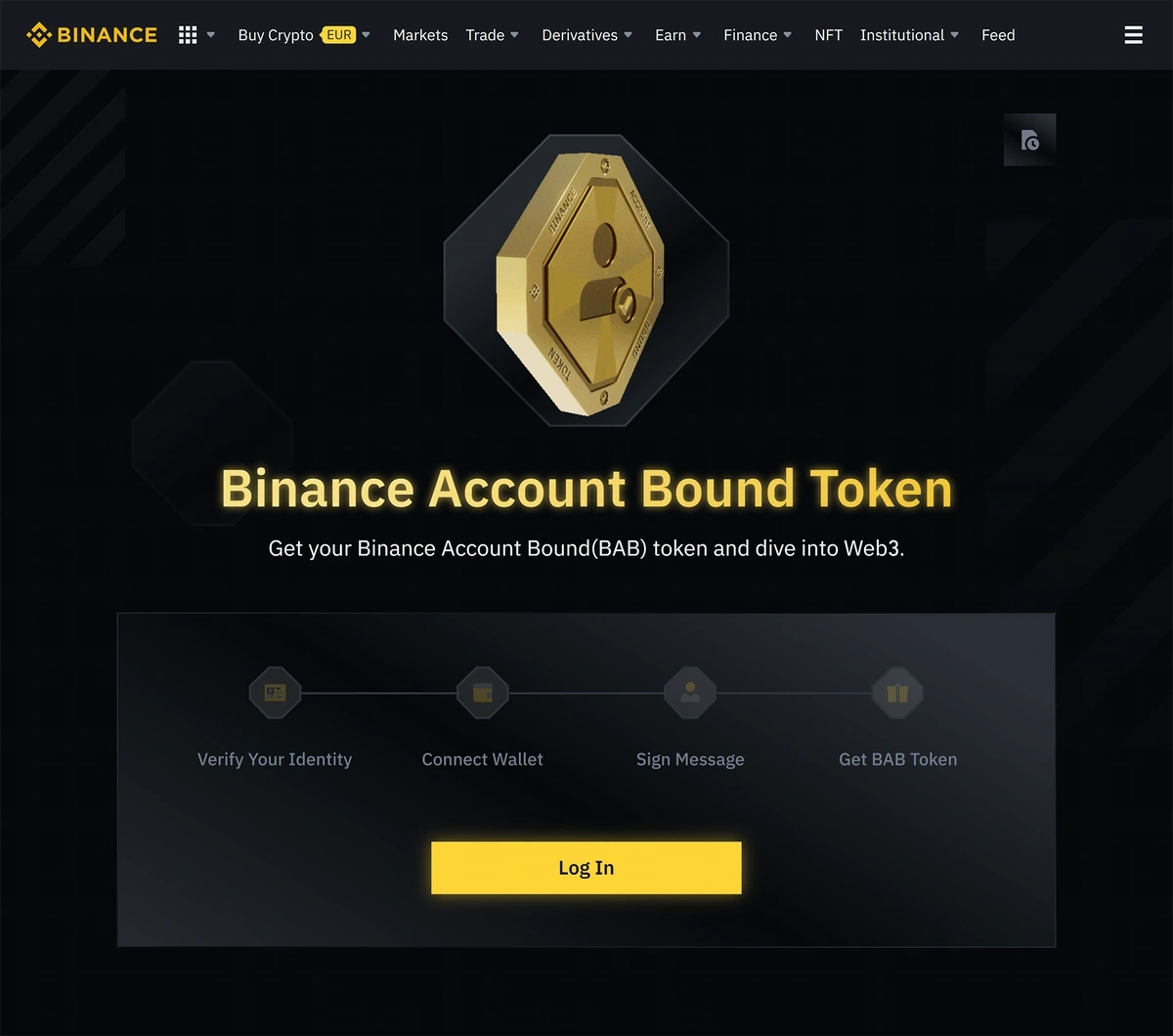
Overall, this branch of NFTs is still in its infancy. However, Binance launched the first SBT in August 2022. It’s called the Binance Account Bond (BAB).
The BAB token is the first-ever SBT on Binance.
This token verifies that a user has passed through Binance’s know-your-customer protocol.
6. Regulation and Legal Battles Increase
Because NFTs are a fairly new phenomenon, regulations, and legal repercussions have been lagging behind the market.
But with a host of million-dollar transactions, the NFT market couldn’t stay under the radar for long.
The Department of Justice, the Securities and Exchange Commission, and other regulators are now attempting to catch fraud and reign in the industry.
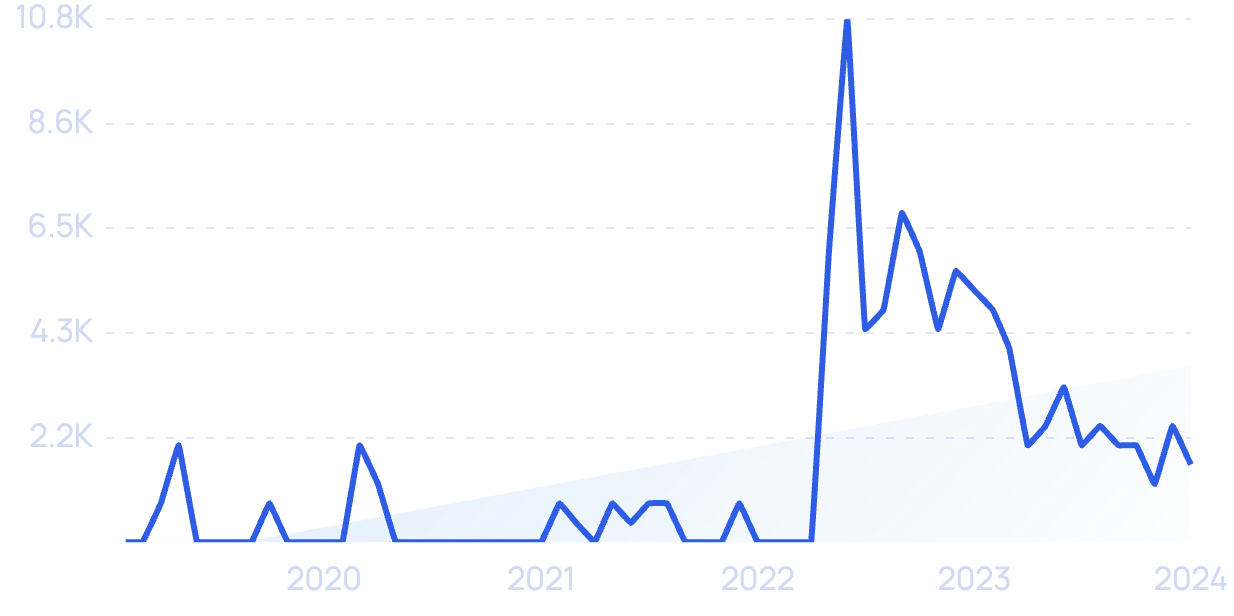
In mid-2022 the DOJ indicted Nathaniel Chastain, a former employee of OpenSea, on charges of wire fraud and money laundering. They argue he was participating in insider trading with NFTs.
Search volume for “OpenSea” spiked in recent months.
Six individuals involved in a massive NFT scheme were also arrested in mid-2022.
The group named Baller Ape Club claimed to sell NFTs but then disappeared, deleted their website, and took the $2.6 million they had collected from the mint and laundered it through several types of cryptocurrencies.
Aside from catching criminal activity, regulators are attempting to properly classify NFTs as securities, commodities, or something else entirely.
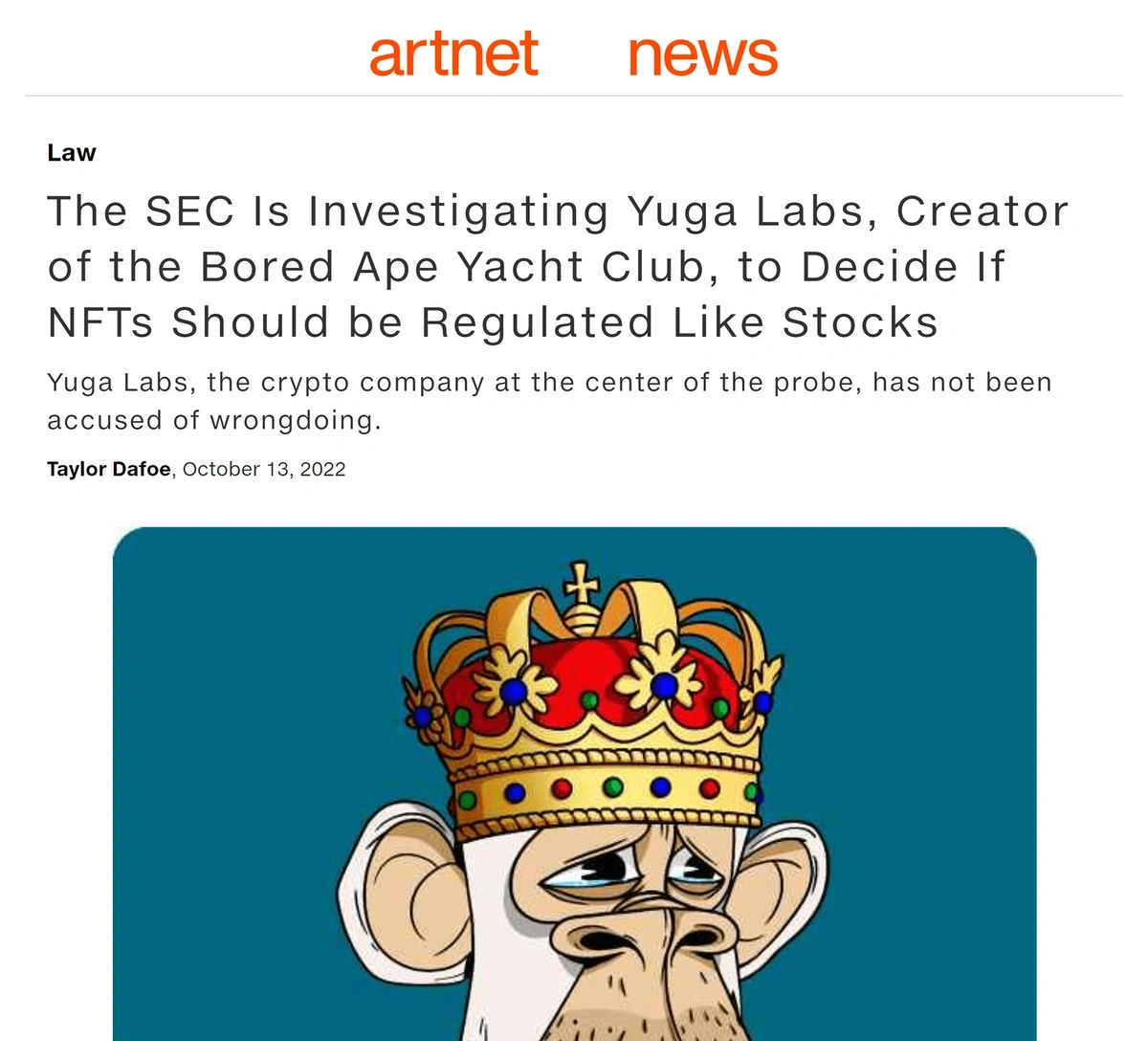
The SEC recently began investigating Yuga Labs (creator of Bored Ape Yacht Club) in order to determine if their NFTs should be treated as securities or not. But the company hasn’t been accused of wrongdoing.
The SEC began investigating Yuga Labs in late 2022.
Cryptocurrency is considered a commodity by the Commodity Futures Trading Commission, so it follows that NFTs might be treated the same.
But some NFTs are also providing an expectation of financial profit, which makes them securities.
Fractional NFTs could even be legally treated as investment contracts.
Another major issue with the regulation of NFTs is copyright and the principle of digital-first sales.
As of now, the secondary market for NFTs is technically illegal because of copyright law.
That’s because of the first-sale doctrine, which states that an individual can sell their own property even if it contains copyrighted material. However, an individual cannot sell copyrighted material in a digital format.
The law is read this way because the US Copyright Office has no method to ensure that the file is deleted once it’s sold and transferred. There could be countless copies of a copyrighted digital product.
1/6 🚨 That cool NFT you bought on @opensea was an illegal transfer (without prior agreement) due to a loophole in copyright law: there is no “digital first sale” doctrine. So NFT creators could legally claw back secondary sales, under current law, leaving you with nothing 🤷🏻♂️
This doesn’t apply to NFTs because blockchain prevents the reproduction of an NFT, but the law still stands as-is.
Regulation gets even more complicated when considering who actually owns the copyright and has a claim to the intellectual property of an NFT.
And, the NFT is never really protected under the law unless the creator goes through the official legal process of copyrighting it.
When it comes to the large majority of NFT sales, details regarding these legal implications are murky at best and difficult for the average consumer to understand.
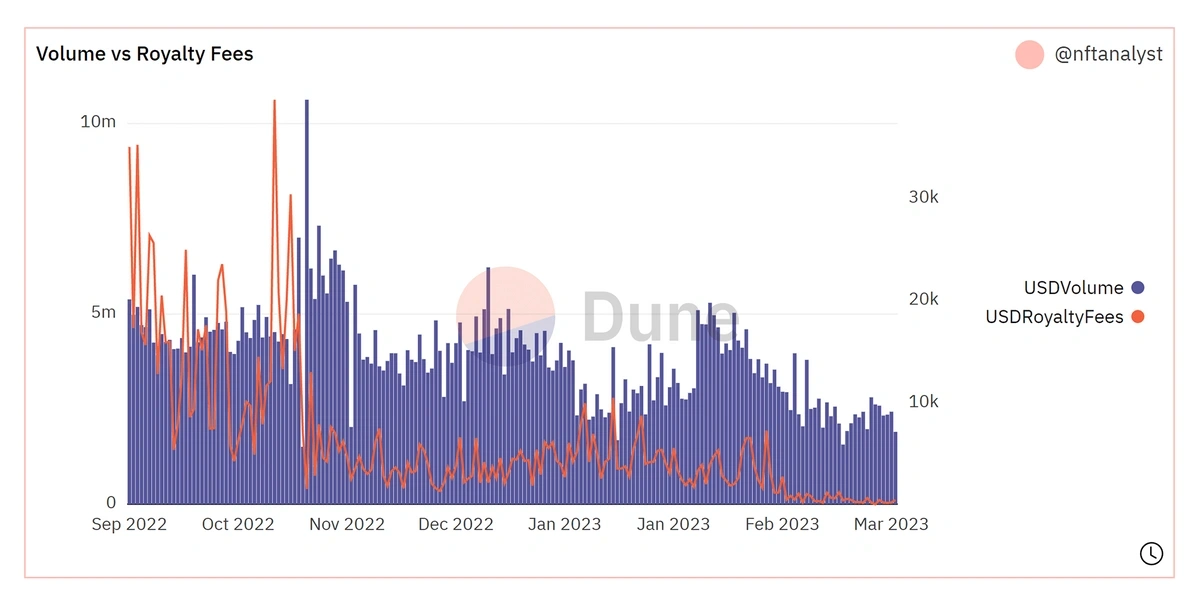
Lastly, there’s the issue of royalties.
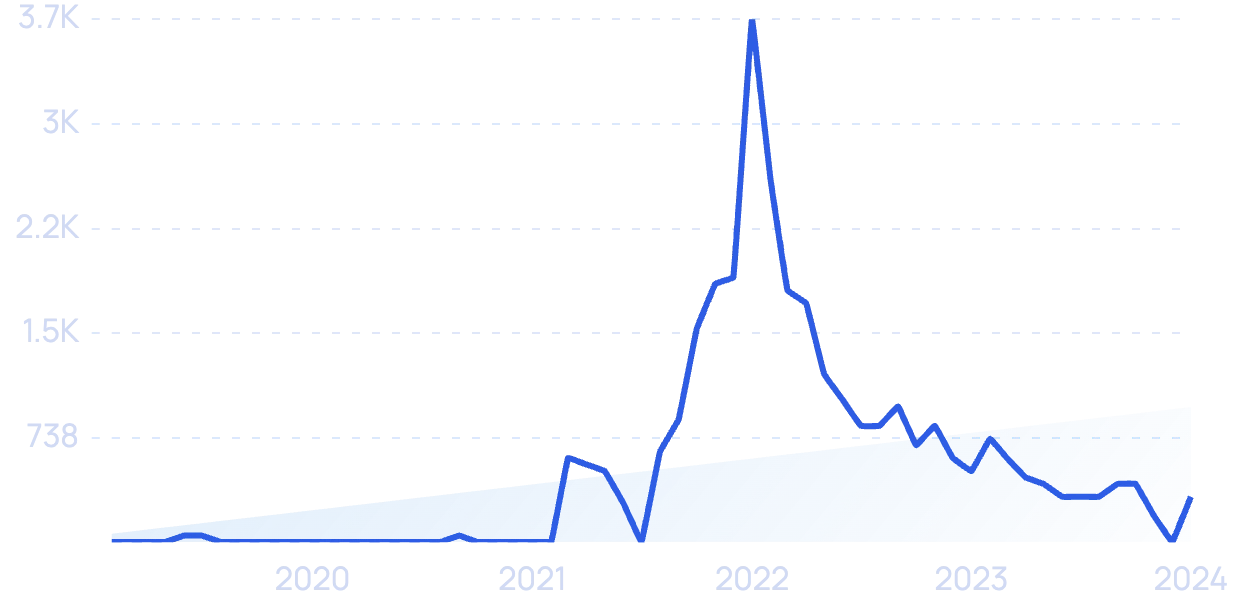
Search volume for “NFT royalties” spiked in 2022.
Creators do have the ability to create smart contracts that ensure royalties on the NFTs they sell.
The royalty is usually between 2.5% and 10% of the NFT price.
However, the name “contract” is a bit of a misnomer. These contracts are not enforceable by law.
And, in the face of a bear market, some marketplaces have made royalties optional in an effort to attract more customers.
These platforms, like Magic Eden, X2Y2, and LooksRare, give buyers the option to honor the smart contract or not.
That wraps up our list of five of the top NFT trends for 2025.
The market may be down overall, but new developments and investments by major companies may be enough to keep interest going in the months to come. That’s certainly true for the real estate industry and others who are looking to capitalize on new use cases for NFTs and blockchain technology.
In addition, this market slowdown may be good news for regulators who hope to gain some breathing room in sorting out criminal activity and legal issues surrounding NFTs.
Adidas and Xociety are launching 2,600 limited edition NFT mystery boxes containing Adidas-themed character skins for the Sui-based game on May 16.
The $129 NFT boxes include digital Adidas clothing sets of varying rarity levels, authenticity certificates, and XCS tokens.
Adidas has done multiple crypto project collabs in the past, including with Doodles and the Bored Ape Yacht Club.
Adidas and the makers of Sui-based game Xociety announced a collaboration this week to release limited edition NFT mystery boxes containing in-game character skins, marking the athletic apparel brand’s latest move in the blockchain world.
The collection, launching May 16, will offer 2,600 mystery boxes priced at $129 each, each containing Adidas-themed virtual clothing and accessories for player avatars in Xociety—a “pop shooter” game built on the Sui blockchain.
Each mystery box contains Adidas-branded digital clothing sets with varying rarity levels from “Uncommon” to “First.” The boxes also include authenticity certificates and XCS tokens representing corporate shares in Xociety. The tokenized apparel NFTs can be traded on marketplaces following the drop.
Adidas digital apparel on Xociety game avatars. Image: Xociety
The mystery boxes will be available for purchase through Sui NFT platform Tradeport, with sales continuing until May 23. The rarest First tier boxes will include all eight available Adidas skin sets, while Uncommon boxes include three sets. Each set features an Adidas-branded top, bottom, and sneakers for players’ digital avatars.
Xociety will hold its next playtest on May 15, with the game available via the Epic Games Store. The firm raised $7.5 million last summer to help fund production of the game.
Adidas first entered the NFT space in late 2021 via a collaboration with the Bored Ape Yacht Club, and has launched further apparel drops alongside crypto projects like Doodles and Stepn.
While Adidas has continued playing in the space over the years, other apparel giants have exited the industry. Nike shuttered its RTFKT subsidiary—which had produced co-branded digital and physical sneaker drops—at the end of 2024, three years after acquiring the once-hot Web3 startup.
GG Newsletter
Get the latest web3 gaming news, hear directly from gaming studios and influencers covering the space, and receive power-ups from our partners.
The recent unblocking of Web3 games to sell NFTs through the iOS App Store marks a significant shift for the crypto gaming sector, as it expands the target market dramatically. Last week, the audience for most Web3 games was confined to the crypto space, with an estimated 90 million weekly active users (WAU) as of early May 2025. However, a pivotal update reported on May 7, 2025, via a tweet by Robbie Ferguson, co-founder of Immutable, revealed that Apple’s iOS App Store, which boasts 650 million WAU, now allows Web3 games to integrate NFT sales. This policy change effectively sextuples the potential market reach for these games, as noted in the same tweet by Ferguson. This is a game-changer for blockchain-based gaming projects and related cryptocurrencies, as it bridges a previously isolated niche into a mainstream tech ecosystem. The direct implication is a massive influx of potential users who can now interact with NFT marketplaces and Web3 gaming tokens without needing crypto-specific wallets or platforms. For traders, this news signals a potential bullish catalyst for gaming-focused cryptocurrencies and NFT-related tokens, as adoption could skyrocket with access to a broader audience. The timing of this announcement, made public at approximately 10:00 AM UTC on May 7, 2025, aligns with a period of heightened interest in digital assets, further amplifying its market impact. This event also ties into the stock market, as Apple’s stock (AAPL) could see indirect benefits from increased App Store activity, potentially influencing sentiment toward tech and crypto-adjacent equities.
From a trading perspective, the integration of Web3 games into the iOS App Store opens up numerous opportunities for crypto assets tied to gaming and NFTs. Tokens like Immutable X (IMX), which powers NFT scaling solutions for games, saw a price surge of 8.3% within 24 hours of the announcement, reaching $2.15 as of 12:00 PM UTC on May 7, 2025, according to data from CoinGecko. Similarly, other gaming tokens such as Enjin Coin (ENJ) and The Sandbox (SAND) recorded gains of 5.7% and 6.1%, respectively, over the same period, with ENJ trading at $0.32 and SAND at $0.45. Trading volumes for these tokens spiked significantly, with IMX seeing a 24-hour volume increase of 42% to $58 million, ENJ at 35% to $22 million, and SAND at 38% to $75 million, as reported by CoinMarketCap on May 7, 2025. This volume surge reflects heightened retail interest, likely driven by the news of expanded market access. Cross-market analysis also reveals a correlation with Apple’s stock, which rose by 1.2% to $182.50 by the close of trading on May 7, 2025, as per Yahoo Finance data. This suggests that institutional investors may view Apple’s move as a positive signal for tech-driven innovation, potentially driving capital flows into both AAPL and crypto gaming assets. Traders should monitor pairs like IMX/BTC and SAND/ETH for breakout opportunities, as increased mainstream adoption could fuel further upside.
Diving into technical indicators, the Relative Strength Index (RSI) for IMX/BTC stood at 68 as of 2:00 PM UTC on May 7, 2025, per TradingView data, indicating near-overbought conditions but sustained bullish momentum. Meanwhile, SAND/ETH showed a bullish crossover on the 50-day and 200-day moving averages at 10:00 AM UTC on the same day, signaling a potential long-term uptrend. On-chain metrics further support this outlook, with Immutable X recording a 25% increase in transaction volume to 1.2 million transactions over the past 24 hours, as tracked by Dune Analytics on May 7, 2025. NFT trading volume on platforms like OpenSea also spiked by 18% to $12.5 million in the same timeframe, reflecting growing interest in digital collectibles tied to gaming. Cross-market correlation between crypto and stocks is evident, as Apple’s stock volume increased by 10% to 65 million shares traded on May 7, 2025, per NASDAQ data, suggesting institutional money flow into tech stocks could spill over into crypto markets. Sentiment analysis from social media platforms like Twitter shows a 30% uptick in positive mentions of Web3 gaming tokens post-announcement, as per LunarCrush data at 3:00 PM UTC on May 7, 2025. For institutional impact, this move by Apple could encourage more traditional investors to explore crypto-related ETFs like the Bitwise DeFi & NFT Index Fund, potentially driving further capital into the sector. Traders should remain cautious of profit-taking after initial rallies, using stop-losses near key support levels like $2.00 for IMX and $0.40 for SAND to manage risk.
In summary, the iOS App Store’s unblocking of NFT sales for Web3 games is a pivotal moment for crypto gaming tokens, with direct correlations to stock market movements in tech giants like Apple. Institutional interest, reflected in both AAPL’s stock performance and crypto volume spikes, underscores the potential for sustained growth in this niche. Traders can capitalize on these developments by focusing on gaming tokens and monitoring cross-market trends for optimal entry and exit points.
FAQ Section: What does the iOS App Store update mean for crypto gaming tokens? The update announced on May 7, 2025, allows Web3 games to sell NFTs through the iOS App Store, expanding their market from 90 million to potentially 650 million weekly active users. This has driven price surges in tokens like IMX (up 8.3% to $2.15), ENJ (up 5.7% to $0.32), and SAND (up 6.1% to $0.45) within 24 hours, alongside significant volume increases, as reported by CoinGecko and CoinMarketCap.
How does Apple’s stock movement relate to crypto markets? Apple’s stock (AAPL) rose 1.2% to $182.50 on May 7, 2025, with trading volume up 10% to 65 million shares, per NASDAQ data. This suggests institutional interest in tech innovation, which could drive capital into crypto gaming assets as mainstream adoption grows through platforms like the App Store.
The recent announcement regarding Play Passport zkEVM bringing 5 million registered users to Immutable has sent ripples through the cryptocurrency and web3 gaming sectors, offering significant implications for traders in both crypto and related stock markets. On May 7, 2025, Robbie Ferguson, co-founder of Immutable, shared this milestone on social media, highlighting the massive user onboarding facilitated by Play Passport zkEVM. This layer-2 scaling solution, designed to enhance Ethereum’s capabilities for gaming applications, has positioned Immutable as a key player in the web3 gaming ecosystem. The influx of 5 million users signals robust growth potential for Immutable’s native token, IMX, which is central to its ecosystem for transactions and governance. At the time of the announcement at approximately 9:00 AM UTC, IMX saw a price spike of 8.3%, moving from $2.15 to $2.33 on major exchanges like Binance and Coinbase, as reported by real-time data from CoinGecko. This surge was accompanied by a 24-hour trading volume increase of 12.5%, reaching $58.2 million across IMX/USDT and IMX/BTC pairs. Additionally, this event ties into broader stock market trends, as gaming and tech stocks like Unity Software (U) and Electronic Arts (EA) often correlate with blockchain gaming advancements. Unity Software, for instance, reported a 3.2% uptick to $22.85 per share on the same day at 2:00 PM EST on the NYSE, reflecting investor optimism in gaming tech innovation.
From a trading perspective, the Play Passport zkEVM milestone offers multiple opportunities and risks for crypto investors while highlighting cross-market dynamics. The user growth directly impacts IMX’s demand, as more users are likely to engage in in-game transactions using the token, potentially driving long-term price appreciation. Short-term traders could capitalize on the momentum, targeting resistance levels around $2.40, as observed on Binance’s IMX/USDT pair at 11:00 AM UTC on May 7, 2025, where selling pressure emerged with a volume spike of 3.1 million IMX traded in a single hour. Conversely, profit-taking risks loom, as on-chain data from Etherscan at 1:00 PM UTC showed a 15% increase in IMX transfers to exchange wallets, suggesting potential sell-offs. In the stock market context, the correlation between blockchain gaming and gaming stocks presents arbitrage opportunities. For instance, institutional investors may shift capital from tech stocks to crypto assets like IMX if web3 gaming adoption accelerates, a trend evident in the $1.2 billion inflow into crypto funds reported by CoinShares for the week ending May 7, 2025. This capital flow could further amplify IMX’s price if sustained, while also impacting crypto-related ETFs like the Bitwise DeFi & Crypto Index Fund, which rose 2.7% to $45.12 by 3:00 PM EST on the same day.
Diving into technical indicators and market correlations, IMX’s Relative Strength Index (RSI) on the 4-hour chart stood at 68 as of 4:00 PM UTC on May 7, 2025, per TradingView data, indicating overbought conditions that could precede a pullback unless volume sustains above $55 million daily. The Moving Average Convergence Divergence (MACD) showed bullish momentum with a positive histogram, suggesting continued upside potential if the 5 million user base translates to active wallet growth. On-chain metrics from Dune Analytics at 5:00 PM UTC revealed a 9.4% increase in Immutable X wallet addresses over the prior 24 hours, aligning with user registration data. Trading volume for IMX/ETH also spiked by 10.8% to $12.3 million on Uniswap by 6:00 PM UTC, reflecting heightened decentralized exchange activity. In terms of stock-crypto correlation, the S&P 500 tech sector index gained 1.8% to 3,245 points by 1:00 PM EST on May 7, 2025, per Yahoo Finance, mirroring optimism in gaming and blockchain tech. This suggests a risk-on sentiment driving both markets, with institutional money likely rotating between tech stocks and crypto assets like IMX. Traders should monitor Nasdaq futures for further risk appetite signals, as a downturn could trigger sell-offs in both sectors. Overall, the Play Passport zkEVM milestone underscores Immutable’s growth trajectory, offering actionable trading setups for IMX while highlighting interconnected stock and crypto market trends.
FAQ Section: What is the significance of Play Passport zkEVM for Immutable’s token IMX? The Play Passport zkEVM has onboarded 5 million registered users to Immutable as of May 7, 2025, significantly boosting the potential demand for IMX. This token is used for transactions and governance within the ecosystem, and the price surged 8.3% to $2.33 at 9:00 AM UTC on the same day, with trading volume rising 12.5% to $58.2 million, indicating strong market interest.
How does this event impact stock market correlations with crypto? The announcement aligns with positive movements in gaming and tech stocks like Unity Software, which rose 3.2% to $22.85 per share at 2:00 PM EST on May 7, 2025. This reflects a broader risk-on sentiment, with institutional flows of $1.2 billion into crypto funds for the week ending May 7, as per CoinShares, suggesting capital rotation between stocks and crypto assets like IMX.
Join Our Telegram channel to stay up to date on breaking news coverage
Leading DeFi tokens are seeing a surge in activity as the sector regains momentum. With total value locked (TVL) in DeFi surpassing $95 billion and user engagement steadily rising, investors show renewed confidence in decentralized finance protocols. This resurgence is driven by platforms offering yield opportunities and practical tools for real-world use cases like payments, lending, and governance.
In today’s spotlight are four leading DeFi tokens by market activity—Morpho, Request Network, TrueFi, and Hifi Finance—that are gaining traction through innovative updates and strong market performance. From fixed-rate lending to cross-chain payments and DAO governance, these projects are pushing the boundaries of what’s possible in DeFi while maintaining bullish momentum.
Biggest DeFi Token By Market Activity Today – Top List
Morpho is a decentralized platform that streamlines lending and borrowing in DeFi, with non-custodial Morpho Vaults designed to optimize yield. Request Network enables secure, peer-to-peer payments on Ethereum without intermediaries. TrueFi offers interest-bearing pools for traditional and crypto assets, redefining DeFi lending. Through its decentralized protocol, Hifi allows users to borrow crypto at fixed interest rates. Let’s understand why these tokens are leading DeFi token by market activity today.
1. Morpho (MORPHO)
Morpho is a decentralized platform that simplifies lending and borrowing in DeFi. Lenders earn yields through Morpho Vaults, non-custodial pools designed to optimize returns. Borrowers can directly access assets from Morpho Markets. The platform’s open infrastructure allows developers and businesses to create custom markets and applications, all while being trustless and efficient with low gas consumption.
The Morpho token supports governance and utility within the ecosystem, improving collateralization and interest rates. It enables seamless, decentralized transactions and risk management, allowing developers and businesses to build on the platform’s permissionless infrastructure.
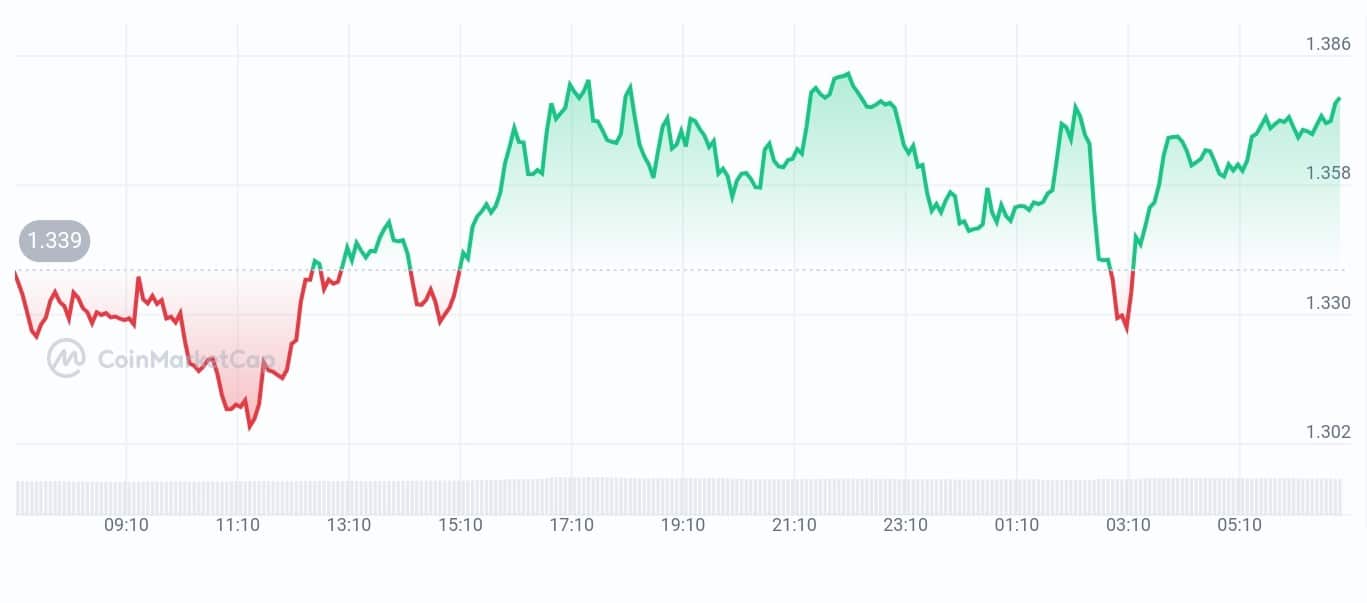
Morpho (MORPHO) is currently priced at $1.37, showing a 3.14% increase in the last 24 hours, 10.20% in the past week, and 19.93% in the previous month. With a price range of $1.31 to $1.38 in the past 24 hours, its consistent upward movement reflects strong investor interest. The token has high liquidity based on its market cap, contributing to its bullish sentiment and indicating potential for continued growth.
Introducing Morpho Lite
A minimal, open-source app with just the essential Earn and Borrow features.
Morpho introduces Morpho Lite, a lightweight, open-source app built for simplicity and speed. Designed with just the essentials—Earn and Borrow—it’s easy to deploy across multiple chains, supporting Morpho’s mission of multichain accessibility.
With Morpho Lite, users can earn by depositing and withdrawing, borrowing with collateral, and tracking rewards (claimable via merkl). While the main Morpho App serves Ethereum and Base, Morpho Lite expands its reach to Polygon, Optimism, World Chain, and beyond—bringing DeFi to more users more efficiently.
2. Request (REQ)
Request Network is a decentralized Ethereum-based payment system that allows users to request and receive payments securely without third-party intermediaries. It offers an open-source platform where apps can work together, creating a seamless financial ecosystem with lower transaction costs and greater privacy.
The REQ token powers the network, enabling governance, staking, and anti-spam functions. It helps ensure the platform’s stability and provides users with benefits like transaction discounts, making it a vital component of the decentralized payment system.
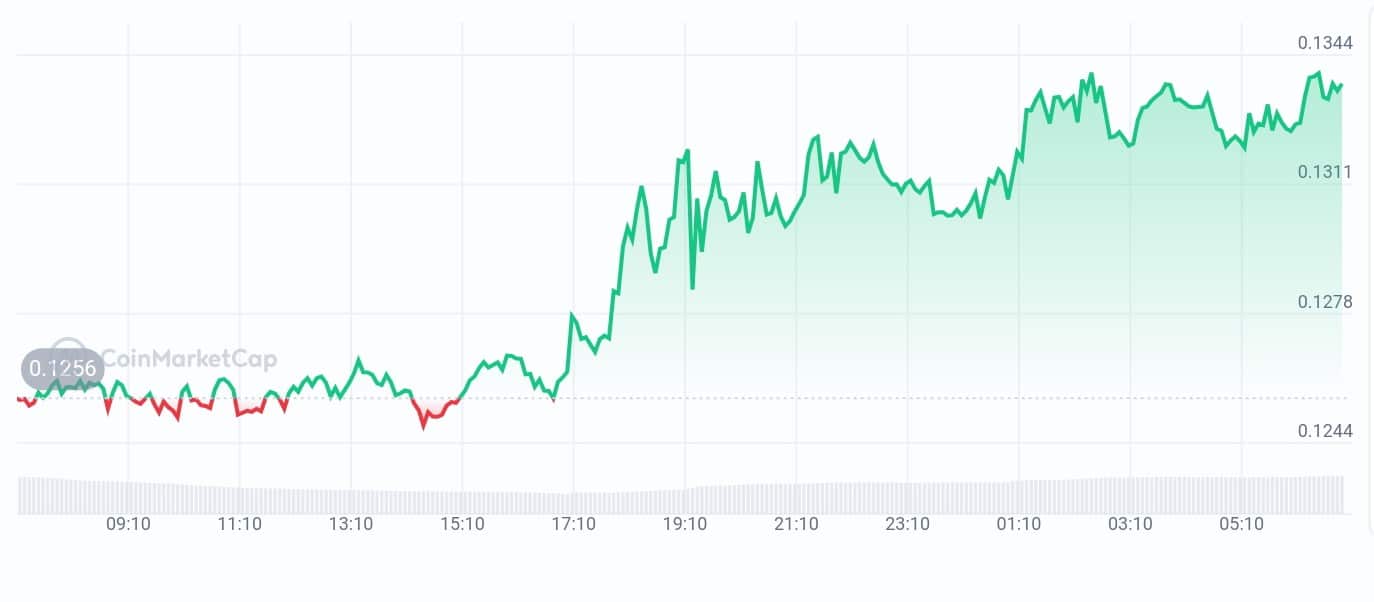
Request (REQ) is currently priced at $0.1335, with a 5.95% increase in the last 24 hours, 8.43% in the past week, and 29.66% in the previous month. The token has outperformed 68% of the top 100 crypto assets over the past year, showcasing its strong performance. Trading above the 200-day simple moving average further solidifies its bullish momentum and long-term potential.
Request Network unleashes a new level of financial freedom with its latest API update. It now supports cross-chain invoice payments with automatic route optimization and token selection for faster, smarter transactions. Designed for seamless integration, this upgrade lets developers enable cross-chain invoicing in just two hours, unlocking efficient, borderless payments for users and businesses.
3. SUBBD Token (SUBBD)
SUBBD is an AI-powered platform revolutionising content monetisation in the creator-subscriber economy. Combining AI tools and Web3 enables creators to manage and monetise content, efficiently cutting out middlemen. With features like AI live streams, voice generators, and a 24/7 personal assistant, SUBBD offers a decentralised alternative to platforms like OnlyFans.
The $SUBBD token powers the platform, enabling access to content, offering tips, and facilitating creator requests. Currently in presale at $0.055325, with over $327,000 raised, the token provides exclusive perks, VIP access, and a 20% annual return through staking. Ten per cent of the total supply is allocated for airdrops and rewards.
It has also been featured on major cryptocurrency platforms, including Cryptonomist, Coinspeaker, Bitcoinist, 99Bitcoins, and TradingView via NewsBTC, highlighting its growing presence in the AI and Web3 space. With its increasing influence, $SUBBD is gaining rapid traction. The launch of the AI Personal Assistant further strengthens its position, offering creators continuous fan engagement. As AI and Web3 redefine digital content, $SUBBD shapes the future of creator income.
TrueFi is a decentralized platform that reshapes lending and borrowing in DeFi by offering interest-bearing pools for both traditional and cryptocurrency assets. Unlike traditional DeFi models, TrueFi provides uncollateralized loans, allowing for competitive interest rates and a more flexible, decentralized lending protocol. Its innovative approach offers higher returns for liquidity providers while eliminating the need for collateral.
The TRU token is essential to the TrueFi ecosystem, playing a key role in governance, rewards, and credit prediction. TRU holders influence lending decisions by rating the creditworthiness of borrowers, shaping the platform’s decentralized credit system. By holding TRU, users have a say in the platform’s future, creating a more inclusive financial system driven by incentives and community participation.
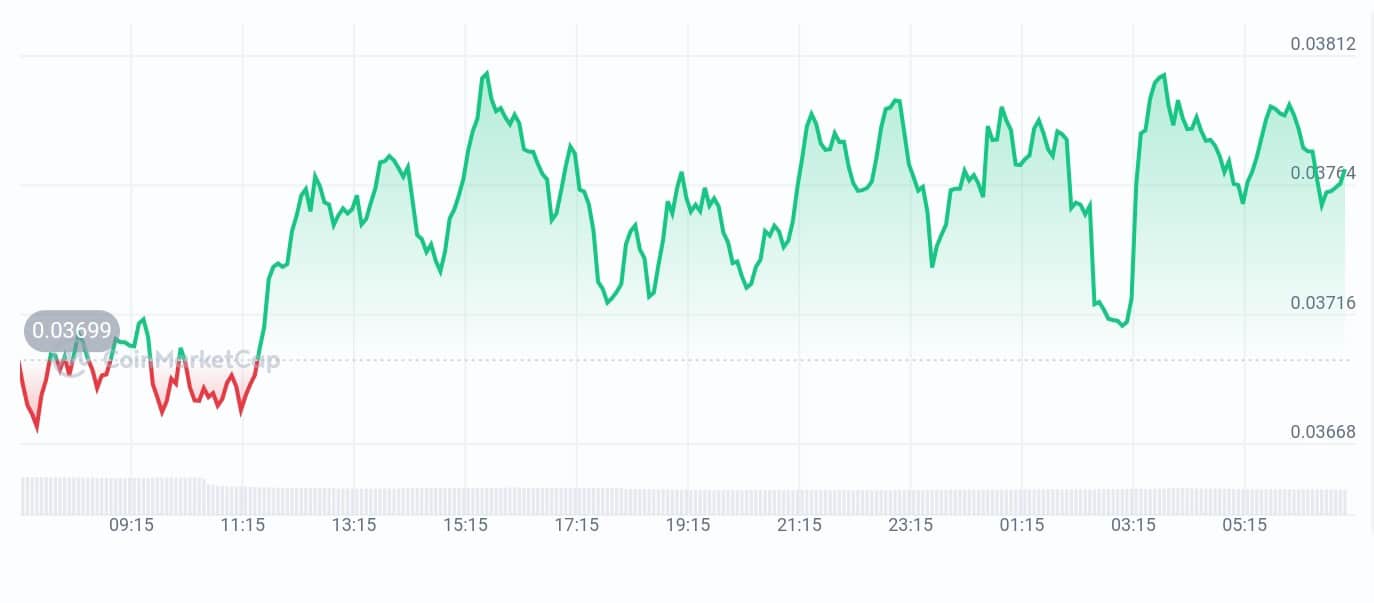
TrueFi (TRU) is currently priced at $0.03765, with a 2.10% increase in the past 24 hours and a 16.96% rise over the last month. The price has fluctuated between $0.03677 and $0.03809 in the past 24 hours. With high liquidity based on its market cap, TRU demonstrates strong market interest and is positioned for potential growth, reflecting its solid performance in the broader market, making it one of the leading DeFi tokens by market activity today.
Treasuries moving onchain aren’t just entering a growth stage—they’re reshaping the landscape of finance and crypto. Yield-bearing digital dollars are reshaping DeFi’s foundation: trust, yield, and composability. Institutions are no longer on the sidelines. This enables new more…
Truefi is leading the charge as treasuries move on-chain, signaling a new growth phase in traditional finance and crypto. Yield-bearing digital dollars are becoming a crucial building block of DeFi, transforming its core principles of trust, yield, and composability. This shift empowers institutions to transition from the sidelines to active participants in the ecosystem.
The move to on-chain treasuries paves the way for developing new, more trusted financial primitives. Institutions adopting these innovations set the stage for groundbreaking advancements in decentralized finance, offering increased security and scalability for all players involved.
5. HiFi Finance (HIFI)
Hifi is a decentralized finance protocol that allows users to borrow crypto at fixed interest rates. It uses an Automated Market Maker model, where liquidity providers supply tokens to pools, and interest rates are determined by supply and demand. This system enables predictable lending and borrowing without the need to negotiate terms.
The HIFI token facilitates governance, giving holders voting rights on protocol changes and proposals. This community-driven approach ensures users can shape the platform’s future. Hifi’s fixed interest rates offer more certainty for borrowers and lenders, making it more predictable than variable-rate protocols.
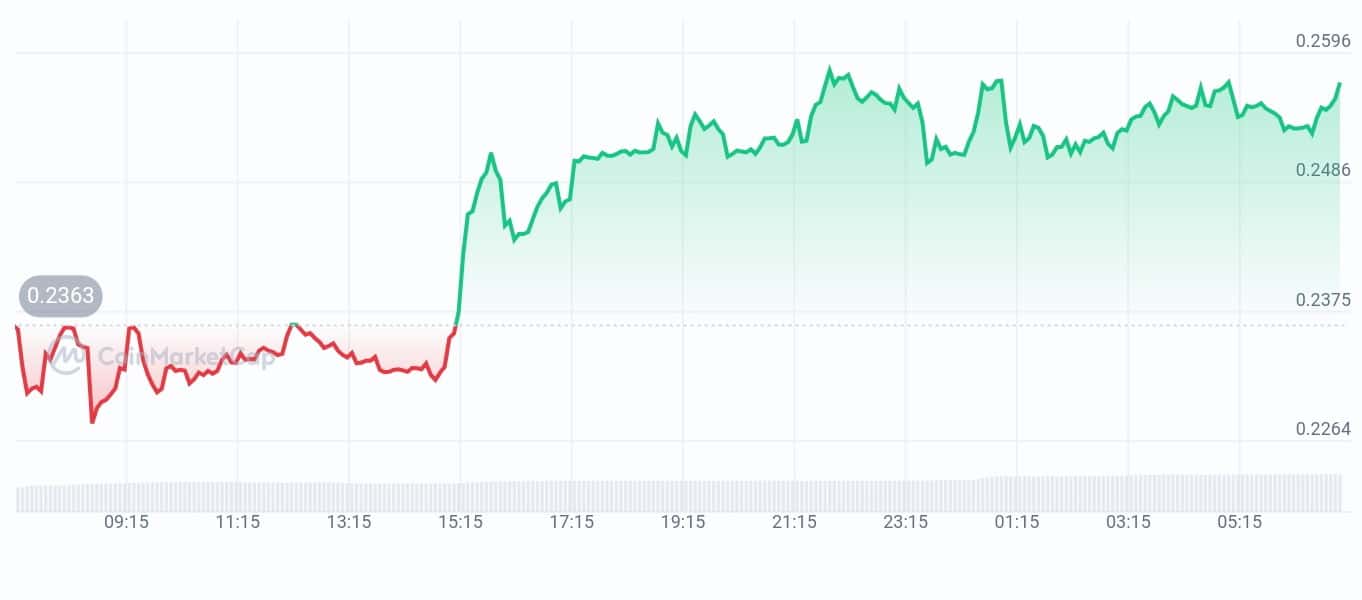
Hifi Finance (HIFI) is currently priced at $0.2661, showing a 16.10% increase in the past 24 hours, 17.02% in the last week, and 44.08% in the past month. Its price performance over the previous 24 hours ranges between a low of $0.228 and a high of $0.2657, reflecting strong bullish momentum. The recent price surge suggests an increased market interest and potential for further growth.
With over 5.9 million votes in favor, we’ve officially passed HIP 16 — a critical measure designed to provide the Hifi DAO with a clear fallback strategy while the long-term direction remains uncertain.
HIFI Finance has successfully passed HIP 16, with over 5.9 million votes in favour. This crucial measure establishes a clear fallback strategy for the Hifi DAO as the community navigates the uncertain long-term direction of the project.
By securing this vote, the Hifi DAO ensures continued stability and governance, providing a solid foundation for future decision-making while maintaining flexibility in response to evolving market conditions.
Read More
Best Wallet – Diversify Your Crypto Portfolio
Easy to Use, Feature-Driven Crypto Wallet
Get Early Access to Upcoming Token ICOs
Multi-Chain, Multi-Wallet, Non-Custodial
Now On App Store, Google Play
Stake To Earn Native Token $BEST
250,000+ Monthly Active Users
Join Our Telegram channel to stay up to date on breaking news coverage
DeFi Development Corp. added more than 80,000 SOL in its latest purchase, valued at $11.2 million.
The company now owns more than 400,000 SOL in total, valued around $58 million.
On Monday, the firm announced it had acquired an unnamed Solana validator business.
Publicly traded AI-powered real estate software company DeFi Development Corp. (formerly Janover) added to its flurry of strategic Solana moves Tuesday by announcing that it purchased another $11.2 million worth of SOL—one day after it announced the acquisition of a Solana validator company.
The firm’s latest purchase added 82,405 SOL at an average price of $135.58, bringing its total Solana holdings to more than 400,000 tokens valued above $58 million.
“The SOL stackin’ saga continues!” the company posted on X (formerly known as Twitter). “All newly acquired SOL is being staked immediately on our validators, meaning we’re earning native yield while helping secure the Solana network.”
On Monday, the firm announced the acquisition of an unnamed Solana validator business for $3.5 million, paid with $3 million in restricted DFDV stock and $500,000 in cash. The acquired network validators come with an average delegated stake of around 500,000 SOL.
“This acquisition doesn’t just add a new line of protocol-native cash flow—it amplifies our alignment with the infrastructure underpinning tomorrow’s decentralized economy,” the company’s CIO and COO Parker White said in a statement.
“Owning and operating validators with significant delegated stake puts us at the core of Solana,” he added, “while furthering our mission of effectively accumulating SOL to deliver superior risk-adjusted returns relative to holding SOL directly.”
The firm’s alignment with crypto and Solana in particular has happened rapidly over the course of the last month.
In April, the company adopted its new digital assets treasury plan that allows it to accumulate crypto assets with a long-term plan, starting with Solana. After multiple SOL purchases, the firm changed its name from Janover to DeFi Development Corporation to better signal its commitment to crypto.
Since that time, the company has announced more Solana purchases and creative financing solutions to accelerate its treasury’s SOL stockpile.
The firm trades publicly on the Nasdaq exchange under the ticker DFDV, having changed from JNVR on Monday.
Shares were up about 1% at close Tuesday at a price of $72.74, rising over 1,700% in the last month.
Solana is down 0.5% in the last 24 hours to a price of about $146. The sixth-largest crypto asset by market cap sits about 50% off its January all-time high of $293.31.
Dubai, May, 2025 — PolyFlow, the pioneering PayFi protocol, made waves at TOKEN2049 Dubai with the official launch of its latest DAPP product, drawing widespread attention from across the industry.
At the same time, PolyFlow was officially announced as a core member of the Global PayFi Alliance, an initiative led by Web3 fintech group Klickl, joining 17 other leading fintech and Web3 infrastructure organizations to collectively advance the reconstruction of an institution-grade payment system.
PolyFlow DAPP Debuts at TOKEN2049, Ignites Market Buzz
During TOKEN2049, PolyFlow unveiled its first-ever decentralized application (DAPP), designed to bridge the gap between traditional financial payments and blockchain. By enabling consumers and merchants to experience real-world benefits from blockchain and crypto in everyday transactions, PolyFlow’s DAPP aims to lay the foundation for the next generation of PayFi financial infrastructure.
The launch immediately captured attention as a standout case of ecosystem-oriented innovation in the PayFi space. In its earlier beta version, the DAPP’s flagship feature — Scan to Earn — enabled users to upload payment receipts and earn rewards. Within just two weeks, it recorded over 8 million payment uploads, fueling a surge of on-chain payment activity.
Will from PolyFlow Joins Global Compliance Panel at CODE MEETS LAW
Will, Head of Research & Innovation at PolyFlow, was invited to join a high-profile panel at LBank’s CODE MEETS LAW side event, alongside leaders from Fireblocks, Elliptic, and Deloitte Middle East, to explore the theme: “Global Playbooks: Navigating Compliance Across Jurisdictions.”
Will stated at the event:
“In PayFi, payment is no longer the endpoint — it’s the starting point. By bringing payments on-chain, a broad spectrum of financial services can be layered seamlessly. With internet access, these services become truly accessible, advancing real financial inclusion.”
He emphasized PolyFlow’s commitment to clear compliance frameworks, agile infrastructure, and global collaboration as the pillars for building a trusted, next-generation payment network.
PolyFlow CFO Chuck Speaks at Web3 PayFi Oasis on RWA and On-Chain Liquidity
PolyFlow’s CFO, Chuck, also joined industry leaders from Aptos, RD Technologies, and OpenPayd at the Web3 PayFi Oasis 2025, hosted by Klickl. He participated in the panel “Rewiring Financial Liquidity: Web3 Clearing, RWA, and the Future of PayFi”, offering key insights into how on-chain clearing systems and RWA tokenization can underpin a new era of compliant, global asset management infrastructure.
“Imagine providing a processing fee, utility-based yield to liquidity providers on-chain. This is DeFi 2.0, this is PayFi. Bringing to consumers what used to be available only to institutions. That’s what we are looking to do.”
PolyFlow Joins Global PayFi Alliance: Toward an Institution-Grade SWIFT for Web3
At the summit, Klickl officially unveiled the Global PayFi Alliance, naming PolyFlow as one of its first 18 strategic partners. The alliance spans five key sectors — on-chain payments, wire clearing, stablecoin infrastructure, compliant wallets, and digital banking — with the mission to create an integrated financial network featuring cross-chain interoperability, regulatory-grade onboarding, stablecoin account settlement, and multilateral clearing recognition.
Dubbed the “institutional SWIFT of the Web3 era,” the Alliance is a landmark step toward global interoperability and trust in blockchain finance.
PolyFlow joins a powerful lineup including Aptos, RD Technologies, OpenPayd, FOMO Pay, Vault, Gate.io, Blockfills, Cobo, and Interlace, working together to promote compliant and efficient standards for global settlement, on-chain account infrastructure, and cross-border payment systems.
Looking Ahead: Institutional Web3 Infrastructure with Global Impact
As a founding member of the PayFi Alliance, PolyFlow will continue to uphold its vision that “payment is the starting point of financial services.” Looking forward, the Alliance will deepen its product development around key modules, including stablecoin account management, cross-chain clearing, and on-chain settlement. It also plans to actively engage in closed-door roundtables and joint pilot programs with Alliance members to drive adoption across the Middle East, Southeast Asia, Europe, and Africa.
“The future of global finance won’t belong to the most technologically advanced island, but to the most institutionally trusted network.”
PolyFlow is defining that future — one that balances innovation with compliance, agility with structure, and technology with trust.