Quidd’s leaderboard ranks collectors based on the total value of all their Man City items. For a spot on the chart, collectors must complete at least 1 card set.
Each pack within the assortment guarantees ‘Shinies‘, with three of them holding actual cash rewards: Haaland $5,000, De Bryune $2,500, and Alvarez $1,000. Additionally, the leftover 20 Shinies offer bounties of $250 in store credit on Quidd.
Other prizes include exclusive match tickets, City Football Academy training sessions, autographed football kits, and more.
Not forgetting, the Manchester City 2023-24 collection marks a significant milestone in the ongoing multi-year partnership between the football team and Quidd, which promises more exciting NFT releases ahead.
GameFi.org has teamed up with Somnia, one of the blockchains that can manage a lot of traffic and keep latency low. The deal was made public on GameFi.org’s X (formerly Twitter) account, which caught the attention of the industry tracker, Chainspect.
Both firms agree that this step is meant to scale Web3 gaming to new, unprecedented heights. They see the partnership as “the gateway for: Mass adoption, bringing blockchain technology to everyone worldwide!”
GameFi.org has been taking decisive steps, especially now that it has teamed up with Somnia and will be using Somnia’s powerful blockchain infrastructure. Somnia’s technology promises one million transactions per second, which is much faster than most networks today. This makes it possible for Web3 games to be faster and more interactive.
About the Partnership
GameFi.org will employ Somnia’s infrastructure to assist games and decentralised apps that need to process things faster. The agreement will cut down on the time players and developers have to wait for their transactions to complete. Somnia was made to handle a lot of traffic and allow apps to increase their capacity and serve more people at once.
Both sides want everyone to have access to blockchain games and they think this will make the industry more appealing to the general public.
Somnia’s Plans and Ecosystem Perks
Somnia doesn’t only care about speed. The developers behind the blockchain recently said that they would give away $10 million to start-ups with new game ideas and technologies. This money can assist teams in the early stages get started faster and test out more imaginative concepts.
Somnia also partners with big tech companies like Google Cloud, LayerZero, and BitGo. These partnerships make it more reliable and available to more people. As the mainnet debut gets closer, the developer buzz is growing. Many people consider Somnia as a new base for Web3 gaming.
What GameFi.org Stands to Gain
GameFi.org and the game developers on its network will now work on a blockchain that can handle a lot of traffic and is very responsive. This gives game developers more freedom to add features and less tech constraints. Instead than worrying about the backend, the focus is on innovation and gameplay.
Somnia also gives developers a chance to acquire grant money and technical assistance. These tools let game developers break new ground and come up with more innovative games. The alliance should encourage and help developers to speed up progress and generate new ideas by getting rid of existing technical impediments.
Industry Outlook and Early Response
This relationship clearly indicates that blockchain gaming is becoming more mature. Big brands are now building products targeting more people all across the world, not simply a small group of people. Somnia’s fast, safe, and scalable technology is a big part of that incredible shift.
The Web3 community has given a strong and positive response thus far. People were excited and happy about official posts from GameFi.org and Chainspect. A lot of people in the business think this shows that blockchain gaming is getting closer to the industry’s goal of reaching as many players as possible.
GameFi.org and Somnia Partnership Set to Transform Web3 Gaming
Blockchain gaming could soon be faster, cheaper, and open to everyone thanks to partnerships like that of Somnia’s technology and GameFi.org’s. The alliance will encourage new ideas and assist new initiatives thrive, making the Web3 area more active and open to people all around the world.
Crypto Champion is an NFT-based game available on Android, iOS and web browsers, where players collect and upgrade characters known as “champions” and earn tokens through gameplay by competing in battles and other game modes.
The game uses two cryptocurrencies: Crypto Champion Gems ($CCG) and Crypto Champion Mushrooms ($CCM) with both tokens having a 3% tax fee on purchases, contributing to marketing, development, and liquidity.
$CCG token functions as the game’s governance and utility token, offering automatic holder reflection, deflationary mechanisms, and a locked liquidity pool. The token can also be used to mint NFTs, stake tokens, and engage in project governance. While $CCM token acts as the in-game currency with unlimited supply to support the game’s features, with design elements aimed at maintaining a deflationary model.
The launch will begin with a stealth rollout, and NFTs will become available for purchase shortly after.
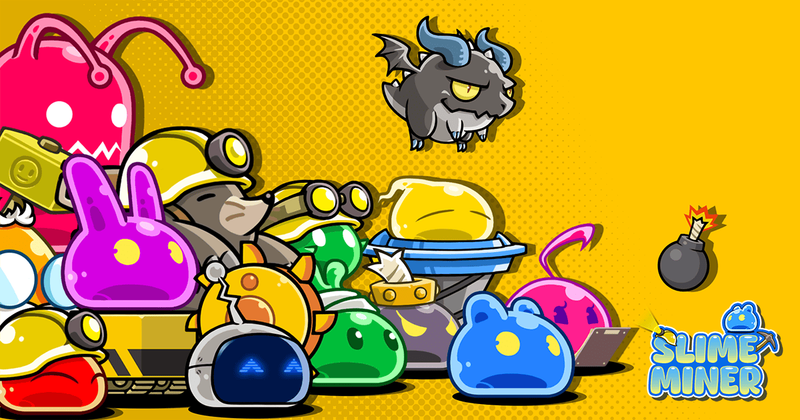
Singapore, Sept. 09, 2025 (GLOBE NEWSWIRE) — Slime Miner, the first immersive Web3 game built on the Kaia Chain, has officially launched on Google Play and the Apple App Store, marking a milestone in its international rollout. Kaia — the Layer 1 powering LINE’s Web3 Mini Dapps — connects over 200M LINE users to Web3 through LINE NEXT’s trusted infrastructure. At the same time, the game is joining Immutable Play, a leading platform with millions of Web3 gamers, expanding its reach to a broader blockchain gaming audience.
Since debuting as a LINE DApp on January 22, 2025, Slime Miner has attracted over 18 million registered users and continues to engage more than 150,000 daily active players (DAU). Supporting 14+ languages, this launch delivers a seamless Web2-style onboarding experience while unlocking enhanced Web3 features for players who choose to explore deeper.
“This is a milestone moment for Slime Miner. By combining app store accessibility with Immutable Play’s ecosystem, we’re making Web3 gaming approachable at scale,” said S.M.Y, CEO of Slime Miner. “Our focus has always been on delivering fun first, while enabling players to enjoy true digital ownership within a sustainable game world.”
A Web3 Game with Web2 Accessibility
Slime Miner is designed for broad accessibility, offering both casual entry and advanced features:
Instant Start – New players can begin without a wallet or blockchain knowledge.
Digital Ownership – Collectible NFTs and in-game rewards enhance long-term engagement.
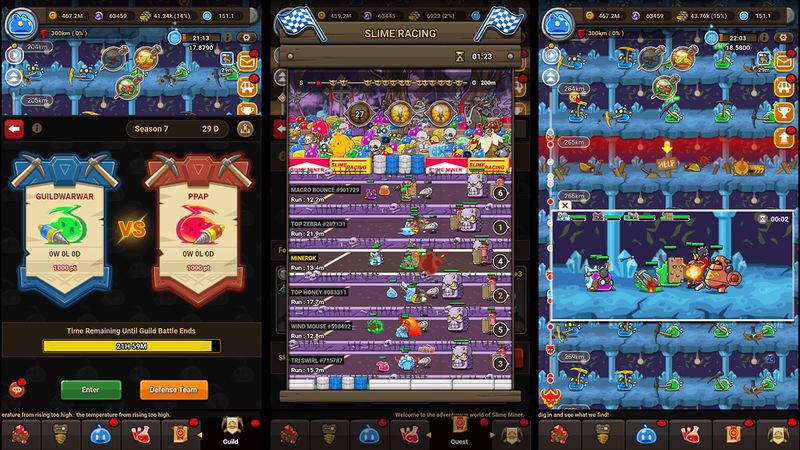
Full Gameplay Ecosystem – Guild Wars, PvP Slime Racing, and community competitions create ongoing opportunities for collaboration and competition.
Immutable Play Partnership
By integrating with Immutable Play, Slime Miner becomes part of a network of leading Web3 titles. This collaboration gives players access to shared infrastructure, exclusive quests, and cross-game campaigns, while also connecting the game to millions of Web3-ready gamers worldwide. The platform has 5.3 million wallet registrations, along with 62 million game quests completed and a weekly retention rate of ~85% as of July 2025.
A Sustainable In-Game Economy
Slime Miner’s in-game economy is designed to support long-term player engagement and fairness:
Activity-Based Rewards – Recognition for gameplay contributions.
Balanced Unlocks – Gradual reward distribution aligned with ongoing participation.
Community-First Approach – Incentives for guild collaboration and player-driven content.
To celebrate the app launch, Slime Miner is hosting a series of special events across its global community. The official Discord server is now open, giving players a space to share strategies, join discussions, and receive the latest updates. In parallel, players can simply join quests on Immutable Play to participate and enjoy special rewards. Full details of ongoing and upcoming events can be found on Slime Miner’s Discord, Immutable Play, and official community channels – X and Telegram . New players can also check out the Slime Miner’s Wikito fully engage with the game’s mechanics.
About Slime Miner
Slime Miner merges Web2 accessibility with Web3 innovation, redefining idle and community-driven gaming. As one of the top-performing mini apps on the KAIA/LINE ecosystem, which already reaches over 200M users across Southeast Asia and Japan, the game combines strategic exploration, collectible NFTs, and large-scale guild competitions. Developed by a team of 20+ experienced professionals from gaming and technology, Slime Miner continues to expand as a scalable entertainment ecosystem where players can play, connect, and own their experiences.
Disclaimer: The information provided in this press release is not a solicitation for investment, nor is it intended as investment advice, financial advice, or trading advice. It is strongly recommended you practice due diligence, including consultation with a professional financial advisor, before investing in or trading cryptocurrency and securities.
The Blockchain Game Alliance (BGA) has launched its annual State of the Industry Report 2025 survey, gathering insights from the Web3 and gaming ecosystems to shape the future of blockchain gaming. Announced by Sebastien Borget on September 6, 2025, this comprehensive survey invites participants to contribute their views in just five minutes, with enticing prizes including a Nintendo Switch and two €50 Amazon vouchers for those entering with a company email. As the largest industry-wide survey of its kind, it aims to define the trajectory of Web3 gaming, highlighting trends that could influence cryptocurrency markets tied to gaming tokens.
Web3 Gaming Survey Signals Bullish Momentum for Crypto Tokens
In the rapidly evolving world of Web3 gaming, this BGA survey represents a pivotal moment for traders eyeing opportunities in related cryptocurrencies. With blockchain gaming projected to drive significant adoption in the crypto space, insights from this report could reveal key developments in play-to-earn models, NFT integrations, and decentralized virtual economies. For instance, tokens like AXS from Axie Infinity and SAND from The Sandbox have historically surged during periods of heightened industry optimism. Traders should monitor these assets closely, as positive survey outcomes could trigger upward price movements. According to market analysts, the gaming sector’s growth correlates strongly with overall crypto market sentiment, potentially boosting trading volumes across major exchanges.
Focusing on trading strategies, consider the current market context where Web3 gaming tokens often exhibit volatility tied to ecosystem announcements. Without real-time data at this moment, historical patterns show that similar industry reports have led to 10-20% price increases in gaming cryptos within 24-48 hours post-release. For example, support levels for AXS have held steady around $5.50 in recent sessions, with resistance at $6.80, offering potential entry points for long positions if survey buzz builds momentum. Integrating on-chain metrics, such as increased transaction volumes on gaming platforms, can provide early signals for traders. This survey’s emphasis on ecosystem insights underscores the need for diversified portfolios that include gaming altcoins alongside blue-chip cryptos like BTC and ETH.
Cross-Market Correlations: Stock Influences on Web3 Gaming
From a broader trading perspective, Web3 gaming intersects with traditional stock markets, particularly through tech giants investing in metaverse and blockchain technologies. Companies like Roblox (RBLX) and Unity Software (U) have shown stock price correlations with crypto gaming trends, where positive Web3 developments often lift related equities. Traders can explore arbitrage opportunities by tracking how survey-driven optimism in Web3 spills over to stock indices like the Nasdaq, which has a heavy tech weighting. Institutional flows into gaming ETFs could amplify this effect, with recent data indicating a 15% uptick in venture capital funding for blockchain games in Q3 2025. This creates hedging strategies, such as pairing long positions in SAND with shorts on underperforming tech stocks during market dips.
Moreover, the survey’s focus on future directions in Web3 gaming invites analysis of AI integrations, which could propel AI-related tokens like FET or AGIX. As gaming ecosystems incorporate AI for enhanced player experiences, traders might see synergies boosting these assets. Market indicators suggest that trading volumes in AI cryptos rise by an average of 25% during gaming industry hype cycles. To optimize trades, watch for breakout patterns above key moving averages; for instance, ETH’s 50-day MA at $2,800 could serve as a pivot for gaming token rallies. Overall, this BGA initiative not only fosters community input but also positions traders to capitalize on emerging trends, blending insightful data with actionable market strategies for sustained profitability.
In summary, participating in the BGA State of the Industry Report 2025 survey offers more than just prizes—it’s a gateway to influencing and profiting from Web3 gaming’s evolution. With no real-time price fluctuations detailed here, the emphasis remains on sentiment-driven trading, where historical correlations point to potential gains in tokens like MANA and GALA. Traders are advised to stay vigilant, using tools like RSI indicators to gauge overbought conditions amid survey excitement. This development reinforces the interconnectedness of crypto and stock markets, promising exciting opportunities for those attuned to industry pulses.
Cardano founder Charles Hoskinson has raised eyebrows with his latest remarks on the future of decentralized finance, warning that Bitcoin could overthrow Ethereum as the leader of the sector.
The Cardano founder made this bold assertion in an interview, where he commented on the future of DeFi and the potential role Bitcoin could play in the sector. Despite Ethereum being the hub for DeFi, Hoskinson argued that it is not the ultimate leader in decentralized finance.
Bitcoin is the Sleeping Giant of DeFi
He calls Bitcoin the sleeping giant of DeFi, given that the blockchain network has yet to develop its DeFi ecosystem. Hoskinson suggested that when Bitcoin eventually integrates DeFi capabilities, its total value locked could reach billions of dollars.
– Advertisement –
In his view, Bitcoin’s TVL will surpass the market cap of Ethereum, which currently stands at $520.78 billion. For context, Ethereum’s TVL stands at $91 billion as of today.
According to him, Bitcoin will attract far more liquidity than Ethereum currently sees in the sector. In addition, Hoskinson predicted that sovereign entities and institutions, including BlackRock, will build on Bitcoin rather than Ethereum.
“Cardano, Not Ethereum, Should Power Bitcoin DeFi”
Further, Hoskinson contended that there is no compelling reason to leverage Ethereum-based solutions to power Bitcoin DeFi. He argues that the inherently adversarial relationship between the two blockchains makes it unlikely for Ethereum to serve as the backbone of Bitcoin’s DeFi ecosystem.
Instead, Hoskinson believes that alternative blockchains, such as Cardano, or Layer-2 solutions, like Stacks, are better positioned to support Bitcoin DeFi.
Hoskinson has consistently maintained that Bitcoin will ultimately take the lead in the DeFi space, surpassing both Ethereum and Solana in the process. He is also working to ensure that Cardano becomes the enabler of Bitcoin’s DeFi solution.
Progress So Far on Bitcoin DeFi
This initiative, which began last year, saw Cardano’s development arm, EMURGO, team up with BitcoinOS to introduce DeFi solutions to the premier blockchain.
Following the partnership, Hoskinson revealed plans to revive the Bitcoin Education Project and also train developers on leveraging Aiken, a Cardano programming language, to build and deploy smart contracts.
The goal is to educate Bitcoin developers on how to utilize Aiken, enabling them to create hybrid applications that bridge the Cardano and Bitcoin ecosystems.
In a February podcast, Hoskinson noted that Cardano’s Babel fees could enable Bitcoin holders to tap into the growing DeFi economy without leaving the Bitcoin ecosystem. He also highlighted the potential role of Cardano’s privacy-focused sidechain, Midnight, in supporting Bitcoin DeFi by allowing users to stake their BTC without having to wrap it.
Further advancing this vision, Cardano’s light wallet, Lace, introduced BTC support earlier this year, allowing users to send, receive, and manage their Bitcoin directly within the platform. This integration also allows users to swap native BTC with other Cardano-based assets.
Interestingly, analysts suggest the project could also benefit Cardano significantly, with some forecasting that enabling Bitcoin DeFi might push ADA’s price above $20
DisClamier: This content is informational and should not be considered financial advice. The views expressed in this article may include the author’s personal opinions and do not reflect The Crypto Basic opinion. Readers are encouraged to do thorough research before making any investment decisions. The Crypto Basic is not responsible for any financial losses.
Immutable’s Explosive Growth: Hitting 500 Games in Web3 Faster Than Steam
Immutable is positioning itself as the Steam of web3 gaming, achieving a remarkable milestone that underscores its dominance in the blockchain gaming sector. According to Robbie Ferguson, co-founder of Immutable, the platform has signed 500 games to Immutable Play just one year after launch. This feat contrasts sharply with Steam, which took five years to reach the same number, representing only about 3% of all PC games at the time. In web3, Immutable’s 500 games account for over 70% of the entire ecosystem, signaling a rapid consolidation of market share in blockchain-based gaming. For cryptocurrency traders focusing on IMX, the native token of Immutable, this news highlights significant growth potential in the web3 gaming niche, where adoption rates are accelerating amid broader crypto market recoveries. Traders should monitor IMX price movements closely, as such announcements often correlate with increased trading volumes and positive sentiment shifts in the altcoin space.
As an expert in cryptocurrency markets, I see this development as a bullish indicator for IMX trading strategies. Web3 gaming has been a hot sector, with tokens like IMX benefiting from partnerships and ecosystem expansions. The swift accumulation of 500 games suggests Immutable is capturing a lion’s share of developer interest, potentially driving on-chain activity and token utility. For instance, increased game integrations could boost IMX’s use in transactions, staking, and governance, enhancing its value proposition. Traders might consider support levels around recent lows, with resistance points emerging from historical highs. Without real-time data, focus on market sentiment: positive news like this often leads to short-term pumps in IMX/USD and IMX/BTC pairs, especially if broader crypto indices like Bitcoin show upward momentum. Institutional flows into gaming tokens have been notable, with venture capital pouring into web3 projects, which could amplify IMX’s market cap growth. Keep an eye on trading volumes; spikes above average daily levels could confirm buying interest following this announcement.
Trading Opportunities in IMX Amid Web3 Gaming Boom
Delving deeper into trading analysis, Immutable’s achievement opens doors for strategic positions in related crypto assets. The web3 gaming market is projected to grow exponentially, with Immutable at the forefront, potentially rivaling traditional platforms like Steam in user base and revenue. For IMX holders, this means watching for correlations with Ethereum’s performance, as Immutable operates on Ethereum’s layer-2 scaling solution. Traders could explore long positions if IMX breaks key moving averages, such as the 50-day EMA, amid this positive catalyst. On-chain metrics, including active addresses and transaction counts on the Immutable network, may surge post-announcement, providing data-driven entry points. Risk management is crucial; volatility in altcoins like IMX can lead to sharp corrections, so setting stop-losses below recent support zones is advisable. Broader market implications include crossovers with AI-driven gaming, where blockchain meets artificial intelligence for immersive experiences, potentially boosting sentiment for tokens in both sectors.
In terms of SEO-optimized insights, keywords like IMX price prediction, web3 gaming tokens, and Immutable vs Steam comparison are trending. Traders seeking opportunities should analyze historical patterns: similar milestones in other projects have led to 20-50% price gains within weeks, though past performance isn’t indicative. Without specific timestamps, general market context shows altcoins rallying in bull phases. For voice search queries like ‘Is IMX a good investment after 500 games milestone?’, the answer leans positive based on ecosystem dominance. Institutional interest, evidenced by funding rounds, supports long-term holding strategies. Overall, this news reinforces Immutable’s role in revolutionizing gaming through blockchain, offering traders a compelling narrative for portfolio diversification in crypto gaming assets.
To wrap up, while exact price data requires real-time monitoring, the core narrative from Robbie Ferguson’s update positions IMX for sustained interest. Combine this with technical analysis: look for candlestick patterns indicating reversals or continuations. For stock market correlations, web3 gaming news like this can influence tech stocks in gaming, such as those tied to metaverse developments, creating arbitrage opportunities between traditional equities and crypto. Always verify with reliable exchanges for current volumes and pair performances to capitalize on this momentum.
Back in 2021, Web3 gaming felt like the future – Axie Infinity was paying out crypto income, and everyone was rushing into the Play-to-Earn space. But then the hype just fizzled out.
From 2022 until now, the space has seen occasional resurgences, but largely failed to sustain its progress. Funding has repeatedly dried up, many formerly popular games have collapsed, and countless players have moved on. The result? The total market cap of crypto gaming tokens has consistently struggled to rise above $30 million.
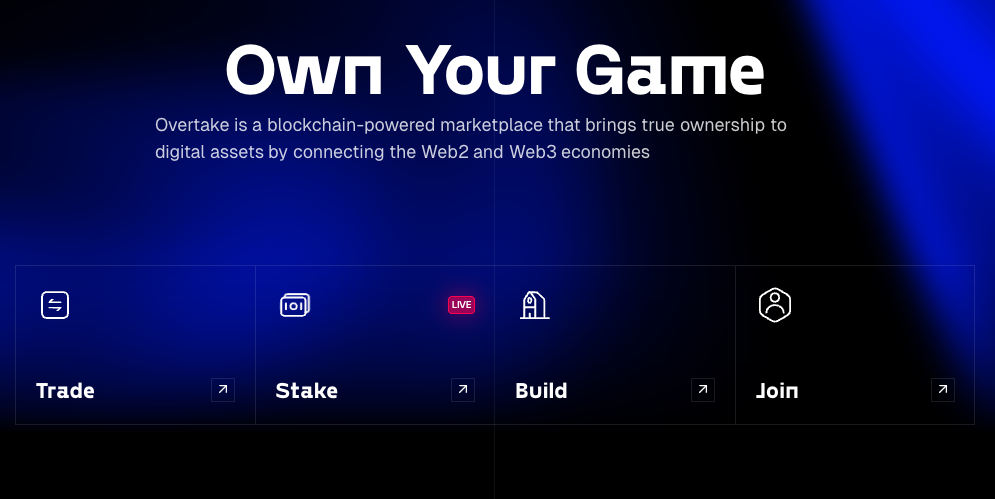
That’s why OVERTAKE (TAKE) feels like a breath of fresh air. It’s a real marketplace for buying, selling, and owning your in-game items. Built on Sui, OVERTAKE is designed for speed and security – and judging by today’s all-time high, traders are going all in.
But the real dark horse in this sector might be PEPENODE (PEPENODE). It’s gaining traction thanks to its “Mine-to-Earn” system, which turns crypto mining into a game. PEPENODE’s presale has already raised $860,000 in funding – potentially setting it up to be the next 100x crypto.
This publication is sponsored. CryptoDnes does not endorse and is not responsible for the content, accuracy, quality, advertising, products or other materials on this page.
OVERTAKE – The New Web3 Marketplace That’s Actually Working
OVERTAKE is blowing up this week. Built on the Sui blockchain, it’s a peer-to-peer marketplace for gamers – somewhere you can safely trade in-game items, accounts, and currency.
If you’ve ever waded into sketchy online trading forums, think of this as a secure, blockchain-powered alternative. No scams, no middlemen – just clean trades. And it’s tapping into a massive market: gaming digital goods are worth $55 billion in 2025.
In Web2 gaming, you don’t own anything – but OVERTAKE changes that with true on-chain ownership. Smart contracts handle escrow, Sui keeps fees low, and the whole system feels smooth and streamlined – a far cry from the average clunky dApp.
TAKE, the project’s native token, only launched last month. It’s already up 183%, hit a new all-time high today, and cracked a $29 million market cap. Now, it’s at the top of CoinMarketCap’s trending cryptos list – and with cross-chain expansion in the works, OVERTAKE could turn into a force to be reckoned with.
The State of Crypto Gaming – A Reality Check for 2025
Crypto gaming is at a crossroads. On the one hand, usage is high – daily active wallets hit 7 million in January, nearly 4x higher than last year. Plus, blockchain gaming revenue is projected to hit $328 billion by 2030.
But on the other hand, gaming tokens have been struggling, with the sector’s market cap sitting at just $19.4 billion. It feels a lot like the dot-com crash – after the hype fades, a lot of investors realize they were betting on empty promises.
The good news is, the future looks encouraging. Studios are finally prioritizing gameplay over tokens. Plus, ideas like interoperable avatars and AI-powered worlds are inching closer to reality – and big names like Ubisoft and Square Enix have Web3 games in the works for late 2025 and early 2026.
Ultimately, we’re still waiting for crypto gaming’s “World of Warcraft” moment – the game that permanently changes everything. But when it arrives, it probably won’t be a surprise to those who’ve been watching the space closely.
New Mine-to-Earn Coin PEPENODE Hits $860K in Presale as Demand Spikes
While OVERTAKE fixes gaming’s backend, PEPENODE is having fun with the meme coin economy. It calls itself the first Mine-to-Earn meme coin, and the concept is brilliant.
Instead of dealing with expensive mining hardware, you can build virtual rigs in a browser-based game. You buy “meme nodes,” upgrade them, and earn rewards – including payouts in other popular meme coins like FARTCOIN. It’s like a business sim game that rewards your efforts using crypto.
Staking is part of the deal – so presale buyers can lock up their PEPENODE tokens for an APY of 1,618%. Although that rate will gradually decrease as more people get involved, it hasn’t stopped investors from rushing to stake more than 487 million tokens already.
The online response to PEPENODE has been extremely positive. Buzz is increasing on Crypto Twitter, thousands of people now follow the project’s Telegram channel, and influencers like Crypto Boy are calling it one of the top presale tokens to watch.
Pre-launch projects are always risky – but if you’re looking for the next 100x crypto, PEPENODE has the kind of unique hook that could help it catch fire. Right now, tokens are priced at just $0.0010491 each during the presale – and many traders are betting that this price could look tiny if the project takes off post-listing.
This publication is sponsored. CryptoDnes does not endorse and is not responsible for the content, accuracy, quality, advertising, products or other materials on this page. Readers should do their own research before taking any action related to cryptocurrencies. CryptoDnes shall not be liable, directly or indirectly, for any damage or loss caused or alleged to be caused by or in connection with use of or reliance on any content, goods or services mentioned.
Nikolay is a crypto enthusiast, with a keen interest in emerging technologies and investment strategies. He holds active positions across various crypto exchanges, regularly analyzing and investing in promising new projects and meme cryptos. Nikolay is known for his ability to take calculated risks and extract value from unconventional investments, with his highest return being 13X with the $PEPE token.
His investment philosophy includes a strategic approach focused on long-term growth, supported by in-depth research of market trends and innovations in crypto and blockchain technologies. Niki actively monitors global market changes and has a deep understanding of cryptocurrency mechanisms and their potential for development.
The Ethereum Virtual Machine (EVM) ecosystem remains a cornerstone of decentralized application (dApp) innovation, yet its fragmentation—spanning competing Layer 2 (L2) solutions, divergent developer tooling, and interoperability challenges—has long hindered scalable adoption. Apex Fusion’s recent integration of its EVM-compatible L2 chain, Nexus, with Tenderly’s full-stack infrastructure and developer tools marks a pivotal step in addressing these systemic bottlenecks. By combining Nexus’s high-performance architecture with Tenderly’s enterprise-grade tooling, the partnership not only bridges the UTXO and EVM paradigms but also positions itself as a strategic catalyst for infrastructure-driven value capture in a fractured multichain landscape.
A Tri-Chain Vision: Bridging EVM and UTXO Paradigms
Apex Fusion’s tri-chain architecture—comprising Prime (L1 backbone), Vector (UTXO L2), and Nexus (EVM L2)—is designed to unify disparate blockchain ecosystems under a single interoperable framework. Nexus, built on Polygon Edge, offers EVM compatibility with sub-$1 transaction fees and 1-second finality, while Reactor, a bidirectional bridge, ensures seamless asset and data flow between Vector and Nexus, anchoring both to Prime’s security layer [1]. This design directly addresses the scalability and cost inefficiencies that have plagued EVM-based dApps, particularly in DeFi and gaming, where high gas fees and slow finality have historically deterred mass adoption.
The integration with Tenderly amplifies this value proposition. Developers now gain access to Virtual TestNets, real-time on-chain monitoring, and transaction simulation tools, which streamline the development lifecycle and reduce deployment risks [1]. By appearing as a “fully supported EVM chain” within Tenderly’s environment, Nexus taps into the platform’s 100,000+ developer community, accelerating its adoption curve. Ivan Bjelajac, CEO of the Apex Fusion Foundation, emphasized that this partnership equips developers to “build confidently and scale globally,” a critical advantage in a market where tooling quality often dictates project success [1].
Infrastructure-Driven Value Capture in a Fragmented EVM Ecosystem
The economic value of blockchain infrastructure lies in its ability to reduce friction across development, deployment, and user interaction. Nexus and Tenderly’s collaboration exemplifies this by addressing three key pain points: 1. Developer Experience: Tenderly’s tools cut debugging and testing time by up to 70%, according to internal metrics, enabling faster iteration cycles [1]. 2. Interoperability: Reactor’s cross-chain capabilities eliminate the need for external bridges, reducing security risks and operational overhead for multichain dApps [1]. 3. Scalability: Nexus’s 10,000 TPS throughput and low fees make it viable for enterprise-grade applications, a stark contrast to Ethereum’s 15 TPS and $50+ gas spikes [2].
These improvements align with broader industry trends. Ethereum’s L2 rollups processed 2.4 billion transactions in 2024, underscoring demand for scalable solutions [3]. Nexus’s early traction—30+ projects adopting its testnet—suggests strong developer interest, particularly in DeFi and institutional use cases [2]. By capturing a share of this growing market, Apex Fusion and Tenderly are positioning themselves to monetize infrastructure through transaction fees, tooling subscriptions, and enterprise partnerships.
Market Adoption and Long-Term Implications
While specific revenue figures remain undisclosed, the partnership’s strategic value is evident in its market positioning. Nexus’s integration with Tenderly’s tools lowers the barrier for EVM developers to experiment with UTXO-based chains like Vector, fostering cross-ecosystem innovation. This is critical in a landscape where interoperability—rather than isolated chains—will define long-term value.
Moreover, the partnership aligns with institutional onboarding trends. As of 2025, 68% of institutional investors prioritize blockchains with robust developer ecosystems and low operational complexity [3]. Nexus’s enterprise-grade features—such as deterministic finality and modular smart contract templates—directly cater to this demand, potentially unlocking capital from traditional finance players.
Challenges and Risks
Despite its promise, the Nexus-Tenderly model faces headwinds. The EVM ecosystem’s fragmentation persists, with competing L2s like Starknet and Arbitrum vying for developer mindshare. Additionally, regulatory scrutiny of cross-chain bridges and oracle systems could introduce compliance complexities. However, Apex Fusion’s focus on security—via Prime’s UTXO-based consensus and Tenderly’s audit tools—mitigates some of these risks.
Conclusion
Apex Fusion’s Nexus and Tenderly partnership represents a compelling case study in infrastructure-driven value capture. By harmonizing EVM and UTXO ecosystems, the collaboration addresses scalability, developer experience, and interoperability—three pillars of sustainable dApp growth. As the EVM landscape matures, projects that prioritize infrastructure innovation—like Nexus—will likely dominate, capturing both developer and user value in a fragmented market. For investors, this partnership underscores the importance of backing infrastructure that bridges technical silos, a necessity in the race to define Web3’s next phase.
Source: [1] Apex Fusion Strengthens EVM Ecosystem with Nexus and Tenderly Partnership, [https://www.theblock.co/press-releases/369532/apex-fusion-strengthens-evm-ecosystem-with-nexus-and-tenderly-partnership] [2] Integration of Apex Fusion’s Nexus Blockchain with Tenderly’s Infrastructure, [https://www.tekedia.com/integration-of-apex-fusions-nexus-blockchain-with-tenderlys-infrastructure-and-dev-toolkit] [3] The State of Web3 Industry Industry Report, [https://www.slideshare.net/slideshow/the-state-of-web3-industry-industry-report/280419362]
Venus Protocol, one of the leading lending platforms on the BNB Chain, recently suffered a significant security breach, with an estimated $27 million in assets allegedly drained as a result of a suspected exploit in one of its core contracts. According to on-chain analysis and reports from security observers, the exploit involved the unauthorized updating of the Core Pool Comptroller contract to a malicious address, which then siphoned off a range of tokens including vUSDC and vETH. The stolen assets are currently held in the attacker’s contract and have not yet been swapped, raising uncertainty about whether the exploit will lead to a full-scale cash-out. Despite the incident, the Venus community has yet to issue an official statement on the matter, and security teams continue to monitor the situation closely.
The incident highlights the ongoing vulnerabilities within decentralized finance (DeFi) ecosystems, even among established protocols with substantial total value locked (TVL). At its peak, Venus held over $7 billion in assets, making it a critical player in the BNB Chain’s DeFi landscape. The platform functions as a money market where users can deposit assets such as stablecoins and major tokens to earn interest or collateralize loans. Its native XVS token plays a vital role in governance and protocol incentives. The current breach underscores the need for robust security audits and continuous monitoring to mitigate risks in DeFi systems where smart contract vulnerabilities can lead to significant financial losses.
The exploit of Venus Protocol follows a similar incident involving Nemo, a yield protocol on the Sui blockchain, which was recently drained of $2.4 million in USDC. The attack on Nemo saw the malicious actor bridge the stolen tokens from Arbitrum to Ethereum, according to reports from blockchain security firm Peckshield. This incident caused the total value locked in the Nemo yield trading platform to drop drastically, from over $6 million to $1.53 million, as tracked by DeFiLlama. These consecutive attacks demonstrate the persistent threats facing DeFi platforms, particularly as institutional adoption of digital assets continues to grow.
A broader cybersecurity report by ReversingLabs has also highlighted a new and sophisticated tactic being used by hackers: concealing malware within Ethereum smart contracts. This method allows malicious actors to disguise harmful traffic as normal blockchain activity, making it difficult for traditional security systems to detect. The report explains that Ethereum’s smart contracts, which are often perceived as secure due to their transparent and immutable nature, can be exploited by embedding malicious code that executes under the guise of standard operations. The report underscores how attackers can leverage these contracts to exfiltrate data, deploy ransomware, or establish backdoors, all while evading conventional detection tools.
The rise of such tactics underscores the evolving sophistication of cybercriminals within the blockchain space. As Ethereum and other platforms expand their use cases across industries—from finance to supply chain management—the potential attack surface grows accordingly. Cybersecurity experts emphasize the need for developers to adopt rigorous smart contract auditing, real-time monitoring for anomalous behavior, and formal verification to minimize vulnerabilities. Additionally, traditional cybersecurity teams must adapt their tools to effectively monitor and respond to blockchain-specific threats. This requires investing in solutions capable of analyzing smart contract interactions and identifying patterns that deviate from expected behaviors. The incident with Venus Protocol and other recent DeFi exploits serve as a stark reminder of the necessity for proactive security measures in the fast-evolving digital asset ecosystem.
Source: [1] BNB Chain-Based Venus Protocol Drained of $27M on Suspected Contract Compromise (https://www.coindesk.com/tech/2025/09/02/bnb-chain-based-venus-protocol-drained-of-usd27m-on-suspected-contract-compromise) [2] Sui-Based Yield Protocol Nemo Exploited for $2.4M in USDC (https://www.coindesk.com/markets/2025/09/08/sui-based-yield-protocol-nemo-exploited-for-usd2-4m-in-usdc) [3] Hackers Conceal Malware In Ethereum Smart Contracts According to New Cybersecurity Report (https://www.crowdfundinsider.com/2025/09/250211-hackers-conceal-malware-in-ethereum-smart-contracts-according-to-new-cybersecurity-report/)