Cardano (ADA) has drawn renewed attention from analysts and investors as technical indicators and market dynamics suggest a potential price surge toward $2. The cryptocurrency, currently trading near $0.87, has shown signs of breaking free from a prolonged consolidation phase, with key resistance levels now in focus. Analysts highlight a mix of short-term momentum and structural catalysts that could propel ADA higher, though risks remain tied to market conditions and broader crypto trends.
A recent analysis by market commentator Gambardello underscored ADA’s positioning within a critical “DO NOT FORGET THIS MOMENT” trading zone, signaling a potential inflection point in the asset’s cycle. While acknowledging the risk of a temporary pullback, he emphasized that ADA appears poised to challenge a long-standing resistance range. Key price levels between $0.87 and $1.30 are identified as pivotal battlegrounds, with a sustained push above $1.30 potentially unlocking a path toward $1.80 if bullish momentum holds. The current price near $0.87 reflects ADA’s resilience after reclaiming key moving averages and exiting a multi-month downtrend.
Technical analysts have further highlighted a bullish pennant pattern and a breakout above the 50-day simple moving average as supportive of an extended upward trend. Historical fractal analysis suggests a target of $2.40, aligning with key resistance markers. More ambitious forecasts, however, predict ADA could reach the $3–$5 range by the third quarter of 2025—though these remain contingent on favorable macroeconomic conditions, regulatory developments, and institutional adoption.
The renewed optimism surrounding Cardano is partly driven by its expanding role in decentralized finance (DeFi) and infrastructure advancements. Strategic collaborations and upgrades aimed at enhancing scalability and interoperability have bolstered the platform’s appeal to developers and investors. ADA’s integration into Layer 2 solutions and cross-chain initiatives has also positioned it as a competitive player in the evolving blockchain landscape. These developments align with the project’s emphasis on academic research and peer-reviewed protocols, distinguishing it from many peers.
Despite the bullish outlook, analysts caution that sustaining momentum will require navigating critical support levels. A breakdown below $0.60 could undermine the upward trajectory, while a successful breakout above $1.00—a psychological milestone—could trigger increased buying activity. The $2 threshold remains a significant target, but achieving it will depend on broader market participation and sustained confidence in ADA’s ecosystem. Regulatory clarity and timely delivery on promised upgrades will also be crucial in maintaining investor trust.
As the crypto market shifts toward altcoin dominance, Cardano’s trajectory reflects broader investor appetite for projects with tangible use cases and active development. However, challenges such as delayed upgrades and regulatory uncertainties could pose headwinds if unresolved. For now, the market watches closely to determine whether ADA can replicate the success of past bull cycles or face obstacles that have historically limited its growth. The coming months will likely test the resilience of its bullish case, with key price levels and technical signals remaining focal points for traders and analysts alike.
Four cryptocurrency projects have emerged as top contenders for 2025, distinguished by their active ecosystems, technological innovation, and real-world adoption potential. BlockDAG, Bittensor, Injective, and Bonk are highlighted for their unique value propositions in addressing blockchain scalability, decentralized AI, high-speed trading, and meme token dynamics, respectively.
BlockDAG (BDAG) stands out as a next-generation Layer 1 blockchain designed to tackle network congestion and high gas fees. Leveraging a hybrid Directed Acyclic Graph (DAG) and Proof-of-Work model, it processes multiple blocks simultaneously while maintaining Ethereum compatibility. With 2 million active users mining via the X1 app, 18,600+ mining devices sold, and a live testnet, the project has secured 20 exchange listings and aims to deploy 1,000 decentralized applications by 2026. During its current global launch phase, BDAG tokens are available at $0.0016 with a projected 3,025% return potential if the confirmed $0.05 launch price is achieved. The project’s “No Vesting Pass” offers instant access to tokens, differentiating it from traditional presales.
Injective (INJ) is gaining traction as a high-performance decentralized trading platform. The protocol enables low-cost, rapid execution for derivatives and synthetic assets, attracting both retail and institutional investors. A recent exchange-traded fund (ETF) filing linked to INJ by a third-party capital provider triggered an 8% price surge in a single trading session, accompanied by $226 million in volume. This development underscores growing interest in its infrastructure for scalable DeFi solutions.
Bittensor (TAO) is reshaping the decentralized AI landscape by creating a network where participants can contribute, train, and share machine learning models. The TAO token recently surged from $220 in June to $430, breaching the $400 psychological level amid an 80% increase in trading volume. Analysts note its potential to reach $500 or $1,000 if current momentum sustains, positioning it as a long-term play in AI-driven blockchain ecosystems.
Bonk (BONK), a Solana-based meme token, has regained relevance as the network’s performance improves. Despite a recent price dip, BONK posted over 50% gains in the past week, with $1.4 billion in daily trading volume and a market capitalization nearing $2.9 billion. The token’s ability to maintain buyer interest despite volatility highlights its role as a speculative asset benefiting from Solana’s broader adoption.
Each of these projects addresses distinct market gaps: BlockDAG prioritizes scalable infrastructure, Injective focuses on efficient DeFi execution, Bittensor bridges AI and decentralization, and Bonk leverages network momentum to reestablish relevance in the meme coin space. BlockDAG’s live ecosystem, including mining participation and developer tools, positions it as a standout option for investors seeking immediate utility and growth potential. The project’s live testnet and confirmed exchange listings further validate its operational readiness compared to traditional presale models.
The analysis underscores the importance of differentiating between projects with functional infrastructure and those relying solely on speculative hype. While price targets and adoption metrics vary, the four projects collectively reflect the evolving priorities of the crypto market, from scalability solutions to AI integration and niche token utility.
Ozzy Osbourne’s passing at 76 has sent ripples through the Web3 community, reigniting interest in his Ethereum-based NFT project, CryptoBatz. The heavy metal icon’s final performance—a stirring rendition of “Crazy Train” at Villa Park in Birmingham—marked a bittersweet farewell, with his legacy now fueling a digital resurgence. Within 24 hours of his death, the floor price of CryptoBatz NFTs surged from 0.02 ETH to 0.1 ETH, driven by collectors and fans seeking to preserve a piece of his enduring cultural impact.
Launched in January 2022, CryptoBatz was a whimsical yet innovative foray into the NFT space. The collection, featuring 9,666 bat-themed tokens, introduced a unique “mutation” mechanic allowing NFTs to interact and evolve—a concept as chaotic and creative as Osbourne’s music. Initially popular with a floor price of 0.6 ETH and over 5,000 holders, the project faded during the crypto bear market. However, Osbourne’s death has rekindled its appeal, transforming the NFTs from speculative assets into digital memorials.
The revival reflects a shift in how fans engage with celebrity legacies in the digital age. What began as a niche collectible is now viewed as a “digital shrine,” blending nostalgia with blockchain permanence. Social media discussions and dormant collectors have resurfaced, with many emphasizing the emotional resonance of the project. For some, holding a CryptoBatz is akin to owning a vinyl record from Osbourne’s final era—a tangible link to a cultural icon who defined generations.
Amid the enthusiasm, debates among collectors highlight the tension between sentiment and speculation. While some view the surge as a fleeting trend and consider cashing out, others argue the NFTs represent a lasting tribute. Unconfirmed speculation about potential “mutations” teased by Osbourne in 2022 has further fueled curiosity, though no concrete plans have been announced. This uncertainty underscores the dual nature of the revival: a celebration of Osbourne’s artistry and a test of the NFT space’s ability to honor legacy beyond hype.
The CryptoBatz phenomenon challenges broader perceptions of celebrity NFTs. Many such projects have been criticized as short-term cash grabs, but this revival demonstrates that emotional resonance can outlast market cycles. By anchoring digital assets to a cultural figure’s enduring influence, CryptoBatz has transcended its initial gimmickry, proving that Web3 can serve as a medium for preserving artistic legacies. For Osbourne’s fans, the NFTs are less about investment returns and more about safeguarding a part of his rebellious spirit for future generations.
As the blockchain community grapples with its role in memorializing icons, CryptoBatz stands as a case study in blending innovation with tradition. Whether as a speculative asset or a digital keepsake, the project has etched Osbourne’s influence into Ethereum’s immutable ledger—a final encore, immortalized in code.
PlayW3, a Web3 social gaming ecosystem built on its proprietary gasless Layer 3 blockchain, has launched a $250 million on-chain partner fund to accelerate global adoption of its decentralized gaming model. The initiative, now live, leverages blockchain infrastructure to automate payouts for creators, influencers, and community contributors, offering real-time compensation tied to verifiable user engagement metrics. The platform has already distributed over $330,000 in stablecoin rewards since its activation.
The fund’s structure emphasizes transparency and scalability through smart contract technology. Participants, known as “Bosses,” generate revenue by deploying Web3 gaming portals via the Be The Boss program, which requires no coding skills or technical expertise. Operators retain 50% of net revenue from user activities such as spins, bets, and predictions, with 20% of earnings allocated to the G Coin treasury. The remaining 30% is distributed as token burns or operational costs. This model has enabled rapid global expansion, with over 90 portals launched in 60+ countries since the program’s inception.
Early adopters in regions such as Israel, Kenya, and Dubai have demonstrated the platform’s potential. One Israeli-based Boss has earned $115,163.67, while a Kenyan participant secured $59,654.75 and a Dubai-based operator accumulated $50,831.63. These figures highlight the program’s ability to create scalable income streams for individuals in diverse markets. The Be The Boss initiative offers a limited-time entry for $1 (originally $5,000), further reducing barriers to participation.
Underpinning the ecosystem is PlayBlock, PlayW3’s gasless Layer 3 blockchain. The platform integrates features such as 0% fee bridges for stablecoins, gasless transactions, and one-click logins via major providers. G Coin, the ecosystem’s utility token, supports transaction flow, user engagement, and reward mechanisms. With over 9,000 on-chain holders and a presale market cap exceeding $4 million, the token plays a central role in sustaining the platform’s economic model.
The initiative’s compliance-focused architecture addresses regulatory concerns through non-custodial wallets, stablecoin-only payouts, and audited smart contracts. Partnerships have expanded to Latin America, Europe, Asia, Africa, and the U.S., with daily portal launches reported in regions like Brazil and Japan. The platform’s rapid deployment capabilities, combined with daily stablecoin payouts, position it as a scalable solution for decentralized content creation.
PlayW3’s approach reflects a broader trend in Web3 gaming: leveraging blockchain to democratize earnings and reduce operational overhead. By automating compensation through smart contracts, the platform minimizes intermediaries and delays, aligning with the sector’s push for transparency. The Be The Boss model further lowers technical barriers, enabling global participation without prior expertise in blockchain infrastructure.
While the $250 million fund is a significant capital injection, its long-term impact will depend on sustained user engagement and the scalability of portal operators. Early data suggests strong adoption, but the ecosystem’s growth will require ongoing innovation in user acquisition and platform utility. The limited-time $1 entry fee underscores a strategic focus on rapid onboarding, though this may shift as the program matures.
The press release does not include financial projections or performance guarantees, emphasizing instead the platform’s current operational metrics and structural advantages. As the Web3 gaming space evolves, initiatives like PlayW3’s partner fund could redefine traditional monetization models by prioritizing decentralized, real-time rewards for contributors worldwide.
Mercurity Fintech Holding Inc. has announced a $200 million equity line of credit secured from Solana Ventures Ltd., earmarked for the development of a Solana-based digital asset treasury. This strategic initiative, disclosed on July 22, 2025, aims to expand the firm’s engagement with tokenized assets and institutional-grade decentralized finance (DeFi) protocols within Solana’s blockchain ecosystem. The funding will be allocated to accumulate SOL tokens, stake assets, operate validator nodes, and explore real-world asset tokenization projects.
Wilfred Daye, Mercurity’s Chief Strategy Officer, emphasized Solana’s role as a high-performance infrastructure for decentralized networks, citing its speed, cost-efficiency, and regulatory adaptability. “MFH is evolving beyond fintech infrastructure to engage directly in the value creation and utility of decentralized networks,” Daye stated. The partnership marks a shift from traditional financial infrastructure to active, protocol-driven value generation, aligning with Mercurity’s broader vision to bridge conventional finance and blockchain innovation.
The immediate market response to the announcement was notable. Solana’s native token (SOL) surged by 5% following the news, while Mercurity’s stock also saw a significant increase. Analysts attribute this reaction to growing institutional confidence in Solana’s scalability and its potential to redefine corporate digital asset management. The capital influx addresses past operational challenges for Mercurity, including profitability and cash flow constraints, and positions the firm to leverage Solana’s expanding ecosystem.
The initiative is expected to enhance on-chain liquidity by incrementally deploying capital into staking and DeFi protocols. Increased SOL staked on-chain could elevate Solana’s total locked value (TVL) and liquidity metrics, further solidifying its position in the DeFi space. Historically, similar treasury strategies—such as large-scale Bitcoin accumulations—have correlated with asset price appreciation, suggesting institutional participation can drive market dynamics.
Mercurity’s focus on Solana aligns with broader industry trends where fintech firms seek blockchain solutions to optimize efficiency and reduce costs. By integrating validator nodes and tokenized assets into its offerings, the firm aims to diversify its revenue streams and mitigate reliance on traditional markets. The partnership also underscores Solana’s appeal to institutional investors, who are increasingly prioritizing scalable, low-cost blockchain networks for real-world applications.
While the terms of the equity line remain undisclosed, the transaction reflects confidence in Mercurity’s long-term strategic direction. The firm plans to accelerate its innovation roadmap, including cross-chain solutions and institutional-grade digital asset services. As Solana’s ecosystem expands through protocol upgrades and partnerships, Mercurity’s treasury strategy could serve as a model for bridging legacy financial systems with next-generation blockchain infrastructure.
This move signals a calculated bet on the future of blockchain-driven finance. For Mercurity, the $200 million injection from Solana Ventures is not merely a capital raise but a strategic repositioning that could redefine its role in the global fintech landscape. Success will depend on effective execution of the treasury strategy and the broader adoption of Solana-based solutions. The initiative highlights the convergence of traditional finance and decentralized networks, with implications for the evolution of digital asset management and institutional-grade DeFi protocols.
The Solana NFT market has experienced a dramatic resurgence, with trading volume surpassing $2 million in the past 24 hours, marking the highest daily figure in 113 days, according to CoinMarketCap. This surge highlights a renewed wave of interest in the NFT space, with Solana emerging as a key driver of activity.
Leading the revival is the Taiyo Robotics collection, now Solana’s top NFT collection by floor price. The collection’s floor price has surged to 56.71 SOL (approximately $11,129), reflecting a 640% increase over the past month, per CoinGecko. This meteoric rise underscores the platform’s ability to attract liquidity and sustain momentum in a competitive market.
The broader NFT ecosystem is also showing signs of life. Total NFT market capitalization recently surpassed $6 billion, with $1 billion added in a single day. Weekly trade volume hit a six-month high, while Ethereum-based blue-chip projects like Bored Apes and CryptoPunks saw positive price movements. These trends suggest a broader reinvigoration of NFT demand across multiple blockchain platforms.
Solana’s infrastructure appears uniquely positioned to capitalize on this momentum. Its low transaction fees and high throughput enable seamless trading, even during periods of heightened volume. Collections previously deemed dormant are experiencing renewed activity, with floor prices across top and mid-tier projects narrowing as fresh liquidity flows into the market. The platform’s accessibility is further amplified by its appeal to small-cap traders, who benefit from lower gas costs and competitive participation.
The surge in NFT activity is part of a larger trend of rising altcoin enthusiasm. The Altcoin Season Index, which measures altcoin outperformance relative to Bitcoin, climbed to 57% in recent days, up from 39% a week earlier. Concurrently, Google Trends data reveals peak search interest for “altcoin” this month, indicating growing retail investor curiosity and a sense of FOMO. These factors create a self-reinforcing cycle: rising volume pressures floor prices, attracting more buyers, while improved liquidity reduces premiums and fuels further trading.
Looking ahead, the market’s trajectory hinges on several dynamics. High-profile NFT drops are expected to test the depth of current demand, with rapidly filling whitelists signaling strong participation. Monitoring floor price gaps between top-tier and mid-tier projects will be critical—widening disparities could signal profit-taking or waning momentum. On-chain metrics like active wallets and unique buyers will also provide insights into whether this rally reflects genuine adoption or speculative fervor.
Institutional players are closely watching developments. Gaming guilds, NFT-focused funds, and metaverse investment vehicles are assessing entry points, with some already increasing Solana exposure. These entities view NFTs as a gateway for retail investors, offering Ethereum’s functionality without its high gas costs. Meanwhile, infrastructure innovations such as cross-chain bridges, fractional ownership protocols, and real-world asset tokenizers are advancing the ecosystem’s long-term potential, expanding NFT use cases beyond art into areas like event tickets and equity shares.
Despite the optimism, risks remain. A slowdown in altcoin momentum could disrupt NFT markets, while rug pulls and regulatory scrutiny pose persistent threats. Macroeconomic factors, including interest rate hikes, may also temper enthusiasm. However, current data remains bullish, with strong on-chain activity and rising sentiment suggesting a sustained period of growth. The challenge now is whether this momentum can evolve into a broader bull cycle or if it represents a temporary spike in demand.
PlayW3, a Web3 social gaming ecosystem built on its proprietary gasless Layer 3 blockchain, has launched a $250 million on-chain partner fund to accelerate global adoption of its decentralized gaming model. The initiative, now live, leverages blockchain infrastructure to automate payouts for creators, influencers, and community contributors, offering real-time compensation tied to verifiable user engagement metrics. The platform has already distributed over $330,000 in stablecoin rewards since its activation.
The fund’s structure emphasizes transparency and scalability through smart contract technology. Participants, known as “Bosses,” generate revenue by deploying Web3 gaming portals via the Be The Boss program, which requires no coding skills or technical expertise. Operators retain 50% of net revenue from user activities such as spins, bets, and predictions, with 20% of earnings allocated to the G Coin treasury. The remaining 30% is distributed as token burns or operational costs. This model has enabled rapid global expansion, with over 90 portals launched in 60+ countries since the program’s inception.
Early adopters in regions such as Israel, Kenya, and Dubai have demonstrated the platform’s potential. One Israeli-based Boss has earned $115,163.67, while a Kenyan participant secured $59,654.75 and a Dubai-based operator accumulated $50,831.63. These figures highlight the program’s ability to create scalable income streams for individuals in diverse markets. The Be The Boss initiative offers a limited-time entry for $1 (originally $5,000), further reducing barriers to participation.
Underpinning the ecosystem is PlayBlock, PlayW3’s gasless Layer 3 blockchain. The platform integrates features such as 0% fee bridges for stablecoins, gasless transactions, and one-click logins via major providers. G Coin, the ecosystem’s utility token, supports transaction flow, user engagement, and reward mechanisms. With over 9,000 on-chain holders and a presale market cap exceeding $4 million, the token plays a central role in sustaining the platform’s economic model.
The initiative’s compliance-focused architecture addresses regulatory concerns through non-custodial wallets, stablecoin-only payouts, and audited smart contracts. Partnerships have expanded to Latin America, Europe, Asia, Africa, and the U.S., with daily portal launches reported in regions like Brazil and Japan. The platform’s rapid deployment capabilities, combined with daily stablecoin payouts, position it as a scalable solution for decentralized content creation.
PlayW3’s approach reflects a broader trend in Web3 gaming: leveraging blockchain to democratize earnings and reduce operational overhead. By automating compensation through smart contracts, the platform minimizes intermediaries and delays, aligning with the sector’s push for transparency. The Be The Boss model further lowers technical barriers, enabling global participation without prior expertise in blockchain infrastructure.
While the $250 million fund is a significant capital injection, its long-term impact will depend on sustained user engagement and the scalability of portal operators. Early data suggests strong adoption, but the ecosystem’s growth will require ongoing innovation in user acquisition and platform utility. The limited-time $1 entry fee underscores a strategic focus on rapid onboarding, though this may shift as the program matures.
The press release does not include financial projections or performance guarantees, emphasizing instead the platform’s current operational metrics and structural advantages. As the Web3 gaming space evolves, initiatives like PlayW3’s partner fund could redefine traditional monetization models by prioritizing decentralized, real-time rewards for contributors worldwide.
The crypto market is printing green candles across the board, with 80% of altcoins outperforming Bitcoin this month — but gaming tokens seem to have missed the memo.
While the broader market is soaring alongside Bitcoin and Ethereum’s recent rally, gaming-related tokens are showing signs of life, but still lagging. According to MMORPG game Calamity co-founder Seva, it’s a credibility problem.
“Trust is broken. Too many raised millions, delivered zero,” Seva said of blockchain games in a recent X post.
As a result of the lack of trust, Seva said gamers have little confidence in any of the gaming tokens and are mainly chasing quick gains. “Short-term mindset dominates selling early,” he said.
“Believers are tired. No wins, just waiting.”
Seva said attention and money are now “spread thin” across too many gaming projects, and it is “time to change that.”
The numbers show a small increase for popular gaming tokens over the past seven days since Bitcoin reached new all-time highs on Binance of $123,100 on July 14.
Ronin (RON) is up 9.09%, Beam (BEAM) is up 9.85% and Axie Infinity (AXS) is up 6.82% over the past seven days, according to CoinMarketCap data.
However, that pales in comparison to Tezos (XTZ), which has risen 67.73%; Ethena (ENA), which is up 47.45%; and Lido DAO (LDO), which has a 42.88% gain over the same period.
No bull run, or are we just waiting for a repeat of 2021?
Respectable gains if you’re in traditional finance. Tragic if you’re in a crypto bull run.
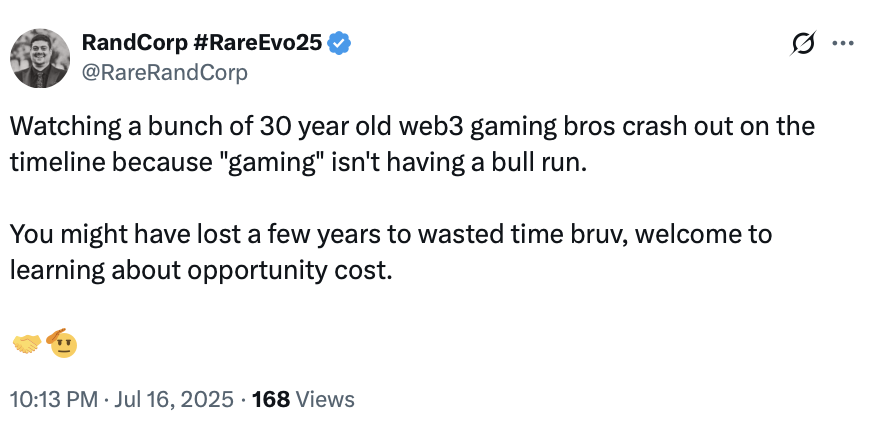
Some found humor in the fact that gaming tokens still haven’t taken off. Rare Evo co-founder RandCorp said: “Watching a bunch of 30-year-old Web3 gaming bros crash out on the timeline because ‘gaming’ isn’t having a bull run.”
“You might have lost a few years to wasted time, bruv, welcome to learning about opportunity cost,” RandCorp said.
But not everyone sees it as doom and gloom. Crypto gaming commentator Camol is still optimistic, saying, “There’s so much momentum in crypto right now, and people are searching for use cases.”
“This cycle, we definitely have more this time around, but digital ownership + gaming is a massive one,” Camol said.
In the 2021 bull run, gaming tokens didn’t really move until some time after the rest of the market had already pumped. When Bitcoin hit its first local peak of $63,523 in April, gaming assets had yet to take off.
It wasn’t until July, around three months later, that Axie Infinity (AXS), the standout token of the cycle, began its explosive run. Over the next four months, AXS surged 15x, peaking in November, around the same time Bitcoin reached a new yearly high of $69,000.
So, if history repeats, this might just be a delayed start, not a dead end.
The easy hack to get users to new games: Improbable CEO
Why build a brand-new game from scratch when players already love the worlds they’re watching on television?
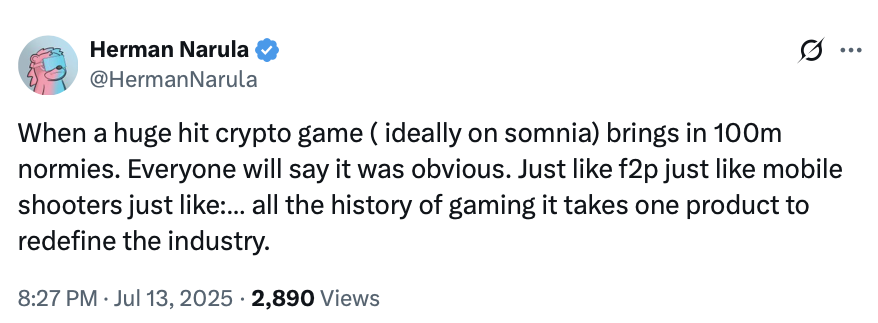
That’s the thinking of Herman Narula, the CEO of metaverse developer and venture capital firm Improbable, who argues that blockchain game developers should stop obsessing over originality and start leaning into familiar, proven franchises to win players over.
“IP reduces the cost of user acquisition a lot,” he says. “If you’ve got, you know, I’m just making up names here, but Bond or Jurassic Park or John Wick or the Avengers, it’s a hell of a lot easier to get people to play your game,” he explains.
Narula believes this strategy could offer a lifeline to an industry facing a “huge economic crisis.”
“The cost of making someone like you or me buy a new game for free is 40 bucks,” he says.
“You have to spend 40 bucks on ads just to make a punter attempt to play a free game. So it’s almost impossible to launch new titles,” he explains.
Improbable is known for its cloud platform, SpatialOS, which helps build and run large online games and simulations. In 2024, it launched the Somnia blockchain, which now hosts popular Web3 games like the horror survival game Night Spawn and the battle royale Maelstrom. Narula says its one of the few companies still investing in games development.
IP acquisition is a chance for smaller developers to shine
You no longer need to be a massive studio to pick up rights, according to Narula.
“IP owners have started to get a lot more generous with their terms. So they’re willing to offer people, even small teams, a crack at making games with their IP.”
“I think using IP actually creates a lot of discipline and gives people a lot more focus on making gameplay good, rather than, like, inventing a new world, new history, new characters,” he explains.
Original content still has its place, he admits. But these days, IP-backed games “feel like a really good deal.”
Animoca Brands is another games company pursuing an IP strategy. In 2024, television giant ITV partnered with The Sandbox to bring some of its biggest reality shows, such as The Voice, Love Island, and I’m a Celebrity, Get Me Out of Here, as games in the metaverse.
Peaky Blinders, one of the world’s most popular television shows with 80 million viewers, is also getting a crypto game adaptation in 2026.
It might seem surprising that a game with the simple goal of making a monkey fly as far as possible was once banned from the Apple App Store.
But SaruTobi was removed from the App Store in March 2015 due to its Bitcoin integration and payout features — prohibited under Apple’s stricter policies at the time.
It was later reinstated, with the developers opting for “in-game Bitcoin” rather than real Bitcoin to fit in with Apple’s anti-crypto rules. Even then, Apple eventually suspended the game again, worried that users might still confuse the in-game currency with actual Bitcoin.
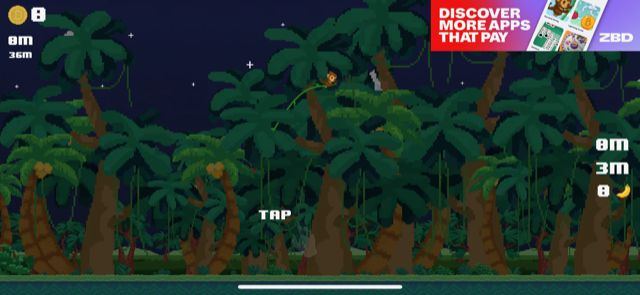
The aim of SaruTobi is simple….fly as far as you can as a monkey (SaruTobi)
A decade later, SaruTobi is back on the App Store this month following Apple’s change of heart toward cryptocurrency-related apps.
Even better, the game has real Bitcoin integrated. Using ZBD’s Bitcoin Lightning technology, SaruTobi now features Bitcoin microtransactions, allowing players to earn and spend sats in-game through the Lightning Network.
It is the first game that Apple has approved to have Bitcoin microtransactions.
The game itself is intentionally simple and mindless; you swing a monkey through the jungle, collecting bananas and other rewards, with the primary goal of launching the monkey as far as possible.
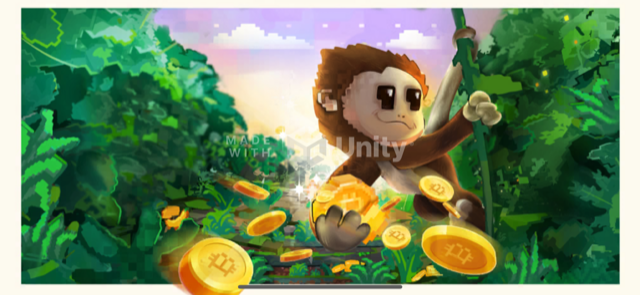
Even the loading screen is flashing Bitcoin everywhere! (SaruTobi)
Bananas can be used to improve your monkey’s ability with power-ups like rockets, increasing your chances of earning more sats.
These sats can be spent on in-game items like skins or withdrawn to a ZBD wallet. Thankfully, because it uses the Lightning Network, there’s no need to wait for a large balance before withdrawing, players can withdraw even just a few cents worth of Bitcoin instantly.
You’re not going to get rich playing SaruTobi, but being able to earn and withdraw real Bitcoin just by flinging a monkey through the air is a pretty cool win for the Bitcoin community.
Other News:
— South Korean game studio Delab Games is teaming up with AI game maker Verse8 to “create flagship experiences that prove the value of AI-assisted development at scale.”
— Ronin Network has launched the Ronin Creator Rumble, rewarding creators on Ronin with USDC for the best content contributed to the network.
Subscribe
The most engaging reads in blockchain. Delivered once a
week.
Ciaran Lyons
Ciaran Lyons is an Australian crypto journalist. He’s also a standup comedian and has been a radio and TV presenter on Triple J, SBS and The Project.
Bitcoin ETFs approved and trading in the US; SEC’s X account is hacked, causing havoc in markets; and Venezuela discontinues its national cryptocurrency, Petro.
Pendle’s Total Value Locked (TVL) surged to an all-time high of $5.59 billion in its latest weekly update, reflecting robust demand for its structured yield strategies. The platform’s PT (Principal Token) collateral across lending protocols has exceeded $3 billion, with Aave dominating the ecosystem, holding $2.46 billion in PT deposits. Morpho and Euler also contributed significantly, with $442 million and $67 million in Pendle collateral respectively, underscoring the protocol’s expanding influence in decentralized finance (DeFi) markets.
A notable focus of the update is the PT-sUSDe token (set to mature in September 2025), which currently offers an annualized yield of 11.11%. This figure has climbed as liquidity from the July 2025 contract nears its end, with the price of the July PT approaching par value. Pendle has urged users to reallocate funds to the September contract to secure fixed income. On-chain data indicates approximately $1.9 billion in liquidity is expected to migrate from the July series, potentially reducing competition for high-yield opportunities. The impending shift is described as a “low-competition, high-yield deployment window” as the market adjusts to new terms.
Expanding its asset offerings, Pendle announced a partnership with HyperEVM to integrate additional structured yield products. The collaboration aims to list assets such as Hyperwave (hwHLP), Kinetiq (kHYPE), and Hyperbeat Ultra (HYPE), further diversifying Pendle’s ecosystem. This move aligns with broader trends in DeFi, where protocols seek to enhance user utility through innovative tokenized instruments.
The surge in TVL and PT collateral highlights growing institutional and retail interest in fixed-income strategies within DeFi. Pendle’s ability to generate consistent yields—particularly in a low-interest-rate environment—has attracted liquidity providers seeking alternatives to traditional markets. The platform’s multi-protocol integration (Aave, Morpho, Euler) demonstrates its adaptability and the interoperability driving DeFi’s evolution. However, the need for users to actively migrate funds before maturity underscores the importance of strategic timing and market awareness in capitalizing on these opportunities.
The collaboration with HyperEVM signals a focus on ecosystem expansion, a critical factor in sustaining growth in competitive DeFi markets. By broadening its asset base, Pendle aims to reinforce its position as a leader in structured yield finance. The upcoming PT-sUSDe deployment window presents a key test for the platform’s ability to balance liquidity inflows and yield optimization. As the DeFi landscape matures, protocols that offer clear, actionable insights—such as Pendle’s migration guidance—may gain a significant edge in retaining users and capital.
Ethereum’s price has surged to $3,770, marking a 3% gain in the last 24 hours and a 50% rise since July 6. This price rally is fueled by a significant recovery in the NFT market, with trading volumes reaching $75 million, a 300% increase from two weeks ago. The NFT market revival is evident, with Ethereum maintaining a dominant position in NFT trading, generating $32 million in sales over 24 hours, a 339% spike. This resurgence in NFT activity has pushed weekly trading volumes to six-month highs, indicating renewed interest from both institutions and individual investors in digital collectibles.
The NFT market revival is characterized by rising blue-chip floor prices and a total market cap exceeding $10 billion, nearing 2021’s $15.6 billion peak. This revival aligns with Ethereum’s recent price gains, with support levels for ETH currently hovering around $3,200, and a break above $3,600 could confirm bullish momentum driven by this NFT resurgence. The NFT market has seen a sharp rebound in trading, with total weekly sales across all blockchains topping $110 million last week.
Institutional confidence is indicated by a whale purchasing 45 CryptoPunks NFTs, driving their floor price up to nearly $175,000. This action at the institutional level shows that there is a lot of demand for high-quality NFT assets and that people are generally confident in Ethereum’s ecosystem. The whale activity coincides with the development of new products by institutions, such as the filing for a PENGU token ETF that would hold assets from the Ethereum-based Pudgy Penguins collection. This development shows that Ethereum-based digital assets are becoming more widely accepted.
From a technical point of view, Ethereum’s present momentum looks like it will last because there are a lot of bullish signals that agree. The cryptocurrency has effectively broken over the daily resistance level at $3,730, which now serves as vital support for the continued rally. The Relative Strength Index (RSI) on the daily chart is currently at 86, which is significantly over the usual overbought level of 70. This means that there is very strong bullish momentum. High RSI levels usually mean that there is a chance of short-term consolidation, but the strong purchasing pressure shows that there is strong demand underneath. The MACD indicator still shows a bullish crossover that started in early July. The increasing green histogram bars above the neutral zero line show that bullish momentum is gaining strength, not losing it. This technical setup backs up the idea that prices will keep going up.
If Ethereum keeps going in the same direction and successfully holds the $3,730 level as support, technical analysis implies that it could move up to the $4,000 level, which is a psychological level. This is an additional 6.4% upside from current levels and would be Ethereum’s highest price point since December 2024. The convergence of technical momentum, increasing network activity through NFT trading, and whale accumulation offers a favorable atmosphere for continued price rise. Market experts have called Ethereum’s rise “absolutely phenomenal.” They point out that while ETH has returned to its December highs, many altcoins are still 50–80% below their previous highs, which means that the whole ecosystem has a lot of room to grow.
Ethereum’s price surge follows renewed NFT interest and whale activity. The NFT market cap increased by over 28%, peaking at $6.4 billion, indicating robust sector activity. Participants identified over 5,400 active Ethereum wallet addresses engaged in the current NFT-led rally. This resurgence highlights the economic contributions NFTs make through cultural and social avenues. The impact is most significant on Ethereum’s market dynamics, with a noted 3% rise to $3,770 within 24 hours.
Ethereum’s success in leveraging NFT trends underscores its dominance in the space, further fueled by consistent whale purchases and growing daily transaction volumes. Historical trends suggest Ethereum price spikes align with NFT market booms. A surge in trading volume and blue-chip investments often precedes significant ETH price hikes, suggesting similar outcomes in current scenarios. NFTs embody identity, social status, and community belonging, which drive real economic value.