
Africa Tea Market Size, Share & Trends, 2033
Africa Tea Market Size
The Africa Tea Market Size is estimated to grow from USD 10.35 billion in 2024 to USD 15.05 billion in 2033, representing a CAGR of 4.25% during the forecast period
Tea is a vital part of the continent’s agricultural and beverage industry, deeply rooted in both local consumption habits and export-oriented production. Tea cultivation in Africa is concentrated primarily in East and Southern African countries such as Kenya, Malawi, Rwanda, Uganda, and Tanzania. The region benefits from favorable climatic conditions, fertile soils, and high-altitude growing areas that contribute to the production of high-quality black and green teas.

Kenya, the largest tea producer in Africa, plays a dominant role in global exports, particularly of black tea. According to the Food and Agriculture Organization (FAO), the country has consistently ranked among the top three tea exporters worldwide over the past decade. As per the Kenya Tea Development Agency, smallholder farmers account for more than 60% of national tea production, highlighting the sector’s importance in rural livelihoods.
Beyond exports, domestic tea consumption is on the rise due to shifting dietary patterns and increasing urbanization. In Nigeria and Ghana, for example, ready-to-drink (RTD) tea products are gaining popularity among younger consumers. Apart from these, there is growing interest in herbal and specialty teas derived from indigenous plants like rooibos and honeybush, particularly in South Africa. These trends indicate a dynamic and evolving market landscape where both traditional farming systems and modern consumer preferences shape the trajectory of the African tea industry.
MARKET DRIVERS
Increasing Domestic Consumption Due to Urbanization and Changing Lifestyles
The rising domestic consumption fueled by rapid urbanization and changing lifestyle preferences across major cities is one of the primary drivers of the African tea market. According to the United Nations, Africa’s urban population is expected to reach nearly 1 billion by 2050, significantly expanding the consumer base for packaged and convenience beverages, including tea. In countries like Nigeria, Ethiopia, and Kenya, the growing middle class is increasingly adopting tea as part of daily routines, replacing traditional drinks with commercially available variants.
This shift is evident in the expansion of retail chains, supermarkets, and cafes that offer a variety of tea-based beverages tailored to local tastes. Besides, tea manufacturers are introducing flavored and instant versions to cater to evolving consumer preferences, especially among Gen Z and working professionals seeking quick yet healthy refreshment options.
Moreover, health awareness campaigns promoting tea as a hydrating and antioxidant-rich beverage have contributed to its mainstream acceptance.
Expansion of Organic and Specialty Tea Production
The growing emphasis on organic and specialty tea production, which aligns with global consumer demand for sustainable and premium beverages, is a significant driver of the African tea market. As per the Research Institute of Organic Agriculture (FiBL), Africa accounts for nearly 10% of the world’s certified organic tea production, with Kenya, Malawi, and Rwanda leading the way. This shift toward organic certification not only enhances product value but also attracts premium pricing in international markets, particularly in Europe and North America.
These initiatives help improve soil health, reduce chemical inputs, and ensure better wages for farm workers, making African tea more competitive in ethically conscious markets.
Moreover, the development of locally inspired specialty teas, such as rooibos in South Africa and lemongrass-infused blends in Uganda, has created new export opportunities.
MARKET RESTRAINTS
Climate Change and Unpredictable Weather Patterns
Climate change poses a serious threat to the African tea market, with erratic rainfall, prolonged droughts, and rising temperatures affecting crop yields and quality. According to the Intergovernmental Panel on Climate Change (IPCC), average temperatures in East Africa have risen by approximately 1°C over the last five decades, altering traditional growing seasons and increasing pest infestations. In Kenya, one of the world’s leading tea exporters, prolonged dry spells have led to reduced harvest volumes and lower leaf quality, impacting both local supply chains and export revenues.
As per the Kenya Meteorological Department, the 2023 growing season experienced a 25% reduction in rainfall compared to the historical average, forcing many smallholder farms to implement costly irrigation measures. In Malawi, similar disruptions have affected soil moisture levels, making it harder for farmers to maintain optimal tea bush growth. These environmental challenges increase production costs and threaten the livelihoods of millions of small-scale tea growers who rely on consistent weather patterns.
Furthermore, unpredictable climate conditions make long-term investment planning difficult for both private companies and governments.
Limited Access to Financing and Modern Farming Technologies
Access to financing and modern agricultural technologies remains a significant constraint for tea producers across Africa, particularly among smallholder farmers who dominate the sector. According to the Alliance for a Green Revolution in Africa (AGRA), less than 20% of small-scale tea farmers have access to formal credit, limiting their ability to invest in improved planting materials, mechanized harvesting, and post-harvest processing facilities.
Many banks perceive agriculture as a high-risk sector, making loan approvals difficult without collateral or reliable income documentation. This lack of capital restricts the adoption of efficient irrigation systems, pest control measures, and digital tools that could enhance yield and quality.
Further, limited extension services and technical support hinder knowledge transfer on best farming practices. According to the Food and Agriculture Organization (FAO), only 30% of tea cooperatives in Malawi and Uganda receive regular training on sustainable farming techniques.
MARKET OPPORTUNITIES
Growing Demand for Herbal and Functional Teas
The rising global demand for herbal and functional teas, which offer natural wellness benefits beyond traditional black and green tea varieties, presents one of the most promising opportunities for the African tea market.
Africa is uniquely positioned to capitalize on this trend due to its rich biodiversity and abundance of indigenous medicinal plants. Rooibos and honeybush, native to South Africa, have gained international recognition for their antioxidant properties and caffeine-free composition. As per the South African Rooibos Council, exports of rooibos tea reached record levels in 2023, with Germany, the Netherlands, and Japan emerging as key markets.
In addition, other African countries are exploring the commercial potential of locally sourced herbs such as ginger, hibiscus, lemongrass, and moringa in tea formulations. These ingredients are increasingly being incorporated into functional beverages marketed for digestive health, stress relief, and metabolic support.
Digital Transformation and E-commerce Growth in Tea Distribution
Digital transformation presents a significant opportunity for the African tea market, particularly through the expansion of e-commerce platforms and direct-to-consumer sales channels. This technological shift allows tea producers, especially small and medium enterprises, to bypass traditional intermediaries and reach both regional and international buyers directly.
Online marketplaces such as Jumia, Takealot, and Amazon Global Selling have facilitated cross-border trade for African tea brands, enhancing visibility and accessibility. This digital shift supports brand-building efforts and enables real-time consumer feedback, allowing for product customization and targeted marketing.
Moreover, social media platforms like Instagram, TikTok, and Facebook Marketplace are playing an increasing role in promoting artisanal and organic tea offerings. Also, influencer-led campaigns have boosted online sales by creating awareness about the health benefits and cultural significance of African-origin teas.
MARKET CHALLENGES
Price Volatility in the Global Tea Market
Price volatility in the global tea market poses a persistent challenge for African tea producers, who rely heavily on international exports for revenue generation. According to the Food and Agriculture Organization (FAO), tea prices on global commodity exchanges fluctuate significantly due to factors such as oversupply, geopolitical tensions, and shifts in consumer demand. For instance, in 2023, the Mombasa Tea Auction recorded sharp price declines for Kenyan black tea due to surplus stocks from India and Sri Lanka, reducing farmer incomes and export earnings.
These fluctuations create uncertainty for smallholder farmers, many of whom operate on thin profit margins and lack the financial cushion to absorb sudden drops in revenue. As per the Kenya Tea Development Agency, nearly 70% of tea-producing households in Kenya reported declining profitability in 2023 due to falling auction prices. The absence of effective hedging mechanisms and stable long-term contracts further exacerbates vulnerability to market shocks.
Apart from these, African tea producers face competition from large integrated players in Asia who benefit from economies of scale and government subsidies. According to the International Tea Committee, Indian and Chinese tea exports often undercut African prices in key markets such as Pakistan, Russia, and Egypt. Without stronger collective bargaining power and strategic pricing models, African producers remain exposed to external economic pressures.
Labour Shortages and Aging Farmer Populations
Labor shortages and an aging workforce present a critical challenge for the African tea market, threatening the sustainability of production in key growing regions. This demographic imbalance jeopardizes future productivity and knowledge transfer within the sector.
Many young people view tea farming as labor-intensive and economically unstable, opting instead for urban employment or alternative industries. In response, some plantation owners have resorted to hiring seasonal migrant workers, which introduces issues related to labor rights and continuity.
Besides, the lack of mechanization in African tea harvesting limits efficiency and output. According to the Food and Agriculture Organization (FAO), only 5% of tea farms in Sub-Saharan Africa utilize mechanical plucking machines, compared to over 70% in China and Japan.
REPORT COVERAGE
|
REPORT METRIC |
DETAILS |
|
Market Size Available |
2024 to 2033 |
|
Base Year |
2024 |
|
Forecast Period |
2025 to 2033 |
|
CAGR |
4.25% |
|
Segments Covered |
By Type, Packaging, Distribution Channel, and Region |
|
Various Analyses Covered |
Global, Regional & Country Level Analysis; Segment-Level Analysis; DROC, PESTLE Analysis; Porter’s Five Forces Analysis; Competitive Landscape; Analyst Overview of Investment Opportunities |
|
Regions Covered |
Sudan, Egypt, Kenya, Ethiopia, South Africa, and the Rest of Africa |
|
Market Leaders Profiled |
Unilever, Tata Consumer Products, James Finlay Kenya, Eastern Produce Kenya Ltd, Cargill Inc., Williamson Tea Kenya Ltd, Mabroc Teas, Empire Teas Pvt Ltd, Ajanta Tea, Ekaterra |
SEGMENTAL ANALYSIS
By Type Insights
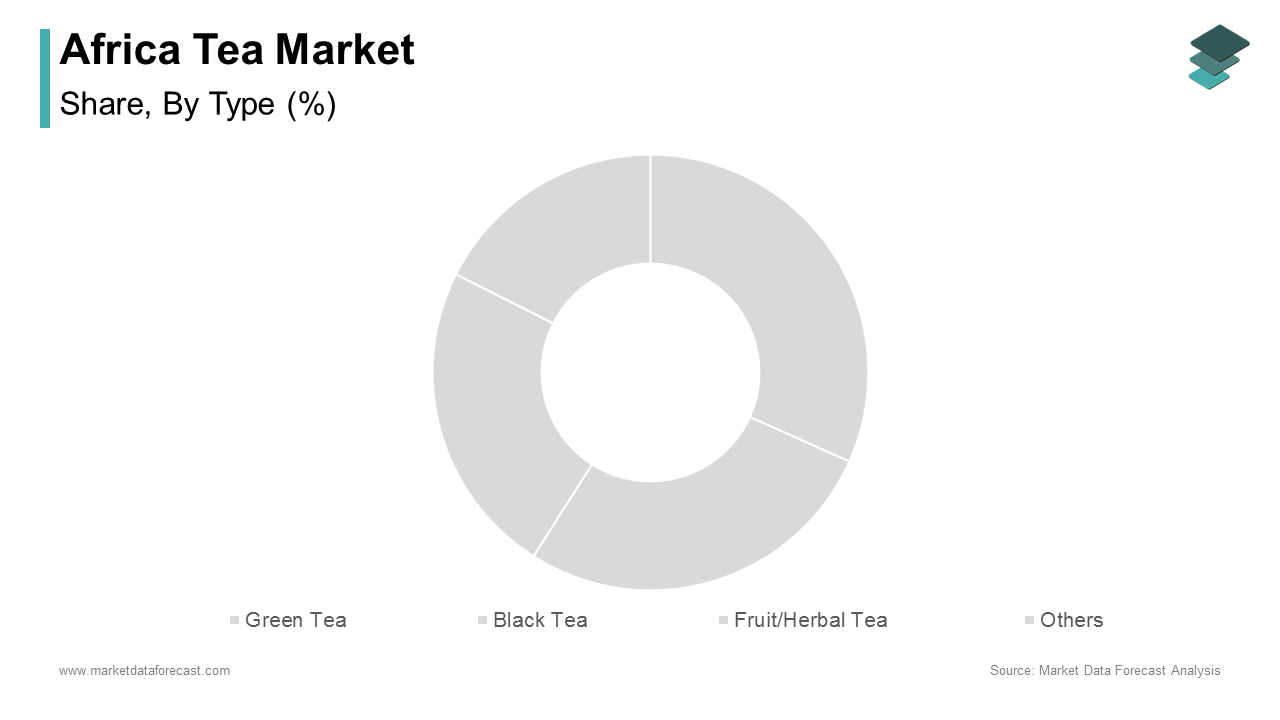
The black tea segment dominated the African tea market by capturing 56.3% the total share in 2024. Its integration into daily consumption habits across East African countries such as Kenya, Uganda, and Tanzania is one of the key drivers behind the dominance of the black tea segment. This strong consumer preference ensures consistent demand even amid fluctuating global prices. Kenya, the largest tea producer in Africa, accounts for a significant portion of global black tea exports, with over 90% of its annual production comprising this type.
Moreover, black tea remains a major agricultural export commodity for African economies. The continued reliance on black tea for foreign exchange earnings reinforces its entrenched position within the regional and global tea trade.
The fruit/herbal tea segment is emerging as the fastest-growing category within the African tea market, projected to expand at a CAGR of 11.6% from 2025 to 2033.
The rising popularity of indigenous herbal infusions such as rooibos and honeybush in South Africa, hibiscus in Egypt, and ginger-lemon blends in Nigeria is a primary factor fuelling the growth of the herbal tea segment. As per the South African Rooibos Council, rooibos tea exports increased by 18% in 2023 compared to the previous year, reflecting heightened global demand for caffeine-free, antioxidant-rich alternatives.
Moreover, urban consumers across Africa are increasingly seeking functional beverages that align with dietary preferences such as organic, gluten-free, and plant-based ingredients.
Further, digital marketing campaigns and influencer endorsements have played a crucial role in educating consumers about the health benefits of herbal teas.
By Packaging Insights
The loose tea segment led the African tea market by accounting for 47.4% of total packaging demand in 2024. Affordability and accessibility, particularly in rural and semi-urban areas where packaged tea products may be cost-prohibitive, are among the key factors propelling the influence of the loose tea segment. This pricing advantage makes it a staple in budget-conscious households across Sub-Saharan Africa.
Apart from these, cultural preferences play a significant role in sustaining demand for loose tea. Also, many consumers believe that loose-leaf tea offers superior aroma and flavor compared to bagged alternatives. In countries like Egypt and Morocco, where mint tea is a central part of hospitality rituals, loose tea remains integral to social customs and daily routines.
Furthermore, smallholder farmers and local traders continue to dominate the loose tea supply chain, ensuring widespread availability through informal markets and roadside vendors. As per the Food and Agriculture Organization (FAO), over 70% of tea sold in rural markets across East Africa is in loose form, reinforcing its entrenched presence in the regional tea ecosystem.
The tea bags segment is the fastest-growing packaging format in the African tea market by expanding at a CAGR of 9.8% from 2024 to 2033. Shifting consumer lifestyles, particularly among younger urban populations who prioritize convenience, speed, and hygiene in their beverage choice, are driving the growth of the tea bags segment.
The expansion of modern retail infrastructure, including supermarkets, hypermarkets, and convenience stores, which offer standardized and branded tea products, is another key driver of tea bag adoption.
An additional influential factor is the rise of office culture and fast-paced work environments, where consumers prefer quick brewing options that fit into their schedules.
Besides, multinational tea brands such as Lipton, Twinings, and local players like James Finlay have intensified marketing efforts around tea bags, promoting them as premium yet accessible products.
By Distribution Channel Insights
The supermarkets segment commanded the biggest distribution channel in the African tea market by holding 39.4% of the total share in 2024.
Their ability to offer a wide range of tea varieties under one roof, catering to diverse consumer preferences, is one of the main reasons for the dominantpositionnsupermarkett segment.
The expansion of organized retail networks across Africa, supported by government policies encouraging formalization of food supply chains, is another key driver of this segment.
Moreover, promotional activities such as seasonal discounts, loyalty programs, and in-store tastings contribute to higher conversion rates.
The online stores segment is the fastest-growing distribution channel in the African tea market and is projected to expand at a CAGR of 16.4%. The rapid growth of this segment is attributed to increasing internet penetration, mobile commerce adoption, and the proliferation of e-commerce platforms tailored to food and beverage categories.
A further key driver behind online tea sales is the rising influence of digital-savvy consumers, particularly millennials and Gen Z, who prefer shopping via mobile apps and websites. Platforms like Jumia, Takealot, and Amazon Global Selling have facilitated cross-border transactions, allowing African tea producers to reach international buyers.
An additional important factor is the growing demand for specialty and artisanal tea products, which are often marketed through visually engaging content on social media.
Moreover, the convenience of home delivery, flexible payment options, and subscription models have further boosted online tea consumption.
REGIONAL ANALYSIS
Kenya Tea Market Insights
Kenya led the African tea market by accounting for 34.5% of total regional revenue in 2024. The country’s high-altitude growing regions, favorable climate, and well-established auction system in Mombasa ensure its dominance in both quality and quantity of tea exports.
A key factor supporting Kenya’s market leadership is the significant contribution of smallholder farmers, who produce over 60% of the country’s tea.
Further, Kenya has been investing in value addition through improved processing facilities and branding initiatives aimed at distinguishing its tea in global markets. According to the United Nations Conference on Trade and Development (UNCTAD), Kenya’s tea industry contributes nearly 3% of the national GDP, reinforcing its economic importance. With ongoing investments in sustainable farming and export diversification, Kenya continues to solidify its position as Africa’s tea powerhouse.
South Africa Tea Market Insights
South Africa holds a unique position due to its globally recognized production of rooibos and honeybush teas.
A key driver of South Africa’s market strength is the growing international demand for herbal and functional teas, particularly in Europe and North America. As per the International Trade Centre, rooibos exports grew in 2023, driven by its reputation as a caffeine-free, antioxidant-rich alternative to traditional teas.
Apart from these, the government and private sector have collaborated to enhance research, improve farming techniques, and promote rooibos as a protected geographical indication (PGI) product.
With increasing investment in organic certification and product innovation, South Africa is leveraging its botanical diversity to carve a niche in the global herbal tea market, positioning itself as a leader in specialty tea production within Africa.
Malawi Tea Market Insights
Malawi occupies a significant position in the African tea market. According to the Food and Agriculture Organization (FAO), Malawi is one of the oldest tea-producing nations in Africa, known for its high-quality black and green teas cultivated in the Mulanje and Thyolo regions.
A major factor underpinning Malawi’s market position is its long-standing reputation for producing premium orthodox teas, particularly sought after in the UK, Germany, and Japan. As per the Tea Association of Malawi, the country exported over 45,000 metric tons of tea in 2023, with a significant portion being certified organic and fair-trade.
Another key driver is the increasing participation of smallholder farmers in contract farming arrangements with larger estates, improving productivity and sustainability. According to the Ethical Tea Partnership, over 30,000 smallholder families were engaged in sustainable tea production in 2023, benefiting from training, financial support, and better access to international markets.
Furthermore, Malawi has been exploring opportunities to expand into ready-to-drink and herbal tea segments to diversify its offerings. Also, investments in new processing units and packaging facilities are expected to enhance value addition and reduce reliance on raw tea exports, strengthening Malawi’s competitive edge in the regional tea market.
Uganda Tea Market Insights
Uganda remains a notable player in the African tea market. In addition, the country produced over 50,000 metric tons of tea in that year, with black tea accounting for the majority of output. Uganda’s tea industry is centered in the eastern and southwestern regions, where fertile soils and favorable rainfall support robust growth.
One of the key factors driving Uganda’s market position is the increasing emphasis on organic and sustainable tea production.
Besides, the government has implemented policies to attract private sector investment in tea processing and export infrastructure. According to the World Bank, recent improvements in transport logistics and energy access have enhanced operational efficiency for tea estates and cooperatives.
Moreover, Uganda is exploring the potential of herbal and blended teas to complement its traditional offerings. These developments position Uganda as a dynamic player in the evolving African tea landscape.
Nigeria’s Tea Market Insights
Nigeria’s market is predominantly import-dependent, sourcing black and green tea from Kenya, India, and China.
A key factor influencing Nigeria’s market dynamics is the expanding retail sector and growing presence of modern supermarkets, which offer a wider selection of branded and specialty teas.
Another important driver is the rising awareness of tea’s health benefits, particularly among middle-class consumers.
Despite limited domestic production, Nigeria’s strategic location and large population make it a key market for tea imports and innovations. Also, the country is beginning to explore localized tea cultivation initiatives to reduce dependency on foreign suppliers and boost self-sufficiency in the coming years.
LEADING PLAYERS IN THE AFRICAN TEA MARKET
James Finlay & Co. is a leading multinational tea producer with a strong presence across East and Southern Africa. The company plays a crucial role in cultivating, processing, and exporting high-quality black and green teas, particularly from Kenya and Malawi. Known for its sustainable farming initiatives and vertically integrated operations, James Finlay ensures consistent supply chain efficiency and product excellence. Its focus on ethical sourcing and farmer partnerships has reinforced its reputation as a reliable supplier to global markets.
Unilever East Africa, through its Lipton brand, is a major player in the African tea industry, particularly in Kenya and Uganda. The company engages in large-scale tea production and export while also catering to domestic consumers with packaged and value-added tea products. Unilever’s emphasis on research-driven innovation and consumer engagement has helped shape modern tea consumption habits across the continent.
Kenya Tea Development Agency (KTDA) manages a network of over 60 tea factories serving hundreds of thousands of smallholder farmers. KTDA plays a pivotal role in aggregating, processing, and marketing Kenyan tea globally. It supports farmer welfare, quality control, and auction systems that influence international pricing. KTDA’s cooperative model ensures that small-scale producers benefit directly from global demand, making it an essential institution in the African tea market.
TOP STRATEGIES USED BY KEY MARKET PARTICIPANTS
One major strategy employed by key players in the African tea market is investing in sustainable and organic farming practices. Companies are increasingly adopting environmentally friendly cultivation methods, soil conservation techniques, and water-efficient irrigation systems to ensure long-term viability and meet global demand for ethically sourced products.
Another strategic approach is enhancing value addition through local processing and packaging facilities. By investing in modern tea processing units and branding initiatives, companies aim to increase profitability, reduce dependency on raw exports, and cater to premium markets that prioritize quality and traceability.
Lastly, leading firms are focusing on strengthening digital engagement and e-commerce platforms. With rising internet penetration and mobile commerce growth, tea producers are leveraging online sales channels, social media marketing, and direct-to-consumer models to reach both regional and international buyers more efficiently and build brand loyalty.
KEY MARKET PLAYERS AND COMPETITION OVERVIEW
Major Players of the African tea Market include Unilever, Tata Consumer Products, James Finlay Kenya, Eastern Produce Kenya Ltd, Cargill Inc., Williamson Tea Kenya Ltd, Mabroc Teas, Empire Teas Pvt Ltd, Ajanta Tea, Ekaterr.a
The African tea market features a competitive landscape shaped by a mix of multinational corporations, government-backed institutions, and independent smallholder cooperatives. Large players such as James Finlay, Unilever, and the Kenya Tea Development Agency dominate export volumes and set quality benchmarks, benefiting from established infrastructure and global distribution networks. However, they face increasing competition from emerging private equity-backed ventures and regional processors aiming to capture niche markets through differentiation and innovation.
At the same time, smallholder farmers remain integral to the sector, contributing significantly to overall production, especially in Kenya and Malawi. Their collective strength through cooperatives allows them to negotiate better prices and maintain relevance in a market often influenced by commodity fluctuations. Moreover, the rise of specialty teas, including herbal infusions like rooibos and honeybush, has introduced new players focused on health-conscious and functional beverages.
Competition is further intensified by evolving consumer preferences, sustainability expectations, and the need for digital adaptation. As traditional exporters seek to maintain their foothold, newer entrants are leveraging branding, traceability, and direct-to-consumer strategies to carve out space in both domestic and international markets, creating a dynamic and rapidly transforming industry.
RECENT HAPPENINGS IN THE MARKET
- In February 2024, James Finlay launched a new line of sustainably sourced herbal teas derived from indigenous African plants, targeting health-conscious consumers in Europe and North America while supporting local farmer livelihoods.
- In July 2023, Unilever East Africa expanded its partnership with blockchain-based traceability firm Techemy to enhance transparency in tea sourcing, ensuring ethical production and improving consumer trust in African-origin tea products.
- In November 2023, the Kenya Tea Development Agency (KTDA) introduced a mobile-based digital payment system for smallholder farmers, streamlining revenue distribution and reducing financial inefficiencies in the supply chain.
- In March 2024, Twinings collaborated with South African rooibos producers to develop a co-branded wellness tea range, highlighting the unique health benefits of African-grown ingredients and expanding market access in premium retail outlets.
- In September 2023, James Finlay invested in a state-of-the-art tea packaging facility in Malawi, aimed at enhancing product shelf appeal and meeting growing demand for premium tea formats in international markets.
MARKET SEGMENTATION
This research report on the African tea market has been segmented and sub-segmented based on type, packaging, distribution channel, and region.
By Type
- Green Tea
- Black Tea
- Fruit/Herbal Tea
- Others
By Packaging
- Plastic Containers
- Loose Tea
- Paper Boards
- Aluminium Tin
- Tea Bags
By Distribution Channel
- Supermarkets
- Speciality Stores
- Convenience Stores
- Online Stores
- Others
By Region
- KSA
- UAE
- Israel
- Rest Of GCC Countries
- South Africa
- Ethiopia
- Kenya
- Egypt
- Sudan
- Rest Of MEA
Source link











Share this article: