
Adaptogen Oils Market Size, Share and Forecast 2025–2035
Adaptogen Oils Market Outlook (2025 to 2035)
The global adaptogen oils market is expected to reach USD 2.9 billion by 2035, up from USD 1.2 billion in 2025. During the forecast period 2025 to 2035, the industry is projected to expand at a CAGR of 9.3%.
The adaptogen oils market is gaining strong momentum as consumers increasingly seek natural solutions to manage stress, boost energy, and support overall well-being. The proven properties of adaptogens are driving demand to regulate cortisol levels, strengthen immunity, and enhance mental clarity.

The ongoing diversification of adaptogen oils into beauty, dietary supplements, and aromatherapy is broadening their application base and accelerating market penetration. As the global shift toward plant-based, functional health solutions continues, adaptogen oils are poised to experience sustained growth and wider adoption.
Quick Stats for Adaptogen Oils Market
- Industry Value (2025): USD 1.2 Billion
- Projected Value (2035): USD 2.9 Billion
- Forecast CAGR (2025 to 2035): 9.3%
- Leading Segment (2025): Organic (51.2% Market Share)
- Fastest Growing Country (2025-2035): India (11.6% CAGR)
- Top Key Players: Nutra Industries Inc., Organic India, Amax NutraSource, NutraCap Labs, Emami Limited, and REBBL
What are the drivers of the Adaptogen Oils Market?
The adaptogen oils market consumption is on the rise, as stress management, cognitive balance, and immune resiliency are some of the most pertinent benefits to health-conscious consumers among natural wellness offerings. Growing stresses of urban lifestyles and employment are causing the interest in adaptogen-containing oils to grow in aromatherapy, cosmetic skin-care products and supplements.
The routes of consumer faith and clinical practice are being reinforced with scientific verification of the effects of adaptogens to stabilize cortisol levels, increase energy, and improve sleep. The emphasis on clean-label, plant-derived actives by the regulators is also another aspect that favors market reception. The customization of blends by age and conditionally targeted well-being is also driving the trend, and the collaboration between nutraceutical, cosmetic, and wellness brands is fueling the trend’s growth.
What are the regional trends of the Adaptogen Oils Market?
The regional outlook of the adaptogen oils market demonstrates varied growth patterns that are influenced by wellness preferences, regulatory frameworks and consumer awareness levels. Globally, North America is driving adoption with a high level of interest in aromatherapy, nutraceuticals, clean-label personal care, as well as a thriving natural products industry in the U.S. and Canada.
In Europe, regulatory-driven organic certifications and environmentally friendly sustainability are preferred, with the Nordics and Germany leading the growth in holistic health using herbal oils in 2023.
The Asia-Pacific region is fast growing in this industry due to a combination of Ayurveda, Traditional Chinese Medicine and K-beauty and its overlap with modern practices of wellness, namely, in India, China and South Korea.
What are the challenges and restraining factors of the Adaptogen Oils Market?
A major problem that faces the adaptogen oils market is the absence of standardization in the extraction procedure and the composition of bioactive compounds, which contributes to variation in the efficacy of the products and skepticism among consumers. Assurance of the quality of this therapeutic component is further undermined by variances in plant sourcing, growing conditions, and processing, which weaken confidence in clinical effects.
The other limitation is less clinical backing; although traditional use substantiates adaptogen benefits, there is still a paucity of large-scale scientific studies. The complexities in regulations that vary among regions, notably labeling, proving therapeutic claims, and organic certification, are additional factors that slow the growth of the market. Fractured supply chains and reliance on small-scale herbalist suppliers lead to unstable prices and limit the possibility of commercializing on a large scale.
Country-Wise Insights
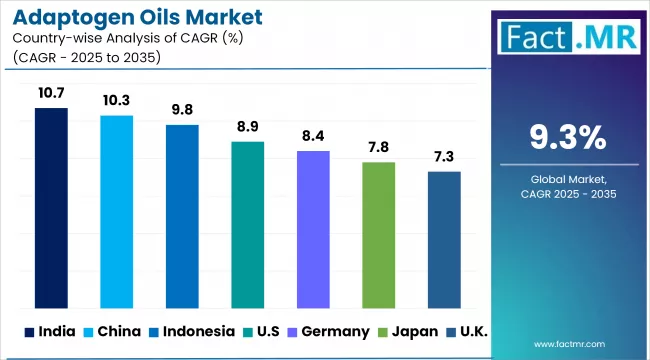
India leads with Ayurveda-driven adaptogen oils in global markets
The adaptogen oils market in India is rooted in Ayurveda, with emerging use cases in the nutraceutical, personal care and aromatherapy industries. Solid matching domestic demand is due to the increased consumer demand for natural stress-relieving and immunity supplementing products.
Manufacturers are incorporating adaptogen oils, including ashwagandha, tulsi, and holy basil, into beverages, skin products and nutritional supplements. The export is rising, particularly to North America and Europe, where Ayurveda-supported oils have been gaining ground. The Ministry of AYUSH offers regulations and guidelines that certify the quality of the practice and build its global credibility.
The regional producers use organic certifications and online sales channels to expand their market, which has further made India lead in the manufacturing process of adaptogen oils.
China drives adaptogen oils via TCM, exports, and innovation
China has been growing rapidly in the adaptogen oil marketplace thanks to its deeply developed Traditional Chinese Medicine (TCM) industry, with ginseng, schisandra and rhodiola oils being some of the more prevalent adaptogen oils. The urban stress level and progressive aging populations are resulting in increased consumer demand of oils that deliver a sense of vitality, mental alertness and skin wellness.
It is investing in major technology advancements and incorporating adaptogen oil into nutrition supplements and personal care programs. The acceptance of Chinese adaptogen oils is on the increase globally due to government efforts that enhance the standardization of herbal medicine.
Exports remain strong, particularly in the Asia-Pacific region. Multinational players are sharing core competencies with local manufacturers so as to tap the enormous herbal raw materials base of China.
Japan advances premium adaptogen oils in skincare and wellness
The wellness culture and premium positioning in the functional beauty and health products mean that the adaptogen oils market in Japan will be moulded. There is increasing interest in adaptogen oils such as reishi and ginseng, particularly related to anti-aging skin care, aromatherapy and stress-reducing applications.
Natural oils without residue obtained through scientifically validated methods are preferred by consumers, and this leads to alliances between biotech companies and conventional producers. The extraction and encapsulation of the oil technology are being adopted to improve the bioavailability of the oil in supplements.
Under stringent quality guidelines, the Japanese brands are achieving e-reputations in the international market in terms of purity and innovation. The home market is experiencing substantial growth in wellness in high-end retail, online and other emerging channels with a healthy, affluent population in Japan.
Category-Wise Analysis
Ashwagandha oil gains traction in stress, sleep, immunity markets
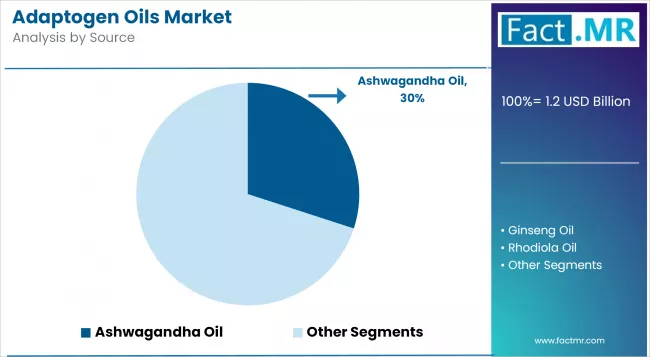
Ashwagandha oil is gaining a strong momentum based on its contribution in stress management, reducing anxiety and immune modulation. As Ayurveda-supported clinical proof sets and with consumers showing more interest in holistic wellness, it is getting used in capsules, tinctures and treatment-enhancing mixtures.
To increase the bioactive content of the products, producers are optimizing the cold-press extraction process, thereby ensuring high effectiveness of the products in nutraceuticals and cosmetics. The segment is advantaged by a surge in popularity of natural adaptogens in performance-based wellbeing regimes, especially in the domains of sleep, mood and cognitive enhancement.
The advantages of being positioned as a premium brand, obtaining organic certifications, and export dynamics are strengthening the position in the market. The adoption pattern of Ashwagandha oil is within the trend of preventative healthcare and a balance of the mind and body.
Organic oils surge with clean-label, sustainable, premium demand
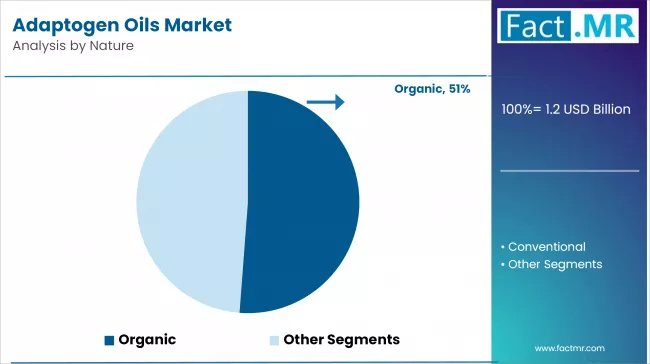
The organic market is growing at an incredibly fast pace since consumers seek clean-label, residue-free oils with purity and sustainability on record. Organic-certified cultivation and extraction is taking place at an expanded scale to allow the production of dietary supplements and personal care products to engage premium price points.
Transparency and traceability are also essential, as moves towards wellness emerge across the globe and regulators look closely at chemical residues. E-commerce is also broadening distribution, especially in North America and Europe, where organic adaptogen oils have a high level of loyalty.
The development of this segment is reinforced by the existing cooperation with cosmetic companies and nutraceutical developers that are oriented toward organic and performance-oriented products. Organic integrity gains the stress on resiliency against pressures of commoditization.
Dietary supplements dominate adaptogen oils through daily wellness adoption
Dietary supplements are the most significant application segment, and this is attributed to the incorporation of adaptogen oils in capsules, soft gels, and liquid tinctures. Stress reduction, energy lifting, and immunity building are the main consumer drivers that expose adaptogen oils to daily wellness status.
Advances in precision formulation and encapsulation are making bioavailability better, where efficacy is achieved across product form types. Companies are mixing up combinations of ashwagandha, Ginseng, and rhodiola oils geared towards attaining cognitive performance, athletic recovery and metabolic support.
The increasing practice of preventive healthcare models and wellness plans on a subscription basis also supports growth. The sustainable success of the segment can be ensured by lifestyles as the driving force and evidence-based product introductions.
Competitive Analysis
Key players in the adaptogen oils industry include Nutra Industries Inc., Organic India, Amax NutraSource, NutraCap Labs, and Changsha Organic Herb Inc, Emami Limited, REBBL, PLT Health Solutions, Thorne Research Inc., and Vital Nutrients Inc.
The Adaptogen Oils Market is highly competitive on the rise as there is an increasing demand in the market to find stress relievers, cognitive enhancement and immune-stimulating natural solutions. Key players are distinguishing in organic labels and high-level extraction processes as well as science-supported claims in pursuit of the high-end market base. The current research and development interest areas in blends are centered in multifunctional blends, enhanced bioavailability, and inculcation in cosmetics, dietary supplements, and functional beverages.
The availability of raw materials drives the regional players in India and China, whereas international nutraceutical and beauty brands are government-regulated. The challenge of e-commerce channels, sustainability positioning and clean-label are raising the competition, forcing companies to start introspection to supply open value chains, in-house manufacturing capacities and spread into worldwide operations.
Recent Development
- In May 2025, MIGU Adaptogen Bio-tech Co., Ltd. declared it has extended its botanical extract line with premium Rhodiola Rosea and Griffonia Seed extracts. As part of a focus on stringent cGMP, ISO and organic certification, these new items demonstrate an ongoing commitment to a scalable line of high-purity adaptogen ingredients targeting the health and wellness markets.
- In Early 2025, Sequoya Biotechnologies refines already existing innovation in the manufacture of custom supplements. They now provide functional adaptogen oil blends to support mental focus, calmness and metabolism. The formulations – including weight-management formulations consisting of Rhodiola rosea, Schisandra, Cordyceps and green tea – are made in GMP-certified European production facilities and tailored toward clean-label brand requirements.
Fact.MR has provided detailed information about the price points of key manufacturers of the Adaptogen Oils Market positioned across regions, sales growth, production capacity, and speculative technological expansion, in the recently published report.
Methodology and Industry Tracking Approach
The 2025 Adaptogen Oils Market report has engaged a multi-directional approach to research, which is primarily based on primary and secondary sources of information to carry out solid research. More than 10,000 stakeholders were interviewed in 30 countries, with a balanced presence of producers, distributors, nutraceutical formulators, cosmetic brands and end users. Verification against emerging trends was done through in depth interviews with experts and focus groups. In secondary research, academic literature, herbal pharmacopeia, patents, company filings, trade figures and regulatory documents were reviewed. To forecast demand trends and drivers, and to determine the relevant growth and disaggregate segment performance, advanced statistical tools were deployed including regressional modelling and correlation mapping, with regional weighting being applied where relevant.
With Fact.MR monitoring consumer behavior, product efficacy, industry trends, and market opportunities since 2018, this report is becoming an authoritative source of information that stakeholders can rely on.
Segmentation of Adaptogen Oils Market
-
By Source :
- Ashwagandha Oil
- Ginseng Oil
- Rhodiola Oil
- Holy Basil (Tulsi) Oil
- Schisandra Oil
- Reishi Mushroom Oil
- Others (Maca, Licorice, etc.)
-
By Nature :
-
By Application :
- Dietary Supplements
- Functional Foods & Beverages
- Cosmetics & Personal Care
- Pharmaceuticals
- Others
-
By Region :
- North America
- Latin America
- Western Europe
- Eastern Europe
- East Asia
- South Asia & Pacific
- Middle East & Africa
Source link











Share this article: