
From Scratch: Matcha’s history, variety and impact brew a global obsession | From Scratch

Step inside any coffee shop, and you’re bound to find matcha — a Japanese powdered green tea.
From being mixed into lattes and milkshakes, ice creams and brownies, it has grown from a ritual drink of monks and tea masters to a global obsession.
Swiping on social media, which presents all things up-and-coming in the food world, one can easily see the chatter about matcha. Some chase down the “best” matcha in their city. Some invent recipes of the newest flavor combinations with it.
And some use matcha to poke fun at the “performative male,” a social media archetype of men curating an aesthetic that he thinks would appeal to progressive women.
But long before matcha became a buzzword, its history, variety and impact stretched back centuries.
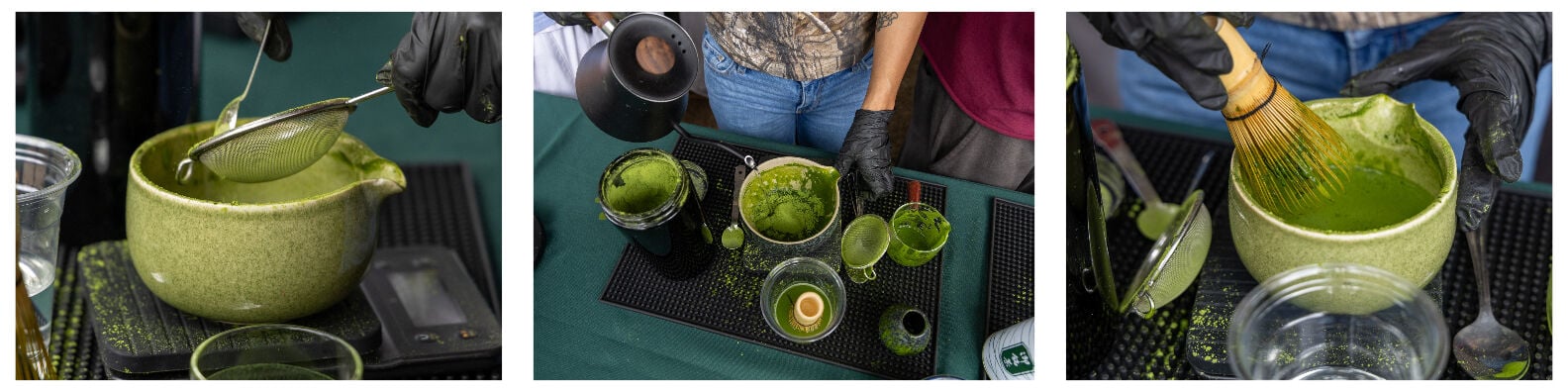

Koicha matcha hosts a pop-up Sept. 24 outside the Central Library. A small amount of water is added to the matcha powder before it is mixed.
The history
Like many social media sensations, matcha is not “new.”
Tea master Sen no Rikyū codified the tea ceremony in Japan in the 16th century, placing matcha at its center. But the practice traces back to the early centuries in China, where powdered tea was used in Buddhist temples, said Fletcher Coleman, assistant professor of art history.
Japanese monks brought the tradition home, valuing its highly caffeinated content and its spiritual role in meditation, Coleman said. By the Edo period from the 17th to 19th centuries, tea culture trickled down from elite circles into everyday society.
“That’s a moment in time where wealth and power is shifting between social classes in Japan as a result of economic changes into the way society is structured,” he said.
Modern matcha has different quality grades varying in taste and color.
The ceremonial grade, considered the highest quality, is supposed to have hints of smoothness, sweetness and bitterness, said Elijah Castaneto, information systems senior and co-owner of the matcha pop-up Koicha.
There’s also the culinary grade matcha, which leans more brownish-green and is used for making pastries, Castaneto said.
“If you look at a piece of grass and it resembles the matcha powder, then it’s probably good,” Castaneto said.
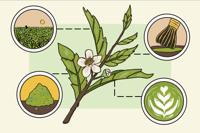
Traditionally, matcha growers would shade the plants before grinding them into a verdant dust. The process locks in its color and nutritional qualities.
Matcha is prepared in single batches by adding hot, but not boiling, water and whisking vigorously to mix in the powder and froth the top. The finished product can be drunk directly from the bowl in which it was prepared. Or you pour it on top of steamed — or ice cold — milk for a matcha latte.
“An aged one of these vessels is a valued object because it adds a degree of flavor to your cup of tea,” Coleman said. “But that’s why you don’t mix between, say, a black tea and a green tea in that vessel because it will affect the long-term flavor.”
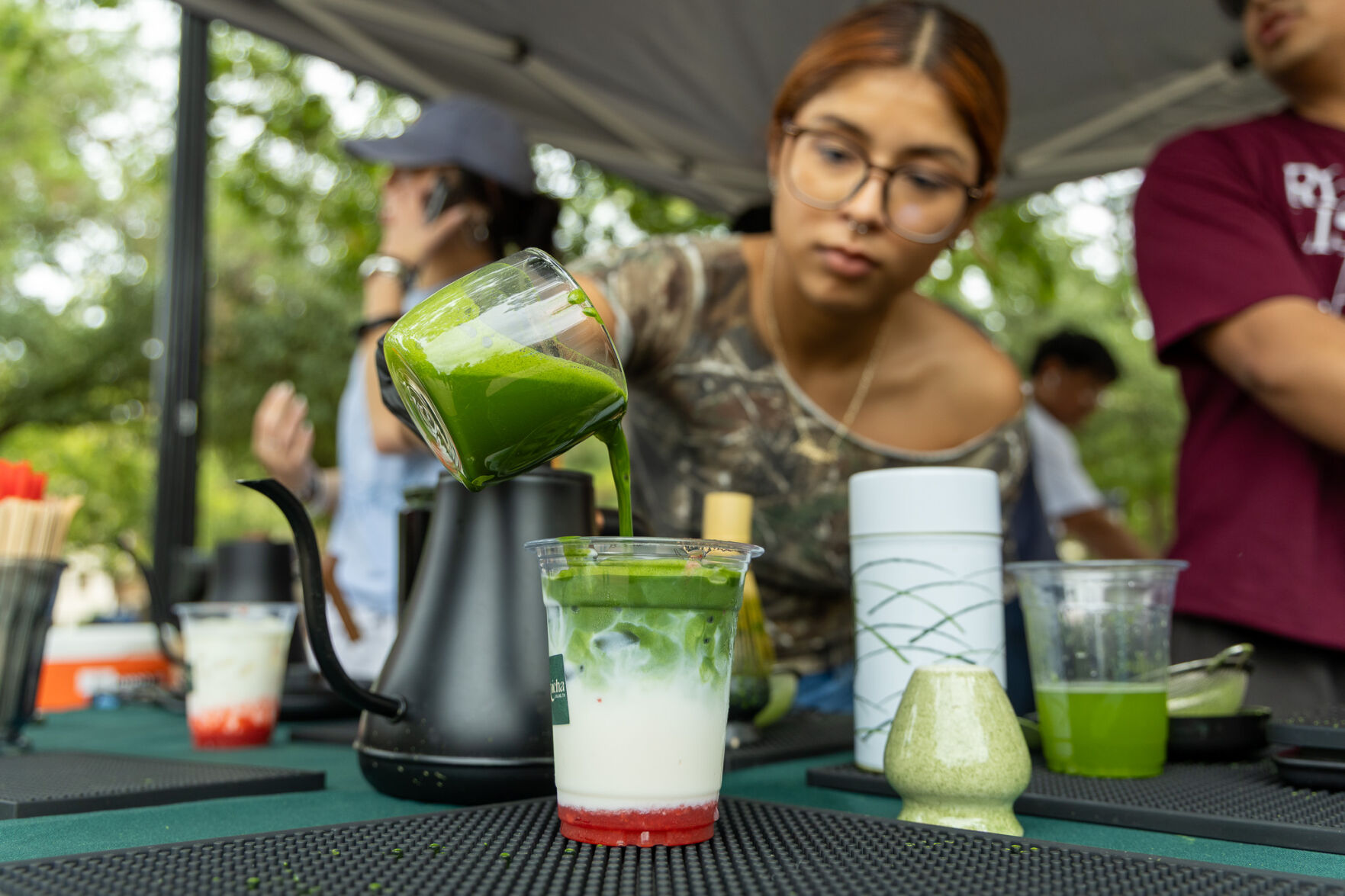
Nursing student Aliayah Govea pours matcha mix into a strawberry matcha latte during a Koicha matcha pop-up Sept. 24 outside the Central Library. The event offered three matcha drink options.
The variety
On a sweltering Monday in September, students lined up opposite the Central Library for an event between Koicha and the student organization Society of Asian Scientists and Engineers.
“I’m glad that culture is being spread,” said Hoang Long Phan, the organization’s president and a matcha drinker for 13 years.
Castaneto carefully watched his baristas grind exactly 4 grams of matcha for each drink. His pop-up provided classic matcha lattes and also dabbled into flavors like strawberry, earl grey and jasmine teas, or served them with cold foam.
Koicha usually draws inspiration from Asian flavors to mix with its matcha, which is sourced from Japan. Baristas have experimented with ube — a Filipino purple yam — for their pop-up events and are working on a coconut cloud matcha and a black sesame foam, Castaneto said.
“I want to sell a drink that I believe represents actual Japanese matcha lattes, rather than American matcha lattes that are super milky,” he said. “You don’t taste the matcha, you more taste whatever syrup that they use and stuff like that.”
Some choose to zhuzh their matcha up more subtly.
Biology freshman Lwin Thein likes brown sugar with her matcha for a “little sweet hint,” she said.
Computer science sophomore Denzel Nieves has matcha once or twice a week. He wants his drink with oat milk and honey.
“I really look for the creamier matcha,” Nieves said. “I like the texture of it, and I like the taste of it.”
The popularization of matcha has its negatives and positives, he said. On one hand, some have become more performative in drinking matcha, but on the other, stores are offering more variety.
In March, Kayla Baluyot launched her pop-up, Matcha with Kay, at MavMarket, UTA’s student marketplace. Called “matcha-rista” — a combination of “matcha” and “barista” — by family and friends, she creates homemade syrups and adjusts them to her audience’s taste.
A friend told Baluyot they didn’t like strawberry puree, so she strained out the pulp for a cleaner texture while maintaining the flavors.
“I try to experiment to make sure that my flavors of syrups don’t overpower the matcha as well,” Baluyot said. “I just do my best to make sure they complement one another.”
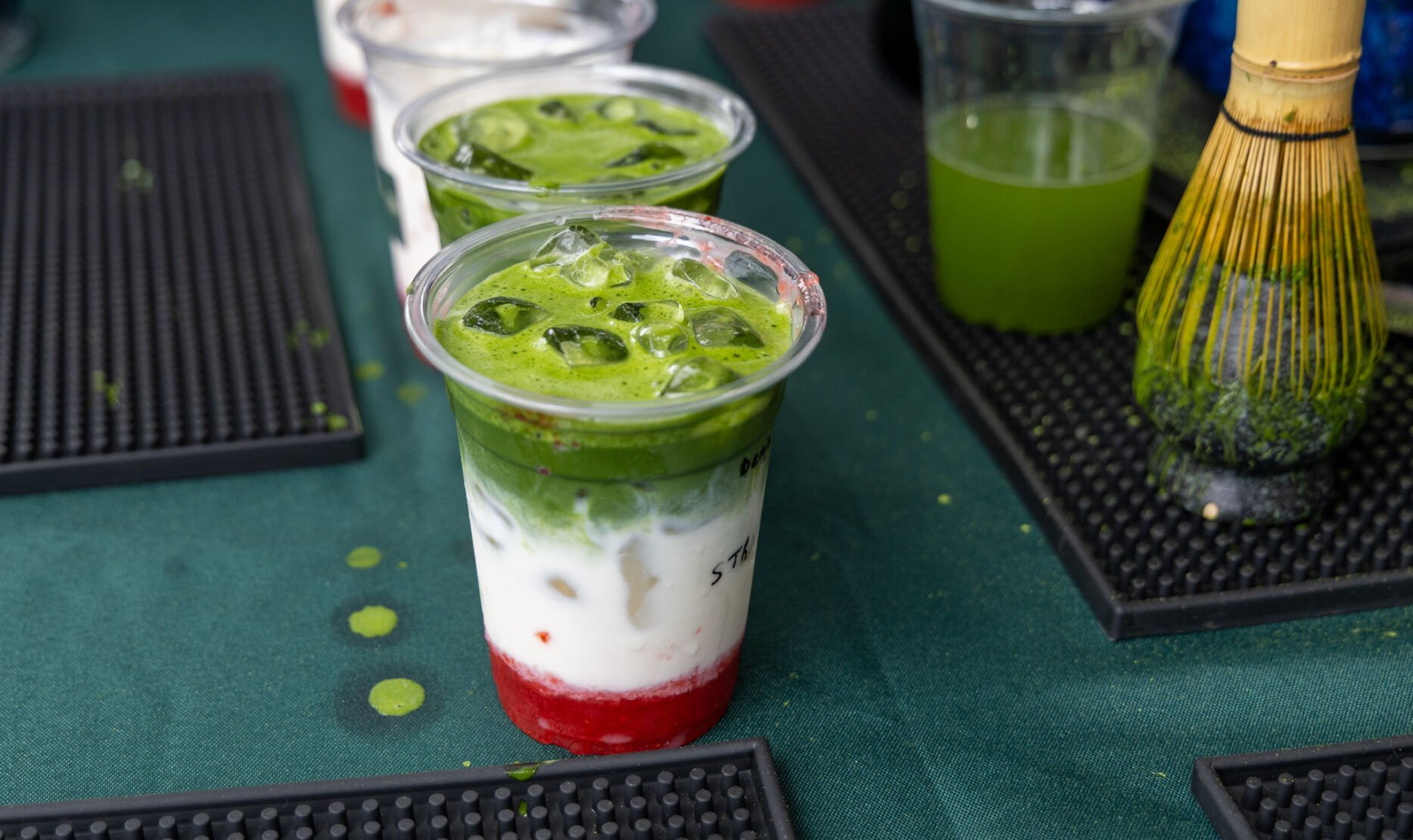
A strawberry matcha latte sits on a table during a Koicha matcha pop-up Sept. 24 outside the Central Library. Matcha can be traced back to early centuries in Buddhist temples in China.
The impact
As matcha globalized, Starbucks added the drink to its menu in 2006. Like many companies, it uses Chinese matcha, which is often considered inferior and used as a flavoring for things like matcha-flavored KitKat bars. However, many places now use Chinese matcha for their drinks due to a shortage of Japanese matcha stemming from poor weather.
Starbucks’ matcha drinks have little similarity to traditional Japanese unsweetened powdered green tea, Coleman said.
“Drinking a bowl of Japanese green tea is kind of a slap in the face more so than a really heavily sweetened drink,” he said.
Yet, it’s some people’s cup of tea.
“I like how the thickness of it is so textured, especially with the cold foam,” business sophomore Hawraa Altaie said.
Altaie, though, liked the strawberry matcha that she got from Koicha after waiting in line, she said.
“I like how different it is than regular coffee,” she said. “Doesn’t give you that anxious, shaky feeling. It’s just a fun drink.”
Consumption of leaf green tea and matcha is continuing to expand. The global matcha market is expected to surge from about $2.8 million in 2023 to about $4.7 million by 2028, according to the market research firm The Business Research Company.
Like many cultural exports, matcha’s tradition has been diluted on an everyday level, Coleman said. Still, whisks of authenticity remain.
“For example, the vessels people use to drink tea from, or the quality of the tea that people drink now,” he said.
Baluyot, who first had matcha as a kid, said she’s glad it’s popular but hopes it isn’t only reduced to negative connotations like the performative male trend — even if she thinks it’s funny.
“At the end of the day, those are just social media things. That’s not really representative of the whole culture that goes behind all of this,” she said.
Back in front of the Central Library, the line dwindled. Despite planning enough matcha for a four-hour event, Koicha ran out within an hour and a half. Some people tried to get their matcha, but there was none left.
Around the stand, students sipped their lattes, swapped with friends and took photos of the drinks, blending centuries of ritual traditions with the vibrant rhythm of campus life.
Some would say it’s a match-a made in heaven.
@DangHLe
Source link










Share this article: