
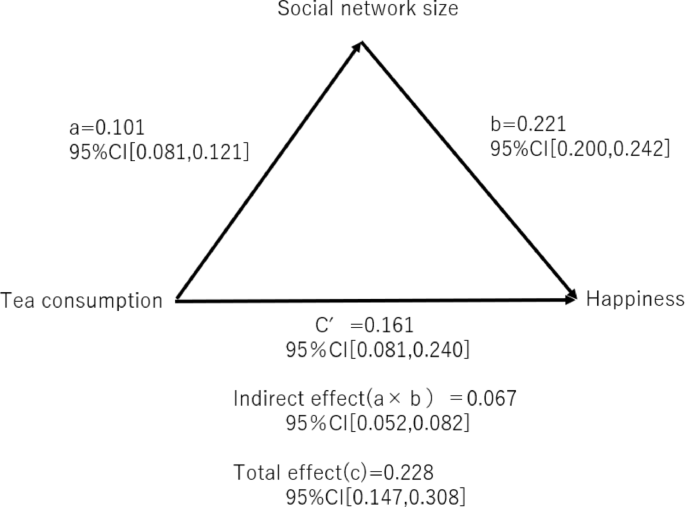
The relationship between green tea consumption and happiness
Nanri, H. et al. Association between green tea and coffee consumption and body iron storage in Japanese men and women: A cross-sectional study from the J-MICC Study Saga. Front. Nutr. 10, 1249702. https://doi.org/10.3389/fnut.2023.1249702 (2023).
Yaegashi, A., Kimura, T., Hirata, T. & Tamakoshi, A. Green tea consumption and risk of depression symptoms: A systematic review and meta-analysis of observational studies. J. Nutr. Sci. Vitaminol. (Tokyo) 68, 155–161. https://doi.org/10.3177/jnsv.68.155 (2022).
Chen, Y., Abe, S. K., Inoue, M., Yamaji, T., Iwasaki, M., Nomura, S., Hashizume, M., Tsugane, S., Sawada, N., JPHC Study Group. Green tea and coffee consumption and risk of kidney cancer in Japanese adults. Sci. Rep. 12, 20274 https://doi.org/10.1038/s41598-022-24090-z. (2022).
Diener, E. Subjective well-being. The science of happiness and a proposal for a national index. Am. Psychol. 55(1), 34–43. https://doi.org/10.1037/0003-066X.55.1.34 (2000).
Zager Kocjan, G., Jose, P. E., Sočan, G. & Avsec, A. Measurement invariance of the subjective happiness scale across countries, gender, age, and time. Assessment 29(4), 826–841. https://doi.org/10.1177/107319112199355 (2022).
Mousavi, A., Sharafi, Z., Mahmoudi, A. & Shahraki, H. R. Measurement invariance and psychometric analysis of ox ford happiness inventory scale across gender and marital status. Biomed. Res. Int. 21(2020), 8906209. https://doi.org/10.1155/2020/8906209 (2020).
Li, C., Ning, G. & Xia, Y. Does exercise participation promote happiness?: Mediations and heterogeneities. Front. Public Health. 10(11), 1033157. https://doi.org/10.3389/fpubh.2023.1033157 (2023).
Hill, P. L., Burrow, A. L. & Allemand, M. Moving beyond promoting ‘Happiness’ in gerontology interventions. Age Ageing. 50(1), 62–64. https://doi.org/10.1093/ageing/afaa226 (2021).
Gardiner, G., Lee, D., Baranski, E., Funder, D., Members of the International Situations Project. Happiness around the world: A combined eticemic approach across 63 countries. PLoS One 15(12), e0242718. https://doi.org/10.1371/journal.pone.0242718. (2020).
Song, I., Kwon, J. W. & Jeon, S. M. The relative importance of friendship to happiness increases with age. PLoS ONE 18(7), e0288095. https://doi.org/10.1371/journal.pone.0288095 (2023).
Milovanska-Farrington, S. & Farrington, S. Happiness, domains of life satisfaction, perceptions, and valuation differences across genders. Acta Psychol. (Amst). 230, 103720. https://doi.org/10.1016/j.actpsy.2022.103720 (2022).
Rudaz, M., Ledermann, T. & Fincham, F. D. Initial development and validation of a brief scale to measure genuine happiness in the USA. J. Relig. Health. 62(3), 2163–2180. https://doi.org/10.1007/s10943-022-01659-6 (2023).
Liu, B., Floud, S., Pirie, K., Green, J., Peto, R., Beral, V., Million Women Study Collaborators. Does happiness itself directly affect mortality? The prospective UK Million Women Study. Lancet 387(10021), 874–81 https://doi.org/10.1016/S0140-6736(15)01087-9. (2016).
Yonekura, Y. et al. Daily coffee and green tea consumption is inversely associated with body mass index, body fat percentage, and cardio-ankle vascular index in middle-aged Japanese women: A cross-sectional study. Nutrients 12, 1370. https://doi.org/10.3390/nu12051370 (2020).
Wee, J. H. et al. Analysis of the relationship between asthma and coffee/green tea/soda intake. Int. J. Environ. Res. Public Health 17, 7471. https://doi.org/10.3390/ijerph17207471 (2020).
Nakagomi, A., Tsuji, T., Saito, M., Ide, K., Kondo, K., Shiba, K. Social isolation and subsequent health and well-being in older adults: A longitudinal outcome-wide analysis. Soc. Sci. Med. 327, 115937 https://doi.org/10.1016/j.socscimed.2023. (2023).
Tomida, K., Shimoda, T., Nakajima, C., Kawakami, A. & Shimada, H. Classification of social isolation and factors related to loneliness and life satisfaction among socially isolated individuals. Geriatr. Nurs. 54, 163–170. https://doi.org/10.1016/j.gerinurse.2023.09.011 (2023).
Hong, J. H. et al. Are loneliness and social isolation equal threats to health and well-being? An outcome-wide longitudinal approach. SSM-Popul. Health. 23, 101459. https://doi.org/10.1016/j.ssmph.2023.101459 (2023).
Tsuji, T. et al. Change in the prevalence of social isolation among the older population from 2010 to 2016: A repeated cross-sectional comparative study of Japan and England. Arch. Gerontol. Geriatr. 91, 104237. https://doi.org/10.1016/j.archger.2020.104237.10.1136/bmj.a2338 (2020).
Fowler, J. H. & Christakis, N. A. Dynamic spread of happiness in a large social network: longitudinal analysis over 20 years in the Framingham Heart Study. BMJ 337, a2338. https://doi.org/10.1136/bmj.a2338 (2008).
Kishimoto, Y. et al. Associations between green tea consumption and coffee consumption and the prevalence of coronary artery disease. J. Nutr. Sci. Vitaminol. (Tokyo) 66, 237–245. https://doi.org/10.3177/jnsv.66.237 (2020).
Kimura, Y., Suga, H., Kobayashi, S., Sasaki, S., Three-Generation Study of Women on Diets and Health Study Group. Intake of coffee associated with decreased depressive symptoms among elderly Japanese women: a multi-center cross-sectional study. J Epidemiol 30, 338–344 https://doi.org/10.2188/jea.JE20190010. (2020).
Zhang, S. et al. Green tea consumption is associated with annual changes in hippocampal volumes: A longitudinal study in community-dwelling middle-aged and older Japanese individuals. Arch. Gerontol. Geriatr. 96, 104454. https://doi.org/10.1016/j.archger.2021.104454.10.1016/j.archger.2021.104454 (2021).
Kesse-Guyot, E. et al. Total and specific polyphenol intakes in midlife are associated with cognitive function measured 13 years later1–23. J. Nutr. 142(1), 76–83. https://doi.org/10.3945/jn.111.144428 (2012).
Fu, S. R., Lee, M. F. & Ou, S. J. Effects of reminiscing about nostalgic smells on the physiological and psychological responses of older people in long-term care facilities. Ageing Soc. 40(3), 501–511. https://doi.org/10.1017/S0144686X18001058 (2020).
Herz, R. S. & Cupchik, G. C. An experimental characterization of odor-evoked memories in humans. Chem. Senses 17(5), 519–528. https://doi.org/10.1093/chemse/17.5.519 (1992).
Yamamoto, K. & Sugiyama, H. Influences of age-related positivity effect on characteristics of odor-evoked autobiographical memories in older Japanese adults. Front. Psychol. https://doi.org/10.3389/fpsyg.2022.1027519 (2023).
Hozawa, A. et al. Green tea consumption is associated with lower psychological distress in a general population: the Ohsaki Cohort 2006 Study. Am. J. Clin. Nutr. 90(5), 1390–1396. https://doi.org/10.3945/ajcn.2009.28214 (2009).
Uchida, Y., Kanamori, M., Fukushima, S. & Takemura, K. Interdependent culture and older adults’ well-being: Health and psychological happiness in Japanese communities. Curr. Opin. Psychol. 55, 101729. https://doi.org/10.1016/j.copsyc.2023.101729 (2024).
Markus, H. R. & Kitayama, S. Culture and the self: Implications for cognition, emotion, and motivation. Psychol. Rev. 98(2), 224–253. https://doi.org/10.1037/0033-295X.98.2.224 (1991).
Yamagishi, T., Jin, N. & Miller, A. S. In-group bias and culture of collectivism, Asian. J. Soc. Psychol. 1, 315–328. https://doi.org/10.1111/1467-839X.00020 (1998).
Hitokoto, H. & Uchida, Y. Interdependent happiness: Theoretical importance and measurement validity. J. Happiness Stud. 16, 211–239. https://doi.org/10.1007/s10902-014-9505-8 (2015).
Hommerich, C., Ohnuma, S., Sato, K. & Mizutori, S. Determinants of interdependent happiness focusing on the role of social capital: Empirical insight from Japan. Jpn. Psychol. Res. 64, 205–221. https://doi.org/10.1111/jpr.12415 (2022).
Cabinet Office, Government of Japan. The 2010 National Survey on Lifestyle Preferences. Available from: http://warp.da.ndl.go.jp/info:ndljp/pid/10361265/www5.cao.go.jp/seikatsu/senkoudo/h22/22senkou_02.pdf, accessed 10 October 2017. (In Japanese).
Sasaki, I. et al. Are pension types associated with happiness in Japanese older people?: JAGES cross-sectional study. PLoS ONE 13(5), e0197423. https://doi.org/10.1371/journal.pone.0197423 (2018).
Tsuboi, H., Takahashi, M., Minamida, Y. & Yoshida, N. Psychological well-being and green tea consumption are associ ated with lower pentosidine serum levels among elderly female residents in Japan. J. Psychosom. Res. 126, 109825. https://doi.org/10.1016/j.jpsychores.2019.109825 (2019).
Kim, J. & Kim, J. Green tea, coffee, and caffeine consumption are inversely associated with self-report lifetime depression in the Korean population. Nutrients 10, 1201. https://doi.org/10.3390/nu10091201 (2018).
Pham, N. M. et al. Green tea and coffee consumption is inversely associated with depressive symptoms in a Japanese working population. Public Health Nutr. 17, 625–633. https://doi.org/10.1017/S1368980013000360 (2014).
Higdon, J. V. & Frei, B. Tea catechins and polyphenols: Health effects, metabolism, and antioxidant functions. Crit. Rev. Food Sci. Nutr. 43, 89–143. https://doi.org/10.1080/10408690390826464 (2003).
McKay, D. L. & Blumberg, J. B. The role of tea in human health: An update. J. Am. Coll. Nutr. 21, 1–13. https://doi.org/10.1080/07315724.2002.10719187 (2002).
Rice-Evans, C. Implications of the mechanisms of action of tea polyphenols as antioxidants in vitro for chemoprevention in humans. Proc. Soc. Exp. Biol. Med. 220, 262–266. https://doi.org/10.1046/j.1525-1373.1999.d01-45.x (1999).
Hollman, P. C., Feskens, E. J. & Katan, M. B. Tea flavonols in cardiovascular disease and cancer epidemiology. Proc. Soc. Exp- Biol. Med. 220, 198–202. https://doi.org/10.1046/j.1525-1373.1999.d01-33.x (1999).
Ahmad, N. & Mukhtar, H. Green tea polyphenols and cancer: Biologic mechanisms and practical implications. Nutr. Rev. 57, 78–83. https://doi.org/10.1111/j.1753-4887.1999.tb06927.x (1999).
Dreosti, I. E. Bioactive ingredients: Antioxidants and polyphenols in tea. Nutr. Rev. 54, S51–S58. https://doi.org/10.1111/j.1753-4887.1996.tb03819.x (1996).
Alway, S. E. et al. Green tea extract attenuates muscle loss and improves muscle function during disuse but fails to improve muscle recovery following unloading in aged rats. J. Appl. Physiol. 118, 319–330. https://doi.org/10.1152/japplphysiol.00674.2014 (2015).
Crespy, V. & Williamson, G. A review of the health effects of green tea catechins in in vivo animal models. J. Nutr. 134(Suppl. 12), 3431S-3440S. https://doi.org/10.1093/jn/134.12.3431S (2004).
Nanri, H., The Kameoka Study Group, Yamada, Y., Itoi, A., Yamagata, E., Watanabe, Y., Yoshida, T., Miyake, M., Date, H., Ishikawa-Takata, K. et al. Consumption of green tea but not coffee is associated with the oral health-related quality of life among an older Japanese population: Kyoto-Kameoka cross-sectional study. Eur. J. Clin. Nutr. 73, 577–584 https://doi.org/10.1038/s41430-018-0186-y. (2019).
Tomata, Y. et al. Green tea consumption and the risk of incident functional disability in elderly Japanese: The Ohsaki Cohort 2006 Study. Am. J. Clin. Nutr. 95, 732–739. https://doi.org/10.3945/ajcn.111.023200 (2012).
Noguchi, T. et al. Association between social isolation and depression onset among older adults: a cross-national longitudinal study in England and Japan. BMJ Open 11, e045834. https://doi.org/10.1136/bmjopen-2020-045834 (2021).
Abe, S. K. & Inoue, M. Green tea and cancer and cardiometabolic diseases: A review of the current epidemiological evidence. Eur. J. Clin. Nutr. 75, 865–876. https://doi.org/10.1038/s41430-020-00710-7 (2020).
Mahdavi-Roshan, M., Salari, A., Ghorbani, Z. & Ashouri, A. The effects of regular consumption of green or black tea beverage on blood pressure in those with elevated blood pressure or hypertension: A systematic review and meta-analysis. Complement Ther. Med. https://doi.org/10.1016/j.ctim.2020.102430 (2020).
Aida, J. et al. Social and behavioural determinants of the difference in survival among older adults in Japan and England. Gerontology 64(3), 266–277. https://doi.org/10.1159/000485797 (2018).
Source link









Share this article: