
Category: Forex News, News
Why Record-High Copper Prices Aren’t Forecast to Last
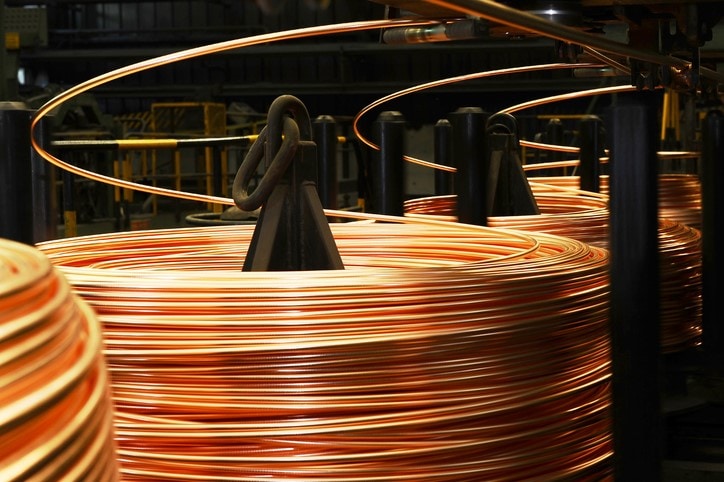
One key driver of the commodity’s price is likely to be a mid-year decision from the US administration on refined copper tariffs, writes Goldman Sachs Research analyst Eoin Dinsmore. Buyers have been stockpiling copper in the US in advance of the expected import tax, creating expectations of temporary scarcity outside of the US.

“We do not expect the price above $13,000 to be sustained,” Dinsmore writes.
Why have copper prices risen so fast?
Goldman Sachs Research cites three themes as contributing to the recent run-up in prices. For one, copper buyers significantly increased their requests in December to take metal from LME warehouses, confirming the tightness in markets outside the US. The second theme was the anticipation of strong artificial intelligence (AI)-related demand from the construction of data centers, which use copper in cooling and power distribution.
There was also a narrative in markets that US policymaking for the economy was meant to “run it hot,” as copper and riskier assets rallied in the new year. While Goldman Sachs Research expects growth in consumption of US semi-finished copper products, our analysts don’t anticipate this to have a material impact on global demand growth since the US only accounts for 7% of the market.
How copper could be impacted by tariff uncertainty
Goldman Sachs Research’s copper forecast is based on the expectation that the Trump administration will announce a 15% tariff on refined copper by mid-2026. But there’s uncertainty around that outcome as affordability remains a key focus in the lead up to US mid-term elections which could cause the tariff decision to be delayed.

For now, uncertainty surrounding the US refined copper tariff is supporting the LME copper price as US stockpiles of the metals continue to rise. Goldman Sachs Research expects this to result in a decline in stocks elsewhere in 2026, therefore keeping a floor under prices over the coming months. A definitive tariff decision in mid-2026 should signal the end of US stockpiling, allowing the price to move lower.
But if the tariff announcement itself is delayed until 2027, that could be bearish for copper prices as the probability of a tariff reduces and focus shifts back to the well-supplied global market. The recent Critical Minerals Section 232 decision suggests that the Trump Administration is no longer solely relying on tariffs to enhance US security of supply in metals.
In the short term, the speculative peak in copper prices could still be ahead. Speculative positioning in the futures market is already at a record high, but the level of long positions as a share of total open interest on the Chicago Mercantile Exchange is not as extreme as prior speculative peaks.
“We are very likely in the late stages of this rally, but US economic growth, AI spending, and US stockpiling will likely remain supportive in the coming months,” Dinsmore writes.
The global copper surplus
Once the tariff uncertainty has passed, investors are likely to focus once again on the market’s underlying fundamentals, including a large overhang of global supply. The global copper market recorded a 600 kilotonne (kt) surplus in 2025, the largest absolute surplus since 2009, and inventory outside of the US is now rising, despite continued US stockpiling.
High prices are likely to dampen demand growth and lift scrap supply this year, and this expectation leads our researchers to boost their global surplus forecast for 2026 to 300 kt from a previous outlook for 160 kt.
They note that China’s consumption of refined copper has weakened materially, and that the pullback in Chinese demand is more acute than in 2024, when a “China buyers strike” ended the rally that year. They also reduced their forecast for US stockpiling in 2026 from 750 kt to 600 kt due to less attractive import arbitrage opportunities.
On a fundamental basis, Goldman Sachs Research estimates that copper’s fair price is around $11,500 per tonne, close to their price forecast of $11,200 per tonne for the fourth quarter of 2026.
“We feel that the price has overshot its fair fundamental level,” Dinsmore concludes. A clear decision on US refined copper tariffs should serve as a “catalyst for a correction.”
Source link


Written by : Editorial team of BIPNs
Main team of content of bipns.com. Any type of content should be approved by us.






Share this article: