Scientists have stated that one of the most popular beverages in the world can effectively protect against hair loss. We’re talking about green tea – a drink that many people consume daily for energy and health benefits.
Studies conducted by a group of trichologists and nutritionists have shown that regular consumption of green tea helps strengthen hair follicles and slow down the balding process. It’s all due to the high content of antioxidants, particularly polyphenols, which improve blood circulation in the scalp and reduce inflammatory processes.
It was also found that green tea helps reduce levels of dihydrotestosterone (DHT) – a hormone associated with androgenic alopecia, the most common form of hair loss in men and women.
Specialists recommend drinking 2-3 cups of green tea per day to notice a positive effect. However, they remind that the beverage is not a panacea and works better in combination with proper nutrition and hair care.
Thus, this beverage loved by millions can become not only a source of energy but also a real ally in the fight for healthy and strong hair.
XRP futures open interest surged by 41.6% in one week, prompting speculation of a new all-time high price this week.
Whale wallets accumulated over 900 million XRP in 30 days, reinforcing a strong XRP price prediction narrative.
JetBolt has sold over $3.2 million worth of tokens during its presale, with a live, zero-gas ecosystem ready from the outset.
JetBolt’s rise in daily presale numbers is driven by its zero gas tech, AI utility, social staking, and exclusive Alpha Box bundles.
Whales are fueling XRP’s momentum as Ripple Labs’ leverage climbs. Meanwhile, JetBolt continues to soar with over 350 million tokens sold. Though their paths differ, XRP and JetBolt are two of the most trending crypto coins this May. In this article, we’ll explore experts’ analysis on XRP price prediction and why JetBolt is a top buy in May 2025.
XRP Open Interest Surges 41% as Bullish Leverage Returns
Stepping away from regulatory headlines, XRP is making waves this week thanks to a surge in market momentum. According to Glassnode, XRP futures open interest jumped from $2.42 billion to $3.42 billion in just seven days—a 41.6% increase that mirrors the token’s 24% price rally over the same period.
XRP’s Futures Open Interest grew by 41.6% over the past week. Source: Official Glassnode on X
From what we have gathered, this rise in leverage is drawing attention from top market watchers. Crypto analyst Daan Crypto Trades points to XRP’s recent breakout candle as a significant momentum shift, highlighting how the trend structure has flipped in favor of the bulls.
With XRP now trading around $2.55, crypto bulls eye the $2.60 resistance zone—an area where bold XRP price predictions are forming this month.
Clean Price Action and Whale Accumulation Define XRP’s Comeback
In a recent post, DonAlt described XRP’s monthly chart with just two words: “So Clean.” The token’s steady rise from $0.70 last October to a recent high of $3.40 marks a structural breakout that’s been years in the making.
Ali Martinez’s XRP price chart surged in May after whales bought more than 900 million XRP tokens
At the same time, whale activity is reinforcing this bullish narrative. Sentiment data from crypto pundit Ali Martinez shows that crypto whales bought over 900 million XRP tokens over the last 30 days. That accumulation comes as XRP continues to hold the $2.35–$2.50 support range despite broader market volatility.
As Bitcoin hovers above $100K and Ethereum retests $2,200, XRP is emerging as one of the most technically aligned altcoins. With leverage, accumulation, and market structure all pointing in the same direction, some market watchers speculate that XRP’s recent upsurge could potentially mark a new ATH this week.
JetBolt Continues to Soar, Reaching New Presale Milestones of Over 350 Million Tokens
Breaking news: JetBolt (JBOLT) has officially crossed the 350 million token mark in its presale, highlighting crypto whale appetite for new crypto coins. According to JetBolt’s live presale dashboard, this milestone brings the young altcoin’s total presale revenue to over $3.2 million. With staggering presale numbers, JetBolt is reinforcing its momentum as one of the hottest trending altcoins in 2025.
JetBolt’s landing page shows more than 3.2 million tokens in presale revenue
The surge comes amid buyers’ growing appetite for presale tokens that offer immediate access to blockchain utility. Unlike typical presale projects still in development, JetBolt’s platform is already live—allowing users to stake tokens, execute gas-free transactions, and explore key features after purchasing JBOLT tokens.
JetBolt’s instant custody model further sets it apart from other emerging crypto coins, enabling buyers to engage with the ecosystem from the outset. Buyers can put their tokens to work without delays or third-party dependencies.
JetBolt’s Alpha Box bundles are accelerating presale momentum, offering up to 25% extra tokens for batch purchases. Combined with daily presale price increases, JetBolt’s presale introduces a sense of urgency that magnetizes early-stage buyers and crypto whales.
Whales Celebrate JetBolt’s Ready-To-Use Features
JetBolt’s architecture is designed around one goal: convenience without compromise. Utilizing Skale’s cutting-edge framework, JetBolt removes gas fees entirely while offering near-instant transaction finality, addressing two of the most persistent pain points in Web3 adoption.
JetBolt’s biometric Web3 wallet—which supports face recognition and WebAuthN—eliminates the usual hurdles tied to token management, enabling faster onboarding for new users.
Adding to this accessibility is JetBolt’s social staking system. Users can get more rewards by staking and engaging with the network, turning staking into a novel, interactive experience.
Rounding out its toolset is JetBolt’s AI-powered news dashboard, which displays crypto news and token updates by sentiment (bullish, neutral, bearish). This smart AI integration is an increasingly important tool in a space where blockchain news can be convoluted.
With over 350 million tokens sold and counting, JetBolt delivers a working ecosystem positioned to meet the growing expectations of today’s crypto users.
Final Thoughts
With rising open interest, whale accumulation, and clean technical structure, market watchers are making their XRP price predictions and are optimistic about Ripple’s new market developments. Based on XRP’s current trends, some experts speculate that a new ATH this week could be possible.
While XRP prepares for its next moves, young altcoin JetBolt continues to soar with over $3.2 million worth of tokens sold. JetBolt claims its spot as one of the trending new crypto coins this May, introducing a live, zero-gas ecosystem that’s ready to use for any crypto buyer.
Discover what zero-gas, instant-access crypto really looks like—visit the official JetBolt website to learn more today.
This content does not serve as financial advice or a guaranteed outlook. The crypto market moves quickly, shifts unexpectedly, and comes with its share of risk. Always do your own research, think critically, and avoid making decisions based on hype alone. Step into the space with clarity, caution, and a solid understanding of what’s at stake.
BOCA RATON, FL, May 14, 2025 (GLOBE NEWSWIRE) — DeFi Development Corp. DFDV (the “Company”) the first public company with a treasury strategy built to accumulate and compound Solana (“SOL”), announced today that its Board of Directors has approved a new compensation framework for the Company’s executives and core treasury strategy team, directly tying bonus outcomes to growth in SOL per Share (“SPS”). With this plan, DFDV becomes the first public company to directly link compensation to per-share crypto asset accumulation.
The new framework is designed to closely align management incentives with long-term shareholder value. Bonus payouts for executive officers and non-executive employees will be based on achieving specific SPS targets as of April 30, 2026, with payouts increasing in proportion to growth in per-share SOL exposure.
The structure has four tiers corresponding to a respective SOL/share target: (1) NGMI Tier, (2) SOLid Tier, (3) LFG Tier, and (4) WAGMI Tier. Crucially, the SOLid Tier represents the minimum performance threshold required to trigger any bonus payout. If the Company falls into the NGMI Tier, no bonuses are paid. The structure is designed to reward disciplined capital allocation that increases per-share SOL exposure.
“Most public companies reward market cap expansion — even if it comes at the cost of shareholder dilution,” said Parker White, COO and CIO. “Our structure flips that model. We only win when our shareholders hold more SOL per share.”
A summary of the SPS tiers and corresponding bonus multipliers is shown below:
Bonus payouts for executives and treasury team scale with SOL Per Share performance. No bonuses are paid if the SOLid tier is not met
Under this structure, executive officers — including CEO Joseph Onorati, CFO John Han, and CIO Parker White — are eligible for up to 200% of their target bonus, with the full payout contingent on achieving 1.0 SOL/share (pre-split) by the April 2026 measurement date. Non-executive staff are also eligible for performance-based bonuses, subject to a similar framework.
The company believes this alignment reinforces its commitment to transparency, accountability, and long-term compounding.
For more information, visit defidevcorp.com. Details of the compensation plan will be included in a forthcoming Current Report on Form 8-K, which the Company expects to file with the U.S. Securities and Exchange Commission in due course. To stay up-to-date with the latest company developments, subscribe to our blog.
About DeFi Development Corp.
DeFi Development Corp. DFDV has adopted a treasury policy under which the principal holding in its treasury reserve on the balance sheet will be allocated to Solana (SOL). In adopting its new treasury policy, the Company intends to provide investors a way to access the Solana ecosystem. The Company’s treasury policy is expected to provide investors economic exposure to SOL investment.
We are an AI-powered online platform that connects the commercial real estate industry by providing data and software subscriptions as well as value-add services to multifamily and commercial property professionals as we connect the increasingly complex ecosystem that stakeholders have to manage.
We currently serve more than one million web users annually, including multifamily and commercial property owners and developers applying for billions of dollars of debt financing per year, professional service providers, and thousands of multifamily and commercial property lenders including more than 10% of the banks in America, credit unions, real estate investment trusts (“REITs”), debt funds, Fannie Mae® and Freddie Mac® multifamily lenders, FHA multifamily lenders, commercial mortgage-backed securities (“CMBS”) lenders, Small Business Administration (“SBA”) lenders, and more. Our data and software offerings are generally offered on a subscription basis as software as a service (“SaaS”).
Forward-Looking Statements
This release contains “forward-looking statements” within the meaning of the safe harbor provisions of the U.S. Private Securities Litigation Reform Act of 1995. Forward-looking statements can be identified by words such as: “anticipate,” “intend,” “plan,” “believe,” “project,” “estimate,” “expect,” strategy,” “future,” “likely,” “may,”, “should,” “will” and similar references to future periods. Forward-looking statements are neither historical facts nor assurances of future performance. Instead, they are based only on our current beliefs, expectations and assumptions regarding the future of our business, future plans and strategies, projections, anticipated events and trends, the economy and other future conditions. Because forward-looking statements relate to the future, they are subject to inherent uncertainties, risks and changes in circumstances that are difficult to predict and many of which are outside of our control. Our actual results and financial condition may differ materially from those indicated in the forward-looking statements. Therefore, you should not rely on any of these forward-looking statements. Important factors that could cause our actual results and financial condition to differ materially from those indicated in the forward-looking statements include, among others, the following: (i) fluctuations in the market price of SOL and any associated impairment charges that the Company may incur as a result of a decrease in the market price of SOL below the value at which the Company’s SOL are carried on its balance sheet; (ii) the effect of and uncertainties related the ongoing volatility in interest rates; (iii) our ability to achieve and maintain profitability in the future; (iv) the impact on our business of the regulatory environment and complexities with compliance related to such environment including changes in securities laws or other laws or regulations; (v) changes in the accounting treatment relating to the Company’s SOL holdings; (vi) our ability to respond to general economic conditions; (vii) our ability to manage our growth effectively and our expectations regarding the development and expansion of our business; (viii) our ability to access sources of capital, including debt financing and other sources of capital to finance operations and growth and (ix) other risks and uncertainties more fully in the section captioned “Risk Factors” in the Company’s most recent Annual Report on Form 10-K and other reports we file with the SEC. As a result of these matters, changes in facts, assumptions not being realized or other circumstances, the Company’s actual results may differ materially from the expected results discussed in the forward-looking statements contained in this press release. Forward-looking statements contained in this announcement are made as of this date, and the Company undertakes no duty to update such information except as required under applicable law.
Investor Contact:
ir@defidevcorp.com
Media Contact:
Prosek Partners
pro-ddc@prosek.com
Attachment
DFDV Treasury Team Compensation Structure Tied to SOL Per Share
Risk appetite eased, but investors keep dropping safe-haven assets.
Thursday will bring some interesting macroeconomic figures from major economies.
XAU/USD trades at fresh one-month lows, aiming to extend its near-term slide.
Gold prices are down on Wednesday with the bright metal trading at its lowest since mid-April. The XAU/USD pair accelerated its slide during American trading hours, piercing the $3,200 mark, as investors keep moving away from safe-haven assets. Despite risk appetite receding on Wednesday, investors are less concerned about global growth and a potential United States (US) recession, given the de-escalation of trade tensions between the US and China.
Meanwhile, speculative interest kept digesting US inflation data. The slight uptick in the Consumer Price Index (CPI) in April reminded investors of the “hawkish” Federal Reserve’s stance. As a result, Wall Street trades mixed, with the Nasdaq Composite and the S&P 500 posting modest intraday advances and the Dow Jones Industrial Average (DJIA) down for a second consecutive day.
Data-wise, the macroeconomic calendar remained scarce, but Thursday will bring Australian monthly employment figures, an update on the United Kingdom (UK) Gross Domestic Product, and the US April Producer Price Index (PPI).
XAU/USD short-term technical outlook
From a technical point of view, the daily chart for the XAU/USD pair shows it fell further below a now flat 20 Simple Moving Average (SMA), while technical indicators resumed their slides within negative levels, in line with another leg lower. The 100 and 200 SMAS keep advancing, yet are too far below the current level to be relevant.
In the near term, and according to the 4-hour chart, XAU/USD is bearish. The pair trades below all its moving averages, with the 20 SMA about to cross below the 200 SMA. The latter stands at $3,232, providing relevant resistance in the case of a recovery. Finally, technical indicators lack directional strength but hold within negative levels, reflecting the absence of buying interest.
Important DisclaimersThe content provided on the website includes general news and publications, our personal analysis and opinions, and contents provided by third parties, which are intended for educational and research purposes only. It does not constitute, and should not be read as, any recommendation or advice to take any action whatsoever, including to make any investment or buy any product. When making any financial decision, you should perform your own due diligence checks, apply your own discretion and consult your competent advisors. The content of the website is not personally directed to you, and we does not take into account your financial situation or needs.The information contained in this website is not necessarily provided in real-time nor is it necessarily accurate. Prices provided herein may be provided by market makers and not by exchanges.Any trading or other financial decision you make shall be at your full responsibility, and you must not rely on any information provided through the website. FX Empire does not provide any warranty regarding any of the information contained in the website, and shall bear no responsibility for any trading losses you might incur as a result of using any information contained in the website.The website may include advertisements and other promotional contents, and FX Empire may receive compensation from third parties in connection with the content. FX Empire does not endorse any third party or recommends using any third party’s services, and does not assume responsibility for your use of any such third party’s website or services.FX Empire and its employees, officers, subsidiaries and associates, are not liable nor shall they be held liable for any loss or damage resulting from your use of the website or reliance on the information provided on this website.Risk DisclaimersThis website includes information about cryptocurrencies, contracts for difference (CFDs) and other financial instruments, and about brokers, exchanges and other entities trading in such instruments. Both cryptocurrencies and CFDs are complex instruments and come with a high risk of losing money. You should carefully consider whether you understand how these instruments work and whether you can afford to take the high risk of losing your money.FX Empire encourages you to perform your own research before making any investment decision, and to avoid investing in any financial instrument which you do not fully understand how it works and what are the risks involved.
OB-GYNs are fighting for our vaginal health over on TikTok. In one video, Staci Tanouye, MD, scans a crowded feminine hygiene aisle saying “no” to every single option. Another clip shows Karen Tang, MD reacting to Kourtney Kardashian’s brand Lemme’s vaginal health gummies with “You…don’t need these. Bye!” Ali Rod, MD, (who goes by The Latina Doc) politely asks women—in a video that has been viewed over five million times—to not put yogurt, garlic, yoni pearls, herbs and spices, twigs, and leaves, or apple cider vinegar in their vaginas. “Just leave her alone,” Dr. Rod says.
These board-certified physicians, who presumably have patients to see, are spending their time begging us not to mess with our vaginas because of all the other content creators—without a medical degree—who preach passionately about said medical topic: “Get ready with me while I tell you all the things that I do to smell and taste good down there,” says one perky influencer on TikTok, tapping bronzer across her cheekbones as she tells hundreds of thousands of followers about the virtues of boric acid suppositories. According to her, they should be inserted every time after you “hang out” with someone and on the last day of your period to get a “refresh.”
Women have been fussing over their vaginal hygiene for decades because brands have been marketing the message that we should be for just as long. This particular corner of capitalism dates back to the 1900s and often relied on far more insidious messaging than the easy breezy ‘90s-era advertisements I recall of women smiling in tree swings while talking about summer breezes. In the 1930s, Lysol (yes, that Lysol) was marketed as both a cleanser and contraceptive (women would eventually die from using it as a douche) with print advertisements that warned women they could lose their husbands if they were careless about their feminine hygiene. During the 1960s, Pristeen feminine deodorant could give even a despondent young woman standing alone in a field the “peace of mind of being an attractive, nice-to-be-with girl.” In 2010, Summer’s Eve ran an advertorial in Women’s Day magazine stating that the first step for a woman to build up confidence before asking for a raise at work was… to douche.
Fast forward to today and the market for “feminine hygiene” products is set to grow from $9 billion in 2024 to nearly $16 billion by 2034—and this number only accounts for washes, wipes, creams, and sprays. It doesn’t include the new frontier in this space: supplements. See Kourtney Kardashian, who, besides gummies for your vagina is also hawking ones for hair growth and a purported Ozempic dupe, because every bandwagon must be leaped upon. (I digress.)
Most doctors agree that oral supplements claiming to have a positive effect on your vaginal negatives (whatever you think they might be) are generally snake oil. There’s little to no data to back up their claims. More concerning to some, though, are the over-the-counter “vaginal health” products sold as suppositories. Most promise “odor support,” and say they’ll improve this organ’s “pH balance.” The ones most frequently name-checked on TikTok—or in group chats or over brunch tables—are produced by a growing list of start-up wellness brands with bright packaging and cutesy euphemisms. And many are boric acid-based. So let’s start there.
Why would you put a boric acid capsule in your vagina?
It was on the recommendation of a friend that Allison*, 40, first tried boric acid suppositories. She had a new boyfriend, and was having all the intercourse that comes with one. The friend told her that using a boric acid suppository prophylactically could prevent yeast infections, something she was historically prone to, and recommended her personal favorite. “I inserted one and by the next day, I knew something was wrong,” she shares. “My vagina felt like it was on fire. Every time I had to pee, it was like jumping into the Dead Sea with cuts all over your legs. Afterwards, I would have to immediately rinse my vagina in the shower and then get in an epsom salt bath for some relief. I didn’t leave the house for a week.” After a pelvic exam, Allison’s ob-gyn said she had no infection or anything else that could be treated—there was nothing she could do but wait for the symptoms to subside. Allison turned to Reddit where she found other women who’d had a similar experience. They suggested a manuka honey ointment that she found soothing. “But it was still three weeks before I was totally back to normal,” she says.
Boric acid, or hydrogen borate, is a water-soluble chemical compound that has antiseptic and antimicrobial properties and is also a common household insecticide. The premise for using boric acid in the vagina is that it could potentially shift the organ back to its ideal acidic state when, during an infection, the spectrum has moved to a more basic or alkaline environment, allowing bacteria to overgrow, says Kameelah Phillips, MD, a New York-based OB-GYN and founder of Calla Women’s Health. Walk the feminine care aisle of any drugstore and you’ll find plenty of boric acid options. The new Monistat Boric Acid Odor Control Kit contains 10 600mg boric acid suppositories (plus 10 individually wrapped wipes) “to help control vaginal odor and balance pH.” You’ll find similar products from Azo, Nutrablast, and Honey Pot (this last offering contains not only boric acid but “herbs”). One of the buzzier offerings is a suppository called “The Killer,” sold by Love.Wellness, a brand founded by lifestyle influencer Lo Bosworth of MTV’s Laguna Beach and The Hills.
Solana (SOL) has been one of the standout performers of past crypto cycles, surging from obscurity to triple-digit valuations thanks to its blazing-fast transaction speeds and thriving DeFi ecosystem. Analysts now project SOL could reclaim the $200–$250 range in the upcoming bull run, particularly if institutional interest and NFT momentum continue to grow. Meanwhile, attention is shifting to Mutuum Finance (MUTM), which is being positioned as high-upside contenders that could mirror Solana’s earlier growth trajectory.
With a scheduled launch cemented at listing price $0.06, Phase 4 investors of the Mutuum Finance presale are poised to reap 140% returns when the token hits the open market. The presale so far has raised in excess of $8.1 million and boasts over 9800 holders with phase 4 over 70% sold out.
Solana’s Next Move: Can SOL Recapture Its Explosive Momentum in 2025?
Solana (SOL) is in the spotlight once again after a wave of analysts project a solid rebound up to the $200 level and new impetus from growing developer interest and more exposure to the institutional sphere. SOL is poised to profit from an expansive market resurgence with its rapid blockchain operations and increasing utility in DeFi and meme coins.
However, this cycle is unlike that of 2021, when there was a meteoric explosion, and the only praxis may be more than just speed and scalability to beat peers, given that Ethereum Layer-2s and other smart contract flourishes are narrowing the gap. Despite remaining a major contender, new low-cap tokens such as Mutuum Finance (MUTM) are starting to fall under speculative capital of traders in search of exponential profits.
Over $8.1M Raised from 9,800+ Early Adopters
Mutuum Finance presale is not easing off. Now in Phase 4, the $0.025 token is on the verge of a price hike. When the presale enters Phase 5, the value will rise to $0.03, treating current investors to an instant 20% gain. With a projected launch price of $0.06, the profit potential grows by the day. Crypto analysts have already designated MUTM as one of the most undervalued DeFi tokens of the year. With more than $8.1 million funded and 9,800+ users, Mutuum Finance is set to fly.
Driving Engagement Through Leaderboards and Incentives
Mutuum Finance has introduced a real-time leaderboard for the holders of MUTM to display the top 50 holders which is more community driven. These holders are to be rewarded with bonus tokens that bring innovative competitive aspects to their platform. This way, Mutuum Finance is encouraging the token holding while also raising the level of interaction among big supporters in the community.
Mutuum Finance is building a fully collateralized, USD-backed stablecoin to be issued on the Ethereum network. Its overcollateralized design ensures long-term price stability, eschewing the collapse risks which have plagued algorithmic stablecoins. On the security front, the platform is run by open-source, third-party audited smart contracts, laying a good foundation for user trust and institutional adoption.
Gamified Ecosystem and Community Incentives
Mutuum Finance is also gamifying the user interface with a leaderboard of the top 50 holders of tokens, who are to be rewarded with additional MUTM tokens. On top of that, there is a $100,000 giveaway going on, with ten winners selected to each receive $10,000 in tokens. There is also a referral program running, which rewards users for helping to grow the platform through organic, grassroots outreach.
Solana made millionaires, Mutuum Finance (MUTM) could be next. Over $8.1M raised, 9,800+ holders, and Phase 4 is 70% sold. Buy at $0.025 now for 140% gains at launch. Leaderboard rewards and a $100K giveaway add fuel. Blink, and you’ll miss it.
For more information about Mutuum Finance (MUTM) visit the links below:
Join Our Telegram channel to stay up to date on breaking news coverage
As the DeFi space thrives, market activity is crucial to a project’s growth and potential. With the rapid evolution of decentralized finance, these platforms are reshaping how we think about traditional finance, offering decentralized alternatives for lending, borrowing, trading, and more. In this dynamic landscape, specific tokens stand out, not just for their technological innovations but also for their consistent performance in the market.
This article explores some of the leading DeFi tokens, including Hedera Hashgraph (HBAR), Aave (AAVE), Raydium (RAY), and Jupiter (JUP). With impressive growth in market price and user engagement, these tokens are shaping the future of decentralized finance. Let’s look at their recent performance and how they contribute to the evolving DeFi ecosystem.
Biggest DeFi Token By Market Activity Today – Top List
Hedera Hashgraph is a decentralized platform for building fast, secure, scalable applications. Aave Protocol is a decentralized lending platform built on Ethereum. It enables users to lend, borrow, and earn interest on digital assets. Raydium is an automated market maker (AMM) platform built on the Solana blockchain. Jupiter is one of the largest DeFi protocols on the Solana network, reaching impressive transaction volumes. Let’s dive deeply into why these tokens are some of the leading DeFi tokens by market activity today.
1. Hedera (HBAR)
Hedera Hashgraph is a decentralized platform for building fast, secure, scalable applications. Unlike traditional blockchains, it uses a unique technology called Hashgraph, which enables high transaction throughput and low fees. The network is governed by a global council of leading organizations, ensuring transparency and long-term stability.
Its native token, HBAR, powers the ecosystem by fueling transactions, smart contracts, and network services. HBAR is also interested in helping maintain network security and integrity. As adoption grows, HBAR continues to play a key role in supporting Hedera’s performance-driven DLT infrastructure.
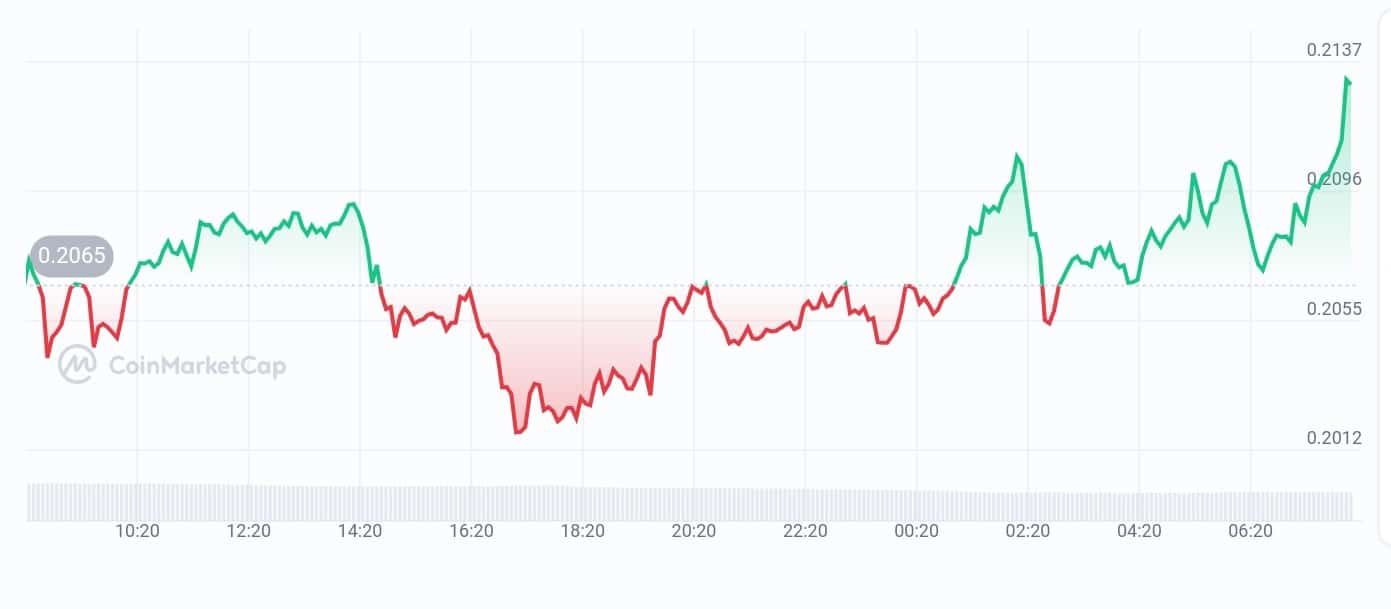
Hedera is trading at $0.2132, reflecting a 3.09% increase in the last 24 hours. Over the past week, it has surged by 20.59% and experienced a solid 26.47% rise over the past 30 days. With a price range of $0.2018 to $0.2137, Hedera shows positive performance, signaling growing investor confidence in its potential.
gm and hello future. It’s a new era for Hedera.
The Hedera ecosystem just leveled up with a fresh identity, strategic upgrades, and new leadership designed to bring alignment across the board. 🧵 pic.twitter.com/fWY2O6KUIk
Hedera has entered a new era with a fresh identity and strategic upgrades, including a shift from the HBAR Foundation to the Hedera Foundation, focusing on ecosystem and retail growth. The leadership transition includes Sylvester as President and Mance Harmon as Chair-Elect, reinforcing Hedera’s commitment to governance and enterprise adoption. The Hedera network remains the backbone of the digital economy, focusing on transparency, decentralization, and real-world utility.
This evolution positions Hedera for greater growth and efficiency, attracting more enterprise adoption and decentralized applications. Investors can expect stronger governance and a sharper focus on innovation, ensuring that Hedera remains a leading layer of trust in the digital economy.
2. Aave (AAVE)
Aave Protocol is a decentralized lending platform built on Ethereum. It enables users to lend, borrow, and earn interest on digital assets. By depositing cryptocurrencies into liquidity pools, users contribute to the protocol’s funds, which can then be lent to other users. Aave offers two types of tokens: aTokens, given to lenders to accumulate interest, and AAVE tokens, which represent the platform’s native currency.
The AAVE token plays a crucial role in the governance of the Aave ecosystem, allowing holders to propose and vote on protocol changes. Additionally, a portion of the platform’s fees is used to buy back AAVE tokens, reducing the token’s supply and increasing its scarcity over time.
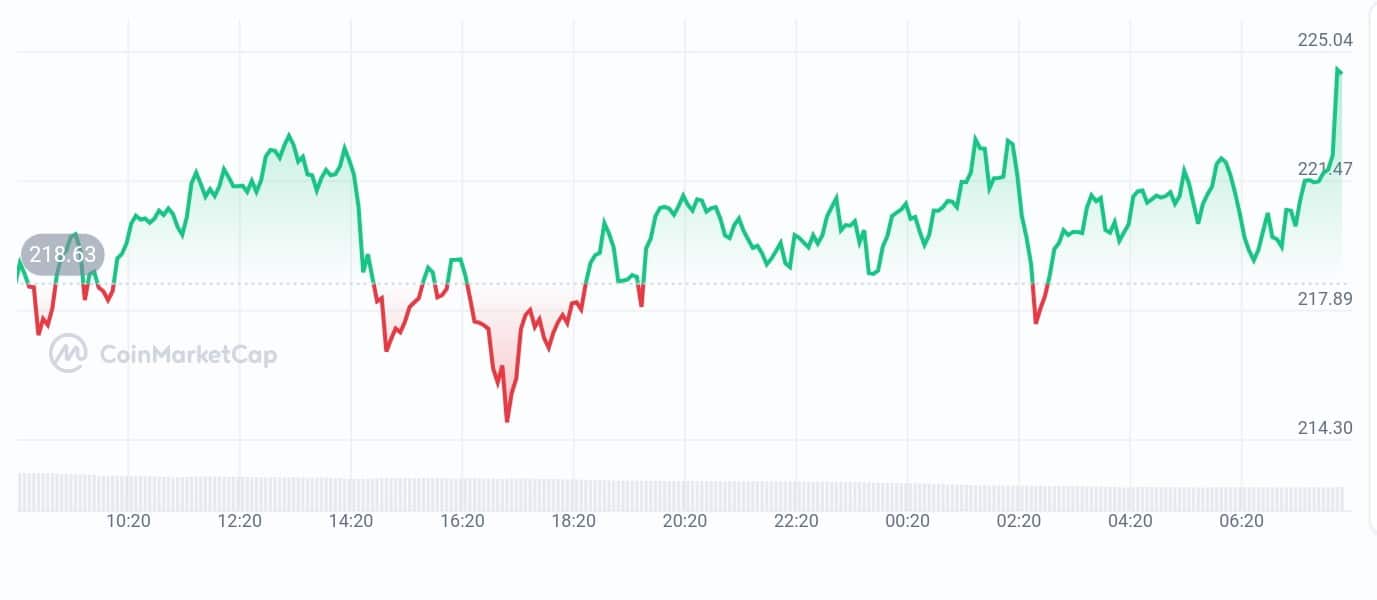
Aave is priced at $224.62, a 2.55% increase in the last 24 hours. The token has performed exceptionally well over the past week, rising by 26.61%, and has surged by 64.57% over the previous 30 days. Aave shows strong momentum with a price range between $214.73 and $225.54, reflecting positive market sentiment and investor confidence.
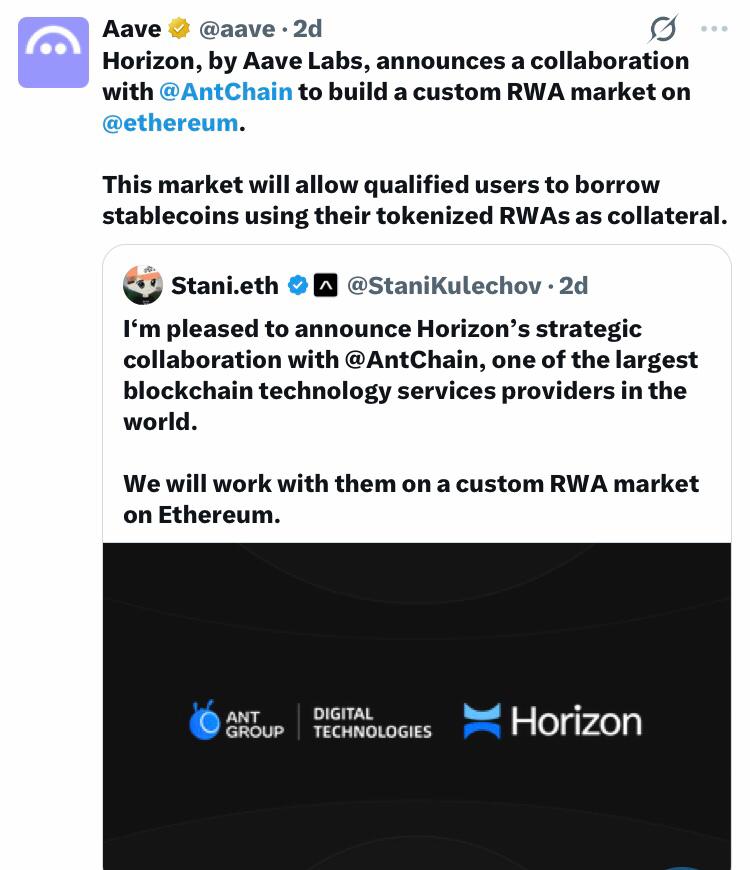
Horizon by Aave Labs has partnered with AntChain to create a custom Real-World Asset (RWA) market on Ethereum. This collaboration will enable qualified users to borrow stablecoins using tokenized RWAs as collateral, marking a significant step toward integrating real-world assets with decentralized finance.
This partnership enhances the DeFi ecosystem by bridging traditional assets with blockchain technology, providing greater liquidity and access to borrowing. This development allows investors to diversify collateral options and engage with tokenized real-world assets, unlocking new possibilities for the DeFi space.
3. SUBBD Token (SUBBD)
SUBBD is an AI-powered platform revolutionising content monetisation in the creator-subscriber economy. Combining AI tools and Web3 enables creators to manage and monetise content, efficiently cutting out middlemen. With features like AI live streams, voice generators, and a 24/7 personal assistant, SUBBD offers a decentralised alternative to platforms like OnlyFans.
The $SUBBD token powers the platform, enabling access to content, offering tips, and facilitating creator requests. Currently in presale at $0.055375, with over $376,000 raised, the token provides exclusive perks, VIP access, and a 20% annual return through staking. Ten per cent of the total supply is allocated for airdrops and rewards.
From an idea to AI generated reality, if you can describe it, you can make it on SUBBD 📷
It has also been featured on major cryptocurrency platforms, including Cryptonomist, Coinspeaker, Bitcoinist, 99Bitcoins, and TradingView via NewsBTC, highlighting its growing presence in the AI and Web3. With its increasing influence, $SUBBD is gaining rapid traction. The launch of the AI Personal Assistant further strengthens its position, offering creators continuous fan engagement and support. As AI and Web3 redefine digital content, $SUBBD shapes the future of creator income.
Raydium is an automated market maker (AMM) platform built on the Solana blockchain. It bridges liquidity and order books with Serum, Solana’s top decentralized exchange. Raydium’s AMM provides on-chain liquidity to Serum’s order book, enabling users to access the entire Serum ecosystem seamlessly.
Users can earn yield by providing liquidity through staked digital assets and participating in liquidity farming. Additionally, Raydium offers token swapping, trading, and the opportunity to participate in Initial DEX Offerings (IDOs).
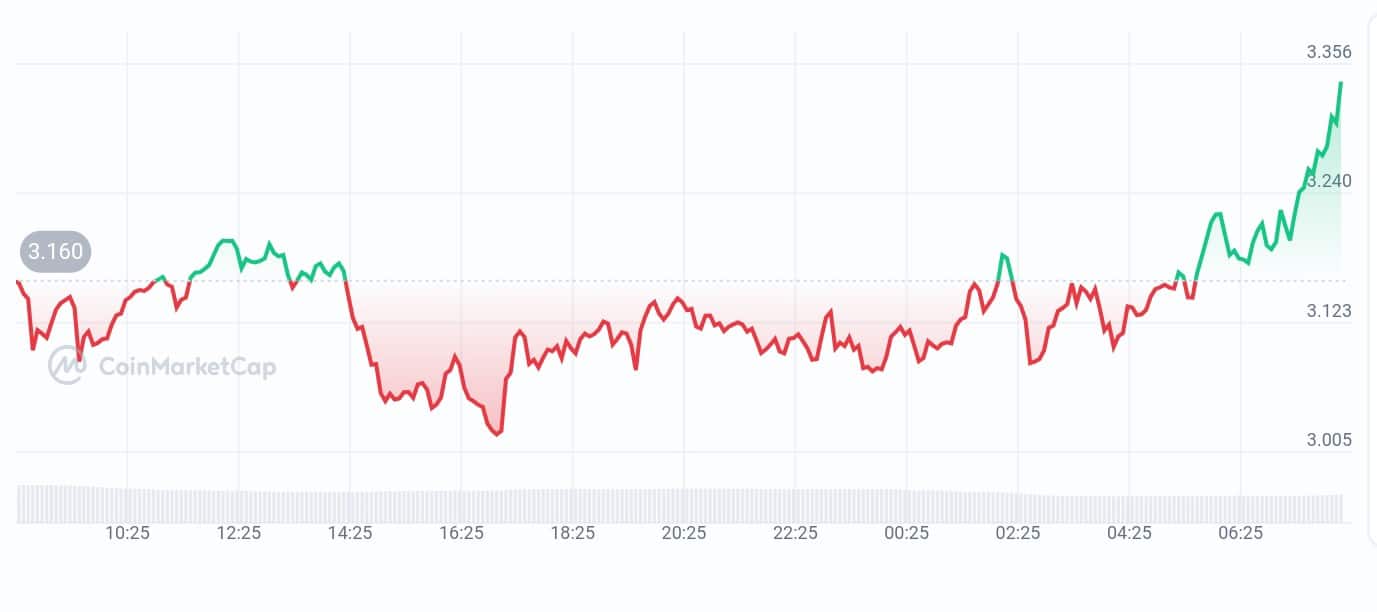
Raydium is trading at $3.34, with a notable 5.81% increase in the last 24 hours. Over the past week, it has seen a solid 23.12% gain; in the previous 30 days, the token has surged by 87.24%. With a price range of $3.00 to $3.33, Raydium’s strong performance reflects positive momentum and investor confidence, indicating a bullish sentiment in the market.
Introducing the LaunchLab Leaderboard 🏆
Trade pre-migrated LaunchLab tokens and climb the leaderboard to become eligible for daily rewards.
LaunchLab has introduced the LaunchLab Leaderboard, where users can trade pre-migrated LaunchLab tokens and earn RAY rewards based on their trading volume. The leaderboard is updated daily, and users can participate by trading tokens on any of LaunchLab’s integrated partner platforms.
This new feature gamifies the trading experience, incentivizing users to increase their trading volume to climb the leaderboard and earn rewards. It enhances the utility of LaunchLab tokens while promoting the platform’s integrated partners. For investors, it encourages active participation in the ecosystem and offers a way to earn rewards through strategic trading, boosting liquidity, and engagement.
5. Jupiter (JUP)
In November 2023, Jupiter, one of the leading DeFi tokens, became one of the largest DeFi protocols on the Solana network, reaching impressive transaction volumes. As one of the industry’s most advanced swap aggregation engines, Jupiter delivers essential liquidity infrastructure for the Solana ecosystem. Moreover, Jupiter is expanding its DeFi product offerings, featuring a comprehensive suite that includes Limit Order, DCA/TWAP, Bridge Comparator, and Perpetuals Trading.
The JUP token acts as a governance token, allowing community members to participate in decision-making processes, including the approval and voting on key aspects of the Jupiter platform.
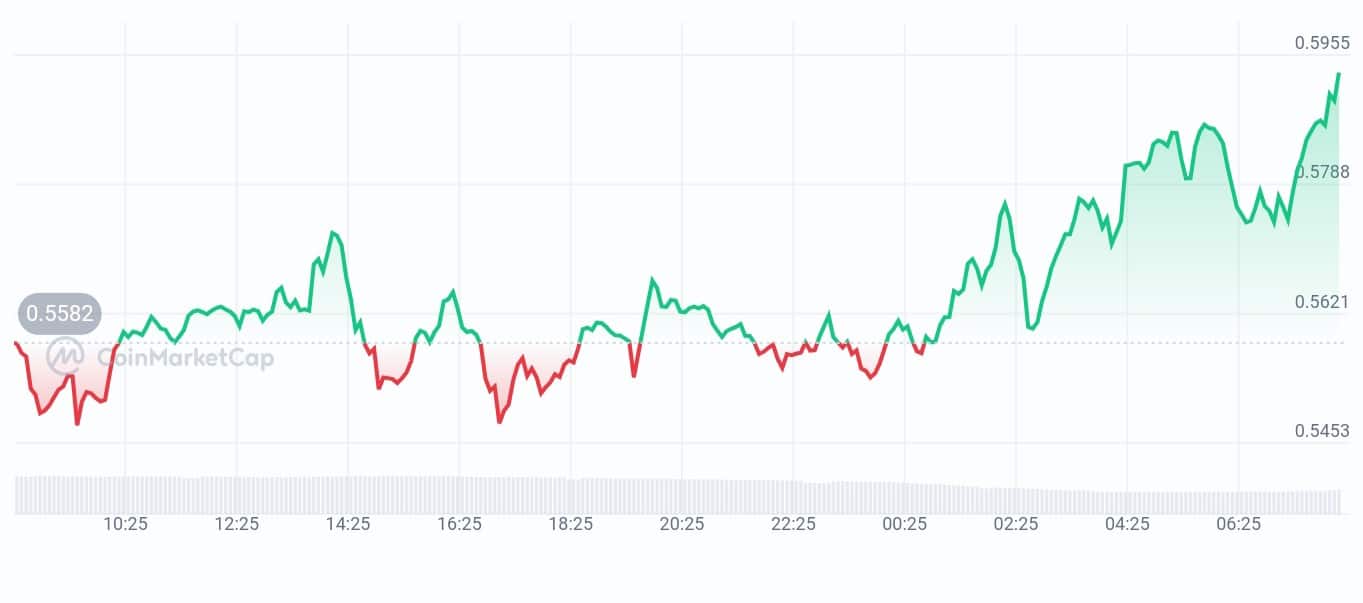
Jupiter is trading at $0.5948, reflecting a 6.35% increase in the last 24 hours. Over the past week, the token has seen a significant 37.11% gain; in the previous 30 days, it has surged by 55.08%. With a price range between $0.5475 and $0.5919, Jupiter’s strong performance signals a positive market sentiment and growing investor interest.
Jupiter Mobile has launched Universal Send, a feature that enables users to send any token—like SOL, USDC, or even meme coins—anywhere in the world with ultra-low fees. The service allows users to send money instantly without needing a wallet from the recipient; if the recipient doesn’t claim the tokens, they can be returned to the sender.
Universal Send significantly lowers the barriers to crypto adoption, making it easier for users to send and receive funds globally. By offering gasless transactions and simple claim methods, it caters to crypto enthusiasts and newcomers, enhancing the utility of Solana-based tokens in everyday transactions. For investors, this streamlines the process of onboarding new users and could expand the reach of Solana’s ecosystem into everyday financial use cases.
Read More
Best Wallet – Diversify Your Crypto Portfolio
Easy to Use, Feature-Driven Crypto Wallet
Get Early Access to Upcoming Token ICOs
Multi-Chain, Multi-Wallet, Non-Custodial
Now On App Store, Google Play
Stake To Earn Native Token $BEST
250,000+ Monthly Active Users
Join Our Telegram channel to stay up to date on breaking news coverage
Silver price plunges to near $32.15 as 90-day US-China trade truce dampens the demand for safe-haven assets.
Both the US and China agreed to lower tariffs by 115%.
Investors await Fed Powell’s speech for fresh monetary policy guidance.
Silver price (XAG/USD) is down over 1% to near $32.15 during North American trading hours on Wednesday. The white metal faces a sharp selling pressure as demand for safe-haven assets has fizzled out, with the United States (US) and China aiming to avert a more than a month-long trade war.
The white metal outperformed when the world’s two largest powerhouses entered a trade war after Beijing announced counter-tariffs against reciprocal tariffs imposed by US President Donald Trump in April.
Additionally, easing inflationary pressures have also diminished the demand for Silver. The US Consumer Price Index (CPI) data showed on Tuesday that the headline inflation fell to 2.3%, the lowest level seen in over four years.
Going forward, the next trigger for the Silver price will be the Federal Reserve (Fed) Chair Jerome Powell’s speech on Thursday. Investors would like to know whether Powell has turned dovish on the interest rate outlook after soft inflation data and a temporary US-China trade truce.
Silver technical analysis
Silver price trades in a Symmetrical Triangle formation on a four-hour timeframe. The chart pattern reflects indecisiveness among market participants. The near-term trend of the white metal is bearish as it trades below the 20-period Exponential Moving Average (EMA), which is around $32.70.
The 14-period Relative Strength Index (RSI) oscillates inside the 40.00-60.00 range, indicating a sharp volatility contraction.
Looking up, the March 28 high of $34.60 will act as key resistance for the metal. On the downside, the April 11 low of $30.90 will be the key support zone.
Silver four-hour chart
Silver FAQs
Silver is a precious metal highly traded among investors. It has been historically used as a store of value and a medium of exchange. Although less popular than Gold, traders may turn to Silver to diversify their investment portfolio, for its intrinsic value or as a potential hedge during high-inflation periods. Investors can buy physical Silver, in coins or in bars, or trade it through vehicles such as Exchange Traded Funds, which track its price on international markets.
Silver prices can move due to a wide range of factors. Geopolitical instability or fears of a deep recession can make Silver price escalate due to its safe-haven status, although to a lesser extent than Gold’s. As a yieldless asset, Silver tends to rise with lower interest rates. Its moves also depend on how the US Dollar (USD) behaves as the asset is priced in dollars (XAG/USD). A strong Dollar tends to keep the price of Silver at bay, whereas a weaker Dollar is likely to propel prices up. Other factors such as investment demand, mining supply – Silver is much more abundant than Gold – and recycling rates can also affect prices.
Silver is widely used in industry, particularly in sectors such as electronics or solar energy, as it has one of the highest electric conductivity of all metals – more than Copper and Gold. A surge in demand can increase prices, while a decline tends to lower them. Dynamics in the US, Chinese and Indian economies can also contribute to price swings: for the US and particularly China, their big industrial sectors use Silver in various processes; in India, consumers’ demand for the precious metal for jewellery also plays a key role in setting prices.
Silver prices tend to follow Gold’s moves. When Gold prices rise, Silver typically follows suit, as their status as safe-haven assets is similar. The Gold/Silver ratio, which shows the number of ounces of Silver needed to equal the value of one ounce of Gold, may help to determine the relative valuation between both metals. Some investors may consider a high ratio as an indicator that Silver is undervalued, or Gold is overvalued. On the contrary, a low ratio might suggest that Gold is undervalued relative to Silver.
GBP/JPY retraces to near 194.45 from the four-month high of 196.50 as the Japanese Yen outperforms.
BoJ’s Uchida expressed confidence in more interest rate hikes ahead.
The UK economy is expected to have grown strongly by 0.6% in the January-March period.
The GBP/JPY pair corrects to near 194.45 during European trading hours on Wednesday from its four-month high of 196.40 posted earlier in the day. The cross retraces sharply as the Japanese Yen (JPY) strengthens across the board after comments from Bank of Japan (BoJ) Deputy Governor Shinichi Uchida indicated that hopes of further interest rate hikes are still alive despite global economic uncertainty in the wake of tariffs announced by United States (US) President Donald Trump.
Japanese Yen PRICE Today
The table below shows the percentage change of Japanese Yen (JPY) against listed major currencies today. Japanese Yen was the strongest against the Australian Dollar.
USD
EUR
GBP
JPY
CAD
AUD
NZD
CHF
USD
-0.32%
-0.21%
-0.98%
-0.00%
0.04%
-0.12%
-0.41%
EUR
0.32%
0.12%
-0.66%
0.32%
0.36%
0.18%
-0.09%
GBP
0.21%
-0.12%
-0.80%
0.20%
0.24%
0.06%
-0.21%
JPY
0.98%
0.66%
0.80%
0.98%
1.02%
0.84%
0.56%
CAD
0.00%
-0.32%
-0.20%
-0.98%
0.04%
-0.12%
-0.40%
AUD
-0.04%
-0.36%
-0.24%
-1.02%
-0.04%
-0.16%
-0.45%
NZD
0.12%
-0.18%
-0.06%
-0.84%
0.12%
0.16%
-0.28%
CHF
0.41%
0.09%
0.21%
-0.56%
0.40%
0.45%
0.28%
The heat map shows percentage changes of major currencies against each other. The base currency is picked from the left column, while the quote currency is picked from the top row. For example, if you pick the Japanese Yen from the left column and move along the horizontal line to the US Dollar, the percentage change displayed in the box will represent JPY (base)/USD (quote).
Japan’s underlying inflation and medium- to long-term inflation expectations are likely to temporarily stagnate. But even during that period, wages are expected to continue rising as Japan’s job market is very tight, Uchida said on Tuesday, Reuters reported.
Meanwhile, the Pound Sterling (GBP) trades calmly ahead of the flash United Kingdom (UK) Q1 Gross Domestic Product (GDP) data, which will be released on Thursday. The UK economy is estimated to have expanded at a robust pace of 0.6%, compared to 0.1% growth seen in the last quarter of 2024.
On the monetary policy front, the Bank of England (BoE) is expected to reduce interest rates further as the UK labor market has cooled down. The Office for National Statistics (ONS) reported that the ILO Unemployment Rate accelerated to 4.5%, as expected, from 4.4% in the three months ending February. In the same period, the economy added 112K fresh workers, significantly lower than the prior release of 206K.
GBP/JPY struggles to extend its upside above the horizontal resistance plotted from the March 27 high of 196.00. However, the outlook of the cross is still bullish as the 20-day Exponential Moving Average (EMA) slopes higher, which trades around 192.32.
The 14-day Relative Strength Index (RSI) retraces to near 60.00 from 67.00. A fresh bullish momentum would emerge if the RSI holds above the 60.00 level.
The pair could extend its upside to near the January 7 high of 198.26 and the psychological level of 200.00 after breaking above the four-month high of 196.40.
On the flip side, a downside move by the pair below the May 6 low of 190.33 will expose it to the March 11 low of 188.80, followed by the February 7 low of 187.00.
GBP/JPY daily chart
Economic Indicator
Gross Domestic Product (QoQ)
The Gross Domestic Product (GDP), released by the Office for National Statistics on a monthly and quarterly basis, is a measure of the total value of all goods and services produced in the UK during a given period. The GDP is considered as the main measure of UK economic activity. The QoQ reading compares economic activity in the reference quarter to the previous quarter. Generally, a rise in this indicator is bullish for the Pound Sterling (GBP), while a low reading is seen as bearish.