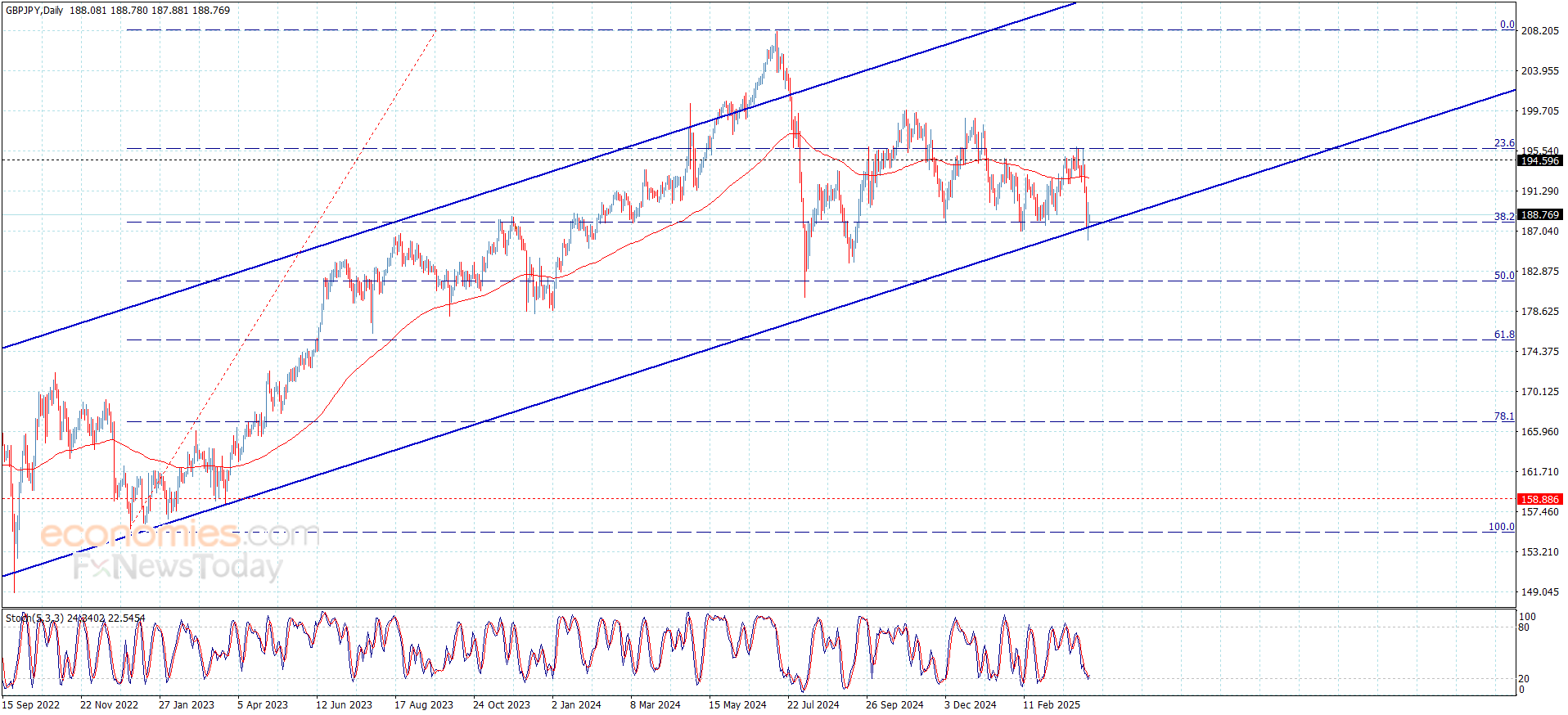
The GBPJPY pair succeeded to face the negative pressures by its rally above the critical support at 187.50, increasing the chances for its stability within the bullish channel’s levels and begin forming bullish waves, noticing its stability near 188.70.
Note that forming more of the bullish attempts is important to surpass the obstacle at 189.60 level, reinforcing the chances for recording extra gains that might extend towards 190.30 and 191.45, while the failure to breach the obstacle will force the price to provide mixed trading, we should confirm that monitoring the price is important in case declining to the critical support, to avoid any losses that might be caused by exiting the bullish track.
The expected trading range for today is between 187.90 and 190.30
Doubling down on its focus on B2B functional ingredients, Clasado has sold its Bimuno consumer prebiotic range to high protein cereal brand, Eleat.
Through this acquisition, Eleat will obtain the finished product line, as well as the commercialisation license rights needed to sell a consumer product containing Bimuno GOS as the only active ingredient within the UK.
Clasado will still have full ownership of the galactooligosaccharide prebiotic, which the company will continue to provide to supplement formulators across the globe.
Recent studies involving Bimuno GOS have found that the ingredient has a prebiotic effect even at low doses, and is currently backed by health claims around its prebiotic efficacy, gut health and immunity-boosting potential.
Bimuno already a hit with consumers
The Bimuno supplement line, according to Clasado, has built a good reputation amongst consumers, with a 4.5 star rating from more than 3,900 reviews on Trustpilot.
A 2024 customer satisfaction survey also revealed that 94% of customers taking Bimuno daily noticed improvements in digestion and general gut health.
“The divestment of our finished product, consumer-targeted range represents an exciting new chapter for Clasado, allowing us to focus on our core strengths and dedicate our effects to providing prebiotic functional ingredients,” said Clasado’s CEO, Per Rehné.
“Gut health has become very important on a global level, and our team is looking forward to building on the success of our science-backed biotic, Bimuno GOS,” he added.
This decision comes at a time when research from McKinsey reveals that more than 80% of consumers view gut health as important, and 50% predict it’ll be a priority for them within the next two to three years.
“As a breakthrough brand in the healthy breakfast space, we’re keen to help people eat well, and this acquisition supports that goal,” commented Hywel Rose, Co-founder at Eleat.
“The Bimuno supplement range is established and scientifically backed, and will help us diversify our product portfolio to accelerate growth. We see tremendous potential for this product in the UK market, and we’re excited to take it forward.”
Over time, the Bimuno supplement range will transition to Eleat’s brand architecture.
Cardano price prediction shows a potential rebound after a 47% YTD drop, with institutional backing and bullish signals suggesting a recovery is on the horizon.
After a rough start to 2025, Cardano is back in focus. The ADA Cardano price has dropped nearly 47% year-to-date, caught in the crossfire of global tariff tensions and a broader market pullback. But now, it’s hovering near a level where buyers have stepped in before, and some early signals suggest they might be circling again.
At the same time, institutional players like Grayscale are doubling down, and key indicators are hinting at a possible reversal. With sentiment still shaky but not broken, ADA could be setting up for a positive move.
Markets Rattled as Tariff Wars Spark Crypto Sell-Off
A fresh wave of volatility has hit the crypto market, triggered by tariff tensions between global countries. With investors turning risk-averse, top digital assets have faced sharp declines since the start of 2025. In a recent post, CryptoDiffer highlighted how macro pressure continues to weigh heavily on the crypto landscape, with Bitcoin, Ethereum, and even ADA posting deep pullbacks. Geopolitical and economic uncertainty is casting a long shadow over risk assets.
Cardano price down 47% YTD as global macro tensions spark renewed crypto market sell-off. Source: CryptoDiffer via X
As noted, the Cardano price hasn’t escaped the damage, shedding nearly 47% YTD. Bearish momentum still lingers as macro headwinds weigh heavy, but not all is lost. ADA is now hovering near a historically significant zone where reversals have occurred before. With steady network upgrades and a loyal holder base, a bounce is still on the table if sentiment stabilizes. For now, it’s a battle between short-term fear and long-term conviction.
Cardano Climbs the Ranks in Grayscale’s Smart Contract Fund
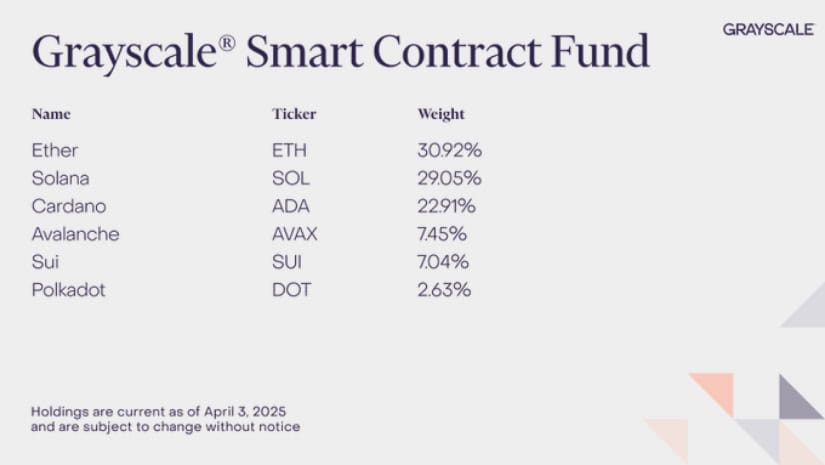
Cardano just scored a quiet win in the institutional space. In its latest rebalancing, Grayscale has increased ADA’s share to 22.91% within its Smart Contract Fund, pushing it up to become the third-largest holding in the basket. This move places Cardano ahead of Avalanche, Polkadot, and Sui combined, signaling continued institutional interest in the protocol’s long-term potential.
Grayscale boosts Cardano to 22.91% of its Smart Contract Fund. Source: Mintern via X
Analyst MinTern notes that while it’s not a flashy pump headline, it does speak volumes about confidence in Cardano’s fundamentals. In a market where investor trust is hard to earn, this reallocation suggests that Grayscale sees real staying power in ADA’s ecosystem.
Cardano Price Flashes Bullish Signals
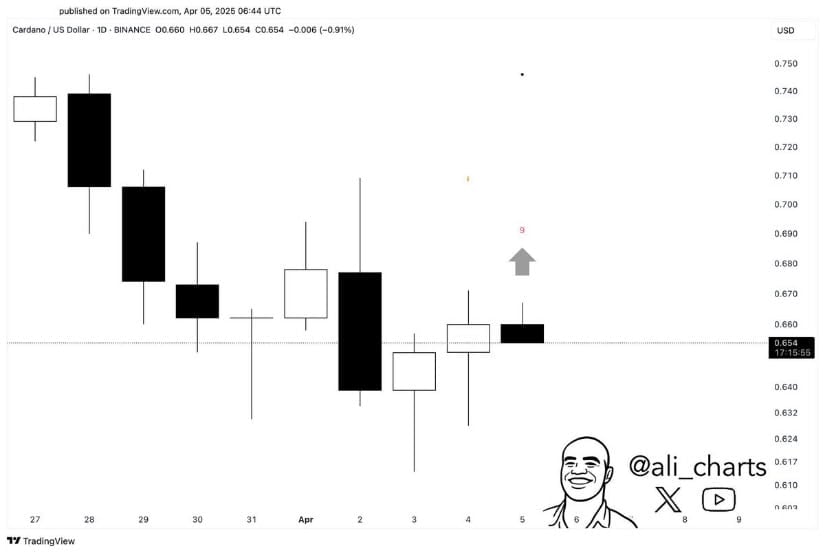
Despite broader market weakness, Cardano just delivered a glimmer of hope for ADA bulls. According to crypto analyst Ali Martinez, the TD Sequential indicator has flashed a daily buy signal, often seen ahead of short-term trend reversals.
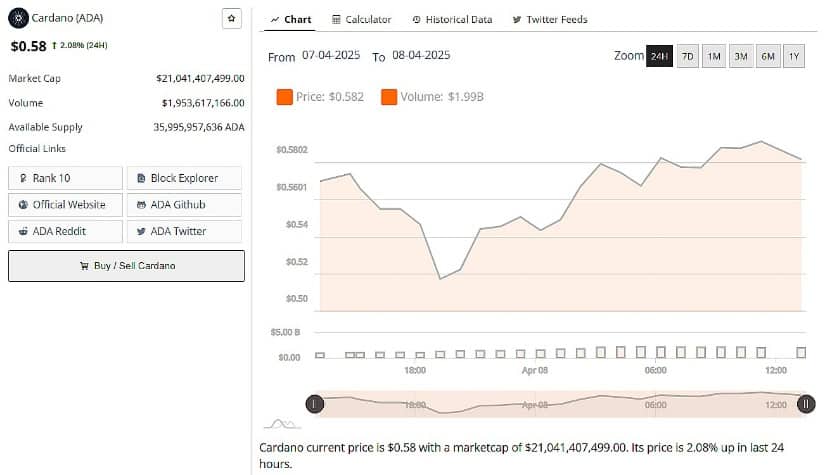
The pattern suggests ADA could be preparing for a rebound after trading in the $0.58–$0.60 zone, where price action has historically found support.
Cardano flashes a TD Sequential buy signal as bulls eye a rebound from key support. Source: Ali Martinez via X
While the macro landscape still leans bearish, Bitcoin has quickly rebounded from its initial tariff induced low of $74,900 and this Cardano technical cue adds weight to a potential relief rally. If momentum holds, ADA could look to reclaim $0.66 and possibly retest $0.70 in the short term. That said, a breakdown below $0.50 would invalidate the setup and expose ADA to further downside. The next few daily closes could be crucial in deciding whether Cardano finds its footing or continues to drift lower.
Long Positions Surge as Traders Lean on ADA Reversal
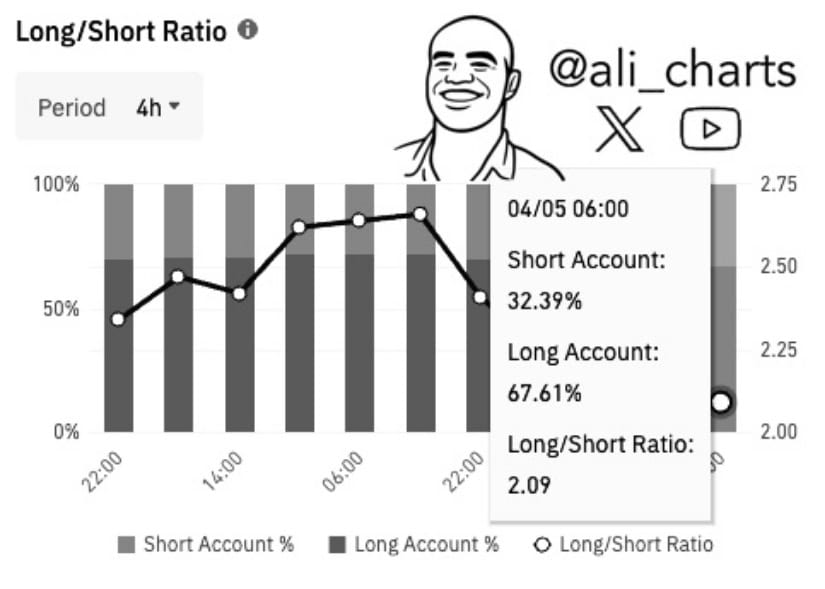
While Cardano’s price continues to wrestle with macro pressure, trader sentiment is beginning to tilt bullish. According to on-chain analyst Ali Martinez, 67.61% of traders on Binance Futures are currently holding long positions on ADA, with a long/short ratio of 2.09. This suggests that despite short-term uncertainty, a majority of participants are positioning for a potential upside move.
Over 67% of Binance Futures traders are long on ADA. Source: Ali Martinez via X
The data highlights that technical indicators, such as the TD Sequential, are signaling potential reversals. Martinez’s data shows that traders are quietly front-running a bounce, betting that ADA’s historical support zones will hold firm once again.
Cardano Price Prediction: Technical Outlook
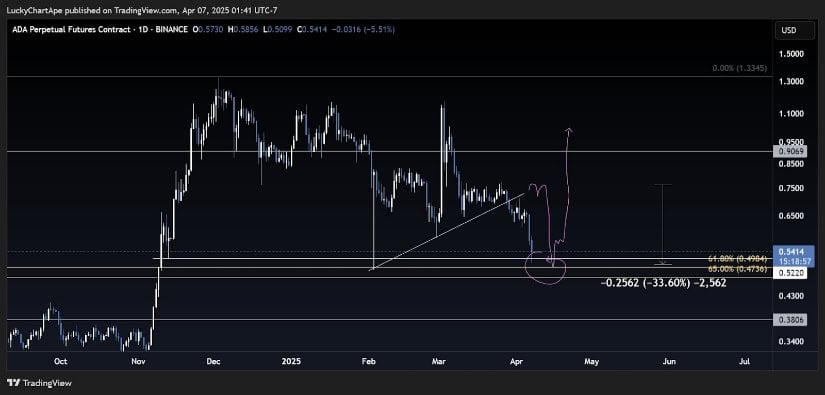
According to analyst LuckyChartApe, Cardano’s price is currently sitting at a key technical zone between $0.52 and $0.47, an area that aligns with the 61.8% and 65% Fibonacci retracement levels. These levels have historically attracted buying interest, making this a potentially important area to monitor. While ADA has seen a steep decline, this zone could act as a pivot if buyers step in with enough momentum.
Cardano tests key Fibonacci support between $0.52 and $0.47, with upside potential toward $0.90. Source: LuckyChartApe via X
As part of this Cardano price prediction, the analyst notes that if ADA can hold this level and start building a base, a move toward $0.66 might be on the table, and possibly even $0.90 if broader sentiment improves. But if this support breaks down, the drop can take out even the $0.38 level support.
Final Thoughts: What’s Next for the ADA Cardano Price?
The ADA Cardano price is at important support levels, and how it reacts here could shape its next move. If buyers step in and the price gets back above $0.63, there’s a chance it could slowly work its way back toward $0.66 or even $0.90 if the broader market improves. But if that level breaks, ADA might see a deeper pullback, possibly toward $0.38. For now, it’s a wait-and-see situation as the market looks for direction.
The Silver price gains ground to near $30.15 in Tuesday’s Asian session.
The negative outlook of the index remains intact with a bearish RSI indicator.
The first support level to watch is $30.00; the first upside barrier is seen at $30.85.
The Silver price (XAG/USD) posts modest gains around $30.15 during the Asian trading hours on Tuesday. The upside for the white metal might be limited due to investors liquidating positions to secure profits, possibly covering losses or margin calls on falling asset valuations, fueled by concerns about a global trade war. Nonetheless, the weaker Greenback might help limit the USD-denominated commodity price’s losses.
According to the daily chart, the bearish sentiment of the Silver remains in play as the price remains capped below the key 100-day Exponential Moving Average (EMA). Furthermore, the downward momentum is supported by the 14-day Relative Strength Index (RSI), which stands below the midline near 32.70, supporting the sellers in the near term.
The first downside target for the XAG/USD emerges at the $30.00 psychological level. Further south, the next contention level is seen at $28.80, the low of December 20, 2024. The additional downside filter to watch is $28.31, the low of April 7.
On the bright side, the immediate resistance level is located at $30.85, the high of January 21. Any follow-through buying above this level could pave the way to $31.77, the 100-day EMA. A decisive break above the mentioned level could see a rally to $33.20, the high of February 20.
Silver price (XAG/USD) daily chart
Silver FAQs
Silver is a precious metal highly traded among investors. It has been historically used as a store of value and a medium of exchange. Although less popular than Gold, traders may turn to Silver to diversify their investment portfolio, for its intrinsic value or as a potential hedge during high-inflation periods. Investors can buy physical Silver, in coins or in bars, or trade it through vehicles such as Exchange Traded Funds, which track its price on international markets.
Silver prices can move due to a wide range of factors. Geopolitical instability or fears of a deep recession can make Silver price escalate due to its safe-haven status, although to a lesser extent than Gold’s. As a yieldless asset, Silver tends to rise with lower interest rates. Its moves also depend on how the US Dollar (USD) behaves as the asset is priced in dollars (XAG/USD). A strong Dollar tends to keep the price of Silver at bay, whereas a weaker Dollar is likely to propel prices up. Other factors such as investment demand, mining supply – Silver is much more abundant than Gold – and recycling rates can also affect prices.
Silver is widely used in industry, particularly in sectors such as electronics or solar energy, as it has one of the highest electric conductivity of all metals – more than Copper and Gold. A surge in demand can increase prices, while a decline tends to lower them. Dynamics in the US, Chinese and Indian economies can also contribute to price swings: for the US and particularly China, their big industrial sectors use Silver in various processes; in India, consumers’ demand for the precious metal for jewellery also plays a key role in setting prices.
Silver prices tend to follow Gold’s moves. When Gold prices rise, Silver typically follows suit, as their status as safe-haven assets is similar. The Gold/Silver ratio, which shows the number of ounces of Silver needed to equal the value of one ounce of Gold, may help to determine the relative valuation between both metals. Some investors may consider a high ratio as an indicator that Silver is undervalued, or Gold is overvalued. On the contrary, a low ratio might suggest that Gold is undervalued relative to Silver.
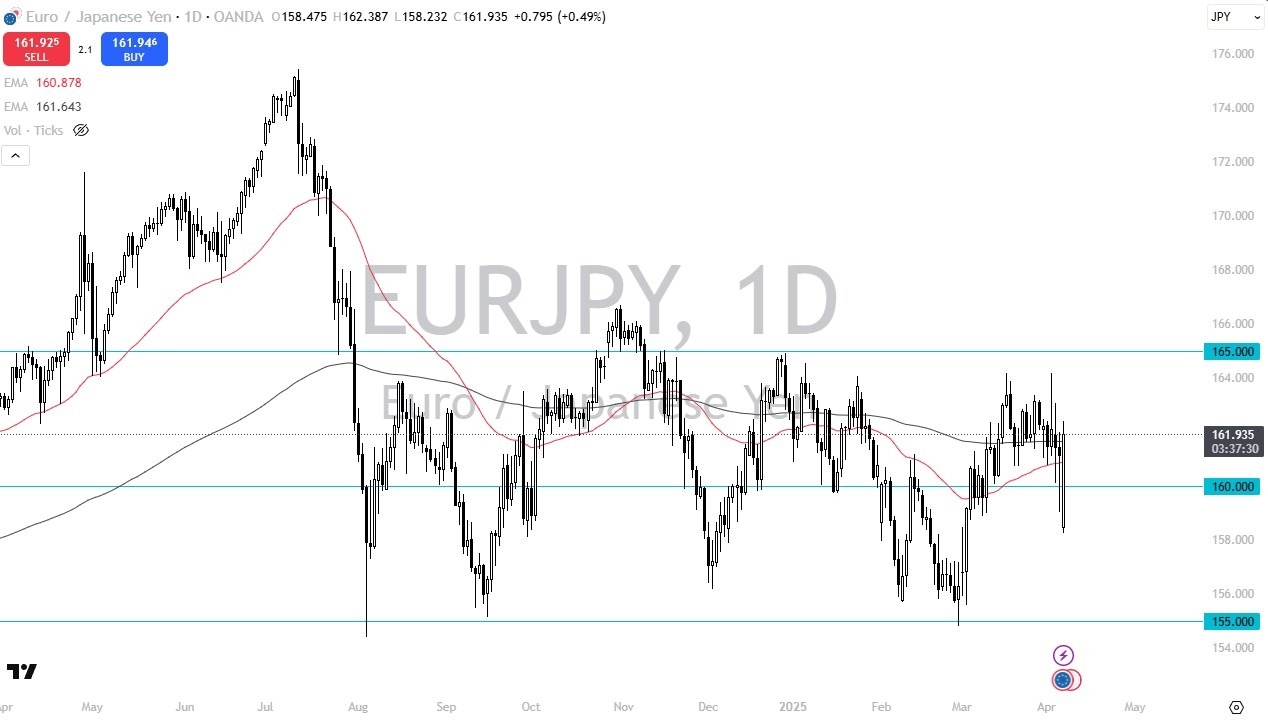
The euro initially gapped lower against the Japanese yen during trading on Monday, only to turn around and skyrocket to the upside.
All things being equal, this is a pair that is going to continue to be very noisy because a lot of traders out there are concerned about the global economy.
As long as that’s going to be the case, there could still be traders out there looking to buy the Japanese yen for some type of safety, especially now that the Bank of Japan has at least paid some interest into the idea of tightening monetary policy.
Technical Analysis
The technical analysis for this pair is actually fairly neutral, perhaps even starting to show signs of positivity, as the initial gapped lower look terrific, but the market was resilient enough to turn things around. That’s a good sign, and it does suggest that perhaps we are at least going to try to stay in the same range we have been in for a bit of normalcy. If that’s going to be the case, then I think we could go looking to the ¥165 level, but we need a little bit of positivity to make that happen easily.
On the other hand, if we do break down below the ¥160 level, then we will probably start to see the market reach down to the ¥158 level, the region that we had bounce from earlier in the session on Monday. Anything underneath there, then we probably see the euro drop down to the ¥155 level. This is an area that’s been important multiple times, so you need to be cognizant that this could happen, and you also need to recognize that it has been so well supported in the past that might end up being a nice buying opportunity based on value. Regardless, this is a market that I think continues to bounce around quite violently, just like the rest of the financial markets.
It feels like everyone is drinking matcha these days. Every time I open Instagram, someone’s busy whisking up a cup. I asked a nutritionist friend if it actually had any real benefits, and she said it’s a great alternative to coffee for an energy boost.
“Matcha gives you sustained energy because it comes from a concentrated form of green tea,” explains nutritionist Mariana Perez Trejo, who drinks it regularly. “Coffee causes a sharp energy spike—that’s why you feel like you need cup after cup just to keep going.”
When she told me it helps with fatigue, I was intrigued. But, as she warned, the quality of the matcha really matters. “If it’s not high quality, you miss out on most of its benefits.”
So I decided to dig deeper—turn to the experts, figure out what makes matcha actually healthy (or not) and understand its benefits.
What are the benefits of matcha?
Matcha, in itself, is great for your health. “Green tea in powdered form lets you consume the entire leaf, which is where all its benefits are concentrated,” explains food coach Giovanna Alva. “One of its biggest advantages is its high antioxidant content, especially EGCG (epigallocatechin gallate), which is known for fighting cellular ageing and reducing inflammation.”
What does matcha do in the body?
Alva also notes that matcha helps improve focus and mental calm. “It contains theine, which is combined with L-theanine—an amino acid that smooths out the effects of theine, promoting a steady state of alertness without the sharp spikes or crashes you get from coffee.”
He adds that L-theanine also boosts the production of dopamine and serotonin—AKA the “happy hormones.” “That’s why people say matcha ‘activates’ you without overstimulating the nervous system. It’s a gentler option, especially for those prone to anxiety or nervousness,” says Alva.
And the benefits don’t stop there. According to the nutrition expert, matcha also stimulates metabolism, helps regulate blood sugar levels, and supports the immune system. “That’s thanks to its high concentration of polyphenols and vitamins C, A, and E.”
What are the downsides of matcha?
“If it’s not high quality, matcha can contain heavy metals and lead due to soil contamination where it’s grown,” warns Giovanna Alva. “It can also cause acidity or digestive discomfort in people with sensitive stomachs—especially if consumed on an empty stomach.”
Dogecoin price broke below long-term trendline, with analysts forecasting a potential 59% drop to $0.060
Bullish divergence on the RSI hints at possible recovery despite recent decline
A whale transferred 300M DOGE to Binance, adding uncertainty amid technical breakdown
DOGE has fallen 22% from Saturday’s high of $0.171
Social media engagement and active addresses have declined, suggesting recovery challenges
Dogecoin price has been experiencing heavy volatility in recent days. The popular meme cryptocurrency has fallen by 22% from Saturday’s high of $0.171, with analysts now predicting a potential 59% drop. Technical indicators suggest DOGE might be heading toward a major price correction in the coming weeks.
The price decline comes as Dogecoin broke below a long-standing ascending parallel channel that had guided its price action since 2018. This breach marks a notable technical shift in DOGE’s market structure.
According to technical analysts, the loss of this key trendline support suggests growing bearish momentum. The breakdown coincides with rejection at the 0.786 Fibonacci retracement level, located at approximately $0.16395.
Experts note that the next major support level for Dogecoin lies at the 0.618 Fibonacci retracement, which is around $0.06167. This level aligns with previous consolidation zones, making it an important focus point for traders.
Adding to market uncertainty, a whale has transferred 300 million Dogecoin, valued at around $41.7 million, to the Binance exchange. Such large transfers often precede selling pressure or major position adjustments.
Signs of Potential Recovery
Despite the bearish outlook, there are hints of a possible recovery. Crypto trader Trader Tardigrade points out a bullish divergence on Dogecoin’s daily chart.
This pattern emerges when price moves lower while the Relative Strength Index (RSI) bounces and posts higher lows. The divergence suggests selling momentum may be weakening, potentially indicating a price reversal.
Dogecoin is currently testing the $0.135 price level, which has acted as both support and resistance in the past. This level held firm throughout a consolidation phase in early 2023, and the current price action may present a reversal pattern.
Some analysts believe that if Dogecoin can sustain these support levels, there’s a possibility that DOGE price may recover and eventually reach higher targets.
“If the price bounces from this level, we are likely to see the start of a new bull trend,” one analyst commented. However, they cautioned that if support fails, further downside movement could test $0.12 or even $0.10.
Declining On-Chain Activity Raises Concerns
On-chain metrics paint a concerning picture for Dogecoin’s short-term prospects. Daily active addresses have fallen toward levels maintained since January, after seeing a major uptick in November.
Social media engagement around DOGE has also been declining. The social dominance trend has been falling, with April setting new lows in social volume. This suggests that unless the price trend changes direction, attention and capital flows will continue to leave the market.
The funding rate has moved into negative figures after a week of efforts from bulls. This highlights favorable conditions for sellers in the derivatives market.
On the technical side, the one-day Dogecoin chart shows steady selling pressure since December, with the On-Balance Volume indicator slowly but steadily falling. The RSI has remained below the neutral 50 level since mid-January, indicating an ongoing bearish trend.
The $0.131 and $0.102 support levels from October 2024 are now the next price targets. The former has been tested in recent hours and could yield a bounce to the $0.154-$0.164 range.
Despite the potential for a 15% short-term bounce, the overall trend remains firmly bearish in the near term, according to market analysts.
Some market participants suggest watching for a reclaiming of the $0.18 level as a sign of a possible fakeout or short-term recovery. If Dogecoin can flip this level and close above it, further resistance levels would be set at $0.25 and $0.30.
However, if the price fails to break through the key levels at $0.18 and $0.20, the memecoin may experience a continued slowdown in its recovery attempts.
The most recent liquidation data shows $37.15 million worth of DOGE positions were liquidated across all exchanges, with $31.87 million (85.78%) being long positions.
Dogecoin’s price slide of 22.6% in 24 hours came as Bitcoin shed 10.68% of its value after panic spread across global markets due to trade war developments.
The theme for World Health Day 2025 is ‘Healthy beginnings, hopeful futures.’ This year’s theme will kick off a year-long campaign on maternal and newborn health. This initiative will encourage governments and the healthcare sector to intensify their actions to eliminate preventable maternal and newborn deaths.
Here are seven simple but powerful habits that create strong starts for mothers, babies, and families—laying the foundation for a healthier future generation.
Prioritize Prenatal Care Early and regular prenatal checkups can detect and prevent complications, monitor fetal development, and provide essential health education. They are small appointments that hold immense power for both mother and baby. Ensure expectant mothers begin antenatal visits in the first trimester and attend all scheduled appointments.
Nourish the Mother, Nurture the Baby A balanced, nutrient-rich diet during pregnancy supports a baby’s brain, bone, and organ development. It also reduces the risk of maternal anemia, gestational diabetes, and preterm birth. Include iron, folic acid, calcium, and protein-rich foods daily—and drink plenty of water.
Embrace Emotional Support Pregnancy and postpartum can be emotionally overwhelming. Compassionate conversations, community support, and mental health check-ins reduce the risk of perinatal depression and anxiety. Ask new and expectant mothers how they feel—and listen without judgment.
Promote Safe Birth Practices Skilled birth attendance is critical for safe deliveries. Choosing a trained midwife or healthcare provider reduces risks for both mother and newborn, especially in emergencies. Advocate for safe birthing spaces and emergency care—every woman deserves a safe delivery, no matter where she lives.
Champion Breastfeeding from Hour One Initiating breastfeeding within the first hour of birth strengthens immunity, promotes bonding, and reduces neonatal mortality. Exclusive breastfeeding for six months offers optimal nutrition and protection. Target educating families about the benefits of colostrum—the “first milk”—and the importance of skin-to-skin contact.
Encourage Vaccinations and Newborn Screening Vaccinations during pregnancy (like tetanus and influenza) protect both mom and baby. Early newborn screenings help detect and treat life-threatening conditions before symptoms appear. Keep a clear record of vaccinations, and schedule newborn screenings within the first few days after birth.
Build a Village of Care Public health is personal—but it’s also collective. Family, friends, health workers, and policymakers all play a role in ensuring that no mother or child is left behind. Support maternal health drives, donate to newborn care kits, oroffer help to a new mom in your neighborhood.
Every mother deserves a safe pregnancy. Every newborn deserves a strong start. And every small action—from a shared meal to a timely checkup—can shape a healthier, more hopeful future for generations to come.
This World Health Day, let’s champion the quiet, powerful beginnings that make all the difference.
Disclaimer The Content is not intended to be a substitute for professional medical advice, diagnosis, or treatment. Always seek the advice of your physician or other qualified health provider with any questions you may have regarding a medical condition.
XRP rebounds after immense volatility in recent days, triggered by US President Donald Trump’s reciprocal tariffs.
A negative MVRV ratio signals that XRP is significantly undervalued, calling on traders to buy the token.
A noticeable decline in the network’s on-chain activities could slow recovery.
Ripple (XRP) seeks stability in a volatile crypto landscape influenced by macroeconomic factors, including reciprocal tariffs. The international money transfer token hit a low of $1.64 on Monday after opening the week at $1.92, representing a 14.5% daily drop. At the time of writing on Tuesday, during the late Asian session, XRP had recovered Monday losses, exchanging hands at $1.92, as global markets continue to adjust and digest United States (US) President Donald Trump’s ever-changing tariff policy.
XRP rebound targets $2 as President Trump maintains tariff tune
After a gruesome sell-off on Monday, major assets like Bitcoin (BTC), Ethereum (ETH), and Solana (SOL) are bouncing back. Trump’s blanket 10% reciprocal tariffs announced on April 2 will be effective on Wednesday.
Despite the bleeding in global markets, including US stocks, Trump insisted during a press conference with Israeli Prime Minister Benjamin Netanyahu on Monday that tariffs would continue as planned. The president seemed to add fuel to the fire, threatening an additional 50% tariff on China.
It is not immediately clear whether the recovery in XRP price to $1.92 is sustainable, especially with tariffs taking effect in just a day. Meanwhile, some on-chain fundamentals support the beginning of a larger rebound, calling on investors to consider buying XRP at current levels.
Santiment’s Market Value Realized Value (MVRV) metric holds 9.47% below the mean at 1 in the chart, suggesting that XRP is heavily undervalued. Traders holding the XRP token are unlikely to sell at the current price as they would realize substantial losses. This situation could translate to reduced selling pressure, hinting at a potential rebound amid growing seller exhaustion. A negative MVRV ratio has historically been viewed as a buy signal.
XRP MVRV | Source: Santiment
Can XRP sustain a recovery above $2?
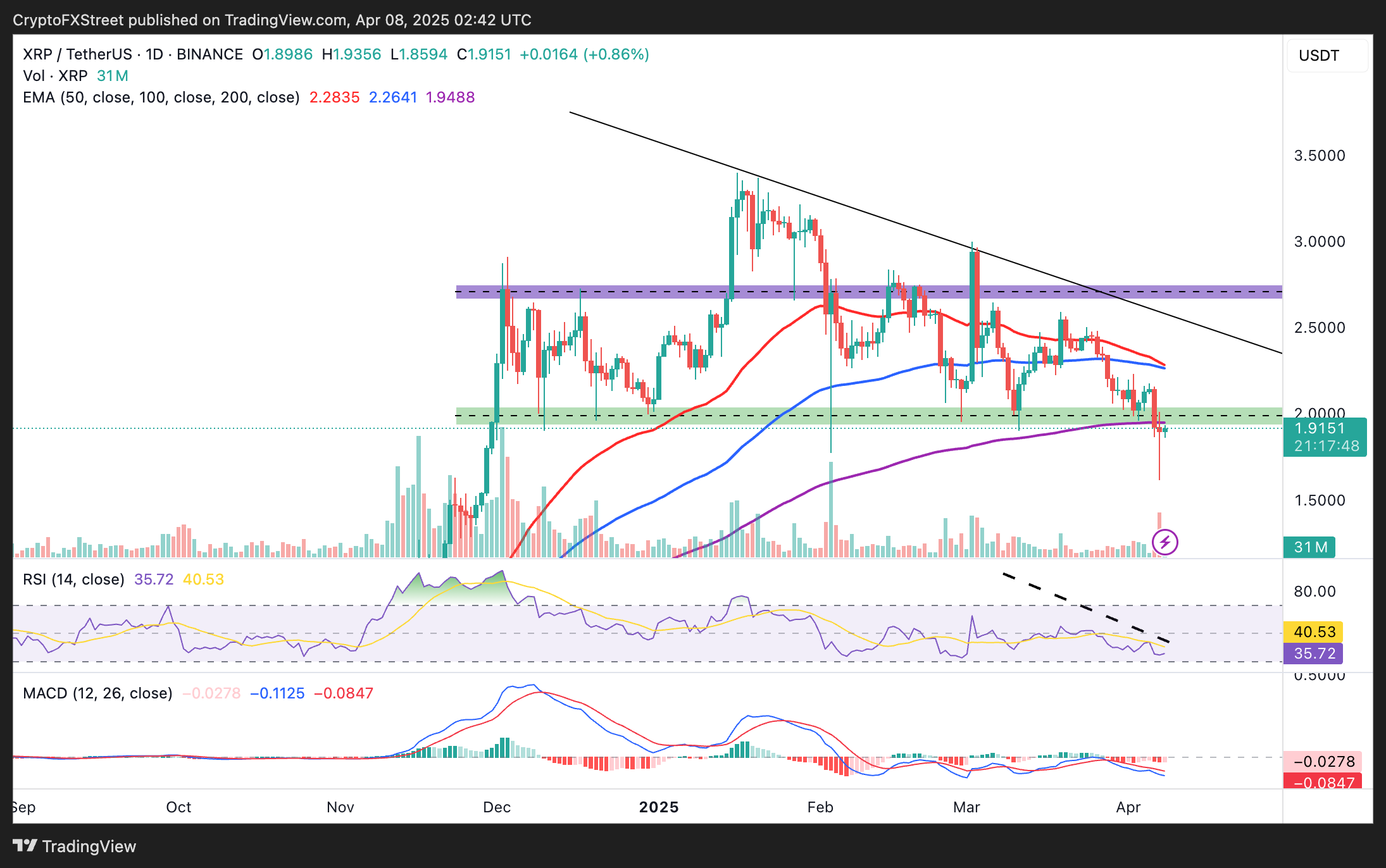
XRP could rejuvenate its bullish structure if support at $2 is reclaimed. However, bulls must first navigate a volatile landscape to keep the price higher, including a daily close above the 200-day Exponential Moving Average (EMA). Moreover, the Relative Strength Index (RSI) continues to slide toward the oversold region, which may encourage sellers to stay put. At the same time, the Moving Average Convergence Divergence (MACD) indicator sustained a sell signal on March 28, suggesting a deeper downtrend is in play.
XRP/USDT daily chart
All eyes are set on the bull’s ability to reclaim the $2.00 level as support — a move that could reinforce XRP’s bullish structure and pave the way for recovery to $3.00.
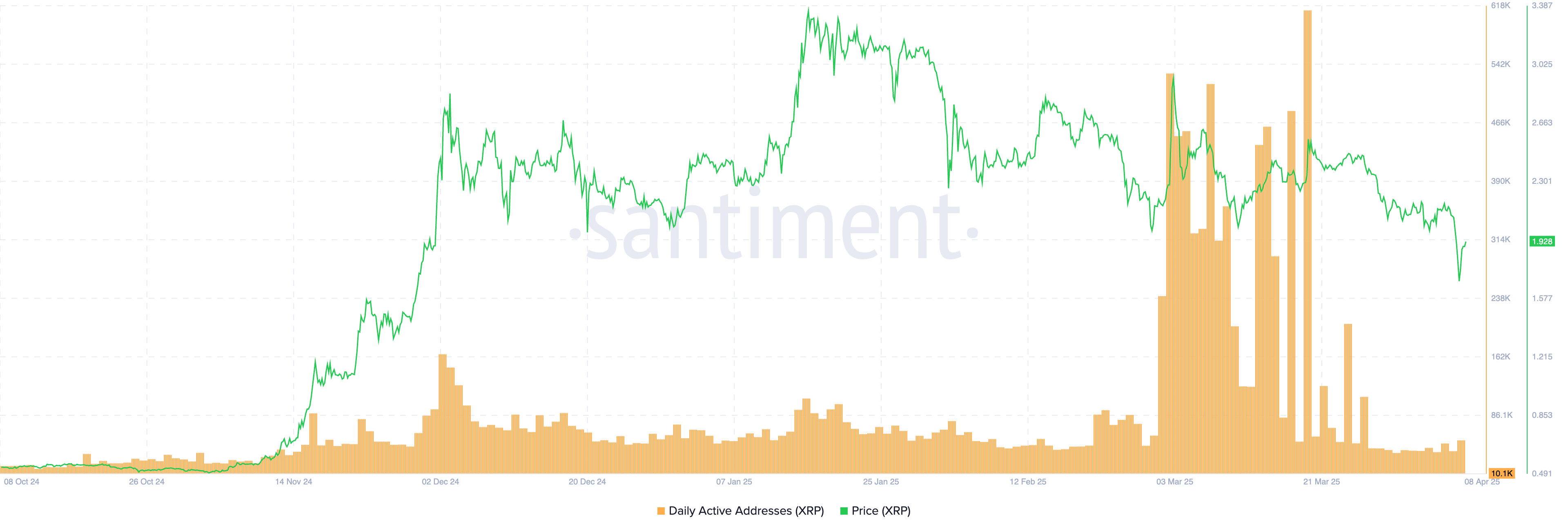
However, the declining network activity observed with Santiment’s Daily Active addresses metric could slow recovery. As per the chart, only 10,100 addresses were active on the network on Monday compared to 581,000 addresses on March 19.
XRP Daily Active Addresses | Source: Santiment
A consistent drop in network activity impacts the underlying asset’s performance, depriving it of momentum to sustain recovery due to low demand. Hence, waiting for a trend confirmation before going all in and buying the dip would be prudent.
SEC vs Ripple lawsuit FAQs
It depends on the transaction, according to a court ruling released on July 14, 2023:
For institutional investors or over-the-counter sales, XRP is a security.
For retail investors who bought the token via programmatic sales on exchanges, on-demand liquidity services and other platforms, XRP is not a security.
The United States Securities & Exchange Commission (SEC) accused Ripple and its executives of raising more than $1.3 billion through an unregistered asset offering of the XRP token.
While the judge ruled that programmatic sales aren’t considered securities, sales of XRP tokens to institutional investors are indeed investment contracts. In this last case, Ripple did breach the US securities law and had to pay a $125 million civil fine.
The ruling offers a partial win for both Ripple and the SEC, depending on what one looks at.
Ripple gets a big win over the fact that programmatic sales aren’t considered securities, and this could bode well for the broader crypto sector as most of the assets eyed by the SEC’s crackdown are handled by decentralized entities that sold their tokens mostly to retail investors via exchange platforms, experts say.
Still, the ruling doesn’t help much to answer the key question of what makes a digital asset a security, so it isn’t clear yet if this lawsuit will set precedent for other open cases that affect dozens of digital assets. Topics such as which is the right degree of decentralization to avoid the “security” label or where to draw the line between institutional and programmatic sales persist.
The SEC has stepped up its enforcement actions toward the blockchain and digital assets industry, filing charges against platforms such as Coinbase or Binance for allegedly violating the US Securities law. The SEC claims that the majority of crypto assets are securities and thus subject to strict regulation.
While defendants can use parts of Ripple’s ruling in their favor, the SEC can also find reasons in it to keep its current strategy of regulation by enforcement.
Your body produces creatine, an organic compound that helps produce energy and keeps muscles healthy and strong.
Many athletes take creatine supplements to boost muscle growth, improve exercise performance, and support recovery.
Some research suggests that creatine may also benefit brain function, improve blood sugar control, and slow down muscle loss as you age.
Creatine is naturally found in seafood, meat, and poultry, but not in plant foods.
Fish, cows, pigs, and chickens store over 90% of their creatine in muscle tissue. Some fish and beef contain similar amounts of creatine per pound (raw), but some fish, such as herring, have more creatine.
Total creatine is 45% more abundant in white, fast-twitch (type I) muscle fibers than in red, slow-twitch (type II) muscle fibers. Fish typically have more white muscle to meet the high-energy demands of swimming, which may explain why some seafood contains more creatine. Ultimately, the amount of creatine varies by species.
Keep in mind that cooking can cause some creatine losses in both seafood and meat.
VICUSCHKA / Getty Images
Creatine: 1.25 grams per 4-ounce serving
Kippered herring is usually served with crackers or scrambled or poached eggs. Herring contains up to 5 grams of creatine per pound, or 1.25 grams per 4 ounces raw, making it one of the richest sources of creatine.
Just 100 grams (a little over 3 ounces) of kippered herring has nearly 25 grams of protein and contains 11% and 9.5% of the Daily Value (DV) for magnesium and potassium, respectively.
SimpleImages / Getty Images
Creatine: 0.5 grams per 4-ounce serving
Salmon contains up to 0.5 grams of creatine per 4-ounce serving (2.0 grams per 1 pound raw). Due to its higher fat content, salmon is a rich source of omega-3s, polyunsaturated fatty acids that contribute to brain and heart health.
Salmon is a good source of protein, and it contains nutrients like calcium, potassium, and vitamins A and B12.
annick vanderschelden photography / Getty Images
Creatine: 0.23 grams per 4-ounce serving
American plaice is a type of flounder. Plaice is in the same family as flounder, sole, and halibut. It is a flat fish with two right eyes found in the deep waters of the New England and mid-Atlantic regions.
Plaice contains 0.9 grams per pound (0.23 grams per 4-ounce serving). It is considered a lean fish because it has less than 4 grams of fat per 100 grams.
Lew Robertson / Getty Images
Creatine: 0.45 grams per 4-ounce serving
Like salmon, bluefin tuna is a cold-water fish with higher fat and omega-3 content than leaner fish. It contains 1.8 grams of creatine per pound, or nearly 0.45 grams per 4-ounce serving.
Bluefin tuna is one of the few food sources of vitamin D, with 5.7 micrograms per 3.5 ounces (100 grams), or 28% of the DV. The same serving contains 36.5 micrograms of selenium, or 66% of the DV. It is also a source of heart-healthy B vitamins.
Bluefin tuna is commonly used in sushi and is sometimes available canned.
Roberto Machado Noa / Getty Images
Creatine: 0.35 grams per 4-ounce serving
Cod contains 1.4 grams per pound of creatine, or 0.35 grams per 4-ounce serving. The same serving also delivers 20 grams of satiating protein and bone-boosting nutrients like calcium, magnesium, and vitamin D.
Krit of Studio OMG / Getty Images
Creatine: 0.57 grams per 4-ounce serving
Pork contains 2.3 grams of creatine per pound raw, providing 0.57 grams per 4-ounce serving. Pork also provides high-quality protein, B-complex vitamins, and essential minerals like iron and zinc.
Pork loin, the leanest cut of pork, contains moderate levels of saturated fat compared to beef. It also has a balanced fatty acid profile, with nearly equal amounts of monounsaturated and saturated fatty acids.
Jupiterimages / Getty Images
Creatine: 0.41 grams per 3-ounce serving
Lean cuts of beef contain 2 grams of creatine per pound (about 0.41 per 3-ounce serving). Lean beef is a high-quality protein offering essential nutrients like iron, zinc, and B vitamins, which contribute to energy and overall health.
istetiana / Getty Images
Creatine: 0.41 grams per 3.5-ounce (100-gram) serving
Chicken is a relatively affordable and easily accessible high-quality protein. Skinless, boneless chicken contains 0.36–0.39 grams of creatine per 100 grams (about 3.5 ounces). The same serving also provides 22.5 grams of protein.
Choosing skinless chicken will reduce the saturated fat you consume.
Creatine supplements may help improve muscle strength.
Studies have shown that creatine may benefit athletic performance, particularly in rowing, soccer, and jumping. Exercise may maximize creatine’s potential. However, there is limited research on whether taking it pre- or post-workout is better than taking it at other times.
Taking 4-5 grams of creatine daily for up to 18 months is generally considered safe. Up to 10 grams over 5 years may be safe. A short-term dose of 20 grams daily can be taken for 7 days, followed by 2.25-10 grams daily for 16 weeks.
Potential side effects include dehydration, stomach upset, and cramps. People who are pregnant or breastfeeding should not take creatine. People with kidney disease, Parkinson’s, and bipolar disorder should also avoid supplementing with creatine as it can make their condition worse.
Always speak with a health provider first if considering taking creatine supplements.
Creatine is a compound your body creates to support your muscles. It plays a key role in energy production.
Athletes often supplement with creatine to help boost muscle growth and recovery. You can also obtain creatine naturally through foods like seafood, chicken, pork, and beef.
Speak with a healthcare provider if you’re considering taking a creatine supplement.







:max_bytes(150000):strip_icc()/Health-GettyImages-FoodsWithCreatine-c580041cf0164bfd9049f9562068e746.jpg "8 Foods High in Creatine To Boost Muscle Growth")