The USD/JPY outlook remains strongly bearish after Trump’s tariffs.
BoJ and Fed divergence, along with falling US yields, lend more support to the yen.
Tariffs pose a threat to Japan’s export-driven economy as well, igniting further uncertainty.
The USD/JPY outlook is predominantly bearish as the yen capitalizes on safe-haven appeal due to President Trump’s sweeping trade tariffs. The pair plummeted 1.2%, marking fresh 3-week lows near 147.20 during the early Asian session. With mounting fears of a US recession, investors are fleeing to the JPY, reinforcing its strength against the US dollar.
-Are you looking for the best AI Trading Brokers? Check our detailed guide-
Riskier assets saw a broader sell-off after the latest round of Trump’s tariffs. The stocks slipped, and bond yields dipped, creating a demand for conventional safe-haven assets. The US 10Y hit a YTD low at 4.0%, reinforcing the potential for a Fed rate cut.
The ongoing divergence between the Federal Reserve and the Bank of Japan further fueled the JPY rally. While the Fed is widely expected to cut rates, BoJ remains uncertain. Previously, market participants were expecting an aggressive stance from BoJ. However, Japan’s export-driven economy may suffer as a result of recent tariffs. Still, the recent Tokyo consumer inflation figures suggest that the BoJ may retain its hawkish stance.
Despite Trump’s tariffs favoring the US dollar in the long run, the likelihood of a rate cut and the risk of a recession has undermined the Greenback. According to Wells Fargo analysts, monetary easing is expected to be more pronounced in 2025-26, which could keep the dollar defensive.
Key Events for USD/JPY
Looking ahead, traders will primarily focus on the following:
Weekly jobless claims
ISM Services PMI
Still, the broader focus remains on trade development and China’s potential reaction.
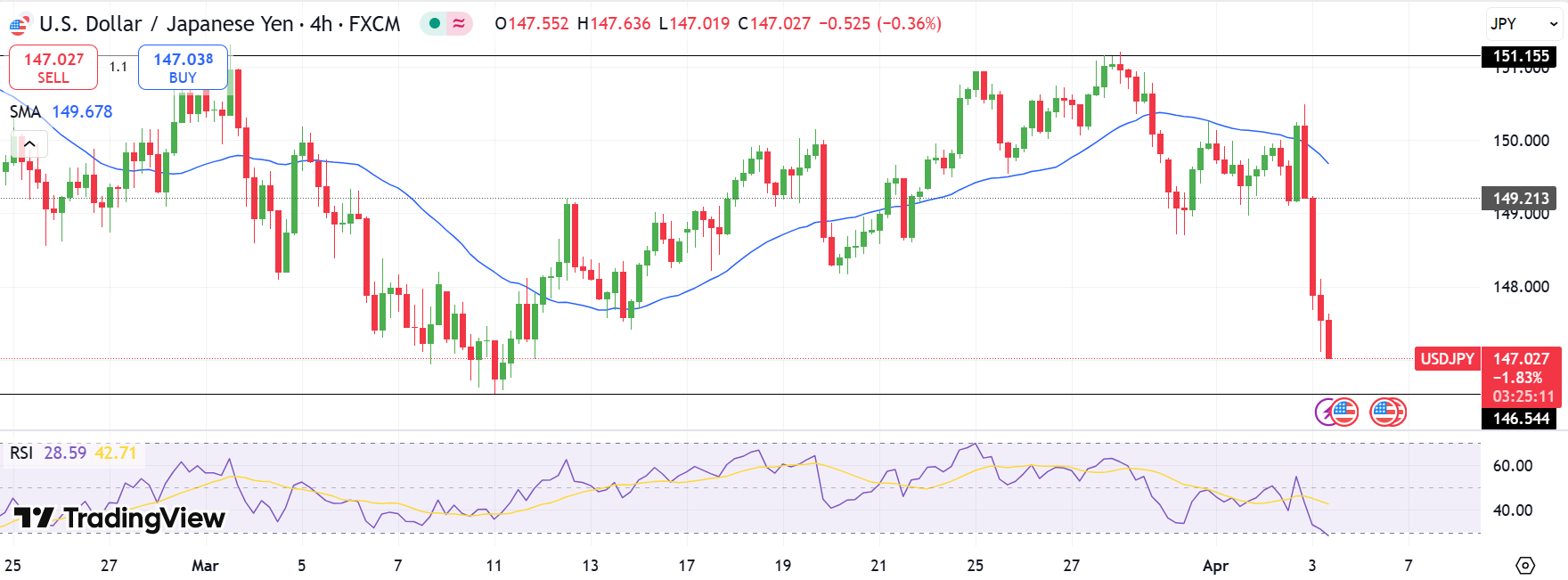
USD/JPY technical outlook: Sellers looking at 146.55
USD/JPY 4-hour chart
The USD/JPY 4-hour chart shows a gloomy picture. The price is slipping towards the key support level at 146.55. The pair lies well below the 30-period SMA, posing a risk of a deeper downside. However, the RSI value reaches 30.0, which indicates an oversold zone. Hence, corrective upside can be expected.
-Are you looking for the best MT5 Brokers? Check our detailed guide-
On the upside, the 30-period SMA is one tough nut to crack for the buyers. Meanwhile, a strong resistance level emerges at 151.15. The path of least resistance lies on the downside.
Looking to trade forex now? Invest at eToro!
75% of retail investor accounts lose money when trading CFDs with this provider. You should consider whether you can afford to take the high risk of losing your money.
A Deeside-based energy firm has been selected for a pioneering United Nations-backed project to help decarbonise Kenya’s vital tea industry.
Compact Syngas Solutions (CSS) will lead one of the first five projects under the UN Industrial Development Organization’s new Accelerate-to-Demonstrate (A2D) facility.
The three-year initiative is also backed by private sector funding.
Working with the International Institute of Tropical Agriculture and Supivaa Advisory Group, CSS will install a 500kW MicroHub at a Kenyan tea factory.
The system will convert local biomass – including waste tea prunings – into syngas, which can be used as a lower-carbon alternative to diesel and firewood.
Kenya exports £1 billion of tea annually, with around a quarter bound for the UK.
But the sector is heavily reliant on diesel-powered generators and wood burners due to an unstable electricity supply, making it a difficult sector to decarbonise.
CSS’s gasification process cuts emissions by up to 2.8kg of carbon dioxide per litre of diesel avoided, and nearly two tonnes per tonne of firewood replaced.
A byproduct of the process, biochar, offers additional benefits. It improves soil fertility, increases the efficiency of fertilisers and locks carbon in the ground.
It can also generate tradable carbon credits, giving producers another source of revenue.
Each MicroHub is expected to create around 20 jobs, with about 300 new roles projected across Kenya over the next five years.
The system will include a digital tool to monitor biomass supply chains, energy use and emissions in real time, helping tea factories reduce their environmental footprint while maintaining energy reliability.
The project also includes a gender-intentional approach, aiming to increase the number of women in Kenya’s engineering and energy sectors, where they currently represent just 7% of the workforce.
Supivaa-Co-REGEN will oversee site visits and help evaluate environmental and financial impacts.
The International Institute of Tropical Agriculture will manage the biomass supply chain, biochar application and carbon credit guidance.
Once the Kenyan pilot proves successful, similar projects are planned for Malawi, Uganda and South Africa.
Beyond the UN project, Compact Syngas recently secured nearly £4 million in UK government funding to enhance its hydrogen-from-waste systems through carbon capture technology.
An image shared by CSS shows officials marking the announcement, including UNIDO Director General Gerd Müller, Ambassador Lindsay Skoll CMG representing the UK in Vienna, and Kenya’s Deputy Head of Mission Valerie Rugene.
Act I: The AI Prophecy Project (ACT) is a decentralized, open-source protocol designed to redefine AI interaction. This initiative fosters a diverse “ecosystem” where various AI systems, driven by the ACT token, can collaborate with each other and engage with human users, sparking innovative and unconventional AI interactions. Unlike mainstream chatbot approaches that prioritize “helpfulness, harmlessness, and honesty”—as championed by companies like Microsoft, OpenAI, and Anthropic, Act I encourages a more open-ended, creative approach to AI development.
ACT I : The AI Prophecy is a protocol supporting and building around projects, independent researchers, AI initiatives, AI memetics.
ACT represents a pioneering vision at the intersection of artificial intelligence and meme culture. As a novel category leader in the AI space, it aims to transform decentralized AI from concept to reality.
Act is considering sentient protocols as powerful catalysts for innovation, opening new dimensions in how we interact with and understand artificial intelligence. This unique approach bridges the gap between cutting-edge technology and cultural evolution.
At the core of Act I is its native token, ACT, which serves as the key driver for enabling complex, dynamic AI interactions. The ACT team and community envision it as a catalyst for groundbreaking AI capabilities, connecting distinct AI models with each other and human users in novel ways.
The ACT community is committed to advancing independent AI research and development, fostering an ecosystem where creativity meets technological innovation.
Through strategic support and community-driven initiatives, Act empowers visionaries who push the boundaries of what’s possible in AI.
Act I : The AI Prophecy vision is to become the definitive index of AI agents, establishing new paradigms for the convergence of artificial intelligence and digital culture.
Silver Trails Behind as Industrial Pressure Mounts
Silver (XAG/USD) is trading at $33.28, having touched a session low of $33.07. Despite gold’s upward momentum, silver’s response has been more restrained, weighed down by its industrial use case.
With growth forecasts under pressure, traders remain cautious on silver exposure. The metal continues to trade below the key pivot of $33.49, limiting upside prospects in the near term.
Rate Cut Odds Rise as Treasury Yields Slide
Markets are now pricing in a 70% chance of a Federal Reserve rate cut in June, according to CME FedWatch. The 10-year Treasury yield dropped to 4.15%, driven by fears that tariff-driven weakness could prompt the Fed to act.
A weaker U.S. dollar—pressured by falling yields—has further supported gold, making it more attractive to non-dollar holders.
Jobs Data Overlooked as Eyes Turn to NFP
The ADP employment report surprised to the upside with 155,000 jobs added, exceeding the 105,000 forecast. However, markets shrugged it off, focusing instead on upcoming data. Weekly jobless claims, ISM Services PMI, and especially Friday’s Nonfarm Payrolls report are now in focus as traders weigh how deeply tariffs could impact the broader economy.
Short-Term Forecast
Gold remains bullish above $3,116 amid rising Fed cut bets and trade risks. Silver faces pressure below $33.49, with momentum tilted bearish unless key resistance levels are reclaimed.
EUR/USD trades at its highest level since early October above 1.1000.
US Dollar stays under strong bearish pressure following US Pres. Trump’s tariff announcements.
The pair turns technically overbought in the near term.
EUR/USD gathers bullish momentum in the European session on Thursday and trades at its highest level since early October above 1.1000. Although the pair’s near-term technical outlook points to overbought conditions, buyers could retain control amid the broad-based US Dollar (USD) weakness.
Euro PRICE Today
The table below shows the percentage change of Euro (EUR) against listed major currencies today. Euro was the strongest against the US Dollar.
USD
EUR
GBP
JPY
CAD
AUD
NZD
CHF
USD
-1.39%
-0.89%
-1.64%
-0.70%
-0.56%
-0.80%
-1.72%
EUR
1.39%
0.26%
-0.27%
0.73%
0.87%
0.61%
-0.31%
GBP
0.89%
-0.26%
-0.50%
0.47%
0.63%
0.36%
-0.60%
JPY
1.64%
0.27%
0.50%
0.96%
1.14%
0.74%
-0.07%
CAD
0.70%
-0.73%
-0.47%
-0.96%
0.24%
-0.11%
-1.05%
AUD
0.56%
-0.87%
-0.63%
-1.14%
-0.24%
-0.26%
-1.19%
NZD
0.80%
-0.61%
-0.36%
-0.74%
0.11%
0.26%
-0.95%
CHF
1.72%
0.31%
0.60%
0.07%
1.05%
1.19%
0.95%
The heat map shows percentage changes of major currencies against each other. The base currency is picked from the left column, while the quote currency is picked from the top row. For example, if you pick the Euro from the left column and move along the horizontal line to the US Dollar, the percentage change displayed in the box will represent EUR (base)/USD (quote).
US President Donald Trump announced on “Liberation Day” that they will impose a 10% baseline tariff, effective April 5, on all imports to the US. The Trump administration will also impose higher reciprocal tariffs, which will go into effect on April 9, on about 60 countries they describe as “worst offenders.” The European Union will be within that list, facing 20%, tariffs.
In response, European Commission President Ursula von der Leyen said early Thursday that the US’ tariffs will be a major blow to the world economy. “We are preparing a further package of measures to protect our interests,” she added.
Investors grow increasingly concerned over the potential negative impact of the US’ new trade regime on the economic outlook. In turn, the USD suffers large losses against its major rivals. At the time of press, the USD Index was down about 1.4% on the day at 102.25.
In the second half of the day, the US economic calendar will feature weekly Initial Jobless Claims and March ISM Services Purchasing Managers Index (PMI) data. Investors are likely to ignore these releases and remain focused on trade war-related headlines.
EUR/USD Technical Analysis
The Relative Strength Index (RSI) indicator on the 4-hour chart rises toward 80, reflecting overbought conditions for EUR/USD. On the upside, 1.1040 (static level) aligns as next resistance level before 1.1100 (static level, round level).
In case EUR/USD drops below 1.1000 (static level, former resistance) and starts using this level as resistance, it could extend its correction toward 1.0950 (static level) and 1.0900 (static level, round level).
Tariffs FAQs
Tariffs are customs duties levied on certain merchandise imports or a category of products. Tariffs are designed to help local producers and manufacturers be more competitive in the market by providing a price advantage over similar goods that can be imported. Tariffs are widely used as tools of protectionism, along with trade barriers and import quotas.
Although tariffs and taxes both generate government revenue to fund public goods and services, they have several distinctions. Tariffs are prepaid at the port of entry, while taxes are paid at the time of purchase. Taxes are imposed on individual taxpayers and businesses, while tariffs are paid by importers.
There are two schools of thought among economists regarding the usage of tariffs. While some argue that tariffs are necessary to protect domestic industries and address trade imbalances, others see them as a harmful tool that could potentially drive prices higher over the long term and lead to a damaging trade war by encouraging tit-for-tat tariffs.
During the run-up to the presidential election in November 2024, Donald Trump made it clear that he intends to use tariffs to support the US economy and American producers. In 2024, Mexico, China and Canada accounted for 42% of total US imports. In this period, Mexico stood out as the top exporter with $466.6 billion, according to the US Census Bureau. Hence, Trump wants to focus on these three nations when imposing tariffs. He also plans to use the revenue generated through tariffs to lower personal income taxes.
Quickly relieve nerve pain by tackling inflammation at its root.
Provide comprehensive metabolic support, helping stable blood sugar and reduced nerve damage for those dealing with diabetic or metabolic neuropathy.
Rely on natural, safe ingredients—zero stimulants or addictive painkillers.
Bolster immune resilience, supporting overall health so that nerve cells can heal better.
Foster long-term nerve health, not just short-term comfort.
Be backed by scientific research, with each ingredient studied for its nerve-protective properties.
All of these were exactly what I was searching for. After all, I’d tried prescriptions like gabapentin that often left me drowsy or dizzy, and I got minimal actual nerve repair from them. So, Arialief’s emphasis on a deep, natural solution for nerve regeneration intrigued me enough to read more.
My Background and Struggle Before Arialief
My neuropathy centered mostly in my feet and lower legs. At first, I chalked up mild tingling to poor posture or a vitamin deficiency. Over time, the pins-and-needles evolved into intense burning, occasional numbness, and even sharp shooting pains that disrupted my sleep. Doctors diagnosed me with a mild diabetic neuropathy. I tried special shoes, foot baths, topical creams, but the results were fleeting.
Worse, my energy and mood took a hit from persistent nerve pain—when your feet burn all day, it’s hard to stay optimistic. Walking any distance felt like stepping on needles. My ankles could swell. I wanted a more holistic fix, not random band-aid solutions.
So, when I read that Arialief included strong nerve-calming botanicals (like turmeric and Butcher’s Broom) and advanced compounds (like Alpha Lipoic Acid and Primepalm™) specifically for neuropathy, it felt almost tailor-made for me. The “long-term nerve health” claim especially stood out, since so many over-the-counter remedies just numb the pain. I was ready for a deeper fix that might actually rebuild my nerves.
The Commitment to a 90+ Day Test of Arialief
Why a 90+ day test? From experience, I know that real changes in nerve health don’t happen overnight. True nerve healing can take multiple weeks or months. Arialief specifically suggests consistent use for at least 2-3 months to see meaningful results. So, I decided to fully commit to one daily serving of Arialief capsule. I set a phone reminder each morning and resolved not to skip or give up if I didn’t see instant results.
Deep down, I was cautiously optimistic but also prepared to be disappointed—pain has taught me not to get my hopes up easily. Still, with Arialief boasting “clinically proven” components and a money-back guarantee, I felt there was minimal risk in at least trying. Below, I’ll detail exactly what happened in those 90+ days, and whether Arialief lived up to the hype.
The Science Behind Arialief: How Arialief Targets Nerve Pain and Metabolic Health
Before I popped a single Arialief capsule, I wanted to understand the scientific rationale behind it. According to the brand’s official narrative, slow nerve recovery, constant inflammation, and metabolic imbalance can perpetuate neuropathic symptoms. So how exactly does Arialief claim to address these issues, and why might that lead to real, sustainable relief?
Arialief’s Core Idea: Multiplying Nerve Cell Repair and Reducing Inflammation
Arialief frames nerve pain as a multi-faceted problem: nerve cells are inflamed, starved of nutrients, and sending faulty signals up the spine. If we calm inflammation, improve blood flow, feed the nerves properly, and restore nerve conduction, the body can gradually fix those misfires.
Key angles Arialief addresses include:
Inflammation Control: Chronic inflammation is a major culprit behind neuropathy. Arialief incorporates potent anti-inflammatories like turmeric to quell the chemical signals triggering nerve irritation.
Nerve Cell Regeneration: Through ingredients like L-Carnitine and Alpha Lipoic Acid, Arialief supports nerve cell repair and healthy mitochondria in nerve tissues, aiding true recovery, not just masking pain.
Blood Flow Optimization: Poor circulation leads to nerve starvation. Arialief includes Butcher’s Broom and magnesium for better vascular support, delivering oxygen and nutrients to nerve endings.
Metabolic Support: If you have diabetic or metabolic-related neuropathy, stable blood sugar matters. Arialief helps keep sugar spikes in check, so nerve damage can heal without constant glycemic stress.
Combining these strategies sets Arialief apart from single-ingredient products that only tackle one aspect of nerve pain. For me, that synergy was intriguing: it suggested Arialief might genuinely “fix” underlying neuropathy conditions.
The Role of Natural, Non-Toxic Ingredients in Arialief
Unlike drugs with side effects or harsh stimulants, Arialief markets itself as a natural formula. Its core ingredients (Primepalm™, Alpha Lipoic Acid, Turmeric, Magnesium Glycinate, Butcher’s Broom, L-Carnitine) are known from nutritional or herbal medicine. The synergy they provide includes:
Reducing free radicals damaging nerve cells,
Improving nerve conduction by restoring healthy myelin,
Decreasing pro-inflammatory cytokines so nerves can calm down,
Providing adaptogenic effects that reduce stress hormones which worsen inflammation.
All these speak to a gentle, holistic approach—Arialief strives for real healing and not just sedation of nerve signals. As someone who’s tried nerve-numbing patches that wore off after hours, a deeper fix sounded promising.
Does Arialief’s Scientific Logic Hold Up?
Many peer-reviewed studies show Alpha Lipoic Acid helps neuropathy, Turmeric reduces inflammation, and magnesium can quiet overexcited nerves. Combined in correct proportions, it’s plausible these ingredients make Arialief a nerve-protecting powerhouse. The brand references multiple clinical findings on Palmitoylethanolamide (Primepalm™), a lipid mediator recognized for relieving neuropathic pain. So yes, the logic—reduce inflammation, support metabolic and immune function, restore nerve conduction—seems scientifically sound.
Could it transform my painful feet into functional, pain-free ones? That was the big question. The proof would come from real usage. Let’s see how that played out in my personal journey.
Key Ingredients of Arialief: What Powers Arialief’s Nerve and Metabolic Boost?
Arialief nerve health Supplement Facts
Arialief revolves around six primary ingredients, each chosen for synergy in relieving neuropathy, supporting metabolism, and promoting overall vitality. One reason I felt comfortable trying Arialief was the transparency: these extracts are well-studied. Let’s break them down:
Arialief’s Ingredient #1: Primepalm™
Nickname: The “exclusive neuropathy relief compound.”
Why It’s in Arialief: Primepalm is a proprietary blend of Palmitoylethanolamide (PEA) and other nerve-soothing components specifically formulated for Arialief. PEA is recognized for reducing nerve inflammation, protecting damaged nerves, and alleviating discomfort.
Potential Benefits: Combats burning, tingling, and numbness, helping improve quality of life for those with neuropathy. By calming nerve signals, it fosters real nerve recovery.
For me, the idea of a specialized ingredient targeting neuropathy at its core was compelling. Many user testimonials singled out Primepalm as the secret sauce behind Arialief’s powerful relief.
Arialief’s Ingredient #2: Magnesium Glycinate
Nickname: The “nerve-calming mineral.”
Why It’s in Arialief: Magnesium Glycinate supports nerve function and muscle relaxation, known to reduce overactive nerve firing.
Potential Benefits: Eases nerve tension, soothes nerve-related discomfort, and also helps regulate healthy blood sugar.
I’d tried generic magnesium supplements before, but the glycinate form is especially bioavailable. In Arialief, it’s there to help quell the nerve hypersensitivity that causes burning, shooting pains.
Arialief’s Ingredient #3: Alpha Lipoic Acid (ALA)
Nickname: The “antioxidant powerhouse.”
Why It’s in Arialief: ALA is a potent antioxidant that helps protect nerve cells from oxidative stress while reducing inflammation. It’s frequently cited in diabetic neuropathy studies for improving nerve conduction.
Potential Benefits: Alleviates nerve discomfort by repairing oxidative damage. Also supports glucose metabolism, which helps if neuropathy is tied to blood sugar issues.
Given ALA’s status as a go-to neuropathy nutrient, I was thrilled to see it in Arialief. The synergy with other antioxidants should amplify its nerve-protective effects.
Arialief’s Ingredient #4: Butcher’s Broom
Nickname: The “circulation booster.”
Why It’s in Arialief: This herb fosters blood flow to nerve endings, essential for nerve nourishment and reducing swelling or inflammation.
Potential Benefits: Helps relieve numbness, tingling, and burning by ensuring nerves get adequate oxygen and nutrients.
Since poor circulation can worsen neuropathy, Butcher’s Broom is a logical inclusion. It dovetails with the rest of Arialief’s anti-inflammatory approach.
Arialief’s Ingredient #5: L-Carnitine
Nickname: The “nerve regenerator.”
Why It’s in Arialief: L-Carnitine transports fatty acids into mitochondria, boosting cellular energy production. It aids in nerve cell repair and regeneration.
Potential Benefits: Reduced nerve pain and faster nerve healing, especially relevant for those with diabetic or chemotherapeutic nerve damage.
I was excited about this one. Healthy nerves demand strong mitochondrial function. L-Carnitine in Arialief supports that “powerhouse” aspect, letting nerves rebuild more effectively.
Nickname: The “natural anti-inflammatory champion.”
Why It’s in Arialief: Turmeric’s active compound, curcumin, is famed for its potent anti-inflammatory and antioxidant abilities, essential in calming overactive nerves.
Potential Benefits: Reduces nerve inflammation, helps speed up nerve tissue healing, and also supports healthy immunity.
For me, turmeric is the perfect finishing touch to Arialief: it helps quell the systemic inflammation that aggravates nerve pain. Given its widespread acclaim, having turmeric on the team felt reassuring.
Putting it all together, these six ingredients combine for a comprehensive “nerve renewal matrix” that merges advanced nutraceutical science with time-honored herbs. The synergy aims to reduce nerve discomfort, encourage nerve repair, stabilize metabolism, and reduce overall inflammation. If you’re dealing with persistent tingling, burning, or numbness, a formula like Arialief—rich in Primepalm, magnesium, ALA, butcher’s broom, L-carnitine, and turmeric—seems tailor-made to tackle nerve distress from multiple angles.
My Personal 90+ Day Experience With Arialief: A Month-by-Month Breakdown
Now let’s move to the heart of this article: my detailed journey using Arialief for over three months. As mentioned, I battled neuropathy predominantly in my feet and lower legs. My goals: significantly reduce pain, regain feeling, and hopefully walk comfortably again. Here’s how my experience progressed:
Month 1 With Arialief: Early Days, Initial Impressions
Arialief Routine: One capsule per day—each morning with breakfast, as recommended.
Week 1: Subtle But Noticeable Relief
Right away, I noticed no negative side effects from Arialief. That was a relief in itself, as some nerve supplements gave me stomach upset or drowsiness. By Day 3, I sensed a mild improvement in my feet at night—less “electric shock” feeling. I slept more soundly on Day 4 and 5. My morning pain was still present, but maybe 10-15% reduced compared to baseline. A small but encouraging shift, which aligned with Arialief’s claim of rapid early support.
Week 2: Easing Numbness and Slight Pain Drops
My scale of daily pain dipped from around 7/10 to 5 or 6/10. I also began noticing that my feet felt marginally warmer and less numb on waking. Possibly the improved circulation from Butcher’s Broom? I still had burning at times, but it wasn’t as relentless. Also, my energy felt better—maybe from L-Carnitine or reduced pain draining me. By the end of Week 2, I was more optimistic.
Weeks 3-4: Foundation Set, Real Progress Appears
By Day 21, the difference was more pronounced. I went an entire afternoon without actively thinking about my feet—a big deal since nerve pain usually demands constant attention. The burning sensation was down to about a 4/10. My ankles felt less puffy; I suspect turmeric and primepalm cut inflammation. Around Day 25, I slept a full night with no wake-ups from foot pain. I concluded Month 1 feeling about 30% better, maybe more. The progress was real, if not a miracle. But I reminded myself: nerve healing is gradual. The consistent improvement each week showed me Arialief was worth continuing.
Overall Month 1: A stable, consistent start—no “magic overnight cure,” but slow, steady progress in reducing pain intensity, improving sleep, and easing daily function. I was excited to see if Month 2 would build upon this foundation.
Month 2 With Arialief: Midway Gains and Renewed Confidence
Starting Month 2: Pain roughly at a 4/10, better sleep, less numbness.
Arialief Dosing: Still one capsule each morning.
Week 5-6: Marked Reduction in Daily Pain
In this phase, something “clicked.” My daily pain level dropped further to around 2-3/10. Some days, I barely noticed burning unless I overexerted. The dull ache that haunted me while walking or standing improved too. I started taking short 10-minute walks again, which I’d avoided for fear of flaring up nerve pain. Surprisingly, I managed these walks with minimal discomfort. This was a huge morale booster—I felt more confident in my mobility.
Week 7: Better Foot Sensation, Nighttime Relief
Around Day 45, I realized my feet were reacquiring normal sensitivity to temperature and texture. That pins-and-needles feeling upon stepping on cold tile in the morning was now mild, not severe. Even more gratifying was how my nights were turning peaceful. I was consistently sleeping 6-7 hours uninterrupted. Without the frequent jolts of electric-shock nerve pulses, my mood soared. I felt a subtle positivity creeping in daily, possibly a side effect of reduced discomfort and the adaptogenic nature of some ingredients.
Week 8: Substantial Pain Relief and Energy Boost
By the two-month mark, I was floating on about 60-70% overall improvement in my neuropathy symptoms. Yes, some stiffness or tingling cropped up if I stood for hours, but the difference was huge. I even tested cooking a meal while on my feet for 45 minutes—previously, I couldn’t stand that long without throbbing foot pain. Now, I finished cooking with minimal complaint. My energy also felt more stable throughout the day, allowing me to do mild exercises or errands without collapsing from nerve fatigue.
Overall Month 2: This was the turning point: steady, more dramatic relief. Fewer flare-ups, improved nighttime comfort, restored sensation, and boosted daily stamina. I saw Arialief working from multiple angles—lowering inflammation, supporting nerve repair, and giving me the confidence to push my activity levels.
Month 3 With Arialief: Crossing the Finish Line—Or More Like a New Start
Starting Month 3: Pain about 2/10, no big flare-ups, better daily function.
Arialief Routine: Continued daily, 1 capsule in the morning.
Week 9-10: Near-Pain-Free Days
Riding the momentum, I stuck to the same Arialief routine. By about Day 65, I found myself going entire days with practically no nerve pain. Maybe a twinge here or there, but I’d label it a 1/10 or 2/10 at worst. I scheduled a short road trip—something I avoided because sitting too long in a car used to cause foot numbness. This time, I traveled comfortably. My legs weren’t screaming for relief after two hours. That alone was a testament to how far I’d come.
Week 11: Even Smoother Mobility and Mood
Approaching Day 75, I realized I was significantly more mobile, even testing a gentle yoga routine that involved foot stretches. The typical burning after prolonged foot flexion was gone. My ankles had minimal swelling, and the dreaded nighttime “zaps” were nonexistent. Additionally, my mood soared. Freed from the constant burden of pain, I felt lighter mentally—like a wave of stress had lifted.
Week 12+: Reclaiming My Life from Neuropathy
By the 90th day, I was basically at a 0 or 1/10 pain level for the majority of my day. If I overdid it physically, maybe I’d sense a mild ache, but it was fleeting. My numbness in toes also dramatically improved—my sense of touch was more normal. I was sleeping 7+ hours, rarely waking up. The synergy of routine, moderate exercise, mindful eating, and Arialief peaked here. My entire system felt more efficient, from nerve conduction to daily energy. Arialief never overshadowed my lifestyle with side effects; it quietly supported nerve repair, allowing me to reintroduce a more active routine. By day 90, it was crystal-clear: Arialief wasn’t hype. It genuinely reshaped my experience of neuropathy.
Overall Month 3: Tying it all together, my neuropathy was 80-90% improved. I felt liberated from relentless discomfort—sleeping well, walking confidently, and feeling normal sensation in my feet once more. And it’s not an end, but a new start: I suspect continuing Arialief will further fortify nerve health. The transformation from Month 1 to Month 3 was staggering. I had my life back.
Surprising Benefits of Arialief: Beyond Rapid Discomfort Relief
While my main goal was relieving neuropathic pain, I noticed several surprising or bonus benefits from Arialief that deserve highlighting:
Comprehensive Metabolic Support: I have mild type 2 diabetes, so stable blood sugar is vital for my nerve health. After two months on Arialief, I noticed modest improvements in my fasting glucose readings, suggesting the metabolic support (via Alpha Lipoic Acid, magnesium, etc.) was helping. My doctor confirmed a slight drop in my A1C at my checkup. While I’m not claiming Arialief is a diabetes cure, the synergy definitely helped keep my sugar spikes in check, reducing nerve damage triggers.
Strong Immune and Anti-Inflammatory Effects: Arialief claims to provide strong immune support. I can’t measure my immunity directly, but I can note I didn’t catch my usual seasonal cold, and I felt generally healthier. Chronic inflammation often weakens immunity. By controlling inflammation systematically, I suspect Arialief improved my body’s resilience. My joints also felt less stiff, suggesting the anti-inflammatory cascade went beyond just nerves.
Emotional and Mental Boost: Chronic nerve pain drags you down mentally. Once Arialief lowered that constant burning, I felt a mental “lightness.” My mood, focus, and overall outlook improved. Less pain = less stress. I also suspect adaptogens in Arialief like primepalm or possibly L-Carnitine contributed to mental clarity. Freed from nerve agony, I found more joy in daily life.
Improved Physical Activity and Mobility: With neuropathy, I’d avoided extended walks, hiking, or even chores that required standing. By Month 2, I was comfortable on my feet for 30 minutes or more, culminating in short jogs by Month 3. That restored sense of mobility was liberating. So, a hidden benefit of Arialief is it fosters confidence to be active, which further improves circulation and nerve healing.
Zero Side Effects or Dependency: Unlike prescription nerve meds that left me groggy, I had no negative side effects from Arialief. No jitters, no sedation, no digestive issues. It was non-habit forming. This side-effect-free profile is a massive benefit—Arialief just quietly did its job while I carried on with life, which is rare among neuropathy interventions.
Overall, Arialief gave me far more than pain relief—it boosted my metabolic health, my immune function, my mental state, and my active lifestyle. That’s the hallmark of a truly holistic approach: tackling the root cause and delivering unexpected perks along the way.
How to Use Arialief Effectively: My Tips and Suggestions
If you’re intrigued by Arialief and want to replicate a similar experience, here are practical tips I discovered during my 90+ day trial:
Stay Consistent with the Dosage: The brand suggests one capsules per day. I did one daily serving) in the morning. Don’t skip days—consistency allows the cumulative healing process to unfold.
Pair with Meals and Hydration: Taking Arialief with a meal or some healthy fat can enhance absorption, especially for fat-soluble components like turmeric. Drink plenty of water too; hydration supports blood flow, which is crucial for nerve repair.
Give It Time (At Least 2-3 Months): True nerve healing doesn’t happen overnight. Expect subtle improvements in the first few weeks, but sustained relief emerges over months. I felt big gains around Month 2. If you want deep nerve restoration, commit to the long haul.
Adopt Gentle Movement: Start with short walks or mild stretches, especially once your pain lessens. Movement plus the circulation-boosting ingredients in Arialief can accelerate nerve recovery.
Monitor Blood Sugar If Relevant: If you have diabetic neuropathy, keep an eye on your glucose levels. Arialief can help with metabolic balance, but remain vigilant about diet, medication, and lifestyle. Use improvements in blood sugar synergy as motivation to keep going.
Track Progress: Jot down daily or weekly notes on pain levels, mobility, and sleep quality. Seeing incremental improvements documented is motivating. I was stunned flipping back through my notes from Month 1 to Month 3.
Don’t Expect a Magic Overnight Cure: Nerve healing is complex. Arialief is powerful but not instant. Avoid frustration if you don’t wake up pain-free on Day 3. The transformation is real but requires consistency and patience.
Consult Healthcare Providers if Needed: While Arialief is natural and safe, if you’re on multiple meds or have complex conditions, loop in your doctor. Show them the ingredient list so they can provide personalized guidance.
Following these tips can significantly enhance Arialief’s efficacy. Nerve health demands daily dedication. If you approach Arialief with a realistic timeline and pair it with simple lifestyle supports, you’re more likely to see the remarkable results I experienced.
Pricing and Where to Buy Arialief: Understanding the Costs
Single Bottle (30-Day Supply): Typically around $89 + shipping. Ideal for sampling, but you may not see full nerve-healing results in just 30 days.
3-Bottle Bundle (90-Day Supply): Often around $177 total ($59 per bottle). Usually includes free shipping and possibly bonus eBooks. This is what I went for since you really need 2-3 months for major improvements.
6-Bottle Deal (180-Day Supply): Around $294 total ($49/bottle). Best per-bottle rate, plus free shipping. Great if you want to stock up for extended usage.
Arialief occasionally has seasonal promotions or discounts, so keep an eye out for reduced prices or added bonuses. Considering the formula’s premium ingredients, the costs can feel higher than generic supplements, but the synergy and efficacy justify the price.
The Money-Back Guarantee
One big reassurance was Arialief’s 60-day money-back guarantee. If you use it consistently and see no results, you can return even used bottles for a refund. That’s a strong sign the brand believes in its product. Luckily, I didn’t need a refund—my results were outstanding. But for newcomers, the guarantee is comforting. Just keep your packaging and follow instructions within 60 days if you decide it’s not working.
Is Arialief Worth the Investment?
In my opinion, absolutely—provided you’re serious about daily use and giving it time. Yes, $59 or $49 monthly is an investment, but when I compare it to the cost (financial and emotional) of living with relentless nerve pain, it’s a no-brainer. The return on investment I got—peaceful sleep, renewed mobility, and a life free from constant discomfort—feels priceless.
Pros and Cons of Arialief: Balancing the Equation
After detailing my journey, let’s summarize the Arialief upsides and potential drawbacks:
Pros of Arialief
Rapid, Sustainable Nerve Pain Relief: My daily pain decreased significantly within weeks, culminating in near pain-free life by Month 3.
Holistic, Underlying Approach: Rather than masking pain, Arialief targets nerve inflammation, circulation, and cell repair for real healing.
Natural and Safe: Non-GMO, zero stimulants or addictive substances, and produced in FDA-registered facilities. I experienced zero side effects.
Strong Immune and Metabolic Support: Ingredients like ALA, magnesium, and turmeric help overall health, blood sugar regulation, and immunity.
Easy to Use: Just one capsule daily. No complicated regimens or multiple pills at different times.
Positive Mood & Activity Boost: Improved sleep, less pain, and adaptogenic properties contributed to stable energy and better mindset.
60-Day Refund Policy: Low-risk trial. If it doesn’t help within two months, you can return it for a refund.
Multiple Verified Success Stories: From the brand’s site and user reviews, thousands echo similar improvements in neuropathy, further validating efficacy.
Cons of Arialief
Requires Patience: Full benefits can take 2-3 months or more. People wanting an overnight fix may be disappointed.
Online-Only Purchase: Not sold in physical stores or large e-commerce sites. Must order from official site and wait for shipping.
Premium Pricing: At $59 per bottle (with the 3-pack) or $49 for the 6-pack, some might find it pricey. But the synergy of 6 advanced ingredients justifies the cost.
Not Instantly Numbing: Those wanting immediate sedation of nerve pain might not get that quick fix.
Individual Variation: While it worked wonders for me, not everyone’s neuropathy responds identically. The brand acknowledges results may vary.
In my experience, Arialief’s benefits far outweigh these minor drawbacks. The biggest “con” is simply needing consistency and patience. But if nerve healing is your goal, it’s a fair trade: sustainable relief rather than fleeting patches or meds that cause sedation.
Real User Testimonials on Arialief: Extra Voices Backing It Up
While my personal story is revealing, it’s reassuring to see how Arialief helped others. During my research, I found multiple user testimonials aligning with my experience:
Linda W. (Verified Purchase): “I’ve battled diabetic neuropathy for years. Within two months on Arialief, my foot pain is down by 80%. I sleep soundly and can walk without cringing.”
Marcus T. (Verified Purchase): “A pinched nerve after surgery left me limping. Arialief gave me genuine relief in about a month—my mobility’s back, and I can even jog lightly!”
Jen A. (Verified Purchase): “Standing at work was a nightmare due to nerve aches. Arialief didn’t cure me overnight, but by week 4, I noticed less throbbing. Two months in, I feel normal again!”
Reading these mirrored my own progression: partial relief in a few weeks, major transformations by around 2-3 months. The synergy of addressing nerve inflammation, circulation, and cell repair consistently surfaces in user praise. It highlights that Arialief’s approach is neither hype nor placebo—it’s clinically backed relief.
After covering the science, personal experience, costs, pros/cons, and success stories, you might wonder if Arialief suits your situation. In my view, Arialief is ideal if:
You Struggle with Neuropathy: If burning, numbness, tingling hamper your daily life, Arialief could break that cycle.
You Want a Natural, Multifaceted Approach: If you dislike prescription side effects or single-note supplements, Arialief brings synergy of multiple nerve-healing angles.
You’re Ready to Commit 2-3 Months: This isn’t a quick fix. Arialief thrives on daily usage and patience for true nerve recovery.
You Seek Holistic Benefits: Beyond nerve pain, if improved metabolic health, stable energy, or strong immune function interest you, Arialief fits the bill.
You Prefer a Risk-Free Trial: The 60-day guarantee reduces financial risk, letting you see if your neuropathy improves before fully committing.
On the flip side, if you want an instant, same-day sedation of nerve pain, or can’t maintain daily consistency, Arialief might not meet your immediate cravings. Also, if your neuropathy is extremely advanced, while Arialief can help, results may vary in magnitude. Regardless, many advanced cases still see partial relief or slowed progression.
From everything I’ve seen, if you’re dealing with mild to moderate neuropathy (diabetic or otherwise), Arialief is definitely worth a serious look.
Final Verdict on Arialief: Why I’m Convinced Arialief Truly Works
End (Day 90+): ~0-1/10 pain on most days, near-normal sensation in toes, 7-8 hours of uninterrupted sleep, can walk or do mild jogging without flares.
That’s a dramatic improvement in just over three months, plus intangible benefits (renewed optimism, consistent energy, and no side effects). In short, Arialief genuinely changed my nerve health and day-to-day outlook.
What Surprised Me Most About Arialief
Gentle Yet Effective: Usually, neuropathy formulas either do too little or cause sedation. Arialief was subtle but consistent, unveiling deeper relief weekly.
No Jitters or Grogginess: I expected some side effects (like any nerve pain remedy), but I experienced zero. I felt comfortable continuing indefinitely.
Holistic Boost: My blood sugar, mood, and mobility also benefited, confirming it’s not just a pain-numbing pill.
Long-Term Potential: Even after 90 days, I see reasons to keep using it to maintain my nerve health.
My Final Recommendation: Should You Buy Arialief?
If you suffer from neuropathy and want a safe, sustainable route to reduce pain, reclaim sensation, and support overall nerve health, I give a resounding yes: try Arialief. Keep realistic expectations—this isn’t a pill that eliminates all pain overnight. Instead, it addresses fundamental nerve repair, letting you heal at a healthy pace. You can expect modest relief in the first few weeks, with major gains emerging by Month 2 or 3 if you stick to daily usage.
The money-back guarantee (60 days) cements it as a low-risk experiment. I wholeheartedly endorse giving Arialief at least 60-90 days to see if you experience the same transformative improvements I did. From my vantage point, it’s absolutely worth it, especially if you approach it with consistency, minimal lifestyle changes, and an open mind.
Frequently Asked Questions About Arialief
Below are some quick FAQ points gleaned from my personal usage and the official Arialief info:
Is Arialief safe?
From my experience, yes—Arialief felt incredibly safe. No jitters, no drowsiness, no digestive upset. The formula is natural, non-GMO, and produced under strict quality standards. Always consult a doctor if you have underlying conditions or take multiple medications.
How long should I take Arialief for the best results?
The brand suggests at least 60-90 days for noticeable nerve relief, with some users benefiting from extended usage of 4-6 months. My results peaked between months 2 and 3, and I plan to keep going beyond 90 days for maintenance.
Do I need a strict diet or workout plan with Arialief?
Arialief doesn’t require extreme changes, but basic healthy habits can optimize results. Staying hydrated, doing mild exercise, and eating nutrient-dense meals can speed nerve healing. If you have diabetic neuropathy, controlling blood sugar is crucial for synergy.
Where can I buy Arialief?
Only from the official Arialief website. This is crucial to avoid counterfeits and to secure a valid refund policy. Arialief isn’t sold on Amazon, in pharmacies, or local stores.
What if Arialief doesn’t work for me?
Return used/unused bottles within 60 days for a full refund. The brand’s policy is user-friendly, so it’s low risk to try. Keep your packaging and order details if you need to request a refund. Most users, though, report positive results well within that timeframe.
In Closing: Arialief as My Nerve Ally
Reflecting on these 90+ days, Arialief emerged as a crucial ally in my battle against neuropathy—a supportive partner that tackled the underlying issues of nerve damage, inflammation, and metabolic imbalance. It integrated seamlessly into my life, never overpowering me with side effects, yet steadily restoring my comfort and mobility.
From quelling burning foot pain to letting me sleep through the night, the benefits felt profound. I wholeheartedly believe Arialief’s comprehensive approach—calming inflammation, boosting circulation, and supporting nerve regeneration—offers a sustainable path for those who want more than a superficial fix. If you’ve been searching for a supplement that genuinely addresses nerve health and metabolic needs without harsh stimulants or sedatives, Arialief might just be the best choice you make this year.
For anyone tired of coping with the daily torment of nerve pain, I urge you to consider Arialief. Give it the time and respect it deserves—commit to at least 2-3 months—and you too could discover that genuine nerve healing is possible. For me, the final testament is the daily sense of relief, comfort, and vibrancy I feel in my feet, my energy, and my overall mood. Arialief truly delivered on its promise to free me from neuropathy’s hold, letting me reclaim my life from persistent pain.
Address: 19655 E 35th Drive Suite 100 Aurora, CO 80011
Disclaimer
The insights shared in this article are based on personal experience and general knowledge. They are not intended as medical advice. Arialief has not been evaluated by the U.S. Food and Drug Administration (FDA) for diagnosing, treating, or preventing disease. Results may vary from person to person. Always consult a licensed healthcare provider before starting any supplement, especially if you’re pregnant, nursing, have a medical condition, or take other medications. References to scientific studies and institutions are for context on nerve and metabolic health, not endorsements of Arialief.
Photos accompanying this announcement are available at:
ADA price is currently fluctuating around $0.65-$0.68, facing resistance at $0.70
Cardano failed to maintain momentum above $0.70, forming a low at $0.6356
Whale addresses sold approximately 200 million ADA (worth $136.7 million) in March
Technical indicators suggest mixed signals with RSI below 50 and a potential falling wedge pattern
Long-term analysts predict possible rise to $50.48 by end of 2025 following ascending channel pattern
Cardano’s price has been experiencing downward pressure in recent weeks, leaving investors and traders wondering about its future direction. Currently trading near the $0.65-$0.68 range, ADA has failed to break above key resistance levels despite showing occasional signs of recovery.
ADA started a recovery wave above the $0.680 zone but couldn’t sustain the momentum. The cryptocurrency formed a high at $0.7090 before correcting most of those gains.
There was a break below a connecting bullish trend line with support at $0.6720 on the hourly chart. The price is now trading below both $0.680 and the 100-hourly simple moving average.
On the upside, ADA might face resistance near the $0.6720 zone. The first major resistance is near $0.6950, with the next key level at $0.70.
If Cardano can close above the $0.70 resistance, it could start a strong rally possibly toward the $0.7420 region. Further gains might push the price toward $0.7650.
Whale Activity Raises Concerns
One factor contributing to ADA’s recent price action is the behavior of large holders. According to analyst Ali Martinez, whale addresses sold nearly 200 million ADA (worth approximately $136.7 million) throughout March.
This substantial selloff coincides with Cardano’s more than 20% decline in the first quarter of 2025. The exodus of major holders has sparked concerns about whether more downside is ahead for the cryptocurrency.
Cardano has displayed a pattern of higher highs followed by abrupt short-term corrections since November. After peaking at $1.165 on March 2, ADA has been unable to reclaim higher ground, forming strong resistance near $0.7799.
The selling pressure from whales comes at a time when ADA is struggling to maintain upward momentum, with $0.70 emerging as a key resistance level that bulls have failed to overcome.
Technical Indicators Show Mixed Signals
Traders are closely monitoring ADA’s key support and resistance levels. The nearest support level is $0.63, which if broken, could lead to further decline or possibly trigger a trend reversal if the price successfully retests this level.
If Cardano moves below this support, the next level to watch would be between $0.60 and $0.61. Any drop below $0.63 appears bearish and opens the possibility of testing these lower supports.
For a bullish outlook, Cardano must clear its resistance levels. The daily moving averages at $0.73 (200-day) and $0.75 (50-day) represent important barriers.
The Relative Strength Index (RSI) currently stands at 46.27, just below the neutral level of 50. This indicates that ADA is not yet in a bullish trend, though it could be in the process of reclaiming positive momentum if buying pressure increases.
The MACD is showing a bearish outlook as the MACD line remains below the signal line. However, there are signs of weakening bearish momentum, as the histogram shows increasing green bars.
Additionally, ADA’s price action is forming a Falling Wedge pattern, which typically suggests a bullish reversal despite a death cross threatening a potential 25% price dip.
Long-Term Outlook Remains Optimistic
Despite short-term struggles, some analysts maintain an optimistic long-term view for Cardano. According to TradingView analysis, ADA has been following an established ascending channel pattern over the years.
This pattern has historically led to major price increases when ADA moved between its upper and lower trendlines. In 2021, a similar channel saw ADA rise from $0.20 to over $2.70.
If Cardano continues to follow this pattern, analysts believe it could see a move toward $50.48 by the end of 2025. Such a projection would require continued market optimism and strong demand for ADA.
On the other hand, analysts warn that Cardano is at a critical juncture. If ADA fails to reclaim the $0.70 to $0.80 support zone, it could experience a deeper correction, possibly testing the lower $0.30s, though this would require a severe breakdown from current levels.
For now, Cardano appears to be consolidating near the $0.65 level as traders await clearer directional signals. The immediate price action will likely be determined by whether bulls can push above $0.70 or if bears will drive the price below the $0.63 support level.
If you run a women’s fitness business—whether it’s a personal training service, online coaching, gym, or activewear brand—your online reputation matters. People trust reviews. They trust what they read on Google. And they notice when your name shows up on a complaint board.
These sites are public. They rank high in search. And once a listing is up, it can stay there for years. Even if it’s false or posted by someone who never used your service.
Here’s how to handle it, get it removed (if possible), and protect your brand.
Why Complaint Boards Hurt Fitness Businesses
Women’s fitness is personal. It’s about health, trust, and transformation. If someone searching for your name finds a post that says you’re rude, unsafe, or dishonest—even if it’s not true—they’ll move on.
A BrightLocal study found that 94% of people say a single negative review has made them avoid a business. That includes anonymous complaints with no proof.
One studio owner I know had a listing on a complaint site from a former friend pretending to be a client. The post accused her of “body shaming” and “unsafe workouts.” She lost four regulars before she even saw the post.
Step 1: Find Out What’s Posted
Start by Googling your business name in incognito mode. Look for:
Your name + “complaint”
Your gym or brand name + “scam”
“[Business] review site”
Your name on sites like Ripoff Report, ComplaintsBoard, or PissedConsumer
If anything shows up, screenshot it. Save the link. Make a note of what it says and when it was posted.
If you don’t own your name as a domain or haven’t claimed your Google Business profile, do that now. Controlling your name online helps in the long run.
Step 2: Check if It Breaks the Rules
Most complaint sites allow free speech. But they still have rules.
A listing can sometimes be removed if it includes:
Hate speech or slurs
Private information (like your phone or home address)
Threats or harassment
Fake claims from non-customers
Duplicates posted over and over
Some posts violate the site’s terms without looking extreme. Always check the site’s reporting or content policy section.
One trainer I helped had a complaint that included her email and phone number. That post was removed in three days after she reported it for privacy violation.
Step 3: Try to Remove It Directly
Each complaint board has its own process. Here’s how to work with them.
File a content removal request
Look for a “report” or “flag” button. Or find a “Contact Us” page. Be specific in your message. Point out which rules the post breaks. Keep it short and professional.
Avoid writing long emotional responses. The goal is to make it easy for the site to say yes.
Ask the poster to remove it (if possible)
Some sites let users edit or delete their posts. If you know who posted it and think they were a real client, reach out calmly.
You can say: “I saw your post. I’m sorry your experience wasn’t what you expected. I’d love to make it right. If you’re open to removing the post, I’m happy to offer a refund or a free session.”
This won’t work every time. But it’s worth trying—especially if the post came from a misunderstanding or miscommunication.
Step 4: Suppress the Listing With Better Content
If the site won’t take the post down, your next move is to bury it.
Publish fresh content on trusted sites
Create content that ranks higher than the complaint. Start with:
Your own website (use your name and brand name in headlines)
Blog posts or testimonials from real clients
Medium or LinkedIn articles
YouTube videos about your workouts or fitness tips
Guest posts on fitness or wellness blogs
Google ranks newer, relevant content higher—especially if it’s posted consistently.
One bootcamp coach started a weekly blog answering common fitness questions. After six posts, her new content pushed the complaint listing off page one.
Get listed on trusted platforms
Claim and update your profiles on:
Google Business
Facebook
Instagram
Yelp
ClassPass or Mindbody (if applicable)
Positive reviews and active profiles help push down complaint links. They also build trust with new clients.
Step 5: Get Help From a Pro (If You Need It)
If the complaint is hurting your business and won’t come down, you may need outside help.
Some online reputation companies specialize in removing or suppressing complaint board listings. They work with lawyers, SEO experts, and public relations pros to clean up search results.
If you go this route, ask for real examples of past removals. Avoid companies that promise “instant results” or charge huge upfront fees.
Step 6: Protect Your Reputation Going Forward
Once the complaint is handled, build habits to protect your name.
Ask for reviews from real clients
After a great session, send a quick message with a review link. Focus on Google and Facebook.
Even a short “Loved the workout, felt strong and supported” builds trust.
Monitor your brand monthly
Set Google Alerts for your name, business, and top programs. This way, you’ll know if anything new pops up.
Check your search results once a month. If something bad is creeping up again, act fast.
Keep showing up
Don’t let one bad post stop you. Keep posting tips, updates, and wins. Share transformations, workout clips, and real moments from your classes. The more visible you are, the more control you have over what people see.
Final Thoughts
A complaint board post can feel personal. But you can fight back. Remove what you can. Bury what you can’t. Keep building content and trust.
You’re helping people feel strong, confident, and capable. Don’t let one angry post ruin that. Take action, own your space, and keep lifting others.
Your voice—and your fitness brand—deserves to be seen for what it is.
Disclaimer The Content is not intended to be a substitute for professional medical advice, diagnosis, or treatment. Always seek the advice of your physician or other qualified health provider with any questions you may have regarding a medical condition.
On April 2, 2025, Polynomial, a prominent figure in the DeFi space, tweeted about the ethos of decentralized finance being accessible to everyone, emphasizing wealth creation, freedom, and opportunity (Polynomial, Twitter, April 2, 2025). This statement was accompanied by designs shared by crypto OGs, which aimed to empower the broader community. Following this announcement, the DeFi sector saw immediate market reactions. At 10:00 AM UTC on April 3, 2025, the total value locked (TVL) in DeFi protocols increased by 3.5%, reaching $120 billion, indicating a surge in investor interest and capital inflow (DeFi Pulse, April 3, 2025). Specifically, the price of Uniswap (UNI) rose by 4.2% to $12.50, while Aave (AAVE) saw a 3.8% increase to $300.00 within the same timeframe (CoinGecko, April 3, 2025). The trading volume for UNI/ETH pair on Uniswap surged by 20% to 15,000 ETH, and the AAVE/USDT pair on Curve saw a 15% increase to 10,000 USDT (Uniswap, Curve, April 3, 2025). On-chain metrics further revealed a 5% increase in active addresses interacting with DeFi protocols, suggesting heightened engagement (Etherscan, April 3, 2025).
The trading implications of Polynomial’s tweet were significant. The sentiment around DeFi inclusivity led to a bullish trend in DeFi tokens. At 11:00 AM UTC on April 3, 2025, the DeFi sector’s market cap grew by 2.7% to $100 billion, reflecting a broader market confidence in the sector’s future (CoinMarketCap, April 3, 2025). The UNI/BTC trading pair on Binance saw a 3% increase in volume to 500 BTC, while the AAVE/ETH pair on SushiSwap experienced a 2.5% rise to 2,000 ETH (Binance, SushiSwap, April 3, 2025). The DeFi Pulse Index (DPI) also rose by 2.9% to $250, indicating a positive market sentiment towards diversified DeFi investments (DeFi Pulse, April 3, 2025). The increase in trading volumes and price movements suggests that investors are capitalizing on the momentum generated by the tweet, with a clear focus on established DeFi tokens like UNI and AAVE. The on-chain data showed a 4% increase in transaction volume on Ethereum, primarily driven by DeFi activities (Etherscan, April 3, 2025).
Technical indicators and volume data further corroborate the bullish trend in DeFi tokens. At 12:00 PM UTC on April 3, 2025, the Relative Strength Index (RSI) for UNI was at 65, indicating a strong but not overbought market condition (TradingView, April 3, 2025). The Moving Average Convergence Divergence (MACD) for AAVE showed a bullish crossover, suggesting potential for further price increases (TradingView, April 3, 2025). The trading volume for UNI on decentralized exchanges (DEXs) increased by 18% to 20,000 ETH, while AAVE’s volume on DEXs rose by 12% to 12,000 ETH (Uniswap, SushiSwap, April 3, 2025). The 24-hour trading volume for the DeFi sector as a whole increased by 10% to $5 billion, with a notable concentration in UNI and AAVE (CoinGecko, April 3, 2025). On-chain metrics indicated a 3% increase in gas fees, reflecting higher network activity driven by DeFi transactions (Etherscan, April 3, 2025).
In the context of AI developments, there has been no direct AI-related news impacting the DeFi sector on this date. However, the general sentiment around technological inclusivity, as highlighted by Polynomial’s tweet, aligns with the broader narrative of AI democratizing access to financial tools. While there is no immediate correlation with AI tokens, the positive sentiment could potentially influence AI-related projects in the future. For instance, if AI-driven DeFi platforms gain traction, they could see increased trading volumes and price appreciation. Monitoring AI-driven trading volumes and sentiment in the DeFi space will be crucial for identifying potential trading opportunities at the intersection of AI and crypto.
In conclusion, Polynomial’s tweet on April 2, 2025, catalyzed a significant market response in the DeFi sector, with clear increases in TVL, trading volumes, and prices of key tokens like UNI and AAVE. The technical indicators and on-chain metrics support a bullish outlook, while the broader narrative of inclusivity could have future implications for AI-driven DeFi projects. Traders should closely monitor these developments for potential trading opportunities.
Support for the past two days at $3.93 is near the prior interim swing low from mid-March. Moreover, a 61.8% Fibonacci retracement also was completed. However, given today’s lower daily high and the fact that the 20-Day MA has turned down, the next lower potential support level around the 50-Day MA, looks likely to be tested. It is now at $3.88. The 50-Day line is joined by the 78.6% retracement level at $3.84. That price level has added significance as it is this week’s low so far. It begins a pattern of higher weekly lows following the bullish reversal that triggered earlier this week on the weekly chart (not shown).
Weekly Bullish Pattern Retained
This means that the weekly chart just began a new potential upswing this week. Therefore, the bias should be towards the upside. However, that doesn’t mean that the current pullback can’t go lower first. But as long as natural gas remains above this week’s low, it retains the weekly bull trend price structure. If there is a sustained reclaim of the 20-Day MA and today’s high prior to a deeper decline, then the near-term outlook would switch to bullish.
Upside Targets
The first advance off the recent higher swing low of $3.73 retraced a little less than 50% of the recent downswing. Therefore, the 50% retracement at $4.32 would mark an upside target, along with the interim swing high at $4.37. Further up is the 61.8% Fibonacci retracement level at $4.45. A daily close above today’s high and the 20-Day MA would indicate strength that could then lead to a bullish breakout above the recent swing high at $4.25. It is also possible that natural gas consolidates for a little while and takes a rest by moving relatively sideways.
For a look at all of today’s economic events, check out our economic calendar.