Emerging research highlights the significant role of blueberries in modulating the gut-brain axis, thereby influencing both gastrointestinal and cognitive health. The gut-brain axis is the bidirectional communication network connecting the gastrointestinal tract and the brain, involving neural, hormonal, and immunological pathways.
Blueberries and The Gut-Brain Axis
Impact on Gut Health:
Blueberries are rich in anthocyanins and other polyphenols, which possess prebiotic properties that support a healthy gut microbiome. These compounds can enhance the growth of beneficial bacteria, such as bifidobacteria, and improve intestinal barrier function. A systematic review of animal studies indicated that blueberry supplementation improved gut health by enhancing intestinal morphology, reducing gut permeability, suppressing oxidative stress, and modulating gut microbiota composition.
Influence on Cognitive Function:
The gut microbiome plays a crucial role in brain health through the production of neurotransmitters and the modulation of inflammation. By promoting a balanced gut microbiota, blueberries may indirectly support cognitive functions. For instance, a study found that daily consumption of wild blueberries led to improved executive function, better short-term memory, and faster reaction times in older adults.
Modulation of the Gut-Brain Axis:
Research suggests that the beneficial effects of blueberries on the gut-brain axis may be mediated through several mechanisms:
Neuroinflammation Reduction:
Blueberry anthocyanins have been shown to decrease neuroinflammation, which is linked to cognitive decline. In a mouse model of autism spectrum disorder, anthocyanin-rich extracts from blueberries alleviated autism-like behaviors and reduced both neuroinflammation and gut inflammation.
Serotonin Production:
Approximately 90% of serotonin, a neurotransmitter that regulates mood, is produced in the gut. Blueberries may influence serotonin levels by promoting a healthy gut microbiome, positively affecting mood and cognitive functions.
Short-Chain Fatty Acid (SCFA) Production:
The fermentation of blueberry fibers by gut bacteria leads to the production of SCFAs, which have anti-inflammatory and neuroprotective properties. This process supports the integrity of the gut barrier and influences brain health.
Incorporating them into the diet may offer a natural approach to enhancing gut health and cognitive function by positively influencing the gut-brain axis.
Disclaimer The Content is not intended to be a substitute for professional medical advice, diagnosis, or treatment. Always seek the advice of your physician or other qualified health provider with any questions you may have regarding a medical condition.
Brent oil price provided new negative trades to approach our first waited target at 72.20$, and continues to move inside the main bearish channel that appears on the chart, which supports the chances of continuing the bearish trend on the intraday and short-term basis, supported by the EMA50.
Flow/USD currency price (FLOWUSDT) edged lower in the intraday levels, amid the dominance of the downward trend in the short term, with negative pressure due to trading below the 50-day SMA, coupled with negative signals from the RSI despite reaching oversold levels, with the price thus readying to pierce the pivotal support of $0.469.
Therefore we expect more losses for the price, provided the aforementioned support of $0.469 was breached, thus targeting the next one at $0.347.
Vitafer-L Gold Liquid dietary supplement is being recalled because it contains undeclared tadalafil, an ingredient in FDA approved products that is prescribed for male erectile dysfunction. This ingredient cannot be used in dietary supplements, which makes this product an unapproved new drug for which safety and efficacy have not been established. There have been no reports of adverse events received to date by the company. The recalling firm is Natural Dior LLC.
Tadalafil can interact with nitrates in some prescription drugs and can cause a significant drop in blood pressure that can be life threatening. People with diabetes, high blood pressure, high cholesterol, or heart disease often take these types of prescription drugs.
The dietary supplement is made with iron and vitamins and is used as a state indication. The following lot numbers and expiration dates are included in this recall:
Lot 7021-2304 – Exp. April 2025
Lot 7017-2304 – Exp. April 2025
Lot 7040-2305 – Exp. May 2025
Lot 10020-2402 – Exp. February 2026
Lot 10011-2404 – Exp. April 2026
Lot 7695-2307 – Exp. Not specified
Lot R6715-2303 – Exp. March 2025
Lot 7292-2305 – Exp. May 2025
Lot 9669-2403 – Exp. March 2025
Lot 10060-2404 – Exp. April 2026
This item was sold nationwide through Amazon and Walmart and was exported to Miami, Florida through an importer. If you purchased this Vitafer-L Gold Liquid dietary supplement, stop using it immediately. Call your city to learn how to dispose of it properly, or take it back to the store where you bought it for a full refund.
The Cardano (ADA) price has managed to remain above key support levels despite market volatility. Currently trading at $0.68, Cardano is teetering on the edge of a crucial breakout or further decline. Analysts point to $0.80 as a pivotal resistance level that could trigger a bullish rally. Should ADA break this barrier, the next milestone is the psychological $1 mark, which could propel its trajectory toward $1.35 in the near term.
However, failure to maintain its position above $0.67 could signal an impending drop to $0.54, causing concern among investors. The question now is: will Cardano (ADA) holders ride out the turbulence or look for alternatives?
Many ADA millionaires are already diversifying into Coldware (COLD), a rising DePIN presale that’s capturing attention with its innovative Layer 1 blockchain infrastructure. Unlike traditional smart contract platforms, Coldware (COLD) integrates decentralized physical infrastructure networks (DePIN) with Web3 security solutions, making it an attractive hedge for Cardano (ADA) investors looking to maximize long-term gains.
As ADA faces a critical moment, investors are eyeing Coldware (COLD)’s potential for exponential growth, with analysts forecasting a 50x surge before the next major market cycle.
Smart Money Looks to Coldware (COLD) for Stability
As Cardano (ADA) investors seek safer ground, many are turning to Coldware (COLD) —a DePIN presale crypto poised to shake up decentralized finance with real-world asset integration and blockchain security solutions.
Coldware (COLD)’s hardware-backed DeFi model introduces cutting-edge decentralized infrastructure that could redefine the way blockchain assets are secured and utilized. With a 50x potential on the horizon, ADA millionaires are strategically diversifying their portfolios with Coldware (COLD) to hedge against further losses.
Coldware (COLD) Capitalizes on DePIN Growth
Decentralized Physical Infrastructure Networks (DePIN) have surged in popularity, offering tangible real-world applications for blockchain technology. Unlike Cardano (ADA), which primarily focuses on smart contracts and scalability, Coldware (COLD) is building a robust security framework that bridges the gap between hardware and decentralized finance.
ADA whales are increasingly allocating capital into Coldware (COLD) as a hedge, recognizing its emerging dominance in Web3 security. As DePIN adoption grows, Coldware (COLD) stands to benefit from first-mover advantage, positioning it as a prime candidate for mass adoption by 2025.
Cardano (ADA) Price Outlook: $5 by 2025? Investors Already Switch To Coldware (COLD)
Despite current challenges, analysts still anticipate a $5 price target for Cardano (ADA) in the coming years, provided it maintains bullish momentum. However, the growing appeal of Coldware (COLD) is drawing significant interest from institutional investors and high-net-worth individuals, shifting the narrative in the DeFi space.
For those seeking early-stage, high-growth potential, Coldware (COLD) may be the most promising presale token of 2025, while Cardano (ADA) must prove its long-term sustainability in an increasingly competitive market.
For more information on the Coldware (COLD) Presale:
Gold price posts modest gains to near $2,920 in Thursday’s early Asian session.
Uncertainty and safe haven buying provide some support to Gold.
A hawkish Fed might cap the upside for the Gold price.
Gold price (XAU/USD) trades with mild gains around $2,920 during the early Asian session on Thursday. Trade tensions and economic uncertainty continue to drive demand for safe-haven assets like Gold.
Late Wednesday, US President Donald Trump reiterated his insistence on 25% tariffs on Canada and Mexico, as well as adding the European Union (EU) to the mixed list of countries from which he will penalize US consumers for importing. Trump added that tariffs on Canada and Mexico will go into effect on April 2.
Market players will closely watch the developments surrounding further Trump’s tariff policies. The tariff uncertainty could boost the safe-haven flows, benefiting the precious metal.
On the other hand, Trump’s plans for higher tariffs have raised inflation worries at the US Federal Reserve (Fed), which might convince the US central bank to keep interest rates higher for longer. This, in turn, might cap the upside for the precious metal as higher interest rates tarnish non-yielding gold’s appeal.
Additionally, analysts suggest that the pullback is part of a normal profit-taking cycle, with long-term bullish remains in place. “We continue to see an overall upward trend,” said David Meger, director of metals trading at High Ridge Futures. “This appears to be routine profit-booking rather than a shift in sentiment,” Meger added.
Gold FAQs
Gold has played a key role in human’s history as it has been widely used as a store of value and medium of exchange. Currently, apart from its shine and usage for jewelry, the precious metal is widely seen as a safe-haven asset, meaning that it is considered a good investment during turbulent times. Gold is also widely seen as a hedge against inflation and against depreciating currencies as it doesn’t rely on any specific issuer or government.
Central banks are the biggest Gold holders. In their aim to support their currencies in turbulent times, central banks tend to diversify their reserves and buy Gold to improve the perceived strength of the economy and the currency. High Gold reserves can be a source of trust for a country’s solvency. Central banks added 1,136 tonnes of Gold worth around $70 billion to their reserves in 2022, according to data from the World Gold Council. This is the highest yearly purchase since records began. Central banks from emerging economies such as China, India and Turkey are quickly increasing their Gold reserves.
Gold has an inverse correlation with the US Dollar and US Treasuries, which are both major reserve and safe-haven assets. When the Dollar depreciates, Gold tends to rise, enabling investors and central banks to diversify their assets in turbulent times. Gold is also inversely correlated with risk assets. A rally in the stock market tends to weaken Gold price, while sell-offs in riskier markets tend to favor the precious metal.
The price can move due to a wide range of factors. Geopolitical instability or fears of a deep recession can quickly make Gold price escalate due to its safe-haven status. As a yield-less asset, Gold tends to rise with lower interest rates, while higher cost of money usually weighs down on the yellow metal. Still, most moves depend on how the US Dollar (USD) behaves as the asset is priced in dollars (XAU/USD). A strong Dollar tends to keep the price of Gold controlled, whereas a weaker Dollar is likely to push Gold prices up.
Matthew Brienen, COO of CryptoCharged, isn’t shy about his bullish XRP prediction. He thinks XRP hitting four digits isn’t just possible—it’s likely.
In a recent YouTube video, he called it his biggest investment, doubling down on the idea that XRP has insane upside potential.
But let’s be real—does that actually make sense? We’re breaking down XRP’s charts and technical indicators to see if there’s any real shot at numbers that high.
We’ll also check out PlutoChain ($PLUTO), a new hybrid layer 2 project that could help Bitcoin overcome its scalability problems. Let’s check out the details…
Let’s check out the details…
What Could Drive XRP’s Long-Term Growth?
Matthew Brienen’s big-picture view on XRP comes down to real-world utility—specifically in remittance payments.
He believes XRP has huge potential in this space, pointing out that it can move money globally in just five seconds for a fraction of a cent.
Because of this, Brienen thinks XRP’s price could land somewhere between $100 and $1,000 within the next decade. Of course, timing is the big question—he admits it could happen faster or slower, depending on how market cycles play out.
Right now, XRP is sitting at $2.66 with a $154 billion market cap. If it ever reached $100 or even $1,000, that would mean a market cap between $5.7 trillion and $57 trillion—a mind-blowing 41,393% increase.
Whether that’s realistic or just a crypto fantasy is up for debate, but one thing’s certain—XRP’s long-term potential keeps people talking.
Can PlutoChain Be the Upgrade Bitcoin Desperately Needs?
Bitcoin is secure, decentralized, and dominant—but let’s be honest, it’s not great for everyday use. Transactions take forever, fees fluctuate like crazy, and using BTC for anything other than holding feels impossible.
That’s where PlutoChain may help. This hybrid Layer-2 solution could fix Bitcoin’s biggest issues by processing blocks in just 2 seconds—a massive improvement over Bitcoin’s sluggish 10-minute block times.
But it’s not just about speed. PlutoChain’s Ethereum Virtual Machine (EVM) compatibility could bring DeFi, NFTs, and smart contracts to Bitcoin, something it can’t support on its own.
Early tests look solid—PlutoChain has processed over 43,200 transactions in a single day. Security checks from SolidProof, QuillAudits, and Assure DeFi add confidence and its governance model puts decision-making in the hands of users, not just miners.
If PlutoChain delivers, Bitcoin might finally become more than just “digital gold”—it could actually work as a real, efficient payment system.
Final Words
XRP’s future is up for debate, but Matthew Brienen is convinced it has a shot at $100—maybe even $1,000.
Whether that actually happens depends on market trends, institutional backing, and how well XRP cements itself in global payments.
At the same time, Bitcoin’s biggest problem is usability, and PlutoChain ($PLUTO)might be the fix. With faster transactions, lower fees, and DeFi integration, it could turn Bitcoin into more than just a store of value.
——–
Please remember that this article is purely informational and not financial advice. Any and all cryptocurrencies are volatile, with prices prone to rapid changes. Always do your own research and consult an expert before joining any crypto venture. We are not liable for any outcomes based on the information in this article. Statements about the future entail risks and may not reflect updates.
Join Our Telegram channel to stay up to date on breaking news coverage
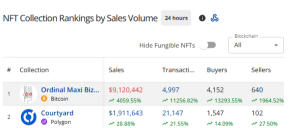
The global non-fungible token market has recorded positive gains today after the Ordinal Maxi Biz and other non-fungible token collections exploded in trading sales volume. In the past 24 hours, the global non-fungible token market has amassed a trading sales volume of $22 million, up over 80% from the past day. This is the first day for the NFT market to record positive gains after suffering a short bear market in the past several weeks.
Bitcoin Tops In The NFT Market Chart
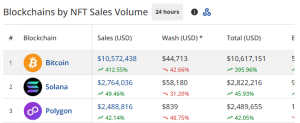
Data compiled by Cryptoslam.io, an on-chain crypto market data aggregator and a non-fungible token collection explorer, indicates the global non-fungible token market has recorded positive gains today. In the past 24 hours, the global NFT market has amassed a trading sales volume of $22 million. During this time, the global NFT market trading sales volume has increased by 83% from the past day.
Bitcoin, the blockchain network renowned for powering the once popular runes, Ordinals, and BRC-20 non-fungible tokens, is the most-traded blockchain network in the NFT market, dethroning Ethereum, the blockchain network renowned for powering most blue-chip NFTs. In the past 24 hours, the Bitcoin-based NFT collection have a trading sales volume of $10 million, up over 400% from the past day.
During this time, Solana, a decentralized blockchain network that supports a variety of smart contracts for non-fungible tokens and decentralized apps, is today’s second most-traded NFT blockchain. In the past 24 hours, the Solana-based NFT collection has amassed a trading sales volume of $2.7 million. The Solana NFT trading sales volume has surged by 49% from the past day.
On the other hand, the Ethereum-based blockchain networks Mythos Chain and Polygon rank third and fourth most-traded networks in the NFT market. In the past 24 hours, the Polygon-based NFT collection has raised a trading sales volume of $2.4 million, while Mythos Chain-based NFT collections have raised a trading sales volume of $1.9 million. During this time, Polygon NFT trading sales volume has surged by 42% from the past day.
OMB Surges +4,000% In Daily NFT Sales Volume
Today’s NFT market resurgence is associated with the recent Ordinal Maxi Biz minting. Earlier this week, the Ordinal Maxi Biz team added 3,750 items to the NFT market. The NFT collection called the “Black Eyes NFT collection,” was successfully minted in just a few hours. The NFT collection lowered the entry price and increased the market cap, making it the 5th most valuable Bitcoin NFT collection.
Ordinal Maxi Biz leads 24h volume 📈 after successfully minting out the Black Eyes collection
The addition of 3,750 extra items lowered the entry price, but market cap increase now makes it the 5th most valuable BTC collection 🏆 pic.twitter.com/MlqKB9ibYg
Other top ordinal collections in the Bitcoin NFT market today include Bitcoin Puppets, a non-fungible token collection comprising 10,001 unique profile pictures (PFPs) inscribed on the Bitcoin blockchain using Ordinals technology and NodeMonkes, an Ordinals collection featuring a limited set of 10,000 unique images inscribed on the Bitcoin blockchain. In the past 24 hours, the Ordinal Puppets and NodeMonkes NFT collection have amassed a trading sales volume of $141,025 and $69,097, respectively.
If support remains above $3.91, natural gas may rise. Although a breakout above today’s high will show strength, an advance above Tuesday’s high at $4.19 would be a clearer bullish sign. Nonetheless, natural gas would be rising into a potential resistance zone that stopped the last two advances at $4.37 and $4.48, respectively. The rising internal trendline marks dynamic support for the uptrend and a bearish signal would be indicated on a decisive drop below that line.
Further Weakness Possible
Moreover, it would increase the risk that this week’s low of $3.91 fails as support and the price of natural gas goes down further. Since resistance was seen at the top of a large rising trend channel in the current advance and for the prior swing high, there is the possibility that the next lower trendline is eventually tested as support.
Either way, that possibility could lead to a notable bearish correction towards lower potential support levels. It is notable that since the 50-Day MA was reclaimed two weeks ago and there has not yet been a pullback to test the 50-Day line as support. That makes the 50-Day MA around $4.69 a potential target. But there are other price levels near the 50-Day line, which can be considered as well.
50-Day Moving Average Support Could be Tested
Although the 50% retracement at $3.73 is the next lower target if natural gas falls below $3.91, lower price levels converge between the 50% retracement and the 61.8% Fibonacci retracement level at $3.56. The 50-Day MA is included within that price area, as well as the 20-Day MA at $3.33, plus a weekly low at $3.55.
For a look at all of today’s economic events, check out our economic calendar.
The business of tea is at an inflection point. Traditional perceptions are being redefined, and the … [+] opportunity for innovation is vast. For retailers and brands, this is a moment to rethink their approach whether by investing in premium product ranges, crafting more immersive customer experiences, or doubling down on ethical sourcing.
getty
There’s an old British saying from the playwright Arthur Wing Pinero: “Where there’s tea, there’s hope”. And it seems there’s plenty of hope brewing in the business world, as tea stages an impressive comeback, not just in the UK but across the globe.
Long associated with comforting rituals and rainy afternoons, tea has often been seen as the quieter counterpart to coffee’s buzzy, fast-paced energy. Yet, today, its appeal is expanding well beyond its traditional roots. From trendy matcha’s in New York to artisan tea bars in London and functional wellness teas in Japan, consumers are rediscovering the humble leaf. And with this resurgence comes a fresh wave of business opportunities.
So, what’s driving the shift? And more importantly, how are retailers, brands, and hospitality businesses making the most of it?
A Cultural Staple Finds New Fans
Tea has always been a mainstay of British culture, but recent years have seen significant changes in drinking habits. While black tea remains the nation’s favourite, herbal, green, and speciality teas are carving out a more substantial share of the market.
A survey by the UK Tea & Infusions Association found that interest in herbal and fruit teas rose by 80% during lockdowns, as consumers sought out functional drinks with added health benefits. The demand for alternatives to traditional black tea has continued to climb, particularly among younger consumers. More than a third of Millennials and Gen Z now drink herbal tea weekly, with ingredients like turmeric, ginger, and peppermint leading the charge. The same organisation released 2024 data that highlights the trends for selecting loose leaf varieties amongst the youngest (18-29-year-old) adults. Dr Sharon Hall, CEO explains: “Both herbal infusions and green tea, (amount to) more than a quarter (28%) of this age group”.” This compares to only 5% of the older adults”.
This trend isn’ just a passing fancy, it reflects broader lifestyle changes. Health-consciousness, sustainability, and a desire for more mindful consumption are all influencing the way people think about their daily brews.
The Health Halo: Tea as a Lifestyle Choice
The rise of wellness culture has been a major catalyst for teas growing popularity. Unlike coffee, which is often associated with high caffeine and an on-the-go mentality, tea is increasingly positioned as a drink that supports well-being.
In the US, tea consumption has grown significantly, with Americans now drinking around 85 billion servings of tea each year. Matcha, kombucha, and functional tea’s infused with adaptogens, collagen, or probiotics are at the forefront of this boom.
HeyTea (喜茶) is a Chinese tea brand that was founded in 2012 in Jiangmen, Guangdong Province. The … [+] brand is known for its inventive teas and stylish locations and has opened a stylish store in Times Square, New York as well as Los Angeles, Irvine, Rowland Heights, and Seattle.. (Photo credit should read CFOTO/Future Publishing via Getty Images)
CFOTO/Future Publishing via Getty Images
HeyTea (喜茶) is a Chinese tea brand that was founded in 2012 in Jiangmen, Guangdong Province. The brand is known for its inventive teas and stylish locations and has opened a stylish store in Times Square, New York as well as Los Angeles, Irvine, Rowland Heights, and Seattle.
Retailers and brands are responding by diversifying their offerings. Major supermarkets have expanded their tea selections, while specialist brands like Pukka, Twinings, and Teapigs have capitalised on the health-conscious movement with targeted product lines. Even high-street coffee chains are now investing in tea-led innovations. Starbucks, for example, has seen steady growth in sales of matcha and chai-based drinks, particularly among younger customers looking for alternatives to high-caffeine options.
Beyond the Supermarket Shelf: The Business of Tea Experiences
Whilst British grocery stores once stocked a limited amount of tea brands and blends, now retailers have tuned into selling the tea experience. The UK’s independent tea scene has flourished, with boutique tea shops offering tasting sessions, subscription services, and limited-edition blends.
Luxury brands are also tapping into tea’s premium potential. Harrods, Fortnum & Mason, and specialist retailers like Mariage Freres have elevated tea into a high-end offering, turning it into an indulgent purchase rather than just a daily necessity.
Meanwhile, cafes and hospitality businesses are rethinking their approach to tea. London-based chains like EL&N and Saint Aymes have transformed tea-drinking into a social media moment, pairing beautifully presented teas with curated aesthetic experiences.
The Sustainability Imperative
Tea’s resurgence isn’t just about health, it’s about ethics too. As consumers become more conscious of sourcing and environmental impact, organic, fair-trade, and plastic-free packaging are becoming industry must-haves.
Brands such as Clipper and Teapigs have led the charge, ensuring their teas are not only ethically sourced but also packaged sustainably. Loose-leaf teas, once seen as a niche offering, are gaining traction among eco-conscious consumers looking to avoid single-use packaging.
At the same time, traceability and transparency are becoming key selling points. Consumers want to know where their tea comes from, how it was farmed, and whether workers were paid fairly. This shift is reshaping the entire supply chain, prompting brands to rethink their ethical commitments.
A Global Phenomenon with Local Impact
In Japan, where tea has always been central to daily life, younger generations are rekindling an interest in traditional brewing techniques, spurring new artisanal businesses.
In China, where coffee culture was once on the rise, tea is now making a strong comeback, with modern tea houses popping up in major cities.
Even in historically coffee-dominated markets like the US, tea is gaining ground. The rise of bubble tea culture, matcha-based drinks, and functional wellness teas has driven a significant shift in consumer behaviour. The US tea market is now projected to grow by nearly 20% over the next five years, proving that coffee may no longer hold the monopoly on daily caffeine habits.
What’s Brewing Up Next?
The business of tea is at an inflection point. Traditional perceptions are being redefined, and the opportunity for innovation is vast.
For retailers and brands, this is a moment to rethink their approach whether by investing in premium product ranges, crafting more immersive customer experiences, or doubling down on ethical sourcing.
For cafe’s and hospitality venues, the message is clear: tea is no longer the secondary option, but a major revenue driver. Whether it’s through bespoke blends, high-end tea experiences, or creative tea-based drinks, the businesses that embrace this shift will be the ones that thrive.
Ultimately, the rise of tea is about more than just changing tastes, it’s about how consumers see themselves, their health, and their connection to the world. And as long as those priorities remain, the kettle will keep on boiling.