Silver trades at $32.35 after briefly touching a three-month high of $33.39.
RSI remains bullish, but failure to confirm higher highs raises caution.
Key support at $31.92; upside targets $32.50 and $33.00 psychological level.
Silver price edges higher and registered gains of over 0.70% on Monday as US financial markets remained closed in observance of Presidents’ Day. At the time of writing, XAG/USD trades at $32.35 as Tuesday’s Asian session begins, virtually unchanged.
XAG/USD Price Forecast: Technical outlook
The grey metal shifted from neutral to upward biased, though a quick rejection candle printed on February 14 after hitting a three-month high of $33.39 could pave the way for further downside.
The Relative Strength Index (RSI) remains bullish, but it is worth noting that as XAG/USD spiked past $33.00, the RSI failed to record a higher high, indicating that a ‘negative divergence’ looms.
If Silver drops below the February 17 swing low of $31.92, the grey metal would be poised to test the 100-day Simple Moving Average (SMA) at $31.15. A breach of the latter will expose the 50 and 200-day SMAs, each at $30.60 and $30.42.
On the other hand, if XAG/USD rallies past $32.50, the psychological $33.00 mark would be the key resistance. Once surpassed, the year-to-date (YTD) high would be up next at $33.39.
XAG/USD Price Chart – Daily
Silver FAQs
Silver is a precious metal highly traded among investors. It has been historically used as a store of value and a medium of exchange. Although less popular than Gold, traders may turn to Silver to diversify their investment portfolio, for its intrinsic value or as a potential hedge during high-inflation periods. Investors can buy physical Silver, in coins or in bars, or trade it through vehicles such as Exchange Traded Funds, which track its price on international markets.
Silver prices can move due to a wide range of factors. Geopolitical instability or fears of a deep recession can make Silver price escalate due to its safe-haven status, although to a lesser extent than Gold’s. As a yieldless asset, Silver tends to rise with lower interest rates. Its moves also depend on how the US Dollar (USD) behaves as the asset is priced in dollars (XAG/USD). A strong Dollar tends to keep the price of Silver at bay, whereas a weaker Dollar is likely to propel prices up. Other factors such as investment demand, mining supply – Silver is much more abundant than Gold – and recycling rates can also affect prices.
Silver is widely used in industry, particularly in sectors such as electronics or solar energy, as it has one of the highest electric conductivity of all metals – more than Copper and Gold. A surge in demand can increase prices, while a decline tends to lower them. Dynamics in the US, Chinese and Indian economies can also contribute to price swings: for the US and particularly China, their big industrial sectors use Silver in various processes; in India, consumers’ demand for the precious metal for jewellery also plays a key role in setting prices.
Silver prices tend to follow Gold’s moves. When Gold prices rise, Silver typically follows suit, as their status as safe-haven assets is similar. The Gold/Silver ratio, which shows the number of ounces of Silver needed to equal the value of one ounce of Gold, may help to determine the relative valuation between both metals. Some investors may consider a high ratio as an indicator that Silver is undervalued, or Gold is overvalued. On the contrary, a low ratio might suggest that Gold is undervalued relative to Silver.
Avalanche’s currency price (AVAXUSD) gained ground in the intraday levels, amid negative pressure due to trading below the 50-day SMA, while trading alongside the downward secondary trend line in the short term, with a steep angle for the decline, indicating the strength of this trend, with negative signals from the RSI after reaching overbought levels compared to the price’s movements, hinting at negative divergence and doubling negative pressures on the price.
Therefore we expect the price to decline and target the pivotal support of $17.28.
We’re ready to spill the tea on this spring’s event in Japan’s most famous city for green tea.
Visitors from around the world flock to Kyoto Prefecture’s Uji City for some of the best-quality, hand-picked green tea in the world. The city boasts tea in all different forms, from pure tea leaves to delectable sweets made from the finest Uji matcha.
For those who want an even closer look at the production process behind their favorite tea-infused treats, historical tea park Chazuna has announced that it’s now taking reservations for its annual tea-harvesting experience event, which will begin on April 12 this year and last through mid-May. The park is conveniently located right next to Uji Station on the Keihan Uji Line, making it an easy stop to add to the itinerary for anyone who plans to visit Kyoto this spring.
▼ An unforgettable hands-on experience during your trip to Kyoto
Chazuna’s grounds were designed to resemble a historically accurate tea-growing garden, and simply walking around them will transport you back in time. However, for those who want to pick the leaves, make sure you show up promptly on time since the tea-harvesting experience is scheduled to occur at two times on weekdays (10 a.m. and 11:30 a.m.) and three times on weekends and public holidays (10 a.m., 11:30 a.m., and 2 p.m.) during the event period. Please keep in mind that the duration of the event includes a number of consecutive holidays during Japan’s annual Golden Week timeframe.
The best part about the experience is that participants can take home all of the leaves they pick to try them out in recipes provided by event staff! It doesn’t get any more locally sourced than this.
Furthermore, authentic tea-picking outfits are available for visitors to don on weekends and holidays during the event period for an additional 2,000 yen (US$13). Clothing sizes include options for 120 centimeters (47.2 inches), 140 centimeters, and adult Small, Medium, and Large.
Since the experience takes place outdoors and is subject to the elements, participants will be notified of any cancelations by advance email in the case of inclement weather.
For those who want to learn a bit more about the historical background of tea in Uji, tickets for the tea-harvesting experience also include admission to Chazuna’s on-site museum where you can learn about the special qualities of tea leaves, best practices for picking them, and the differences between tea gardens of the past versus now.
Admission prices for Chazuna’s tea-harvesting experience varies by day of the week and age, with weekday tickets (adults: 1,800 yen / children up to 15 years old: 1,500 yen / children up to 6 years old: 1,200 yen) being slightly discounted compared to weekend and holiday tickets (adults: 2,000 yen / children up to 15 years old: 1,700 yen / children up to 6 years old: 1,400 yen).
Of course, there are plen-tea of other things to do–and eat–in the Uji region during your visit as well. We hope you enjoy steeping in all of the ancient histor-tea the area has to offer.
Event information Tea and Uji Town Historical Park Chazuna / お茶と宇治のまち歴史公園 茶づな Address: Kyoto-fu, Uji-shi, Todo, Maruyama 203-1 京都府宇治市莵道丸山 203-1 Duration: April 12-mid-May (depends on this year’s tea-growing conditions) Website
AI algorithms are enhancing XRP price predictions by analyzing vast amounts of data with speed and precision.
These algorithms outperform traditional forecasting methods by detecting hidden patterns and using machine learning techniques.
AI is integrating with decentralized finance (DeFi) platforms to create reliable predictive models, reducing biases and correcting past inaccuracies.
Advanced AI tools consider social media sentiment, news, and economic factors to provide comprehensive insights into XRP’s price movements.
For investors, AI serves as a strategic ally, facilitating adaptation to market changes and enabling innovative investment strategies in XRP.
The integration of AI in cryptocurrency forecasting is a transformative development, leading to smarter investing in digital currencies.
In the fast-paced universe of cryptocurrencies, Ripple’s XRP continues to captivate investors and tech enthusiasts alike. The latest disruption? Artificial Intelligence (AI) is revolutionizing XRP price predictions, transforming the landscape with astonishing speed and accuracy.
Picture AI algorithms as digital detectives, swiftly processing vast oceans of historical data and current market trends. These algorithms unlock a treasure trove of insights that eclipse traditional forecasting methods. By uncovering hidden patterns and harnessing machine learning, AI enhances the precision of future XRP price predictions.
The innovation doesn’t stop there. In a remarkable twist, decentralized finance (DeFi) platforms are fusing with AI technologies, forging predictive models that stand as pillars of reliability. This synthesis minimizes biases and corrects historical inaccuracies, promising a new dawn for XRP predictions.
But how is AI achieving this holistic transformation? It’s not just numbers. AI dives into the depths of social media sentiment, news cycles, and economic currents, creating an all-encompassing tapestry of what influences XRP’s price trajectory.
For investors, these advanced AI tools are more than crystal balls. They are strategic allies, enabling nimble adaptation to market shifts and laying the groundwork for groundbreaking investment strategies in XRP and beyond.
Embracing AI in cryptocurrency forecasting isn’t just a trend; it’s a game-changer. As this technology evolves, it holds the tantalizing promise of ushering in a new era of intelligent investing in digital currencies, with XRP at its helm. Get ready to ride the wave of progress as AI reshapes the future of cryptocurrency markets, one prediction at a time.
AI-Powered Predictions: How Ripple’s XRP Prices are Defying the Odds
AI Brings Unprecedented Accuracy to XRP Price Forecasts
The integration of Artificial Intelligence (AI) in cryptocurrency forecasting has ushered in an era of unprecedented accuracy, especially for digital currencies like Ripple’s XRP. AI algorithms, powered by vast amounts of historical and real-time data, are leading the charge in revolutionizing price predictions. But how exactly is this transformation achieved, and what makes AI predictions more reliable than traditional methods?
Key Questions and Answers
1. How does AI enhance the precision of XRP price predictions?
AI utilizes advanced machine learning models that analyze extensive historical data, market trends, and even social media sentiment. By detecting hidden patterns in these data sets, AI can make highly accurate predictions about future XRP price movements. Unlike traditional forecasting methods, AI can process and adapt to new information in real-time, allowing for more nimble and precise predictions.
2. What role does DeFi play in AI-driven XRP predictions?
Decentralized Finance (DeFi) platforms work in conjunction with AI technologies to enhance the reliability of predictive models. By leveraging the decentralized nature of DeFi, these platforms can minimize biases inherent in centralized systems and correct historical inaccuracies. This collaboration results in more robust and dependable predictions, providing a solid foundation for investors relying on these forecasts.
3. Are there any limitations to relying on AI for XRP predictions?
While AI offers enhanced precision, it is not without its limitations. AI models are only as good as the data they are trained on. Inaccurate or biased data can result in flawed predictions. Additionally, the rapidly evolving nature of the cryptocurrency market means that AI models must be continually updated to remain effective. Investors should use AI tools as part of a comprehensive strategy and remain aware of these constraints.
Related Information
– Pros and Cons: AI brings unprecedented precision to forecasts and mitigates biases, but it requires high-quality, updated data.
– Trends and Innovations: Ongoing AI innovations are making investment strategies more strategic and data-driven.
– Market Forecasts: AI predicts a significant shift in investment patterns towards AI-driven models for cryptocurrency trading.
– Compatibility: AI tools are increasingly compatible with DeFi platforms, creating seamless integration for investors.
For additional insights, you can explore more about the possibilities of AI in cryptocurrency forecasting at IBM or delve into the future of DeFi and AI on CoinDesk.
As the landscape of cryptocurrency continues to evolve, the marriage of AI and DeFi in predictive modeling predicts an exciting new frontier for Ripple’s XRP and the broader digital currency market. Stay ahead of the curve by understanding and embracing these technological advances.
Silver price fluctuates within sideways track since yesterday, noticing that the EMA50 continues to support the price from below, waiting to gather positive momentum that assist to push the price to resume the expected bullish trend for the upcoming period, which its targets begin by testing 32.86$.
The competitive landscape of the calcium supplement industry in Japan is quickly expanding, owing to an aging population, increased health consciousness, and a growing desire for self-care. Leading companies in the Japan calcium supplement industry include Eisai, Morinaga Milk Industry, UNIMAT RIKEN, ORIHIRO, Asahi Group, Otsuka, DHC, Bean Stalk Snow, Dainippon Pharmaceutical, and Kobayashi Pharmaceutical.
NEWARK, DE / ACCESS Newswire / February 17, 2025 / The Japan calcium supplement market is projected to grow significantly from USD 185.5 million in 2025 to USD 482.2 million by 2035, reflecting a compound annual growth rate (CAGR) of 9.7% over the forecast period. The increasing demand for calcium supplements in the healthcare and pharmaceutical sectors is a primary factor fueling this growth. By 2035, these sectors are expected to account for over 60% of total market consumption.
Growing awareness about osteoporosis, dietary deficiencies, and the benefits of calcium intake is driving market expansion. Furthermore, the rising preference for organic and plant-based calcium supplements, driven by sustainability concerns, is influencing consumer choices.
People are suffering from various lifestyle ailments due to growing urbanization and, as a result, a rise in sedentary lifestyles. This has resulted in many individuals suffering from dietary deficiencies, particularly calcium inadequacy, with women being the most affected. As a result of this circumstance, sales of calcium supplements have increased, and consumers have begun to consume more of them.
Calcium insufficiency is a prevalent problem among older people. Bone problems such as osteoporosis grow more frequent as people age. Health specialists recommend calcium supplements to safeguard their bone health. As a result of individuals’ rising need for calcium supplements, the industry has grown considerably in Japan.
Consumption Analysis of Calcium Supplement in Japan:
Health supplement companies now have the chance to reach a larger audience and increase their online presence, owing to the trend toward eCommerce. Furthermore, there is an increased emphasis on wellbeing and self-care. In uncertain times, many resorted to supplements as a self-care strategy to keep things regular.
Supplements containing calcium, particularly, are becoming increasingly well-liked as a convenient option for keeping strong bones. At present, individuals learn more about the science underlying the body’s need for calcium and its potential advantages in maintaining the health of the heart, muscles, and neurons. As a result, the use of calcium supplement in Japan is anticipated to increase in the coming years.
As the demand for cruelty-free products rises, people started shifting from animal-based proteins to plant-based supplement items. Moreover, the body digests and absorbs vitamins and minerals from plants far more efficiently than synthetic sources.
Manufacturers are increasingly focusing to innovative technologies that offer targeted products domestically. Consequently, a growing number of people are using herbal remedies and supplements. Additionally, businesses are drawn to providing clean-label products to cater to their clientele’s changing preferences.
Key Takeaways from Market Study
The Japan calcium supplement market is projected to grow from USD 185.5 million in 2025 to USD 482.2 million by 2035, with a CAGR of 9.7%.
The healthcare and pharmaceutical sectors will contribute to over 60% of total market consumption by 2035.
Rising osteoporosis cases and dietary deficiencies among Japan’s aging population are fueling market demand.
Organic and plant-based calcium supplements are gaining traction due to sustainability concerns and improved absorption capabilities.
Government health initiatives and awareness campaigns are boosting consumer adoption of calcium supplements.
“According to market analysts, the introduction of plant-based calcium sources, such as algae-derived calcium, has significantly influenced consumer preferences. Sustainability and bioavailability are becoming essential purchasing factors, prompting manufacturers to innovate their product offerings. Furthermore, the rise of e-commerce and digital health platforms is making supplements more accessible to consumers, further driving market growth.” – says Nandini Roy Choudhury, Client Partner at Future Market Insights.
Calcium Supplements: A Key Player in Japan’s Nutritional Healthcare
Calcium supplements are widely used across various sectors, including healthcare, pharmaceuticals, and dietary nutrition. These supplements help prevent osteoporosis, improve bone density, and support overall well-being. With Japan’s aging population facing an increasing risk of calcium deficiency, supplements play a crucial role in maintaining optimal health.
The growing demand for plant-based and organic calcium sources is reshaping the market. Algae-derived calcium, fortified food products, and chewable supplements are becoming popular alternatives to traditional calcium carbonate and calcium citrate formulations. Additionally, technological advancements in supplement delivery systems, such as nano-calcium particles, are enhancing absorption rates, making them more effective for consumers.
Category-wise Insights:
Soft Gel Pills are the Next Big Thing in Japan’s Calcium Supplement Industry
Attributes
Details
Form
Soft Gel Pills
Industry Share in 2023
49.8%
The soft gel pill segment is anticipated to expand considerably, accounting for 49.8% of the total in 2023. Due to their easy swallowing and suitability for oil- and fat-soluble formulations, soft gel tablets now dominate the industry share.
People with dietary restrictions now have additional options for vitamins, minerals, and supplements, owing to the addition of carrageenan in vegetarian and vegan encapsulations.
Soft gel pills are easier to carry and swallow, making them the perfect choice to dominate the landscape of calcium supplement in Japan.
Male Population Primarily Propels the Demand Calcium Supplement in Japan
Attributes
Details
End Use
Men
Industry Share in 2023
39.5%
Men’s supplement consumption is predicted to capture a 39.5% industry share in 2023.
Sales of calcium supplement in Japan are predicted to grow significantly due to men’s growing health consciousness and gym lifestyle.
One of the important target markets for producers of supplements for bone and joint health is the male population.
Since these supplements target a specific area of the body and provide health advantages, customers are willing to pay a premium for them to maintain a healthy lifestyle and prevent age-related bone problems, especially in later life.
Regional Outlook: A Strong Market Presence in Japan
The Japan calcium supplement market is regionally segmented, with major demand concentrated in urban centers such as Tokyo, Osaka, and Yokohama. These metropolitan areas have a higher population density, increased disposable income, and a greater awareness of nutritional health.
In rural regions, calcium supplement consumption is steadily rising due to improved healthcare accessibility and government-led awareness programs. Moreover, the presence of key market players in Japan has facilitated the local production and distribution of high-quality calcium supplements, catering to diverse consumer needs.
Key Players:
Otsuka Pharmaceutical Co., Ltd.
Shionogi & Co., Ltd.
Ajinomoto Co., Inc.
Meiji Holdings Co., Ltd.
Yakult Honsha Co., Ltd.
Asahi Group Holdings, Ltd.
Suntory Holdings Limited
DHC Corporation
FANCL Corporation
Kracie Holdings, Ltd.
Calcium Supplement in Japan Market Segmentation:
The market is segmented into form, source, end user, and distribution channel.
By Form:
By form, the market is further divided into tablets, capsules, gummies, powder, and liquid.
By Source:
By source, the market is further divided into dairy-based, plant-based, and synthetic.
By End User:
By end user, the market is further divided into adults, children, elderly population, and pregnant women.
By Distribution Channel:
By distribution channel, the market is further divided into pharmacies/drug stores, supermarkets/hypermarkets, online retail, and specialty stores.
The demand for global Egg White Substitute market is expected to be valued at USD 1.43 Billion in 2025, forecasted at a CAGR of 5.9% to have an estimated value of USD 2.55 Billion from 2025 to 2035. From 2020 to 2025 a CAGR of 5.1% was registered for the market.
The global egg replacer market is estimated to be worth USD 1.4 billion by 2024 and is projected to reach a value of USD 2.5 billion by 2034 reflecting a CAGR of 6.0% over the assessment period 2024 to 2034.
The worldwide egg yolk oil market size presently stands at USD 308 million in 2024 and is set to experience a continuous growth of 5.2% CAGR during the assessment period. By 2034, the sector is projected to reach USD 513 million by 2034.
The global fortified eggs market size is expected to reach a market valuation of USD 383.6 million in 2023. Furthermore, with growing usage across the food service industry and households, the overall sales of fortified eggs are slated to grow at a CAGR of 8.5% between 2023 and 2033, totaling a valuation of USD 821.9 million by 2033.
The global vegan egg market size is expected to reach a market valuation of USD 1,973 million in 2023, accelerating at a CAGR of 6% from 2023 to 2033. By 2033, the market is expected to generate market value of USD 3,494.7 million.
The global Dried Eggs Market size is projected to exhibit astounding growth during the forecast period from 2023 to 2033. According to the research report published by Future Market Insights, the global market is poised to surpass a valuation of USD 2,080 million in 2023.
The global enteral nutrition market forecast is estimated to be worth USD 8,232.3 million by 2024 and is projected to reach a value of USD 14,882.5 million by 2034, reflecting a CAGR of 6.1% over the assessment period 2024 to 2034
Global Medical Nutrition industry overview sales reached approximately USD 16,192.6 million at the end of 2024. Forecasts suggest the market will achieve a 6.4% compound annual growth rate (CAGR) and exceed USD 26,555.9 million in value by 2034
The Global Folic Acid market segmentation is poised to reach a value of USD 627.5 million in 2024, and further expand at a CAGR of 4.8% to reach USD 1,233.2 million by the year 2034.
The Global Wound Healing Nutrition Market Analytics sales are estimated to be worth USD 2,594.3 million by 2024 and are projected to reach a value of USD 4,225.9 million by 2034, with the global target sales reflecting a Compounded annual growth rate (CAGR) of 5% over the forecast period of ten years from 2024 to 2034.
About the Food & Beverage Division at Future Market Insights:
Expert analysis, actionable insights, and strategic recommendations – the food & beverage team at Future Market Insights helps clients from all over the globe with their unique business intelligence needs. With a repertoire of over 1,000 reports and 1 Million+ data points, the team has analyzed the food & beverage industry lucidly in 50+ countries for over a decade. The team provides end-to-end research and consulting services; reach out to explore how we can help.
About Future Market Insights (FMI)
Future Market Insights, Inc. (ESOMAR certified, recipient of the Stevie Award, and a member of the Greater New York Chamber of Commerce) offers profound insights into the driving factors that are boosting demand in the market. FMI stands as the leading global provider of market intelligence, advisory services, consulting, and events for the Packaging, Food and Beverage, Consumer Technology, Healthcare, Industrial, and Chemicals markets. With a vast team of over 400 analysts worldwide, FMI provides global, regional, and local expertise on diverse domains and industry trends across more than 110 countries. Join us as we commemorate 10 years of delivering trusted market insights. Reflecting on a decade of achievements, we continue to lead with integrity, innovation, and expertise.
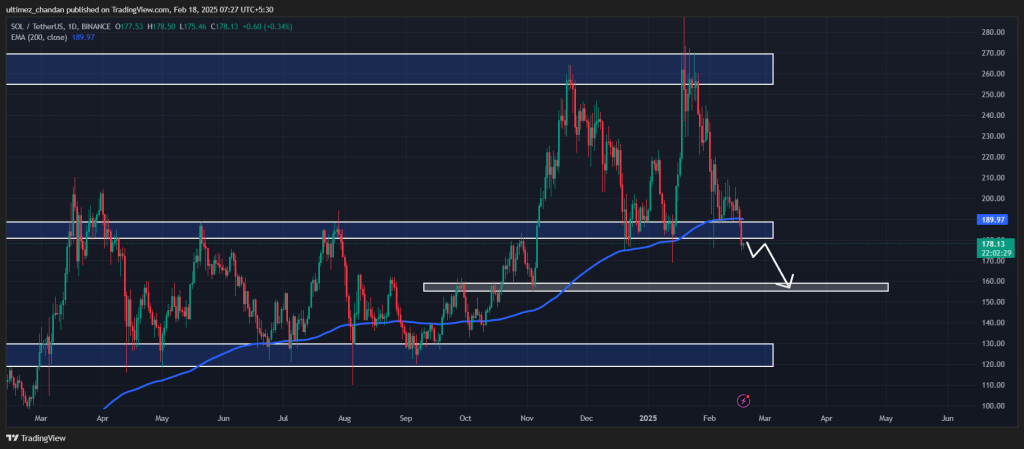
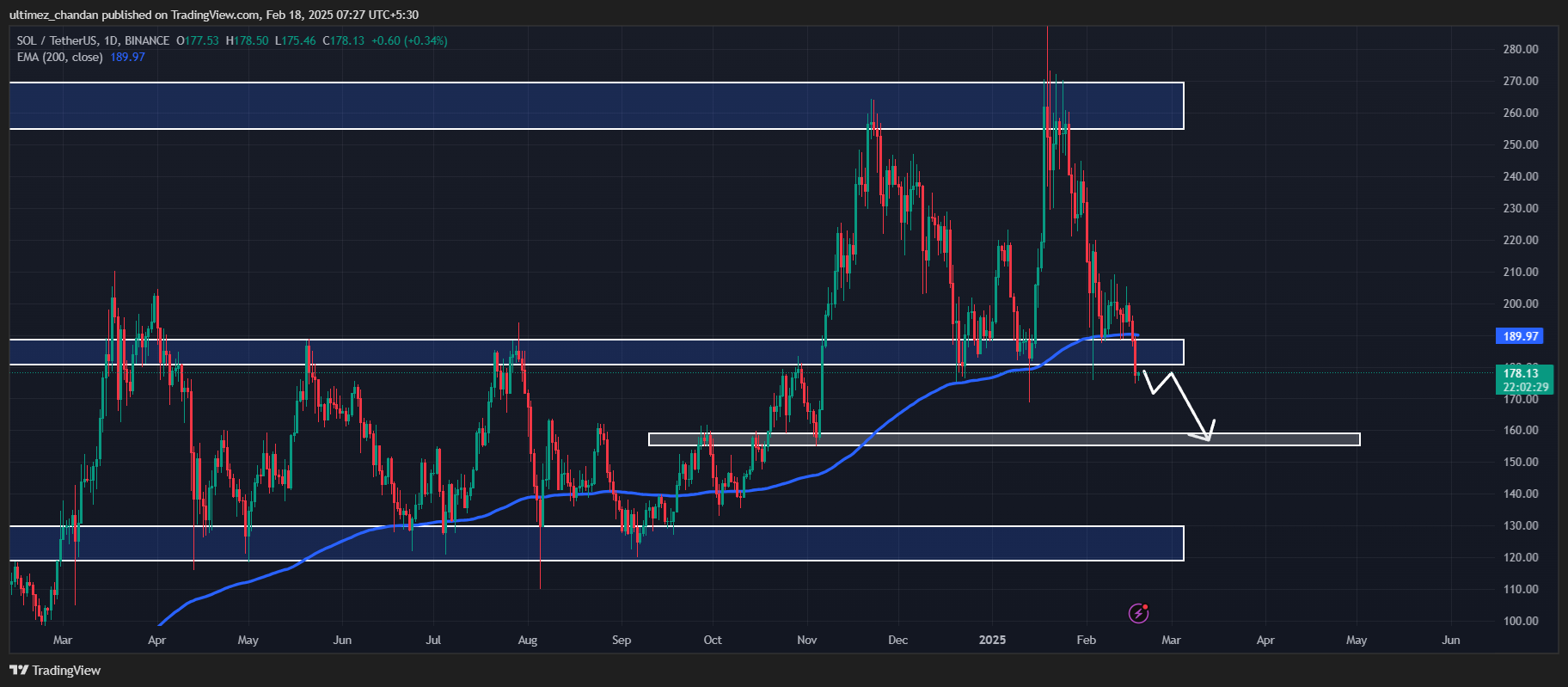
Solana (SOL), the world’s fifth-largest cryptocurrency by market cap, failed to hold strong and is now poised for a price drop. The current market sentiment appears bearish, with major assets experiencing notable declines. SOL has also broken below its crucial support level of $180.
Solana (SOL) Price Action and Upcoming Level
According to expert technical analysis, SOL has been gaining support from this crucial level since November 2024 and has tested it multiple times.
Source: Trading View
However, this time, as the asset fails to sustain, it loses this key level and closes a daily candle below $180, partially confirming a bearish move ahead. Based on recent price action and historical patterns, there is a strong possibility that SOL could witness a 15% price drop, reaching the $155 level in the coming days.
$115 Million Worth SOL Outflow
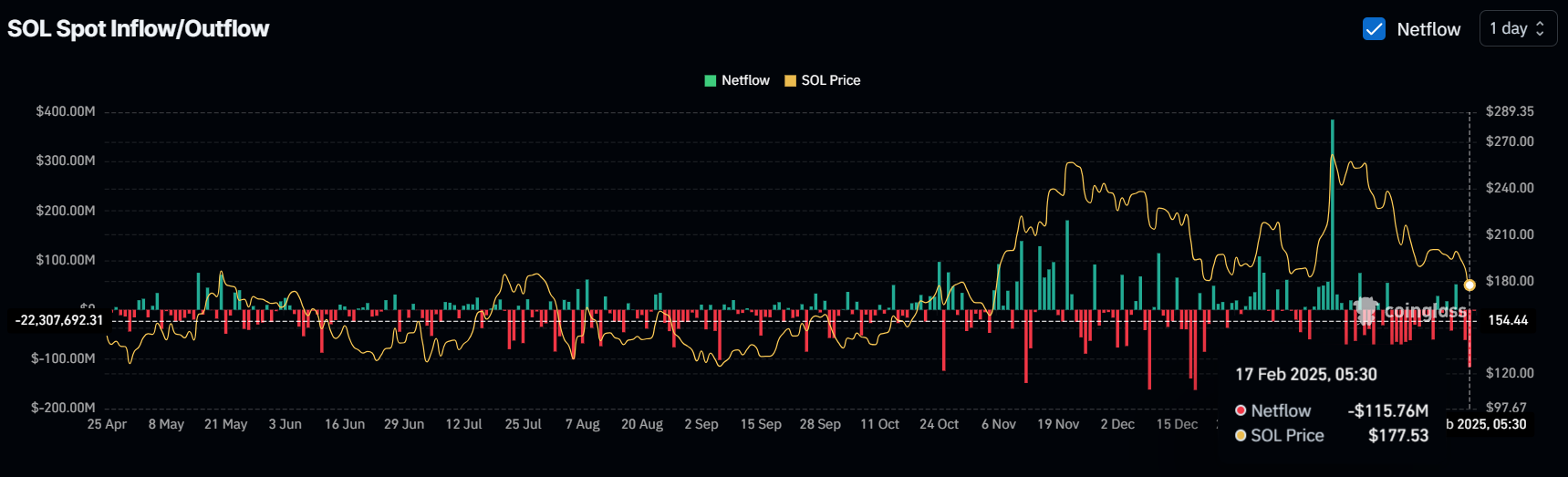
Following this notable breakdown, investors and long-term holders have been accumulating SOL tokens, as reported by the on-chain analytics firm Coinglass. Data from spot inflow and outflow reveal that exchanges have witnessed a significant outflow of $115 million worth of the asset, indicating potential accumulation.
Source: Coinglass
In this bearish market trend, such outflows can create buying pressure and potentially lead to a price rebound.
However, intraday traders appear to be following long-term holders, as they seem to be betting on the long side.
$45 Million Worth Long Bet
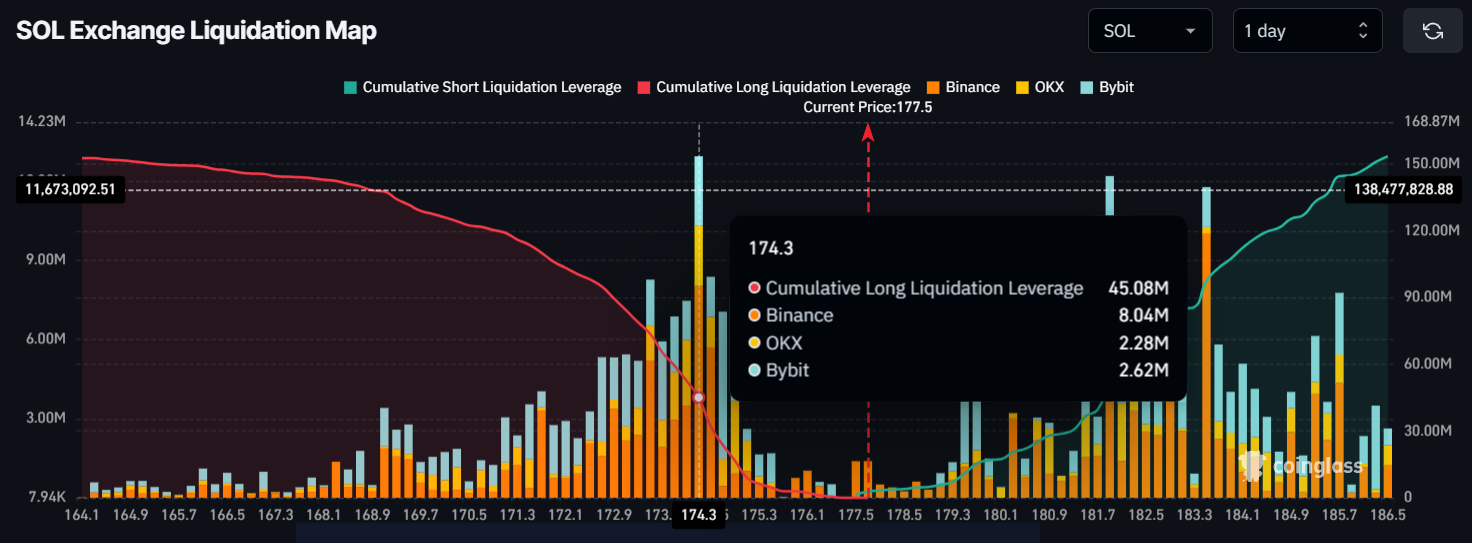
Data shows that traders holding long positions are strongly dominating the asset and are over-leveraged at $174.3, with $45 million worth of long positions. With such significant open positions, this level acts as a crucial support.
Conversely, $180 is another key level where traders holding short positions are over-leveraged, with $15.50 million worth of short positions. This suggests that short sellers are exhausted, which could help bulls reclaim the lost support level.
Source: Coinglass
Current Price Momentum
SOL is currently trading near $177 and has experienced a 6% price drop in the past 24 hours. During the same period, its trading volume surged by 110%, indicating heightened participation from traders and investors amid the price decline.
Silver trades at $32.35 after briefly touching a three-month high of $33.39.
RSI remains bullish, but failure to confirm higher highs raises caution.
Key support at $31.92; upside targets $32.50 and $33.00 psychological level.
Silver price edges higher and registered gains of over 0.70% on Monday as US financial markets remained closed in observance of Presidents’ Day. At the time of writing, XAG/USD trades at $32.35 as Tuesday’s Asian session begins, virtually unchanged.
XAG/USD Price Forecast: Technical outlook
The grey metal shifted from neutral to upward biased, though a quick rejection candle printed on February 14 after hitting a three-month high of $33.39 could pave the way for further downside.
The Relative Strength Index (RSI) remains bullish, but it is worth noting that as XAG/USD spiked past $33.00, the RSI failed to record a higher high, indicating that a ‘negative divergence’ looms.
If Silver drops below the February 17 swing low of $31.92, the grey metal would be poised to test the 100-day Simple Moving Average (SMA) at $31.15. A breach of the latter will expose the 50 and 200-day SMAs, each at $30.60 and $30.42.
On the other hand, if XAG/USD rallies past $32.50, the psychological $33.00 mark would be the key resistance. Once surpassed, the year-to-date (YTD) high would be up next at $33.39.
XAG/USD Price Chart – Daily
Silver FAQs
Silver is a precious metal highly traded among investors. It has been historically used as a store of value and a medium of exchange. Although less popular than Gold, traders may turn to Silver to diversify their investment portfolio, for its intrinsic value or as a potential hedge during high-inflation periods. Investors can buy physical Silver, in coins or in bars, or trade it through vehicles such as Exchange Traded Funds, which track its price on international markets.
Silver prices can move due to a wide range of factors. Geopolitical instability or fears of a deep recession can make Silver price escalate due to its safe-haven status, although to a lesser extent than Gold’s. As a yieldless asset, Silver tends to rise with lower interest rates. Its moves also depend on how the US Dollar (USD) behaves as the asset is priced in dollars (XAG/USD). A strong Dollar tends to keep the price of Silver at bay, whereas a weaker Dollar is likely to propel prices up. Other factors such as investment demand, mining supply – Silver is much more abundant than Gold – and recycling rates can also affect prices.
Silver is widely used in industry, particularly in sectors such as electronics or solar energy, as it has one of the highest electric conductivity of all metals – more than Copper and Gold. A surge in demand can increase prices, while a decline tends to lower them. Dynamics in the US, Chinese and Indian economies can also contribute to price swings: for the US and particularly China, their big industrial sectors use Silver in various processes; in India, consumers’ demand for the precious metal for jewellery also plays a key role in setting prices.
Silver prices tend to follow Gold’s moves. When Gold prices rise, Silver typically follows suit, as their status as safe-haven assets is similar. The Gold/Silver ratio, which shows the number of ounces of Silver needed to equal the value of one ounce of Gold, may help to determine the relative valuation between both metals. Some investors may consider a high ratio as an indicator that Silver is undervalued, or Gold is overvalued. On the contrary, a low ratio might suggest that Gold is undervalued relative to Silver.
Meanwhile, in the South Island, 20-year-old Samantha Lloyd got the wheels turning on her very own forest green coffee and matcha cart just before Christmas. The old single-axle caravan which she turned into @Gigi’s is pumping out up to 300 matcha beverages a day for between $7.50 and $8.
Lloyd has been working as a barista since she finished school, saving money for some sort of hospitality venture in her home town Christchurch.
She said watching the rise in popularity of matcha on social media overseas gave her a good indication there was hype building around the drink. She boosted interest in her start-up by documenting the van transformation into @Gigi’s – sanding, four coats of fresh paint, window work and some rust treatment. It’s now permanently parked up at The Vale, a heritage site in Merivale.
“With my TikToks kind of popping off, I knew that there was going to be some traffic, but I definitely didn’t expect this much,” she says.
“The fact that there’s queues even on a Tuesday – like, there’ll be a line of 15 people and I’m like, ‘Oh, I’m here by myself! I’m so sorry for the wait, but thank you so much for waiting’.
“It’s just crazy.”
Lloyd was running out of milk during her first month of roaring trade, and has bought every bag of powder her matcha supplier Tokyo Foods has in stock. She’s going through at least 2kg a week of the stuff, selling about 150 drinks a day.
“I sell more matcha than I do coffee at the moment.”
Enna Ye and her cousin May Chen co-own NZ matcha supplier Thea. Ye explains the drink has always been enjoyed during special occasions in various Asian cultures.
But its popularity is peaking in New Zealand, and she puts a lot of that down to what we’ve learned the benefits of matcha (alongside the pretty pictures) are on social media.
“Talking to a lot of the cafes that we supply… it’s kind of come out all of a sudden,” she says.
Matcha is made of ground tea leaves. Photo / 123RF
Matcha, she explains, is made of ground green tea leaves, but to get the best quality it’s more laborious than that, which comes at a cost. About 800g of matcha retails for $60, compared to 1kg of coffee, which is about $40.
Ye visited the farm in Kyoto, Japan, where their product is sourced, to learn about the process that goes into Thea’s goods.
“Matcha is shaded about a month before it’s actually plucked… that encourages the sort of greenness that you get, and then they’ll start plucking the leaves and getting it ready to be ground.”
She says the first harvest is plucked in May, and this is typically the youngest leaves at the top of the plant, which are reserved for the best-quality matcha.
“These leaves taste very smooth, sometimes with a hint of sweetness, umami… When you drink it, you shouldn’t get [those] sort of grassy notes that a lot of people get put off by.”
The second harvest of leaves typically consists of the bigger leaves, which are a little less green and used for confectionery. Finally, the third harvest is the cheapest grade and is best used for baking.
The leaves are then roasted and ground with a stone mill or by machine.
“I like to compare it to if you’re drinking coffee or you’re drinking wine… different regions, different flavour notes, etc.”
The leaves are packed with L-theanine, an amino acid, which when paired with caffeine mitigates the side effects.
“I guess matcha has become a lot more popular because of that – so you feel a bit more alert and awake, but you don’t feel the sweatiness or the anxiety that you get from coffee.”
Making the drink involves whisking matcha powder with water. Photo / 123RF
To make the drink, matcha powder is whisked with water, explains barista King Tee from Blackdrop Eatery in Newmarket. His recipe is specific – 5g of matcha to 50g of water. The warmer the water, the more bitter the flavour. In it’s original form, warm milk is added to make a hot drink, like a latte.
“A good matcha doesn’t really need much, it just has its own natural sweetness, its own nuttiness,” Tee says.
In New Zealand the iced variations are more popular, as the coolness takes the edge off that “grassy” bitterness. All the cafes say strawberry matcha is the top pick from their menu – it can be made with strawberry milk, a syrup or even fresh strawberries.
“We want to offer a variety of matcha drinks that’s more interesting and easy to drink – peach and other flavours make matcha more enjoyable for first-timers,” Tee says.
Tee’s strawberry matcha is made using a house-made strawberry jam with milk. The pink and green creation was the first twist he added to the creative drinks menu.
“It just introduced us to people who don’t really know about matcha because … matcha on its own is … earthy, it’s grassy, umami, so not everybody like likes it.
That was one and a half years ago. “We went from selling maybe a couple a week to hundreds a week.”
U.Today – The market is staying in the green zone today, according to CoinStats.
(BNB) is the exception to the rule, falling by 5.52%.
On the hourly chart, the rate of BNB is on its way to the local support of $660. If the situation does not change by the end of the day, one can expect a level breakout, followed by a move to the $650 zone.
On the bigger time frame, the picture is more bearish than bullish. The volume remains low, which means buyers are not ready to seize the initiative.
In this case, a correction to the $625-$650 area is the more likely scenario within the next few days.
From the midterm point of view, one should pay attention to the weekly bar’s closure in terms of the nearest area of $700. If the bar closes far from it, bears may come back to the game, which might lead to a drop to the $600 mark.